
Educational content, not medical advice. Peptides vary widely in legal status: some require a prescription, some are classified for research use only, and some are cosmetic supplements sold over the counter. Talk to a licensed clinician before starting any injectable peptide protocol.
Short answer: The delivery method depends entirely on which peptide you are taking. Subcutaneous injection reaches 65 to 95% bioavailability for most therapeutic peptides; oral collagen peptides absorb at around 63% because they survive digestion; most other injectable peptides taken orally fall below 2% bioavailability due to digestive enzymes breaking them apart before they reach the bloodstream. The correct answer to “how do you take peptides” is almost always whichever route the peptide was designed for, not whichever route feels most convenient.
Choosing a peptide delivery method? Your bloodwork can tell you what your body actually needs first. One at-home Superpower draw checks 100+ biomarkers, physician-reviewed.
Why does the delivery method matter so much with peptides?
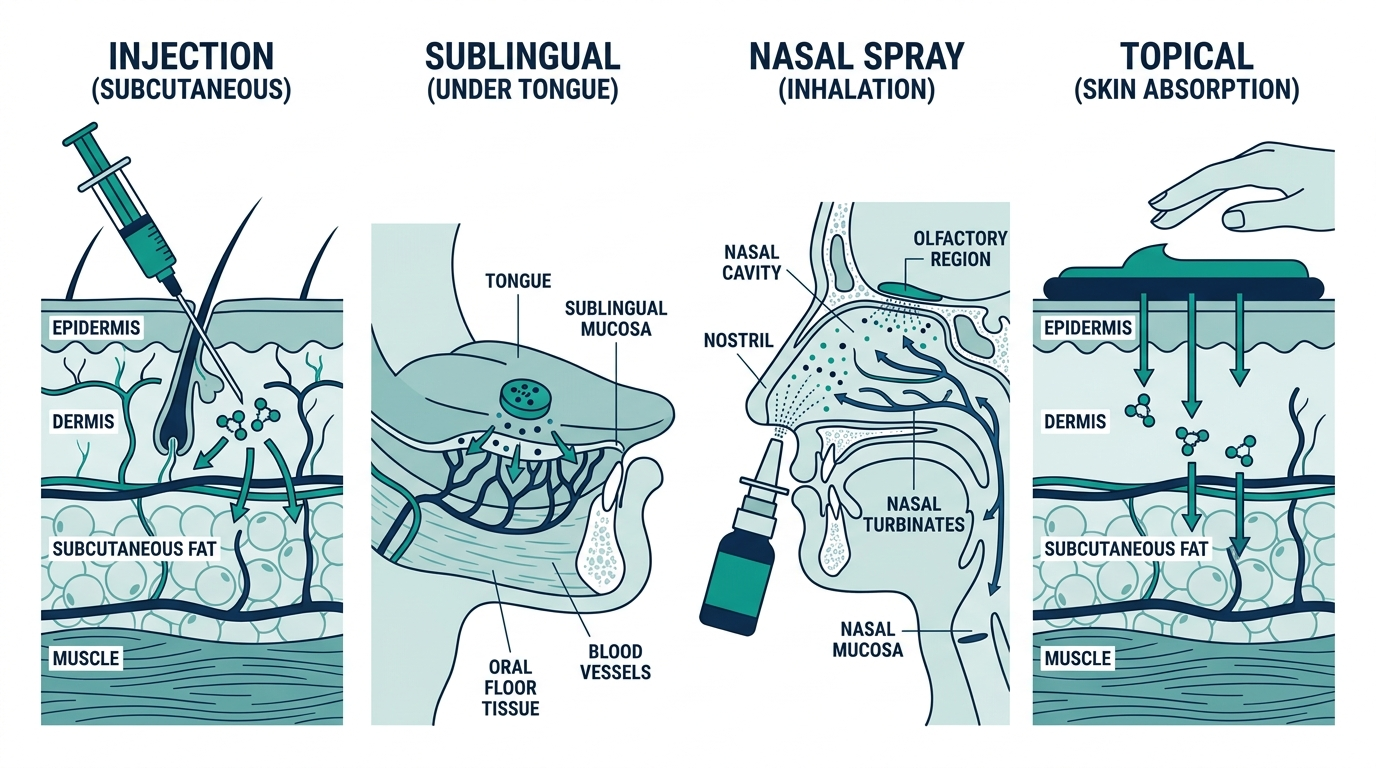
Peptides are chains of amino acids, and the gut treats them exactly as it treats a piece of steak: enzymatic machinery in the stomach and small intestine breaks them into individual amino acids before they can be absorbed intact. For most therapeutic peptides, that degradation happens before even 2% of the dose reaches circulation.
This is not a minor inconvenience. It is the defining constraint of peptide pharmacology, and it explains why most clinical research and the entire injectable peptide category exist. If oral bioavailability were easy, there would be no grey-market subcutaneous vials. There would just be capsules.
The molecular size problem compounds the digestive problem. The widely cited rule in drug delivery is that molecules above 500 Daltons cannot passively cross the skin’s outer layer, the stratum corneum. Most therapeutic peptides land between 500 and 4,000 Daltons, which is why rubbing a vial onto your forearm does not work.
Full-body lab membership: 100+ biomarkers, doctor-reviewed, tracked over time.
What are the actual peptide delivery routes?
There are five routes in regular use, and they are not interchangeable. Here is the honest map before we go deeper into each.
| Route | Best for | Bioavailability | OTC? |
|---|---|---|---|
| Subcutaneous injection | Therapeutic peptides (sermorelin, BPC-157, GLP-1) | 65-95% | No, requires prescription or research lane |
| Oral supplement | Collagen peptides only (hydrolyzed) | Up to 63% for collagen | Yes |
| Oral tablet with enhancer | Semaglutide (Rybelsus) only | ~1% absolute, effective at scale | Prescription only |
| Intranasal spray | PT-141, oxytocin, some GHRH peptides | 50-60% for PT-141 | Depends on peptide |
| Topical serum | GHK-Cu (copper peptide), cosmetic only | Near-zero for injectable-grade; surface-level for serums | Yes (cosmetic) |
The most important column is “Best for.” Matching the route to the molecule matters more than personal preference about needles.
How do subcutaneous injections work for peptides?
Subcutaneous means the needle goes into the fat layer just below the skin, not into muscle. For most therapeutic peptides, subcutaneous injection achieves 65 to 95% bioavailability, with absorption slower and more sustained than intravenous but far superior to any oral route for these molecules.
The practical reason subcutaneous injection dominates the therapeutic peptide space is that it bypasses the digestive system entirely. The peptide enters the interstitial fluid around fat cells, absorbs into capillaries, and reaches systemic circulation with its structure intact.
The injection sites used by licensed clinics and self-administering research users follow a standard rotation to prevent lipodystrophy (visible dents or hard lumps from repeated injections in one spot). The abdomen, at least two inches from the navel, is the most commonly recommended starting area because it offers consistent fat tissue depth and a large surface area for rotation. The outer thighs and flanks are common secondary sites.
The “clock method” is the practical tool for daily injection rotation: imagine a clock face around your navel, pick a new position each day, and by the time you return to the 12 o’clock position, the original site has had nearly two weeks to recover, which is adequate for most people.
Gauge matters. A 29 to 31 gauge, half-inch insulin syringe is the standard for subcutaneous peptide injections. At 31 gauge, most users describe the sensation as a mild pinch rather than pain. The reconstituted peptide solution should be allowed to reach room temperature for 15 to 20 minutes before injection; cold solution stings more on entry.
Personally, the single most underrated aspect of subcutaneous technique is the angle. At 45 degrees on leaner tissue, the needle deposits solution into fat rather than muscle; at 90 degrees on thicker sites, both work. Clinicians who train patients in self-injection spend more time on angle and site rotation than on any other technique point, because those two variables account for most of the absorption inconsistency users report.
What is the reconstitution process, and why does the math matter?
Most injectable peptides arrive as lyophilized powder, meaning they have been freeze-dried for stability. You add bacteriostatic water (sterile water with 0.9% benzyl alcohol to inhibit bacterial growth) to dissolve the powder before use. This step is where a significant number of errors happen.
The concentration formula is: peptide amount in mg divided by water volume in mL equals concentration in mg per mL.
Add 2 mL of bacteriostatic water to a 5 mg vial and you get 2.5 mg/mL (2,500 mcg/mL). On a U-100 insulin syringe, 10 syringe units equals 0.1 mL. So if your target dose is 250 mcg, you divide 250 by 2,500 to get 0.1 mL, which is 10 syringe units.
Do not shake the vial after adding water. Inject the water slowly down the glass wall, not directly onto the powder, and let it dissolve by gentle swirling. Shaking can degrade the peptide structure. Discard reconstituted vials 30 days after mixing, regardless of how much remains.
The critical insider point is that a single decimal error in this math changes the dose by a factor of ten. A compounding pharmacy delivers a labeled, pre-mixed, dosed product and removes this calculation from the patient entirely. A research vial gives you a powder and a number and assumes you have done the math correctly. That gap is a real part of what the price difference between the two routes represents.
How do oral peptide supplements work, and which ones actually absorb?
Oral bioavailability for most injectable-class peptides is below 2% because proteolytic enzymes in the stomach and small intestine cleave peptide bonds before the molecule can be absorbed. This is not a formulation failure; it is basic biochemistry.
Collagen peptides are the major exception. Hydrolyzed collagen, meaning collagen that has been enzymatically pre-digested into short chains (typically 2,000 to 3,500 Daltons, sometimes called low molecular weight collagen peptides), can reach oral bioavailability as high as 63% according to absorption studies. The reason is that the peptide chains are short enough to survive partial digestion and cross intestinal epithelium, and the gut has specific transport systems for di- and tri-peptides that evolved for dietary protein.
A 2026 meta-analysis published in Frontiers in Medicine examined 19 randomized controlled trials involving 1,341 participants (mean age 50.2 years) taking oral or topical peptides for skin aging. Oral polypeptides produced a statistically significant reduction in wrinkle depth (mean difference 1.5, p = 0.01) and a striking improvement in skin hydration (mean difference 5.79, p less than 0.01). Topical-only formulations showed minimal impact on those same measures. The takeaway: oral collagen supplementation has genuine clinical evidence behind it; most other oral “peptide” supplements do not.
For oral collagen, the practical administration guidance is a daily dose of 10 to 20 grams, with vitamin C co-administration shown to improve collagen synthesis utilization by around 15% in absorption studies, because ascorbic acid is a cofactor in collagen cross-linking. Timing to a fasted state in the morning has theoretical support (reduced competition from dietary protein for intestinal transporters), though clinical trials have not isolated timing as a major variable.
Do not believe the marketing on most oral “peptide capsule” products for bodybuilding or GH support. If the product contains injectable-class peptides (sermorelin, ipamorelin, BPC-157), the oral route delivers the amino acids, not the intact bioactive peptide. What reaches your bloodstream is functionally indistinguishable from eating a piece of chicken.
What makes semaglutide the exception for oral peptide delivery?
Rybelsus, oral semaglutide approved by the FDA in September 2019, is the most important proof-of-concept that an injectable-class GLP-1 peptide can be made orally bioavailable at clinical scale. The mechanism is a co-formulation with SNAC (sodium N-(8-[2-hydroxybenzoyl] amino) caprylate, 300 mg per tablet).
SNAC works through three simultaneous actions: it buffers the local gastric pH from around 1 to 2 up to approximately 5, which inactivates pepsin and halts enzymatic degradation of semaglutide at the point of contact with the stomach wall. It also drives peptide monomerization, converting semaglutide from inactive aggregated clusters to absorbable single molecules. Third, it fluidizes the gastric epithelial membrane briefly to allow the monomer to cross into circulation.
The result is an absolute oral bioavailability of roughly 1%, which sounds terrible until you realize the dose is engineered to compensate: subcutaneous semaglutide is dosed in milligrams (0.5 to 2 mg weekly), while Rybelsus is dosed at 7 to 14 mg daily, roughly 50 times more oral dose to achieve a comparable systemic exposure. The SNAC technology is not generalizable to other peptides without reformulation; it specifically exploits semaglutide’s chemistry.
Rybelsus must be taken once daily in the fasting state with exactly 120 mL of water, and you must wait at least 30 minutes before eating, drinking anything other than plain water, or taking other medications. This is the strictest food interaction rule of any commonly prescribed oral medication, and it exists because even a small amount of food shifts gastric pH and disrupts SNAC’s protective microenvironment.
How do nasal sprays work for peptides, and when are they used?
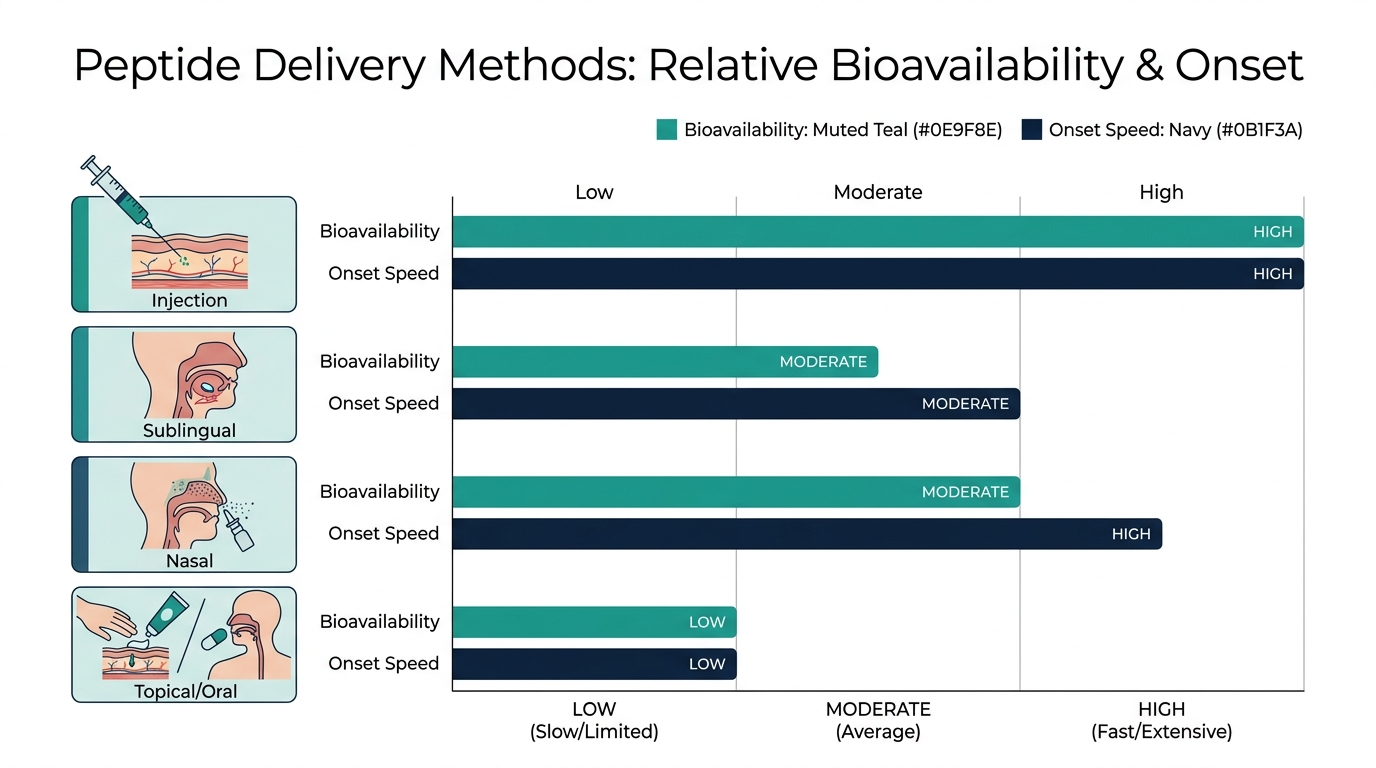
Intranasal delivery bypasses the digestive system by absorbing peptides across the highly vascular nasal mucosa directly into systemic or central nervous system circulation. The bioavailability is lower than subcutaneous injection (roughly 50 to 60% for PT-141, depending on the study) but avoids injections entirely and, for some peptides with CNS targets, provides faster central effects.
PT-141 (bremelanotide), a melanocortin receptor agonist used for sexual dysfunction, was originally developed as an intranasal spray and studied in early clinical trials in that form. The nasal formulation showed meaningful efficacy in women with sexual arousal disorder but was associated with nausea, flushing, and transient blood pressure elevation at the doses needed to compensate for lower bioavailability. The approved pharmaceutical form (Vyleesi, approved 2019) is subcutaneous injection for exactly this reason: better dose control, lower side-effect burden.
Oxytocin nasal spray has the deepest published evidence base of any intranasal peptide, including FDA-approved formulations (Syntocinon), though the clinical literature on its use in social cognition and bonding produces inconsistent results once you move past small early studies.
BPC-157 intranasal formulations are being sold by some grey-market vendors in 2026, but there is no published human research on nasal bioavailability or safety for this compound. The evidence base is essentially zero.
The key variable for nasal delivery is molecular size and lipophilicity. Peptides that are small enough (generally below 1,000 Daltons) and sufficiently lipophilic to cross the nasal epithelium work best. Larger, more hydrophilic peptides absorb poorly nasally without enhancement technology, and most grey-market nasal spray formulations contain no such enhancers.
How do topical peptide serums work?
Topical copper peptide serums (GHK-Cu) are the primary legitimate cosmetic peptide application. GHK-Cu has a molecular weight of 340.4 Daltons, which technically falls below the 500 Dalton rule for passive dermal penetration. The practical picture is more complicated.
HPLC analysis of 12 commercial GHK-Cu serums stored at 25 degrees Celsius for six months found that products in clear or translucent bottles retained less than 40% of their initial copper-peptide complex, while products in opaque airless pump dispensers retained 87 to 92%. Copper peptides are oxidation-sensitive, and light exposure degrades them faster than heat or time alone. This means a GHK-Cu serum in a clear glass dropper bottle on a sunlit bathroom shelf is likely delivering a fraction of the listed concentration by month two, regardless of what the label says.
The effective concentration range in published skin trials is 0.05% to 2% GHK-Cu. Timeline expectations from clinical data: hydration and early inflammation reduction appear within one to two weeks; wrinkle and firmness improvements emerge between weeks six and twelve; maximum effects build over three to six months.
One thing the cosmetic industry will not say clearly: the clinical benefit data for topical GHK-Cu come largely from studies with enhanced delivery (micro-needling, iontophoresis, microinfusion), not from simple surface application. Surface-only application on intact skin delivers primarily hydration and a mild surface-level effect. The dermal remodeling results require some form of barrier disruption to drive the peptide past the stratum corneum.
Full-body lab membership: 100+ biomarkers, doctor-reviewed, tracked over time.
Does food timing change how well peptides work?
For injectable therapeutic peptides, the food interaction question is almost entirely about GH secretagogues: CJC-1295, ipamorelin, GHRP-6, and similar compounds. These peptides work by stimulating the pituitary to release a pulse of growth hormone. Insulin release, which occurs after meals, blunts the GH response by activating somatostatin, the natural GH suppressor.
This is why the two-hour fasting window before a GH secretagogue injection is described as “non-negotiable” in licensed clinical protocols. The largest natural GH pulse occurs during the first phase of deep sleep, which is why bedtime is the most common injection timing for once-daily CJC-1295/ipamorelin stacks. Injecting well-fed, with insulin still circulating from dinner, measurably reduces the GH response compared to fasted injection.
For collagen peptides taken orally, the fasting advantage is less clinically compelling. Taking them on an empty stomach in the morning eliminates competition from dietary amino acids for intestinal transporters, which is the theoretical basis for the fasted timing recommendation. Studies have not shown a large enough effect from timing alone to make this a strict rule the way the GH secretagogue rule is.
For injectable GLP-1 peptides (semaglutide, tirzepatide), timing relative to food does not affect absorption of the subcutaneous dose, but it does affect how early side effects like nausea are experienced. Most clinicians recommend injecting on a day with lighter meals and avoiding high-fat or high-sugar meals within two hours of the injection during the dose-escalation phase.
What is the difference between subcutaneous and intramuscular injection for peptides?
Most therapeutic peptides use the subcutaneous route, not intramuscular. Intramuscular injection, used for vaccines and some hormone preparations, drives medication deep into muscle tissue where it absorbs more rapidly but with greater peak-and-trough swings. For peptides with shorter half-lives and pulsatile targets (GH secretagogues, BPC-157, TB-500 in research contexts), subcutaneous provides a more stable absorption curve and is less painful and technically simpler for self-administration.
The practical distinction matters because some users coming from anabolic steroid protocols assume intramuscular is the “stronger” route. For most peptides, that assumption is wrong and may result in unnecessarily rapid absorption, peak-and-trough side effects, and injection site reactions in muscle tissue not designed for frequent small-volume injections.
TB-500 (thymosin beta-4) is the peptide most commonly discussed as intramuscular in the research community, with some protocols noting that IM may improve delivery to muscle tissue for injury applications. Even here, the evidence comparing IM versus subcutaneous in human users is anecdotal rather than trial-based.
Turn what you just learned into action.
Superpower lets you test 100+ biomarkers from home, then re-check them over time so you can actually see progress, physician-reviewed at every step.
Frequently asked questions
Can you take peptides orally in capsule form?
Only collagen peptides and similar hydrolyzed supplement peptides are effective orally. Therapeutic and research-class peptides (BPC-157, sermorelin, ipamorelin, GHK-Cu injectable) are degraded by digestive enzymes before reaching circulation in meaningful amounts. Oral bioavailability for injectable-class peptides is below 2%. An oral BPC-157 capsule delivers amino acids, not the intact peptide with its proposed bioactivity.
How deep does a subcutaneous peptide injection go?
A standard half-inch (12.7 mm) insulin needle at a 45-degree angle enters approximately 8 to 9 mm, which reliably deposits solution into subcutaneous fat in most individuals. At 90 degrees on well-padded abdominal tissue, the same needle can be used. The goal is the fat layer, not the dermis above it or the muscle below it.
How long do reconstituted peptides stay stable?
Once you add bacteriostatic water to a lyophilized vial, the peptide is stable at refrigerator temperature (2 to 8 degrees Celsius) for approximately 30 days. Never freeze a reconstituted solution; freeze-thaw cycles damage the peptide. The lyophilized powder before reconstitution is stable for 18 to 24 months when refrigerated and kept away from light.
Does it hurt to inject peptides subcutaneously?
At 29 to 31 gauge, most users describe the sensation as a brief pinch. The main causes of injection pain are cold solution (warm to room temperature for 15 to 20 minutes before injecting), injecting too quickly, and choosing a site with less subcutaneous fat. Slow injection over 5 to 10 seconds and site rotation reduce discomfort substantially.
Can copper peptide serum be used with retinol or vitamin C?
This is the most common skincare compatibility question for topical peptides. High-dose L-ascorbic acid (vitamin C at pH below 3.5) can theoretically chelate the copper ion in GHK-Cu, disrupting the complex. In practice, most dermatologists who use copper peptide serums recommend separating them by at least 30 minutes from low-pH vitamin C serums or using them at different times of day: vitamin C in the morning, copper peptide serum in the evening. Retinol does not interact with GHK-Cu and can be layered with it in most protocols.
What happens if you inject air into a subcutaneous injection?
A small air bubble in a subcutaneous injection is not dangerous. The concern about air bubbles causing embolism applies to intravenous injection, where air enters the venous bloodstream. Subcutaneous air is simply absorbed into the tissue over time. That said, good technique calls for flicking the syringe to move bubbles to the top and expelling them before injecting, not for safety reasons but for dose accuracy.
Is intramuscular or subcutaneous better for peptides?
Subcutaneous is the standard clinical and research route for nearly all commonly discussed peptides (sermorelin, CJC-1295/ipamorelin, BPC-157, semaglutide, tirzepatide). Intramuscular is faster-absorbing but produces sharper peaks and troughs and is more uncomfortable for frequent injections. The exceptions are a small number of IM-specific protocols in research contexts; any legitimate clinic prescribing peptides will specify their preferred route in your protocol.
Full-body lab membership: 100+ biomarkers, doctor-reviewed, tracked over time.
Author: Vital Signs Today Editorial Team, [credential]”]. Educational content, not medical advice. Sources linked inline.
Primary sources:
– Frontiers in Medicine: Oral and topical peptides for skin aging, systematic review, 19 RCTs, n=1,341
– Frontiers in Drug Delivery: Oral peptide delivery challenges and bioavailability 2026
– Frontiers in Drug Delivery: Fourth CRS workshop on oral peptide administration 2026
– Novo Nordisk / Rybelsus mechanism of action (SNAC)
– PMC: Pharmacological overview of oral semaglutide
– Swolverine: Peptide delivery methods injection vs oral vs nanoparticles
– Proxiva Labs: Peptide bioavailability oral vs injectable vs nasal
– Peptide Deck: Subcutaneous injection guide 2026
– Peptide Nerds: Injection sites and rotation guide 2026
– Real Peptides: GHK-Cu cosmetic bioavailability and absorption
– Innerbody: Beginner’s guide to peptide therapy 2026
Related reading
Vital Signs Today may earn a commission if you buy through links on this page. It does not affect our editorial assessments.