
Educational content, not medical advice. Talk to a licensed clinician before starting any supplement regimen.
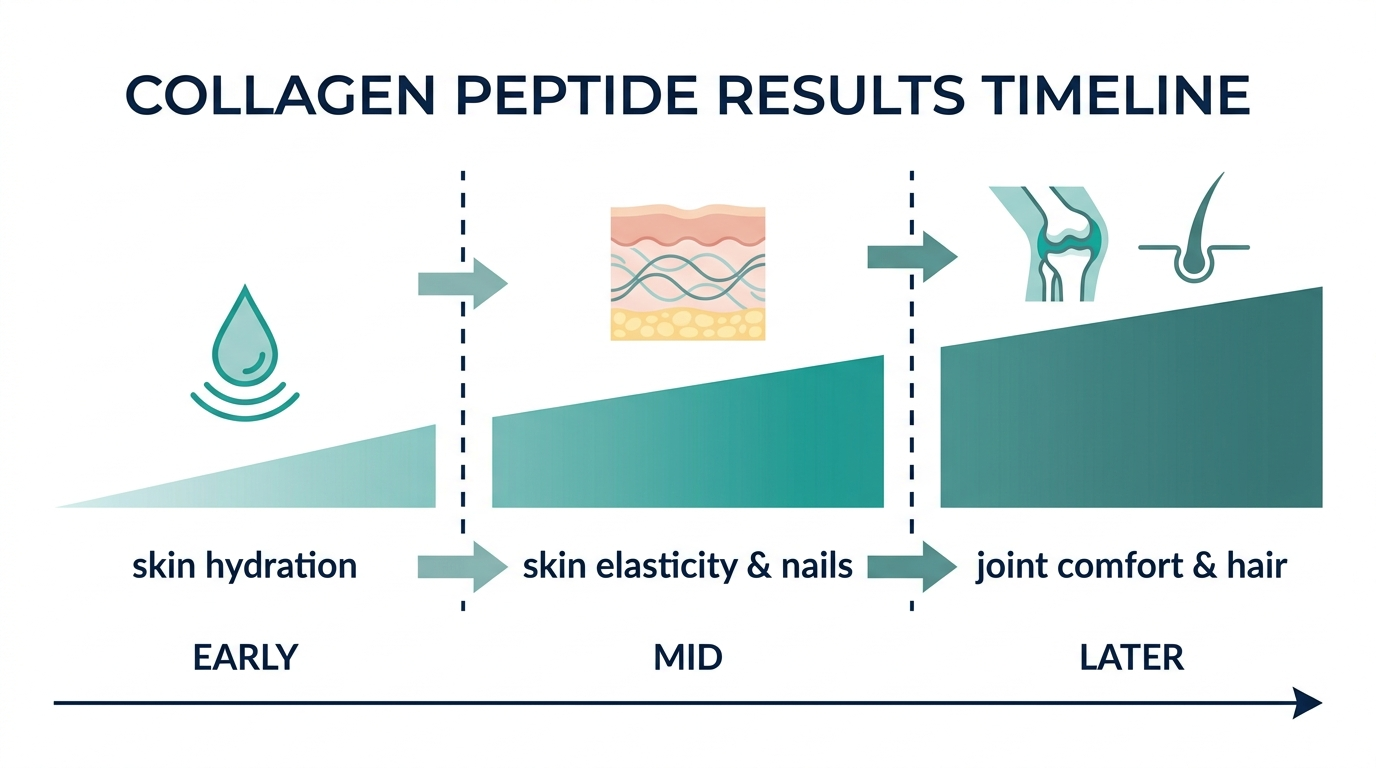
Short answer: Most people notice the first measurable changes in skin hydration after 4 to 6 weeks of daily supplementation. More visible improvements in skin elasticity and fine lines appear at 8 to 12 weeks. Joint pain reduction, backed by a 2025 randomized controlled trial in Frontiers in Nutrition, shows significant improvement starting around 12 weeks, with the greatest benefit at 24 weeks. Hair and nail changes are typically last, often taking 3 to 4 months of consistent use.
Waiting weeks to see if collagen is working? Bloodwork can show what’s changing under the surface right now. One at-home Superpower draw checks 100+ biomarkers, physician-reviewed.
Collagen peptides are now a $6 billion global market, and the gap between expectation and reality is where most buyers get frustrated. People open a canister of Vital Proteins, stir it into their morning coffee for two weeks, see nothing, and conclude the whole category is a scam. That conclusion is wrong, but so is the marketing that promises visible skin changes in days.
The honest answer is more specific, and more interesting, than either extreme. Below is what the clinical evidence actually says about timelines, what variables speed things up or slow them down, and one test most dedicated users never think to run.
Full-body lab membership: 100+ biomarkers, doctor-reviewed, tracked over time.
Why does collagen take so long to show results?
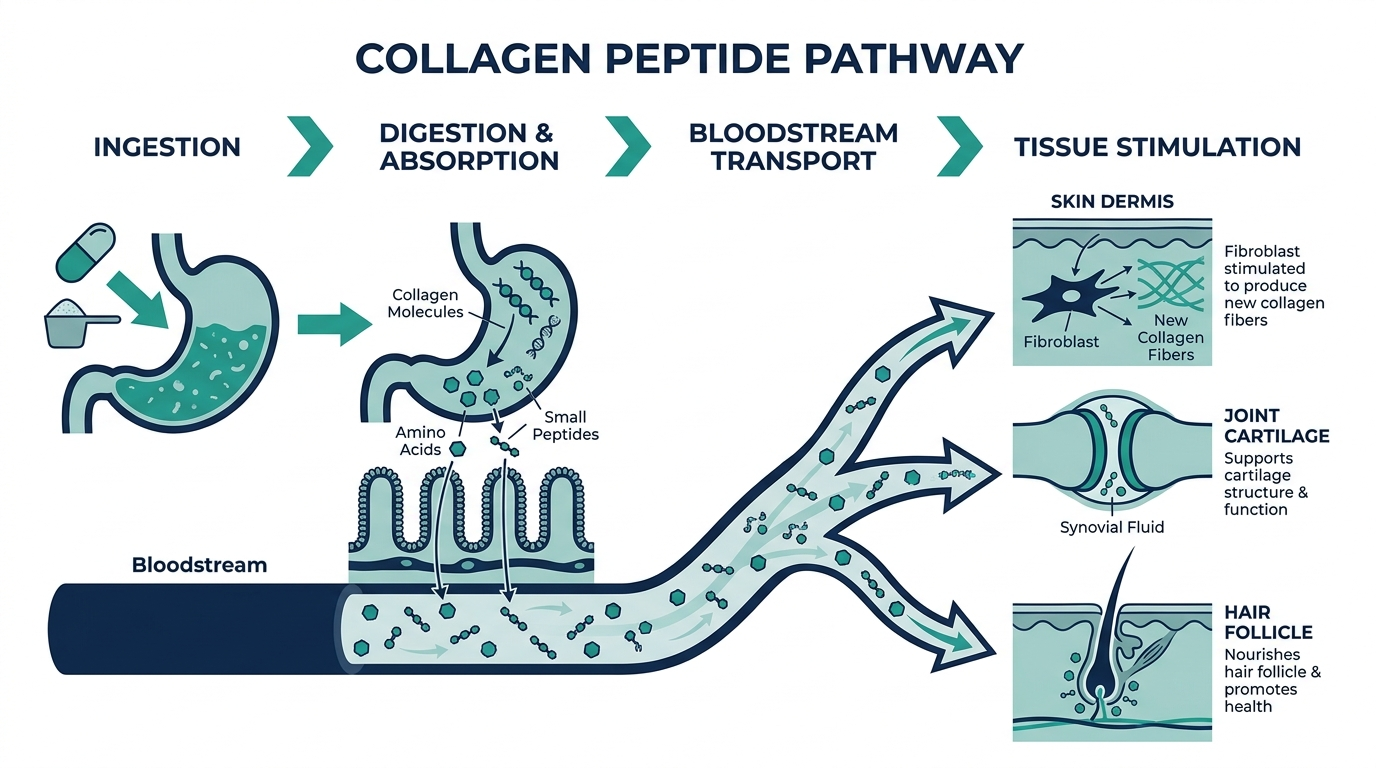
Collagen is not a fast-acting molecule. It is structural protein, the scaffold that makes up roughly 30% of total body protein and 70-80% of the dry weight of skin. You are not adjusting a neurotransmitter or a hormone. You are asking your body to rebuild fibrous tissue that degrades gradually and rebuilds gradually.
The mechanism works in two stages. First, hydrolyzed collagen peptides are absorbed in the small intestine as short chains, primarily as the dipeptide Pro-Hyp (prolyl-hydroxyproline) and its relatives, and detected in blood within 30 minutes of ingestion. A 2024 crossover study in Frontiers in Nutrition confirmed that these bioactive dipeptides circulate intact, not just as free amino acids. Second, those dipeptides act as signaling molecules, stimulating fibroblasts, the cells that build collagen fibers, to increase their own collagen synthesis.
That second step is what takes time. Fibroblasts do not sprint. They express new collagen over days and weeks, and the new fibers must integrate into existing tissue matrices before any functional change registers. Think of it like renovation: the supplies arrive fast, but the construction takes months.
This is why the “collagen just gets digested into regular amino acids” criticism, while partially true, misses the point. The signaling effect of the specific Pro-Hyp dipeptides is biologically distinct from just eating more protein.
What does the 4- to 6-week window actually feel like?
Week 4 to 6 is typically the first objectively measurable zone, though the signals are subtle enough that most people miss them without a benchmark.
Skin feels less tight after washing, a change driven by improved hydration rather than structural elasticity. You may notice nail beds growing slightly faster and appearing less flaky at the tips. A 2018 randomized double-blind trial in Nutrients measuring low-molecular-weight collagen peptides over 8 weeks found statistically significant improvements in skin hydration at the 4-week interim measurement, before elasticity changes had registered.
Personally, I find the nail change to be the most honest early indicator, because it is entirely objective and harder to attribute to placebo than subjective skin feel. If your nails are growing noticeably faster or breaking less at the 4-week mark, something is happening systemically.
For joint discomfort, this window is too early. Do not give up on that endpoint yet.
When do you actually see skin elasticity and fine-line changes?
The 8- to 12-week range is where the research consistently places structural skin changes.
A 2023 meta-analysis of 26 randomized controlled trials covering 1,721 participants, published in Nutrients, found oral hydrolyzed collagen significantly improved skin hydration and elasticity, with the strongest effects appearing after 8 weeks of supplementation or longer. Marine collagen produced slightly stronger effects than bovine collagen in this analysis, likely due to its lower average molecular weight of 2,000 to 3,000 daltons compared to bovine at 3,000 to 8,000 daltons, which may allow faster intestinal absorption.
A 90-day clinical study involving 120 participants found skin elasticity improved by approximately 40% and skin hydration scores rose significantly by the three-month mark. That figure is often cited in marketing materials but rarely alongside the context: it required 90 consecutive days of daily dosing, not three weeks of inconsistent use.
The timeline by outcome, based on the aggregated clinical literature:
| Outcome | First signal | Clear change | Plateau / max benefit |
|---|---|---|---|
| Skin hydration | 3-4 weeks | 6-8 weeks | 12 weeks |
| Skin elasticity | 6-8 weeks | 10-12 weeks | 16-24 weeks |
| Fine lines / wrinkles | 8-10 weeks | 12-16 weeks | 24+ weeks |
| Nail strength | 4-6 weeks | 8-12 weeks | Ongoing |
| Hair shedding reduction | 8 weeks | 12-16 weeks | 6 months |
| Joint pain (mild to moderate) | 8-12 weeks | 16-24 weeks | 6 months |
| Athletic recovery | 4-6 weeks | 8-10 weeks | Ongoing |
How long does it take for collagen peptides to help joints?
Joint results require the most patience, and the most recent evidence is worth reading carefully.
A 2025 randomized, double-blind, placebo-controlled trial published in Frontiers in Nutrition followed 80 adults aged 40 to 75 with Kellgren-Lawrence grade I or II knee osteoarthritis. The group taking 3,000 mg per day of low-molecular-weight collagen peptides showed statistically significant reductions in WOMAC pain scores versus placebo (p = 0.006) at the 6-month mark. Physical function and total WOMAC scores also improved significantly (p = 0.035 and p = 0.028 respectively). Critically, the researchers noted that improvements began accumulating around the three-month point and continued building through month six.
A separate 2025 Turkish study in Joint Diseases and Related Surgery using 8 weeks of supplementation found statistically significant improvements in WOMAC pain, physical function, and total scores at p less than 0.001. Eight weeks was enough for grade 2 to 3 osteoarthritis patients to feel a difference.
Do not believe anyone who says collagen peptides cannot help joints. The clinical signal is real. But it is also fair to say the dose that works in these trials (3,000 mg to 10,000 mg daily) is specific, and most people using 10 g of a mixed collagen powder are hitting the right ballpark only by luck.
Does the type of collagen you take change the timeline?
Yes, and most collagen buyers are confused about this in a way that leads to wasted months.
Type I collagen (the dominant type in bovine and marine collagen peptides) makes up roughly 80% of the collagen in human skin, tendons, and bones. If skin and nails are your primary goal, Type I is correct, and it is what virtually all major retail powders like Vital Proteins Collagen Peptides contain. One 20 g serving contains Type I and Type III collagen from grass-fed bovine hide, costs roughly $1.35 to $1.64 per serving at retail, and dissolves in water at room temperature without clumping.
Type II collagen is structurally different. It is the primary collagen in cartilage. A 2025 double-blind trial in Joint Diseases and Related Surgery directly compared Type I/III collagen peptides versus Type II hydrolyzed collagen for osteoarthritis outcomes and found both effective, but with slightly different mechanisms. Type I/III works through systemic amino acid supply and fibroblast signaling; Type II may work partly through oral tolerization, an immune mechanism that reduces cartilage-attacking inflammation. For serious joint goals, some clinicians now combine both.
The takeaway: if you have been taking a standard bovine or marine collagen powder for months and noticed skin improvements but little joint relief, switching to a formulation that includes undenatured Type II collagen (often labeled UC-II, derived from chicken sternum cartilage, dosed at 40 mg rather than 10 g) may produce a different result through a different mechanism entirely.
What actually speeds up collagen peptide results?
Three variables genuinely accelerate the timeline, and one of them is almost always overlooked.
1. Vitamin C, taken the same day. Vitamin C is not a “booster” that improves absorption of collagen peptides. What it does is serve as an essential cofactor for the enzymes prolyl hydroxylase and lysyl hydroxylase, which stabilize newly synthesized collagen chains. Without adequate vitamin C, your fibroblasts produce structurally weak collagen. The practical implication: if you are deficient in vitamin C, which is more common than most adults assume, your fibroblasts cannot fully use the amino acid supply arriving from your supplement. Most of the clinical trials showing strong skin results include 50 to 100 mg of vitamin C alongside the collagen dose.
2. Dose and molecular weight. The studies showing results are almost uniformly using 10 g or more per day. A 2025 paper in PMC found that 30 g of hydrolyzed collagen augmented whole-body collagen synthesis more than 15 g in resistance-trained men, though interestingly, 15 g did not significantly outperform zero in that context. For skin, the dose-response curve is different, with 2.5 g to 10 g daily showing measurable effects in multiple trials. Lower doses are not useless, but the timeline for visible change lengthens.
3. Consistency without gaps. This is the one nobody likes to hear. Collagen synthesis is a cumulative process. Missing three days here and a week there does not just delay results, it partially resets the fibroblast signaling cycle. The trials showing results at 8 to 12 weeks are built on daily supplementation with no gaps. If you average five out of seven days per week, your 12-week endpoint is closer to 16 to 20 weeks.
The myth that collagen peptides are just expensive protein powder
This is the most persistent skeptical argument, and it deserves a direct answer rather than a dismissal.
The claim: your digestive system breaks collagen peptides into generic amino acids, which your body uses for whatever it needs, not specifically for making new collagen. This is partially true. The majority of collagen does get fully digested.
What the argument misses: first, the specific Pro-Hyp dipeptides that survive intestinal digestion intact have been shown in multiple in vitro studies to directly stimulate fibroblast collagen production via a receptor-mediated signaling pathway. They are not just building blocks; they are messengers. Second, collagen is uniquely rich in glycine, proline, and hydroxyproline, amino acids that are genuinely limiting for collagen synthesis in most adults whose diets are rich in muscle meat (which is low in these amino acids). Supplementing with collagen provides a substrate profile that ordinary dietary protein does not. Third, a 2025 paper in npj Aging found that a specific glycine-to-proline-to-hydroxyproline ratio supplementation reduced biological age by 1.4 years in six months in a clinical observational trial, suggesting systemic effects beyond local skin remodeling.
The honest verdict: collagen peptides are not “just protein.” They are a protein source with specific signaling properties whose effects are real but modest, require months, and are sensitive to dosing and consistency.
How do you know if your collagen supplement is actually working?
This is where most people rely on mirror-based self-assessment, which is the least reliable measurement tool available. Skin appearance is affected by hydration, sleep, UV exposure, hormones, and seasonal humidity. A week of bad sleep can reverse what looks like six weeks of collagen progress.
Three more objective approaches:
Photography protocol. Take a standardized photo every 4 weeks under the same light, angle, and lens distance. The goal is not Instagram results, it is a consistent record. Changes in under-eye crepe texture and nasolabial fold depth are often more visible in a dated comparison than in daily observation.
Nail growth ruler. Measure the distance from cuticle to tip on the index finger every two weeks. Nail growth rate is a surprisingly reliable proxy for systemic collagen synthesis activity.
Biomarker panel including serum hydroxyproline and inflammatory markers. Most standard blood panels do not include this. Specialized panels through services like Superpower or Function Health test markers tied to connective tissue metabolism and inflammation, giving you objective data before and after supplementation.
How much should you actually be taking?
The clinical evidence points to a range, not a single dose, depending on your goal.
| Goal | Evidence-backed daily dose | Duration for effect |
|---|---|---|
| Skin hydration and elasticity | 2.5 to 10 g | 8-12 weeks |
| Joint pain (mild to moderate OA) | 3,000 to 10,000 mg | 12-24 weeks |
| Athletic recovery and tendon | 15 to 30 g (peri-exercise) | 4-8 weeks |
| Hair and nail strengthening | 2.5 to 5 g | 12-16 weeks |
Vital Proteins Collagen Peptides contains 20 g per two-scoop serving, placing you well within the effective range for all of the above goals. One scoop (10 g) is adequate for skin and joint maintenance.
For the 30 g peri-exercise protocol, the timing matters. A 2025 study at PMC found that consuming 30 g of hydrolyzed collagen one hour before exercise, then engaging in activity that loads connective tissue, significantly augmented whole-body collagen synthesis compared to 15 g. The mechanical loading appears to direct the amino acids toward tendon and cartilage synthesis rather than general turnover.
Hydrolyzed type I & III collagen peptides, third-party tested, unflavored.
Don’t just read about your health, track it.
A single result is a snapshot. Superpower re-tests 100+ markers over time so you can watch them move as you change sleep, food, and training.
Frequently asked questions
How long does it take for collagen peptides to work for skin?
Most clinical trials show measurable improvement in skin hydration at 4 to 6 weeks of daily supplementation, with elasticity and fine-line changes appearing more clearly at 8 to 12 weeks. The 2023 meta-analysis of 26 trials places the strongest effects at 8 weeks or beyond. Marketing claims about results in days are not supported by any peer-reviewed trial.
How long do collagen peptides take to work for joints?
The 2025 Frontiers in Nutrition RCT found significant WOMAC score improvements beginning around 12 weeks and continuing through 24 weeks in adults with mild to moderate knee osteoarthritis. A shorter 8-week Turkish trial also found significant improvements, suggesting the onset may vary with osteoarthritis severity. Give joints at least 3 months before concluding the supplement is not working.
What happens if you stop taking collagen peptides?
Results are not permanent. The fibroblast-signaling effect from Pro-Hyp dipeptides depends on a continued supply. Most users report that skin changes begin to regress within 4 to 6 weeks of stopping, as the collagen synthesis stimulus fades and normal degradation continues. This is not a flaw; it is how structural tissue maintenance works.
Does it matter when you take collagen peptides during the day?
Timing is less important than consistency. One practical approach: take collagen one hour before exercise that loads connective tissue, walking, resistance training, yoga, to align circulating amino acids with mechanical signaling, which appears to direct synthesis toward tendon and cartilage. For skin goals, timing does not appear to matter meaningfully based on current evidence.
Is marine collagen faster-acting than bovine collagen?
Marine collagen has a lower average molecular weight (2,000 to 3,000 daltons versus 3,000 to 8,000 daltons for bovine), and some studies suggest it may be absorbed up to 1.5 times more efficiently. However, clinical outcomes in head-to-head trials are similar. Both sources are predominantly Type I collagen. The practical difference is small unless you are taking the minimum effective dose, at which point the higher bioavailability of marine collagen may matter.
Can you take too much collagen?
Studies using up to 30 g per day have not found safety concerns in healthy adults. However, collagen is high in the amino acid hydroxyproline, and very high doses may increase urinary calcium in people with a history of kidney stones. Anyone with kidney disease should consult a physician before taking high-dose collagen. Standard retail doses of 10 to 20 g daily carry a well-established safety record across thousands of subjects in clinical trials.
Why have I been taking collagen for 2 months and see no results?
The three most common reasons: (1) inconsistent dosing (five out of seven days instead of daily extends the effective timeline by 30 to 50%), (2) a dose below the evidence threshold (under 5 g per day for skin or under 3 g for joints), or (3) an unmeasured starting point that makes progress invisible. Consider running a standardized photo protocol and ensuring your dose matches the clinical evidence before concluding the product has failed.
Author: Vital Signs Today Editorial Team, [credential]”]. Educational content, not medical advice. Sources linked inline.
Hydrolyzed type I & III collagen peptides, third-party tested, unflavored.
Primary sources
- Frontiers in Nutrition (2025): Low-molecular-weight collagen peptides in knee osteoarthritis RCT
- PMC / Nutrients (2023): Meta-analysis of 26 RCTs on oral hydrolyzed collagen
- PMC (2018): Low-molecular-weight collagen peptide, skin hydration and elasticity RCT
- PMC (2024): Absorption of bioactive peptides following collagen hydrolysate intake, crossover study
- PMC (2025): Collagen synthesis response to 30 g vs 15 g hydrolyzed collagen, resistance exercise
- NutraIngredients (2025): Collagen peptide may reduce knee pain in early osteoarthritis, Korean study
- Joint Diseases and Related Surgery (2025): Type I/III vs Type II collagen supplementation RCT
- npj Aging (2025): Collagen amino acid composition reduces biological age
- Vital Proteins Collagen Peptides product page
- PMC (2025): Collagen supplementation and regenerative health, biomarker detection review
Related reading
Vital Signs Today may earn a commission if you buy through links on this page. It does not affect our editorial assessments.