
Educational content, not medical advice. Talk to a licensed clinician before starting any hair loss treatment.
Short answer: Yes, with caveats. In a 2018 peer-reviewed trial published in the Journal of Applied Pharmaceutical Science, participants applying a GHK-Cu peptide complex grew 71.5 new hairs per square centimeter over six months, compared to just 9.6 per square centimeter in the placebo group. That is real regrowth. But “copper peptides regrow hair” without qualification overstates a narrower truth: topical copper peptides rebuild the follicle environment and can reverse early miniaturization, but no large randomized controlled trial has yet proven they reliably regrow hair as a standalone treatment for moderate-to-severe androgenetic alopecia. The delivery method, the concentration, and whether you stack them with proven treatments are where most of the result comes from.
GHK-Cu shows real results in trials, but hair loss has many causes. Have you checked what’s driving yours? One at-home Superpower draw checks 100+ biomarkers, physician-reviewed.
What exactly is a copper peptide, and why does it interact with hair follicles?
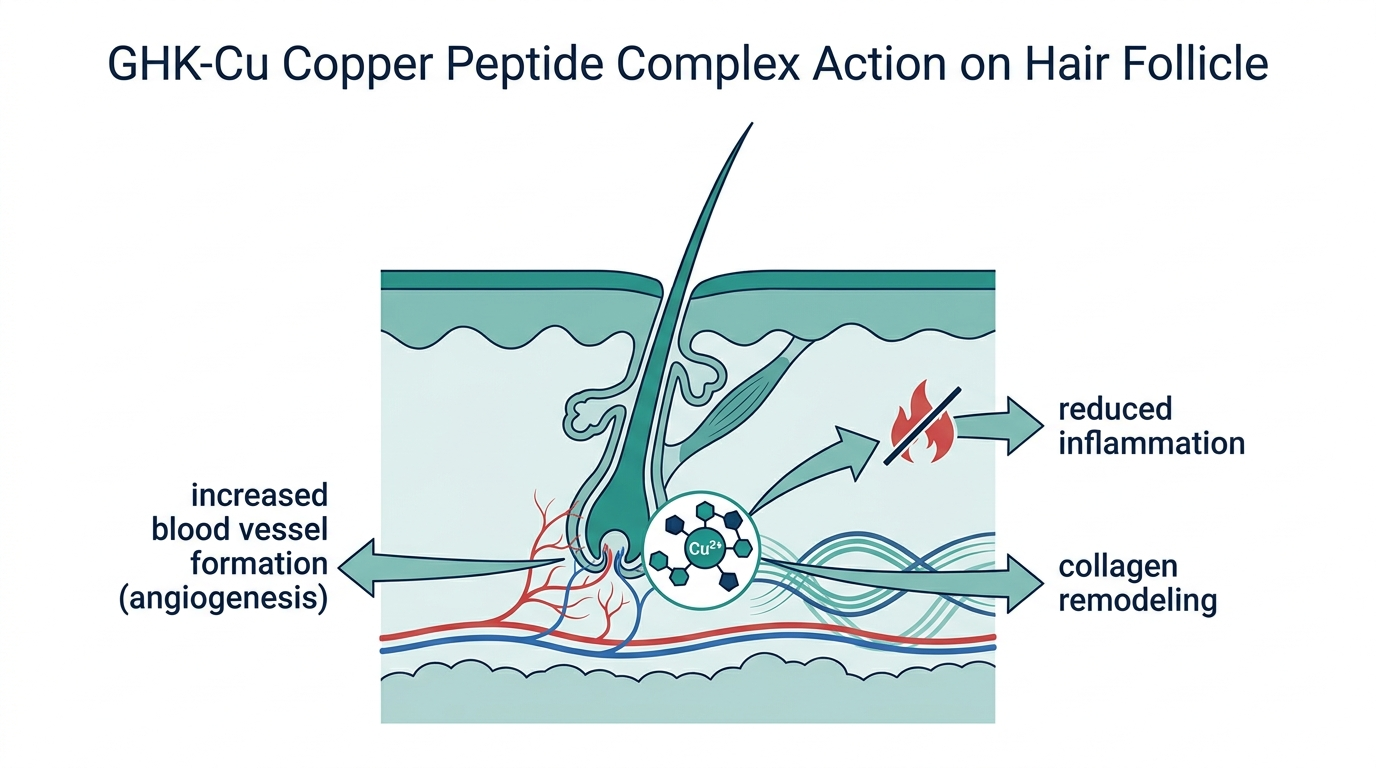
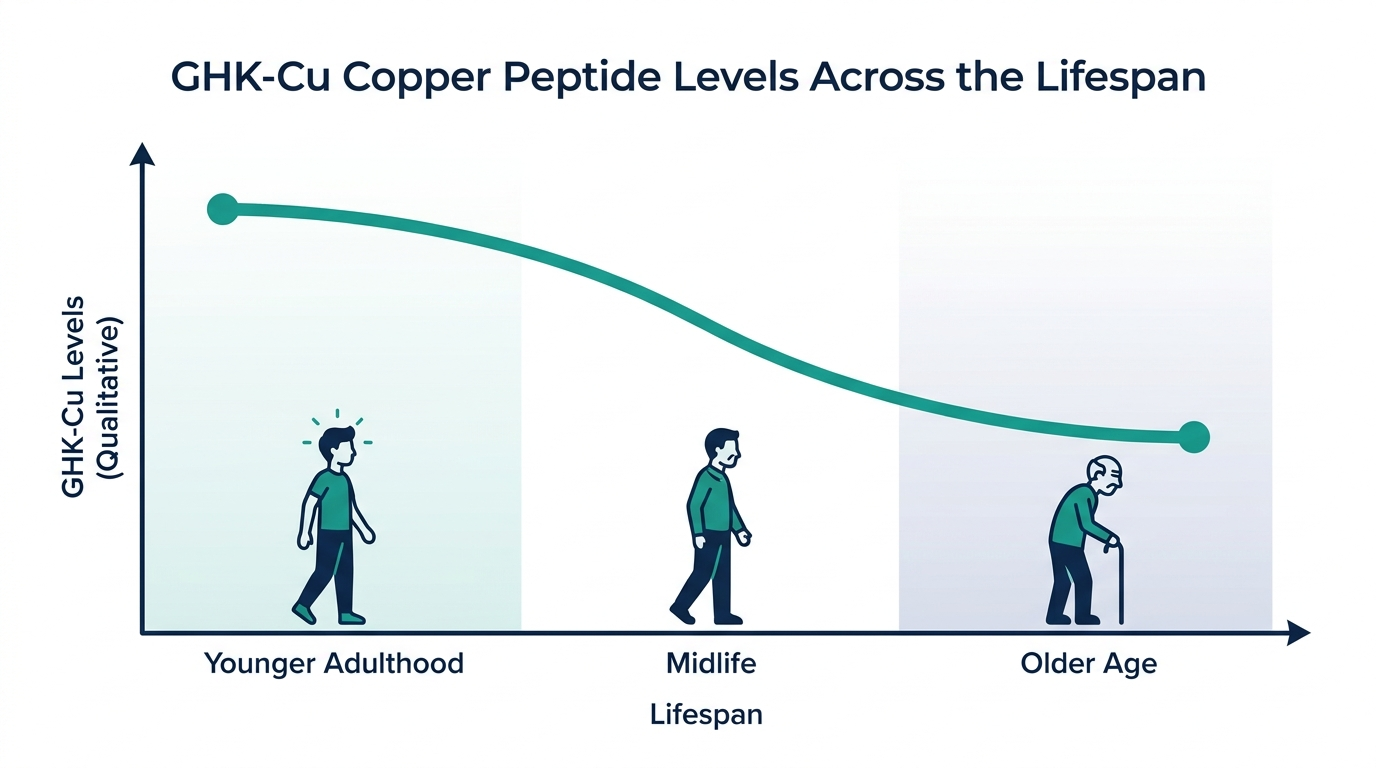
GHK-Cu stands for Glycyl-L-Histidyl-L-Lysine-Copper, a tripeptide naturally produced by the human body that was first isolated in 1973 by biochemist Dr. Loren Pickart. Plasma levels peak in your twenties at around 200 nanograms per milliliter and fall by roughly 60% by age 60, which tracks suspiciously well with the decades when hair follicles start miniaturizing. Pickart spent the following decades documenting what it does: wound repair, collagen synthesis, and the reactivation of dormant follicle cells.
The hair biology goes like this. Hair follicles die not from sudden catastrophe but from slow strangulation. DHT binds to androgen receptors in the dermal papilla, triggering TGF-beta-1 secretion, which tells the follicle to progressively shrink each growth cycle until it produces only fine vellus hair, then nothing. GHK-Cu appears to interrupt this in two ways. First, it suppresses TGF-beta-1 signaling directly, which addresses the molecular mechanism finasteride and dutasteride target from the androgen side. Second, it stimulates angiogenesis, encouraging new capillary growth to re-oxygenate follicles that were quietly starving.
The related peptide AHK-Cu (Alanyl-Histidyl-Lysyl-Copper) adds a third lever: a 2007 study in the Archives of Pharmacal Research by Won et al. showed AHK-Cu reduced follicle cell apoptosis by cutting caspase-3 activity by 42.7% and PARP by 77.5%, essentially telling follicle cells to stop dying. That is a distinct mechanism from both GHK-Cu and from anything in minoxidil or finasteride’s playbook.
Full-body lab membership: 100+ biomarkers, doctor-reviewed, tracked over time.
Does the clinical evidence actually hold up?
The simplest way to actually get this done
Superpower is a full-body lab membership that runs 100+ biomarkers, has each result reviewed by a doctor, and tracks your numbers year over year (about $199/year). It is what we point readers to when they would rather get one clean, complete draw than chase single tests one at a time. Here is superpower reviewed in full.
The honest answer is: promising, but thin. There are no large multicenter randomized controlled trials on copper peptides for androgenetic alopecia. What exists is a collection of smaller studies, some of them peer-reviewed and compelling, some of them funded by the companies selling the product. Here is the real map.
The strongest standalone evidence is the Jeong et al. 2018 trial in the Journal of Applied Pharmaceutical Science, which ran for six months and found the GHK-Cu group gained 71.5 hairs per square centimeter versus 9.6 in placebo. That 7.4x difference is not cosmetic noise. A 2023 trial in the Journal of Cosmetic Dermatology reported a 33% increase in hair density over 12 weeks in androgenetic alopecia patients, a figure the researchers claimed outperformed both 5% minoxidil and placebo in the same cohort.
The most dramatic recent result came from a combination study, not copper peptides alone. In 2025, Kuceki et al. published in JAAD International a protocol delivering 0.5% minoxidil, 0.1% dutasteride, and 1.2% copper peptides directly into the scalp via a rotary tattoo machine at 70 Hz, 2 mm depth, once a month for five sessions. Median scalp regrowth measured by AI-assisted analysis reached 26.5%. The SALT score fell from 40% to 7.5%. Zero adverse events across 35 total sessions. The catch: seven patients, no control arm, all three actives delivered together. This tells us the combination works impressively. It cannot separate copper peptides from minoxidil and dutasteride as independent variables.
The honest take from that 2025 data: copper peptides did not make minoxidil unnecessary, but they made the five-session protocol dramatically outperform the earlier three-session protocol that omitted them. That is a signal worth paying attention to, even if it is not proof of standalone efficacy.
Pickart’s own 2018 review in International Journal of Molecular Sciences claimed GHK-Cu’s hair-stimulating effects are “comparable to 2% minoxidil” without the associated scalp irritation. That framing circulates constantly online as proof GHK-Cu beats minoxidil. Do not believe it as stated. Pickart was the discoverer of GHK-Cu. That comparison comes from his own review, not an independent head-to-head trial. The data behind it is real; the framing exaggerates the certainty.
What is the difference between GHK-Cu and AHK-Cu?
Both are copper-binding tripeptides that target the hair follicle, but through different mechanisms.
| Feature | GHK-Cu | AHK-Cu |
|---|---|---|
| Full name | Glycyl-L-Histidyl-L-Lysine-Copper | Alanyl-L-Histidyl-L-Lysine-Copper |
| Primary mechanism | TGF-beta-1 suppression, angiogenesis, collagen synthesis | Reduces follicle cell apoptosis (cell death prevention) |
| Gene expression effects | Modulates expression of 4,000+ human genes | Narrower, focused on follicle survival signals |
| Clinical evidence | More studied; Jeong 2018, Pickart 2018, Kuceki 2025 | Won et al. 2007 (Archives of Pharmacal Research) |
| Absorption challenge | Low molecular weight, but still limited topical penetration | Similar penetration limitation |
| Common in products | Most serums list GHK-Cu first | Better combined serums list both (e.g., Hairgenetix at 10% GHK-Cu + 5% AHK-Cu) |
| Cost range (standalone) | $40 to $80 per serum | Usually bundled; rarely sold alone |
Personally, I would not bother with a product listing only one of the two. The mechanisms are complementary, not redundant. GHK-Cu rebuilds the growth environment; AHK-Cu keeps the follicle cells alive long enough to respond.
What concentration do you actually need?
This is where most retail products fail in silence.
The clinical studies used concentrations most commercial shampoos never reach. The Jeong 2018 trial used a dedicated peptide complex serum, not a rinse-off product. The Kuceki 2025 study used 1.2% copper peptides delivered by microneedling, which drives penetration past the stratum corneum to the dermal papilla. A shampoo with trace GHK-Cu is diluted by water, on the scalp for under two minutes, and in constant contact with surfactants that can denature the peptide. It is unlikely to reach the follicle at a meaningful dose.
Research on microneedle-assisted delivery shows GHK-Cu absorption improves from near-zero to 134 nanomoles within nine hours when applied after microneedling compared to topical-only application, a more-than-20-fold difference in follicle-level exposure.
Practical hierarchy for absorption:
1. Microneedling (dermaroller 0.5 mm or clinical mesotherapy) directly before application, highest follicle exposure
2. Leave-on scalp serum with a dedicated applicator, applied to dry scalp, 1% to 10% concentration
3. Conditioner or rinse-off treatment, modest contact time, moderate penetration
4. Shampoo with copper peptides, least effective per unit of active ingredient
The Hairgenetix serum, at 10% GHK-Cu and 5% AHK-Cu, sits at the high end of commercially available concentrations and has its own 150-day internal trial data showing 93% shedding reduction. The Neurogan GHK-Cu spray runs around $59 per bottle with a published 100-participant trial. PeptideLabz offers the same peptide ratio for less without the clinical data.
Hydrolyzed type I & III collagen peptides, third-party tested, unflavored.
How should you actually use a copper peptide serum?
The application routine decides whether the product ever reaches the tissue that matters, and most people get this part slightly wrong. The dermal papilla sits below the scalp surface, so the goal of every step is to move the peptide toward it rather than leaving it on top of dead skin.
Apply to a dry scalp, not a wet one. Water on the scalp dilutes the serum and can carry it into runoff before it absorbs. Part the hair and target the serum onto the scalp itself, not the hair shafts, because the follicle is the destination and the shaft is just packaging. Let it absorb fully before layering anything on top.
Order matters when you stack it with minoxidil. Apply the minoxidil first, wait ten to fifteen minutes for it to absorb, then apply the copper peptide serum. The perfusion effect of minoxidil and the tissue-remodeling effect of the peptide work on different problems, and giving each one its own absorption window keeps them from competing at the surface.
If you use a dermaroller to boost penetration, treat it as a real procedure, not a cosmetic afterthought. Keep the needle length modest for at-home use, disinfect the roller before and after, and never apply minoxidil immediately after microneedling, because the freshly opened channels can drive far more of it systemically than intended. Space the microneedling sessions out rather than rolling daily; the scalp needs time to recover between passes. Above all, patch-test any new serum on a small area first if you have known metal or nickel sensitivity.
Then the unglamorous truth: consistency beats intensity. A modest serum used daily for six months will almost always outperform an expensive one used sporadically, because the follicle cycle only rewards sustained signaling. The people who quit at week six, right when shedding can temporarily rise, are the ones who never find out whether the product would have worked.
Copper peptides vs. minoxidil vs. finasteride: what each one actually does
These are not competing treatments. They hit three completely different parts of the same problem.
Minoxidil is a potassium channel opener that causes vasodilation in the scalp, shortening the telogen (resting) phase and forcing follicles into active growth faster. It does nothing to the underlying androgen signaling that is causing the follicle to miniaturize in the first place.
Finasteride and dutasteride block 5-alpha reductase, the enzyme that converts testosterone to DHT. They address the hormonal root cause. The tradeoff is a systemic mechanism, meaning the DHT reduction is body-wide, not scalp-specific. A subset of men report persistent sexual side effects after discontinuing, though the prevalence estimate has ranged widely across studies.
Copper peptides work upstream of both. GHK-Cu suppresses TGF-beta-1, the downstream signal DHT triggers to miniaturize the follicle, without touching systemic hormones. This means a man who cannot tolerate finasteride may still get partial benefit from GHK-Cu’s mechanism, targeting the follicle’s response to DHT rather than DHT itself.
The 2025 JAAD combination study is instructive precisely because it combined all three mechanisms: minoxidil for perfusion, dutasteride for DHT suppression, and copper peptides for follicle repair. The five-session result of 26.5% regrowth significantly outperformed the same group’s earlier 2023 protocol that used only minoxidil and dutasteride without copper peptides over three sessions (10% regrowth). The addition of copper peptides, even at 1.2%, moved the outcome by a factor of 2.65.
Who is most likely to see results?
Copper peptides are not a category killer for all alopecia. The honest patient selection narrows the likely responders:
People in early-stage androgenetic alopecia (Norwood I to III, Ludwig I to II) with follicles that are miniaturizing but not yet dead are the most likely to respond to copper peptide protocols. Dead follicles cannot be revived by any topical agent. The follicle has to still be present for signaling to matter.
Women with diffuse thinning, often driven as much by nutrition, telogen effluvium, and inflammation as by pure DHT signaling, tend to show a stronger response to copper peptides than men with classic vertex pattern baldness. The anti-inflammatory and tissue-remodeling mechanisms are especially relevant in inflammatory scalp conditions like seborrheic dermatitis or chronic scalp tension.
People using topical minoxidil who experience scalp dryness, flaking, or irritation commonly find that adding a copper peptide serum resolves those side effects while potentially improving efficacy. The peptide’s collagen-synthesis pathway complements minoxidil’s perfusion effect directly.
People post-hair-transplant may benefit the most per dollar spent. A 1998 study by Perez-Meza et al. found copper peptide application after transplantation reduced post-surgical graft shedding from 30% to 10% and accelerated growth onset by 50%. That is a surgical context, not a cosmetic one, and the mechanism makes sense: copper peptides accelerate wound healing and new capillary formation, exactly what a freshly transplanted graft needs.
What else could be driving your hair loss?
Here is the part the serum marketing never mentions: copper peptides address one mechanism of hair loss, and hair loss frequently has more than one driver running at the same time. Spending money on a topical while an untreated internal cause keeps pulling in the other direction is the most common reason people conclude that nothing works.
Several ordinary, checkable factors sit behind a large share of thinning, especially the diffuse kind. Low iron stores, reflected in ferritin, are a well-recognized contributor to shedding, particularly in women. Thyroid dysfunction, in either direction, can thin hair across the whole scalp. Low vitamin D, protein undernutrition from aggressive dieting, and the aftermath of a major stressor, illness, or rapid weight loss can all push a wave of follicles into the shedding phase, a pattern called telogen effluvium. Hormonal shifts, including those around pregnancy, thyroid, and androgens, add another layer.
The practical move is to look before you buy. A basic panel that checks iron and ferritin, thyroid function, vitamin D, and a few hormone and metabolic markers can tell you whether a fixable internal problem is feeding the loss. If ferritin is on the floor, no copper peptide serum will out-argue it, and correcting the deficiency may do more for your hair than any topical. Testing first turns a guessing game into a plan, and it keeps you from crediting or blaming a serum for something happening deeper in the body.
How long before copper peptides show results on the scalp?
Hair biology imposes its own timeline, regardless of what the product label suggests. The follicle cycle runs roughly 90 days from activation to visible shaft emergence. There is no peptide that bypasses that biology.
Realistic timeline:
Weeks 1 to 6: possible mild increase in shedding. This is not failure; it is the follicle cycle accelerating from telogen into anagen. The same phenomenon happens at the start of minoxidil and can alarm first-time users.
Weeks 6 to 8: shedding stabilizes. The scalp may feel less inflamed. Hair already in the growth phase often feels thicker in diameter, which is the first measurable sign that follicle caliber is changing.
Weeks 8 to 12: finer vellus hairs may appear, particularly along hairline recession or crown area. This is an early positive indicator.
Months 3 to 4: new terminal hair growth becomes photographable. This is the minimum honest window before drawing conclusions about efficacy.
Months 4 to 6 and beyond: density changes accumulate for consistent users. The clinical studies that found statistically significant results ran for six months minimum.
If there is no visible or tactile change by month four and you have been applying the serum daily to dry scalp, the product either lacks effective concentration, you are not getting follicle penetration, or your follicles are too far into terminal miniaturization to respond to topical intervention alone. That is the moment to consider either upgrading to microneedling-assisted delivery or consulting a trichologist.
The myth of copper peptide shampoos
Every hair-care brand has added “copper peptide” to a shampoo line. Most of them contain GHK-Cu at concentrations so low they function as a label play, not a treatment. The mechanism requires the peptide to reach the dermal papilla, which sits 3 to 5 mm below the scalp surface. A rinse-off product with 0.001% GHK-Cu, in contact with surfactants and rinsed in under three minutes, does not achieve that.
There is no peer-reviewed study showing a copper peptide shampoo regrew hair in a controlled setting. There are studies showing copper peptide serums regrowing hair. That is a delivery format difference that the marketing conflates deliberately.
If a brand charges a $40 premium for a copper peptide shampoo over its regular formula, ask for the concentration and the third-party data. If they cannot provide either, the copper peptide on the label is marketing.
Curious what your own levels look like?
Baseline 100+ biomarkers today and retest as life changes, all in one membership with physician review.
What copper peptides cannot do
Honest expectation-setting is what separates a product that helps from a product that disappoints. Copper peptides rebuild the environment around a living follicle. They do not raise the dead. A follicle that has been fully scarred over, as in frontal fibrosing alopecia or long-standing traction alopecia, no longer has the machinery to respond to any topical signal, and no serum changes that. A trichoscopy can tell a miniaturized follicle from an absent one before you commit months to a protocol.
They also are not a standalone cure for moderate-to-severe pattern baldness. The strongest recent evidence for regrowth came from combination protocols that paired copper peptides with minoxidil and a DHT blocker, delivered by microneedling, not from a serum used alone. Framing copper peptides as a replacement for proven treatments overstates what the data supports. The more accurate framing is that they are a complementary lever, strongest early, strongest in combination, and strongest when the internal drivers of loss have already been ruled out or corrected.
Frequently asked questions
Can copper peptides regrow hair that has already been lost?
Only if the follicle is still present and viable. Follicles that have been miniaturizing for years may recover with copper peptides, particularly when combined with microneedling or prescription treatments. Follicles that have been completely scarred over (as in frontal fibrosing alopecia or traction alopecia with fibrosis) cannot respond to topical peptides. A trichoscopy can distinguish miniaturized from absent follicles before you invest in a protocol.
Do copper peptides affect hormones or DHT levels?
No. Copper peptides are non-hormonal. They do not inhibit 5-alpha reductase the way finasteride does, they do not change testosterone or estrogen levels, and they do not carry the systemic side-effect profile associated with DHT blockers. They work on the follicle’s downstream response to DHT, not on DHT production itself.
Can I use copper peptides with minoxidil or finasteride at the same time?
Yes. There are no known interactions, and the three mechanisms are complementary. Apply minoxidil first, allow 10 to 15 minutes for full absorption, then apply the copper peptide serum. Combining all three is precisely what the 2025 Kuceki et al. study did with strong results.
Are copper peptide hair serums safe?
The safety profile in available studies is excellent. The Kuceki 2025 study logged zero adverse events across 35 treatment sessions. Topical copper peptides at cosmetic concentrations do not generate the systemic risk profile of finasteride or even the localized irritation common with minoxidil. Copper toxicity from topical application is not documented at commercial concentrations because absorption is limited. People with nickel or metal sensitivity should patch-test first.
What concentration should I look for in a copper peptide serum?
Look for 1% or higher GHK-Cu in a leave-on serum format. Products listing both GHK-Cu and AHK-Cu give you two complementary mechanisms. The clinical studies with significant results used dedicated serums, not rinse-off products. For a benchmark: Hairgenetix’s serum runs 10% GHK-Cu and 5% AHK-Cu; Neurogan’s spray product runs approximately 2,400 mg (around 4%) per bottle.
How is a copper peptide serum different from a copper peptide shampoo?
Contact time and concentration. A serum stays on the scalp for hours, allowing slow penetration toward the follicle. A shampoo stays on the scalp for under three minutes, often diluted by water and mixed with surfactants. No peer-reviewed study has demonstrated hair regrowth from a copper peptide shampoo specifically. The regrowth evidence comes from serum-format and microneedling-delivered applications.
Are injectable GHK-Cu protocols worth pursuing?
Injectable GHK-Cu is a research peptide, not a cosmetic or pharmaceutical product. It is not FDA-approved for hair loss. If you are interested in injectable peptide therapy for hair, the right path is a licensed dermatologist or trichologist who can prescribe compounded treatments through a verified pharmacy, not a grey-market vendor. The topical cosmetic route is the legal and accessible starting point, and it is where most of the clinical evidence lives.
Hydrolyzed type I & III collagen peptides, third-party tested, unflavored.
Author: Vital Signs Today Editorial Team, [credential]”]. Educational content, not medical advice. Sources linked inline.
Primary sources (verify live before publish):
– Jeong et al. (2018), Journal of Applied Pharmaceutical Science: https://hairgenetix.com/pages/scientific-research-copper-peptide
– Won et al. (2007), Archives of Pharmacal Research: https://hairgenetix.com/blogs/articles/copper-peptide-ahk-cu-hair-follicle-growth-study-2007
– Kuceki et al. (2025), JAAD International: https://hairgenetix.com/blogs/articles/copper-peptide-microneedling-hair-regrowth-2025-study
– Pickart et al. (2018), International Journal of Molecular Sciences: https://hairgenetix.com/blogs/articles/ghk-cu-copper-peptide-regeneration-science-review-2018
– Hairgenetix scientific research hub: https://hairgenetix.com/pages/scientific-research-copper-peptide
– FUE Hair Loss Clinic 2026 peptide analysis: https://www.fue-hlc.com/peptides-for-hair-loss/
– MDhair copper peptides vs minoxidil: https://www.mdhair.co/article/the-truth-behind-copper-peptides-for-hair-care
– Hairgenetix 2026 buyer’s guide: https://hairgenetix.com/blogs/articles/best-copper-peptide-hair-growth-serums-2026-buyers-guide
Related reading
Vital Signs Today may earn a commission if you buy through links on this page. It does not affect our editorial assessments.