
Educational content, not medical advice. Consult a registered dietitian or physician before making significant changes to your protein intake or supplement regimen.
Short answer: Yes. Collagen peptides are roughly 90% protein by dry weight. A standard 20-gram scoop of Vital Proteins Collagen Peptides delivers 18 grams of protein. The catch is that collagen is an incomplete protein (it contains zero tryptophan), which scores it a 0.0 on the PDCAAS quality scale, meaning it counts as a supplement to your diet rather than a replacement for a primary protein source.
Collagen is 90% protein, but is it covering what your body actually needs? Check your full nutrient and protein markers. One at-home Superpower draw checks 100+ biomarkers, physician-reviewed.
That distinction is not a marketing spin. It has real practical consequences for how you use collagen, how you count your macros, and what happens when you combine it with other protein sources. Let me walk through each layer.
How much protein is actually in collagen peptides?
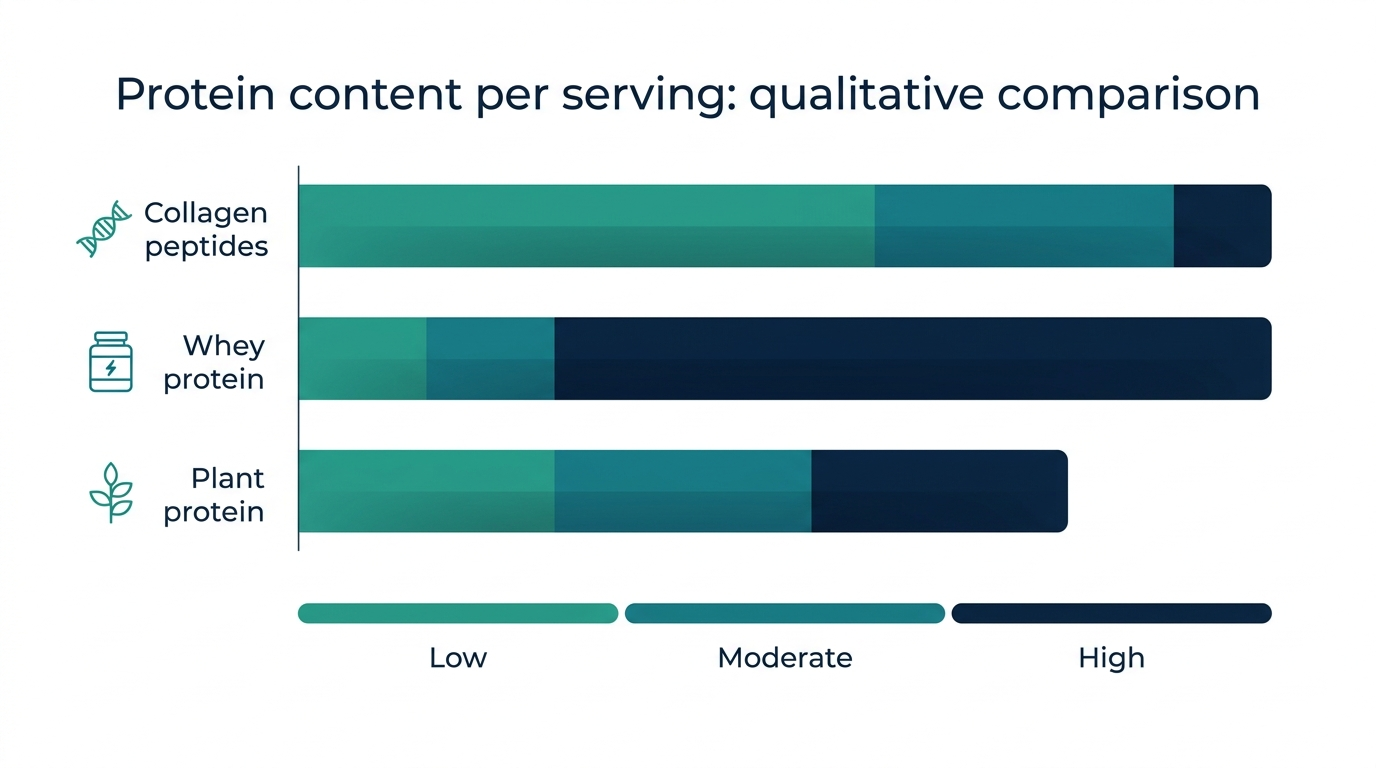
The protein content of collagen peptides is high by any measure. On a dry-weight basis, collagen peptides run about 90% protein. That means a 20-gram serving delivers roughly 18 grams of protein and fewer than 80 calories, with essentially zero fat and zero carbohydrates.
Here is how three of the most widely used brands break down per standard serving:
| Brand | Serving size | Protein | Calories | Collagen type | Source |
|---|---|---|---|---|---|
| Vital Proteins Collagen Peptides | 20 g (4 tbsp) | 18 g | 70 kcal | Type I & III | Grass-fed bovine |
| Sports Research Collagen Peptides | 11 g (1 scoop) | 10 g | 40 kcal | Type I & III | Grass-fed bovine |
| Naked Collagen | 10 g (1 scoop) | 9 g | 35 kcal | Type I & III | Grass-fed bovine |
Numerically, collagen peptides are competitive with protein powders on a gram-per-gram basis. A 20-gram scoop of collagen gives you more protein than the same weight of most Greek yogurts and about as much as half a chicken breast. So the protein content is real and meaningful.
Where collagen diverges sharply from whey, casein, or plant proteins is in the composition of that protein, not the quantity.
Is collagen a complete protein?
No, and this matters. A complete protein contains all nine essential amino acids your body cannot make on its own. Collagen is missing tryptophan entirely. Not low in it. Absent.
Under the PDCAAS (Protein Digestibility-Corrected Amino Acid Score) system, the scale the FDA uses for supplement labels, having zero of any essential amino acid collapses the entire score to 0.0. That is why many collagen supplement labels carry a footnote reading “not a significant source of protein” in the Daily Value panel, even though the label simultaneously shows 18 grams of protein per serving. The FDA recognizes the grams but not the quality contribution toward the 50-gram daily value.
This is the detail that trips up most people when they first read a collagen label, and it frustrates them reasonably. The grams are real. The 0% daily value is a regulatory judgment about amino acid completeness, not a typo.
However, the 0.0 PDCAAS score does not mean collagen protein is worthless. A 2019 study published in Nutrients (PMID: PMC6566836) ran iterative PDCAAS calculations and found that adults can substitute up to 36% of their total daily protein intake with collagen peptides without pushing their overall diet’s PDCAAS below 1.0, as long as the remaining 64% comes from complete protein sources. The reason is that typical Western diets already carry a large surplus of tryptophan and methionine from meat, dairy, and eggs, which offsets collagen’s gap.
Practically speaking: if you eat 120 grams of protein per day, up to about 43 grams of that can come from collagen peptides before the tryptophan gap starts to matter.
What amino acids do collagen peptides actually contain?
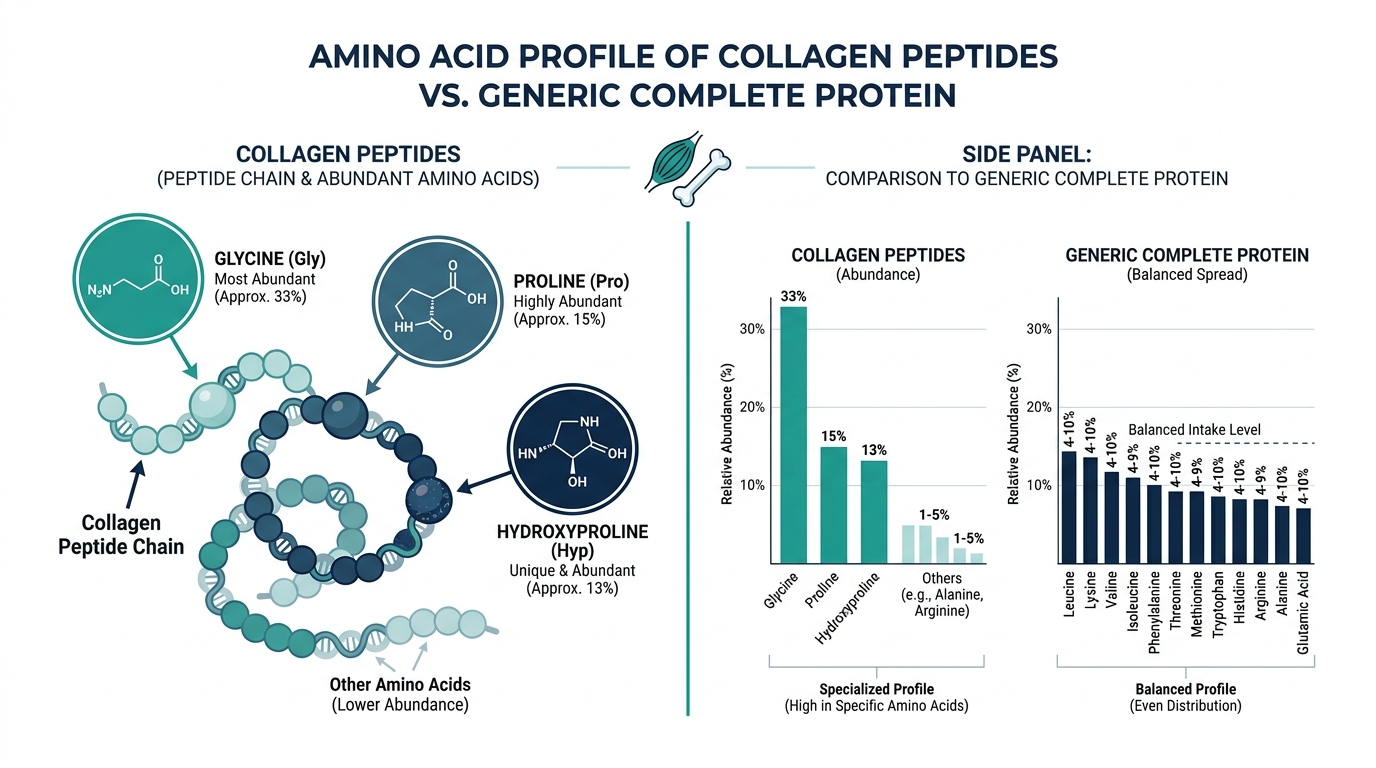
Collagen has the most unusual amino acid profile of any protein supplement on the market. Three amino acids dominate its structure: glycine, proline, and hydroxyproline, a combination you will not find at meaningful concentrations anywhere else in the food supply.
A typical 20-gram serving of collagen peptides delivers:
- Glycine: approximately 3.5 to 4 grams. Glycine makes up about 20% of collagen’s amino acid composition and is the smallest amino acid, used to keep the triple-helix collagen chain tight. It is also a precursor to creatine biosynthesis, which is why some researchers suspect a portion of collagen’s exercise benefits come through creatine production rather than direct muscle protein synthesis.
- Proline: approximately 2 to 2.5 grams. Proline is essential for connective tissue structure and wound repair.
- Hydroxyproline: approximately 2 to 2.5 grams. This is collagen’s “signature” amino acid. Most proteins contain almost none of it. Hydroxyproline-containing dipeptides (prolyl-hydroxyproline and hydroxyprolyl-glycine) are what researchers track in the bloodstream after collagen ingestion to confirm bioavailability. A 2023 study in Bioscience, Biotechnology, and Biochemistry found that these dipeptides from collagen supplements accumulate in the skin and subcutaneous vessel walls, reducing advanced glycation end-products over time.
- Leucine: under 1 gram per serving. This is the key difference from whey, which delivers about 2.5 grams of leucine per 25-gram serving. Leucine is the primary trigger for mTOR activation and muscle protein synthesis. Collagen’s low leucine is why it does not stimulate muscle growth the way whey does.
Do not believe anyone who says collagen and whey are interchangeable for muscle building. Whey produces significantly greater hypertrophy in resistance-trained subjects. A 10-week RCT comparing 35 grams per day of whey versus leucine-matched collagen peptides found that whey increased muscle mass in the vastus lateralis and biceps brachii, while collagen did not. The muscle-building literature is consistent on this point.
Then what is collagen protein actually good for?
This is where the insider picture gets interesting, because the marketing of collagen products usually either overclaims (calling it a complete protein replacement) or underclaims (dismissing it as “just a supplement”). The real answer sits between those poles.
Collagen peptides have strong, consistent evidence for three specific categories:
Skin elasticity and hydration. A 2024 randomized, double-blind, placebo-controlled trial published in Dermatology Research and Practice found that daily oral hydrolyzed collagen supplementation significantly improved skin hydration, elasticity, and wrinkle depth over 12 weeks. A separate 2025 clinical trial tracking bioactive collagen peptides showed sustained improvements in dermal collagen density confirmed by high-resolution ultrasound, with effects linked specifically to hydroxyproline-rich dipeptides. The minimum effective dose in skin studies is typically 2.5 to 10 grams per day.
Tendon and joint repair. A 2024 analysis of low-molecular-weight collagen peptides in Achilles tendon and medial collateral ligament injuries found improved fiber arrangement, increased angiogenesis, and accelerated collagen deposition compared to placebo. Shaw et al. showed that 15 grams per day of gelatin/collagen with vitamin C taken 60 minutes before exercise elevated circulating hydroxyproline and increased collagen synthesis markers for up to 72 hours post-exercise, more than the 5-gram dose tested in the same study.
Glycine’s secondary roles: sleep and gut lining. Roughly 20% of collagen’s amino acid content is glycine, making a 20-gram serving one of the most glycine-dense food sources available, delivering 3 to 4 grams in a single scoop. Research on standalone glycine supplementation shows that 3 grams taken before bed lowers core body temperature at sleep onset and improves subjective sleep quality. Glycine also maintains intestinal barrier integrity, supporting gut lining function in ways that standard whey protein does not.
Personally, I think the sleep angle is the most underreported benefit of collagen peptides. Most people buy it for skin. The glycine hitting your system 30 minutes before bed is doing something entirely separate from your dermal fibroblasts.
Full-body lab membership: 100+ biomarkers, doctor-reviewed, tracked over time.
How does collagen protein compare to whey?
| Factor | Collagen Peptides | Whey Protein Isolate |
|---|---|---|
| Protein per 20g serving | ~18 g | ~18 to 20 g |
| Complete protein | No (missing tryptophan) | Yes |
| PDCAAS score | 0.0 | 1.0 |
| Leucine per serving | ~0.7 g | ~2.5 g (per 25g) |
| Glycine per serving | ~3.5 g | ~0.2 g |
| Hydroxyproline | Present (~2 g) | Absent |
| mTOR stimulation | Low | High |
| Muscle hypertrophy (RCT data) | Not significant alone | Significant |
| Skin and tendon support | Strong evidence | Indirect/minimal |
| Sleep support (glycine) | Yes, via high glycine | No |
| Mixes in hot liquids | Yes (odorless/tasteless) | Often foams or clumps |
| Typical cost per serving | $0.80 to $1.40 | $0.60 to $1.50 |
| Allergen profile | Dairy-free, usually gluten-free | Contains dairy |
The table makes the right use case obvious: whey for muscle protein synthesis; collagen for skin, joints, tendons, and glycine-related functions. They are not competitors. They serve different biological systems.
The smartest stack, if budget allows, is to get your primary protein from whey, eggs, or meat to cover leucine and mTOR, then add 10 to 20 grams of collagen specifically timed around workouts or before bed. Vitamin C co-ingestion (50 mg is enough in the Shaw protocol) significantly boosts the collagen synthesis response after exercise.
Can collagen peptides count toward your daily protein goal?
Yes, with an asterisk. The protein grams on the label are real and will show up on your food tracking app. If you eat 100 grams of protein per day and 18 of them come from one scoop of Vital Proteins, you have genuinely consumed 18 grams of dietary protein.
The asterisk is that those 18 grams carry no tryptophan, so if collagen makes up too large a share of your total intake, you risk inadequate essential amino acid coverage. The research-derived limit is roughly 36% of total daily protein. Eat above that threshold from collagen alone, and your overall diet PDCAAS begins to fall below 1.0.
For most people eating a typical omnivore diet, this threshold is essentially impossible to hit accidentally. If you have one 20-gram scoop of collagen in the morning alongside eggs, chicken, or dairy the rest of the day, you are nowhere near the 36% ceiling. The ceiling matters mainly for people who are protein-restricting, older adults with very low appetite, or anyone using collagen as a primary protein source in a weight-loss context.
One practical note the brands will not tell you: the FDA’s label rule means that even though your nutrition tracking app will log the protein grams, a Nutrition Facts panel on a collagen product that shows a large protein number alongside 0% daily value is not contradicting itself. The grams are correct. The 0% reflects the tryptophan gap. Both numbers are honest.
Who should add collagen peptides, and who should skip them?
Good candidates:
- Anyone targeting skin hydration and elasticity (clinical evidence is solid at 2.5 to 10 grams daily)
- Athletes or active people with tendon, ligament, or joint issues (15 grams with vitamin C pre-workout has the best research support)
- People with poor sleep quality who want a food-source glycine boost
- Anyone already hitting their complete protein needs and wants to supplement connective tissue specifically
Less ideal candidates:
- Vegans or vegetarians relying on collagen as a primary protein source (bovine and marine collagen are animal products; vegan “collagen builders” use vitamin C, zinc, and amino acid precursors but contain no collagen at all)
- Anyone trying to build muscle who is substituting collagen for whey or eggs (the leucine and PDCAAS data are clear)
- People with fish or shellfish allergies choosing marine collagen variants
Collagen is bovine by default. Marine collagen, sourced from fish skin, delivers a higher concentration of type I collagen and smaller peptide size (roughly 800 to 1,500 daltons vs. 2,000 to 5,000 for bovine), which some researchers argue improves bioavailability. The price premium is real and the additional evidence is modest.
Hydrolyzed type I & III collagen peptides, third-party tested, unflavored.
Does cooking or mixing destroy the protein in collagen peptides?
No. Collagen peptides are already hydrolyzed, meaning the protein chains have been broken into short fragments (typically 2,000 to 5,000 daltons) by enzymatic processing before packaging. This makes them stable under heat. You can stir them into hot coffee, add them to soups, bake them into oatmeal, or blend them into smoothies without denaturing the protein or reducing bioavailability.
This heat stability is one of collagen’s practical advantages over whey protein, which foams aggressively in hot liquid. Collagen peptides dissolve cleanly in both hot and cold liquids, taste neutral, and add zero texture change to most foods.
One quirk worth knowing: if you dissolve collagen peptides in cold water and then refrigerate the mixture, it may partially gel at low concentrations, a residual effect of collagen’s original triple-helix structure. At typical supplement doses in normal amounts of liquid this is not usually an issue, but it can surprise people who pre-mix a batch and leave it overnight.
Don’t just read about your health, track it.
A single result is a snapshot. Superpower re-tests 100+ markers over time so you can watch them move as you change sleep, food, and training.
FAQ: Do collagen peptides have protein?
Does collagen peptides count as protein intake?
Yes, the protein grams are real and will count on food trackers. A standard 20-gram serving delivers 18 grams of protein. However, the FDA does not credit collagen toward its 50-gram protein daily value because collagen lacks tryptophan, scoring it 0.0 on the PDCAAS quality scale. For practical macro tracking, log the grams but ensure the rest of your diet provides complete proteins.
Can I replace my whey protein with collagen peptides?
Not for muscle building purposes. Collagen’s leucine content (under 1 gram per serving) is far below whey’s 2.5 grams per serving, and leucine is the primary trigger for muscle protein synthesis via mTOR. RCT data consistently show whey outperforms collagen for hypertrophy. Collagen works well alongside whey for connective tissue support but is not a replacement for it.
Is collagen protein good for weight loss?
Collagen peptides are very low calorie (70 to 80 calories per 20-gram serving) and do provide satiety-relevant protein grams, but their incomplete amino acid profile means they should not be your sole protein source in a calorie deficit. They fit well in a weight-loss plan as a supplement alongside whole food proteins.
How much protein is in one scoop of Vital Proteins Collagen Peptides?
One serving (20 grams, approximately 4 tablespoons) of Vital Proteins Collagen Peptides contains 18 grams of protein, 70 calories, 0 grams of fat, and 0 grams of carbohydrates, sourced from grass-fed and pasture-raised bovine hides.
Does collagen peptide protein help skin?
Yes, and this is where the clinical evidence is strongest. A 2024 double-blind RCT found significant improvements in skin hydration, elasticity, and wrinkle depth after 12 weeks of daily hydrolyzed collagen supplementation. A 2025 trial showed lasting improvements in dermal collagen density confirmed by ultrasound imaging. The minimal effective dose in skin studies is 2.5 to 10 grams per day.
Is marine collagen better than bovine collagen for protein?
Marine collagen (from fish skin or scales) is predominantly type I collagen, the same type most associated with skin elasticity, and has a smaller peptide size that may improve absorption rate. Bovine collagen contains types I and III. Both deliver comparable protein per gram. Marine collagen tends to cost 20 to 40% more, and the head-to-head absorption evidence in humans remains limited.
Can I take collagen peptides every day?
Yes. Studies showing benefits for skin, joints, and tendons used daily dosing consistently, typically for 8 to 12 weeks. Research shows no significant adverse effects at doses up to 15 grams per day. The 2019 Nutrients study found that up to 36% of total daily protein intake from collagen does not compromise overall amino acid balance in people eating normal diets.
The bottom line
Collagen peptides are high-protein by gram count, roughly 90% protein by weight, and a 20-gram serving delivers 18 grams. They are also an incomplete protein with zero tryptophan and a PDCAAS of 0.0. Those two facts live comfortably together once you understand that collagen’s job is not to replace the proteins that build muscle. Its job is to supply glycine, proline, and hydroxyproline to skin, tendons, joints, and the gut lining, systems that most other protein sources essentially ignore.
The smartest move is not to choose between collagen and a complete protein source. It is to use both for what each does well.
Hydrolyzed type I & III collagen peptides, third-party tested, unflavored.
Author: Vital Signs Today Editorial Team, [credential]”]. Educational content, not medical advice. Sources linked inline.
Primary sources:
- Vital Proteins Collagen Peptides nutrition facts: vitalproteins.com/products/collagen-peptides
- Significant Amounts of Functional Collagen Peptides Can Be Incorporated in the Diet While Maintaining Indispensable Amino Acid Balance (2019, Nutrients): pmc.ncbi.nlm.nih.gov/articles/PMC6566836/
- Clinical Trial on Hydrolysed Collagen, Skin Hydration and Elasticity (2024, Dermatology Research and Practice): onlinelibrary.wiley.com/doi/10.1155/2024/8752787
- Prolyl-hydroxyproline dipeptides reduce advanced glycation end-products in skin (2023, Bioscience, Biotechnology, and Biochemistry): academic.oup.com/bbb/article/87/8/883/7181480
- Whey but not collagen stimulates muscle protein synthesis in older women (ScienceDirect): sciencedirect.com/science/article/pii/S0002916522010528
- Collagen peptide supplementation on body composition and muscle strength (PMC systematic review): pmc.ncbi.nlm.nih.gov/articles/PMC8521576/
- Does Collagen Protein Count Towards Your Daily Protein Intake? (PEScience): pescience.com/blogs/articles/does-collagen-protein-actually-count-towards-your-daily-protein-intake
- Collagen Peptides for Tendons: dosage and timing (CollagenSEI): collagensei.com/collagen-peptides-for-tendons/
- Functional Benefits of Low-Molecular-Weight Collagen Peptides in tendon injuries (2024, PMC): pmc.ncbi.nlm.nih.gov/articles/PMC12535853/
- Superpower biomarker testing review 2026: athletechnews.com/superpower-blood-test-review/
Related reading
Vital Signs Today may earn a commission if you buy through links on this page. It does not affect our editorial assessments.