
Last updated 18 June 2026. Educational content, not medical advice. Topical copper-peptide serums are sold legally as cosmetics. Talk to a licensed clinician before starting any injectable peptide protocol.
Short answer: For topical use, apply 3 to 5 drops of a 0.1% to 1% GHK-Cu serum to clean skin in the evening, wait one to two minutes for absorption, then follow with moisturizer. Avoid layering directly with L-ascorbic acid vitamin C or strong exfoliating acids in the same step. Results in skin firmness and fine-line reduction typically appear at four to eight weeks, with measurable changes documented at 12 weeks in a double-blind trial of 60 women.
You’re layering copper peptides onto your skin, but do you know what’s happening underneath it? One at-home Superpower draw checks 100+ biomarkers, physician-reviewed.
What exactly is GHK-Cu, and why does it work differently from other peptides?
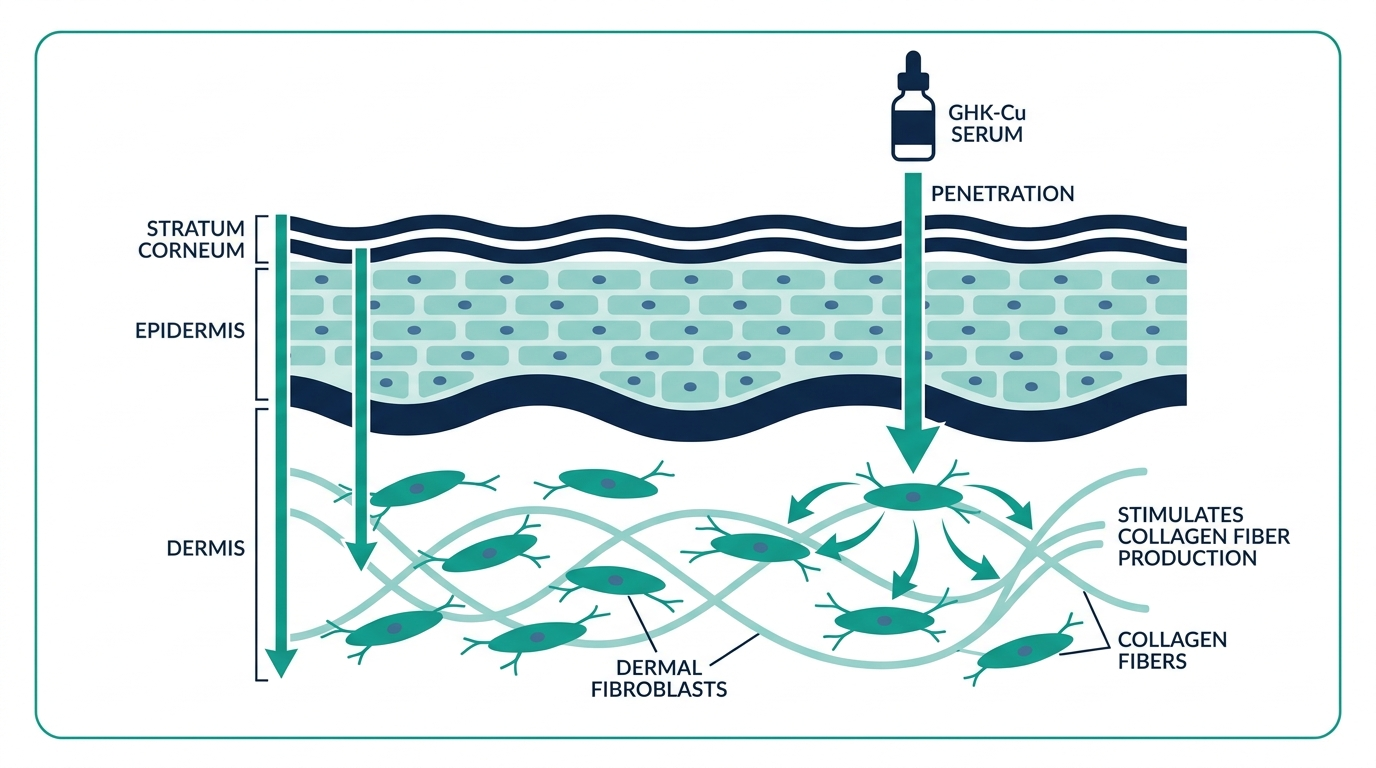
GHK-Cu is a copper-binding tripeptide: three amino acids (glycine, histidine, lysine) chelated around a single copper ion. That copper is the key distinction. Most signaling peptides in skincare act on one or two surface pathways. GHK-Cu, because it carries a bioavailable copper ion directly into the skin, plugs into a much wider set of biological processes, from collagen and elastin synthesis to angiogenesis to the cellular cleanup system (the ubiquitin-proteasome pathway).
A biochemist named Loren Pickart discovered it in 1973 while studying why blood plasma from young donors helped aged liver tissue regenerate more effectively in the lab. He isolated the active fragment, identified its structure, and spent the next five decades publishing on it. Most “breakthrough” skin ingredients do not come with a fifty-year research trail attached. This one does, which is both its strength and the reason the marketing around it tends to dramatically oversimplify the evidence.
Here is the thing the brand pages skip over: GHK is not something your body runs out of entirely. It is something your body produces less of with age. Pickart’s own measurements showed plasma GHK levels fall from roughly 200 ng/mL at age 20 to under 80 ng/mL by age 60, a drop of more than 60%. That age-related decline is real and it is why GHK-Cu earned genuine scientific interest. But declining endogenous levels and “topical application replaces the deficit” are two different claims, and the gap between them is where most of the marketing lives.
Full-body lab membership: 100+ biomarkers, doctor-reviewed, tracked over time.
Why your skin needs the right GHK-Cu concentration (not more)
Here is the insider detail that almost every review article misses: GHK-Cu has a biphasic concentration response. At low to moderate concentrations (roughly 0.01% to 1% in a finished product), it drives collagen synthesis and tissue repair. At very high concentrations, it also upregulates collagen-degrading enzymes, partially reversing the benefit. This is not a hypothetical; it is documented in fibroblast models.
The practical consequence is that the “more is better” instinct that works for vitamin C percentages works against you with copper peptides. The effective topical window is roughly 0.05% to 2% GHK-Cu, with most serious cosmetic formulas sitting in the 0.1% to 1% range. A product advertising 5% GHK-Cu is not five times better than one at 1%. It may actually produce fewer net collagen-synthesis benefits than the lower-concentration formula.
What concentrations actually show up in trials:
| Concentration | Evidence | Typical products |
|---|---|---|
| 0.05% to 0.1% | Used in the 71-woman facial cream trial (3 months, measurable firmness increase) | Entry-level serums, eye creams |
| 0.1% to 0.5% | Most common in peer-reviewed topical studies; Asterwood uses 0.1% as its baseline formulation | Mid-range serums, including Skin Biology CP Serum |
| 1% | Neurogan’s hair and skin line; a 12-week trial showed 32.8% reduction in wrinkle depth at 2% | Premium serums, targeted treatments |
| 2% to 3% | Skin Biology’s 3% GHK VIP Luxury Serum (founded by Pickart himself); highest end of tested cosmetic range | Specialist brands, post-procedure recovery |
The takeaway: anything from 0.1% to 2% is a legitimate, well-tolerated range. Anything outside that range either undershoots or risks the biphasic penalty. Read the label. If a product does not disclose the GHK-Cu percentage at all, that is a signal worth noting.
How to use GHK-Cu in a morning routine
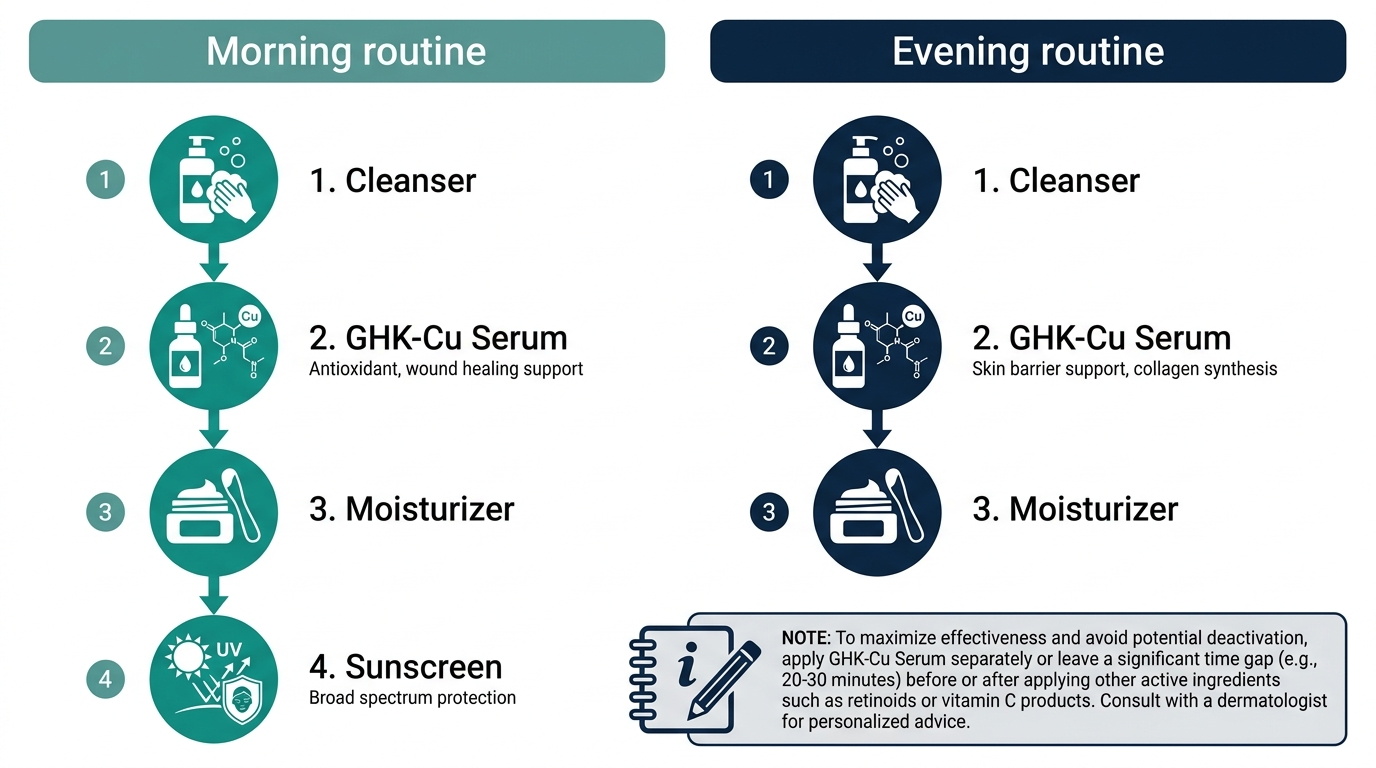
The morning routine is the simpler case. Copper peptides are stable, hydrating, and compatible with nearly every product you would use before sunscreen.
Step-by-step morning application:
- Cleanse with a gentle, pH-balanced cleanser. Copper peptides work best on a clean-canvas skin that is not stripped of its acid mantle.
- Optional: toner or hydrating mist. Apply to still-damp skin. Copper peptides absorb better into lightly hydrated skin than into completely dry skin.
- Apply GHK-Cu serum. Dispense 3 to 5 drops for the face, warm between fingertips, and press gently into skin. Do not rub aggressively; the peptide molecules are fragile enough that mechanical friction matters less than even distribution.
- Wait one to two minutes. This is not optional theater. The copper-peptide complex needs time to adsorb before you cover it with an occlusive layer.
- Hyaluronic acid or niacinamide (optional). Both are fully compatible and extend hydration without competing with the peptide’s mechanism.
- Moisturizer, then SPF 30 or higher. This step matters more than it sounds: unprotected UV exposure degrades collagen faster than any topical active can rebuild it. GHK-Cu is not a substitute for sun protection.
What to avoid in the morning step: direct combination with L-ascorbic acid (pure vitamin C) at the same application. L-ascorbic acid works best at pH 2.5 to 3.5; GHK-Cu is optimally stable closer to neutral pH. Layering them back-to-back in the same step can destabilize both actives. Use vitamin C in the morning if you want, but reserve the GHK-Cu for the evening, or separate them by applying vitamin C first and letting the skin pH normalize (about 15 to 20 minutes) before applying the peptide.
How to use GHK-Cu in an evening routine (the stronger case)
The evening routine is where GHK-Cu does its best work, because the skin’s repair and regeneration cycles are most active during sleep. Collagen synthesis peaks at night, which means applying GHK-Cu in the evening aligns the external signal with the internal timing.
Step-by-step evening application:
- Double cleanse if you wear SPF or makeup. Residue from sunscreen or foundation creates a physical barrier that blocks peptide absorption more than any pH incompatibility.
- GHK-Cu serum on damp skin. Same 3 to 5 drops as the morning step. If your routine includes multiple actives, apply GHK-Cu first, before retinol or other treatments.
- Wait 10 to 15 minutes before retinol (if using). Retinol slightly increases skin permeability. Applying GHK-Cu first lets it absorb cleanly; applying retinol after, on top, allows both to work without one accelerating the irritation potential of the other.
- Barrier moisturizer last. A ceramide-rich or occlusive moisturizer seals the stack and supports the overnight repair that copper peptides are triggering.
The retinol question gets asked constantly, and the answer is more nuanced than the “never mix” crowd suggests. Retinol and GHK-Cu are not chemically incompatible. The concern is purely about irritation potential when skin is already sensitized, and about retinol’s pH affecting peptide stability if they are mixed wet and applied simultaneously. Sequenced correctly (peptide first, wait, retinol after), most skin types tolerate both without issue. If you are new to retinol or have sensitive skin, use them on alternating nights for the first four weeks before combining.
Hydrolyzed type I & III collagen peptides, third-party tested, unflavored.
The layering compatibility table: what works, what does not, and why
Confusion about what can be combined with copper peptides is the number-one reason people abandon serums that are actually working. Here is the honest guide.
| Ingredient | Compatibility | How to layer |
|---|---|---|
| Hyaluronic acid | Excellent | Apply HA first on damp skin, GHK-Cu on top, or vice versa |
| Niacinamide | Excellent | Either order; both are stable at similar pH ranges |
| Ceramides | Excellent | Ceramide moisturizer goes on last as a seal |
| Retinol | Workable with sequencing | GHK-Cu first, wait 10 to 15 minutes, then retinol |
| L-ascorbic acid (pure vit C) | Time-separate | Vitamin C morning, copper peptides evening |
| Vitamin C derivatives (ascorbyl glucoside, MAP) | Generally compatible | Lower pH conflict; can layer if stable |
| AHAs / BHAs | Alternate nights or wait 15-20 min | Acids first, wait for pH normalization, then peptide |
| Benzoyl peroxide | Avoid direct layering | BP oxidizes the copper ion; alternate times or nights |
| High-pH cleansers | Avoid in the same step | Alkaline residue on skin can affect peptide stability |
Personally, the combination I have seen cause the most unnecessary confusion is glycolic acid plus copper peptides used back-to-back. The acid is not “destroying” the peptide in a dramatic sense. It is raising the pH of the acid on your skin, which slightly reduces exfoliation efficiency, while the peptide absorbs into a slightly more permeable barrier, which could increase mild irritation. Neither effect is catastrophic. Both are avoided by a 15-minute gap between steps.
What the evidence actually says about results (the honest timeline)
Do not believe the three-day before-and-after photos. The clinical timeline for copper peptides is longer than the marketing suggests, and the actual evidence is worth understanding before you commit to a routine.
Week 1 to 2: Most users notice improved hydration and a subtle increase in skin plumpness. This is primarily the hyaluronic acid co-formulated with the GHK-Cu serum, not the peptide itself at work. Real peptide effects take longer to accumulate.
Week 4 to 6: The first measurable changes in skin texture and fine line depth begin to appear. This is supported by a 12-week split-face trial (n = 60, aged 40 to 65) comparing 0.05% GHK-Cu serum to placebo, which showed a 22% increase in skin firmness and a 16% reduction in fine lines by week 12. The changes were measurable instrumentally (cutometer and profilometry) but not dramatic in photographs at 4 weeks.
Week 8 to 12: The landmark 71-woman facial cream trial (Cosmetic Dermatology, cited in multiple meta-analyses) documented increases in skin density and thickness after three months of twice-daily use, alongside reductions in fine lines and improvements in overall photodamage appearance. A separate 41-woman eye cream trial showed similar improvements at the periocular area over the same period.
The hair growth data is intriguing but requires calibration. Copper peptides for the scalp have been compared to 2% minoxidil in some studies, with favorable outcomes for hair density and shedding reduction. One trial reported a 40% reduction in hair shedding with consistent scalp application over 12 weeks. The mechanism is plausible: GHK-Cu appears to extend the anagen (growth) phase, reduce follicle inflammation, and support dermal papilla cell signaling. The honest caveat is that most of this data comes from manufacturer-sponsored small trials, not large independent RCTs. GHK-Cu for scalp is promising, not proven at minoxidil’s evidence level.
The 50-year research trail that gives copper peptides credibility is mostly wound-healing and fibroblast data. The skin-aging evidence is real but thinner than the marketing suggests. That does not mean it does not work. It means the benefit is real but incremental, not transformative.
The gene expression story most articles skip
Here is the depth that differentiates GHK-Cu from virtually every other peptide in cosmetic science. In a 2018 analysis using the Broad Institute’s Connectivity Map database, Pickart, Vasquez-Soltero, and Margolina showed that GHK-Cu modulates the expression of approximately 4,000 human genes, representing 31.2% of the human genome, at a threshold of 50% or greater expression change. Of those, 59% were upregulated and 41% were suppressed.
The functional categories are not just skin-deep. GHK-Cu upregulates 41 ubiquitin-proteasome system genes (the cellular “garbage collection” pathway that clears damaged proteins), suppresses 70% of genes overexpressed in metastatic cancer patients in gene profiling studies, and reverses gene expression patterns associated with COPD. The top single upregulated gene, OPRM1, showed a 1,294% expression change.
This is not a collagen serum story. It is a broad biological signaling story, and the cosmetic application is just the tip of it. Whether topical application drives these gene changes in living skin at cosmetic concentrations is a genuinely open question. The gene-expression data comes from cell culture models at doses that may not translate exactly to the concentration on your face. But the breadth of the biological signal is why GHK-Cu attracted medical interest far beyond anti-aging skincare, including wound healing devices that have been incorporated into FDA-cleared wound care products.
Myth: copper peptides and retinol “cancel each other out”
This is one of the more persistent myths in the skincare community, and it is not true in the way it is usually stated.
The origin of the myth appears to be confusion between two different claims. First, that acidic formulations can destabilize peptide bonds chemically. Second, that retinol and copper peptides “compete” for the same repair pathways and one will undo the other’s work. Neither holds up.
Copper peptide bonds are not easily broken at the pH levels produced by leave-on retinol formulations. The “competition” framing is even weaker: GHK-Cu stimulates collagen synthesis and reduces degradation while retinol speeds cell turnover and increases dermal collagen deposition through different pathways (primarily retinoic acid receptor signaling). These mechanisms are additive, not opposing. A 2023 review article from Drip Hydration cited the combination as likely synergistic for mature skin, with the caution around irritation rather than efficacy cancellation.
The real rule is simpler: do not mix any two actives wet in the same palm and apply them simultaneously. Sequence them, give skin time between steps, and the “cancel” problem largely disappears.
Copper peptides and the injectable question: what the 2026 regulatory shift actually means
If you have been reading about GHK-Cu online, you have almost certainly encountered the injectable form alongside the topical serum, and the regulatory picture changed in early 2026 in ways worth understanding.
In late 2023, the FDA placed injectable GHK-Cu on its 503A Category 2 bulk substances list, effectively restricting compounding pharmacies from manufacturing it. On April 15, 2026, the FDA confirmed removal of injectable GHK-Cu from Category 2, based on a decision that the original nomination was withdrawn. The practical effect: licensed 503A compounding pharmacies and 503B outsourcing facilities will again be permitted to compound injectable GHK-Cu once FDA advisory guidance finalizes, expected before the end of 2026.
This matters for one reason: the injectable GHK-Cu route is moving toward a legitimate channel. The PCAC advisory panel reviewing this and related peptides (BPC-157, TB-500, CJC-1295, and others) is expected to meet before the end of February 2027. The grey-market “research use only” injectable vials that currently dominate the search results for “buy GHK-Cu injection” are a different risk class entirely: no pharmacy oversight, no purity guarantee tied to a named compounding facility, and a label that transfers all legal and safety risk to you.
Do not believe anyone who conflates the two. Topical GHK-Cu serum and “research use only” injectable GHK-Cu are not the same product at different delivery speeds. They are two different risk decisions. For the vast majority of people whose goal is better skin or healthier hair, the topical form has the evidence base, the safety profile, and the regulatory clean bill of health. The injectable form, even as the regulatory path opens, will require a physician’s prescription and a named pharmacy. That is the correct route if clinical use is your goal.
Who should use GHK-Cu (and who can skip it)
GHK-Cu is not for every skin concern, and understanding where it genuinely fits saves you money and routine complexity.
Good candidates:
– Skin in the 35 to 65 age range showing early to moderate signs of collagen loss: fine lines, reduced firmness, dull texture
– Post-procedure recovery (microneedling, laser resurfacing, chemical peels): copper peptides are used by some clinicians precisely because GHK-Cu appears to accelerate wound resolution and reduce post-inflammatory redness
– Anyone using retinol long-term who wants to add a collagen-synthesis signal without adding irritation potential
– Scalp thinning in earlier stages, where follicles are still present but underperforming
Situations where GHK-Cu is the wrong tool:
– Active acne (benzoyl peroxide is incompatible with the copper ion, and most copper-peptide formulations are not designed for acne-prone skin)
– Skin that is currently irritated, compromised, or in active barrier disruption: copper peptides support repair but work better as a preventive and recovery aid than as an acute treatment
– Anyone expecting rapid visible transformation: this is a 12-week minimum ingredient, not a week-one reveal
The copper overload myth is worth addressing: some people worry that applying copper topically raises systemic copper levels. Topical absorption of copper through intact skin is minimal. The concentration in a 1% GHK-Cu serum is orders of magnitude below what would be required for any systemic effect. This concern applies to internal copper supplementation, not cosmetic serums.
Curious what your own levels look like?
Baseline 100+ biomarkers today and retest as life changes, all in one membership with physician review.
Frequently asked questions
How long does it take for GHK-Cu to work?
The first measurable skin changes (firmness, texture) appear at four to six weeks in most clinical studies. The most cited trial, which used a 0.05% concentration in 60 women aged 40 to 65, showed a 22% increase in skin firmness and a 16% reduction in fine line depth at 12 weeks, compared to placebo. Expect gradual, incremental improvement, not a sudden transformation.
Can I use GHK-Cu every day?
Yes. Twice-daily use is the protocol used in most clinical trials and is generally well-tolerated. If you are new to copper peptides and have sensitive skin, start with once daily in the evening for two weeks before moving to morning and evening.
Can I use GHK-Cu with vitamin C?
Yes, but separate them by time of day. L-ascorbic acid (pure vitamin C) works at a low pH that can interfere with copper-peptide stability. Use vitamin C in the morning and GHK-Cu in the evening, or vice versa. Vitamin C derivatives (ascorbyl glucoside, magnesium ascorbyl phosphate) have a less aggressive pH profile and can be layered more flexibly.
What is the best concentration of GHK-Cu to look for?
The clinically supported range is 0.05% to 2%. Most high-quality serums sit between 0.1% and 1%. The 3% GHK VIP Luxury Serum from Skin Biology (founded by Pickart himself) sits at the upper end of the tested cosmetic range. Avoid very high-concentration products that skip disclosing the percentage, and remember the biphasic effect: more is not always better.
Can GHK-Cu help with hair loss?
There is credible mechanistic and small-trial evidence supporting GHK-Cu for scalp application. Studies have reported 40% reductions in shedding and improved hair density over 12 weeks. The mechanism (extending the anagen phase, reducing scalp inflammation, supporting dermal papilla cells) is well-supported. The evidence is not at the level of minoxidil’s large-scale RCT body, but the safety profile is considerably better. Scalp serums should be applied directly to the scalp, not to the hair shaft, and massaged in gently.
Is GHK-Cu safe during pregnancy?
Topical copper-peptide serums have not been specifically studied in pregnancy. Because the systemic copper absorption from intact-skin application is very low, most dermatologists consider topical use low-risk, but the standard advice applies: check with your OB or midwife before adding new actives during pregnancy or breastfeeding.
Does GHK-Cu need to be refrigerated?
Most commercial serums do not require refrigeration, but they should be stored away from direct sunlight and heat. The copper-peptide complex is more stable at neutral pH and is sensitive to UV degradation. Opaque or amber packaging matters. Once opened, use within 6 to 12 months.
Author: Vital Signs Today Editorial Team. Educational content, not medical advice. Sources linked inline.
Hydrolyzed type I & III collagen peptides, third-party tested, unflavored.
Primary sources:
– Pickart, Vasquez-Soltero, Margolina (2018). “GHK-Cu Peptide: Regenerative and Protective Actions.” PMC6073405
– Innerbody GHK-Cu Peptide Guide 2026
– Asterwood Copper Peptides Guide 2026
– PeptIQ: FDA Category 2 Removal for GHK-Cu (April 2026)
– Evenskyn: GHK-Cu 50-Year Research Trail
– Glimmer Goddess: How to Layer Copper Peptides
– Spartan Peptides: GHK-Cu Research Results 2026
– Hairgenetix: Copper Peptides for Hair Growth
– Drip Hydration: GHK-Cu and Retinol in Skin Care
– Skin Biology (Dr. Pickart’s original brand)
Related reading
Vital Signs Today may earn a commission if you buy through links on this page. It does not affect our editorial assessments.