
Educational content, not medical advice. Collagen peptides are dietary supplements, not FDA-approved treatments. Consult a licensed clinician before starting any supplement regimen, especially if you have a medical condition.
Short answer: Take 2 scoops (20 g) of Vital Proteins Collagen Peptides once daily mixed into any hot or cold liquid. For joint and tendon support, research from Shaw et al. shows the best window is 30 to 60 minutes before exercise, taken alongside 48 mg of vitamin C. For skin benefits, a consistent 5 to 10 g daily for at least 8 to 12 weeks is what the randomized trials used.
Vital Proteins timing matters for joints, but your bloodwork tells you if it’s actually working. Want to check? One at-home Superpower draw checks 100+ biomarkers, physician-reviewed.
Most people buy Vital Proteins, shake it into a glass of cold water, and wonder after three weeks why they have not noticed anything. The problem is rarely the product. It is almost always the protocol: wrong dose, wrong timing, or wrong pairing. This guide covers what the research actually prescribes, what Vital Proteins’ own label instructions leave out, and how to build the habit that makes the difference.
Full-body lab membership: 100+ biomarkers, doctor-reviewed, tracked over time.
What exactly is in the Vital Proteins Collagen Peptides canister?
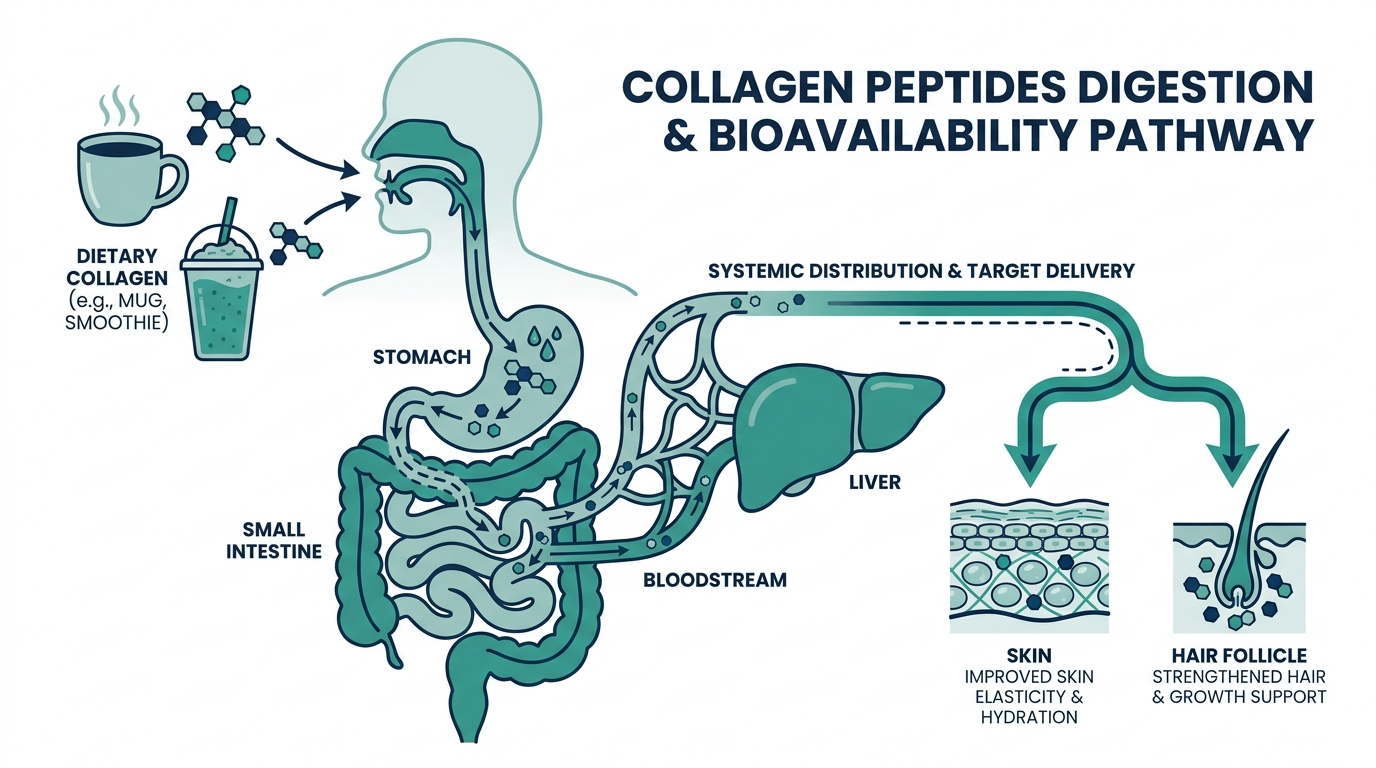
Before getting into how to take it, you need to understand what you are taking, because the label hides a meaningful distinction.
The standard Vital Proteins Collagen Peptides (the classic white canister) contains only one ingredient: bovine hide collagen peptides, sourced from grass-fed, pasture-raised cattle. That is the bare-bones version, and it is the one most people picture. Each 20 g serving delivers 18 g of protein and roughly 70 calories, with zero grams of fat or carbohydrates worth noting.
The Advanced formula (the version with the teal accent and “Advanced” in the name) adds two co-factors: hyaluronic acid (sodium hyaluronate) and vitamin C (ascorbic acid). Hyaluronic acid is a humectant that binds water in connective tissue; vitamin C is a required cofactor for prolyl hydroxylation, which is the enzymatic step that crosslinks collagen fibers into their triple-helix structure. The Advanced canister comes in a 9.33 oz (13 servings, $29.99) and a 20 oz (28 servings, $49.99) size, which works out to roughly $1.64 to $2.30 per serving depending on whether you subscribe.
One thing Vital Proteins does not prominently advertise: collagen is an incomplete protein. It lacks tryptophan, one of the nine essential amino acids. That does not make it useless, it makes it targeted. Do not count your collagen scoop toward your daily protein needs the same way you would count whey.
How many scoops is one serving?
The serving size on every Vital Proteins Collagen Peptides canister is 20 grams, which equals 2 scoops or roughly 2 tablespoons. The Vital Proteins stainless steel scoop is calibrated to 1 tablespoon, which equals approximately 10 g of powder.
Here is the breakdown by goal, based on where the research draws the dose lines:
| Goal | Daily dose | Vital Proteins equivalent | Duration to first signal |
|---|---|---|---|
| Skin hydration, elasticity | 5 to 10 g | 1 to 2 scoops | 8 weeks minimum |
| Joint comfort (active adults) | 5 to 10 g | 1 to 2 scoops | 12 weeks minimum |
| Collagen synthesis before exercise | 15 g | 3 scoops (half serving more) | Acute; cumulative over months |
| Tendon repair protocol | 5 g twice daily | 1 scoop morning, 1 scoop evening | 3 months |
| General daily habit | 20 g | 2 scoops (full serving) | Ongoing |
The full 2-scoop serving is a reasonable default. Dropping to 1 scoop is not a waste, especially if you are supplementing an already high-protein diet; some skin-hydration trials showed significant improvements at 2.5 g, and the most widely cited dose-response data for skin shows meaningful improvement at 5 to 10 g daily.
Do not believe the framing that “more is always better” here. Collagen is not like creatine, where saturation loading changes the calculus. The body’s collagen synthesis machinery has rate limits set by enzyme availability and vitamin C status, not by how many scoops you pour.
Does timing actually matter?
Yes, but only for one specific use case. Let me separate the real signal from the marketing noise.
For skin and general wellness goals, timing is largely irrelevant. Vital Proteins says as much on their own blog: “there is really no proven time of day that is ‘best’ for taking collagen; what matters most is consistency and preference.” Morning coffee, evening smoothie, lunchtime soup, all are equivalent for these goals. The research on skin trials does not even specify a time window; it measures 8 to 12 week cumulative results.
For joint and tendon collagen synthesis, pre-exercise timing is the meaningful window. This is the finding that separates collagen peptides from most other protein supplements in terms of how you use them.
Shaw et al. (2017) found that consuming 15 g of gelatin-derived collagen enriched with 48 mg of vitamin C approximately 60 minutes before a bout of mechanical loading (6 minutes of jump rope in their protocol) produced a 153% increase in collagen synthesis markers from baseline, far outperforming both 5 g and placebo. Blood levels of the key amino acids glycine and proline peaked at about 60 minutes post-ingestion, which is why the timing is not arbitrary; you want those amino acids circulating when the tendon or joint is being stressed and mechanically stimulated.
Practically, this means: if your goal is tendon health or joint recovery, take 2 to 3 scoops of collagen with a vitamin C source (a glass of orange juice, a kiwi, or 48 mg ascorbic acid separately) about an hour before your workout, not after.
For post-workout recovery from soreness: a 2023 double-blind crossover clinical trial found that collagen peptides significantly reduced exercise-induced muscle soreness in healthy middle-aged males when taken consistently. This effect was not timing-dependent in the way tendon collagen synthesis is; it accumulated over the supplementation period.
How do you mix it without clumps?
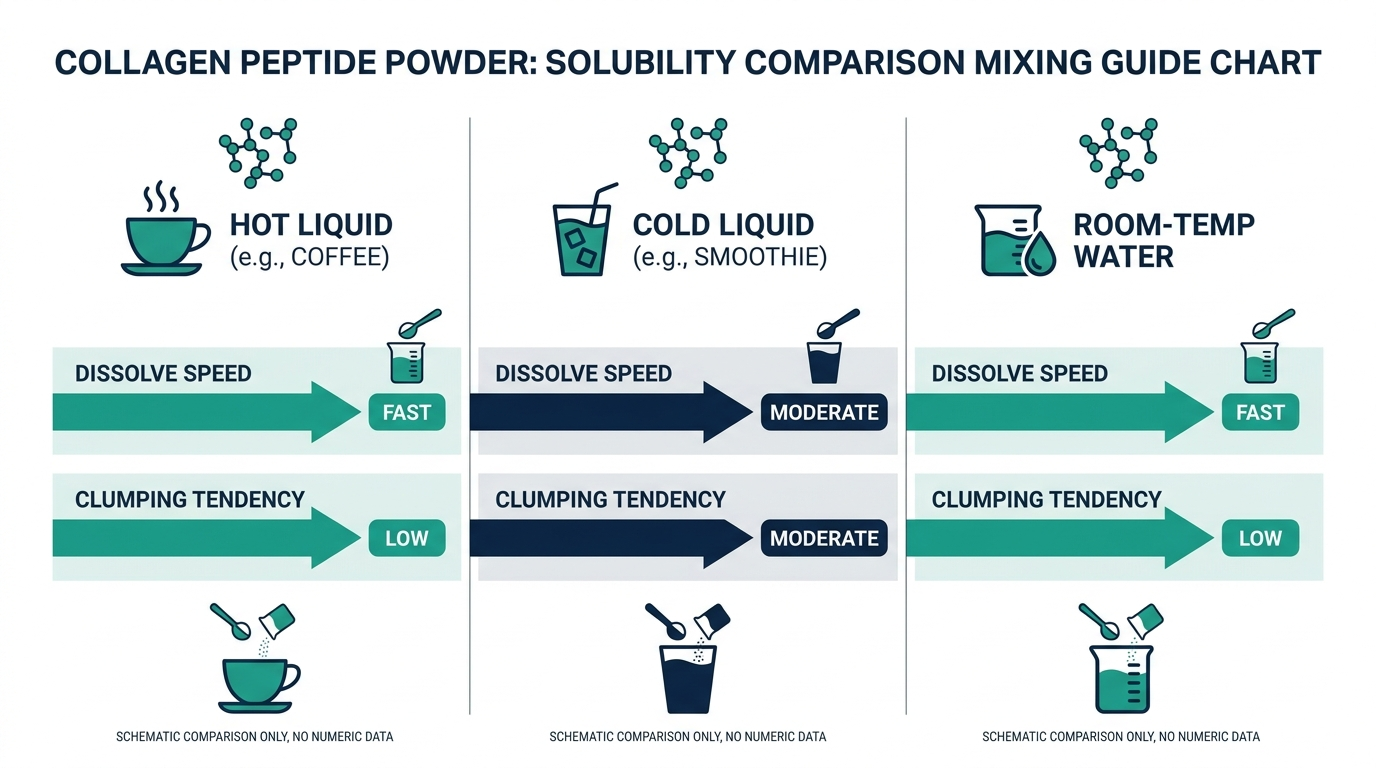
Vital Proteins Collagen Peptides dissolves well in hot liquids by design because the hydrolysis process has already broken the collagen chains into short fragments (molecular weight under 5,000 Da). But cold-liquid mixing is where the complaints live, and the fix is simple.
Vital Proteins’ own advice: start by filling your glass one-third of the way with lukewarm water, add the powder and stir or swirl until dissolved, then top off with cold liquid or ice. The warm water step dissolves the powder before the cold temperature can cause it to seize up into clumps.
Specific mixing scenarios:
- Hot coffee or tea: Stir in the powder after pouring. One to two stirs is usually enough. The unflavored version has no taste in coffee; a BarBend tester reviewing the product in 2026 noted “one or two stirs and it’s completely dissolved” in hot liquid.
- Smoothie: Add the powder with the other ingredients and blend normally. No special order needed.
- Cold water or juice: Follow the lukewarm-first method above. The unflavored version can leave visible floaters in plain cold water, which bothers some people aesthetically but does not affect the collagen itself.
- Oatmeal or yogurt: Stir in after cooking or while warm. Collagen does not change the flavor of savory or sweet foods in any significant way at a 20 g dose.
- Soup or broth: Stir in while the liquid is hot. This is actually the oldest delivery method; bone broth is essentially collagen in a savory format.
Personally, the most reliable way to build the habit is to attach it to a drink you already make every single morning, not to set up a separate collagen ritual. The compliance data from supplement trials is fairly brutal: people who try to take something “at the right moment” skip more often than people who add it to an existing daily anchor.
What does the research say about how well it actually works?
This is where honesty matters, because the marketing and the science are not always telling the same story.
Skin health: real evidence, with a caveat. A 2019 randomized, placebo-controlled trial found that 2.5 g of collagen peptides daily significantly improved skin hydration, elasticity, roughness, and density over 12 weeks. A 2024 clinical trial in Frontiers in Nutrition confirmed that significant amounts of collagen-derived peptides, specifically Hyp-Gly and Pro-Hyp dipeptides, do reach the bloodstream intact after oral ingestion, which addresses the earlier skeptical argument that digestion destroys any meaningful peptide structure before absorption.
The caveat: a 2025 meta-analysis of 23 RCTs found that when you strip out industry-funded trials, the skin elasticity evidence is weaker. Bubs Naturals summarizes it clearly: higher-quality, independent trials show modest benefits, not dramatic transformations. Set expectations accordingly.
Joint and tendon: the strongest, most consistent evidence. A 2021 systematic review in PMC (Frontiers) found consistent evidence across multiple trials that collagen peptides reduce activity-related joint pain. A specific 12-week trial with 180 active adults aged 18 to 30 found that 5 g per day produced a statistically significant reduction in knee pain during exercise. A 2025 RCT in Frontiers in Nutrition specifically examining low-molecular-weight collagen peptides in knee osteoarthritis found significant pain reduction and functional improvement compared to placebo.
Muscle building: do not count on it alone. Collagen lacks tryptophan and is low in leucine, the amino acid that most potently triggers muscle protein synthesis. Research directly comparing whey protein to collagen for muscle thickness after 10 weeks of resistance training showed greater gains in the whey group. Collagen’s strength is connective tissue, not lean mass accrual. Use it alongside, not instead of, a complete protein source.
Hydrolyzed type I & III collagen peptides, third-party tested, unflavored.
How long before you feel anything?
The honest answer most brands avoid: longer than you think, and it depends heavily on which goal you are chasing.
Skin hydration can show measurable improvement in as little as 4 to 8 weeks of consistent supplementation at 5 to 10 g per day. You will likely notice it as skin that feels less tight after washing, not as a dramatic visible change in the mirror.
Joint discomfort reduction, the most robust signal in the literature, typically becomes noticeable in 8 to 12 weeks. The underlying mechanism, a gradual increase in the collagen density of cartilage and tendons, is slow biological remodeling, not a fast anti-inflammatory effect.
If you stop after three weeks because “nothing happened,” you have not given the mechanism a fair test. The clinical trials that show results run for 12 weeks minimum. Patience is not optional here; it is the actual protocol.
What should you pair it with?
The research-backed pairings, ranked by quality of evidence:
Vitamin C: highest evidence, lowest friction. Vitamin C is required for the enzyme prolyl hydroxylase to function, and this enzyme is what gives collagen fibers their structural stability. Without adequate vitamin C, the collagen triple-helix cannot form correctly. The Shaw protocol used a modest 48 mg per dose, which is well below the 90 mg daily RDA and is easily met by a small glass of orange juice or a kiwi fruit.
The Vital Proteins Advanced formula includes vitamin C in the formula itself, so if you choose that version, you have the pairing built in.
Exercise/mechanical loading: required for tendon-specific benefits. The collagen synthesis signal shown in pre-exercise timing research is specifically triggered by mechanical loading of the tissue. The amino acid spike from collagen ingestion provides the substrate; the physical stress provides the stimulus. One without the other produces a smaller response. This is why a tendon recovery protocol always combines collagen with eccentric loading exercises, not just supplementation.
Zinc and copper: supporting actors. These trace minerals support collagen crosslinking enzymes. Most people with reasonably varied diets are not deficient, but it is worth knowing if you are optimizing for connective tissue synthesis across the board.
What does not need pairing: meals. Despite the occasional claim that an empty stomach improves collagen absorption, Vital Proteins explicitly states there is no strong evidence that fasting timing makes a significant difference. Take it with or without food based on what you will actually remember to do consistently.
Is there anyone who should not take it?
Vital Proteins Collagen Peptides is sourced from bovine hide, so it is not appropriate for:
- Vegans and vegetarians (no plant-derived collagen equivalent exists; marine collagen from fish is an option for pescatarians)
- Anyone with a known beef allergy
- Individuals keeping halal or kosher who need certifications their specific canister may not carry
It is a dietary supplement, not a drug, so it is regulated under DSHEA rather than FDA drug approval pathways. That means no pre-market efficacy review from the FDA. Vital Proteins is third-party tested, which earns it a higher trust mark than most, but the “supplement, not drug” status is worth understanding if you are managing a medical condition.
One under-discussed practical limit: collagen powder can develop a faint odor if exposed to humidity or stored in a hot cabinet. Keep it in a cool, dry place with the lid sealed. The canister redesign Vital Proteins rolled out in 2026, moving to 90% less plastic with FSC-certified paperboard, is better for sustainability but slightly more susceptible to moisture infiltration if the lid seal is damaged.
Curious what your own levels look like?
Baseline 100+ biomarkers today and retest as life changes, all in one membership with physician review.
Frequently Asked Questions
How many scoops of Vital Proteins Collagen Peptides should I take?
The standard serving is 2 scoops (20 g) once daily. Clinical skin and joint trials have shown benefits at 5 to 10 g per day, so 1 scoop is not wasted effort. For pre-exercise collagen synthesis, the Shaw et al. protocol uses 15 g (3 scoops), taken 60 minutes before activity with a vitamin C source.
Can I take Vital Proteins Collagen Peptides twice a day?
Yes. Some tendon-recovery clinical protocols split the dose into 2.5 g twice daily. If your goal is maximizing the pre-exercise synthesis window, a pre-workout dose plus an evening dose is reasonable and consistent with published protocols. Nothing in the safety literature suggests twice-daily use is a problem.
What is the best liquid to mix Vital Proteins collagen peptides in?
Hot coffee, tea, or broth dissolves it fastest. For cold liquids, pre-dissolve in one-third lukewarm water before topping off with cold liquid or ice. The unflavored formula is genuinely tasteless in coffee and most flavored beverages; the only complaints come from mixing it in plain cold water, where it can produce visible floaters.
Does Vital Proteins Collagen Peptides dissolve in cold water?
It does, but not as cleanly as in hot liquid. Use the lukewarm pre-dissolve step described above, and any visible clumping disappears. Do not add the powder directly to an ice-filled glass.
Can I cook with Vital Proteins Collagen Peptides?
Yes. Hydrolyzed collagen peptides are heat stable, unlike gelatin, which gels when cooled. You can stir it into oatmeal, soups, stews, baked goods, or pancake batter without affecting texture or losing meaningful bioactivity. Avoid boiling the solution for extended periods, but normal cooking temperatures are fine.
How long does it take for Vital Proteins Collagen Peptides to work?
Skin hydration changes can appear in 4 to 8 weeks at 5 to 10 g per day. Joint discomfort improvements are typically reported at 8 to 12 weeks with consistent use. Most clinical trials run 12 weeks, which is a fair benchmark for deciding whether it is working for you.
Does it matter if I take collagen before or after a workout?
For tendon and connective tissue goals, pre-exercise timing (30 to 60 minutes before) paired with vitamin C is supported by research showing significantly higher collagen synthesis compared to post-workout dosing. For general skin and gut health goals, the timing relative to exercise does not appear to matter.
Author: Vital Signs Today Editorial Team, [credential]”]. Educational content, not medical advice. Sources linked inline.
Hydrolyzed type I & III collagen peptides, third-party tested, unflavored.
Primary sources:
- Vital Proteins product page: https://www.vitalproteins.com/products/collagen-peptides
- Vital Proteins Advanced formula: https://www.vitalproteins.com/products/vp-collagen-peptides
- Vital Proteins serving size and how many servings: https://www.vitalproteins.com/blogs/stay-vital/how-many-collagen-servings
- Vital Proteins timing blog: https://www.vitalproteins.com/blogs/stay-vital/when-should-i-take-collagen
- Vital Proteins anti-clumping mixing guide: https://www.vitalproteins.com/blogs/stay-vital/prevent-collagen-clumping
- Shaw et al. collagen + vitamin C pre-exercise RCT (ClinicalTrials.gov NCT03293004): https://clinicaltrials.gov/study/NCT03293004
- PMC systematic review, collagen peptides body composition and joint recovery (2021): https://pmc.ncbi.nlm.nih.gov/articles/PMC8521576/
- PMC collagen skin hydration, elasticity, density RCT (2019): https://www.ncbi.nlm.nih.gov/pmc/articles/PMC6835901/
- PMC oral collagen skin hydration and wrinkling RCT (2018): https://www.ncbi.nlm.nih.gov/pmc/articles/PMC6073484/
- Frontiers in Nutrition, collagen hydrolysate absorption RCT (2024): https://www.frontiersin.org/journals/nutrition/articles/10.3389/fnut.2024.1416643/full
- Frontiers in Nutrition, collagen peptides knee osteoarthritis RCT (2025): https://www.frontiersin.org/journals/nutrition/articles/10.3389/fnut.2025.1644899/full
- PMC exercise-induced muscle soreness and collagen peptides (2023): https://www.ncbi.nlm.nih.gov/pmc/articles/PMC10158542/
- ACSH collagen vs. whey protein analysis (March 2026): https://www.acsh.org/news/2026/03/23/collagen-vs-whey-marketing-hype-or-scientific-reality-50020
- BarBend Vital Proteins Collagen Peptides review (2026): https://barbend.com/vital-proteins-collagen-peptides-review/
Related reading
Vital Signs Today may earn a commission if you buy through links on this page. It does not affect our editorial assessments.