
Last updated 18 June 2026. Educational content, not medical advice. Sermorelin is a prescription compound in the United States; it requires a licensed prescriber and a compounding pharmacy. Talk to a qualified clinician before starting any peptide therapy.
Short answer: The only legitimate way to buy sermorelin peptide in 2026 is through a licensed telehealth clinic or in-person hormone clinic with a real prescription, filled by a PCAB- or 503A-accredited compounding pharmacy. Reputable telehealth programs run $175 to $225 a month, including medication, supplies, and physician oversight, versus $500 to $3,000 or more monthly for synthetic HGH. Grey-market “research” vials of sermorelin exist, but unlike BPC-157 or TB-500, sermorelin has never had a research-use lane to hide behind, and buying it from an unlicensed vendor is both legally and medically riskier than buyers usually realize.
Buying sermorelin legitimately means finding a real prescriber, and that process goes faster with your bloodwork in hand. One at-home Superpower draw checks 100+ biomarkers, physician-reviewed.
Why are so many people searching for sermorelin right now?
Growth hormone naturally declines roughly 14 to 15 percent per decade after age 30. By the time most people are in their mid-40s, that cumulative drop shows up as disrupted slow-wave sleep, slowing recovery from exercise, gradual fat accumulation around the midsection, and skin changes they can no longer entirely attribute to stress.
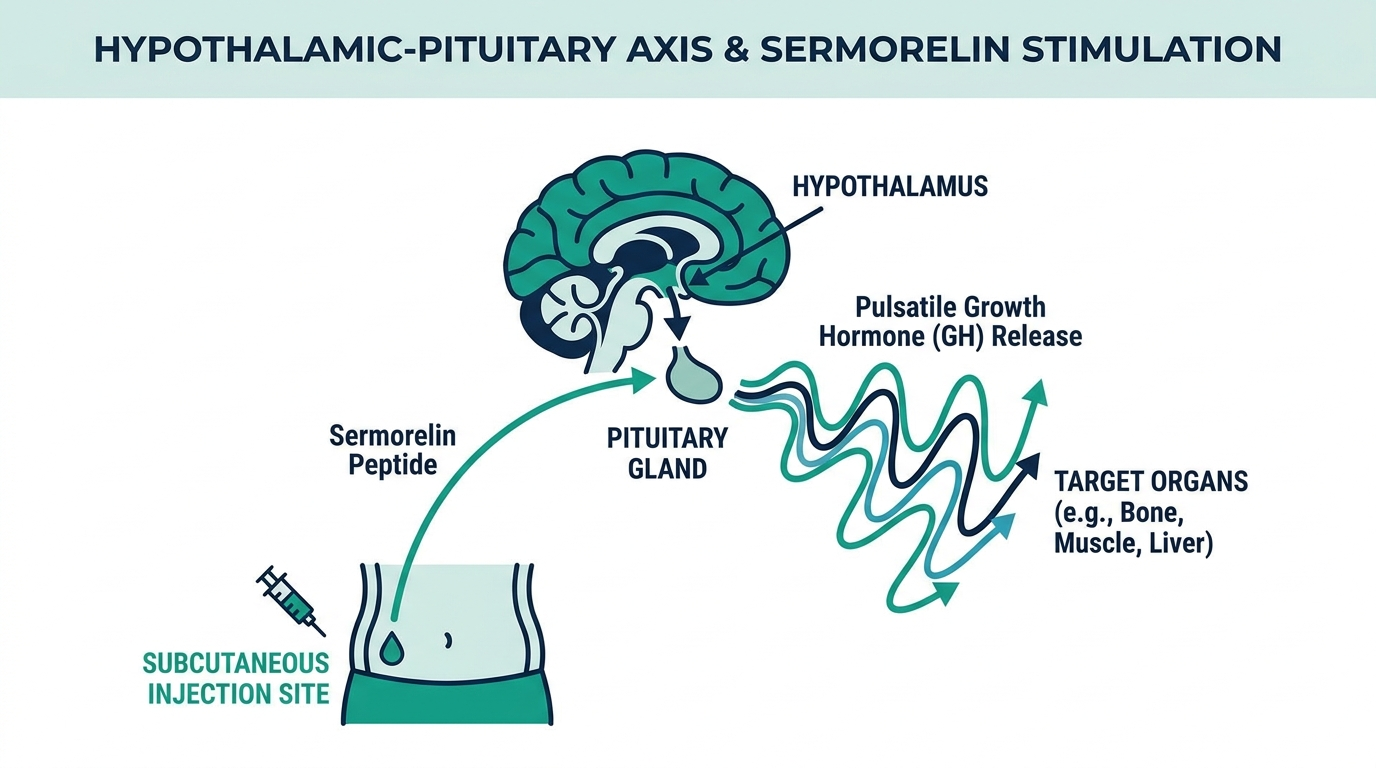
Sermorelin is a 29-amino-acid synthetic analogue of growth hormone-releasing hormone (GHRH). Unlike synthetic HGH injections, which put exogenous growth hormone directly into circulation, sermorelin stimulates the pituitary gland to release its own growth hormone in pulses that follow the body’s natural rhythm. That distinction matters for two reasons. First, your own pituitary acts as a safety valve, dampening output if levels climb too high. Second, the pituitary can only release what it has, so people with severely depleted GH reserve respond less dramatically than those with a functioning but underperforming axis.
Interest has also been pushed by the 2025 to 2026 FDA enforcement wave that swept dozens of grey-market peptide vendors offline, including Peptide Sciences and Science.bio, both of which closed in early 2026. With the chaotic grey market thinning out, more buyers are asking which legitimate channels actually exist. The answer for sermorelin is simpler than for most peptides: the clinical route is essentially the only route.
Full-body lab membership: 100+ biomarkers, doctor-reviewed, tracked over time.
Is sermorelin legal to buy in the United States?
Yes, with one non-negotiable requirement: a valid prescription from a licensed physician, nurse practitioner, or physician assistant.
The brand-name product Geref (sermorelin acetate) was voluntarily discontinued in the US market in 2008 for commercial rather than safety reasons. The FDA formally confirmed that in 2013. Sermorelin is not on the FDA’s 503A Category 2 list of substances that “may present significant safety risks,” unlike BPC-157 before April 2026. It is not a controlled substance. Under Section 503A of the federal Food, Drug, and Cosmetic Act, licensed state pharmacies can compound patient-specific sermorelin preparations from bulk substance with a valid prescription. Under 503B, FDA-registered outsourcing facilities can prepare batches for prescribers without a patient-specific order.
The 2026 regulatory update most buyers have not heard about: in January 2026, the FDA issued guidance requiring 503B prescribers to submit written attestation of medical necessity before those outsourcing facilities can compound sermorelin, specifically documenting that FDA-approved alternatives (tesamorelin for HIV lipodystrophy, somatropin for growth hormone deficiency) were clinically inappropriate or inaccessible for that patient (FDA bulk drug substances list). State pharmacy boards in California, Texas, Florida, and New York began enforcing this in March 2026.
For most patients buying through telehealth, this changes nothing visible: the clinician handles the paperwork. But it is why you sometimes see checkout workflows at legitimate platforms ask a few more intake questions in 2026 than they did in 2024. The extra friction is the compliance process working correctly.
The short version: sermorelin is legal, prescription-required, and compounded. There is no over-the-counter version that is legitimate.
Where to buy sermorelin peptide: the three real options
Option 1: Telehealth hormone clinics (the mainstream route)
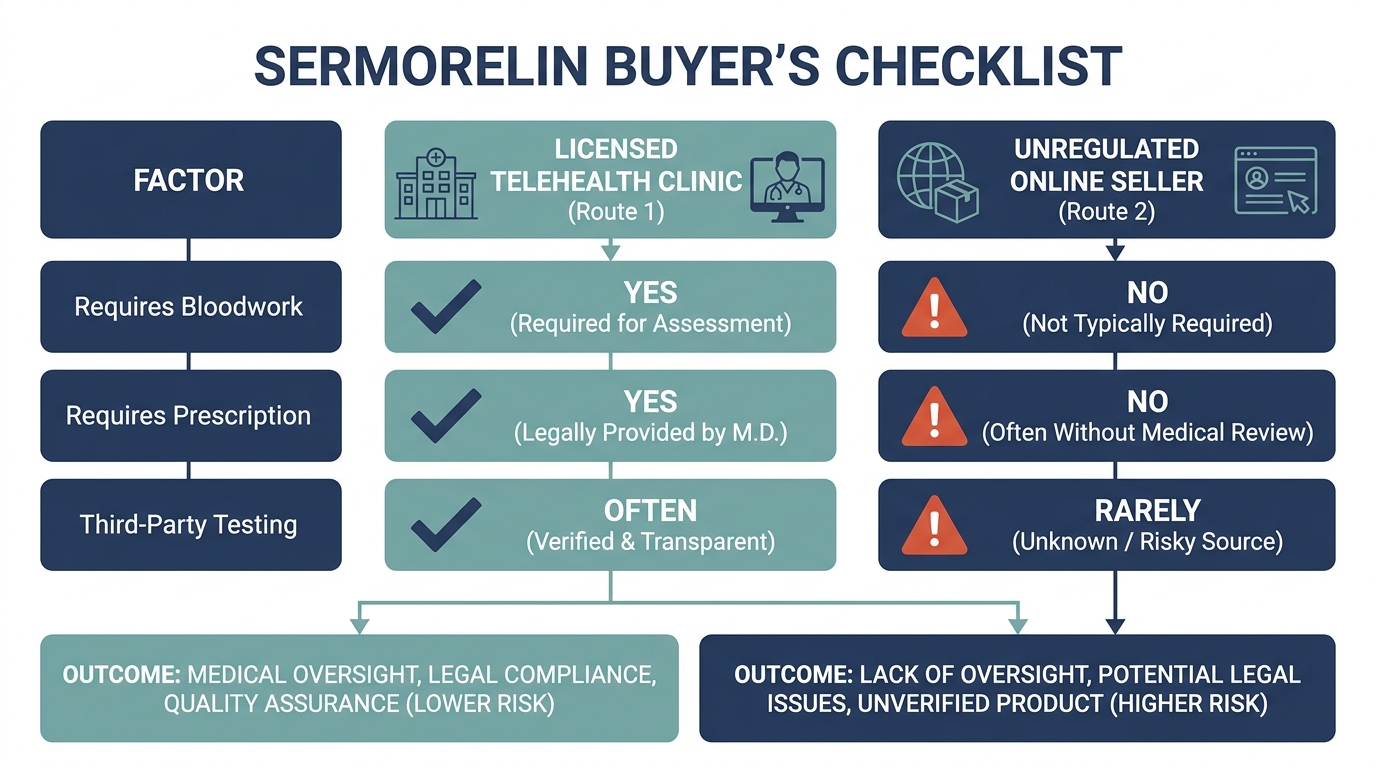
This is where the majority of sermorelin prescriptions are filled, and the category has matured considerably. A legitimate telehealth provider does an intake consultation (usually video or async questionnaire), requires baseline labs before issuing a prescription, connects the patient to a named 503A pharmacy, and provides follow-up monitoring with dose adjustments triggered by IGF-1 retesting.
Named platforms operating in 2026 include:
- Ivy Rx: Monthly subscription runs $225, quarterly option $195/month, six-month plan $175/month. Medication, syringes, and alcohol swabs included. Board-certified physician oversight, unlimited follow-ups via patient portal, medication from FDA-registered pharmacies (IvyRx).
- Defy Medical: Sermorelin is available within broader hormone protocols. Comprehensive HGH peptide protocols including sermorelin range $400 to $650/month, reflecting their more intensive monitoring model and in-house endocrinology team (VirtualCareFinder on Defy Medical).
- Marek Health: $225 to $350/month for full hormone optimization including 65 to 100+ biomarker panels. Prescribes sermorelin for GH stimulation within a supervised protocol (PeptidesExplorer).
- Hone Health: $299/month, includes at-home lab testing.
- Strut Health: Competes on price at $99/month for a basic oral dissolving tablet (ODT) formulation, filled through an ACHC- and PCAB-accredited pharmacy.
The pricing spread reflects real differences in what is bundled. A $99/month plan that ships lozenges is not the same clinical product as a $400/month protocol that includes injection training, quarterly blood draws, and a clinician reviewing your labs.
Option 2: In-person hormone and longevity clinics
Local concierge clinics, men’s health centers, and functional medicine practices also prescribe sermorelin. Pricing runs $200 to $400/month for the medication itself, plus $100 to $300 for the initial consultation, plus any lab fees the clinic does not bundle. The advantage is in-person injection training, which matters more than buyers expect when they are handling a lyophilized vial and insulin syringes for the first time. The disadvantage is geographic: these clinics are concentrated in major metros, and a clinic near you may not have meaningful hormone optimization experience.
Option 3: The grey-market vendor route (and why it is riskier for sermorelin specifically)
Research-grade vendors exist, and some buyers try to source sermorelin this way. The risk profile is higher for sermorelin than for most research peptides, for a reason rarely discussed in forums.
Peptides sold as “research use only” occupy a grey zone because they were never FDA-approved as finished drugs. That legal fiction is thin, but it has historically provided some cover. Sermorelin sits in a different position: it was once an FDA-approved drug. Selling it outside the prescription channel is not occupying a grey zone, it is crossing a clear line. Vendors labeling sermorelin vials as “for research use only, not for human use” are selling a molecule that FDA history makes harder to defend in court than, say, a novel research peptide with no approval history.
Additionally, independent quality testing of compounded peptides across vendors found that nearly 40 percent of sermorelin samples tested below labeled potency, and sterility failure rates ran five times higher than traditional pharmaceutical categories. That figure is for compounded pharmacies under state oversight. For unregulated vendors with no oversight at all, there is no floor.
Personally, I would not buy sermorelin from a research vendor. Not because the forums do not have recommendations for vendors with clean third-party Certificates of Analysis, but because the clinical route for sermorelin is both accessible and comparably affordable, and the grey-market route for this specific molecule removes protections while offering no meaningful advantage.
Telehealth GLP-1 program with provider visits and pharmacy coordination.
What does a legitimate sermorelin prescription actually involve?
Understanding the process removes most of the anxiety that pushes buyers toward grey-market shortcuts.
Step 1: Intake and baseline labs. A legitimate provider collects your medical history, checks for contraindications (active malignancy, diabetic retinopathy, and intracranial hypertension are disqualifiers), and requires baseline labs before issuing a prescription. The minimum panel includes IGF-1, comprehensive metabolic panel, lipid panel, fasting insulin, thyroid panel (TSH, free T3, free T4), and a CBC. Some protocols add cortisol and testosterone. That baseline IGF-1 number matters: patients with a starting IGF-1 below 150 ng/mL typically see 40 to 80 percent increases after 16 to 20 weeks of nightly dosing, while those starting above 200 ng/mL see more modest 10 to 25 percent changes (sermorelin.com on IGF-1).
Step 2: Prescription and pharmacy fulfillment. The prescription goes to a named compounding pharmacy. The two most widely used for sermorelin in 2026 are Empower Pharmacy (Houston-based 503A/503B, PCAB-accredited, tests for potency, sterility, and endotoxins on every batch) and Strive Pharmacy (state-licensed 503A, third-party analytical testing, multiple dosage forms including injection, troche, and nasal spray). Belmar Pharmacy is a third option with significant hormone-compounding history. A pharmacy filling your prescription should be licensable, findable, and able to answer questions about their testing process. If your telehealth provider will not tell you which pharmacy is filling your prescription, that is a problem.
Step 3: Reconstitution and administration. Compounded sermorelin arrives as a lyophilized powder. You reconstitute with bacteriostatic water (included or purchased separately), draw the dose using a U-100 insulin syringe, and inject subcutaneously, typically into the abdomen or thigh, before bed. The before-bed timing is not arbitrary: sermorelin amplifies the largest natural GH pulse, which occurs during slow-wave sleep. Injecting first, then sleeping, is not a protocol detail to skip.
Step 4: Follow-up monitoring. IGF-1 should be retested at 4 to 6 weeks, then quarterly. Dose adjustments track IGF-1 response. A clinician who issues you a prescription and never looks at a follow-up lab is not running a clinical protocol, they are running a subscription business.
Sermorelin vs the alternatives: which GH secretagogue belongs on your radar?
Sermorelin is not the only option in this category, and knowing where it sits relative to the alternatives helps you have a real conversation with a prescriber.
| Peptide | Mechanism | Half-life | Clinical evidence | Monthly cost (telehealth) | Legal status 2026 |
|---|---|---|---|---|---|
| Sermorelin | GHRH analogue, 29 AA | 10-12 min | Formerly FDA-approved drug; well-studied in adults | $175-$225 | Prescription / 503A compounding |
| Tesamorelin | Longer GHRH analogue, trans-3-hexenoic acid stabilized | Longer than sermorelin | FDA-approved for HIV lipodystrophy; ~40x more potent than sermorelin; 15% visceral fat reduction in Phase III trials | $350-$600 | Prescription (FDA-approved indication) |
| CJC-1295 + Ipamorelin | GHRH analogue + GHRP on two separate pathways | Longer pulse duration than sermorelin alone | No standalone RCTs; clinical use extrapolated from component studies | $200-$350 | HHS-signaled for 503A Category 1, pending July 2026 PCAC review |
| Synthetic HGH (somatropin) | Direct GH replacement | N/A (acts via GH receptor) | Extensive; FDA-approved for GH deficiency | $500-$3,000+ | Prescription (brand) |
Three things jump out of that table.
First, tesamorelin is the more potent GHRH option and has a genuine FDA approval, but it is approved specifically for HIV-associated lipodystrophy, not general anti-aging. Using it off-label for body composition is possible but harder to justify medically and noticeably more expensive.
Second, the CJC-1295 / ipamorelin stack is the most popular GH secretagogue protocol in functional medicine clinics as of 2026, because it stimulates two separate pathways and produces a larger GH pulse. But it still lacks RCT evidence specifically for adult longevity, and its HHS reclassification to 503A Category 1 is still pending the July 23 to 24, 2026 Pharmacy Compounding Advisory Committee meeting. For now, it sits in a less settled regulatory position than sermorelin.
Third, sermorelin is the most conservative entry point: the lightest mechanism, the most predictable safety profile, and the most clinical history of any compounded growth hormone secretagogue. For someone new to this category, “start with sermorelin” is defensible medicine, not a compromise.
What does sermorelin actually do? The clinical evidence, not the forum hype
Sermorelin stimulates the anterior pituitary to release growth hormone, which in turn drives IGF-1 production in the liver. IGF-1 is the primary downstream mediator of sermorelin’s effects on tissue.
The documented effects in adults include:
Body composition. A landmark study published in The New England Journal of Medicine found that older men treated with GH secretagogues showed significant increases in lean body mass and decreases in adipose tissue over six months. This is the foundational reference the longevity community cites, though the subjects were specifically GH-deficient men, not healthy adults.
Sleep quality. GH release is tightly coupled to slow-wave sleep. Research published in Sleep Medicine Reviews demonstrates that restoring pulsatile GH secretion improves the depth and architecture of slow-wave sleep, which has downstream effects on recovery and cognition. This is the sermorelin effect most users report first, typically within the first four to six weeks of a bedtime injection protocol.
IGF-1 response. Among PMC-published studies on GH secretagogues, sermorelin is an effective stimulator of GH and IGF-1 levels in elderly men with reduced baseline IGF-1, with effect size dependent on baseline levels (PMC article on GH secretagogues).
Do not believe the claim that sermorelin produces results comparable to synthetic HGH at a fraction of the cost. Sermorelin stimulates the pituitary to produce more of what it already makes. If the pituitary reserve is substantially depleted, as is common in late-stage GH deficiency, sermorelin has less to work with. Patients with severe GH deficiency, documented by stimulation testing, are better candidates for direct somatropin replacement. Sermorelin is best suited to people with functioning but underperforming pituitary output.
Red flags that tell you a vendor or clinic is cutting corners
The grey-market and clinical routes have different failure modes, but the tells are consistent.
For telehealth providers:
– No baseline labs required before issuing a prescription. Any platform offering “start immediately, no blood test needed” is not running a clinical protocol.
– Will not name the compounding pharmacy filling your prescription.
– Same-day prescriptions with no clinical review. A same-day checkout that produces a prescription without a real clinical intake is a rubber stamp, not medicine.
– Prices dramatically below market with no explanation. Pharmacy ingredient costs alone run approximately $30 to $50 per month before markup, overhead, and clinical staff. A $49/month “sermorelin program” that includes unlimited consultations is not sustainable through legitimate channels.
For grey-market vendors:
– “Research use only” label on sermorelin specifically. As explained above, this carries more legal exposure for sermorelin than for true never-approved research peptides.
– No independently verifiable third-party Certificate of Analysis. A COA from an “in-house lab” proves nothing. Real third-party labs like Janoshik Analytical, MZ Biolabs, and Colmaric Analyticals publish unique verification keys you can confirm on their own sites.
– Crypto-only checkout. Payment processors have been flagging and refusing peptide sales. A vendor that cannot accept cards has usually been dropped by their processor for a reason.
One additional tell specific to sermorelin: any vendor offering oral or topical sermorelin as equivalent to injectable. The gastrointestinal tract and skin both degrade peptides aggressively. Oral lozenges from legitimate compounding pharmacies use specific buccal absorption formulations; “oral sermorelin capsules” from a grey-market vendor are almost certainly inactivated before they reach circulation.
What does sermorelin cost in 2026? Full price breakdown
Pricing varies enough that it is worth mapping the full range, not just quoting one number.
| Source | Monthly cost | What is included |
|---|---|---|
| Telehealth entry (Strut Health) | $99 | ODT formulation, PCAB pharmacy, no in-person visit |
| Telehealth standard (Ivy Rx, six-month plan) | $175 | Injectable, physician oversight, unlimited follow-ups, supplies |
| Telehealth standard (Ivy Rx, monthly) | $225 | Same as above, no commitment |
| Telehealth full-protocol (Marek Health) | $225-$350 | Injection, 65-100+ biomarker panel included |
| Telehealth premium (Defy Medical, stack protocol) | $400-$650 | Peptide stack, intensive endocrinology oversight |
| In-person longevity clinic | $200-$400 (medication) + $100-$300 (consult) | In-person injection training, clinic-directed monitoring |
| Grey-market vial (research grade) | $40-$120 per vial | No clinical oversight, no supplies, no accountability |
| Synthetic HGH comparison (somatropin) | $500-$3,000+ | Prescription; substantially higher dose ceiling |
Two costs that catch first-time buyers off guard: the initial onboarding fee (most telehealth platforms charge a $100 to $300 setup fee covering intake, labs coordination, and the first consultation), and the ongoing quarterly lab retests (typically $75 to $150 per draw at a walk-in lab if not bundled into your plan). Ask about both before you sign up.
None of this is covered by standard health insurance. Compounded sermorelin for body composition or longevity is elective by any insurer’s definition. HSA and FSA accounts can cover prescription medications and lab fees in most cases; confirm with your plan administrator. Some clinical-need presentations, specifically documented GH deficiency with a stimulation test, may qualify for partial coverage under Medicare or commercial plans, but this is not the population buying $175/month telehealth plans.
Curious what your own levels look like?
Baseline 100+ biomarkers today and retest as life changes, all in one membership with physician review.
Frequently asked questions
Is sermorelin a prescription drug?
Yes. Sermorelin requires a prescription from a licensed clinician in the United States. The brand-name product Geref was discontinued in 2008, but sermorelin acetate remains legally compoundable under 503A and 503B. There is no legitimate over-the-counter version.
Can I buy sermorelin online without a prescription?
Vendors sell it labeled “for research use only,” but sermorelin specifically carries more legal and medical risk in this channel than most research peptides because it was once an FDA-approved drug. The prescription clinical route is both safer and, at current telehealth pricing, not significantly more expensive than the grey-market alternative once lab and supply costs are added up.
What labs should I have done before starting sermorelin?
A minimum panel includes IGF-1 (your most important baseline), comprehensive metabolic panel, lipid panel, fasting insulin, thyroid panel (TSH, free T3, free T4), and a CBC. Some protocols add cortisol, free testosterone, and vitamin D. Any provider who prescribes without baseline labs is not practicing responsible medicine.
How long does it take to see results from sermorelin?
Most patients notice improved sleep quality within the first four to six weeks of nightly injections. Body composition changes (lean mass, fat distribution) typically become measurable at the 12 to 16 week mark and continue through a three to six month initial cycle. Patients with baseline IGF-1 below 150 ng/mL respond most dramatically, often seeing 40 to 80 percent IGF-1 increases by week 20 (sermorelin.com).
Is sermorelin the same as HGH?
No. Sermorelin is a GHRH analogue that stimulates the pituitary to produce and release its own growth hormone. Synthetic HGH (somatropin) is exogenous growth hormone injected directly. Sermorelin costs far less and carries lower overdose risk because the pituitary’s feedback loop limits output. The trade-off is a lower ceiling: patients with severely depleted pituitary reserve respond better to direct HGH replacement.
How is sermorelin different from CJC-1295 / ipamorelin?
Sermorelin works on one pathway: the GHRH receptor on the pituitary. CJC-1295 paired with ipamorelin activates both the GHRH receptor and a separate growth hormone secretagogue receptor, producing a larger combined GH pulse. The CJC/ipa stack is the more popular choice in clinical practice for patients seeking stronger body-composition results. Sermorelin is the more conservative, better-documented starting point, particularly for people newer to hormone optimization.
Which compounding pharmacies compound sermorelin?
The two most widely used in 2026 are Empower Pharmacy (Houston, TX; PCAB-accredited 503A and 503B; tests every batch for potency, sterility, and endotoxins) and Strive Pharmacy (503A; third-party analytical testing; offers injection, troche, and nasal spray formulations). Your telehealth provider should name which pharmacy fills your prescription; if they will not, ask specifically before paying.
Author: Vital Signs Today Editorial Team, [credential]”]. Educational content, not medical advice. Sources linked inline.
Primary sources:
– FDA Bulk Drug Substances Under 503A
– IvyRx Sermorelin Cost Guide 2026
– Empower Pharmacy Sermorelin Acetate Injection
– Strive Pharmacy Sermorelin Compounding Guide
– PMC: Role of GH Secretagogues in Body Composition
– Sermorelin and IGF-1: The Downstream Hormone Guide
– HealingMaps Sermorelin Cost Guide
– TrimRX Sermorelin News 2026
– VirtualCareFinder on Defy Medical
– PeptidesExplorer Marek Health Reviews
– sermorelin.com Results Timeline 2026
Related reading
Vital Signs Today may earn a commission if you buy through links on this page. It does not affect our editorial assessments.