- A low LDL cholesterol result usually means below about 40 mg/dL of LDL, and for most people this is considered protective against heart disease rather than harmful, according to StatPearls and Cleveland Clinic.
- Most people with low LDL feel completely normal, since the result itself causes no symptoms and is typically caused by statins, a healthy diet, or an inherited condition called familial hypobetalipoproteinemia.
- Very low LDL becomes worth investigating only when it appears without medication and comes with fatty stools, unintended weight loss, or signs of malabsorption, which can point to an underlying disorder.
Seeing a low number on your lipid panel can feel alarming, especially when most health messaging warns about cholesterol being too high. With LDL, often called the “bad” cholesterol, low is generally the goal. This article explains what a low LDL result means, what drives it, and the rare situations where it deserves a closer look.
Part of our Lipid Panel guide.
Low LDL usually looks reassuring on paper. Confirm the full lipid and metabolic picture behind it. One at-home Superpower draw checks 100+ biomarkers, physician-reviewed.
What does a low LDL cholesterol result mean, and what is the cutoff?
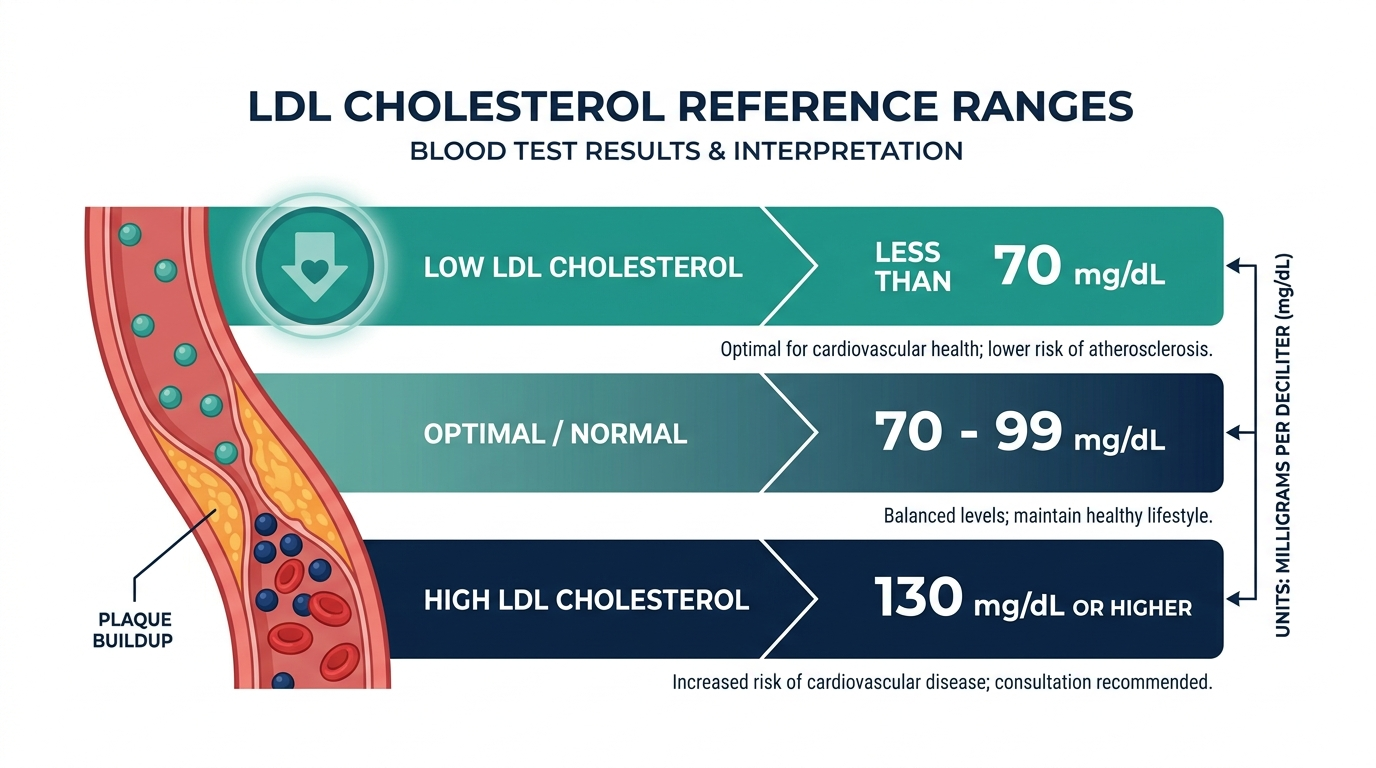
A low LDL cholesterol result generally means your LDL is below about 40 mg/dL. Clinicians start to suspect a true low-LDL condition called hypobetalipoproteinemia when LDL falls below roughly 80 mg/dL, and an apolipoprotein B value under 40 mg/dL is consistent with this picture (StatPearls, Cholesterol Screening).
For context, the population target for LDL is under 100 mg/dL, and people with existing heart disease aim for under 70 mg/dL (StatPearls, Hypercholesterolemia). So a low LDL number often reflects a healthy lipid profile, not a problem. The word “low” matters less than the cause behind it. A 35 mg/dL reading in someone on a statin tells a very different story than the same number in a child with poor weight gain.

What causes low LDL cholesterol?
The most common cause of low LDL today is cholesterol-lowering medication. Statins, ezetimibe, and PCSK9 inhibitors can push LDL well under 40 mg/dL on purpose, and trials show levels even under 30 mg/dL are reached safely (PMC, PCSK9 Inhibitors review).
Beyond medication, common and uncommon drivers include the following.
- Treatment: statins, ezetimibe, and PCSK9 inhibitors lower LDL by design.
- Diet and lifestyle: a very low saturated fat diet and consistent exercise can lower LDL naturally.
- Inherited low cholesterol: familial hypobetalipoproteinemia is a genetic variant, most often in the APOB gene, that keeps LDL low for life (PMC, Familial Hypobetalipoproteinemia).
- Other medical conditions: overactive thyroid, liver disease, chronic infection, malnutrition, malabsorption, and some cancers can all reduce LDL.
Sorting medication and genetics from illness is the main job your clinician does when interpreting a low result.
What are the symptoms of low LDL cholesterol?
Low LDL cholesterol itself causes no symptoms in most people. Those with inherited low LDL, known as heterozygous familial hypobetalipoproteinemia, are usually completely asymptomatic and may never know without a blood test (PMC, Familial Hypobetalipoproteinemia).
The result is essentially silent, which is why it is almost always found by chance on a routine lipid panel. Symptoms, when they exist, come from an underlying cause rather than the low number itself. The more severe inherited forms can produce fat malabsorption, fatty and foul-smelling stools (steatorrhea), poor weight gain in infancy, and in rare cases neurologic or eye changes from vitamin deficiency. If you have low LDL and feel well, the number is reassuring, not a warning sign. Symptoms that travel with the result are the part that matters.
When is low LDL cholesterol dangerous?
For most people, low LDL is not dangerous and is linked to lower cardiovascular risk. Large studies found that people reaching LDL under 30 mg/dL had the lowest rate of heart events without an increase in safety problems, and genetic carriers with LDL under 20 mg/dL showed no clear harm (PMC, Extremely Low LDL-C).
Low LDL becomes a concern in two situations. First, when it signals an underlying illness such as liver disease, an overactive thyroid, undernutrition, or malabsorption. Second, in the severe inherited forms, where extremely low cholesterol limits absorption of fat-soluble vitamins A, D, E, and K. The danger in these cases comes from the cause or the vitamin shortfall, not from low cholesterol on its own. A low number in a healthy adult on a statin is a treatment success, not a hazard.
What should you do next, and when should you see a doctor?
If you take a cholesterol-lowering drug and feel well, a low LDL result usually needs no action beyond continuing your plan, since targets under 40 mg/dL are considered safe (PMC, PCSK9 Inhibitors review). Bring the result to your next routine visit for confirmation.
See a clinician sooner if your LDL is low without any medication, or if it comes with warning signs. These include unintended weight loss, ongoing diarrhea or fatty stools, poor appetite, or symptoms of thyroid or liver disease. Your clinician may repeat the lipid panel, check apolipoprotein B, and order liver and thyroid tests. If an inherited cause is suspected, genetic testing and a check of fat-soluble vitamin levels may follow. The goal is simple: confirm the number, then make sure nothing concerning is driving it.
The insider nuance most people miss about low LDL
Here is the detail that often gets lost: a single low LDL value is rarely the whole story, because LDL is frequently calculated, not measured directly. At low LDL levels, the standard Friedewald calculation becomes less accurate, especially when triglycerides are high, so a directly measured LDL or an apolipoprotein B test gives a truer picture (Endotext, Measurement of Lipids).
This is why clinicians treat the lipid panel as a pattern rather than one number. Apolipoprotein B counts the actual particles, which matters more than the cholesterol carried inside them. A surprisingly low LDL on a calculated panel is sometimes a lab artifact, and a quiet, stable low LDL across repeat tests in someone who feels well is usually a genetic gift, not a disease. The smart move is to interpret the trend, confirm with a direct measure if it looks unusual, and read it alongside how you actually feel.
What LDL actually does in the body
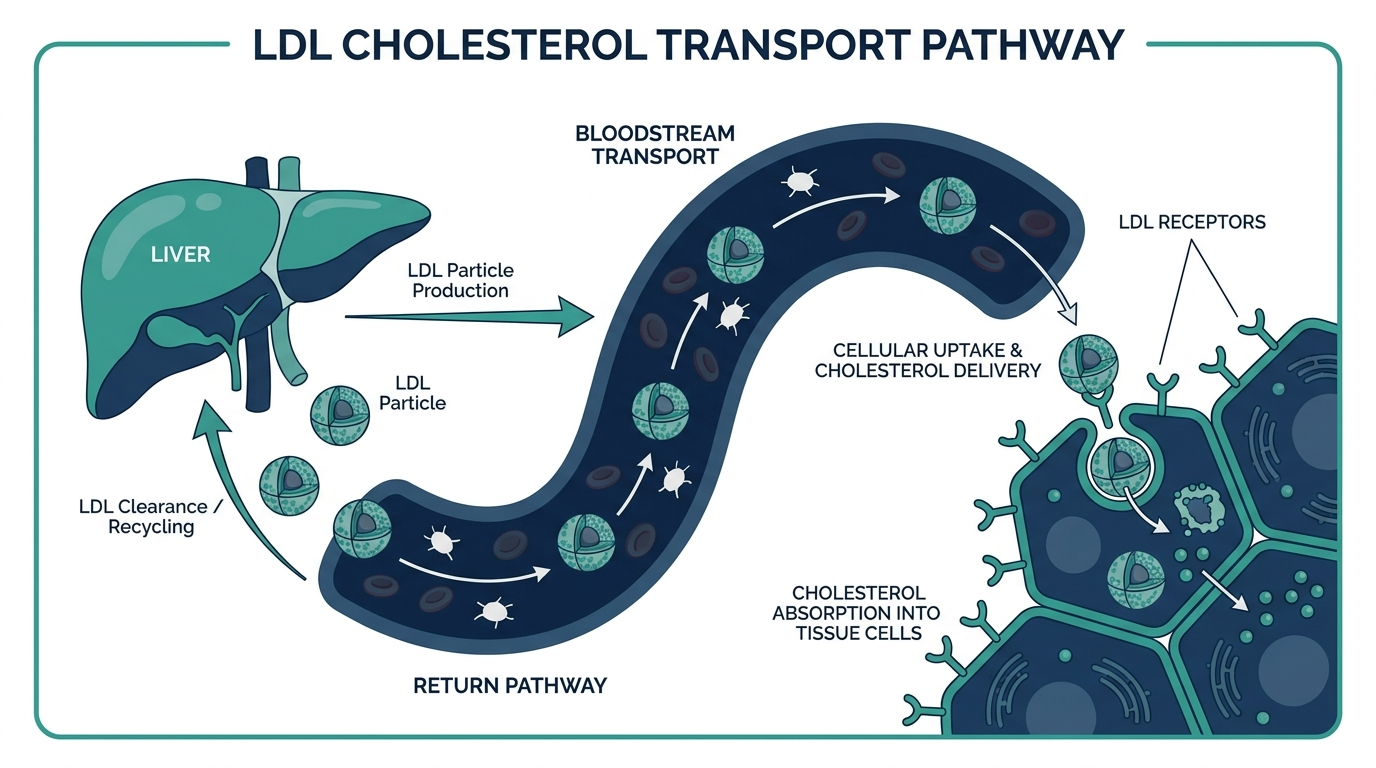
To understand why low LDL is usually reassuring, it helps to know LDL’s real job. LDL, or low-density lipoprotein, is a particle that ferries cholesterol from the liver to cells throughout the body. Cholesterol itself is not a villain. Your body uses it to build cell membranes, make hormones such as testosterone and estrogen, and produce vitamin D and bile acids. The problem with LDL is not the cargo but the delivery pattern: when there are too many LDL particles circulating for too long, they can lodge in artery walls and drive the plaque buildup behind heart attacks and strokes.
This is the key insight behind the “lower is generally better” stance for LDL. The body has multiple ways to supply cells with cholesterol, so pushing LDL down with a statin or a healthy pattern of eating rarely starves your tissues. Fewer LDL particles simply means fewer chances for cholesterol to deposit in artery walls. That is why decades of trials have found lowering LDL reduces cardiovascular events, and why a low LDL number is usually a marker of protection rather than a deficiency to correct.
Reading LDL within the full lipid panel
LDL is one line in a lipid panel, and its meaning sharpens when you read it next to the other numbers. A low LDL means different things depending on what surrounds it.
| Marker | What it tells you | Why it matters next to a low LDL |
|---|---|---|
| Total cholesterol | Sum of cholesterol in all particles | A very low total alongside low LDL can hint at an inherited or illness-related cause |
| HDL | Cholesterol in protective particles | Low LDL with healthy HDL is a favorable pattern |
| Triglycerides | Fat carried in the blood | High triglycerides make a calculated LDL less reliable, so a low value may need direct measurement |
| Apolipoprotein B | The actual count of atherogenic particles | A more direct read of risk than LDL cholesterol alone, and useful to confirm a very low LDL |
The pattern matters more than any single dot. A low LDL with normal HDL, normal triglycerides, and normal liver and thyroid function in someone who feels well is the picture of a favorable profile, not a warning.
Calculated versus measured LDL, and why it matters at the low end
Most routine panels do not measure LDL directly. Instead they calculate it from total cholesterol, HDL, and triglycerides using a formula. That shortcut works well in the middle of the range but loses accuracy at the extremes, especially when LDL is very low or triglycerides are high. The result is that an unusually low calculated LDL can sometimes be a math artifact rather than a true reading.
What clinicians do about it:
- Use a newer calculation. Updated formulas handle low LDL and high triglycerides better than the classic method, and many labs have adopted them.
- Order a direct LDL measurement. A directly measured LDL sidesteps the calculation entirely and is worth doing when a value looks surprisingly low.
- Check apolipoprotein B. Because it counts particles rather than estimating cholesterol content, apoB is a robust confirmation when the LDL number is puzzling.
The practical takeaway: if a single panel shows a startlingly low LDL and the rest of your picture does not fit, ask whether a direct measurement or apoB would clarify it before drawing conclusions.
The medications that drive LDL down on purpose
Since medication is now the most common reason for a low LDL, it is worth knowing how the main options work, because a low number on any of them is a treatment success, not a side effect to fear.
- Statins. The first-line drugs. They reduce the liver’s cholesterol production and prompt it to pull more LDL out of the blood, routinely bringing LDL well under 70 mg/dL in people at risk.
- Ezetimibe. Blocks cholesterol absorption in the gut, often added to a statin for extra lowering.
- PCSK9 inhibitors. Injectable drugs that help the liver clear even more LDL, capable of pushing levels very low, and studied at those depths without a clear safety penalty.
The important framing: reaching a low LDL on these medications is exactly the intended outcome. The trials that support them found low LDL translated into fewer heart attacks and strokes. A patient who sees LDL at 35 mg/dL on treatment and feels well is where the therapy is trying to get them.

Does very low LDL harm the brain or mood?
A common worry is that because the brain contains a lot of cholesterol, driving LDL low might hurt cognition or mood. This concern deserves a clear answer. The brain makes its own cholesterol locally and is largely walled off from blood cholesterol by the blood-brain barrier, so circulating LDL is not the brain’s supply line. Large trials of intensive LDL lowering have not shown that reaching low LDL causes meaningful cognitive harm. Where low cholesterol coincides with poor health, the underlying illness, not the cholesterol number, is usually the driver. If you notice new symptoms on a cholesterol-lowering drug, that is a conversation to have with your clinician rather than a reason to quietly stop the medication.
How to prepare for a lipid test so the result is trustworthy
A lipid panel can be nudged by how you prepare, so a low or unusual result is best judged from a well-collected sample:
- Fasting when requested. Some panels are drawn after an 8 to 12 hour fast, mainly because triglycerides and calculated LDL are sensitive to recent meals. Many labs now accept non-fasting samples, so follow the instruction you are given.
- Avoid a very unusual day before. A day of heavy drinking or an unusually fatty meal can shift triglycerides and distort a calculated LDL.
- Note recent illness. Acute infection or inflammation can temporarily lower cholesterol, so a value drawn while you are sick may not reflect your baseline.
- Keep conditions consistent for retests. Comparing a fasting result to a non-fasting one can introduce differences unrelated to any real change.
The inherited low-LDL conditions worth knowing
A minority of people have naturally low LDL for life because of their genes, and these inherited patterns explain a low value in someone who takes no medication and feels well.
- Familial hypobetalipoproteinemia. Most often caused by a variant in the APOB gene, this keeps LDL low across a lifetime. People who carry one copy of the variant are usually completely healthy, and many discover it only by chance on a routine panel. In this setting, low LDL is often described as a genetic advantage for heart health.
- The severe forms. When the underlying defect is more profound, the body struggles to package and transport fats, which can cause fat malabsorption, fatty stools, and shortfalls of fat-soluble vitamins A, D, E, and K. These forms usually declare themselves in infancy or childhood with poor growth, not as a surprise in a healthy adult.
The distinction matters. A stable, symptom-free low LDL in an adult across repeat tests points toward the benign inherited pattern. A low LDL paired with digestive or growth problems, especially early in life, points toward the severe forms that need specialist care.
Worked scenarios: what a low LDL means in context
- LDL 38 mg/dL on a statin, feels great. Treatment working as intended. Continue the plan and confirm at the next routine visit.
- LDL 45 mg/dL, no medication, lifelong low numbers, no symptoms. Most consistent with the benign inherited pattern. A clinician may confirm with apolipoprotein B and note it as favorable.
- LDL suddenly low with weight loss and fatty stools. The combination, not the number, is the concern. This prompts checks of thyroid, liver, and absorption, since an illness may be driving it.
- LDL very low on a calculated panel with high triglycerides. Possible math artifact. A direct LDL or apoB gives a truer reading before any conclusion.
- Low LDL after a recent infection. May be a temporary dip. Rechecking once recovered shows the real baseline.
Common misunderstandings about low LDL
- “Low LDL means my cholesterol is dangerously depleted.” For most people, low LDL reflects effective treatment, a healthy diet, or genetics, and the body still makes all the cholesterol it needs internally.
- “If my statin made LDL very low, I should cut the dose.” A low LDL on treatment is the goal, not a warning. Dose changes belong to your clinician, not to self-adjustment based on a low number.
- “Any low LDL needs a workup.” Only low LDL without a medication explanation, or low LDL accompanied by symptoms like weight loss or fatty stools, warrants investigation. A quiet, stable low LDL in a healthy person is usually benign.
- “The LDL number is the whole story.” Because LDL is often calculated, apolipoprotein B and the full lipid pattern give a truer read of risk than one calculated value.
Low LDL and the newer risk markers: ApoB and non-HDL cholesterol
LDL cholesterol has been the headline number on lipid panels for decades, but it is no longer the only way to read your cardiovascular risk, and at the low end the distinctions start to matter. Two markers increasingly sit alongside it. The first is non-HDL cholesterol, which is simply your total cholesterol minus your HDL. It captures all the cholesterol carried by particles that can build up in artery walls, not just the LDL fraction, and it needs no fasting to be reliable. The second is apolipoprotein B, or ApoB, which counts the actual number of these harmful particles rather than the amount of cholesterol packed inside them.
The reason this matters for a low LDL result is subtle but real. LDL cholesterol measures the cargo, while ApoB measures the trucks. Two people can share the same LDL number while carrying a very different number of particles, and the particle count often tracks risk more closely. This is also why an ApoB value is used to help confirm a true inherited low-cholesterol state, since a genuinely low particle count lines up with the picture of familial hypobetalipoproteinemia rather than a measurement quirk.
For most people with a low LDL on a statin who feel well, none of this changes the reassuring bottom line. But if your LDL looks low and your clinician wants a fuller read, asking about non-HDL cholesterol or ApoB is a reasonable step, particularly if you have other risk factors, a strong family history, or triglycerides that complicate the standard LDL calculation. The point is not to replace LDL but to see it in company. A low LDL sitting next to a low ApoB and a low non-HDL is a coherent, encouraging pattern, and reading the numbers together gives a truer sense of where you stand than any single line can.
Turn what you just learned about LDL cholesterol into action.
Superpower lets you test LDL cholesterol and 100+ biomarkers from home, then re-check them over time so you can actually see progress, physician-reviewed at every step.
Frequently asked questions
Is low LDL cholesterol good or bad?
For most people, low LDL is good and is linked to lower heart disease risk. Studies show LDL under 30 mg/dL is reached safely with no clear harm (PMC). It only raises concern when an illness or rare inherited disorder is the cause.
What LDL level is considered too low?
There is no firm “too low” threshold for healthy people. Clinicians consider LDL under about 40 mg/dL low and may investigate hypobetalipoproteinemia when LDL drops below roughly 80 mg/dL without medication (StatPearls).
Can low LDL cholesterol cause symptoms?
Low LDL itself causes no symptoms, and most people with it feel completely normal. Symptoms such as fatty stools or weight loss come from an underlying cause, not the low number, and are seen mainly in severe inherited forms (PMC).
Should I stop my statin if my LDL is very low?
No, do not stop on your own. LDL targets under 40 mg/dL on medication are considered safe and reflect effective treatment (PMC). Discuss any dose changes with your clinician before adjusting anything.
What does it mean if my LDL is low but I take no medication?
Low LDL without medication can be inherited (familial hypobetalipoproteinemia) or caused by thyroid, liver, or absorption problems. Your clinician may repeat the test and check apolipoprotein B, thyroid, and liver function to find the cause (PMC).
Sources
- StatPearls (NCBI Bookshelf), Cholesterol Screening
- StatPearls (NCBI Bookshelf), Hypercholesterolemia
- PMC, Hypolipidemia due to Familial Hypobetalipoproteinemia in Adolescents
- PMC, Safety and Efficacy of Achieving Very Low LDL Cholesterol Concentrations with PCSK9 Inhibitors
- PMC, Safety and Efficacy of Extremely Low LDL-Cholesterol Levels
- Endotext (NCBI Bookshelf), The Measurement of Lipids, Lipoproteins, and Apolipoproteins
This article is for general educational purposes and is not medical advice. It cannot diagnose or treat you and does not replace your clinician. Always discuss your lab results and any health decisions with a qualified healthcare professional.
Related: find the right at-home biomarker test.
Vital Signs Today may earn a commission if you buy through links on this page. It does not affect our editorial assessments.