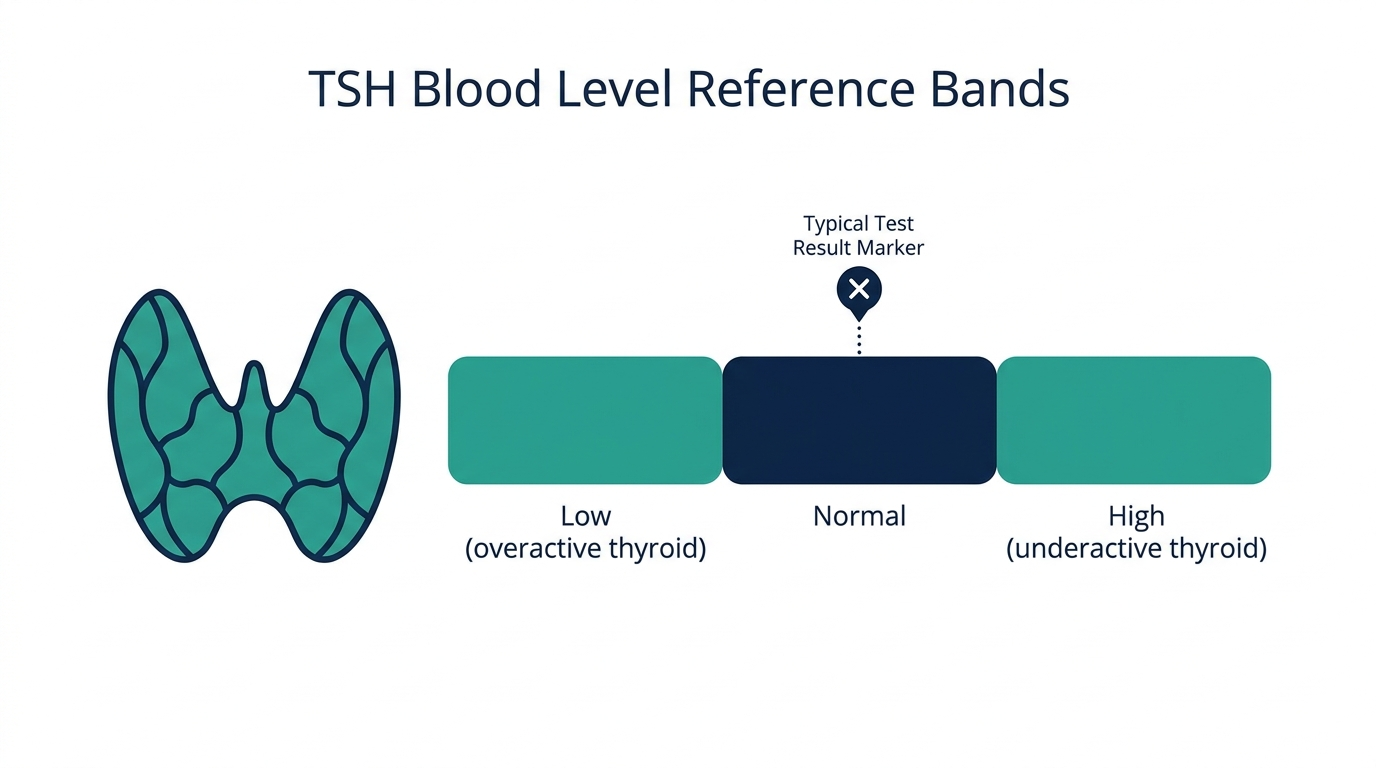
- For most healthy non-pregnant adults, a normal TSH level falls between about 0.4 and 4.0 mIU/L, the standard reference range used by US laboratories.
- TSH reference ranges drift upward with age, so a value near 6.0 mIU/L can be normal for someone over 80 but high for a young adult.
- Newborns have very high TSH right after birth (up to 70 mIU/L in the first day) and pregnancy lowers the upper limit to roughly 4.0 mIU/L in the first trimester.
Part of our Thyroid Panel guide.
What is a normal TSH level?
For most healthy, non-pregnant adults, a normal thyroid-stimulating hormone (TSH) level is roughly 0.4 to 4.0 mIU/L, the reference interval reported by most US laboratories (StatPearls, NCBI). Some labs widen this to 0.4 to 4.5 mIU/L depending on the assay they use.
TSH drifts with age and the range is broad, so is your thyroid actually running where it should? One at-home Superpower draw checks 100+ biomarkers, physician-reviewed.
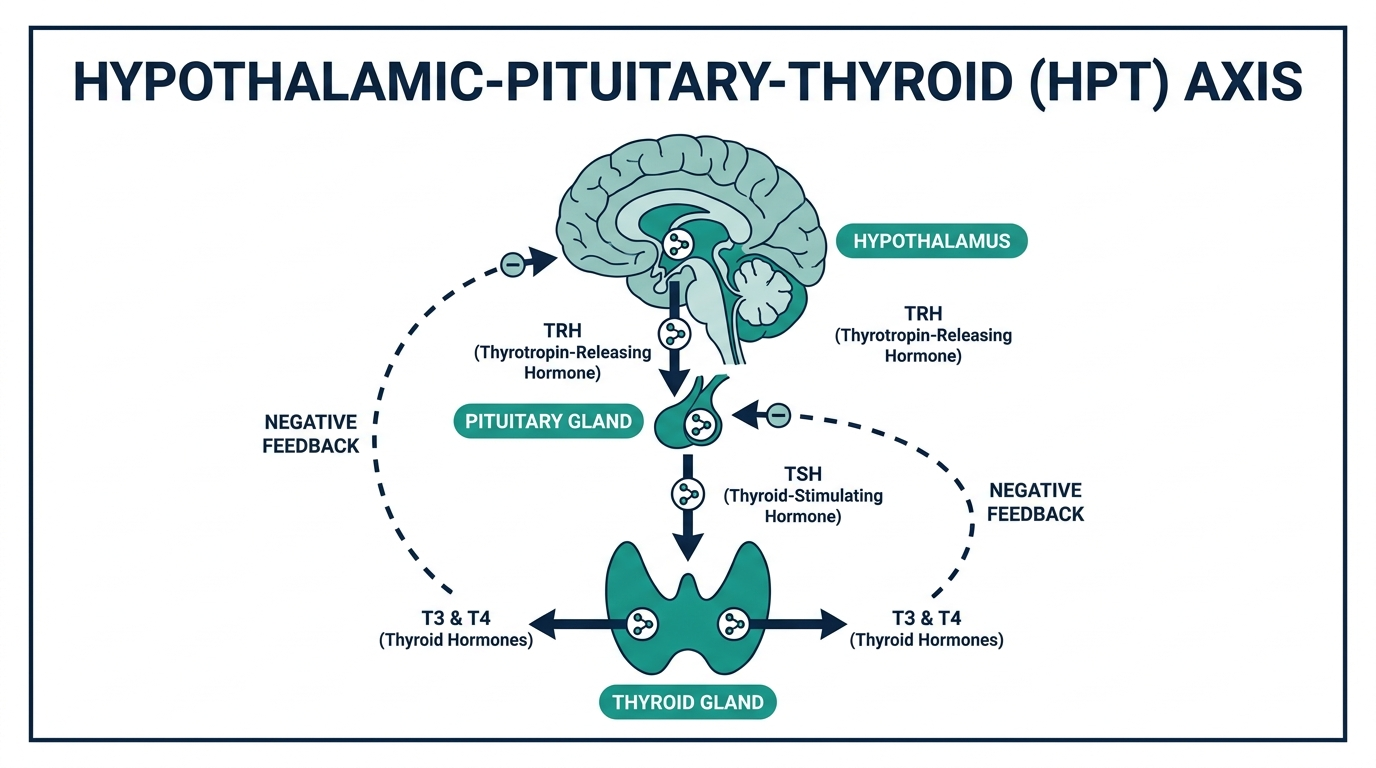
TSH is made by the pituitary gland, and it works like a thermostat for your thyroid. When thyroid hormone runs low, the pituitary pushes TSH up to demand more. When thyroid hormone is plentiful, TSH falls. That inverse relationship is why a high TSH usually signals an underactive thyroid (hypothyroidism), while a low TSH points to an overactive thyroid (hyperthyroidism). The number on its own is only part of the picture; clinicians read it alongside free T4 and your symptoms before drawing conclusions.
One thing that trips people up is how sensitive TSH is. Because the pituitary amplifies small changes in thyroid hormone, TSH moves a lot for a modest shift in T4. That makes it an excellent early warning marker, but it also means a single mildly abnormal reading is more often a signal to look closer than a diagnosis. TSH is the first thyroid test almost everyone gets, precisely because it catches trouble before free T4 has visibly budged.
Optimal range versus normal range
The reference range and the range where people feel their best are not always the same conversation, and thyroid care is where this debate is loudest. The lab flags you only outside roughly 0.4 to 4.0 mIU/L, but many patients and some clinicians argue that people feel better in the lower half of that band, often under about 2.5 mIU/L. There is a grain of truth here: in younger adults the average TSH sits closer to the middle of the range, and a value of 3.8 with real symptoms deserves a second look rather than an automatic all-clear.
The honest caveat is that the evidence does not support treating an asymptomatic person just to nudge a normal TSH lower. Large trials of thyroid hormone for mild, subclinical elevations, especially in older adults, have generally failed to show a benefit in energy or quality of life. So “optimal” is a useful lens for interpreting your own number alongside symptoms, not a mandate to medicate a lab value. We go deeper into this in our guide on TSH optimal range versus normal range.
TSH normal range by age
The simplest way to actually get this done
Superpower is a full-body lab membership that runs 100+ biomarkers, has each result reviewed by a doctor, and tracks your numbers year over year (about $199/year). It is what we point readers to when they would rather get one clean, complete draw than chase single tests one at a time. Here is superpower reviewed in full.
TSH reference ranges shift across the lifespan, and the upper limit tends to climb as people get older. Newborns run extremely high TSH at birth, children settle into wider intervals, and adults over 70 can be normal at values that would look elevated in a 30-year-old. The table below collects age-specific reference values from published medical sources.
| Age group | Approximate TSH range (mIU/L) | Note |
|---|---|---|
| Newborn (first 24 to 48 hours) | up to ~70 | Physiologic TSH surge after birth |
| Newborn (after day 3) | less than ~10 | Drops rapidly within days |
| Children (ages 1 to 6) | ~1.0 to 8.5 | Age-specific pediatric cutoffs |
| Children (ages 6 to 12) | ~1.0 to 7.0 | Narrows toward adult range |
| Adults (general) | 0.4 to 4.0 | Standard US lab reference |
| Older adults (ages 65 to 70) | ~0.65 to 5.5 | Upper limit rises with age |
| Older adults (ages 71 to 80) | ~0.85 to 5.9 | Mild elevation often benign |
| Older adults (over 80) | ~0.8 to 6.7 | Highest normal ceiling |
| Pregnancy (first trimester) | ~0.1 to 4.0 | Upper limit lowered by ATA |
Pediatric and newborn figures come from StatPearls (NCBI); the age-stratified older-adult intervals come from population studies indexed in PMC. Always read your own lab report, because the range printed next to your result is the one your lab validated for its assay.
How do you prepare for a TSH test, and what can skew it?
A TSH test is a routine blood draw and does not require fasting, but a few things move the number enough to change how it reads, and some of them are surprisingly common.
Time of day. TSH follows a daily rhythm, peaking overnight and in the very early morning, then falling through the late morning and afternoon. An afternoon draw can read meaningfully lower than an early one, sometimes enough to push a borderline subclinical hypothyroidism back into the “normal” band. If you are tracking a value over time, test at a consistent time, ideally in the morning, so you are comparing like with like.
Biotin. This is the classic trap. High-dose biotin, found in many hair, skin, and nail supplements, interferes with the assays labs use and can produce a falsely low TSH alongside a falsely high T4 and T3, a pattern that mimics Graves disease and has sent people down needless workups. Stop biotin for two to three days before a thyroid panel, or tell the lab you take it.
Levothyroxine timing. If you already take thyroid medication, the pill barely moves that day’s TSH, so you can take it as usual. But it does raise free T4 for several hours, so if free T4 is being measured too, many clinicians suggest drawing blood before the morning dose for a cleaner reading.
Recent illness. Serious acute illness can distort thyroid tests in a pattern called non-thyroidal illness or sick euthyroid syndrome, where the numbers look off without real thyroid disease. This is why an abnormal TSH found during or just after a hospital stay is usually repeated once you have recovered rather than acted on right away.
What other thyroid tests go with TSH?
TSH is the screen, but it rarely tells the whole story alone. The markers a clinician reaches for next are what turn a lone number into a diagnosis.
- Free T4: the main hormone the thyroid makes. Pairing it with TSH separates overt disease from mild, subclinical shifts. High TSH with low free T4 is overt hypothyroidism; high TSH with normal free T4 is subclinical.
- Free T3: the active hormone. It is most useful when hyperthyroidism is suspected, since T3 can rise first.
- TPO antibodies: the marker of Hashimoto thyroiditis, the most common cause of hypothyroidism in the US. A positive result predicts a higher chance that a borderline TSH will drift into true hypothyroidism over time, which changes how closely you get monitored.
Reading them as a set is what prevents the two classic mistakes: treating a healthy person for a lab quirk, and reassuring a symptomatic person because one number looked fine. Our guide to the full thyroid panel walks through each test and the patterns they form together.
How does sex change the range?
Sex has a smaller effect on TSH than age does, and most labs publish a single adult reference range of roughly 0.4 to 4.0 mIU/L for both men and women (StatPearls, NCBI). Where sex matters most is during the reproductive years, because pregnancy dramatically reshapes a woman’s range.
Women are also several times more likely than men to develop thyroid disease over a lifetime, and thyroid problems often surface around pregnancy, the postpartum window, and menopause. That is a difference in risk, not in the number that counts as normal on a routine panel. If you are pregnant or planning to conceive, the standard adult cutoff no longer applies and trimester-specific targets take over (see the next section). For non-pregnant adults, your clinician interprets the same range regardless of sex, weighting your symptoms and any family history of thyroid disease alongside the lab value.
What makes TSH rise or fall with age?
TSH tends to rise gradually with age, which is why the upper end of normal climbs into the 5 to 7 mIU/L territory in people over 70 (PMC). The French Endocrine Society has even suggested a rough rule of thumb of dividing a patient’s age by 10 to estimate the upper TSH limit when screening older adults.
Several forces move the number:
- Aging: The pituitary-thyroid set point shifts slightly upward, so mildly higher TSH can be a normal feature of older age rather than a disease.
- Pregnancy: The hormone hCG mimics TSH and stimulates the thyroid directly, which suppresses TSH and lowers the upper limit, especially in the first trimester (Endocrine Society).
- Medications: Levothyroxine, steroids, biotin supplements, lithium, and amiodarone can all push TSH up or down or interfere with the assay.
- Acute illness: Serious illness can temporarily distort thyroid tests, so clinicians often repeat the test once you recover.
When is an out-of-range result a concern?
A single out-of-range TSH is rarely an emergency, and clinicians usually confirm it with a repeat test plus a free T4 before acting. A TSH between about 4.5 and 10 mIU/L with normal free T4 is called subclinical hypothyroidism, and in many older adults it does not need treatment if there are no symptoms (Cleveland Clinic Journal of Medicine).
What clinicians watch for:
- High TSH (over 10 mIU/L): More likely to represent true hypothyroidism and is more often treated, especially with symptoms like fatigue, weight gain, cold intolerance, or constipation.
- Low or undetectable TSH: Suggests an overactive thyroid; symptoms can include palpitations, weight loss, tremor, and anxiety.
- Pregnancy: A TSH above the trimester-specific cutoff is taken more seriously because of effects on the developing baby.
- On treatment: People taking thyroid hormone are often targeted to roughly 0.5 to 3.0 mIU/L.
Context decides everything here. The same value can be reassuring in one person and worth following in another, which is why your result belongs in a conversation with your clinician rather than a chart alone.
What causes a high or low TSH?
Knowing the direction is only half the answer. The cause is what determines whether you monitor, treat, or investigate.
A high TSH usually means the thyroid is underactive and the pituitary is pushing harder to compensate. In the US the leading cause by far is Hashimoto thyroiditis, an autoimmune condition where the immune system gradually damages the gland. Other causes include prior thyroid surgery or radioactive iodine treatment, certain medications such as lithium and amiodarone, and, in a subtle twist, the recovery phase after a serious illness. Being under-replaced on thyroid medication also shows up as a high TSH, which is why dose adjustments are guided by the number.
A low TSH usually means the thyroid is overactive and the pituitary has backed off. Graves disease, an overactive nodule, and the early inflammatory phase of thyroiditis are common culprits, as is simply taking a bit too much thyroid hormone. One important exception is worth flagging: in rare pituitary problems, called central or secondary hypothyroidism, TSH can be low or deceptively normal even though thyroid hormone is genuinely low. That is exactly the scenario where relying on TSH alone fails and free T4 rescues the diagnosis.
A realistic example. A 38-year-old woman feels persistently tired, is gaining weight despite no change in habits, and feels cold when others are comfortable. Her TSH comes back at 6.2 mIU/L, above the adult ceiling, but her free T4 is normal, so this is subclinical hypothyroidism rather than overt disease. Her clinician adds TPO antibodies, which are positive, confirming early Hashimoto. Because she has symptoms and is considering pregnancy, where the threshold to treat is lower, they repeat the test in a few weeks and discuss a trial of low-dose levothyroxine, rather than either ignoring the result or medicating on the spot. What you can actually do about a high TSH, from the medical options to the lifestyle and nutrition angles, is covered in our guide on how to lower TSH.
Curious what your own levels look like?
Baseline 100+ biomarkers today and retest as life changes, all in one membership with physician review.
Frequently asked questions
What is a dangerously high TSH level?
There is no single “danger” number, but a TSH above 10 mIU/L is more likely to reflect true hypothyroidism and is more often treated. Very high values, sometimes above 50 to 100 mIU/L, point to significant thyroid underactivity and warrant prompt medical evaluation.
Is a TSH of 5 normal for an older adult?
Often yes. The upper end of normal rises with age, reaching roughly 5.5 to 6.7 mIU/L in adults over 70 (PMC). A TSH of 5 with normal free T4 and no symptoms is frequently considered acceptable in an older person and may not need treatment.
What is the normal TSH range during pregnancy?
In the first trimester the American Thyroid Association uses an upper limit near 4.0 mIU/L, with trimester-specific targets of roughly 0.1 to 4.0 (first), 0.2 to 3.0 (second), and 0.3 to 3.5 mIU/L (third). Your obstetric provider sets the exact target.
Can TSH levels change throughout the day?
Yes. TSH follows a daily rhythm, peaking overnight and dipping in the afternoon, so values can vary by time of day. For consistency, many clinicians draw the test in the morning and repeat borderline results before making any decisions.
Should I worry about a slightly high TSH?
A mildly high TSH with normal free T4 (subclinical hypothyroidism) is common and often does not need treatment, particularly in older adults without symptoms. Clinicians usually repeat the test in a few weeks rather than starting medication immediately. Discuss your result with your provider.
Do I need to fast for a TSH test?
No, fasting is not required for TSH. The bigger variable is the time of day, because TSH runs higher in the early morning and drifts down later. If you want results you can compare over time, test at a similar morning hour each time rather than switching between morning and afternoon draws.
Does biotin affect a TSH test?
Yes, and it is a common cause of confusing results. High-dose biotin supplements can make TSH read falsely low while pushing T4 and T3 falsely high, a combination that looks like an overactive thyroid but is not. Stopping biotin for two to three days before the draw avoids the interference.
Can stress raise TSH?
Everyday stress does not meaningfully change your TSH or cause thyroid disease. Serious physical stress, such as a major illness or hospitalization, can temporarily distort thyroid tests in a pattern called non-thyroidal illness, which is why an abnormal result found during a health crisis is usually rechecked after you recover.
What is the difference between TSH and T4?
TSH is the pituitary’s signal telling the thyroid how hard to work, while T4 is the main hormone the thyroid actually produces. They move in opposite directions: when T4 is low, TSH rises to demand more. Measuring both together is what separates overt thyroid disease from a mild, subclinical shift.
Sources
- StatPearls (NCBI), Thyroid-Stimulating Hormone
- StatPearls (NCBI), Pediatric Hypothyroidism
- PMC, Reference intervals for thyroid hormones in the elderly population
- PMC, Age-specific serum thyrotropin reference range in the elderly
- Endocrine Society, TSH and FT4 Reference Intervals in Pregnancy
- Cleveland Clinic Journal of Medicine, Subclinical hypothyroidism: When to treat
This article is for general educational purposes and is not medical advice. It cannot diagnose or treat you and does not replace your clinician. Always discuss your lab results and any health decisions with a qualified healthcare professional.
Related: best thyroid and hormone tests of 2026.
Vital Signs Today may earn a commission if you buy through links on this page. It does not affect our editorial assessments.