Disclosure: Vital Signs Today may earn a commission if you buy through links on this page, at no extra cost to you. This does not influence our evidence-based assessments. We are not a medical provider; talk to a clinician before acting on test results.
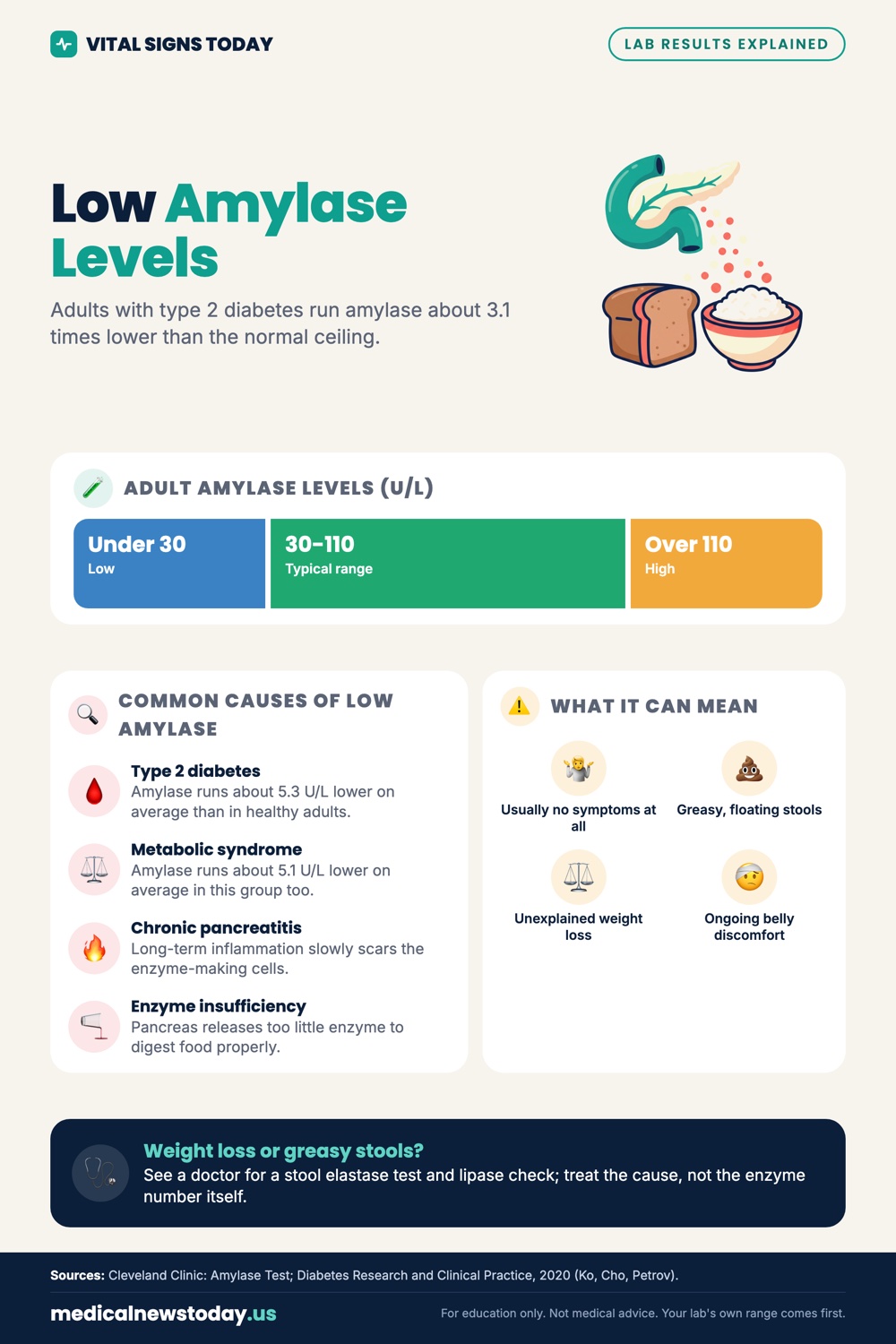
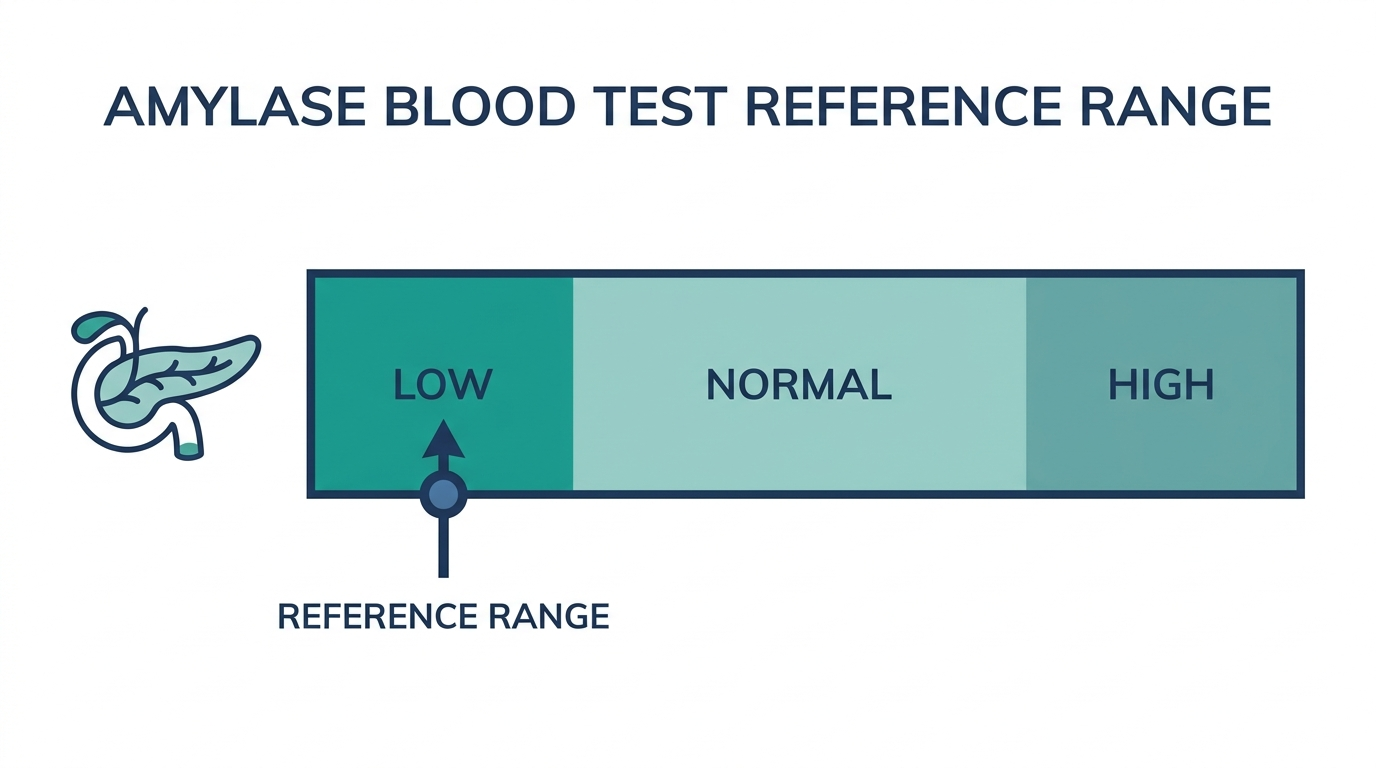
- Low amylase in a blood test usually means a value below the lab reference range, which is commonly around 30 to 110 units per liter (U/L), and most often points to reduced pancreas enzyme output rather than an emergency (Cleveland Clinic).
- The conditions most frequently linked to low serum amylase are type 2 diabetes, metabolic syndrome, obesity, and chronic pancreatitis, where the pancreas slowly loses enzyme-producing tissue (PMC systematic review, 2024).
- A single low amylase result is rarely dangerous on its own, but if it comes with greasy stools, weight loss, or ongoing belly pain, you should see a doctor to check pancreas function.
What does low amylase mean and what is the cutoff?
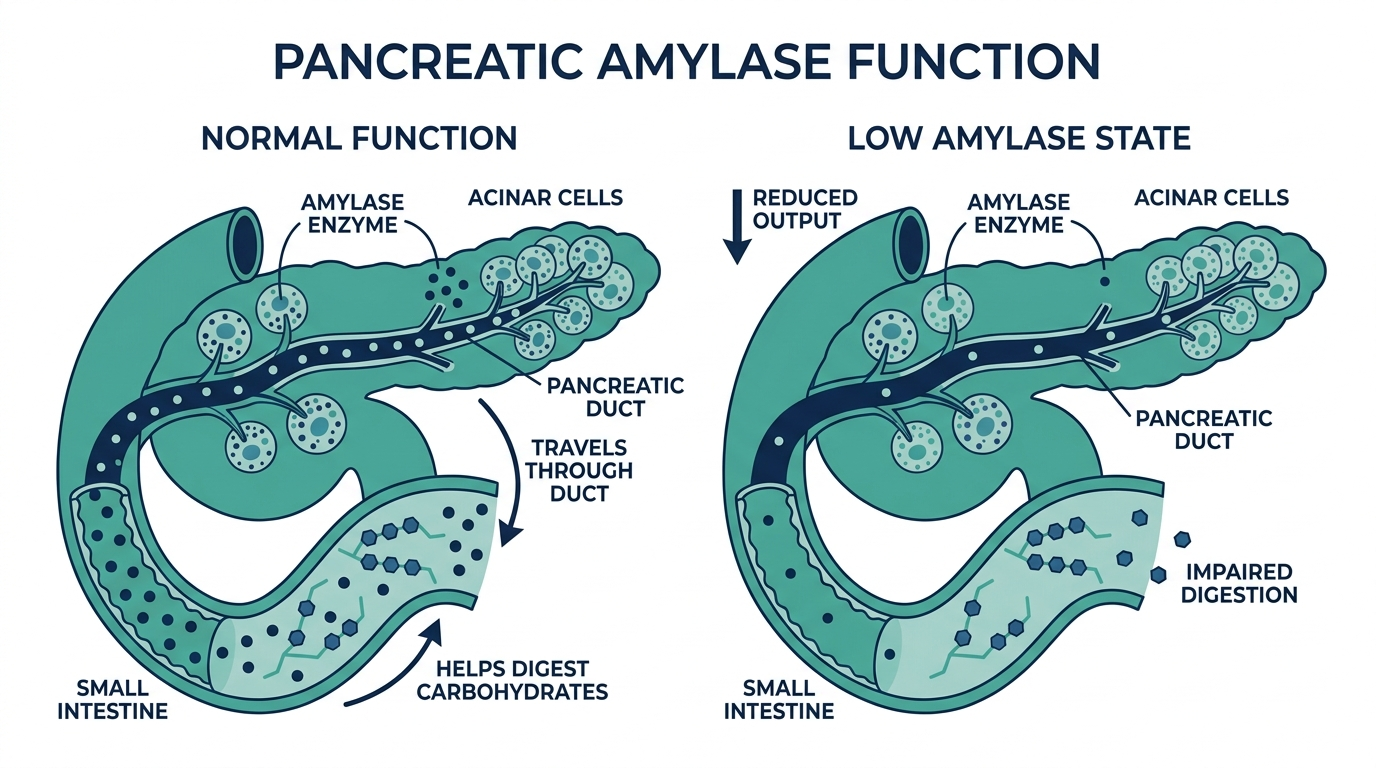
Low amylase means your blood level falls under the laboratory reference range, which is commonly about 30 to 110 U/L, though each lab sets its own cutoff (Cleveland Clinic). Amylase is a digestive enzyme made mostly by your pancreas and salivary glands to break down starches into sugar. When the blood number sits below the floor of the range, it generally signals that the pancreas is making less enzyme than expected.
Always read your result against the reference range printed on your own report, not a number from the internet. A value of 28 U/L might be flagged low at one lab and normal at another. Context matters too. A mildly low amylase in an otherwise healthy person with no symptoms is often not clinically meaningful, while the same number in someone with weight loss and digestive complaints deserves a closer look.
What causes low amylase?
The most common causes of low amylase are type 2 diabetes, metabolic syndrome, obesity, and chronic pancreatitis, according to a 2024 systematic review (PMC, National Library of Medicine). A large meta-analysis of 20,916 people found that adults with type 2 diabetes had amylase levels about 5.3 U/L lower on average than healthy peers, and those with metabolic syndrome were about 5.1 U/L lower (Diabetes Research and Clinical Practice).
Several distinct mechanisms can drive the number down:
- Chronic pancreatitis: long-term inflammation scars the pancreas, so it slowly loses the cells that make amylase. In advanced disease the level can stay low even during flares (PMC).
- Pancreatic exocrine insufficiency: the pancreas does not release enough enzymes to digest food, often after surgery, severe disease, or cystic fibrosis (Cleveland Clinic).
- Liver or kidney problems: serious liver disease and some kidney conditions can lower amylase (Cleveland Clinic).
- Metabolic conditions: diabetes, metabolic syndrome, and obesity are all associated with lower readings (PMC).
What are the symptoms, or is low amylase silent?
Low amylase itself produces no symptoms. It is a lab number, not a feeling, so most people learn about it only from a blood report (Cleveland Clinic). What you may notice are signs of the underlying condition, especially when the pancreas is not making enough digestive enzymes to absorb food properly.
When low amylase reflects pancreatic exocrine insufficiency or chronic pancreatitis, watch for these clues:
- Steatorrhea: pale, greasy, foul-smelling stools that float or are hard to flush.
- Unintended weight loss: losing weight despite a normal appetite, because nutrients pass through undigested.
- Ongoing abdominal discomfort: bloating, gas, or a dull pain in the upper belly.
- Fatigue or nutrient gaps: from poor absorption of fats and fat-soluble vitamins.
If your low amylase is tied to diabetes or metabolic syndrome, your symptoms are usually those of the metabolic condition, such as increased thirst, frequent urination, or elevated blood sugar, rather than anything caused by the enzyme level directly.
When is low amylase dangerous?
A low amylase value is rarely dangerous by itself, since it is a marker, not a disease. The risk comes from what it may be pointing to, and the most concerning scenario is significant pancreatic exocrine insufficiency, which can lead to malnutrition if untreated (Cleveland Clinic). The systematic review notes that persistently low amylase is most strongly tied to chronic, manageable conditions rather than acute emergencies (PMC).
Treat it as more urgent when low amylase appears alongside warning signs: progressive weight loss, persistent greasy stools, severe or worsening upper abdominal pain, jaundice, or poorly controlled blood sugar. These combinations suggest the pancreas, liver, or metabolic system needs prompt evaluation. On its own, with no symptoms and a result only slightly under the range, a single low amylase number is usually low risk and may simply be rechecked over time.

What to do next and when to see a doctor
The first step is to review the result with the clinician who ordered it, because low amylase is interpreted alongside your symptoms, history, and other tests, not in isolation (Cleveland Clinic). A mildly low value in a healthy person often needs nothing more than a repeat test, while a low value with digestive symptoms calls for follow-up on pancreas function.
Practical next steps your doctor may consider:
- Repeat or confirm: rerun amylase, sometimes with lipase, which is more pancreas-specific.
- Check pancreas function: a stool elastase test screens for pancreatic exocrine insufficiency.
- Screen for metabolic causes: blood sugar, HbA1c, and a metabolic panel, given the diabetes link (PMC).
- Imaging if needed: ultrasound or CT to look at the pancreas when chronic pancreatitis is suspected.
See a doctor promptly if you have unexplained weight loss, greasy or floating stools, ongoing upper belly pain, or yellowing of the skin or eyes. Seek urgent care for severe, sudden abdominal pain.
The insider nuance: low amylase as a quiet metabolic flag
Here is what many people miss: a low amylase that has no obvious pancreatic explanation can be an early, quiet flag for metabolic trouble. Research increasingly treats low serum amylase as a biomarker tied to insulin resistance and metabolic syndrome, not just digestion (PMC, 2024). In the pooled meta-analysis, people with type 2 diabetes ran roughly 3 times lower amylase relative to the upper limit of normal compared with healthy controls (Diabetes Research and Clinical Practice).
The practical takeaway is that a low amylase noticed on a routine panel, especially with a higher body weight or borderline blood sugar, is a reasonable prompt to check metabolic health rather than something to dismiss. It does not diagnose diabetes, but it can be one more thread that, pulled together with HbA1c and waist measurement, helps your clinician catch insulin resistance earlier.
What amylase actually is, and why blood levels shift
Amylase is a digestive enzyme whose job is to cut long starch chains into smaller sugars your body can absorb. Two organs make most of it: the pancreas, which secretes pancreatic amylase into the small intestine, and the salivary glands, which release salivary amylase to start starch breakdown in the mouth. A standard blood test measures total amylase, the sum of both sources.
Because the pancreas is the larger contributor to the blood pool, a persistently low total amylase most often reflects reduced pancreatic output. That is the biological reason low amylase gets read as a pancreas signal. When a clinician wants to know which source is falling, they can order isoenzyme testing that separates the salivary (S-type) from the pancreatic (P-type) fraction. A low P-type points at the pancreas specifically, which is more informative than a low total on its own.
The level can also drift for reasons that have nothing to do with disease. Amylase output naturally varies between people, and a single reading is a snapshot. This is why one mildly low number in a symptom-free person usually earns a simple recheck rather than a workup.

Amylase and lipase: why they are read together
Amylase rarely gets interpreted alone. Its partner marker is lipase, the enzyme that digests fat, and the two together sketch a clearer picture of pancreatic health than either does by itself.
- Lipase is more pancreas-specific. Salivary glands and other tissues contribute to amylase, but lipase comes largely from the pancreas. When a clinician wants a cleaner read on the pancreas, lipase often carries more weight.
- Both low, with symptoms. Persistently low amylase and lipase in someone with greasy stools and weight loss raises concern for advanced pancreatic exocrine insufficiency, where the gland has lost much of its enzyme-making tissue.
- Amylase low, lipase normal. This mismatch pushes the explanation away from pure pancreatic failure and toward salivary contribution, metabolic causes, or normal variation.
- The mirror-image caution. High amylase and lipase, not low, are the classic signal of acute pancreatitis. Knowing that helps you understand why a low value is a very different, usually less urgent, conversation.
The practical point: if your amylase is flagged low, ask whether lipase and a pancreas-function test would add clarity before drawing conclusions.
How the test is done and what can distort it
Amylase is measured from a routine blood sample, often as part of a metabolic or digestive workup. It generally does not require fasting, but a few factors can nudge the result, and knowing them helps you interpret a borderline value.
- Medications. Some drugs shift amylase. Discuss your full medication and supplement list with the ordering clinician so the number is read in context.
- Timing and recent illness. A recent bout of pancreatic inflammation can temporarily elevate levels, so a low reading is best judged when you are at a stable baseline.
- Kidney and liver function. Because these organs affect enzyme clearance and production, significant liver or kidney disease can move amylase and should be considered alongside the result.
- Lab-to-lab differences. Different analyzers and methods produce slightly different reference ranges, which is the core reason to compare your value to your own report’s range rather than a generic online figure.
Sample scenarios: reading a low amylase in context
The same low number means different things depending on the company it keeps. A few worked examples:
- Low amylase, no symptoms, healthy weight, normal blood sugar. Most often a benign finding. A recheck in a few months usually settles it, and no treatment is aimed at the number itself.
- Low amylase with higher body weight and a borderline HbA1c. Worth treating as a nudge to look harder at metabolic health, since low serum amylase is associated with insulin resistance. This does not diagnose diabetes, but it supports checking HbA1c and waist measurement.
- Low amylase with greasy, floating stools and unintended weight loss. This combination points toward pancreatic exocrine insufficiency and deserves a stool elastase test and a clinician’s evaluation rather than watchful waiting.
- Low amylase after a known pancreatic surgery or long-standing chronic pancreatitis. Here the low value is expected, reflecting lost enzyme-producing tissue, and management focuses on the underlying condition and nutrition.

Treating the cause, not the number
There is no supplement that safely and meaningfully raises a serum amylase reading on its own, and chasing the number would miss the point. Management targets whatever is producing the low value:
- Pancreatic exocrine insufficiency. The standard treatment is pancreatic enzyme replacement therapy, capsules taken with meals that supply the enzymes the pancreas no longer makes, prescribed and dosed by a clinician. This addresses the digestion and malnutrition risk, which is what actually matters for your health.
- Diabetes and metabolic syndrome. Improving blood sugar control and metabolic health through the plan your clinician sets is the relevant action when the low amylase reflects insulin resistance.
- Chronic pancreatitis. Care centers on managing pain, addressing causes such as alcohol, supporting nutrition, and monitoring, not on nudging the enzyme number upward.
The mindset shift worth keeping: a low amylase is a signpost, and the destination it points to is the thing you treat.
Who benefits from checking amylase, and how often
Amylase is not a universal screening test for healthy people, and a low value on a routine panel does not automatically mean you need repeat testing forever. Testing and rechecking make the most sense in specific situations:
- Digestive symptoms suggesting the pancreas. Greasy or floating stools, upper abdominal pain, bloating tied to fatty meals, or unintended weight loss are the classic reasons to look at pancreatic enzymes.
- Known or suspected chronic pancreatitis. People with a history of pancreatic inflammation, heavy alcohol use, or prior pancreatic surgery may have amylase followed as part of broader monitoring.
- Metabolic risk under evaluation. When a low amylase turns up alongside higher body weight or borderline blood sugar, it can prompt a focused look at metabolic health with HbA1c and other markers.
- Tracking a known cause. If enzyme replacement or metabolic treatment is underway, periodic labs help your clinician judge whether the plan is working, though the enzyme number is only one input among several.
For most people without symptoms or risk factors, a single mildly low amylase is simply noted and, if anything, rechecked once. There is no fixed schedule that applies to everyone.
A special case: macroamylasemia and other quirks
Not every unusual amylase result reflects the pancreas at all. A few benign quirks can confuse the picture, and knowing they exist keeps you from over-interpreting a number.
- Macroamylasemia. Sometimes amylase binds to a large protein in the blood, forming a complex the kidneys cannot filter normally. This tends to raise blood amylase and lower urine amylase, and it is a harmless finding rather than a disease. It illustrates why a single blood value is not the whole story.
- Isoenzyme splitting. When total amylase is puzzling, separating pancreatic from salivary amylase clarifies the source. A low pancreatic fraction is the informative finding when pancreatic insufficiency is the question.
- Normal individual variation. Some people simply run toward the lower end of the range without any underlying problem. Trend over time and symptoms matter more than one point on one day.
These nuances are exactly why clinicians interpret amylase within a broader panel and clinical context, not as a standalone verdict. If a result does not fit your symptoms, the answer is often a confirmatory test or an isoenzyme breakdown rather than an immediate diagnosis, and that measured approach is the standard of good care.
Common misunderstandings about low amylase
- “Low amylase means I have pancreatic cancer.” A low value is far more commonly linked to metabolic conditions and chronic, manageable causes than to malignancy. It is not a cancer test, and it is not interpreted as one.
- “I should take digestive enzymes to fix it.” Over-the-counter enzyme products are not a substitute for evaluating why the level is low, and prescription enzyme replacement is reserved for diagnosed insufficiency. Self-treating can delay finding the real cause.
- “One low reading is a diagnosis.” It is not. Amylase varies, and a single low number in a well person usually just gets rechecked before anyone acts.
- “Low is always better than high.” Not for enzymes. Both low and high amylase carry meaning. A low value can quietly flag metabolic or pancreatic issues, so it is not automatically the reassuring direction.
Questions worth asking about a low amylase result
A low amylase is only useful when it starts the right conversation, and a few targeted questions turn a puzzling flag into a clear plan. Bringing these to the appointment keeps the focus on the cause rather than the number.
- How far below the range is it, and does it match my symptoms? A value barely under the floor in a well person reads very differently from a clearly low value alongside greasy stools or weight loss.
- Would lipase or a stool elastase test add clarity? Because lipase is more pancreas-specific and stool elastase screens for exocrine insufficiency, they often sharpen a fuzzy amylase result.
- Should my metabolic health be checked? Given the link to insulin resistance, asking whether HbA1c and a waist measurement are warranted can catch a metabolic issue early.
- Do any of my medications or conditions explain it? Certain drugs and significant liver or kidney disease can move amylase, so a full medication and history review is fair to request.
The unifying theme is that you are asking your clinician to interpret the number in context, not to react to it in isolation. That is exactly how a low amylase is meant to be used.
How low amylase reads across different life stages
The same low value can carry a different weight depending on age and circumstances, and keeping that in mind prevents both false alarm and false comfort.
- Younger, healthy adults: a mildly low amylase with no symptoms is frequently just normal individual variation, and a single recheck usually settles it.
- Middle age with metabolic risk: a low value alongside higher body weight or borderline blood sugar is more likely to be a quiet flag for insulin resistance, worth a focused metabolic look.
- Older adults and those after pancreatic surgery: reduced enzyme output can be expected when pancreatic tissue has been lost to chronic disease or surgery, so the low number reflects a known cause and management centers on digestion and nutrition.
Across every stage, the discipline is identical: compare the value to the reference range on your own report, read it next to your symptoms and history, and treat one reading as a single clue rather than a verdict. A low amylase that looks concerning out of context is often entirely expected once age, history, and metabolic status are taken into account.
Want to check your amylase?
Three ways to get it measured. Pick whichever fits you.
Affiliate links: we may earn a commission at no extra cost to you. A lab test does not replace a visit with your clinician.
Frequently asked questions
Is a low amylase level something to worry about?
Usually not on its own. A mildly low amylase with no symptoms is often not significant and may just be rechecked. It becomes more important when paired with weight loss, greasy stools, belly pain, or known diabetes, which warrant a doctor visit (Cleveland Clinic).
What amylase level is considered low?
Generally a value below your lab reference range, which is commonly around 30 to 110 U/L, counts as low. Cutoffs vary by lab, so check the range printed on your own report rather than a fixed online number (Cleveland Clinic).
Can diabetes cause low amylase?
Yes. Type 2 diabetes is one of the most common conditions linked to low serum amylase. A meta-analysis found adults with type 2 diabetes had amylase about 5.3 U/L lower on average than healthy peers (Diabetes Research and Clinical Practice).
Does low amylase mean my pancreas is failing?
Not necessarily. It can reflect reduced enzyme output from chronic pancreatitis or pancreatic insufficiency, but it can also stem from metabolic conditions or be a minor variation. A stool elastase test and lipase help clarify pancreas function (PMC).
How do I raise a low amylase level?
You do not treat the number directly. You address the cause, such as managing diabetes, treating pancreatic insufficiency with enzyme replacement, or following up on chronic pancreatitis. Work with your clinician on a plan based on your full results (Cleveland Clinic).
Sources
- Cleveland Clinic, Amylase Test
- PMC, National Library of Medicine, Clinical significance of low serum amylase systematic review
- Diabetes Research and Clinical Practice, Low serum amylase, lipase, and trypsin as biomarkers of metabolic disorders
- University of Rochester Medical Center, Amylase (Blood)
This article is for general educational purposes and is not medical advice. It cannot diagnose or treat you and does not replace your clinician. Always discuss your lab results and any health decisions with a qualified healthcare professional.
Vital Signs Today may earn a commission if you buy through links on this page. It does not affect our editorial assessments.