Disclosure: Vital Signs Today may earn a commission if you buy through links on this page, at no extra cost to you. This does not influence our evidence-based assessments. We are not a medical provider; talk to a clinician before acting on test results.
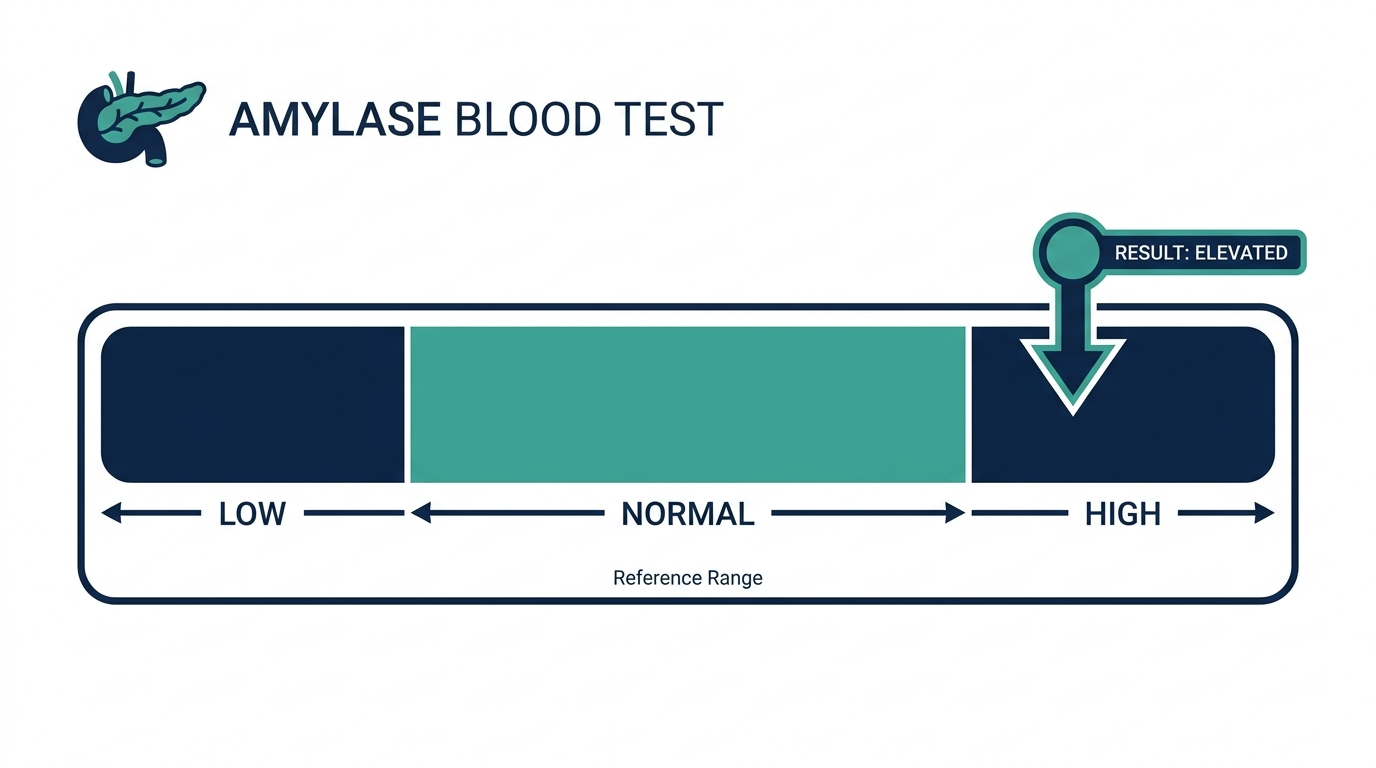
- A high amylase result means your blood holds more of the digestive enzyme amylase than the normal reference range of about 30 to 110 units per liter (U/L), often pointing to the pancreas or salivary glands (Cleveland Clinic; MedlinePlus).
- The classic cause is acute pancreatitis, which typically pushes amylase to three or more times the upper limit of normal, but infections, intestinal problems, mumps, kidney disease, and certain medicines can also raise it (StatPearls, NCBI).
- A high amylase with a normal lipase is frequently not pancreatitis at all and can reflect a harmless lifelong condition called macroamylasemia, which affects roughly 1 percent of people (PMC, NIH).

What does a high amylase result mean, and what is the cutoff?
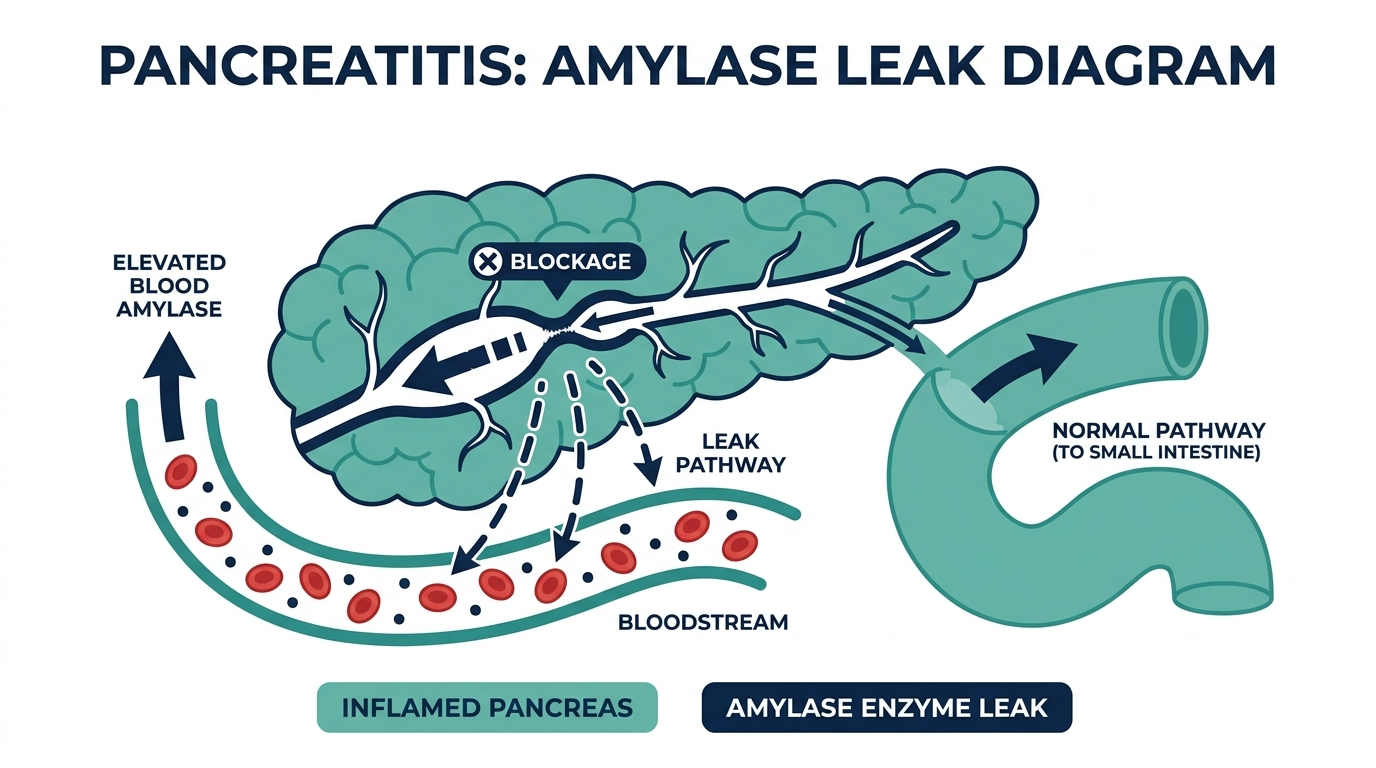
A high amylase result means the level of amylase in your blood is above the laboratory’s reference range, which is usually around 30 to 110 U/L for adults, though it varies by lab and method (Cleveland Clinic; MedlinePlus). Amylase is a digestive enzyme made mostly by your pancreas and salivary glands to break down starch, so a high reading signals that one of those organs may be leaking enzyme into your bloodstream.
The number matters. A mild bump just above the top of the range is interpreted very differently from a dramatic spike. In acute pancreatitis, amylase often climbs to three times or more above the upper limit of normal, and many labs use that threshold as a diagnostic flag (Hyperamylasemia, StatPearls). A small elevation has a much wider list of possible explanations, many of them benign.

What causes high amylase?
The most common cause of a markedly high amylase is acute pancreatitis, which can raise the level four to six times above normal (Medical News Today, clinically reviewed; StatPearls). But amylase is not specific to the pancreas, and many other conditions can lift it.
- Pancreatic causes: acute pancreatitis, a flare of chronic pancreatitis, pancreatic pseudocyst, and pancreatic cancer.
- Salivary causes: mumps, salivary duct stones or blockage, and salivary gland tumors, since these glands also produce amylase.
- Gut causes: a perforated peptic ulcer, bowel obstruction, dead bowel tissue, and appendicitis, which let amylase enter the circulation (StatPearls, Analytical and Clinical Perspectives on Amylase).
- Other causes: kidney disease (which slows enzyme clearance), heavy alcohol use, some medicines, ectopic pregnancy, and diabetic ketoacidosis.
Because the list is long, doctors rarely judge amylase alone. They pair it with lipase, your symptoms, and imaging to find the true source.
What are the symptoms, or is it silent?
High amylase itself causes no symptoms. The number is just a marker, so what you feel depends entirely on the underlying cause. Many people with a mildly elevated amylase, especially from macroamylasemia, feel completely fine and only learn of it through a routine blood panel (Macroamylasemia versus Hyperamylasemia, PMC).
When the cause is pancreatitis, symptoms are usually hard to miss. The hallmark is severe upper abdominal pain, often boring straight through to the back, frequently with nausea and vomiting, fever, and a rapid pulse. The pain commonly worsens after eating. Salivary causes such as mumps bring swelling and tenderness near the jaw and cheeks instead. If your amylase is high but you feel well, that combination itself is a clue that points away from acute pancreatitis and toward a benign or extrapancreatic explanation.
When is a high amylase dangerous?
A high amylase is dangerous when it reflects acute pancreatitis or another acute abdominal emergency, not because of the enzyme level itself. Amylase that sits at three or more times the upper limit of normal alongside severe abdominal pain is a recognized warning sign that needs urgent evaluation (StatPearls).
Severe acute pancreatitis can lead to dehydration, low blood pressure, organ stress, and infection, so it is treated as a medical emergency. The level of amylase does not predict how severe pancreatitis will be, which is why doctors watch your clinical picture closely rather than the number alone. Conditions like a perforated ulcer, bowel infarction, or obstruction are surgical emergencies in their own right. The reassuring side is that an isolated mild elevation with normal lipase and no symptoms is usually low risk and often turns out to be harmless once macroamylasemia or another minor cause is confirmed.
The insider nuance: amylase high but lipase normal
An isolated high amylase with a normal lipase is the single most useful pattern to know, because it often means you do not have pancreatitis. Lipase is a more reliable marker of acute pancreatitis than amylase, and lipase stays elevated longer, up to 8 to 14 days versus about 5 days for amylase (Medscape, Lipase Reference Range).
When amylase is up but lipase is normal, clinicians look beyond the pancreas. A leading explanation is macroamylasemia, a benign condition where amylase binds to large antibody complexes, slows its exit through the kidneys, and accumulates harmlessly in the blood. It affects roughly 1 percent of people and accounts for about 2 to 5 percent of all high amylase results (PMC, NIH). It is not pancreatitis, will not progress, and needs no treatment. A simple urine test called the amylase creatinine clearance ratio can confirm it and spare you invasive workups.
What to do next, and when to see a doctor
What you should do depends on how high the result is and how you feel. Always review the result with the clinician who ordered it, since reference ranges and context differ by lab and by person (MedlinePlus).
- Seek emergency care now if you have a high amylase with severe upper abdominal pain, persistent vomiting, fever, or a racing heart. These can signal acute pancreatitis or another abdominal emergency.
- Book a prompt visit if you feel unwell with milder abdominal discomfort, nausea, or loss of appetite so your doctor can add a lipase test and imaging.
- Schedule a routine follow-up if you feel completely fine and the elevation is mild. Your doctor may simply repeat the test, check lipase, and consider macroamylasemia.
Tell your clinician about alcohol use, all medicines and supplements, abdominal surgeries, and any kidney or salivary problems, because each can change how your result is read.
Macroamylasemia: the benign look-alike worth understanding
Because it explains a meaningful share of high amylase results and is completely harmless, macroamylasemia deserves a fuller look. In this condition, amylase molecules bind to larger proteins in the blood, usually antibody complexes, forming a bundle too big for the kidneys to filter out efficiently. The amylase therefore accumulates in the bloodstream and reads high, even though nothing is wrong with the pancreas.
The key features that distinguish it from pancreatitis:
- No symptoms. People with macroamylasemia typically feel completely well and discover the high amylase incidentally on a routine panel.
- Normal lipase. Lipase does not form these complexes the same way, so it stays normal. A high amylase with a normal lipase is the classic hint.
- It is stable and lifelong. It does not progress to disease and needs no treatment.
To confirm it without invasive testing, clinicians can use a simple urine-based calculation called the amylase to creatinine clearance ratio (ACCR). Because the large complexes are not cleared into the urine, macroamylasemia produces a characteristically low ratio, which helps separate it from true pancreatic disease. Recognizing this pattern can spare a healthy person from unnecessary scans and procedures, which is exactly why the amylase-normal-lipase combination is worth flagging to your doctor.

Causes of a high amylase, sorted by likelihood and system
A high amylase is a signpost, not a diagnosis, and the right interpretation depends on how high it is and what else is present. Grouping the causes helps you reason through it.
- Markedly high (three or more times normal), with pain: most often acute pancreatitis. This is the pattern that demands urgent attention.
- Pancreatic, other: a flare of chronic pancreatitis, a pancreatic pseudocyst, duct obstruction, or a pancreatic tumor.
- Salivary: mumps, a salivary duct stone, salivary gland infection, or gland tumors. The salivary glands make amylase too, so these raise the total without any pancreas involvement.
- Abdominal emergencies: a perforated ulcer, bowel obstruction, dead bowel tissue, or appendicitis, which allow amylase into the circulation.
- Reduced clearance: kidney disease slows amylase removal and commonly produces a mild rise.
- Metabolic and other: diabetic ketoacidosis, heavy alcohol use, ectopic pregnancy, and certain medications.
- Benign: macroamylasemia, a lifelong harmless cause that accounts for a notable fraction of unexplained elevations.
The single most useful next question, once amylase is high, is what the lipase is doing. A high amylase with a high lipase points toward the pancreas; a high amylase with a normal lipase points away from it.
How doctors actually diagnose the cause
Finding out why amylase is high follows a fairly consistent logic. Understanding it helps you know what to expect and what questions to ask.
- Add lipase. Because lipase is more specific to the pancreas and stays elevated longer, it is the first companion test. It often decides whether the pancreas is even in the picture.
- Apply the pancreatitis criteria. The Revised Atlanta Classification diagnoses acute pancreatitis when at least two of three are present: typical abdominal pain, an enzyme (amylase or lipase) three or more times the upper limit of normal, and imaging findings. A high enzyme alone is not enough.
- Image when needed. An abdominal ultrasound can look for gallstones, and a CT scan can visualize the pancreas when the diagnosis is unclear or complications are suspected.
- Check kidney function. Since impaired kidneys raise amylase by clearing it slowly, creatinine is part of the interpretation.
- Consider macroamylasemia when amylase is high, lipase is normal, and the person feels well, using the amylase to creatinine clearance ratio to confirm.
This stepwise approach is why a single high amylase on a report rarely leads straight to a diagnosis. The value opens the investigation; lipase, symptoms, kidney function, and imaging close it.
If it is pancreatitis: what treatment and recovery look like
When a high amylase does turn out to reflect acute pancreatitis, care follows well-established principles, and knowing them makes the diagnosis less frightening.
- Hospital-based supportive care. The mainstays are intravenous fluids, pain control, and monitoring. Early care often means resting the digestive tract briefly, then reintroducing food as tolerated.
- Treating the trigger. If gallstones caused it, gallbladder surgery may be advised to prevent recurrence. If alcohol is the driver, stopping alcohol is central. If very high triglycerides are involved, lowering them matters.
- Watching for complications. Most mild cases settle within days. Severe cases, the minority, can involve dehydration, low blood pressure, organ stress, or infection, which is why prompt evaluation of severe pain matters.
The enzyme number itself does not steer treatment, and it does not predict severity. A very high amylase is not automatically a sicker patient than a moderately high one. Clinicians follow the clinical picture, imaging, and other labs, not the amylase peak, to gauge how serious a case is.
Sample interpretation scenarios
These teaching examples show how a high amylase is read differently depending on context. They illustrate the reasoning and are not a substitute for your clinician reviewing your results.
- Amylase 5 times normal, lipase also high, severe upper abdominal pain to the back. This fits acute pancreatitis and is an emergency; two Atlanta criteria are already met.
- Amylase mildly high, lipase normal, no symptoms, discovered on a routine panel. The pattern suggests a benign cause, often macroamylasemia or kidney-related clearance. The amylase to creatinine clearance ratio can confirm macroamylasemia.
- Amylase high, lipase normal, swollen tender cheeks and jaw. Think salivary source such as mumps or a duct stone, not the pancreas.
- Amylase mildly high with known reduced kidney function. Reduced clearance is the likely explanation, and the value is interpreted alongside creatinine.
- Amylase high with acute severe belly pain but a normal lipase very early or very late in the course. Enzymes can lag the attack, so imaging and clinical judgment carry the diagnosis when the numbers are equivocal.
Preparation and factors that can skew a high result
Amylase is a stable, standardized test, but a few factors influence the number or its meaning.
- Fasting is usually not required for amylase alone, though it is often drawn with tests that do need fasting, so follow your instructions.
- Alcohol and medications matter. Heavy alcohol use and certain drugs can raise amylase, so disclose them for accurate interpretation.
- Kidney function shapes the value. Reduced kidney function raises amylase independent of the pancreas.
- Timing in an acute event. Amylase rises within hours but falls within a few days, so a late test during a genuine attack can read deceptively normal, which is one more reason lipase is favored.
- Macroamylasemia can keep it persistently high in a healthy person, so a chronically elevated amylase with no symptoms is worth confirming rather than repeatedly re-imaging.
Amylase and lipase side by side
Because so much of interpreting a high amylase comes down to what the lipase is doing, a direct comparison is useful. Both are digestive enzymes released when the pancreas is injured, but they differ in ways that shape how a high amylase is judged.
| Feature | Amylase | Lipase |
|---|---|---|
| Main sources | Pancreas and salivary glands | Mostly pancreas |
| Specificity for pancreatitis | Lower | Higher |
| How long it stays high | About 5 days | Up to 8 to 14 days |
| Benign look-alike | Macroamylasemia (harmless) | Less commonly affected |
| Role today | Supporting marker | Preferred first-line marker |
Want to check your amylase?
Three ways to get it measured. Pick whichever fits you.
Affiliate links: we may earn a commission at no extra cost to you. A lab test does not replace a visit with your clinician.
Read together, the pair is more informative than either alone. A high amylase with a high lipase concentrates suspicion on the pancreas, while a high amylase with a normal lipase pushes the search toward salivary glands, kidneys, or the benign macroamylasemia pattern. This is precisely why clinicians so often order both.
Common misconceptions about a high amylase
A few myths cause needless anxiety when people see a flagged amylase. Clearing them up helps you respond calmly and correctly.
- “High amylase always means pancreatitis.” It does not. Salivary disease, kidney impairment, abdominal emergencies, medications, and benign macroamylasemia can all raise it. A mild rise with normal lipase and no symptoms is frequently harmless.
- “A higher number means a worse case.” The magnitude of the amylase elevation does not predict how severe pancreatitis is. Severity is judged clinically, with imaging and other labs.
- “A high amylase needs treatment to bring it down.” You treat the cause, not the number. If the cause is macroamylasemia, there is nothing to treat at all.
- “Feeling fine with a high amylase is a red flag.” Often the opposite is true. Feeling well with a high amylase and a normal lipase is reassuring and points toward a benign explanation, though it still deserves a mention to your doctor.
The unifying lesson across this article is that a high amylase is a starting clue, not a conclusion. Paired with lipase, symptoms, kidney function, and, when needed, imaging, it becomes genuinely useful. Read in isolation, it invites overreaction.
Amylase across ages and specific groups
The same high amylase can mean different things depending on who it belongs to, because the usual causes shift by age and by health background. Reading a result against the person, not just the reference range, is part of what keeps a benign elevation from turning into a scare.
- Children: In kids, salivary causes such as mumps or another cause of swollen salivary glands are a more prominent reason for a raised amylase than they are in adults, which is one reason clinicians look at whether lipase is also up before assuming the pancreas is involved.
- Older adults: With age, kidney function often declines, and because the kidneys clear amylase, a mildly high value can reflect slower clearance rather than any pancreatic problem. Medications also accumulate in this group, and several can nudge amylase upward.
- People with kidney disease: Reduced kidney function raises amylase independently of the pancreas, so a persistently elevated value in someone with known kidney impairment is often expected and read with that context front and center.
The common thread is that a number outside the range is a question, not an answer, and the person’s age and background are a large part of what supplies the answer.
Questions to ask your doctor about a high amylase
Walking into a follow-up with a few focused questions turns a worrying result into a clear plan. Because a high amylase is a starting clue rather than a diagnosis, the most useful questions push toward context and next steps rather than the number itself.
- Was my lipase checked, and what did it show? A high amylase with a normal lipase points away from the pancreas and toward a benign or non-pancreatic cause, so this pairing often reframes the whole result.
- Could this be from my kidneys, a medication, or my salivary glands? Each is a common non-pancreatic reason, and naming them helps your clinician decide what to rule out.
- Should we test for macroamylasemia? If the amylase stays high but you feel well, this benign look-alike is worth confirming so you are not sent for repeated imaging.
- Do I need imaging, or is a recheck enough? For a mild, symptom-free elevation, a repeat test is often the reasonable next move rather than a scan.
Asking these keeps the conversation anchored to what actually changes the plan, and it usually shortens the path from a flagged value to a calm, sensible answer.
Frequently asked questions
Is a high amylase level always serious?
No. A markedly high amylase, three or more times the upper limit of normal with abdominal pain, can be serious and suggests pancreatitis. But a mild rise, especially with a normal lipase and no symptoms, is often benign and may simply reflect macroamylasemia or kidney-related clearance.
What amylase number indicates pancreatitis?
Acute pancreatitis usually pushes amylase to at least three times the upper limit of normal, often four to six times higher, according to StatPearls. With a typical top of range near 110 U/L, that means levels above roughly 330 U/L raise concern, though doctors confirm with lipase and imaging.
Can high amylase come from something other than the pancreas?
Yes. Salivary gland disease like mumps, a perforated ulcer, bowel obstruction, appendicitis, kidney disease, heavy alcohol use, certain medicines, and macroamylasemia can all raise amylase. That is why an elevated amylase with a normal lipase points doctors toward non-pancreatic causes.
What is the difference between amylase and lipase tests?
Both are digestive enzymes, but lipase is more specific and sensitive for acute pancreatitis and stays elevated longer, up to 8 to 14 days versus about 5 days for amylase. Doctors often order both together to separate pancreatic from non-pancreatic causes of a high amylase.
Should I worry if my amylase is high but I feel fine?
Feeling well with a high amylase is reassuring and often points to a benign cause such as macroamylasemia, which affects about 1 percent of people. Still, share the result with your doctor, who may repeat the test, check lipase, and rule out kidney or salivary causes.
Sources
- Cleveland Clinic, Amylase Test
- MedlinePlus, Amylase Test
- StatPearls (NCBI), Hyperamylasemia
- StatPearls (NCBI), Analytical and Clinical Perspectives on Amylase
- PMC (NIH), Macroamylasemia versus Hyperamylasemia
- Medscape, Lipase Reference Range
- Medical News Today, Amylase Blood Test (clinically reviewed)
This article is for general educational purposes and is not medical advice. It cannot diagnose or treat you and does not replace your clinician. Always discuss your lab results and any health decisions with a qualified healthcare professional.
Vital Signs Today may earn a commission if you buy through links on this page. It does not affect our editorial assessments.