You feel exhausted no matter how much you sleep, the scale is creeping in the wrong direction, your hair is thinning, and someone finally said the word “thyroid.” So you sit down to book a blood test and immediately hit a wall of letters: TSH, T4, T3, free this, total that, antibodies. Which one actually checks your thyroid?
Exhausted, thinning hair, stubborn weight. Want to see your full thyroid panel instead of guessing which test to book? One at-home Superpower draw checks 100+ biomarkers, physician-reviewed.
Here is the part most people get wrong. There is no single “thyroid test.” There is a small family of tests, and they are ordered in a deliberate order for a reason. Knowing that order is the difference between getting a real answer and getting a bill for the wrong panel.
What blood test is for thyroid?
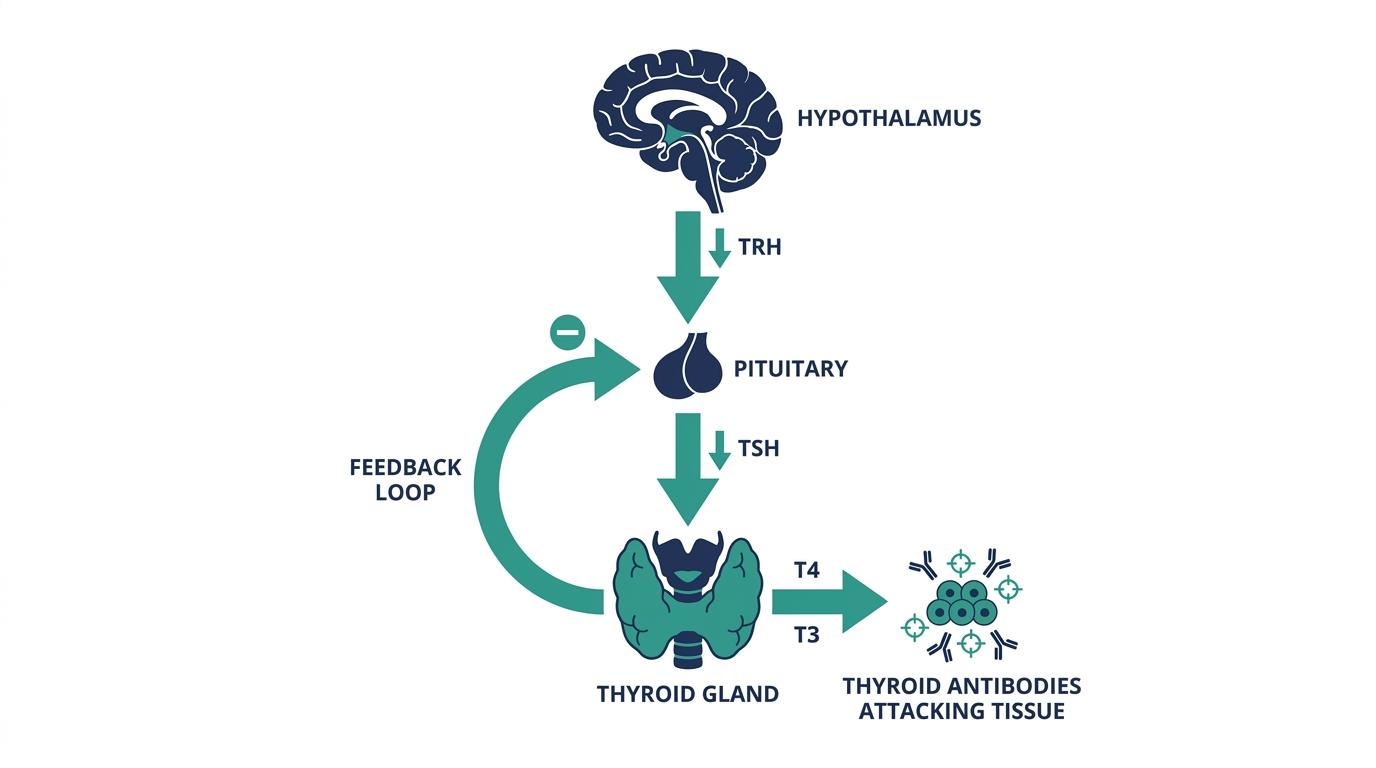
The first and most important blood test for thyroid is the TSH test, short for thyroid-stimulating hormone. It is almost always the first test a provider orders to check thyroid function (Cleveland Clinic). After TSH, the next tests are T4 (thyroxine), T3 (triiodothyronine), and, when an autoimmune cause is suspected, thyroid antibody tests.
Think of it as a tiered system. TSH is the screening question that tells your provider whether your thyroid is keeping up. If TSH comes back off, T4 and T3 measure the actual hormones your thyroid is producing, and antibodies reveal whether your own immune system is the cause. So when someone asks what blood test is for thyroid, the honest answer is: start with TSH, then add the others only if the picture demands it.

What blood test shows thyroid function best?
TSH is the single test that shows thyroid function best, which is why it leads almost every thyroid workup (MedlinePlus). It works through a clever feedback loop. TSH is not made by your thyroid at all. It is made by your pituitary gland in your brain, which acts like a thermostat. When your thyroid hormone runs low, the pituitary pumps out more TSH to push the thyroid harder. When thyroid hormone runs high, the pituitary backs off and TSH drops.
That inverse relationship is the whole trick. Because the pituitary is exquisitely sensitive to even tiny shifts in thyroid hormone, TSH often moves before your actual hormone levels look abnormal. A single TSH number tells your provider whether the system as a whole is balanced, which is why which blood test is for thyroid almost always starts here.
What does a blood test show for thyroid?
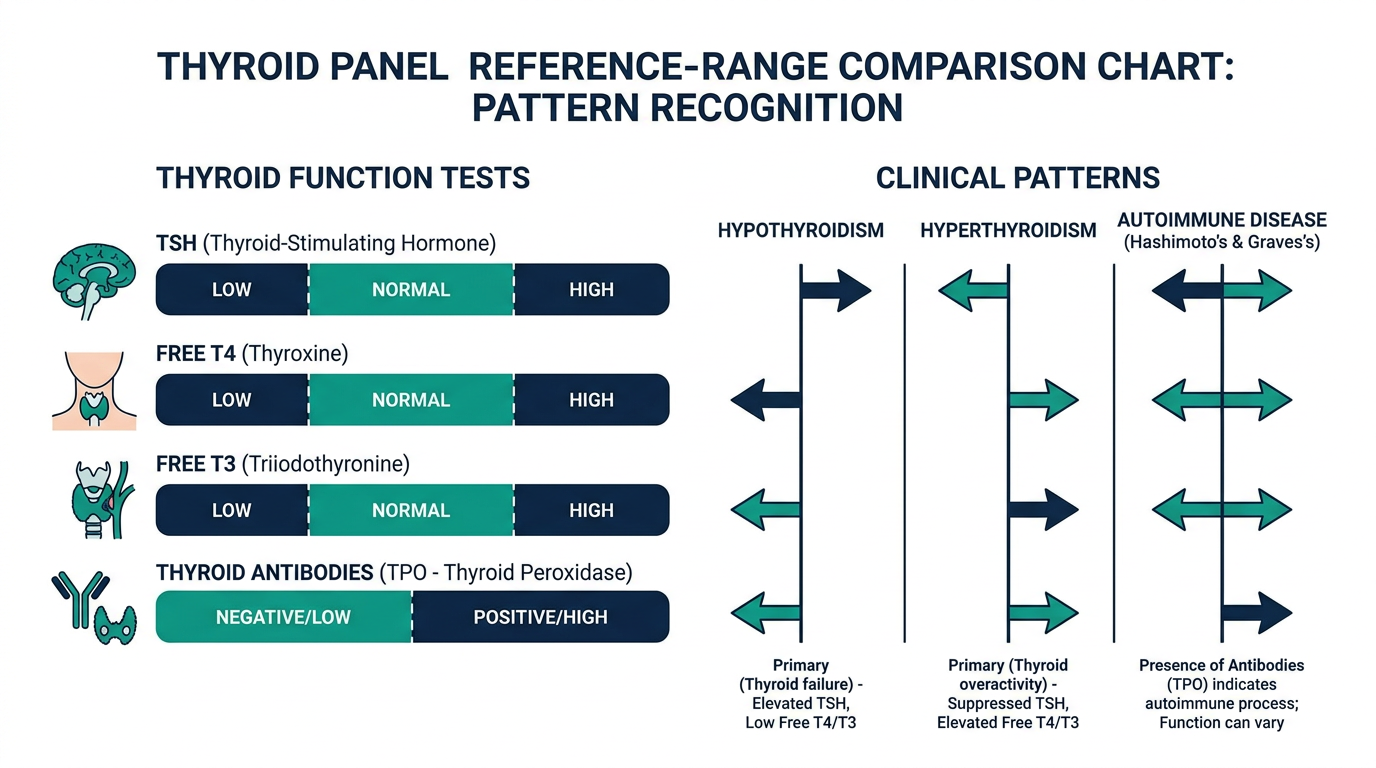
A thyroid blood test panel shows three different things: the signal from your brain (TSH), the hormones your thyroid is actually making (T4 and T3), and whether your immune system is attacking the gland (antibodies). Each piece answers a different question.
- TSH shows the pituitary’s signal, the demand side. High demand means the thyroid is underperforming; low demand means it is overproducing (MedlinePlus).
- T4 (thyroxine) shows the main hormone your thyroid releases, the supply side. Free T4 measures the portion not bound to proteins and able to enter your tissues, and providers generally prefer it over total T4 because it is more accurate (Cleveland Clinic).
- T3 (triiodothyronine) shows the more active hormone, used mainly to pin down hyperthyroidism when TSH and T4 are off (MedlinePlus).
- Thyroid antibodies show whether an autoimmune disease is the root cause (MedlinePlus).
So does a blood test show thyroid problems? Yes, clearly, but the read is most useful when these markers are interpreted together rather than one at a time.
What is the abbreviation for thyroid on a blood test?
The main abbreviation for the thyroid blood test is TSH, which stands for thyroid-stimulating hormone. If you see TSH on a lab order or a results page, that is the core thyroid screen. The other abbreviations you will commonly run into are T4 (thyroxine), T3 (triiodothyronine), FT4 or “free T4,” FT3 or “free T3,” and the antibody markers TPO (thyroid peroxidase), TgAb (thyroglobulin antibodies), and TRAb (thyrotropin receptor antibodies).
People often search for the abbreviation for thyroid blood test expecting one neat acronym. In practice TSH is the one to memorize. Everything else is a supporting cast that gets added when TSH points to a problem.

What is a normal thyroid blood test level?
A commonly cited reference range for TSH in adults is roughly 0.4 to 4.0 mIU/L, though the exact cutoffs vary by lab and method (MedlinePlus). For free T4, Cleveland Clinic lists a normal adult range of about 0.9 to 1.7 ng/dL (Cleveland Clinic).
Two practical points. First, always read your result against the reference range printed on your own report, because that is the range your specific lab calibrated. Second, a TSH inside the range does not automatically mean your thyroid is perfect, and a TSH slightly outside it does not automatically mean disease. Reference ranges describe a population, and your provider reads your number in the context of your symptoms.
What does a high TSH mean?
A high TSH usually means an underactive thyroid, known as hypothyroidism. The logic follows the thermostat: when your thyroid is not making enough hormone, the pituitary cranks up TSH to try to force more output (Cleveland Clinic). The classic symptoms line up with a slowed metabolism: fatigue, weight gain, cold intolerance, dry skin, constipation, and a slow heart rate.
When TSH is high, providers typically check free T4. A high TSH paired with a low free T4 confirms overt hypothyroidism, where the gland is genuinely falling short (Cleveland Clinic). A high TSH with a still normal free T4 points to subclinical hypothyroidism, an early or mild form where the system is straining but hormone levels have not yet dropped.
What does a low TSH mean?
A low TSH usually means an overactive thyroid, known as hyperthyroidism. The pituitary senses too much thyroid hormone in circulation and dials TSH down toward zero (MedlinePlus). The symptoms reflect a revved-up metabolism: weight loss, a racing or irregular heartbeat, anxiety, tremor, heat intolerance, and more frequent bowel movements.
With a low TSH, providers confirm by measuring free T4 and often T3. High T3, sometimes elevated even when T4 is borderline, is a hallmark of hyperthyroidism, which is exactly why the T3 test exists as a confirmatory step (MedlinePlus). A low TSH with elevated free T4 or T3 confirms an overactive gland.

Why are antibody tests added to a thyroid panel?
Antibody tests are added because TSH, T4, and T3 tell you whether your thyroid is misbehaving, but not why. Antibodies reveal the most common cause: autoimmune disease, where your immune system mistakenly attacks your own thyroid (MedlinePlus).
The two big diagnoses map onto specific antibodies. High thyroid peroxidase antibodies (TPOAb) or thyroglobulin antibodies (TgAb) are a sign of Hashimoto’s disease, the leading cause of hypothyroidism in the United States. Thyrotropin receptor antibodies (TRAb) point toward Graves’ disease, the leading cause of hyperthyroidism (MedlinePlus). Identifying the autoimmune cause changes how the condition is monitored and treated over time.
The part most people miss: don’t let a single TSH end the conversation
Here is the insider point that rarely makes it into the patient handout. A “normal” TSH can hide a real problem, and a single abnormal TSH can be a false alarm. TSH is sensitive, but it is a signal about a signal, not a direct measure of your thyroid hormones.
A few situations trip people up. TSH can swing temporarily during acute illness, after high-dose steroids, or with certain supplements, so one off reading deserves a repeat before any label sticks. Biotin, a popular hair and nail supplement, can interfere with many thyroid immunoassays and skew results, which is why labs often tell you to pause it before testing. And in rare central hypothyroidism, the problem is the pituitary itself, so TSH may look low or normal even though the thyroid is genuinely underactive, a pattern you only catch by looking at free T4 alongside it (MedlinePlus).
The takeaway is not to panic over one number, in either direction. It is to make sure your provider reads TSH together with free T4, and adds T3 or antibodies when the story calls for it. One isolated TSH is a starting point, not a verdict.
How to prepare for a thyroid blood test
A thyroid panel is easy to draw, but a few habits can move the numbers enough to muddy the read. Getting the prep right is worth more than any single clever question you ask afterward.
- Biotin is the big one. Biotin, the B vitamin sold in most hair, skin, and nail supplements, interferes with many of the immunoassays labs use to measure TSH, T4, and T3. Depending on the assay, it can push a result falsely high or falsely low, which can mimic either an overactive or underactive thyroid on paper. Many labs advise pausing biotin for a couple of days before a thyroid draw. Ask your clinician or the lab how long to hold it.
- Fasting is usually not required. TSH and the thyroid hormones do not need an empty stomach the way glucose and lipids do. If your thyroid tests are bundled with a metabolic or lipid panel, though, you may still be asked to fast for those.
- Timing can matter for people on replacement. If you already take levothyroxine, when you take your pill relative to the blood draw can shift the reading, so follow your clinician’s instructions on dosing and timing on test day.
- Recent illness skews TSH. An acute illness, a hospital stay, or high-dose steroids can transiently move TSH, a pattern sometimes called sick euthyroid. That is one more reason a single odd TSH during a rough week deserves a calm recheck later rather than an immediate label.
The short version: tell your clinician everything you take, including over-the-counter supplements, and ask specifically about biotin and about whether any part of your panel requires fasting.
Reading the pattern: worked interpretation scenarios
Thyroid results make far more sense as combinations than as single numbers. The table below maps the common patterns clinicians look for. Read it as a way to understand your own report, not as a substitute for your provider’s interpretation.
| TSH | Free T4 | Common interpretation |
|---|---|---|
| High | Low | Overt hypothyroidism, the gland is genuinely underperforming |
| High | Normal | Subclinical hypothyroidism, an early or mild strain on the system |
| Low | High | Overt hyperthyroidism, the gland is overproducing |
| Low | Normal | Subclinical hyperthyroidism, often watched and rechecked |
| Low or normal | Low | Possible central hypothyroidism, where the pituitary is the problem, needs specialist input |
Subclinical hypothyroidism is usually defined as a TSH above the upper limit of normal, often in the range up to about 10 mIU/L, together with a free T4 that still sits inside its reference range. It matters because it can be the earliest visible stage of a thyroid that is starting to fall behind, and whether to treat it depends on how high the TSH is, your symptoms, your antibodies, and your other risk factors. This is a decision for you and your clinician, not for an online chart.
The central hypothyroidism row is the one that catches people out. Because TSH is a signal from the pituitary rather than a direct thyroid measure, a failing pituitary can leave TSH looking low or normal while the thyroid is genuinely underactive. You only spot it by reading free T4 alongside TSH, which is exactly why good workups do not stop at a single screening number.
Symptoms that should prompt a thyroid test
Thyroid disease is easy to miss because its symptoms overlap with ordinary stress, aging, and busy life. The tell is often a cluster rather than one complaint, and the direction of the cluster hints at whether the gland is running slow or fast.
- Signs that suggest an underactive thyroid: persistent fatigue that sleep does not fix, unexplained weight gain, feeling cold when others are comfortable, dry skin, thinning hair, constipation, low mood, brain fog, and a slow heart rate.
- Signs that suggest an overactive thyroid: unexplained weight loss, a racing or irregular heartbeat, anxiety or restlessness, a fine tremor in the hands, heat intolerance and sweating, trouble sleeping, and more frequent bowel movements.
- Signs worth flagging regardless of direction: a visible swelling at the base of the neck, a change in the voice, or difficulty swallowing, all of which can point to a goiter or nodule and deserve a prompt look.
None of these symptoms is proof of a thyroid problem on its own, since each has many possible causes. But when several show up together and stick around, a TSH is a cheap, sensible first step to rule the thyroid in or out.
Special situations: pregnancy, family history, and medications
Thyroid testing is not one-size-fits-all, and a few groups need a different approach.
- Pregnancy. Thyroid hormones shift during pregnancy, and the standard reference ranges do not apply cleanly. Guidelines use trimester-specific ranges, with a lower upper limit for TSH in early pregnancy than in the non-pregnant population, because even mild thyroid dysfunction can affect maternal and neonatal outcomes (NIH). Screening is typically risk-based rather than universal, and women with known or at-risk thyroid disease are often monitored on a set schedule through pregnancy. If you are pregnant or planning to be, this is a conversation to have early with your clinician.
- Family history and autoimmune disease. Autoimmune thyroid disease runs in families and clusters with other autoimmune conditions. A family history of Hashimoto’s or Graves’, or a personal history of another autoimmune disease, lowers the threshold for testing and for adding antibody markers.
- People on thyroid or other medications. Anyone on levothyroxine or antithyroid drugs needs periodic TSH checks to keep the dose right, since needs change over time. Some non-thyroid medications, including certain heart and psychiatric drugs, also affect thyroid function and may warrant monitoring.
What happens after an abnormal thyroid result
An off TSH is the beginning of a process, not the end of one. Knowing the usual next steps takes the fear out of a flagged number.
- Confirm before you commit. A borderline or mildly abnormal TSH is often repeated, usually with a free T4 added, before any diagnosis is made. One reading during illness, stress, or biotin use can mislead.
- Find the cause. If the repeat confirms a problem, antibody tests help identify whether autoimmune disease is behind it. High TPO or thyroglobulin antibodies point toward Hashimoto’s as a driver of an underactive gland, while thyrotropin receptor antibodies point toward Graves’ behind an overactive one.
- Treat and monitor. Overt hypothyroidism is typically treated with daily hormone replacement, with follow-up TSH tests to fine-tune the dose. Hyperthyroidism has several treatment paths, chosen with a specialist, and also relies on repeat labs to track the response.
- Re-test on a schedule. Because the thyroid can drift over months and years, and because treatment needs change, ongoing monitoring is the norm rather than a one-time check.
The common thread is patience and pattern-reading. A thyroid diagnosis is built from repeated, contextual results, which is why the smartest move after a single surprising number is to schedule the follow-up your clinician recommends rather than to draw conclusions overnight.
Common mistakes when reading a thyroid panel
Even when the right tests are ordered, a few interpretation traps send people to the wrong conclusion. Knowing them ahead of time keeps a normal report from causing worry and stops a borderline one from being dismissed.
- Judging TSH alone without the free hormone. TSH is the sensitive first screen, but a TSH result reads very differently depending on the free T4 beside it. A high TSH with a low free T4 points to an underactive thyroid, while a high TSH with a still-normal free T4 is a milder, subclinical picture. Reading TSH in isolation loses that distinction (Cleveland Clinic).
- Forgetting that TSH moves in the opposite direction you expect. Because TSH is the pituitary’s signal to the thyroid, a high TSH usually means an underactive gland and a low TSH usually means an overactive one. People routinely read this backward.
- Treating one abnormal value as a diagnosis. TSH shifts with acute illness, poor sleep, and time of day, so a single mildly off result is often best confirmed with a repeat before any label is applied.
- Ignoring biotin. High-dose biotin supplements can distort several thyroid immunoassays, occasionally mimicking a thyroid disorder that is not there. Pausing biotin for a couple of days before the draw avoids this artifact.
The thread running through each mistake is the same principle experienced clinicians use: a thyroid panel is a pattern, not a single line. Read TSH together with the free hormone and any antibodies, confirm a borderline result with a repeat, and account for supplements and recent illness before drawing conclusions. That approach turns a confusing set of abbreviations into a coherent picture of how the gland is actually working.
Curious what your own levels look like?
Baseline 100+ biomarkers today and retest as life changes, all in one membership with physician review.
Frequently asked questions
Which blood test is for thyroid?
The primary blood test for thyroid is TSH (thyroid-stimulating hormone), which is almost always ordered first (Cleveland Clinic). If TSH is abnormal, providers add T4, T3, and sometimes thyroid antibody tests to pin down the cause.
What is the abbreviation for thyroid blood test?
The main abbreviation is TSH, for thyroid-stimulating hormone. Other common abbreviations on a thyroid panel are T4 (thyroxine), T3 (triiodothyronine), FT4 (free T4), and antibody markers like TPO, TgAb, and TRAb.
What is a normal thyroid blood test level?
A commonly cited TSH range for adults is about 0.4 to 4.0 mIU/L, and free T4 is roughly 0.9 to 1.7 ng/dL, though ranges vary by lab (MedlinePlus, Cleveland Clinic). Always compare against the reference range on your own report.
Does a blood test show thyroid problems?
Yes. A thyroid blood test panel can show whether your thyroid is underactive or overactive and often reveal the cause (Cleveland Clinic). TSH screens function, T4 and T3 measure the hormones, and antibodies identify autoimmune disease.
What does a high or low TSH mean?
A high TSH generally signals an underactive thyroid (hypothyroidism), while a low TSH generally signals an overactive thyroid (hyperthyroidism) (MedlinePlus). Free T4 and T3 are checked to confirm and grade the finding.
This article is for general educational purposes and is not medical advice. It cannot diagnose or treat you and does not replace your clinician. Always discuss your lab results and any health decisions with a qualified healthcare professional.
Related reading
Related: best thyroid and hormone tests of 2026.
Vital Signs Today may earn a commission if you buy through links on this page. It does not affect our editorial assessments.