
Last updated 18 June 2026. Educational content, not medical advice. Many peptides discussed here are not FDA-approved for human use; some require a prescription. Speak with a licensed clinician before starting any peptide protocol.
Short answer: The safest place to get a therapeutic peptide in 2026 is a telehealth clinic or compounding pharmacy with a valid prescription, which costs $199 to $399 a month and gives you a named pharmacist, a real clinician, and a chain of custody for every vial. Over-the-counter collagen and topical copper peptides are available at GNC, Amazon, and most health-food stores for $20 to $60. Research-grade injectable peptides are technically legal to purchase labeled “for research use only,” but you carry every single risk yourself and the regulatory ground is shifting fast toward the licensed route anyway.
There are four real routes to get a peptide safely in 2026, and every one of them starts with knowing your own bloodwork. One at-home Superpower draw checks 100+ biomarkers, physician-reviewed.
Why does the route you choose matter so much right now?
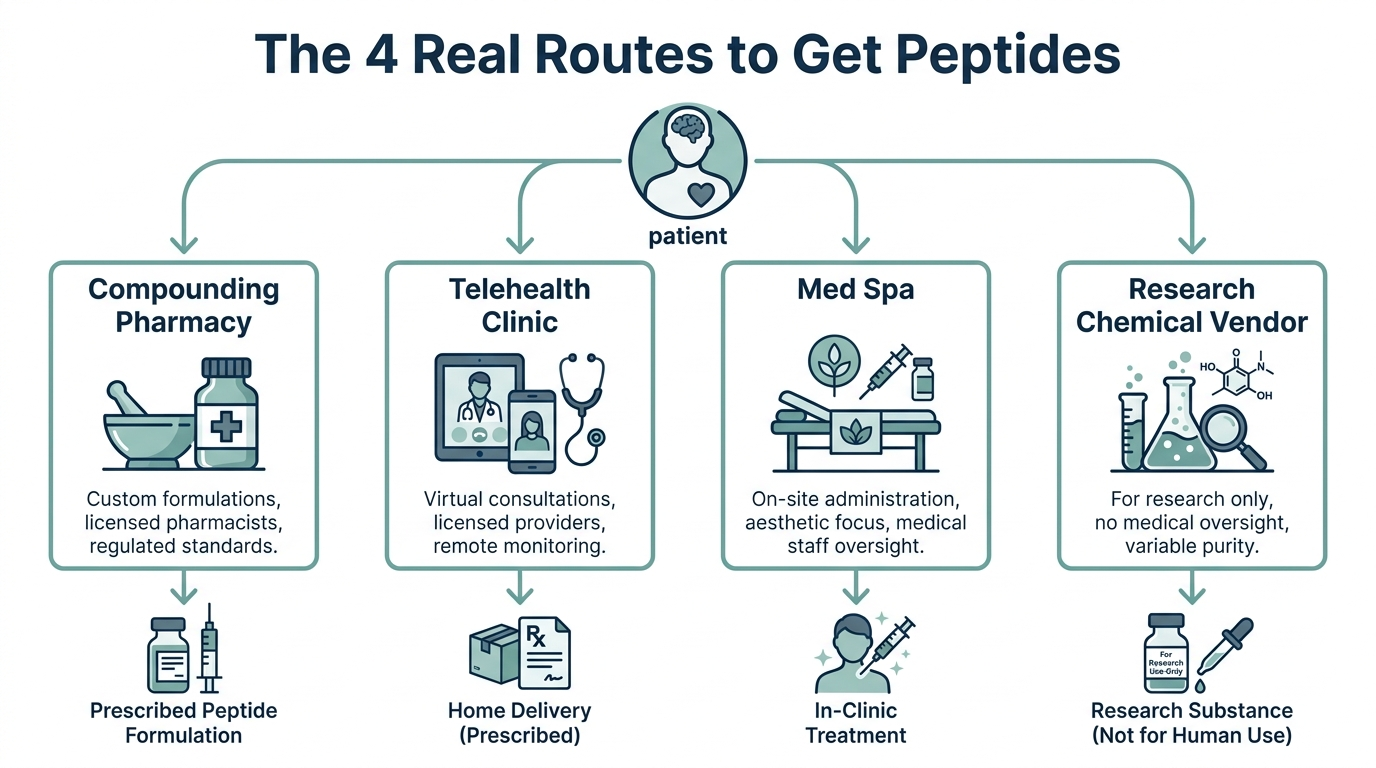
The peptide market in 2026 is not a stable place to navigate by feel. Between late 2024 and early 2026, a wave of FDA warning letters, a federal warehouse raid in June 2025, and multiple Department of Justice criminal pleas dismantled the grey-market vendor landscape most people relied on. Peptide Sciences, long the default recommendation across every longevity forum, posted a goodbye notice on 6 March 2026 with no warning and no refunds. Science.bio had gone dark two months earlier.
At the same time, the regulatory pendulum swung back the other direction. On 27 February 2026, HHS Secretary Kennedy announced that approximately 14 previously restricted peptides, including BPC-157, TB-500, CJC-1295, Ipamorelin, GHK-Cu (injectable), KPV, and MOTS-C, are expected to move from the FDA’s Category 2 restricted list back to Category 1, which permits licensed compounding. The FDA removed BPC-157 from Category 2 on 15 April 2026 and scheduled a Pharmacy Compounding Advisory Committee meeting for 23 to 24 July 2026 at the FDA’s White Oak Campus in Silver Spring, Maryland, where experts will decide whether these peptides join the legally compoundable bulks list.
The net result: the grey market is getting riskier and the licensed route is getting cheaper and more accessible at the same time.
Understanding which route fits which peptide is not optional anymore. The four routes differ by legal status, cost, what verification is possible, and what accountability exists when something goes wrong.
Full-body lab membership: 100+ biomarkers, doctor-reviewed, tracked over time.
Route 1: Telehealth clinic with a prescription (the one that holds up)
This is the route that has matured fastest in 2026, and it is better than most people on the forums will admit. A telehealth peptide clinic connects you with a licensed physician, nurse practitioner, or physician assistant who reviews your intake form, orders baseline bloodwork, writes a prescription, and sends it to a named 503A or 503B compounding pharmacy. The medication arrives ready to use with pharmacy labeling, concentration verified by an independent Certificate of Analysis, and a clinician you can actually call.
Named platforms operating this model include Defy Medical, Marek Health, and Hone Health. OneTwenty launched in June 2026 with a model built around quarterly comprehensive blood panels, continuous wearable data, AI coaching, and a full telehealth visit that turns those numbers into a protocol. Voafit (Arlington, TX), led by an emergency medicine board-certified physician, operates across 41 states.
The Peptide Association maintains a verified directory of 159 licensed providers across all 50 states. Each listing has passed a four-part check: active medical license, board certification, verified 503A or 503B pharmacy sourcing, and documented clinical experience with peptides. That is the fastest way to find a compliant local or telehealth clinic without doing the due-diligence work yourself.
What a legitimate telehealth peptide program actually costs
| Item | Typical range |
|---|---|
| Initial consultation | $150 to $400 |
| Baseline lab work | $100 to $250 (sometimes included) |
| Monthly peptide medication | $200 to $500 |
| Monitoring visits | $75 to $200 per visit, or bundled |
| Full 6-month program, mid-range clinic | $1,900 to $2,200 |
| Full 6-month program, specialist tier (Marek Health) | $2,000 to $3,200 |
| Entry-level monthly subscription (sermorelin or NAD+) | $175 to $225 a month |
Sermorelin specifically runs about $175 to $225 a month through telehealth, compared to $600 to $1,200 a year for old-school synthetic HGH. BPC-157 programs through licensed clinics run $200 to $500 a month for the medication alone, with a single-peptide protocol starting around $445 per treatment cycle at some specialist practices.
None of this is covered by insurance. Compounded peptides for optimization are classified as elective, so budget for it before you start.
The insider tell about which telehealth platforms to avoid
Personally, I find the fastest screen is the pharmacy question. Ask any clinic: “Which 503A or 503B pharmacy are you using?” A legitimate provider names it without hesitation. Massey Drugs, Empower Pharmacy, and Tailor Made Compounding are examples of compliant 503A pharmacies that surface in verified protocols. A clinic that answers the pharmacy question with “our in-house lab” or deflects entirely is not operating a compliant supply chain, no matter how polished the website looks.
A second tell: if a clinic was openly advertising injectable BPC-157 or TB-500 before April 2026, when BPC-157 was still on Category 2, it was either using a non-compliant pharmacy or sourcing from research-chemical vendors and dressing it up in clinical UI. The safe lane and the cutting-corners lane can look identical from the front end.
Route 2: FDA-approved prescriptions through standard pharmacies (the one most people forget)
GLP-1 drugs are peptides. Semaglutide (Ozempic, Wegovy) and tirzepatide (Mounjaro, Zepbound) are among the most widely prescribed medications in the United States in 2026, and you get them through a standard prescription filled at any pharmacy. If you are looking for a peptide for weight loss or metabolic support, this route is fully legal, often insurance-covered for approved indications, and bypasses every purity and authenticity concern entirely.
The compounded-GLP-1 window that opened during the 2022 to 2025 drug shortages largely closed after the FDA declared the tirzepatide shortage resolved on 2 October 2024 and the semaglutide shortage resolved on 21 February 2025. Some telehealth platforms still market compounded GLP-1s through a “personalization” workaround, but as of 2026 the lawful basis requires documented clinical justification for the customization. The $99 compounded semaglutide ads that flooded the internet in 2024 are mostly running on borrowed legal time.
For GLP-1s with a compliant compounding rationale, TeleHealth Med’s SemaglutideRx starts at $147 a month and TirzepatideRx at $199 a month. Most other telehealth providers run $169 to $499 a month depending on dose and subscription structure.
Sermorelin and tesamorelin are also FDA-approved peptides available by prescription through standard pharmacy channels. Sermorelin in particular has become a practical starting point for someone new to peptide therapy because the prescribing pathway is well-worn, the compounding pharmacies are comfortable with it, and the monitoring requirements are straightforward.
Route 3: Over-the-counter collagen and topical peptides (no prescription, no injection)
Collagen peptides are hydrolyzed protein fragments, not drugs, and they are sold openly everywhere. GNC carries Vital Proteins Collagen Peptides, Codeage Multi Collagen, and its own Premier Collagen Powder. Amazon has dozens of options. Pricing runs from $20 to $60 for a month’s supply. These are dietary supplements, not pharmaceuticals, and the research behind them for joint support, skin elasticity, and gut lining is solid enough that major orthopedic practices now routinely recommend them.
Topical copper peptide serums (GHK-Cu, listed on ingredient labels as “Copper Tripeptide-1”) sit in a similar category: cosmetic formulations sold openly without a prescription. Biossance’s Squalane + Copper Peptide Rapid Plumping Serum is available at Sephora. Dr. Brenner Labs’ 1% GHK-Cu Serum and Skin Biology’s copper peptide lineup are available direct. Neurogan Health offers GHK-Cu in topical and supplement formats starting around $16. The topical evidence base for copper peptides is genuinely interesting for skin remodeling and hair thinning, and the route carries none of the risks of injectable peptides.
The myth worth busting here: many people assume that if they can buy a peptide over the counter, it must be safe to inject. Copper peptide in a face serum is not the same compound in the same form as injectable GHK-Cu, which requires sterile preparation, correct dosing, and a compounding pharmacy. The formulation and the route of administration are both load-bearing details.
Quick comparison: the three legal peptide purchase routes
| Route | Examples | Requires prescription? | Cost | Key risk |
|---|---|---|---|---|
| Telehealth / compounding | Defy Medical, Marek Health, OneTwenty | Yes | $175 to $500/mo | Cost; must verify pharmacy |
| Standard pharmacy | Ozempic, Wegovy, Mounjaro | Yes | $0 to $1,349/mo (insurance dependent) | Access, insurance coverage |
| OTC supplements / topical | Vital Proteins, Biossance GHK-Cu serum | No | $16 to $60 | Lower bioavailability than injectable forms |
| Research / “RUO” vendors | Various online sellers | Technically no | $30 to $120/vial | Purity, legality, zero accountability |
Route 4: Research-use-only vendors (the one with the fine print most people never read)
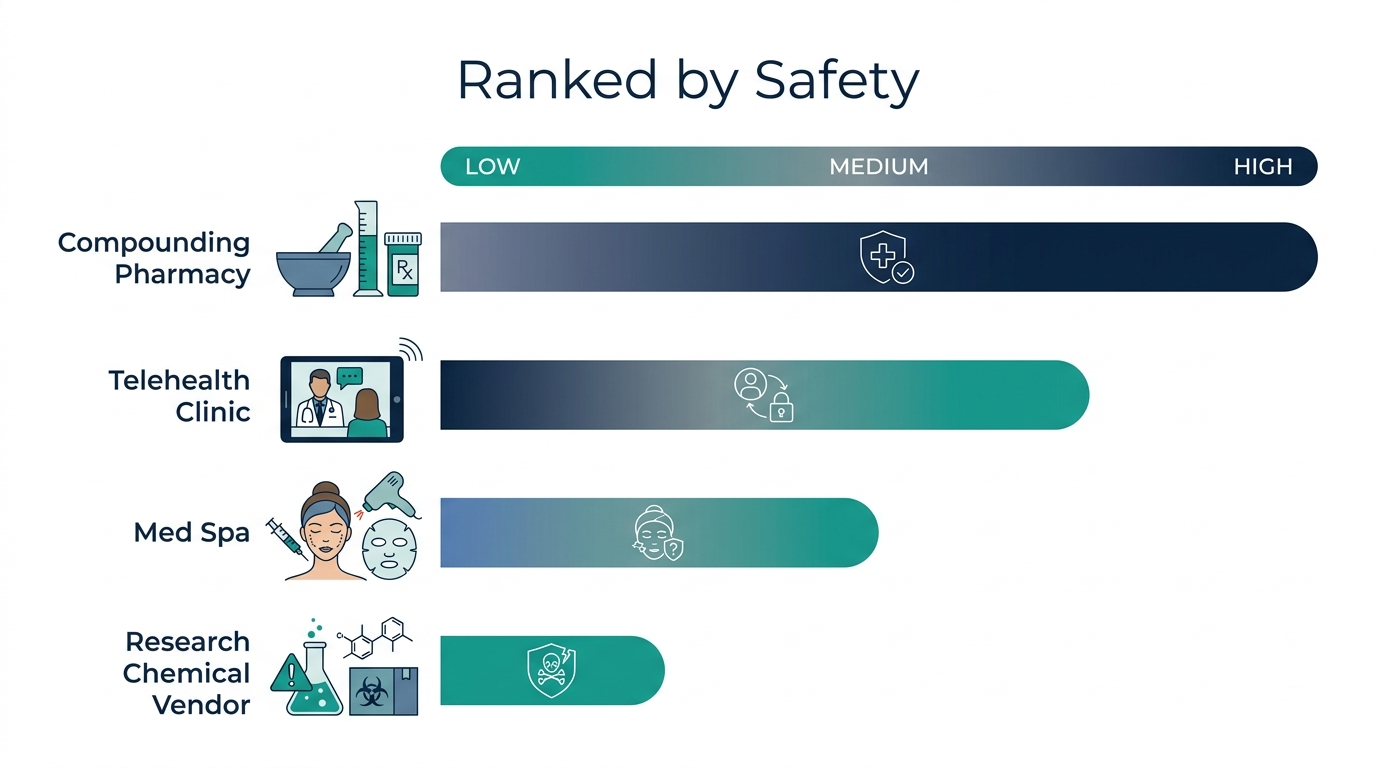
Research peptides are sold online labeled “for laboratory research use only,” and it is legal for a vendor to sell them that way. The label is not marketing language you can ignore; it is the legal fiction that lets the entire market exist. The moment you draw the contents into a syringe, the label’s protection vanishes. You are not a lab. No clinician prescribed it. No pharmacist verified it. Nobody stands behind what is in the vial except the vendor, who in many cases has already demonstrated they will disappear overnight.
The independent testing platform Finnrick now spans more than 8,000 tests across 225 vendors. Their data on Peptide Sciences showed retatrutide failing across 37 batches, with purity as low as 75%, before the shutdown. Other grey-market samples have come back at 62% intended compound with the remainder including bacterial contaminants and endotoxins.
If you are going to use this route anyway, the only thing separating a real batch from a counterfeit is a Certificate of Analysis (COA) from an independent lab. The community standard requires all of:
- HPLC purity of 96% or higher (99%+ is excellent, below 96% is a disqualifier). HPLC measures purity but not identity.
- Mass Spectrometry identity confirmation, which confirms the molecule is the compound named on the label and not a cheaper lookalike. Purity without identity is meaningless.
- Batch-specific and recently dated, with the batch number matching the vial you receive. A single generic PDF used across a whole catalog is not a COA; it is wallpaper.
- Independently verifiable, from labs the community actually trusts: Janoshik Analytical, MZ Biolabs, or Colmaric Analyticals. Janoshik reports carry a unique key you type into Janoshik’s own site to confirm the report is real and not digitally altered.
And cross-check every vendor on Finnrick’s ratings before you trust any “top vendor” listicle, including the ones that conveniently include discount codes.
Do not believe any vendor who says their in-house test is sufficient. An in-house COA is by definition not independently verifiable. The entire point of third-party testing is that there is no financial relationship between the tester and the result. Any vendor who cannot produce a Janoshik or MZ Biolabs key for the specific batch you are about to buy has not passed the bar.
How to actually get a peptide prescription: the step-by-step
Getting a legitimate peptide prescription is less intimidating than the grey market makes it seem, mostly because the grey market has a commercial interest in you thinking the legal route is inaccessible.
Step 1: Identify the peptide and its current legal lane. Semaglutide and tirzepatide, use any telehealth GLP-1 platform or your primary care physician. Sermorelin and tesamorelin, fully prescription-accessible through telehealth. BPC-157 and TB-500, still technically in the grey zone as of June 2026, pending the July 23 to 24 PCAC meeting, but clinics operating in good faith are beginning to offer them through compounding pharmacies that filed for compliance. NAD+ and glutathione, available at most peptide telehealth practices now.
Step 2: Find a provider. The Peptide Association directory (159 verified providers) and the International Peptide Society practitioner finder are the cleanest starting points. Filter by state, then ask whether the clinic requires baseline labs before prescribing. If the answer is no, move on.
Step 3: Get the baseline labs. A responsible provider will not write a prescription without knowing your starting metabolic markers, hormone levels, and inflammation profile. Getting that panel done before you call the clinic means the consult starts faster and you have data to compare against at follow-up. An at-home panel that covers hormones, inflammation markers, metabolic function, and organ health gives a clinician what they need.
Step 4: Book the telehealth consultation. The intake form will cover your goals, history, and any medications. The consult itself is typically 30 to 60 minutes. For straightforward protocols (sermorelin, NAD+), prescriptions often follow within a day or two of the consult and labs.
Step 5: Verify the pharmacy before you accept the shipment. Ask the clinic which 503A or 503B pharmacy is filling your prescription. Look it up in your state’s pharmacy board database or the FDA’s registered outsourcing facilities list. If the clinic cannot give you the pharmacy name, you do not have a compliant program.
Full-body lab membership: 100+ biomarkers, doctor-reviewed, tracked over time.
What does the July 2026 PCAC meeting mean for where you can get peptides?
The Pharmacy Compounding Advisory Committee convenes on 23 to 24 July 2026 at FDA’s White Oak Campus. On the agenda: whether BPC-157, TB-500, KPV, and MOTS-C should be added to the 503A positive bulks list, making them legally compoundable for individual patients by prescription.
If the committee recommends inclusion and the FDA formalizes it, these peptides move from the grey market to the licensed clinic route entirely. The research-chemical vendors who depend on the legal ambiguity lose their primary reason to exist for those compounds. Supply chains shift to compliant 503A pharmacies. Pricing likely settles in the $200 to $400 monthly range for clinic programs.
The two things the committee recommendation does not change: it does not make these peptides FDA-approved drugs, and it does not make the compounded versions subject to the same clinical trial evidence base as an approved drug. The bar for compounding is lower than for approval. What changes is accountability: the pharmacist, the prescriber, and the facility all have licenses to protect, which is the mechanism that makes the licensed route different from a grey-market vial in every meaningful way.
The practical takeaway for anyone deciding right now: waiting until August 2026 to see the PCAC outcome before starting BPC-157 or TB-500 through a clinic is a reasonable choice. The July meeting is a genuine pivot point. It is also worth noting that clinics operating in compliance can already prescribe these compounds in certain configurations, so “waiting for legality” is not the same as “waiting for access.”
Curious what your own levels look like?
Baseline 100+ biomarkers today and retest as life changes, all in one membership with physician review.
Frequently asked questions
Where can I get peptides near me?
The fastest starting point is the Peptide Association clinic directory, which lists 159 verified providers across all 50 states with filters for state, specialty, and compound. Many operate via telehealth, so your physical location mostly determines which licenses the prescribing clinician needs to hold, not whether you can be seen. The International Peptide Society also maintains a practitioner finder.
Can I get peptides without a prescription?
For collagen peptides and topical copper peptide (GHK-Cu) serums, yes; these are supplements and cosmetics sold openly at GNC, Amazon, and health-food stores. For injectable or therapeutic peptides including BPC-157, sermorelin, semaglutide, or tirzepatide, no: a prescription from a licensed provider is required for a compliant purchase, and the “research use only” label on grey-market vials is not a substitute for one.
How do I get a peptide prescription online?
Book a telehealth consultation with a licensed clinic (Defy Medical, Marek Health, Hone Health, OneTwenty, or a provider from the Peptide Association directory). Come with a recent baseline blood panel if you have one. The provider reviews your labs, goals, and health history, writes a prescription, and sends it to a named 503A or 503B compounding pharmacy. Turnaround from consult to shipment is typically two to seven days.
What peptides can I get through telehealth right now?
As of June 2026: sermorelin, NAD+, glutathione, PT-141, and FDA-approved GLP-1 drugs (semaglutide, tirzepatide) are widely available through compliant telehealth platforms. BPC-157, TB-500, CJC-1295, and Ipamorelin are pending the July 2026 PCAC review; some clinics working with compliance-forward pharmacies are already offering them under the new Category 1 interim framework.
How much does it cost to get peptides through a clinic?
Sermorelin runs $175 to $225 a month. Broader peptide therapy programs (BPC-157, GH secretagogue stacks) run $199 to $500 a month for medication alone, with initial consultation ($150 to $400) and baseline labs ($100 to $250) adding to first-month costs. A six-month program at a mid-range clinic totals approximately $1,900 to $2,200. None of this is typically covered by insurance.
Is it legal to buy research peptides online?
Vendors may legally sell peptides labeled “for laboratory research use only.” Buying them is legal; using them on yourself is not what the label covers. The label transfers all risk to the buyer, including the risk that the batch does not contain what it claims. Independent testing across thousands of samples has found purity ranging from 62% to 99%+ from grey-market vendors, with no way to know which end of that range your vial sits on without a third-party COA from Janoshik, MZ Biolabs, or Colmaric Analyticals.
What is the fastest way to verify a peptide vendor?
Check the vendor on Finnrick’s independent ratings, which now spans over 8,000 tests across 225 vendors. Then pull the COA for the specific product and batch, confirm HPLC purity of 96% or higher plus Mass Spectrometry identity, and verify the COA’s unique key on the testing lab’s own website. If the vendor cannot produce a Janoshik or MZ Biolabs key for your batch, do not buy.
Full-body lab membership: 100+ biomarkers, doctor-reviewed, tracked over time.
Author: Vital Signs Today Editorial Team, [credential]”]. Educational content, not medical advice. Sources linked inline.
Primary sources (verify live before publish):
– Peptide Association provider directory (peptideassociation.org)
– Finnrick independent peptide testing database (finnrick.com)
– FDA 503A bulk substances list and Category 2 removals (fda.gov)
– Drug Topics: FDA Set to Review Peptide Access for Compounding Pharmacies
– OpenLoop Health: What Peptides Are Becoming Legal in 2026
– Loti Labs: BPC-157 Legal Status 2026, FDA Category 2 Removal and PCAC Review
– PeakedLabs: BPC-157 Cost Guide 2026
– sermorelin.com: Affordable Peptide and Hormone Therapy Pricing
– OneTwenty: Best Peptide Companies, How to Get Legal Peptides Online
– AccessNewsWire: TeleHealth Med GLP-1 Program Overview 2026
– GNC collagen peptides (gnc.com)
– Biossance GHK-Cu serum (biossance.com)
Related reading
Vital Signs Today may earn a commission if you buy through links on this page. It does not affect our editorial assessments.