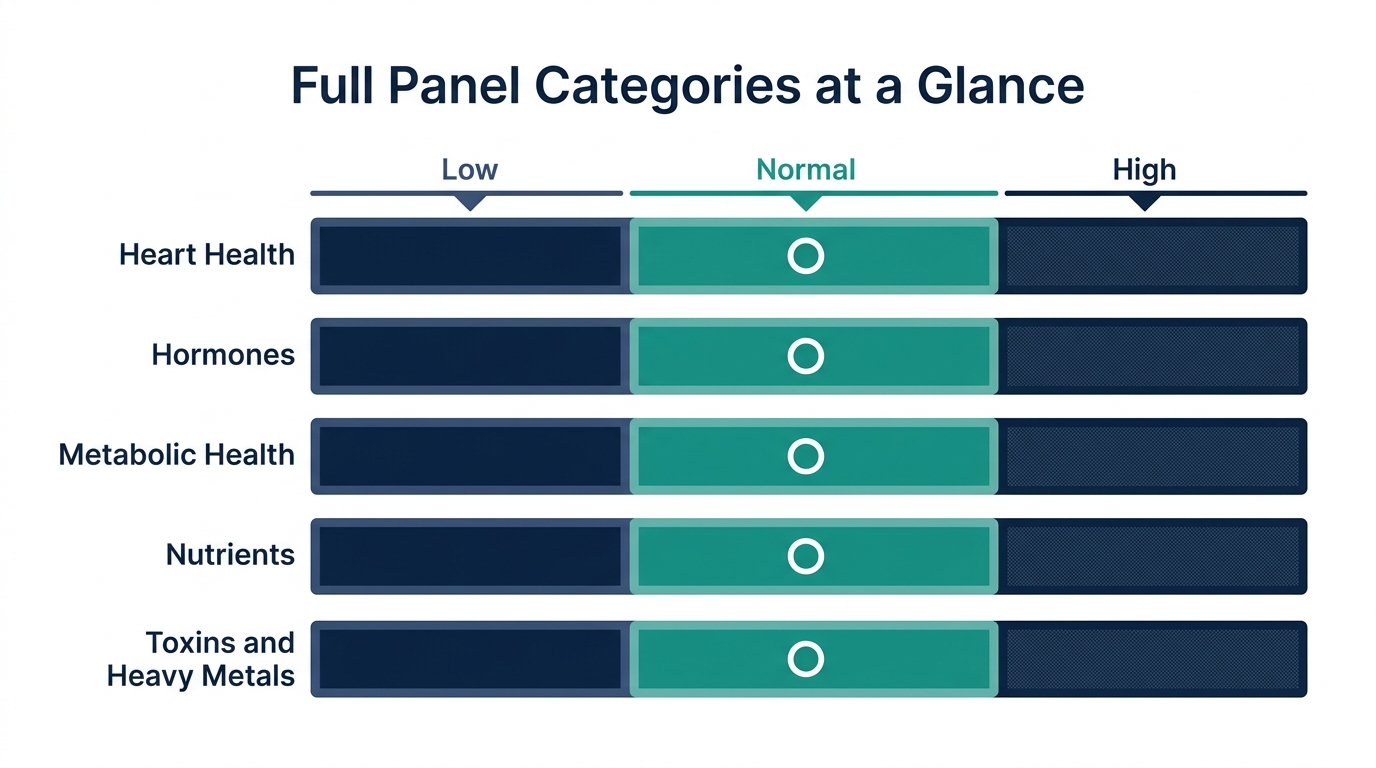
Quick answer: Function Health includes more than 100 biomarkers drawn in a single blood and urine collection, organized into roughly a dozen clinical categories: cardiovascular (including advanced lipid particles), thyroid, metabolic and blood sugar, liver, kidney, hormones (sex and adrenal), complete blood count, nutrients and vitamins, inflammation, and heavy metals. The base membership covers all of these in one annual or semi-annual draw. Certain specialty panels, such as food sensitivity, gut microbiome, and genetic testing, are available as paid add-ons. For a complete picture of what the membership covers and how how Function Health works, read on.
The Core Function Health Test List by Category
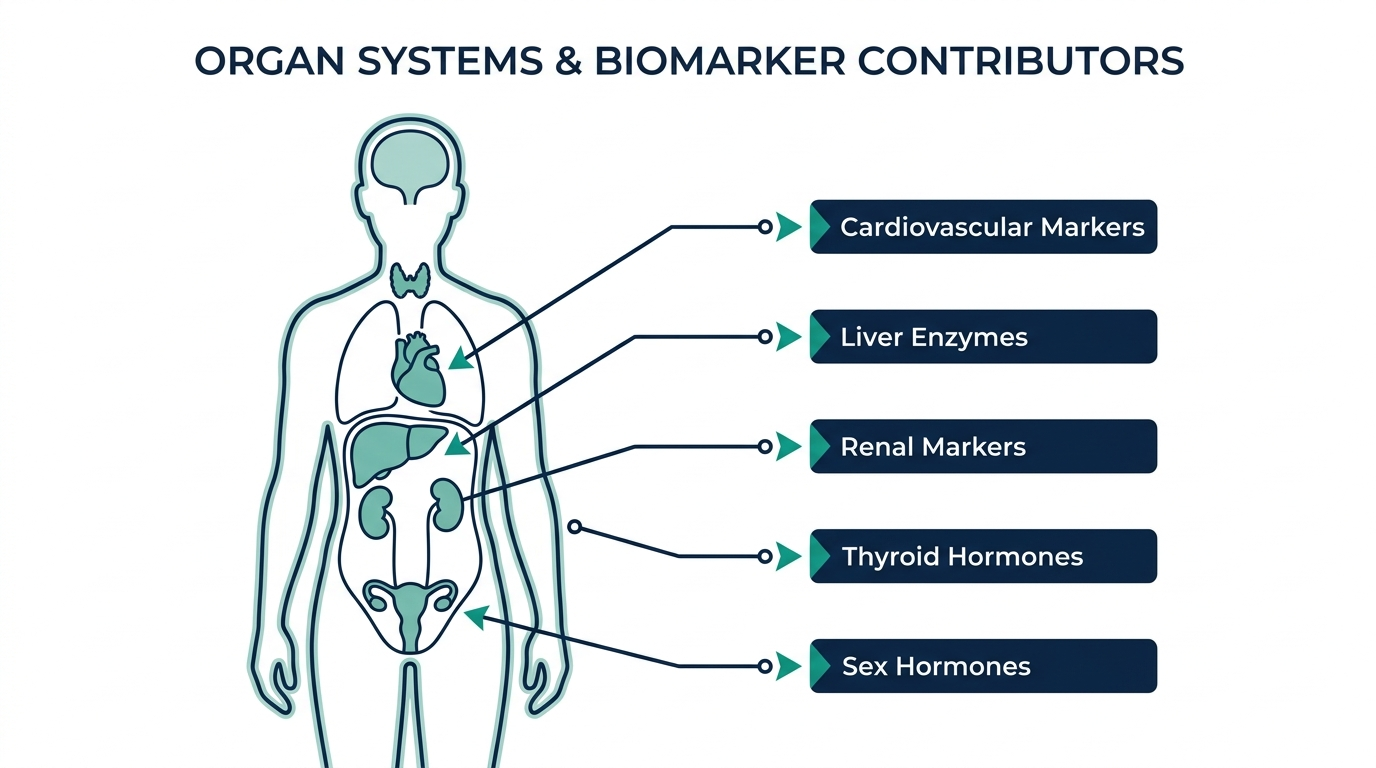
Function Health does not publish a single exhaustive checklist on its marketing pages, which frustrates people trying to compare panels before signing up. Based on what members consistently report and what the company has disclosed in its materials, here is the category-by-category breakdown of what the standard membership includes.
Reviewing what Function Health tests? See how Superpower’s 100+ biomarker panel with physician review stacks up, category by category. One at-home Superpower draw checks 100+ biomarkers, physician-reviewed.
Cardiovascular and Lipids
This is one of the more detailed sections in the Function Health panel. Rather than a standard lipid panel (total cholesterol, LDL, HDL, triglycerides), the cardiovascular section goes into particle-level detail:
- Standard lipid panel: total cholesterol, LDL-C, HDL-C, triglycerides, non-HDL cholesterol
- LDL particle number and small dense LDL (sdLDL)
- ApoB and ApoA-1 (the proteins that carry bad and good cholesterol particles)
- Lipoprotein(a), abbreviated Lp(a), a genetically determined risk factor most people have never had checked
- Oxidized LDL
- Homocysteine
- High-sensitivity C-reactive protein (hs-CRP)
ApoB and Lp(a) are the two markers cardiologists most want on patients who seem fine by standard lipid panels but still have events. Getting both in a membership panel is genuinely useful. Talk to a clinician about what your specific Lp(a) result means for your long-term risk strategy.
Thyroid Function
The thyroid section goes beyond the TSH that most primary care panels run. Function Health typically includes:
- TSH (thyroid-stimulating hormone)
- Free T3 and Free T4 (the active and storage forms of thyroid hormone)
- Reverse T3
- Thyroid antibodies: TPO (thyroid peroxidase) and anti-thyroglobulin
Running antibodies matters because Hashimoto’s thyroiditis can cause symptoms for years while TSH still sits in the normal range. Most annual physicals miss it entirely.
Metabolic and Blood Sugar
- Fasting glucose
- Hemoglobin A1c (HbA1c)
- Fasting insulin
- HOMA-IR (a calculated insulin resistance index derived from glucose and insulin)
- Uric acid
Fasting insulin is the marker most missed by routine labs. A person can have normal fasting glucose and even normal A1c while insulin is already running three or four times higher than optimal, which shows up years before glucose dysregulation becomes visible. This is the metabolic category where Function Health adds real clinical value over what a typical employer health screening captures.
Liver Function
- AST, ALT, alkaline phosphatase, GGT (liver enzymes)
- Total and direct bilirubin
- Albumin and total protein
- LDH (lactate dehydrogenase)
GGT in particular is a sensitive early marker of alcohol-related liver stress and nonalcoholic fatty liver disease (NAFLD), well before structural damage shows on imaging.
Kidney Function
- BMP or CMP panel: creatinine, BUN, eGFR
- Cystatin C (a more sensitive eGFR marker than creatinine alone)
- Urine microalbumin and microalbumin-to-creatinine ratio
- Uric acid (bridges both metabolic and kidney categories)
Cystatin C is particularly valuable for people who are very muscular (where creatinine-based eGFR overestimates kidney function) or very thin. Most labs skip it because it costs more. Function Health including it by default is a meaningful differentiator.
Complete Blood Count and Hematology
- CBC with differential: red blood cells, white blood cells (with differential breakdown), hemoglobin, hematocrit, platelets, MCV, MCH, MCHC, RDW
- Ferritin
- Serum iron and TIBC (total iron-binding capacity)
- Transferrin saturation
Including ferritin alongside the CBC matters because you can have iron-deficiency symptoms (fatigue, cold intolerance, brain fog) with a perfectly normal hemoglobin if your ferritin stores are depleted. Women of reproductive age, especially, often do not get ferritin checked at their annual visit.
Sex Hormones
Both the male and female panels cover:
- Total testosterone
- Free testosterone (calculated or measured)
- SHBG (sex hormone-binding globulin)
- DHEA-S
- Estradiol (E2)
Women’s panels also include FSH, LH, progesterone (timing-dependent), and prolactin. Men’s panels include PSA (prostate-specific antigen) for members above a certain age threshold. For context on how the sex hormone section differs by sex, see the deeper breakdowns in function health for men and the women’s equivalent.
Adrenal and Stress Hormones
- Cortisol (morning serum)
- DHEA-S (also overlaps with sex hormone category)
A single morning cortisol is a screening tool, not a full adrenal axis workup. It catches frank adrenal insufficiency and very elevated cortisol but will not diagnose subclinical dysregulation. Functional medicine providers often want a four-point salivary cortisol curve for that, which is not included here.
Vitamins and Nutrients
- 25-OH Vitamin D (the storage form most labs measure)
- Vitamin B12
- Folate (serum)
- Magnesium (serum)
- Zinc
- Selenium
- Omega-3 index (EPA and DHA as a percentage of total fatty acids in red blood cell membranes)
Serum magnesium is notoriously poor at detecting intracellular magnesium deficiency, but it catches the severe cases. The omega-3 index is a meaningful inclusion because it reflects dietary fat quality over months, not just a recent fish oil dose.
Inflammation and Immune Markers
- hs-CRP (also listed under cardiovascular, since it bridges both)
- ESR (erythrocyte sedimentation rate)
- ANA screen (antinuclear antibodies, a screen for autoimmune conditions)
Heavy Metals and Environmental Toxins
Function Health includes a blood heavy metals panel covering:
- Lead
- Mercury
- Arsenic
- Cadmium
This is not common in standard medical practice and is one of the distinguishing features of the Function Health test list compared to what most primary care offices order. High mercury from frequent fish consumption and elevated lead from old housing are real, actionable findings in US adults and rarely get checked unprompted.
How Many Total Biomarkers Does the Function Health Panel Run?
Function Health markets its panel as covering more than 100 biomarkers, and based on what members receive, the number typically lands in the 110 to 130 range depending on the member’s age, sex, and which specific tests are run in a given draw cycle. For a precise breakdown of the count by category, the article on how many biomarkers does Function Health test goes deeper on this.
The number is large enough to feel overwhelming at first. Function Health addresses this by grouping results by system and flagging anything outside the optimal range (not just the standard lab reference range), with explanatory context for each result in the app.
What Are the Function Health Add-On Tests?
Beyond the base panel, Function Health offers optional add-on tests purchased separately. These are not included in the base membership price. Common add-ons members have reported include:
| Add-On Category | Examples | Typical Price Range |
|---|---|---|
| Food sensitivity | IgG food antibody panel (100+ foods) | $100 to $300 |
| Gut microbiome | Stool DNA analysis (Genova, Vibrant, or similar) | $200 to $400 |
| Genetics | APOE genotype, MTHFR, pharmacogenomics | $50 to $200 |
| Advanced hormones | Dutch urine hormone metabolites, cortisol curve | $150 to $350 |
| Cancer screening | Galleri multi-cancer early detection | $200 to $600 |
| Continuous glucose | CGM (Levels or similar) integration | Varies |
Add-on pricing shifts over time and is best confirmed directly in the Function Health app or at checkout. See the dedicated breakdown of function health add-on test prices for current figures.

How Does the Function Health Panel Compare to What a Regular Doctor Orders?
A standard annual physical in the US typically generates a metabolic panel (CMP or BMP), a lipid panel, CBC, and maybe TSH if you ask. That is roughly 20 to 30 individual data points, and several important values are either missing or not offered unless you specifically request them.
| Marker | Standard Annual Physical | Function Health Base Panel |
|---|---|---|
| ApoB | Rarely ordered | Included |
| Lp(a) | Almost never ordered | Included |
| Fasting insulin | Not standard | Included |
| Cystatin C | Specialist only | Included |
| Free T3, reverse T3 | Not standard | Included |
| Thyroid antibodies | Only if symptoms | Included |
| Heavy metals | Only if occupational exposure suspected | Included |
| Ferritin | Sometimes, if anemia flagged | Included |
| Omega-3 index | Almost never | Included |
| SHBG | Only if hormone symptoms | Included |
The difference is not about whether your doctor is thorough. Most of these markers simply are not part of standard-of-care guidelines for asymptomatic adults, which means insurance will not cover them and most clinicians will not order them unprompted.
What Does Function Health NOT Test?
Worth knowing before signing up: the base Function Health panel does not include everything a proactive health workup might cover.
- Imaging: no coronary artery calcium (CAC) score, no DEXA scan, no whole-body MRI. These require separate referrals.
- Gut microbiome: not in the base panel, add-on only.
- Comprehensive stool testing: not included.
- Continuous glucose monitoring: not included, available as an add-on integration.
- DUTCH urine hormone metabolites: serum hormones are in the base panel, but the full urinary metabolite picture is add-on only.
- IGF-1 (growth hormone proxy): not consistently included in base panel disclosures.
- Comprehensive autoimmune panel: ANA screen is included, but specific autoantibodies (anti-dsDNA, anti-CCP, etc.) require add-ons or a rheumatology referral.
- Cancer biomarkers: PSA is included for eligible men. Multi-cancer liquid biopsy (Galleri) is an add-on.
The simplest way to actually get this done
Superpower is a full-body lab membership that runs 100+ biomarkers, has each result reviewed by a doctor, and tracks your numbers year over year (about $199/year). It is what we point readers to when they would rather get one clean, complete draw than chase single tests one at a time. Here is superpower blood test reviewed in full.

How Function Health Organizes and Displays Its Results
Knowing what tests does Function Health include is one thing. How those results reach you is a separate question that affects whether the data is actually useful. Function Health delivers results through its app (iOS and Android) and web dashboard, typically within five to seven business days of the blood draw.
Each biomarker shows the numeric result, the conventional lab reference range, and a tighter “optimal” range that Function Health applies based on research literature rather than population percentiles. A result can be technically within the normal range but flagged as suboptimal, which is either valuable signal or a source of unnecessary anxiety depending on how you approach it.
There is no live physician consultation built into the base membership. Results come with explanatory text and trend graphs if you have prior draws. If you need a clinician to walk through results with you, that is an add-on service or requires going outside Function Health to your own doctor. For more on what happens after the blood draw, see the function health review.
Who Gets the Most Value from the Function Health Panel Coverage?
The Function Health test list is designed for a specific type of person: someone without acute symptoms, who wants a comprehensive baseline of their physiology, and who is willing to interpret detailed quantitative data. It delivers the most value for:
- Adults 30 to 60 who have never had an advanced lipid panel and do not know their ApoB or Lp(a)
- Anyone with a family history of early cardiovascular disease, where the standard lipid panel may be falsely reassuring
- Women in perimenopause who want to track hormone levels alongside metabolic markers over time
- People with persistent fatigue, weight gain, or brain fog who have been told their labs are normal (because those labs usually do not include thyroid antibodies, fasting insulin, or ferritin)
- High performers optimizing sleep, recovery, and body composition who want actual data on inflammation and nutrient status
It is less useful for someone who needs urgent diagnosis, treatment management, or specialist interpretation. The panel screens broadly but does not replace a cardiology workup, an endocrinology consult, or a gynecology visit.
Function Health vs Superpower: Panel Coverage Side by Side
The two most-compared comprehensive lab memberships right now are Function Health and Superpower. Both run 100+ biomarkers and both use established national labs (Quest and Labcorp network) for the draw. The key differences in panel design:
| Feature | Function Health | Superpower |
|---|---|---|
| Biomarker count | 100+ | 100+ |
| Advanced lipids (ApoB, Lp(a)) | Yes | Yes |
| Heavy metals | Yes | Yes |
| Doctor review of results | No (add-on only) | Yes (included) |
| Physician consult | Add-on | Included |
| Annual price | $499/year (two draws) | About $199/year |
| HSA/FSA eligible | Partially | Yes |
The panel breadth is comparable. The meaningful difference is that Superpower includes a physician review of your results in the base price, while Function Health charges extra for any live clinician interaction. For people who want someone to actually explain what their numbers mean, that distinction matters more than which specific biomarkers appear on the list. The superpower blood test review goes through that tradeoff in detail, and how much does Superpower cost breaks down pricing.
Which Markers on the Panel Actually Change, and How Fast
A comprehensive panel mixes markers that shift week to week with markers that barely move across your whole life. Knowing the difference tells you how often each is worth retesting and how much weight to give a single reading.
- Fast movers (days to weeks): fasting glucose, triglycerides, hsCRP, liver enzymes. These respond quickly to diet, alcohol, illness, and exercise, so a single value can mislead. Recheck under controlled conditions before drawing conclusions.
- Medium movers (weeks to months): HbA1c reflects roughly three months of average blood sugar, ferritin and vitamin D shift over months with supplementation, and lipid particle numbers like ApoB respond to sustained diet and medication changes over about six to twelve weeks.
- Slow or fixed: Lp(a) is largely genetic and stays stable for life, so one measurement is usually enough. Thyroid antibodies, once present, tend to persist. These do not need frequent repeat testing.
This is why a membership format helps for the medium movers, where a trend over two or three draws is far more informative than any single number, while the fixed markers only need to be checked once.
Reading the Complete Blood Count and Metabolic Panel
The two workhorse groups on any panel are the complete blood count (CBC) and the comprehensive metabolic panel (CMP). They rarely make headlines, but they carry a lot of everyday signal.
The CBC measures red cells, white cells, and platelets. Low hemoglobin or hematocrit points toward anemia, which pairs naturally with a low ferritin to suggest iron deficiency. An elevated white cell count can reflect infection or inflammation, while the differential (the breakdown of white cell types) hints at whether a bacterial or viral process is more likely. Platelet counts flag clotting and bleeding tendencies.
The CMP covers electrolytes (sodium, potassium, chloride), kidney markers (creatinine and the calculated eGFR), liver enzymes (ALT, AST, alkaline phosphatase), and proteins (albumin, total protein). Read together, these describe how your kidneys and liver are handling their workload. A mildly elevated ALT with a recent hard workout or a few drinks the night before is a very different story than a persistent elevation, which is why context and rechecking matter so much on these markers.
Factors That Distort Panel Results
Before you read anything into a surprising value, rule out the ordinary reasons a marker can look off. The most common distortions are avoidable.
- Non-fasting draw inflates glucose and triglycerides and can shift the lipid panel.
- Recent intense exercise raises hsCRP, creatine kinase, and liver enzymes for a day or more.
- High-dose biotin supplements interfere with many immunoassays, including thyroid and some hormone tests, and can push results falsely high or low. Pause biotin above 5 mg per day for about 72 hours before a draw.
- Dehydration concentrates the sample and can nudge hemoglobin, hematocrit, and kidney values upward.
- Acute illness or infection temporarily elevates inflammatory markers and can suppress others, so it is worth waiting until you are well for a baseline panel.
- Time of day matters for hormones, since testosterone and cortisol both peak in the morning. Draw at a consistent time for meaningful comparisons.
The discipline of controlling these variables is what turns a panel from an interesting list into a reliable baseline you can trust and repeat.
Building a Personal Retest Schedule From the Panel
Not every marker deserves the same testing frequency, and treating them uniformly wastes money and attention. A sensible personal schedule looks something like this for a healthy adult.
- Once, then rarely: Lp(a) and thyroid antibodies. Establish them, then leave them unless something changes.
- Annually: the full comprehensive panel, to capture the trend on ApoB, glucose, HbA1c, vitamin D, ferritin, and organ function.
- More often when intervening: if you are actively changing diet, starting a supplement, or adjusting a medication, retest the specific affected markers in roughly eight to twelve weeks to measure the response, rather than repeating the whole panel.
This targeted approach gives you the trend data where it matters without paying to re-run stable markers that will not have moved. It is also the pattern a good clinician would recommend if you asked them to build a monitoring plan around your results.
Don’t just read about your health, track it.
A single result is a snapshot. Superpower re-tests 100+ markers over time so you can watch them move as you change sleep, food, and training.
FAQ
What does Function Health test for exactly?
Function Health tests for cardiovascular risk (including particle-level lipids and ApoB), thyroid function, metabolic health and insulin resistance, liver and kidney function, complete blood count, sex and adrenal hormones, vitamins and nutrients, inflammation, and heavy metals. The base panel covers more than 100 individual biomarkers drawn from blood and urine in a single appointment.
Does Function Health include a thyroid panel?
Yes. Function Health includes TSH, Free T3, Free T4, reverse T3, and thyroid antibodies (TPO and anti-thyroglobulin). This is considerably more thorough than the TSH-only check that most primary care annual labs run.
Does Function Health test hormones?
Yes. The base panel includes testosterone (total and free), SHBG, DHEA-S, estradiol, and for women: FSH, LH, and progesterone. Men above a certain age threshold also receive PSA. More detailed urinary hormone metabolites (DUTCH panel) are available as an add-on.
What add-on tests does Function Health offer?
Function Health add-on tests include food sensitivity panels, gut microbiome analysis, genetic testing (APOE, MTHFR), advanced urine hormone metabolites, and multi-cancer early detection (Galleri). These are purchased separately and are not part of the base membership price.
Does Function Health include a cholesterol test?
Yes, and it goes well beyond basic cholesterol. The Function Health panel includes total cholesterol, LDL, HDL, triglycerides, ApoB, ApoA-1, Lp(a), small dense LDL, and oxidized LDL. This is the cardiovascular section where the panel most clearly surpasses what a standard doctor’s office runs.
Does Function Health test for vitamin D and B12?
Yes. Both 25-OH Vitamin D and Vitamin B12 are included in the base panel, along with folate, magnesium, zinc, selenium, and the omega-3 index.
Is a heavy metals test included in Function Health?
Yes. Lead, mercury, arsenic, and cadmium are included in the base panel. This is uncommon in standard medical practice and represents one of the more distinctive parts of the Function Health test list.
Does Function Health test for cancer?
The base panel includes PSA (prostate-specific antigen) for eligible male members. It does not include a general multi-cancer liquid biopsy by default. Galleri, a multi-cancer early detection test, is available as a separate add-on.
How often does Function Health run the full panel?
The standard membership includes two comprehensive draws per year (every six months). Some biomarkers are only run once annually. The schedule is set by Function Health based on clinical guidance for monitoring frequency.
Can I see the full Function Health test list before signing up?
Function Health does not publish a single exhaustive biomarker list on its public marketing pages, which is a common complaint. The most complete picture comes from member-reported disclosures and from the company’s own app after enrollment. The function health review and the breakdown of function health cost include as much detail as is publicly available.
Vital Signs Today may earn a commission if you buy through links on this page. It does not affect our editorial assessments.