High estradiol thresholds depend on your sex and life stage, so what’s your actual number? One at-home Superpower draw checks 100+ biomarkers, physician-reviewed.
- High estradiol on a blood test means your estradiol (the main form of estrogen) is above the lab reference range for your sex and life stage, such as above 50 pg/mL in adult males or above 30 pg/mL in postmenopausal women, per MedlinePlus.
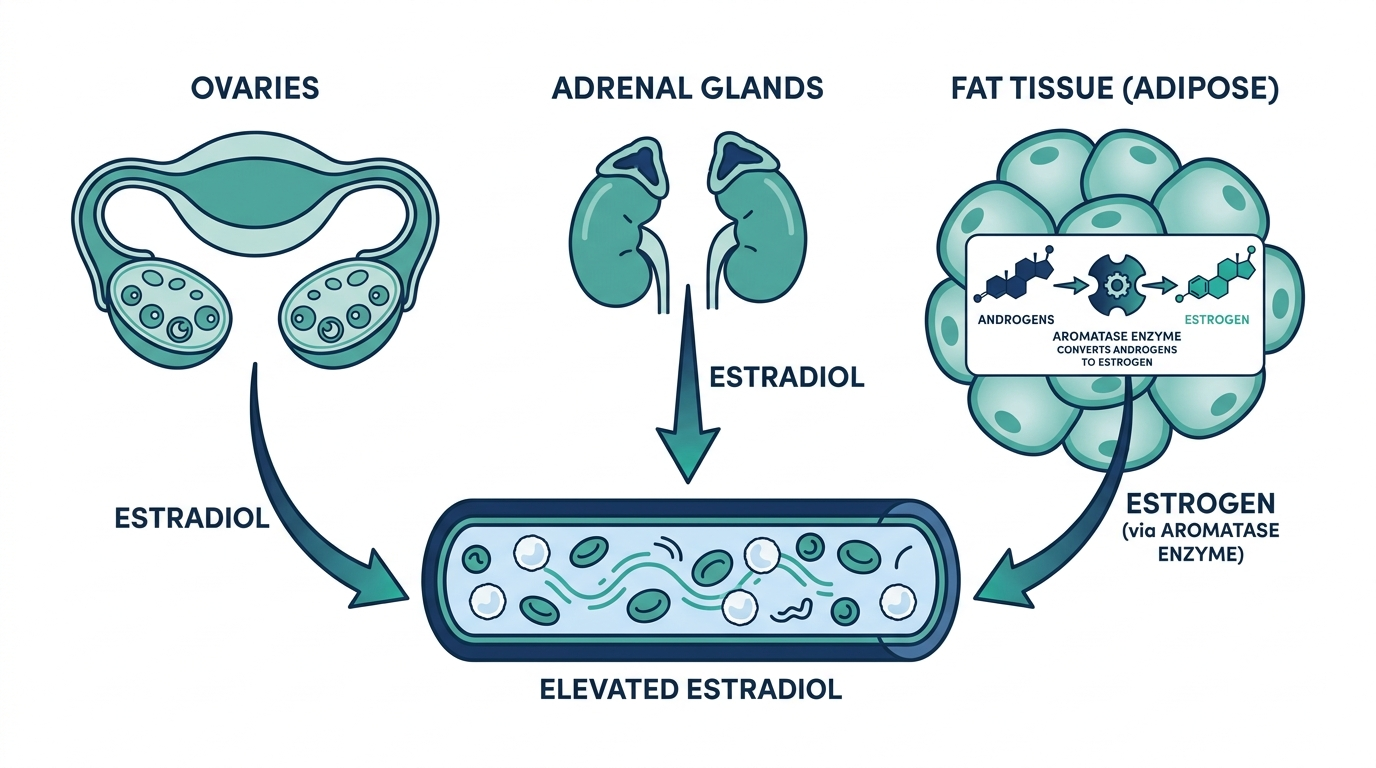
- The most common drivers of high estradiol are excess body fat, which converts testosterone to estrogen through the aromatase enzyme, plus testosterone therapy, certain supplements, and liver disease.
- High estradiol is usually a clue about another problem rather than a disease itself, so a single elevated result should be repeated and discussed with a clinician before any treatment.
Seeing “high” next to your estradiol number can be unsettling, especially when the lab flags it in bold red. Estradiol is the most active form of estrogen, and a high reading rarely points to one simple cause. This guide explains what the number means, what usually pushes it up, and when it actually matters.
What does a high estradiol result mean, and what is the cutoff?
A high estradiol result means your blood level of estradiol (E2) is above the normal reference range for your sex and reproductive stage. According to MedlinePlus, typical ranges are about 10 to 50 pg/mL for adult males, 30 to 400 pg/mL for premenopausal females (fluctuating across the menstrual cycle), and 0 to 30 pg/mL for postmenopausal females. A value above your category’s upper limit is what triggers the “high” flag.
Context matters more than the raw number. In premenopausal women, estradiol naturally peaks before ovulation, so a high value can simply reflect timing. Reference ranges also vary by lab and by the assay used, which is why MedlinePlus notes that normal values “may vary slightly among different laboratories.” Always read your result against the range printed on your own report.

What causes high estradiol?
The most common cause of high estradiol is excess body fat, because the aromatase enzyme in fat tissue converts testosterone into estradiol. This is why estradiol tends to rise with obesity in both men and postmenopausal women. Other frequent drivers include testosterone replacement therapy and DHEA supplements, which give the body more raw material to aromatize into estrogen.
Beyond body composition, several medical causes can raise estradiol:
- Liver disease: Cirrhosis and other liver damage impair the breakdown of estrogen, so it builds up in the blood (NCBI Bookshelf, Endotext).
- Medications and hormones: Estrogen-containing therapy, some fertility drugs, and certain steroids can elevate levels.
- Tumors: Rarely, estrogen-producing tumors of the ovaries, testes, or adrenal glands raise estradiol.
- Pregnancy: Estradiol climbs dramatically and expectedly during pregnancy.
In women, a high result is often just a normal mid-cycle surge rather than a problem.
What are the symptoms of high estradiol, or is it silent?
High estradiol can be silent, but when symptoms appear they differ sharply by sex. In men, the classic sign is gynecomastia, meaning the growth of breast tissue, which the NCBI Endotext chapter links directly to a higher estrogen-to-testosterone ratio. Other male symptoms include reduced libido, erectile difficulty, low mood, and fertility problems.
In women, elevated estradiol may show up as:
- Menstrual changes: heavier, irregular, or unpredictable periods.
- Breast tenderness: swelling or soreness that tracks with hormone shifts.
- Mood and fluid symptoms: bloating, irritability, and headaches.
Because these symptoms overlap with many other conditions, the lab number and the clinical picture have to be read together. Many people with a borderline-high reading feel completely normal, which is one reason a single result is not enough to act on.
When is high estradiol dangerous?
High estradiol is rarely an emergency on its own, but it can signal conditions that need attention. The bigger concern is what is causing it. For example, liver disease severe enough to raise estrogen also produces signs like jaundice, spider angiomas, and palmar erythema (NCBI Endotext), and those point to a serious underlying illness rather than the hormone itself.
A persistently high estradiol with no obvious cause, especially when paired with rapid breast growth in a man, unexplained vaginal bleeding after menopause, or symptoms of liver trouble, deserves prompt evaluation to rule out a hormone-producing tumor. Sustained estrogen excess is also studied in relation to certain hormone-sensitive cancers, which is why postmenopausal women with high readings are usually investigated carefully. The danger lies in missing a treatable root cause, not in the number alone.
What should you do next, and when should you see a doctor?
The first step is usually to repeat the test, because timing, the lab assay, and even biotin supplements can distort estradiol results. A documented case in PMC describes a woman whose falsely elevated estradiol led to an unnecessary procedure, which underlines why one number should not drive treatment. Confirm the result before drawing conclusions.
See a doctor promptly if you have:
- New breast growth or tenderness in a man.
- Postmenopausal bleeding or a high estradiol after menopause.
- Signs of liver disease, such as yellowing skin or easy bruising.
- A high result on testosterone therapy, which may need dose adjustment.
Your clinician may order follow-up tests for testosterone, liver function, and pituitary hormones to find the cause, then treat that rather than the number itself. For women in their reproductive years, retesting on a specific cycle day often resolves the question.
The insider nuance: which estradiol assay your lab used
One detail clinicians weigh that patients rarely see is the type of estradiol assay. Standard immunoassays are calibrated for the high levels found in premenopausal women and lose accuracy at the low concentrations seen in men and postmenopausal women. For those groups, labs increasingly use a sensitive or ultrasensitive assay (often based on mass spectrometry) for reliable readings.
This matters because a “high” flag generated by a less precise method may not hold up on a sensitive assay. If you are a man or a postmenopausal woman with a surprising result, it is reasonable to ask which assay was run and whether a sensitive estradiol test is warranted. Knowing the method can change how much weight your result deserves and can spare you unnecessary worry or treatment.
What estradiol actually does, and where it comes from
To read a high estradiol correctly, it helps to know what the hormone is for. Estradiol (E2) is the most potent form of estrogen, and despite its reputation as a “female” hormone, it is essential in both sexes. In women it drives the menstrual cycle, builds the uterine lining, and supports bone and cardiovascular health. In men it is present in smaller amounts and is critical for bone density, libido, and sperm production. Too little is a problem for anyone; the question with a high result is whether the excess is expected or a signal.
The sources differ by sex. In premenopausal women, the ovaries make most estradiol, and levels swing predictably across the cycle. In men and in postmenopausal women, the dominant source is conversion of androgens (like testosterone) into estradiol in peripheral tissues, especially fat. That single fact explains most unexpected high readings outside the reproductive years, and it is why body composition sits at the center of the story.

The aromatase connection: why body fat drives estradiol up
The enzyme that converts testosterone into estradiol is called aromatase, and it is abundant in fat tissue. The more fat tissue a person carries, the more aromatase activity, and the more testosterone gets converted into estradiol. This is the mechanism behind the strong link between excess body fat and high estradiol in both men and postmenopausal women.
Several everyday factors feed this pathway:
- Excess body fat increases total aromatase capacity, raising estradiol.
- Testosterone therapy and DHEA supplements add raw material for aromatase to convert, which is why estradiol can climb on androgen therapy.
- Heavy alcohol use and liver disease slow the breakdown and clearance of estrogen, letting it accumulate.
- Aging in men often shifts the ratio, as rising fat mass and falling testosterone tilt the balance toward estrogen.
The practical upshot: for many men and postmenopausal women, a high estradiol is less about the ovaries or a tumor and more about how much androgen is being aromatized in fat tissue. That is also why weight loss can meaningfully lower estradiol in these groups.
Estradiol ranges by sex and life stage
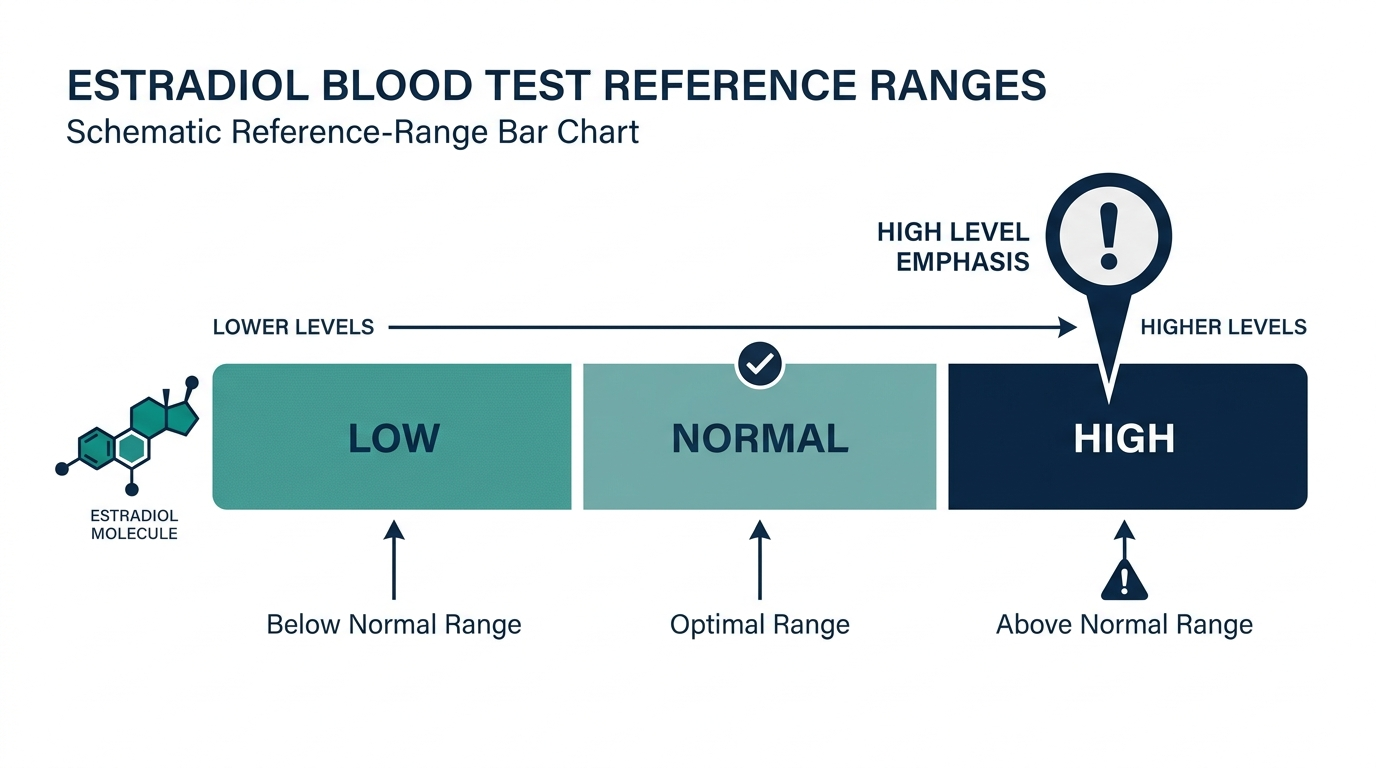
Because “normal” depends entirely on who you are and, for cycling women, when in the month you test, a single generic number is misleading. The approximate reference ranges below, drawn from MedlinePlus, show why context is everything. Always compare against the range printed on your own report, since labs and assays differ.
| Group | Approximate estradiol range | Note |
|---|---|---|
| Adult males | About 10 to 50 pg/mL | Above roughly 50 pg/mL is flagged high |
| Premenopausal females | About 30 to 400 pg/mL | Swings across the cycle; peaks before ovulation |
| Postmenopausal females | About 0 to 30 pg/mL | A high value here warrants investigation |
| Pregnancy | Rises dramatically | A high level is expected and normal |
The takeaway from this table is that the same absolute number can be perfectly normal or clearly abnormal depending on the row you belong to. A value of 200 pg/mL is unremarkable mid-cycle in a premenopausal woman and would be strikingly high in a man or a postmenopausal woman.
Reading estradiol alongside its companion markers
Estradiol is almost never interpreted in isolation. Its meaning sharpens when a clinician sees it beside the hormones and organ markers that shape it. The usual companions:
- Testosterone. In men especially, the estradiol-to-testosterone ratio matters more than estradiol alone. Symptoms like gynecomastia track with a higher estrogen relative to testosterone, not just a high estradiol number.
- LH and FSH. These pituitary hormones help distinguish an ovarian or testicular source from a central (pituitary) one, and they clarify menopausal status.
- SHBG (sex hormone binding globulin). Because much of estradiol travels bound to SHBG, changes in SHBG (from liver disease, thyroid issues, or medications) shift how much free, active hormone there is.
- Liver function tests. Since the liver clears estrogen, abnormal liver enzymes can explain a build-up and point to the real problem.
- Prolactin and thyroid markers. These can contribute to hormonal symptoms and are often checked to complete the picture.
This is why a clinician rarely acts on an isolated high estradiol. The single value is a starting point; the surrounding panel is what turns it into a diagnosis.

How to time and prepare for an estradiol test
Few blood tests are as sensitive to timing and technique as estradiol. Getting these details right prevents both false alarms and missed problems.
- Cycle day is critical for premenopausal women. Estradiol peaks just before ovulation, so a “high” result may simply reflect when you tested. Clinicians often specify a cycle day (for example, early in the cycle) so results are comparable and interpretable.
- Biotin can distort results. High-dose biotin supplements (common in hair, skin, and nail products) can interfere with certain hormone immunoassays and cause falsely high or low readings. A published case describes a falsely elevated estradiol that led to an unnecessary procedure. Stop biotin for a few days before testing if your clinician advises it, and always disclose supplements.
- Ask which assay was used. Standard immunoassays are calibrated for the high levels of premenopausal women and are less accurate at the low levels seen in men and postmenopausal women. For those groups, a sensitive or mass-spectrometry-based assay is more reliable, so a surprising result is worth rechecking with the right method.
- Fasting is not usually required for estradiol, but it may be drawn with other tests that are, so follow your instructions.
- Repeat before acting. Given all of the above, confirming a surprising result on a repeat draw is standard and sensible.
What actually lowers a high estradiol
Since high estradiol is usually a downstream clue rather than a disease, the fix is to address the cause, not chase the number. Depending on what the workup shows, reasonable directions include:
- Reducing excess body fat. Because aromatase lives in fat tissue, losing excess weight can lower the conversion of testosterone to estradiol, particularly in men and postmenopausal women.
- Adjusting medications. If testosterone therapy, DHEA, or estrogen-containing products are driving it, a prescriber may change the dose or approach rather than stopping treatment abruptly.
- Moderating alcohol. Cutting heavy alcohol use supports liver clearance of estrogen.
- Treating the underlying condition. If liver disease or, rarely, a hormone-producing tumor is found, treating that resolves the elevation.
What not to do is self-treat with over-the-counter “estrogen blockers” or aromatase inhibitors based on a single result. Those are medications with real effects and risks, and using them without a confirmed cause can create new problems, including driving estradiol too low, which harms bone and libido. The safe path is to confirm the result, find the cause, and treat that under medical guidance.
Sample interpretation scenarios
Estradiol is a hormone whose meaning lives in context, so seeing it played out in scenarios is more useful than any single cutoff. These are teaching examples, not a substitute for your clinician reviewing your actual results.
- Premenopausal woman, estradiol 250 pg/mL, tested mid-cycle, feeling fine. This is very likely a normal pre-ovulation surge. The “high” flag reflects timing, not a problem. Retesting on a specified cycle day usually settles it.
- Man, estradiol 60 pg/mL, breast tenderness, higher body fat, on testosterone therapy. The pattern fits increased aromatization of testosterone in fat tissue. Management often means adjusting therapy and addressing body composition, guided by the estradiol-to-testosterone ratio.
- Postmenopausal woman, estradiol 45 pg/mL, with vaginal bleeding. A value this high after menopause plus bleeding is a red flag that warrants prompt evaluation to rule out hormone therapy effects, excess adiposity, or an estrogen-producing source.
- Any adult, high estradiol plus yellowing skin, easy bruising, or spider-like blood vessels. These point toward liver disease impairing estrogen clearance, so the liver, not the hormone, is the target of the workup.
- Surprising high result in a person taking a hair-and-nail supplement. High-dose biotin can distort the assay. Rechecking off biotin, or with a different method, may show the true level is normal.
Across all of these, the number is the beginning of the question, not the answer. Sex, life stage, symptoms, medications, and companion labs decide what a high estradiol actually means.
Common misconceptions about high estradiol
A few myths cause a lot of needless worry, so it is worth naming them plainly.
- “High estradiol means I have a tumor.” Estrogen-producing tumors exist but are rare. The common causes are excess body fat, medications, alcohol or liver issues, and, in women, normal cycle timing. Tumors are considered when the elevation is unexplained and persistent, especially with specific red flags.
- “It is only a female issue.” Men need estradiol for bone, libido, and fertility, and men can have clinically high levels, classically showing up as gynecomastia. The hormone matters in both sexes.
- “A high number always needs treatment.” Often it does not. A normal mid-cycle surge, a lab timing quirk, or a biotin artifact needs no treatment at all, just correct interpretation.
- “I should take an estrogen blocker to bring it down.” Self-medicating with aromatase inhibitors or over-the-counter blockers can push estradiol too low and cause its own harms. The right move is to confirm the result, find the cause, and treat that with medical guidance.
Clearing up these misconceptions is the difference between a calm, methodical workup and an anxious, unnecessary intervention. The single value earns its meaning only inside the full clinical picture.
Curious where your estradiol really sits?
Baseline estradiol and 100+ biomarkers today and retest as life changes, all in one membership with physician review.
Frequently asked questions
Is high estradiol always a problem?
No. In premenopausal women, estradiol naturally surges before ovulation, so a high reading often just reflects cycle timing. It also rises normally in pregnancy. The result matters most when it is unexpected for your sex and life stage or paired with symptoms.
What estradiol level is considered high in men?
For adult males, MedlinePlus lists a normal range of about 10 to 50 pg/mL, so values above roughly 50 pg/mL are flagged as high. Ranges vary by lab and assay, so always compare against the range printed on your own report.
Can losing weight lower estradiol?
Often yes, especially in men and postmenopausal women. Fat tissue contains the aromatase enzyme that converts testosterone into estradiol, so reducing excess body fat can lower the conversion and bring estradiol down. Discuss a realistic plan with your clinician.
Does testosterone therapy raise estradiol?
It can. Testosterone is the raw material that aromatase turns into estradiol, so adding testosterone may push estradiol higher. If you are on therapy and your estradiol is elevated, your prescriber may adjust the dose or monitoring rather than stopping treatment.
Should I worry about high estradiol after menopause?
It is worth investigating. Postmenopausal estradiol is normally below about 30 pg/mL, so a high value, particularly with vaginal bleeding, should be checked to rule out hormone therapy effects, excess body fat, or an estrogen-producing source. See your doctor for evaluation.
Sources
- MedlinePlus, Estradiol blood test
- NCBI Bookshelf (Endotext), Gynecomastia: Etiology, Diagnosis, and Treatment
- NCBI PMC, Falsely elevated serum estradiol led to unnecessary intervention: a case report
- Medscape, Estradiol: Reference Range and Interpretation
This article is for general educational purposes and is not medical advice. It cannot diagnose or treat you and does not replace your clinician. Always discuss your lab results and any health decisions with a qualified healthcare professional.
Related reading
Related: best at-home thyroid and hormone tests.
Vital Signs Today may earn a commission if you buy through links on this page. It does not affect our editorial assessments.