- For healthy men aged 19 to 39, a harmonized total testosterone reference range is 264 to 916 ng/dL, established by the Endocrine Society from four large U.S. and European cohorts.
- Adult women have far lower total testosterone, with a typical reference range of about 8 to 60 ng/dL, because the ovaries and adrenal glands make only small amounts.
- Male testosterone peaks in the late teens and twenties, then falls by roughly 1 percent per year after age 30, so a result is judged against your age, sex, and the testing lab’s reference range.
Testosterone is the main androgen sex hormone. It drives sexual development, muscle and bone mass, red blood cell production, sex drive, and mood in both sexes, though men carry roughly 10 to 20 times more of it than women. A blood test reports your level in nanograms per deciliter (ng/dL), and what counts as “normal” shifts with age and sex. This guide lays out the cited reference values you can hold your own result against.
Part of our Hormone Panel guide.
Testosterone reference ranges are wide, so where does your number actually fall for your age? One at-home Superpower draw checks 100+ biomarkers, physician-reviewed.
What is a normal testosterone level?
For healthy, nonobese men aged 19 to 39, the Endocrine Society’s harmonized total testosterone reference range is 264 to 916 ng/dL (9.2 to 31.8 nmol/L), derived from four large cohort studies and standardized to a CDC reference method (JCEM, 2017). Cleveland Clinic describes a broadly similar adult male range of about 300 to 1,000 ng/dL (Cleveland Clinic). For adult women, total testosterone runs much lower, roughly 8 to 60 ng/dL.
“Normal” is a statistical band, not a personal target. Reference ranges typically capture the middle 95 percent of a healthy population, so a value just inside or outside the band is not automatically healthy or diseased. Each laboratory sets its own range based on its assay and the population it tested, which is why your report shows its own numbers next to your result. Levels also swing through the day, peaking in the morning, so testing is usually done before about 10 a.m.
Total, free, and bioavailable testosterone
The number most people see is total testosterone, which counts every molecule in the blood. But most of that testosterone is not available to your tissues. Roughly two thirds is bound tightly to sex hormone binding globulin (SHBG) and cannot act, another chunk is loosely bound to albumin, and only about 2 to 3 percent floats free. Free testosterone plus the loosely albumin-bound fraction is called bioavailable testosterone, and it is the portion your body can actually use.
This matters because SHBG changes with age, weight, and health, and it can make total testosterone misleading. SHBG rises with age, in hyperthyroidism, and in liver disease, which pushes total testosterone up while free testosterone stays flat or falls. SHBG drops in obesity, insulin resistance, and type 2 diabetes, which can make total testosterone look low even when the usable fraction is adequate. That is why a man with clear symptoms and a borderline total number is often re-tested with free testosterone, or with SHBG so free can be calculated. A total in the low-normal 300s paired with a genuinely low free level is a common pattern that a total-only test would miss.
Reference range versus optimal range
A second nuance is that the reference range is a snapshot of a general population, not a definition of thriving. The 264 to 916 ng/dL band is enormous, and a man at 300 and a man at 800 are both “normal” while feeling very different. Many men report best energy, libido, and body composition in the middle to upper part of the range, and levels near the floor, though not flagged by the lab, can still track with symptoms. The honest caveat is that treatment is not decided by chasing a high number. Guidelines only support raising testosterone when a level is genuinely low, confirmed on repeat testing, and paired with real symptoms, and there is no evidence that pushing a healthy man into the top of the range or beyond makes him healthier. Higher is not automatically better, and supraphysiologic levels carry their own risks.
Testosterone normal range by age
The simplest way to actually get this done
Superpower is a full-body lab membership that runs 100+ biomarkers, has each result reviewed by a doctor, and tracks your numbers year over year (about $199/year). It is what we point readers to when they would rather get one clean, complete draw than chase single tests one at a time. Here is superpower reviewed in full.
Total testosterone reference ranges climb steeply through puberty, peak in the late teens to twenties, then drift down with age in men. The table below compiles cited total testosterone values in ng/dL. Male adult anchors come from the Endocrine Society harmonized data (264 to 916 ng/dL for ages 19 to 39) and Cleveland Clinic, while female and pubertal bands reflect commonly used clinical laboratory reference ranges.
| Age and sex group | Total testosterone (ng/dL) |
|---|---|
| Male, prepubertal (under ~10 yrs) | Under 20 |
| Male, puberty (~11 to 17 yrs) | Rising from about 7 to over 800 |
| Male, 19 to 39 yrs | 264 to 916 |
| Male, 40 to 59 yrs | About 250 to 850 |
| Male, 60 yrs and older | About 200 to 750 |
| Female, prepubertal (under ~10 yrs) | Under 20 |
| Female, premenopausal (19 to ~49 yrs) | About 8 to 48 |
| Female, postmenopausal (50+ yrs) | About 2 to 41 |
How to read this table: the male adult bands widen and shift downward with age because testosterone production by the testicular Leydig cells declines from the 30s onward at roughly 1 percent per year (StatPearls, NCBI). The exact cutoffs your clinic uses may differ by 10 to 20 percent depending on the assay, so always compare against the range printed on your own lab report rather than a generic chart.
How do you prepare for a testosterone test?
Testosterone is one of the easier lab values to measure badly, because so many everyday things move it. Getting the conditions right is often the difference between a result you can trust and one that sends you down the wrong path.
Test in the morning. Testosterone follows a daily rhythm, peaking in the early morning and drifting down through the afternoon. Reference ranges were built from morning samples, so a draw before about 10 a.m. is the fair comparison. An afternoon test can read a couple hundred ng/dL lower and manufacture a “low” result that is really just late timing. In younger men this rhythm is strong, so morning matters most.
Consider fasting. Eating, especially a sugar or glucose load, transiently lowers testosterone, so many endocrinologists prefer a fasting morning draw for consistency. If you tested fasting last time, test fasting again so the numbers are comparable.
Skip the test when you are acutely ill or sleep-deprived. A bad flu, a recent surgery, a night of almost no sleep, or a hard illness all suppress testosterone temporarily. A value taken during that window can look hypogonadal and then bounce back once you recover, which is one more reason abnormal results are repeated rather than acted on immediately.
Watch for biotin. High-dose biotin supplements, common in hair and nail products, can interfere with the immunoassays many labs use for hormones and skew the result in either direction. If you take biotin, pause it for a couple of days before the draw or tell the lab.
Recent heavy exercise can shift levels transiently, and anabolic steroid or testosterone use will obviously read high, so an honest medication list is part of interpreting the number.
How does sex change the range?
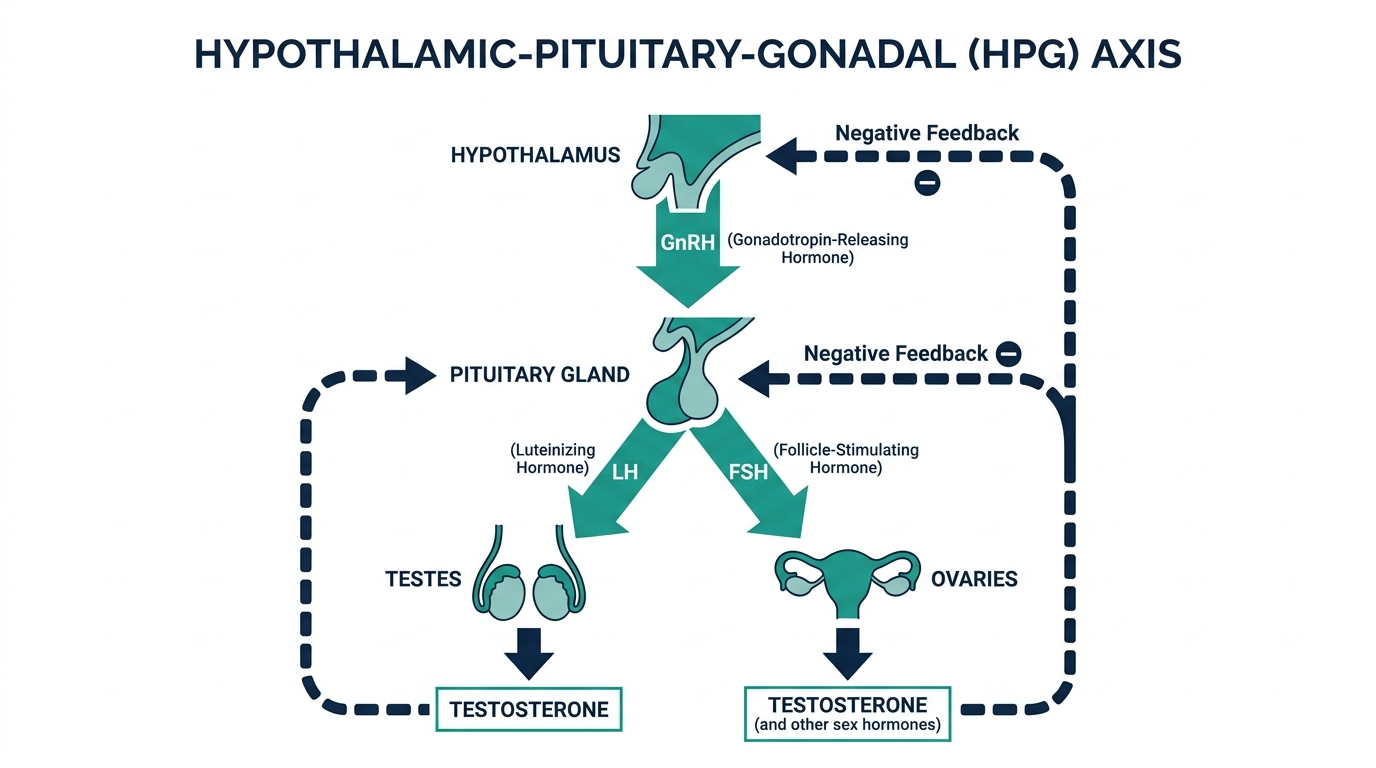
Sex is the single largest driver of the testosterone range. Adult men typically sit between about 264 and 916 ng/dL, while adult women fall around 8 to 60 ng/dL, an order-of-magnitude gap (JCEM, 2017). The reason is anatomical: in men the testes produce about 95 percent of testosterone under signals from the pituitary gland, whereas in women the ovaries and adrenal glands make only small quantities.
Because the female range is so narrow and low, accurate measurement matters more. Standard immunoassays can be unreliable at low concentrations, so labs often use liquid chromatography mass spectrometry for women and children (Mayo Clinic Laboratories). Free testosterone, the small fraction not bound to proteins, is sometimes measured alongside total testosterone, especially when sex hormone binding globulin is abnormal. The Mayo Clinic free testosterone reference for adult women is roughly 0.3 to 1.9 ng/dL.
What makes testosterone rise or fall with age?
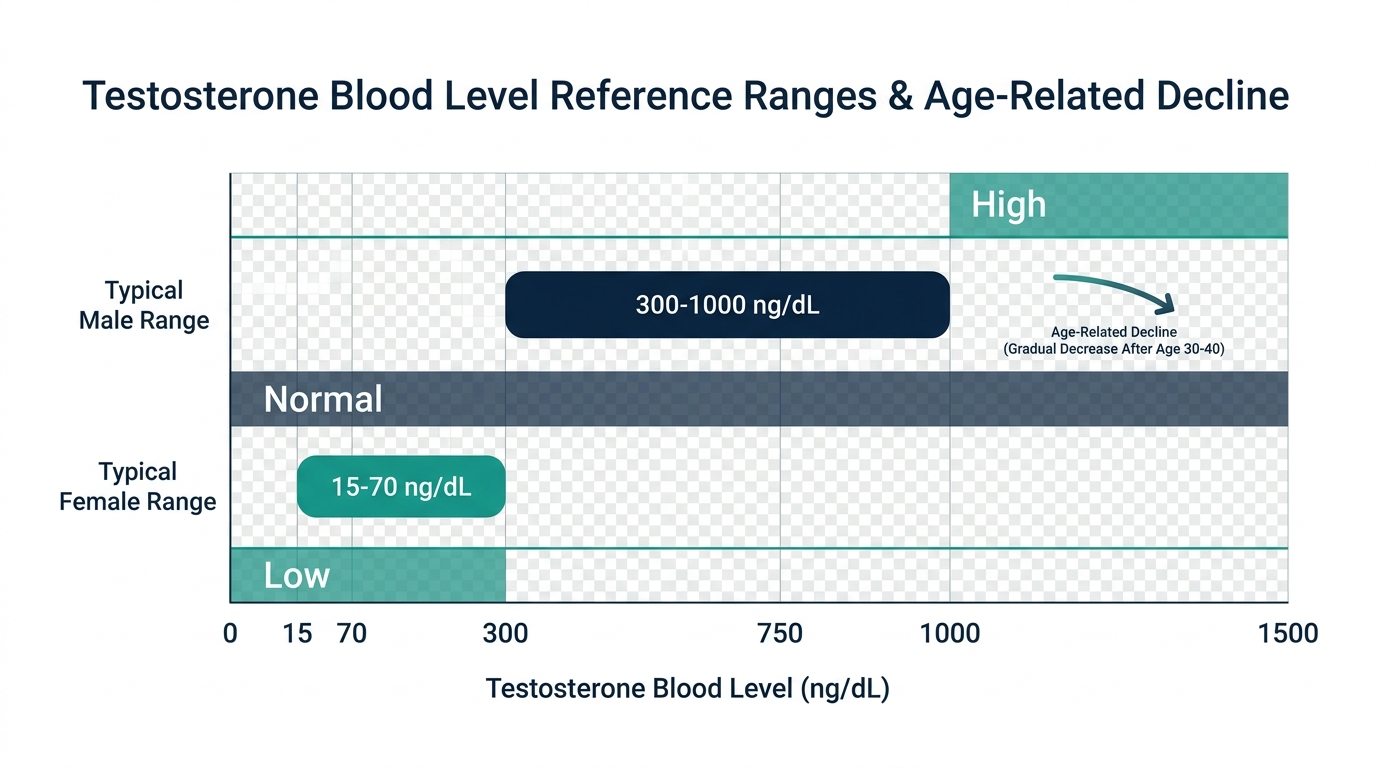
Age is the dominant natural driver: after the pubertal surge, male testosterone falls by about 1 percent per year from the 30s onward, so a 70-year-old man may sit roughly a third below his age-30 level (StatPearls, NCBI). In women, ovarian output declines gradually through the menopausal transition, lowering the postmenopausal range.
Beyond age, several factors move levels:
- Body weight: obesity lowers total and free testosterone, partly because fat tissue converts testosterone to estrogen (Cleveland Clinic).
- Time of day: levels peak in the morning and dip later, so timing changes the number.
- Sleep and stress: short sleep and chronic illness suppress production.
- Medical conditions: pituitary disorders, type 2 diabetes, and certain medications (opioids, steroids) reduce testosterone.
- Polycystic ovary syndrome: in women, PCOS commonly raises testosterone above the female range.
Because a single result reflects a moment in time, clinicians usually confirm an abnormal value with a repeat morning test before acting on it.
When is an out-of-range result a concern?
In men, the American Urological Association defines low testosterone as a total level below 300 ng/dL, confirmed on two separate morning blood tests, and only treated when paired with symptoms (American Urological Association). A single number outside the reference range is not a diagnosis on its own.
Symptoms add the context that a number alone cannot. Low testosterone in men can show up as reduced sex drive, erectile difficulty, fatigue, loss of muscle mass, and low mood. In women, a high level (often from PCOS) may cause acne, excess facial or body hair, and irregular periods, while a very low level rarely causes clear symptoms. High testosterone in men can come from supplement or anabolic steroid use, or rarely from a tumor. Persistently abnormal results, or any result that does not match how you feel, warrant evaluation by a clinician who can order repeat or additional tests (free testosterone, LH, FSH, prolactin) and interpret them in full.
What are the next steps after a low result?
A confirmed low testosterone is the start of the workup, not the end. The key question a clinician asks next is where the problem sits, because the answer changes everything about what to do.
The distinction is between primary and secondary hypogonadism, and two pituitary hormones settle it. LH and FSH are the signals the brain sends to the testes. If testosterone is low but LH and FSH are high, the brain is shouting and the testes are not answering, which points to a testicular (primary) cause. If testosterone is low and LH and FSH are also low or inappropriately normal, the signal itself is weak, which points to a pituitary or hypothalamic (secondary) cause and often prompts a prolactin test and sometimes brain imaging. Clinicians commonly add SHBG so free testosterone can be calculated, and estradiol, since some symptoms of “low T” are really an estrogen imbalance.
A realistic example. A 46-year-old man with low libido, afternoon fatigue, and softer workouts gets an afternoon draw showing total testosterone of 310 ng/dL and is told he is normal. A repeat fasting morning test comes back at 265, and his free testosterone is clearly low with a high-normal SHBG. LH and FSH are normal, pointing to a secondary pattern, so his clinician checks prolactin, reviews his sleep apnea and his opioid painkiller, and treats those reversible drivers before ever discussing testosterone therapy. That order of operations, confirm, subtype, then treat the cause, is the whole point of the workup. What to do about a genuinely low result, from lifestyle levers to when medication is appropriate, is covered in our guide on how to raise testosterone.
What does testosterone mean for women?
The conversation is usually flipped for women, where the concern is more often a level that is too high than too low. The most common cause of high testosterone in women is polycystic ovary syndrome, and the tell-tale symptoms are acne, excess facial or body hair, scalp hair thinning, and irregular or absent periods. A markedly high or rapidly rising level, on the other hand, prompts a look for less common causes such as an adrenal or ovarian tumor. Because the female range is so low and narrow, an accurate assay matters, which is why good labs use mass spectrometry rather than a standard immunoassay for women.
Low testosterone in women is harder to interpret. It falls naturally after menopause and with certain birth control pills, which raise SHBG and lower the free fraction, and it can contribute to low libido, though the evidence and treatment options are more limited than in men. This is an area to work through with a clinician rather than self-diagnose from a single number.
Turn what you just learned into action.
Superpower lets you test 100+ biomarkers from home, then re-check them over time so you can actually see progress, physician-reviewed at every step.
Frequently asked questions
What is a healthy testosterone level for a man by age?
For men aged 19 to 39, the Endocrine Society harmonized total testosterone range is 264 to 916 ng/dL. Levels gradually decline with age, falling about 1 percent per year after 30, so older men’s ranges shift downward. Always compare against your own lab’s reference range.
What is a normal testosterone level for a woman?
Adult women typically have total testosterone of about 8 to 60 ng/dL, far below men. Postmenopausal women often run lower, around 2 to 41 ng/dL. Levels above the female range may suggest PCOS and are worth discussing with a clinician.
At what age does testosterone peak?
In men, testosterone peaks in the late teens through the twenties, near the top of the adult reference range. It then declines gradually from around age 30 onward at roughly 1 percent per year, though body weight, sleep, and health speed or slow that drop.
What is considered low testosterone?
The American Urological Association defines low testosterone in men as a total level below 300 ng/dL, confirmed on two separate morning tests and accompanied by symptoms such as low libido or fatigue. A single low number alone is not a diagnosis.
What time of day should testosterone be tested?
Testosterone is highest in the morning, so blood is usually drawn before about 10 a.m. for the most reliable comparison to reference ranges. Testing later in the day can return a falsely low result, which is one reason abnormal values are repeated.
Does fasting affect a testosterone test?
Yes, a little. Eating, especially a sugary or high-carbohydrate meal, temporarily lowers testosterone, so many clinicians prefer a fasting morning sample for consistency. The effect is modest, but if you want to compare results over time, keep the conditions the same each time by testing fasted in the morning.
My total testosterone is normal but I still have symptoms. Why?
This is often an SHBG issue. If sex hormone binding globulin is high, a lot of your testosterone is locked up and unavailable, so total can read normal while free testosterone, the usable fraction, is low. Asking for a free testosterone or an SHBG level alongside total is the way to see the part of the picture a total-only test hides.
Do I need free testosterone or is total enough?
For many healthy people a total testosterone is enough. Free testosterone earns its place when total sits in a borderline zone, when symptoms and the total number disagree, or when something is likely to shift SHBG, such as older age, obesity, thyroid disease, or liver disease. In those cases free or bioavailable testosterone reflects what your tissues actually receive.
Will testosterone therapy or supplements show up on the test?
Testosterone therapy will read as a normal or high level depending on dose and timing, which is exactly how clinicians monitor it. Anabolic steroid use can push levels well above the reference ceiling. Over-the-counter “testosterone booster” supplements rarely move the actual number much, whatever the label promises, so a booster plus a still-low result is a common and telling combination.
Sources
- Journal of Clinical Endocrinology and Metabolism, Harmonized Reference Ranges for Circulating Testosterone Levels in Men
- Cleveland Clinic, Testosterone
- Cleveland Clinic, Low Testosterone (Male Hypogonadism)
- StatPearls (NCBI Bookshelf), Physiology, Testosterone
- Mayo Clinic Laboratories, Testosterone Total, Bioavailable, and Free, Serum
- American Urological Association, Testosterone Deficiency Guideline
- MedlinePlus, Testosterone Levels Test
This article is for general educational purposes and is not medical advice. It cannot diagnose or treat you and does not replace your clinician. Always discuss your lab results and any health decisions with a qualified healthcare professional.
Related: test your thyroid and hormones from home.
Vital Signs Today may earn a commission if you buy through links on this page. It does not affect our editorial assessments.