Last updated 5 July 2026. Educational content only, not medical advice. Retatrutide (LY3437943) is an investigational drug and is not FDA-approved for any indication. Talk to a licensed clinician before handling any research peptide.
Short answer: For a 12 mg retatrutide vial, add 2.4 mL of bacteriostatic water to get the most practical working concentration of 5 mg/mL. That puts a 1 mg dose at 20 units on a U-100 insulin syringe, a 2 mg dose at 40 units, and a 4 mg dose at 80 units. If you need smaller injection volumes at higher doses, use 1.2 mL instead to hit 10 mg/mL.
Getting the retatrutide math exact? Get equally exact data on how your body is responding with a full panel. One at-home Superpower draw checks 100+ biomarkers, physician-reviewed.
The question sounds simple. It is not, because the answer depends on what dose you plan to draw, which syringe you own, and how many weeks the vial needs to last. Get the math wrong by one decimal place and you are off by a factor of ten. That error range matters more with retatrutide than with most peptides because its therapeutic window in the Phase 3 trials was specifically defined by milligram increments, and the jump from 4 mg to 9 mg to 12 mg is not a rounding error.
This guide walks through every concentration option for a 12 mg vial, shows the unit-by-unit draw tables for each, explains why bacteriostatic water and not sterile water, and covers the one storage rule that changes everything about how you plan your vial.
Full-body lab membership: 100+ biomarkers, doctor-reviewed, tracked over time.
Why does the water volume even matter?
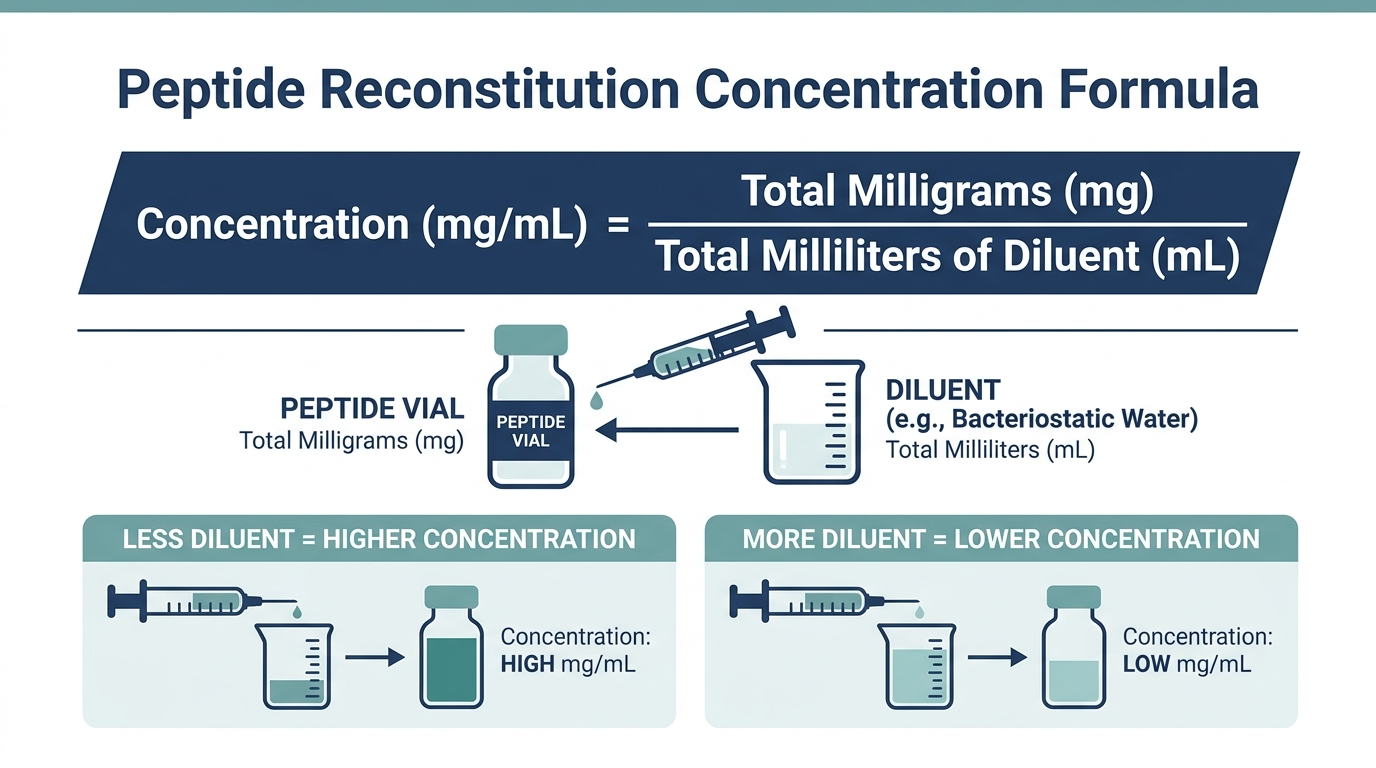
The powder in a research vial is lyophilized, meaning freeze-dried, and it takes up almost no physical volume. When you inject bacteriostatic water, the volume you add becomes the volume of the solution. That is why the math is a direct ratio: total peptide in milligrams divided by total water in milliliters gives you milligrams per milliliter, your concentration.
Change the denominator and you change every dose volume downstream. A researcher who mixes 1.2 mL into a 12 mg vial and one who mixes 2.4 mL into the same vial will draw completely different unit counts for the same milligram dose. Neither is wrong in principle, but using the other person’s table is wrong in practice, and that is how dosing errors happen in forums where people paste unit counts without stating their reconstitution volume.
This is the single most common source of confusion on every peptide forum I have seen. The dose in milligrams is irrelevant unless you know the concentration. Always state both.
The three standard concentrations for a 12 mg vial
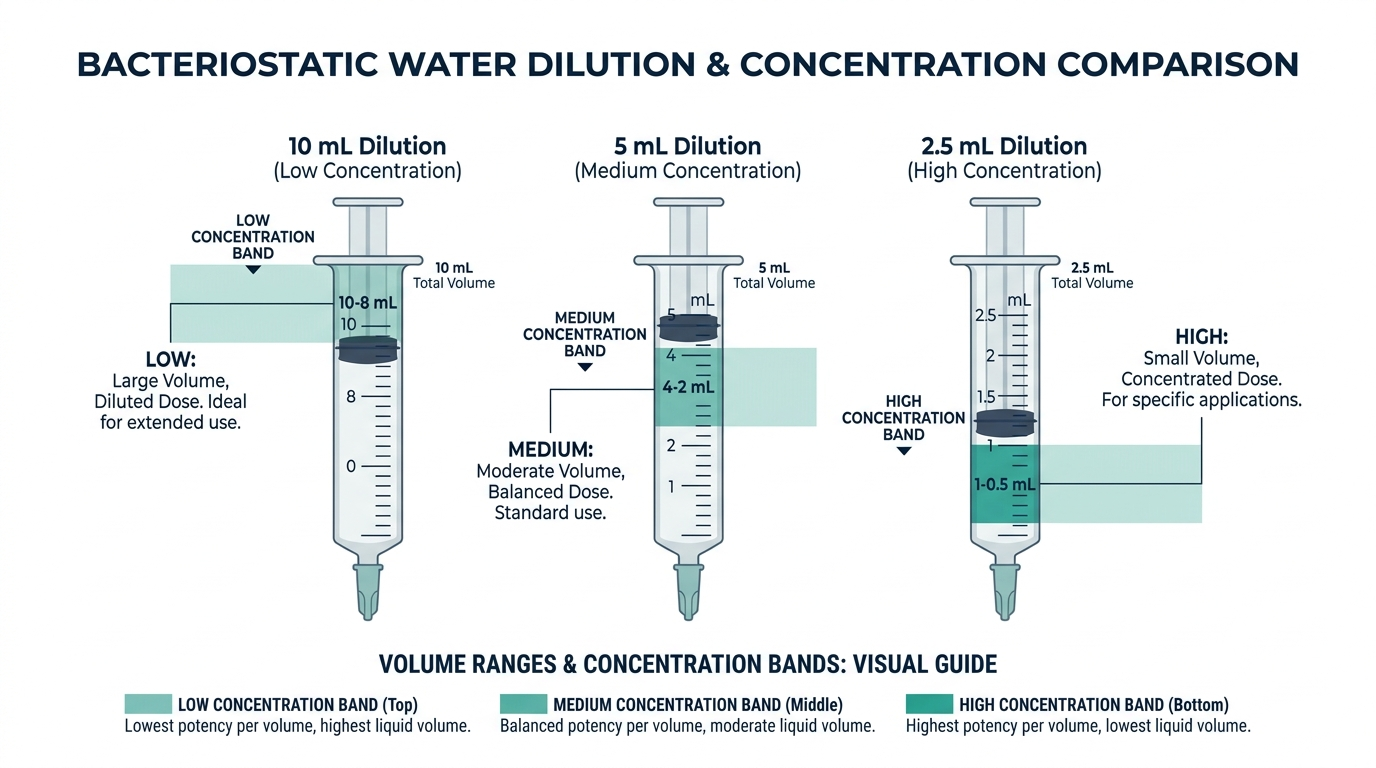
Three reconstitution volumes are worth knowing, each with a different use case.
| BAC Water Added | Concentration | Best For |
|---|---|---|
| 1.2 mL | 10 mg/mL | Higher doses (8 mg+), smaller injection volumes |
| 2.4 mL | 5 mg/mL | Mid-range doses (1 mg to 6 mg), easiest math |
| 4.8 mL | 2.5 mg/mL | Very low starting doses, maximum precision at micro-levels |
The 5 mg/mL option (2.4 mL of water) is the most commonly recommended starting point for a 12 mg vial because the unit math is intuitive: every 10 units on a U-100 syringe delivers exactly 0.5 mg. Most researchers and the reconstitution calculators at GLP3 Planner and BetteryouRx converge on 5 mg/mL as the default for this vial size.
The 10 mg/mL option (1.2 mL of water) compresses injection volumes in half. At that concentration, a 4 mg dose is 40 units and an 8 mg dose is 80 units, both easily within a standard 1 mL syringe. The trade-off is that lower starting doses (0.5 mg or 1 mg) land at 5 and 10 units respectively, which are small enough that minor pipetting variation introduces meaningful percentage error.
The 2.5 mg/mL option (4.8 mL of water) is rarely recommended for a 12 mg vial. At that dilution, even a 4 mg dose requires 1.6 mL, which does not fit in a standard insulin syringe and requires a separate draw into a larger barrel.
The full unit tables for the two practical concentrations
At 5 mg/mL (2.4 mL BAC water added to 12 mg vial)
| Dose | Draw Volume | U-100 Insulin Syringe Units |
|---|---|---|
| 0.5 mg | 0.1 mL | 10 units |
| 1 mg | 0.2 mL | 20 units |
| 2 mg | 0.4 mL | 40 units |
| 3 mg | 0.6 mL | 60 units |
| 4 mg | 0.8 mL | 80 units |
| 6 mg | 1.2 mL | 120 units* |
| 8 mg | 1.6 mL | 160 units* |
| 12 mg | 2.4 mL | 240 units* |
*These volumes exceed a standard 1 mL syringe. Split into two draws or use a 3 mL syringe.
At 10 mg/mL (1.2 mL BAC water added to 12 mg vial)
| Dose | Draw Volume | U-100 Insulin Syringe Units |
|---|---|---|
| 0.5 mg | 0.05 mL | 5 units |
| 1 mg | 0.1 mL | 10 units |
| 2 mg | 0.2 mL | 20 units |
| 4 mg | 0.4 mL | 40 units |
| 6 mg | 0.6 mL | 60 units |
| 8 mg | 0.8 mL | 80 units |
| 12 mg | 1.2 mL | 120 units* |
*Requires a syringe rated for at least 1.2 mL. A standard U-100 syringe tops out at 100 units.
One practical note from the data: the TRIUMPH-1 phase 3 trial used a titration schedule that started participants at 2 mg and stepped up to 4 mg, 8 mg, and finally 12 mg over several weeks (Eli Lilly press release, May 2026). At 5 mg/mL concentration, all four of those titration doses fall within 80 units or less, fitting comfortably in a standard insulin syringe. That is why 5 mg/mL is the practical default.
Why bacteriostatic water, and not just sterile water?
The distinction matters more than most first-time researchers expect. Bacteriostatic water contains 0.9% benzyl alcohol, a preservative that inhibits bacterial replication. Plain sterile water contains none. Once you pierce a vial stopper, the needle introduces potential contaminants with every draw. With sterile water, any bacteria introduced start multiplying immediately, and the vial should be used within 24 to 72 hours (Heritage Labs reconstitution guide).
With bacteriostatic water, the benzyl alcohol suppresses that bacterial growth across multiple entries over the course of weeks. That is the only reason you can use a single reconstituted 12 mg vial over a multi-week dosing schedule.
Bacteriostatic water is sold at most pharmacies without a prescription (common brands include Fresenius Kabi 30 mL flip-top vials), and 30 mL is enough for roughly 10 to 20 reconstitutions depending on vial size. At roughly $8 to $12 per 30 mL vial, it is not the expensive part of this equation.
Do not use saline for reconstitution unless you are drawing the entire vial in a single session. Saline is isotonic and injectable, but it contains sodium chloride rather than benzyl alcohol, so it offers no bacteriostatic protection across multiple draws.
Step-by-step reconstitution technique (the moves most guides skip)
Reconstitution has four steps, but two of them have specific mechanics that affect the finished solution.
Step 1: Temperature equilibration. Let both vials, the lyophilized peptide and the bacteriostatic water, reach room temperature for 15 to 20 minutes before mixing. Injecting cold water into a cold lyophilized cake increases the risk of protein aggregation. This step gets skipped constantly and is one reason some researchers report hazy or particulate solutions on the first draw.
Step 2: Sterilize stoppers. Wipe the rubber stopper of each vial with a fresh alcohol swab and let it air-dry for 30 seconds. The drying matters because wiping wet alcohol directly into a vial dilutes your solution and introduces alcohol-in-water interference.
Step 3: Draw and inject slowly. Using a 23- to 27-gauge needle on either a 1 mL or 3 mL syringe, draw your target volume of bacteriostatic water. Insert the needle through the peptide vial’s stopper and angle it so the water runs down the inside wall of the glass, not directly onto the lyophilized cake. This protects the peptide structure. Inject slowly. The total transfer should take 10 to 15 seconds, not 2. Rushing this step creates foam and mechanical shear that can degrade fragile peptide bonds.
Step 4: Swirl, do not shake. Once the water is in, gently roll the vial between your palms in a circular motion. The powder should dissolve in under a minute. A solution that is still hazy after 2 minutes may indicate incomplete dissolution, temperature shock, or a reconstitution problem worth investigating before drawing a dose. Never shake the vial. Shaking introduces air and causes protein aggregation, the same physical process that ruins foamy egg whites.
Personally, I think the single most underrated step is the wall-injection technique. Every guide mentions it, but most do not explain why: direct impingement on the lyophilized cake is a physical disruption, and retatrutide is a 4,351-dalton linear peptide with a fatty acid modification that makes its three-dimensional structure more susceptible to mechanical stress than smaller, simpler peptides.
Storage after reconstitution: the 28-day rule you cannot bend
Reconstituted retatrutide is stable for 28 days at 36 to 46 degrees Fahrenheit (2 to 8 Celsius), stored upright in the dark (GLP3 Planner storage guide). Some sources quote up to 60 days under optimal conditions, specifically amber-glass vials with foil wrapping and minimal needle entries. The 28-day number is the conservative pharmacy standard and the one to use unless you have a specific reason to believe your storage conditions exceed baseline.
Do not freeze reconstituted retatrutide. Freezing ruptures the aqueous solution structure and can cause irreversible protein aggregation. The lyophilized powder, before reconstitution, can be stored at minus 20 Celsius almost indefinitely, which is why research vendors ship it as powder. Once water is added, the clock starts.
Label the vial with the reconstitution date before you put it in the fridge. This is not a suggestion: on day 29, the solution is discarded regardless of volume remaining.
One insider detail most guides bury: a 12 mg vial at 5 mg/mL yields 2.4 mL of solution. At a 4 mg weekly dose, that is six weeks of supply. But the 28-day stability limit means you cannot use all of it. At best, you draw four weeks of doses (4 doses at 4 mg each = 16 mg used), except the vial only contains 12 mg total. The math means a single 12 mg vial at 4 mg weekly is exactly three doses. Any unconsumed volume remaining at day 28 is discarded. Plan accordingly and do not buy more than your 28-day window will consume.
What retatrutide actually is, and why the 12 mg dose is the one everyone asks about
Retatrutide (development code LY3437943) is Eli Lilly’s investigational triple receptor agonist. It targets three receptors simultaneously: GLP-1 (glucagon-like peptide-1), GIP (glucose-dependent insulinotropic polypeptide), and glucagon. That third mechanism is what separates it from tirzepatide (Mounjaro/Zepbound), which is a dual GLP-1/GIP agonist, and from semaglutide (Ozempic/Wegovy), which hits GLP-1 only (NEJM phase 2 trial).
The glucagon receptor component is the key differentiator. Glucagon activation increases resting energy expenditure and drives hepatic fat oxidation directly. GLP-1 and GIP suppress appetite and improve insulin response. The triple combination addresses both caloric intake and energy expenditure, which is why the phase 3 numbers are larger than either of the approved predecessors.
In TRIUMPH-1, announced by Eli Lilly on 21 May 2026, 2,339 participants were randomized across four arms. The 12 mg dose group showed a mean weight loss of 70.3 lbs (28.3% of body weight) at 80 weeks. Among participants who continued to 104 weeks, the 12 mg group reached 85.0 lbs (30.3%) average loss (Lilly press release). For context, 28.3% beats tirzepatide’s SURMOUNT-1 result (22.5% at 72 weeks) by nearly 6 percentage points and semaglutide’s STEP-1 result (14.9% at 68 weeks) by 13.4.
That is why “12 mg retatrutide” dominates the search volume. It is the highest dose used in the trials, the dose that produced the record-setting headline numbers, and the milestone on the titration schedule that most trial participants eventually reached.
Do not read this as a green light to start at 12 mg. The TRIUMPH-1 protocol started participants at 2 mg and stepped up over 16 weeks. The 12 mg outcome is the ceiling of a multi-month titration, not an entry dose.
The legal reality of retatrutide in June 2026
Here is the part most reconstitution guides skip entirely, because it complicates the clean how-to narrative.
Retatrutide is not FDA-approved. As of June 2026, Eli Lilly has not yet submitted a New Drug Application, with NDA submission targeted for Q4 2026 and approval projected in late 2027 or Q1 to Q2 2028 (retaweightloss.com). That timeline matters for how you should think about access.
Unlike semaglutide and tirzepatide, which were on FDA shortage lists and therefore temporarily accessible through compounding pharmacies, retatrutide never entered a shortage pathway because it was never approved to begin with. The Alliance for Pharmacy Compounding (A4PC), the industry’s own trade organization, has explicitly advised its members not to compound retatrutide because it does not appear on either the 503A or 503B authorized bulk substance lists (FDA statement on unapproved GLP-1 drugs). A telehealth clinic or compounding pharmacy offering retatrutide “with a prescription” in 2026 is operating in genuinely contested legal territory, and the professional bodies in the space are saying no.
The legitimate access pathway that exists right now is clinical trial enrollment. Eli Lilly’s TRIUMPH program still has active trials recruiting, including TRIUMPH-7, TRIUMPH-8, and TRIUMPH-9 as of April 2026 (ClinicalTrials.gov NCT07357415). In a trial, participants receive pharmaceutical-grade retatrutide at no cost, under physician supervision, with labs monitored throughout. That is a meaningfully different safety proposition than a research-labeled vial and a reconstitution calculator.
Research vendors sell retatrutide powder labeled “for laboratory research, not for human use.” That legal fiction is the entire scaffolding the grey market runs on. The label does not protect the buyer. It protects the seller.
Telehealth GLP-1 program with provider visits and pharmacy coordination.
Five things nobody tells you about reconstituting a 12 mg vial
1. The volume matters at both ends of the syringe. Bacteriostatic water vials have a 0.9% benzyl alcohol content, but vial sizes vary. Most 30 mL Fresenius Kabi vials are fine for multiple reconstitutions. Some smaller BAC water vials (10 mL) marketed specifically to peptide users are produced by less-regulated suppliers. The BAC water itself can be a quality variable.
2. Concentration consistency between vials matters more than the absolute concentration you choose. If you switch from 2.4 mL (5 mg/mL) to 1.2 mL (10 mg/mL) between vials, your unit-per-milligram math doubles. Forgetting to update the draw table is how someone accidentally takes twice their intended dose. Choose a concentration and stay consistent across every vial of the same run.
3. A cloudy solution is not always ruined. Some lyophilized peptides have residual excipients (protective agents added before freeze-drying) that create brief turbidity. However, persistent cloudiness after gentle swirling, or cloudiness that returns after apparent dissolution, suggests protein aggregation and the vial should be discarded. Aggregated peptides are not merely less potent. Aggregated proteins can produce unexpected biological responses.
4. The TRIUMPH-1 trial did not reconstitute 12 mg vials. Lilly’s pharmaceutical-grade retatrutide was manufactured as a ready-to-inject aqueous solution in pre-filled pens, identical to how Ozempic and Mounjaro are delivered. Every reconstitution guide you read online describes a process that does not resemble the clinical trial product. The purity, excipients, delivery format, and quality controls are in entirely different categories.
5. Independent testing has flagged retatrutide quality problems at research vendors. The testing platform Finnrick analyzed Peptide Sciences retatrutide across 37 batches before that vendor closed in March 2026 and assigned it an “E” rating, with reported purity dipping as low as 75% (Finnrick vendor database). A vial that tests at 75% purity does not simply deliver 75% of the intended dose. It contains 25% unknown compounds that reconstitution math cannot account for.
Turn what you just learned into action.
Superpower lets you test 100+ biomarkers from home, then re-check them over time so you can actually see progress, physician-reviewed at every step.
Frequently asked questions
How much bacteriostatic water do I add to a 12 mg retatrutide vial?
The most practical option is 2.4 mL, which gives a 5 mg/mL concentration. For a 10 mg/mL concentration with smaller injection volumes, use 1.2 mL. The choice depends on what dose you plan to draw and which syringe you have. At 5 mg/mL, every 10 units on a U-100 insulin syringe equals 0.5 mg.
Can I use sterile water instead of bacteriostatic water?
Only if you plan to use the entire vial in a single session. Sterile water has no preservative, so bacterial contamination from repeated needle entries can start multiplying within 24 to 72 hours. Bacteriostatic water contains 0.9% benzyl alcohol, which suppresses that bacterial growth and extends the usable vial life to 28 days.
How long does reconstituted retatrutide stay stable?
28 days at 36 to 46 degrees Fahrenheit (2 to 8 Celsius), stored upright in the dark. Discard any remaining solution after 28 days regardless of volume. Do not freeze reconstituted solution.
Why do some guides recommend 1.2 mL and others recommend 2.4 mL for a 12 mg vial?
Both are valid. The difference is concentration: 1.2 mL gives 10 mg/mL, and 2.4 mL gives 5 mg/mL. At 5 mg/mL, lower doses (0.5 mg to 4 mg) land at easy-to-read unit marks on a standard syringe. At 10 mg/mL, higher doses (6 mg to 8 mg) fit within a single syringe draw. The guides that recommend one over the other are often assuming a specific dose range without saying so.
Is retatrutide legal to buy in 2026?
Retatrutide is not FDA-approved and is not scheduled as a controlled substance. Research vendors sell it legally as a “for laboratory research only” substance. That label is not a license for personal use; it is a legal carve-out for the seller. For most people, the practical and safer alternative is an FDA-approved GLP-1 drug accessed through a licensed telehealth provider. Compounding pharmacies cannot legally produce retatrutide under either the 503A or 503B frameworks as of mid-2026, and the Alliance for Pharmacy Compounding has told its members not to attempt it.
What concentration does the clinical trial use?
Eli Lilly’s TRIUMPH-1 used pharmaceutical-grade retatrutide as a pre-filled ready-to-inject aqueous solution, not a reconstituted powder. The concentration, excipients, and manufacturing quality are not publicly disclosed in detail and cannot be replicated through research-vial reconstitution.
What are the TRIUMPH-1 trial results for the 12 mg dose?
In TRIUMPH-1 (results announced 21 May 2026), participants on 12 mg retatrutide lost an average of 70.3 lbs (28.3% of body weight) at 80 weeks. Among those who continued to 104 weeks, the 12 mg group reached an average of 85.0 lbs (30.3%) loss. These are the largest average weight-loss numbers ever reported in a Phase 3 obesity trial, roughly 5.8 percentage points above tirzepatide’s SURMOUNT-1 result (Lilly press release).
Telehealth GLP-1 program with provider visits and pharmacy coordination.
Author: Vital Signs Today Editorial Team, [credential]”]. Educational content, not medical advice. Sources linked inline.
Primary sources:
– Eli Lilly TRIUMPH-1 press release (May 21, 2026): https://investor.lilly.com/news-releases/news-release-details/lillys-triple-agonist-retatrutide-delivered-powerful-weight-loss
– NEJM Phase 2 retatrutide trial: https://www.nejm.org/doi/full/10.1056/NEJMoa2301972
– ClinicalTrials.gov TRIUMPH study NCT07357415: https://clinicaltrials.gov/study/NCT07357415
– FDA statement on unapproved GLP-1 drugs: https://www.fda.gov/drugs/drug-alerts-and-statements/fdas-concerns-unapproved-glp-1-drugs-used-weight-loss
– Finnrick vendor testing database: https://www.finnrick.com/
– GLP3 Planner reconstitution guide: https://glp3planner.com/resources/retatrutide-reconstitution-guide
– GLP3 Planner storage stability: https://glp3planner.com/resources/retatrutide-storage-stability
– Heritage Labs bacteriostatic water guide: https://heritagelabsusa.com/guides/bacteriostatic-water-guide/
– RetaWeightLoss FDA approval timeline: https://www.retaweightloss.com/article/complete-retatrutide-guide-2026-phase-3-trials-timeline-whats-next
– AJMC TRIUMPH-1 results: https://www.ajmc.com/view/retatrutide-achieves-up-to-30-3-average-weight-loss-in-phase-3-triumph-1-trial
Related reading
Related: best GLP-1 telehealth providers for 2026.
Vital Signs Today may earn a commission if you buy through links on this page. It does not affect our editorial assessments.