Quick answer: The core difference in functional vs conventional blood tests comes down to reference ranges and goals: conventional blood tests use broad population-based reference ranges and screen for disease. Functional blood tests use the same draw but apply tighter, research-backed “optimal” ranges and order additional markers that conventional panels omit, aiming to catch patterns before pathology sets in. The result is that a person can get a completely normal conventional report and a flagged functional report from blood drawn the same morning. Which approach you need depends on whether you are trying to rule out disease or actually understand your physiology.
What Is the Core Difference Between Functional and Conventional Blood Tests?
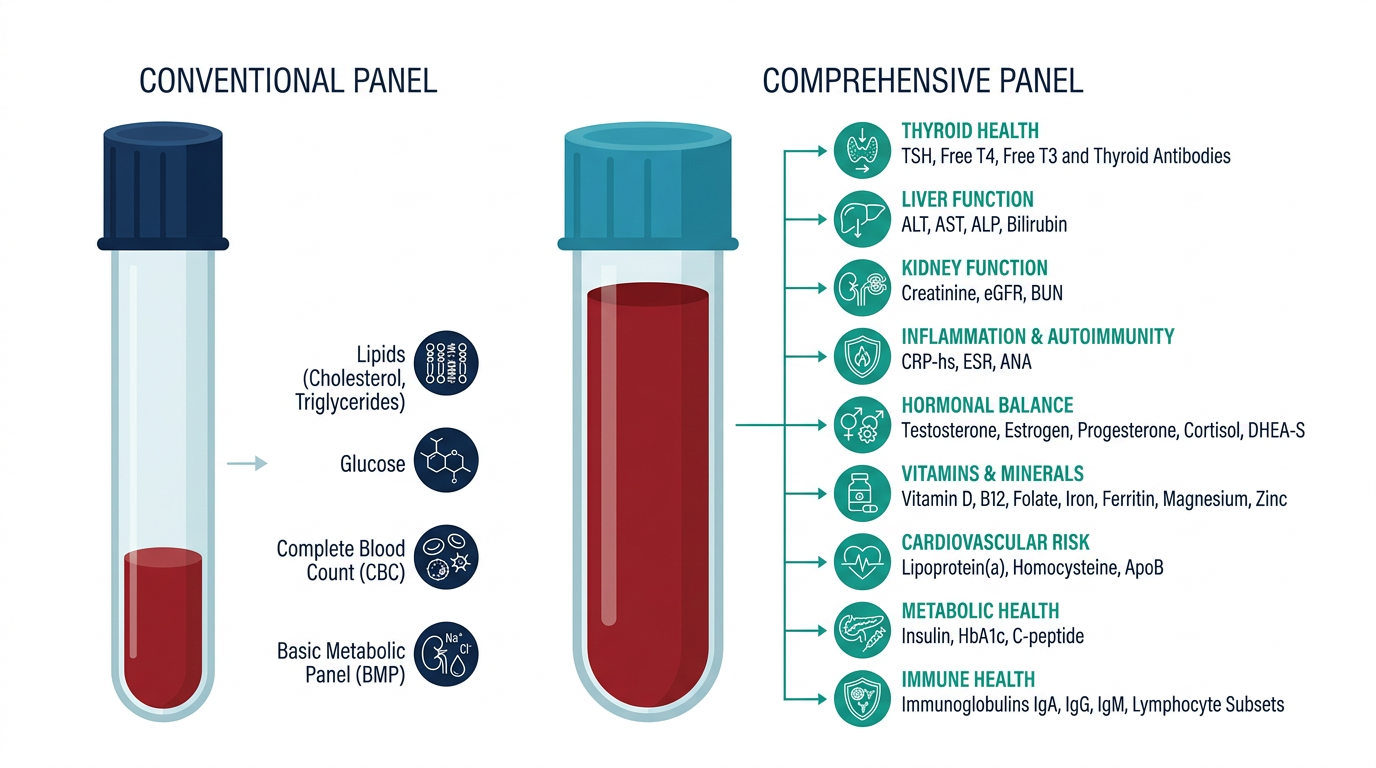
The fundamental split is philosophy, not technology. Both approaches use the same venipuncture, the same Quest or Labcorp analyzer, and largely the same chemistry. The divergence happens in which markers get ordered and how the numbers are interpreted once the results arrive.
Want the tighter, research-backed ranges functional testing uses, without the extra clinic visit? See what 100+ biomarkers reveal. One at-home Superpower draw checks 100+ biomarkers, physician-reviewed.
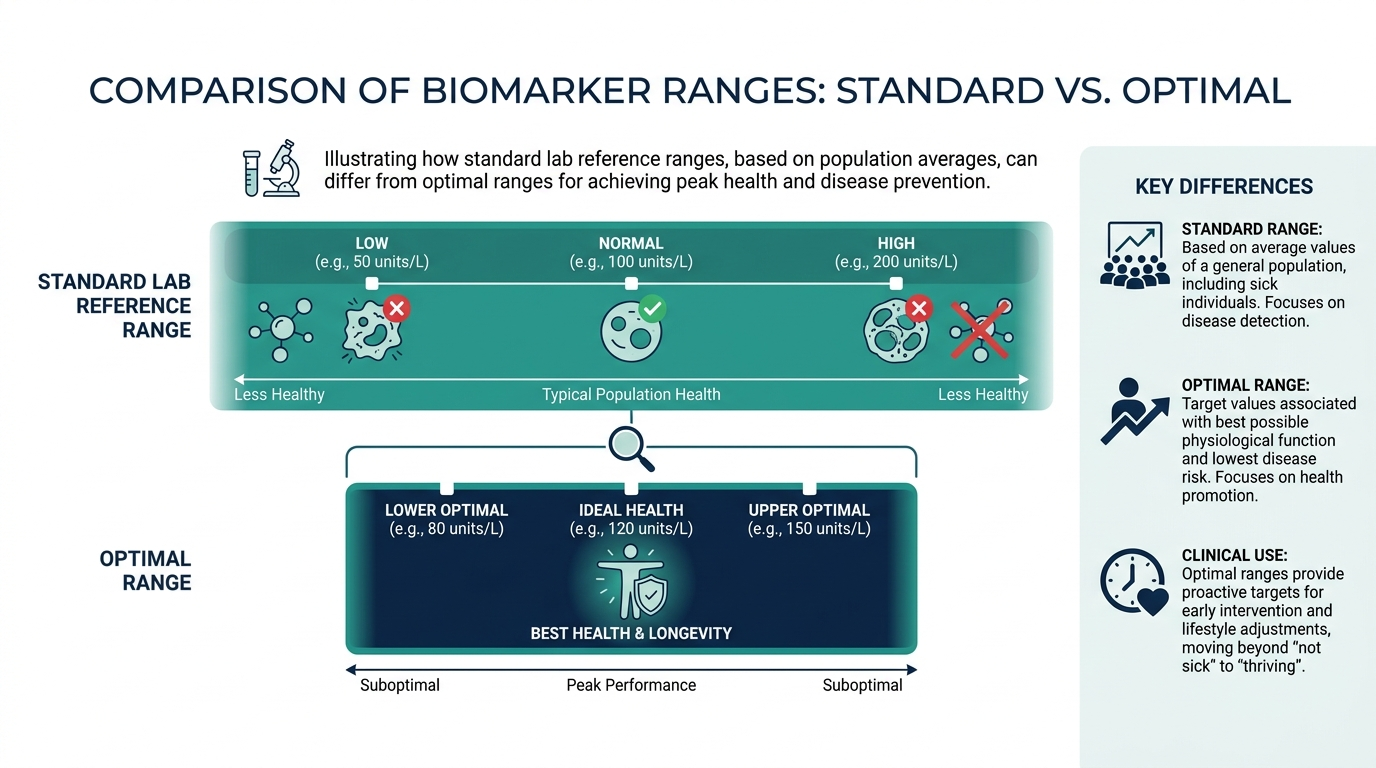
Conventional medicine defines a reference range by collecting results from a large population sample, dropping the top and bottom 2.5 percent, and calling what remains “normal.” That sample includes people who smoke, are sedentary, take medication, and are silently developing conditions not yet diagnosed. When your fasting glucose comes back at 99 mg/dL on a standard CBC with metabolic panel, your report says “normal” because the conventional range tops out at 100. A functional clinician looking at that same number sees early insulin resistance risk and orders a fasting insulin to confirm or rule it out.
Functional medicine testing, as explored in our functional blood testing explained overview, builds on the idea that the distance between “not sick” and “optimally well” is measurable in lab values. The goal is not just to rule out diabetes but to understand whether your metabolic machinery is running cleanly.
Which Markers Does Each Approach Order?
Conventional panels are deliberately lean, ordered to answer a specific clinical question or fulfill a wellness visit checkbox. Functional panels are deliberately broad, ordered to map a baseline and detect patterns across systems.
| Marker category | Conventional standard panel | Functional expanded panel |
|---|---|---|
| Thyroid | TSH only | TSH, free T3, free T4, reverse T3, TPO antibodies, thyroglobulin antibodies |
| Metabolic | Fasting glucose, HbA1c (if at risk) | Fasting glucose, fasting insulin, HbA1c, HOMA-IR calculation |
| Lipids | Total cholesterol, LDL, HDL, triglycerides | All standard plus ApoB, Lp(a), LDL particle size/number, sdLDL |
| Inflammation | CRP (sometimes) | High-sensitivity CRP, homocysteine, fibrinogen, ferritin in context |
| Nutrients | Not ordered unless symptomatic | Vitamin D (25-OH), B12, folate, magnesium RBC, zinc, iron panel with ferritin |
| Hormones | Rarely unless specific complaint | DHEA-S, free and total testosterone, estradiol, cortisol AM, SHBG |
| Organ function | CMP (kidney, liver, electrolytes) | CMP plus GGT isolated, uric acid, cystatin C for kidney |
The practical gap matters. A standard annual physical typically orders a CBC, CMP, and lipid panel, totaling perhaps 20 data points. A full functional panel ordered through a service like Superpower or captured in a Function Health membership runs 100 or more biomarkers. That is not redundancy for its own sake. Each additional marker fills a specific diagnostic gap. Ordering ApoB alongside LDL, for example, catches the subset of patients who have normal LDL but high particle concentration, which carries meaningfully higher cardiovascular risk.
How Do Functional Lab Ranges Differ From Standard Ranges?
Functional ranges are narrower and aspirational rather than statistical. They are derived from research on populations with low disease burden, not from the general population walking into a hospital lab. The practical effect is significant.
| Marker | Conventional “normal” range | Functional “optimal” range |
|---|---|---|
| Fasting glucose (mg/dL) | 70 to 100 | 72 to 85 |
| TSH (mIU/L) | 0.45 to 4.5 | 1.0 to 2.0 |
| Vitamin D 25-OH (ng/mL) | 20 to 100 | 50 to 80 |
| Ferritin (ng/mL, women) | 12 to 150 | 40 to 100 |
| Homocysteine (umol/L) | up to 15 | under 8 |
| hs-CRP (mg/L) | under 3.0 (low risk) | under 1.0 |
| HbA1c (%) | under 5.7 (non-diabetic) | under 5.3 |
The TSH example is instructive. Endocrinology societies set 4.5 mIU/L as the upper conventional limit. A TSH of 3.8 prints “normal” on a standard lab report. Yet multiple studies show that people in the 2.5 to 4.5 range who also have elevated TPO antibodies have a substantially higher rate of progressing to overt hypothyroidism within five years. A functional clinician ordering full thyroid antibody panels catches those cases early. That is not alternative medicine, it is a different risk-tolerance threshold applied to the same evidence base.
Here is the “same morning” scenario made concrete. A 41-year-old woman gives one tube of blood. Her conventional report comes back clean: glucose 96, TSH 3.6, ferritin 24, vitamin D 28, hs-CRP 2.1, all inside the printed ranges, so she is told everything looks normal. Run the identical values against functional ranges and four of them flag: glucose is drifting upward, TSH sits above the 2.0 optimal ceiling, ferritin is low enough to explain her hair shedding, and vitamin D is well under the 50 many clinicians target. Same blood, same lab, two completely different conversations. Nothing was measured wrong. The numbers were simply read against a different question.
Why Does My Doctor Say Normal but I Still Feel Sick?
This is one of the most common frustrations patients bring to functional medicine practitioners, and the explanation is straightforward once you understand the range problem. Conventional ranges are designed to detect disease, not to confirm that you are thriving. There is a large zone between “no diagnosable pathology” and “feeling genuinely well” that standard labs simply do not resolve.
Several specific scenarios explain most cases:
- Sub-optimal thyroid function: TSH of 3.5 with low-normal free T3 reads as normal on a standard panel but often correlates with fatigue, brain fog, and cold intolerance that resolves when TSH is pushed toward 1.5 through treatment or lifestyle changes.
- Low ferritin with normal hemoglobin: Iron deficiency without anemia is missed by every conventional CBC. Ferritin below 30 ng/mL causes hair loss, fatigue, and exercise intolerance in many women even when hemoglobin is 13.5. Standard labs flag ferritin only below 12.
- Vitamin D insufficiency: A level of 22 ng/mL clears the conventional minimum of 20 but is associated with immune underperformance, mood changes, and poor sleep. Functional targets of 50 to 80 reflect actual tissue sufficiency.
- Fasting insulin not ordered: Most conventional metabolic workups skip fasting insulin entirely. A person can have fasting glucose of 92 and insulin of 18 uIU/mL, a HOMA-IR above 4, and strong insulin resistance developing for years before glucose ever crosses the 100 threshold.
- Magnesium serum vs. RBC: Serum magnesium is tightly regulated by the kidneys and is the last thing to fall when you are depleted. RBC magnesium reflects cellular stores and is 30 percent more sensitive for functional deficiency. Conventional panels always order serum; functional panels often order RBC.
If you are working through this question, our guide on whether you need a functional medicine doctor walks through the decision in practical terms.
How Much Do Functional Blood Tests Cost Compared to Conventional?
Cost is where the two approaches diverge most sharply, and where insurance creates the biggest structural distortion.
A conventional annual metabolic panel ordered through your primary care physician and billed to insurance typically costs you $0 to $40 in copays. Behind the scenes, the insurer pays Quest or Labcorp somewhere between $15 and $80 for the whole bundle. You pay almost nothing because insurance covers disease screening.
Functional expanded panels are a different story. Insurance covers markers when they are ordered to investigate a specific diagnosis code. It rarely covers proactive optimization markers like ApoB, Lp(a), fasting insulin, full thyroid antibody panels, or hormone panels ordered without an active diagnosis. A comprehensive functional draw ordered a la carte through a standard lab runs $400 to $1,200 cash, depending on which markers are included and which lab processes them.
Membership services like Superpower and Function Health solve this by bundling the panel under a flat annual fee, typically $99 to $500 per year, which includes the draw, processing, and clinician review. That economics are explained further in our functional medicine lab panel cost breakdown. HSA and FSA dollars are generally accepted by these services, which can cut your effective out-of-pocket cost by 25 to 40 percent depending on your tax bracket.
Medicare and Medicaid coverage for expanded functional panels is limited. If you are on Medicare, your best path is to ask your physician to order individual high-priority markers under a specific indication (ordering ApoB under a cardiovascular risk code, for example) and pay cash for anything insurance will not touch.
The simplest way to actually get this done
Superpower is a full-body lab membership that runs 100+ biomarkers, has each result reviewed by a doctor, and tracks your numbers year over year (about $199/year). It is what we point readers to when they would rather get one clean, complete draw than chase single tests one at a time. Here is superpower blood test reviewed in full.
Who Actually Orders Functional Blood Tests?
How Do You Prepare for a Functional Blood Draw?
Because functional panels lean on markers that swing with your behavior, preparation matters more than it does for a basic screen. Get these wrong and you can manufacture a flag that is not real:
- Fast 10 to 12 hours for glucose, insulin, and the lipid fractions. Black coffee is usually fine and water is encouraged, but a splash of milk or a bite of food skews insulin and triglycerides.
- Draw hormones in the morning. Cortisol peaks early and testosterone runs highest in the morning, so an afternoon draw can read falsely low. Book the earliest slot you can.
- Stop high-dose biotin for 48 to 72 hours first. Biotin above 5 mg, common in hair and nail supplements, distorts thyroid and several other immunoassays, sometimes dramatically. This is one of the most frequent causes of a bogus thyroid result.
- Skip a hard workout the day before. Intense exercise transiently raises CK, hs-CRP, and even liver enzymes, so a punishing session can make inflammation look worse than it is.
- Hold off retesting right after an illness. Ferritin and hs-CRP are acute-phase reactants that spike with any infection, so a cold last week can push ferritin up into the normal range and hide a real deficiency.
If a single marker looks off, the first move is often to fix the prep variable and redraw, not to panic. This is also why membership services that let you retest cheaply are useful: a lone strange value is a prompt to repeat under clean conditions, not a diagnosis.
Who Actually Orders Functional Blood Tests?
Functional panels are ordered by a more varied group of practitioners than most people expect. The category is not limited to integrative or alternative medicine clinics.
- Functional medicine physicians and DOs: Typically the most thorough. Spend 60 to 90 minutes on an intake, order 80 to 150 markers, and interpret results through the lens of root-cause thinking. Expect to pay $300 to $600 for an initial consultation on top of lab costs if they bill outside insurance.
- Concierge and direct primary care (DPC) physicians: Many DPC practices have shifted to expanded panels as a differentiator. Their flat monthly fee often includes the clinical review you would otherwise pay a functional medicine specialist for separately.
- Nurse practitioners in longevity clinics: Operators like Lifeforce and Parsley Health use expanded lab panels as a core service. NP-led protocols are often more affordable than physician-led functional medicine.
- Direct-to-consumer lab membership services: Superpower, Function Health, InsideTracker, and similar platforms let you bypass the ordering physician entirely by pairing your draw with a reviewing clinician built into the service fee. This is now arguably the most common path for people who want functional testing without a functional medicine practice nearby.
- Sports medicine and performance physicians: Athletes and performance-focused patients often discover functional-style testing through this channel, since sports medicine routinely cares about ferritin, testosterone, inflammatory markers, and nutrition status that conventional primary care ignores.
What People Get Wrong About Functional Testing
The most common mistake is treating a flagged functional result as a diagnosis. A functional range flag on TSH or fasting glucose is a signal to investigate further, not a pathology to treat. The value of functional interpretation is pattern recognition across multiple markers simultaneously. One result in the yellow zone means little. TSH at 3.2, free T3 at the lower third of range, ferritin at 19, and morning cortisol low-normal together tell a story about fatigue that individual results do not.
A second misconception is that functional testing replaces conventional testing. It does not. Conventional labs have decades of clinical validation behind their cutoffs for disease diagnosis. The conventional threshold for diagnosing hypothyroidism, diabetes, anemia, or kidney disease is not wrong, it is calibrated to be specific enough to avoid overtreatment. Functional ranges are appropriately less specific because the intervention at the functional level (adjust nutrition, reduce stress, optimize sleep) carries far lower risk than prescribing medication. You would not start someone on levothyroxine based on a functional TSH flag. You would order full thyroid antibodies and retest in six months.
The third error is cost-optimizing by ordering only a handful of markers from a functional checklist. The insight in functional testing comes from the constellation of results, not any single marker. A ferritin of 18 with normal hemoglobin is worth treating. Ferritin of 18 with homocysteine of 14 and hs-CRP of 2.4 is a different, more urgent clinical picture. Ordering three markers and calling it functional medicine misses the point.
A fourth trap is anchoring on a single dramatic number and ignoring the trend. A ferritin of 19 on one draw means less than a ferritin that has fallen from 60 to 19 over two years, and a fasting insulin of 12 matters more if last year it was 7. This is the entire argument for building a longitudinal baseline rather than treating each test as a one-off. The numbers become far more informative once you can watch them move.
How to Decide Which Approach You Actually Need
The honest framework is this: if you have symptoms, a new health concern, or a family history of a specific condition, start with conventional testing because your physician needs to rule out disease before anything else. Insurance will cover it, it will be fast, and the results will be directly actionable within the conventional care system.
If your conventional labs come back normal and you still feel suboptimal, or if you are proactively building a longitudinal health baseline in your 30s, 40s, or 50s, functional testing fills the gap conventional medicine leaves. The functional panel gives you the data to have a more specific, productive conversation with any clinician, whether they call themselves a functional medicine doctor or not.
The two approaches are not competing philosophies. They answer different questions. Conventional labs ask: “Is there disease present?” Functional labs ask: “How well is this person actually functioning, and where are they trending?” Both questions are valid. Most adults over 35 benefit from having answers to both.
Talk to a clinician about any results that fall outside the ranges discussed here, particularly if you have existing conditions or take medication that could affect lab values.
Don’t just read about your health, track it.
A single result is a snapshot. Superpower re-tests 100+ markers over time so you can watch them move as you change sleep, food, and training.
FAQ
What is the main difference between functional medicine and conventional medicine testing?
Conventional testing screens for diagnosable disease using population-derived normal ranges. Functional testing maps your individual physiology against research-based optimal ranges, orders markers that conventional panels omit (fasting insulin, ApoB, full thyroid antibodies, nutrient status), and looks for patterns across systems rather than isolated abnormal values. The draw itself is identical; the philosophy, marker selection, and range interpretation differ.
Can I get functional blood tests through my regular doctor?
Sometimes. Many physicians will order individual markers like hs-CRP, fasting insulin, or ApoB if you request them explicitly. Insurance may not cover them without a matching diagnosis code, so you may pay cash even through a conventional clinic. The systematic 80 to 150 marker panel with functional interpretation is easier to access through a functional medicine practitioner or a direct-to-consumer lab membership service.
Are functional lab ranges scientifically validated?
The underlying research supporting tighter ranges for markers like TSH, HbA1c, and vitamin D is published in peer-reviewed journals and increasingly adopted by conventional endocrinology and cardiology guidelines. The term “functional range” is not itself a standardized regulatory designation, which is why different practitioners use slightly different cutoffs. The concept is evidence-based; the specific numbers vary by source.
Why would I pay $200 for a functional panel when my annual physical labs are free?
Your annual physical labs answer one question: do you have a diagnosable condition right now? A functional panel answers a different question: how is your physiology actually performing, and where is it trending? For people in the “normal but not thriving” category, the incremental cost of a comprehensive panel often surfaces one or two actionable findings, such as low ferritin, subclinical thyroid dysfunction, or insulin resistance, that have been invisible to conventional testing for years.
What is HOMA-IR and why do conventional labs not report it?
HOMA-IR is a calculated index of insulin resistance derived from fasting glucose and fasting insulin: (glucose x insulin) divided by 405. Conventional primary care typically does not order fasting insulin, so the calculation cannot be made. HOMA-IR above 2.5 indicates meaningful insulin resistance well before fasting glucose crosses the pre-diabetic threshold of 100. It is one of the clearest examples of a functional marker that conventional practice structurally misses.
Do functional blood tests require a different type of blood draw?
No. All functional biomarkers measured in blood are drawn from a standard venous blood draw at any Quest Diagnostics, Labcorp, or hospital lab patient service center. Some panels require a fasting draw (8 to 12 hours without food) for accurate glucose, insulin, and lipid fractions. A few hormone panels specify a morning draw to capture the cortisol peak. The phlebotomy technique itself is identical to any conventional draw.
Is functional blood testing covered by HSA or FSA?
Yes, in most cases. Lab testing is an IRS-qualified medical expense, so HSA and FSA funds apply to out-of-pocket lab costs whether ordered through a conventional physician or a direct-to-consumer membership. Some platforms explicitly confirm HSA/FSA acceptance at checkout. This can reduce your effective cost by 22 to 37 percent depending on your marginal tax rate.
How often should I repeat a functional blood panel?
Annually is the standard for a comprehensive longitudinal baseline. The value of functional testing compounds significantly over time: a single panel is a snapshot; three consecutive annual panels let you see whether your numbers are trending toward or away from optimal ranges. Services that store your historical data make this trend analysis automatic. If you are actively working on a specific issue, such as iron repletion or metabolic correction, a targeted retest at 90 days is reasonable to confirm the intervention is working.
Can prep mistakes make my functional results look abnormal?
Yes, and it is common. A non-fasting draw inflates glucose, insulin, and triglycerides. High-dose biotin distorts thyroid readings. A hard workout or a recent cold raises inflammatory markers like hs-CRP and ferritin. Before acting on a single flagged value, confirm your prep was clean and consider a redraw, because a fixable prep variable explains a surprising share of abnormal-looking functional results.
Should I stop my medications or supplements before a functional panel?
Never stop a prescribed medication without talking to your prescriber, but do tell whoever interprets the panel exactly what you take. Some supplements meaningfully change results: high-dose biotin skews thyroid and cardiac assays, and high-dose zinc affects copper and immune markers. The goal is not to hide anything but to read the numbers in the context of what is actually in your system.
Vital Signs Today may earn a commission if you buy through links on this page. It does not affect our editorial assessments.