Quick answer: Most people do not need a full functional medicine doctor, at least not as a first step. If you have a specific chronic complaint that conventional medicine has failed to explain (persistent fatigue, recurring gut issues, unexplained mood changes), a functional medicine workup can genuinely change the outcome. If you are basically healthy and just want better data, a self-ordered comprehensive lab panel often gives you 80 percent of the insight at 10 percent of the cost. The honest answer depends on your symptom pattern, how much detective work your case actually requires, and what you are willing to spend.
What does a functional medicine doctor actually do differently?
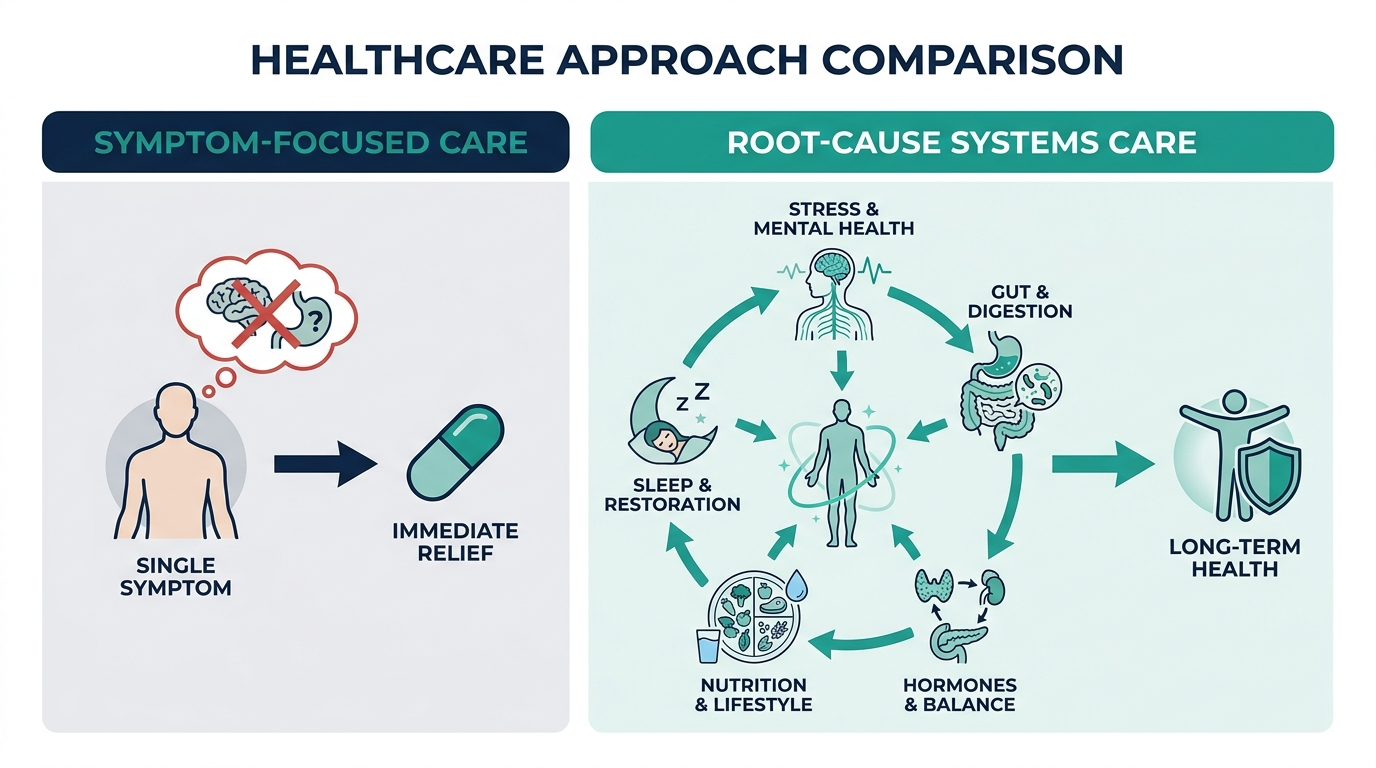
A functional medicine doctor runs a much longer intake than a typical primary care physician and orders labs that most PCPs do not routinely request. Where a standard annual physical might check a basic metabolic panel, CBC, and TSH, a functional medicine intake often pulls comprehensive thyroid panels (free T3, free T4, reverse T3, thyroid antibodies), organic acids, SIBO breath tests, stool microbiome mapping, detailed lipid particle sizing, cortisol curves, and sex hormone panels that go beyond a single testosterone or estradiol draw. The explicit goal is finding the root cause of a symptom rather than managing the symptom itself.
Not sure you need a full functional medicine workup? A self-ordered 100+ biomarker panel might answer the same questions first. One at-home Superpower draw checks 100+ biomarkers, physician-reviewed.
That is the model. In practice, quality varies dramatically. A board-certified internist who completed additional functional medicine training through the Institute for Functional Medicine (IFM) is a different proposition from a chiropractor or health coach who uses the label loosely. Before you spend money, verify credentials.
The intake appointment alone typically runs 60 to 90 minutes, compared with 15 to 20 minutes in a conventional setting. That time difference matters: many root-cause findings come from a detailed history, not just from labs.
Functional medicine vs. primary care: where the gap is real
Primary care excels at acute illness, medication management, preventive screenings recommended by USPSTF, and referrals to specialists. It is optimized for high volume and clear diagnostic categories. Functional medicine is slower, more expensive, and optimized for patients who fall through the gaps of those clear categories.
| Situation | PCP is the right call | Functional medicine adds value |
|---|---|---|
| Sore throat, UTI, minor injury | Yes | No |
| Annual wellness visit, Pap, colonoscopy screening | Yes | No |
| Fatigue with normal standard labs for 2+ years | Limited | Yes |
| IBS diagnosis with no clear trigger identified | Limited | Yes |
| Autoimmune condition seeking root-cause support | For monitoring | Yes |
| Healthy person wanting a data baseline | Reasonable starting point | Overkill unless labs are abnormal |
| Optimizing performance, longevity planning | Limited | Moderate value |
The gap is most real for patients with multi-system symptoms that do not fit a single diagnosis. Clinicians trained in functional medicine are more comfortable holding that complexity and iterating across systems simultaneously.
When to see a functional medicine doctor: five clear signals
These five patterns are the strongest indicators that a functional medicine workup will change your trajectory, not just add more paperwork.
- You have been told your labs are normal but you feel terrible. Standard labs use population reference ranges that catch disease, not suboptimal function. A functional medicine doctor uses tighter optimal ranges and orders markers that conventional labs skip. Thyroid function is the most common example: TSH alone misses subclinical hypothyroidism that free T3 and reverse T3 would flag.
- You have a diagnosed autoimmune condition. Autoimmunity frequently has identifiable triggers (gut permeability, chronic infections, heavy metal load, dietary antigens) that conventional rheumatology does not have time to investigate. Functional medicine protocols for Hashimoto’s, lupus, or psoriatic arthritis have a real evidence base for reducing flare frequency even if they rarely cure the condition.
- You have gut symptoms that GI has not resolved. SIBO, dysbiosis, and intestinal permeability sit outside the scope of standard gastroenterology, which is mostly diagnostic endoscopy and motility. A functional medicine doctor who specializes in gut health, sometimes called functional gastroenterology, will use breath testing, comprehensive stool analysis, and targeted elimination protocols.
- You have mood or cognitive symptoms that psychiatry has not fully addressed. Nutrient deficiencies (B12, folate, vitamin D, iron, zinc), thyroid dysfunction, and blood sugar dysregulation all mimic or worsen depression, anxiety, and brain fog. Functional medicine for mental health means ruling out these physical causes before or alongside medication. Some patients find the root cause is a physical one; others find medication works better once nutritional gaps are closed.
- You have been on medications long-term without a clear plan to reassess. Functional medicine practitioners tend to retest rather than renew. If you have been on a PPI, a statin, or an antidepressant for years without a recent review of whether the underlying problem has changed, a functional medicine intake is a reasonable second opinion.
Is functional medicine worth it financially?
Functional medicine is almost never covered by insurance. A new patient intake costs $300 to $600 out of pocket at most practices. The lab work ordered during that intake, which is what generates the actual findings, adds another $800 to $3,000 depending on the panel. Total first-year costs of $2,000 to $5,000 are common for a thorough workup and follow-up.
HSA and FSA funds can typically cover functional medicine physician fees and lab costs because both are legitimate medical services, but check with your plan administrator since some plans restrict out-of-network lab reimbursement.
The calculus shifts in your favor when the alternative is years of unexplained symptoms plus recurring urgent care visits, specialist copays, and the indirect costs of not functioning well. A single finding (say, SIBO identified after two years of IBS misdiagnosis, or adrenal dysfunction caught instead of a second anxiety medication) can justify the entire expense. When there is no clear symptom to solve, the ROI is murkier. For more detail on what labs typically cost outside insurance, the functional medicine lab panel cost breakdown is worth reading before you book anything.
The self-ordered baseline: when you do not need a doctor at all
If you are basically healthy, have no chronic complaints, and are mainly curious about your numbers, a self-ordered comprehensive lab panel is a legitimate first move. Services like Quest’s MyQuest, Labcorp OnDemand, and annual membership panels let you draw 60 to 100+ biomarkers without a physician visit. You get data. If something looks off, you then have a reason to see someone.
This matters because a significant portion of people who end up in functional medicine offices would have found their answer with a good baseline panel and a follow-up with their PCP. They did not need $3,000 of root-cause detective work; they needed ferritin, free T3, and a 25-OH vitamin D result that a standard annual physical skipped.
The simplest way to actually get this done
Superpower is a full-body lab membership that runs 100+ biomarkers, has each result reviewed by a doctor, and tracks your numbers year over year (about $199/year). It is what we point readers to when they would rather get one clean, complete draw than chase single tests one at a time. Here is superpower blood test reviewed in full.
Is functional medicine legit? The evidence question
Functional medicine as a named specialty does not have the same randomized trial base as cardiology or oncology, and critics are right to point that out. But the individual interventions it draws on often do have evidence: elimination diets for IBS, SIBO treatment protocols, thyroid optimization, vitamin D repletion, low-dose naltrexone for autoimmunity, mitochondrial support for chronic fatigue. The framework is integrative, not made up.
The legitimacy question is really two questions. First, is the practitioner trained? IFM certification, a primary medical degree (MD, DO, ND), and board certification in an underlying specialty are meaningful filters. Second, does the specific intervention being proposed have a reasonable evidence base? A functional medicine doctor who recommends an evidence-backed elimination protocol for your Crohn’s is offering something real. One who charges $500 for a proprietary supplement stack without data is not.
The Cleveland Clinic, Stanford, and the University of Arizona all have functional medicine programs, which signals that the approach has enough academic legitimacy to be worth distinguishing from outright quackery. That does not mean every practitioner using the label deserves your trust. Read the how to find a functional medicine doctor guide before choosing a provider.
Functional medicine for gut health: is it actually different?
For gut-specific complaints, functional medicine offers the most distinct advantage over conventional GI care. Standard gastroenterology is built around colonoscopy, endoscopy, and motility studies. It diagnoses IBD, polyps, motility disorders, and structural abnormalities extremely well. It does not have a protocol for SIBO beyond prescribing rifaximin, and it rarely investigates gut microbiome composition, intestinal permeability, or the food-symptom connection in detail.
A functional medicine GI workup typically includes a lactulose or glucose breath test for SIBO, a comprehensive stool test (GI-MAP or similar) assessing pathogen load, commensal bacteria ratios, inflammation markers like calprotectin, and digestive enzyme output, plus a detailed food and symptom diary. For people with IBS who have been told to try a low-FODMAP diet and call it a day, this level of workup is a genuine step up.
If your GI symptoms include bloating that is worse in the morning, brain fog after meals, or a pattern that cycles with antibiotic use, SIBO testing alone may be worth a standalone order before committing to a full functional medicine practice.
Functional medicine for mental health: where the data is and is not
The honest version: functional medicine for mental health is most useful as an adjunct, not a replacement, for evidence-based psychiatry in moderate-to-severe cases. Where it adds the most value is ruling out physiological drivers that are genuinely common and genuinely missed in standard psychiatric care.
Clinically underdiagnosed contributors to depression and anxiety include hypothyroidism (especially subclinical), ferritin below 30 ng/mL, vitamin D below 30 ng/mL, B12 deficiency, chronic blood sugar instability, and active infections like EBV or Lyme that have not been fully cleared. A psychiatrist working from a DSM checklist and no bloodwork may miss all of these.
Methylation and MTHFR genetics are frequently discussed in functional medicine mental health contexts. The nuance: MTHFR variants are common (roughly 40 percent of the population carries at least one C677T allele) and most carriers function normally. What matters is not the variant but whether active folate and homocysteine levels are actually abnormal. Testing homocysteine and RBC folate is more actionable than a genetic panel alone.
If you are not currently in conventional psychiatric care and you have mild-to-moderate anxiety or depression, ruling out physical causes via a comprehensive lab panel before starting an SSRI is reasonable medicine, not fringe thinking. If you are in a mental health crisis, functional medicine is not the first call.
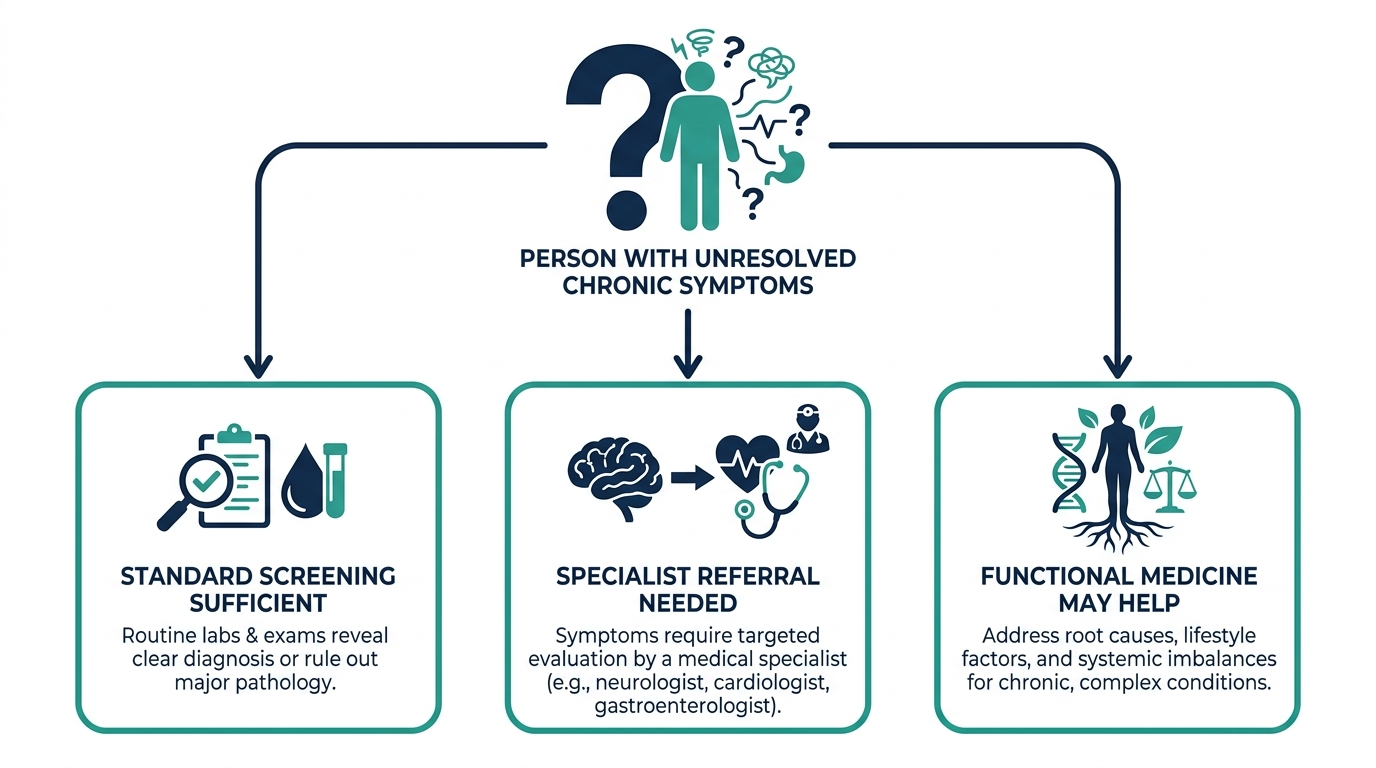
A practical decision framework: three paths
Rather than a binary yes-or-no answer to whether you need a functional medicine doctor, use this three-path model based on your situation.
| Your situation | Recommended path | Estimated cost |
|---|---|---|
| Healthy, want a data baseline, no chronic complaints | Self-ordered comprehensive panel (Superpower, Function Health, Labcorp OnDemand) | $199 to $500/year |
| One or two mild symptoms, no prior workup | PCP visit plus targeted add-on labs, then reassess | $0 to $300 with insurance |
| Chronic multi-system symptoms, 2+ years unresolved | Functional medicine intake plus full lab panel | $1,500 to $4,000 first year |
| Diagnosed autoimmune or chronic condition, want root-cause support | Functional medicine plus maintain conventional specialist for monitoring | $1,500 to $5,000 first year |
| Gut or mental health symptoms unresolved after standard care | Targeted functional testing first (SIBO breath test, comprehensive stool, expanded thyroid) then decide | $300 to $800 for testing only |
The most common mistake is skipping path one entirely and spending $3,000 on a full functional medicine workup before checking whether a $199 annual panel would have shown the problem. Order your own labs first. If everything comes back in the optimal range and you still feel bad, then the case complexity justifies the higher investment. For context on what self-directed testing looks like, the superpower blood test review and the function health review both cover what 100-plus biomarker memberships actually include.
If you do decide a functional medicine doctor is warranted, the approach to finding a vetted practitioner matters more than people realize. Credential shopping is described in detail in our guide on how to find a functional medicine doctor. For those who want to know more about the specific test ordering that happens in a functional workup, see what functional medicine testing at home can replicate without a physician.
Curious what your own levels look like?
Baseline 100+ biomarkers today and retest as life changes, all in one membership with physician review.
FAQ
Do you need a functional medicine doctor for hormone issues?
Not necessarily. Sex hormone imbalances caught on a comprehensive panel can often be addressed first through a PCP or endocrinologist. Where functional medicine adds specific value is when standard labs have been run, come back in the “normal” range by conventional standards, and you still have symptoms. Functional practitioners use tighter optimal ranges for hormones and interpret them alongside thyroid, adrenal, and metabolic markers simultaneously, which conventional endocrinology typically does not do in a single workup.
Is functional medicine worth it for fatigue?
Fatigue is one of the highest-yield presentations for functional medicine, specifically because standard workups routinely miss the most common drivers: suboptimal ferritin (labs call anything above 12 ng/mL “normal,” but symptoms improve for many people only when ferritin is above 50), subclinical hypothyroidism, blood sugar instability, sleep apnea, and B12 deficiency. Before spending on a full functional medicine intake, order a panel that includes ferritin, free T3, reverse T3, fasting insulin, a morning cortisol, and B12. If those are all solidly optimal and fatigue persists, the functional medicine investment becomes more justified.
Can a functional medicine doctor help with weight loss?
Sometimes, if an identifiable physiological barrier is present. Undiagnosed hypothyroidism, insulin resistance, elevated cortisol, and leptin resistance are all addressable through a functional medicine lens and all genuinely impair weight loss when present. If none of those apply and the issue is dietary and behavioral, a functional medicine intake will likely reach the same conclusion a dietitian would reach at lower cost. The honest framing: functional medicine is not a weight loss shortcut but is useful for ruling out hormonal and metabolic blockers first.
What is the difference between functional medicine and integrative medicine?
The terms overlap but are not identical. Integrative medicine is broader and explicitly combines conventional and evidence-based complementary approaches (acupuncture, mind-body medicine, nutrition). Functional medicine is a specific framework focused on root-cause systems biology, typically heavier on advanced lab testing. Many practitioners use both terms interchangeably. When comparing providers, what matters more than the label is their primary medical degree, additional training credentials, and what their intake protocol actually includes.
Is functional medicine covered by insurance?
Rarely in full. Some insurance plans cover the physician visit if the provider accepts insurance and bills under a conventional diagnosis code, but the extended intake time and out-of-network labs almost never get reimbursed at face value. HSA and FSA funds are generally eligible for both physician fees and lab costs from functional medicine doctors, since both qualify as medical expenses. Expect to pay $1,500 to $4,000 out of pocket in year one if you go all-in on a full workup, with lower costs in subsequent years for monitoring panels.
When should you NOT see a functional medicine doctor?
When you have a time-sensitive acute illness, a clear conventional diagnosis that responds to standard treatment, or a mental health crisis. Functional medicine is a slow process built for chronic, complex, sub-acute problems. If you have chest pain, new neurological symptoms, active suicidal ideation, or a cancer diagnosis requiring urgent staging, you need emergency or specialist conventional care first. Functional medicine is not a substitute for that and good functional medicine practitioners will tell you so directly.
How many visits does functional medicine typically take?
A realistic timeline is one 60 to 90 minute intake, a follow-up 4 to 6 weeks later when labs are back, and then quarterly or biannual check-ins once a protocol is established. Practitioners who require 12 visits before you see lab results are a yellow flag. Most legitimate cases yield actionable findings within 2 to 3 appointments and you should start feeling different within 3 to 6 months if the root cause has been correctly identified.
Can you do functional medicine testing without seeing a doctor first?
Yes, in most US states. Direct-to-consumer lab services let you self-order most of the core functional medicine panel without a physician order. What you lose is the physician interpretation, the detailed intake history, and the protocol design. What you gain is the data, which is often enough to determine whether further investigation is warranted. Starting with a self-ordered comprehensive panel is a reasonable way to triage whether your case actually needs the full doctor-led workup or whether your labs are clean and the issue lies elsewhere.
Vital Signs Today may earn a commission if you buy through links on this page. It does not affect our editorial assessments.