Quick answer: Function Health and LabCorp are not truly competing services. Function Health is a membership platform that orders your labs through LabCorp (and occasionally Quest), then layers physician review, trend tracking, and structured interpretation on top. Going directly to LabCorp via its LabCorp OnDemand portal gives you the same analytical lab infrastructure but without the curated panel, the physician sign-off, or the year-over-year dashboard. If you want raw a-la-carte testing you control entirely, direct LabCorp ordering is cheaper per test. If you want 100-plus biomarkers selected by clinicians, results explained in plain language, and a baseline that compounds over time, a membership like Function Health or Superpower is worth the annual fee.
Does Function Health Use LabCorp to Run Its Tests?
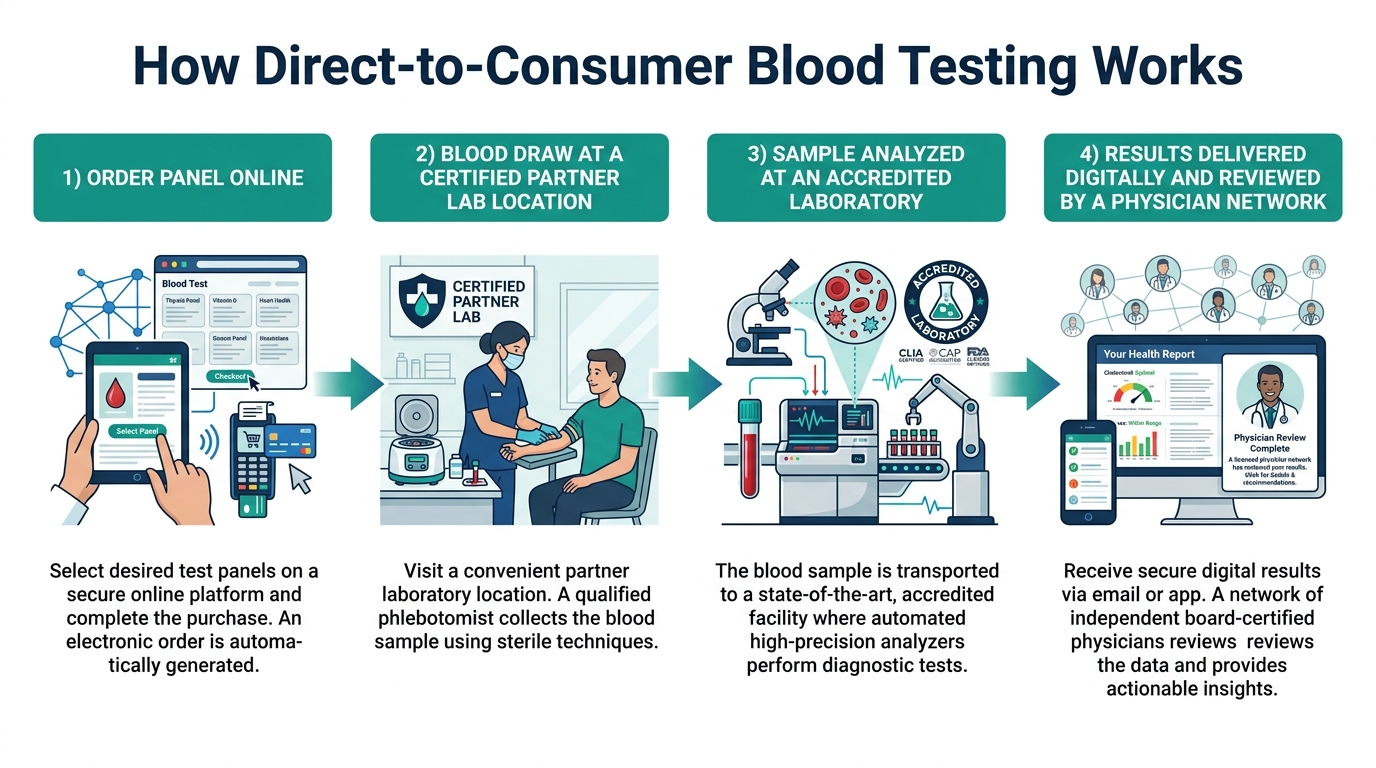
Yes, Function Health uses LabCorp as its primary laboratory partner for the vast majority of its biomarker testing. When you book a draw through Function Health, you walk into one of LabCorp’s 2,000-plus patient service centers across the US, hand over the same requisition slip a doctor’s office would send, and your blood is processed in LabCorp’s certified reference laboratories. The results flow back to Function Health’s platform, where a physician contractor reviews them and the dashboard flags anything outside optimal range.
Deciding between ordering your own labs and a curated membership? See what physician review adds to the same blood draw. One at-home Superpower draw checks 100+ biomarkers, physician-reviewed.
This arrangement is not unusual. Most direct-to-consumer lab companies, including Everlywell and some Superpower locations, route specimens through either LabCorp or Quest Diagnostics because those two networks have the accreditation, equipment, and scale that startup labs cannot replicate. What the membership platform adds is the layer above the raw numbers: panel curation, physician oversight, and software that contextualizes a result against your own prior draws rather than just population reference ranges.
The practical consequence: the analytical quality of a Function Health result and a LabCorp OnDemand result for the same biomarker is essentially identical. The difference is everything that wraps around it.
LabCorp OnDemand vs Function Health: What You Actually Get
LabCorp OnDemand is LabCorp’s direct-to-consumer ordering portal, launched after the pandemic as a way for patients to order tests without a physician order. You browse a menu of individual tests and panels, pay upfront, walk into a draw center, and receive results in your LabCorp patient portal. No membership, no subscription, no annual commitment.
| Feature | LabCorp OnDemand (direct) | Function Health (membership) |
|---|---|---|
| Lab infrastructure | LabCorp reference labs | LabCorp reference labs (same) |
| Panel curation | You pick individual tests | 100-plus biomarkers selected by physicians |
| Physician review | None (results only) | Included; flags abnormals with context |
| Result interpretation | Reference ranges only | Optimal ranges, plain-language explanations |
| Trend tracking | Limited (portal history) | Year-over-year dashboard built in |
| Cost model | Per test, cash pay, no annual fee | Annual membership, unlimited standard draws |
| Insurance accepted | No (cash only via portal) | No (membership fee not billable to insurance) |
| HSA/FSA eligible | Generally yes, per test | Partial (see Function Health HSA/FSA policy) |
The single biggest difference is physician review. LabCorp OnDemand deposits a PDF in your portal and leaves interpretation entirely to you. Function Health employs physician contractors who review every panel, write notes on out-of-range values, and can flag patterns that would not appear on any single result page. For someone comfortable reading lab reports, that gap is small. For someone who has never looked at a ferritin or homocysteine result, it is the entire value proposition.
What Does It Actually Cost to Order Labs Directly Through LabCorp?
A-la-carte LabCorp OnDemand pricing runs from about $29 for a basic test like a TSH to $150 or more for a lipid panel with advanced fractionation. If you tried to replicate Function Health’s roughly 100-biomarker standard panel by piecing together individual LabCorp OnDemand tests, you would spend somewhere between $600 and $1,200 cash for a single draw, depending on which panels overlap and how the portal bundles certain combinations.
- Basic metabolic panel (BMP): $29 to $49 on LabCorp OnDemand
- Complete blood count (CBC): $29 to $39
- Comprehensive thyroid (TSH, free T3, free T4): $89 to $130 bundled
- Advanced lipid panel (LDL-P, ApoB, Lp(a)): $100 to $180
- Hormone panel (testosterone total and free, DHEA-S, SHBG): $99 to $160
- Inflammatory markers (hsCRP, homocysteine, fibrinogen): $60 to $110
- Comprehensive metabolic with GFR: $39 to $59
Add those up and you are well past $500 before you get to cortisol, ferritin, insulin, or any cancer screening markers. Function Health’s annual membership, which was priced around $499 at launch, includes two full comprehensive draws per year. The math flips quickly once you want more than a handful of markers.
If you genuinely only need one or two tests to follow up on something a doctor already ordered, LabCorp OnDemand is the right tool. The per-test cost is reasonable, the turnaround is fast (usually 24 to 72 hours), and there is no annual commitment. You can also use HSA or FSA funds for most individual test purchases, which softens the out-of-pocket hit. For a much deeper look at how Function Health structures its own pricing, see our breakdown of function health cost across its current tiers.

How to Get LabCorp Results Explained Without a Doctor
LabCorp OnDemand results come with reference ranges printed next to each value, but reference ranges are population statistics, not health guidance. A testosterone of 320 ng/dL is technically “in range” for a 40-year-old male by standard references, but it sits in the bottom quartile and is associated with fatigue, body composition changes, and reduced recovery. LabCorp’s portal will not tell you that.
Options for getting results explained if you go the direct LabCorp route:
- Book a telemedicine consult with a service like Plushcare, Ro, or Hims/Hers that offers lab review appointments. Typically $50 to $100 per session.
- Share results with your primary care physician at your next visit. Most will review patient-ordered labs, though some practices push back on labs they did not order.
- Use an AI symptom platform to get a lay interpretation. These are unregulated and vary enormously in quality; treat output as a starting point for questions, not a diagnosis.
- Choose a membership service that includes physician review as part of the package. This is exactly what Function Health and Superpower build into their membership fee.
The hidden cost of the DIY LabCorp path is time and friction. Many people order their own labs, receive numbers they do not fully understand, spiral into Google rabbit holes, and end up paying for a telemedicine call anyway. If that cycle sounds familiar, a curated membership usually works out cheaper per insight once you factor in the consult fees.
What People Get Wrong About the Function Health vs LabCorp Comparison
The most common misconception is that Function Health is competing with LabCorp as a laboratory. It is not. Function Health is competing with the idea that patients should piece together their own lab orders and interpret results alone. LabCorp is the infrastructure; Function Health is a clinical service layer built on top of that infrastructure.
A second misconception: ordering your own labs through LabCorp OnDemand gives you the same panel as Function Health. It does not. Building a comparable panel a-la-carte requires you to know which markers to order, understand which panels include which sub-tests, avoid ordering overlapping components you will pay for twice, and navigate LabCorp’s sometimes confusing menu of test synonyms (“lipid panel” versus “CardioIQ advanced” versus “NMR LipoProfile” are three different things at three different price points).
A third misconception: because Function Health uses LabCorp, you can just get your results from LabCorp directly. That is not quite right either. Function Health’s physician orders flow through LabCorp’s B2B channel, not the consumer portal. Your results go to Function Health’s platform first. You can request copies from LabCorp directly under HIPAA, but the ordering physician of record is Function Health’s affiliated medical group, not you.
For a full look at what you get (and what you do not) under Function Health’s model, our function health review walks through the platform in detail.
When Direct LabCorp Ordering Makes More Sense
LabCorp OnDemand is genuinely the better choice in specific situations:
- Targeted follow-up testing. Your doctor found an elevated TSH six months ago. You want to recheck it yourself before your next appointment without waiting for a referral. One test, $29, done.
- Pre-donation or pre-surgery screening. You need a specific panel that a clinic or blood bank requires and you want to bring your own results. LabCorp’s turnaround and standardized report format satisfy most institutional requirements.
- Short-term monitoring of a known condition. If you manage a chronic condition and already understand which markers matter, you do not need physician interpretation every draw. You need cheap, fast, reliable numbers. LabCorp OnDemand delivers that.
- Geographic areas with no membership service draw centers. Function Health draws at LabCorp locations, but some rural areas have limited access. LabCorp OnDemand serves the same footprint, so this is not usually a differentiator, but it is worth checking your zip code before committing to a membership.
When a Membership Platform Beats DIY LabCorp
A curated membership wins clearly in three scenarios.
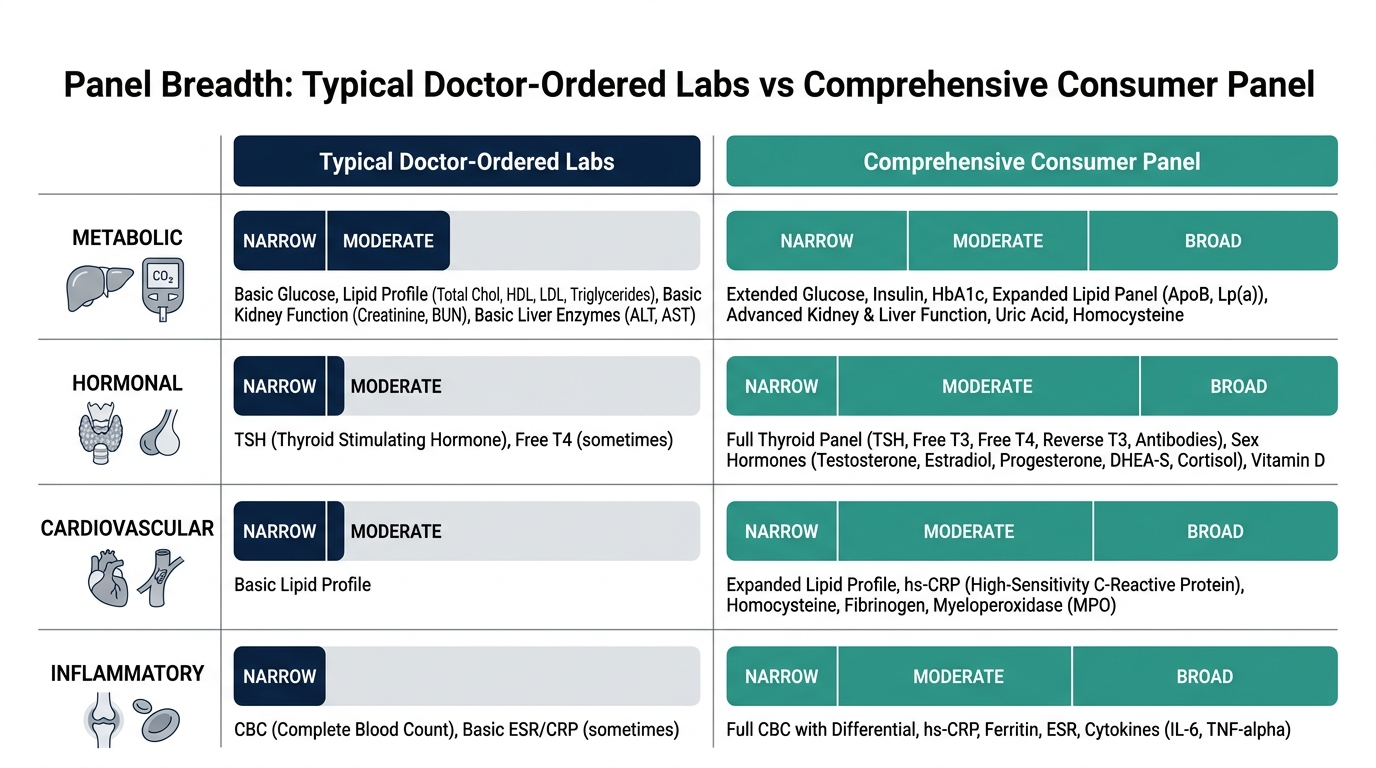
You want a genuine baseline, not a snapshot. A one-time 15-marker draw tells you where you are today. A 100-plus marker panel repeated annually tells you where you are trending. Cardiovascular risk, metabolic dysfunction, hormonal decline, and early thyroid disease all show up as gradual shifts across multiple draws before any single result crosses a clinical threshold. The trend is the finding, and you cannot see a trend with a one-off.
You do not want to research which tests to order. Knowing to order ApoB instead of (or alongside) LDL-C, to add Lp(a) if there is family history of heart disease, to test free testosterone rather than total testosterone alone, to include ferritin with a CBC to catch early iron issues that the CBC itself misses, all of that is non-trivial medical knowledge. A curated panel bakes that knowledge into the draw requisition.
You want physician eyes on the result. Reference ranges are built for population screening, not individual optimization. Optimal ranges narrow considerably when you are trying to maintain performance rather than just avoid disease. A physician who reviews your panel in the context of your symptoms, age, and prior results can flag a result that looks fine to a range chart but is meaningful in context.
The simplest way to actually get this done
Superpower is a full-body lab membership that runs 100+ biomarkers, has each result reviewed by a doctor, and tracks your numbers year over year (about $199/year). It is what we point readers to when they would rather get one clean, complete draw than chase single tests one at a time. Here is superpower blood test reviewed in full.
Medicare, Minors, and the Uninsured: Edge Cases That Matter
Neither Function Health nor LabCorp OnDemand accepts Medicare or Medicaid for the direct-to-consumer portion of their services. If you are on Medicare, ordering through these portals means paying cash regardless. For Medicare beneficiaries, the more economical path is getting a physician order for the specific tests you want and having them billed through Medicare Part B at a negotiated rate. The caveat: Medicare-ordered labs are restricted to what your physician documents as medically necessary, so a comprehensive preventive panel often comes back partially covered or not covered at all.
For minors under 18, both LabCorp OnDemand and most membership platforms require parental consent. LabCorp’s consumer portal technically restricts ordering to adults 18-plus. A parent cannot simply log in and order for a teenager without going through a physician order or a platform that explicitly supports dependent accounts.
Uninsured adults in their 20s and 30s are arguably the ideal users for LabCorp OnDemand’s targeted testing or a low-cost membership. Without insurance, physician-ordered labs at full list price can run $400 to $800 for a comprehensive panel once you add the office visit. A membership at $199 to $499 per year beats that in one draw. If cost is the dominant concern, check the detailed breakdown in our piece on how much does superpower cost.
How the Competitive Landscape Actually Lines Up
Understanding function health vs labcorp properly means situating both within a broader market of options.
| Option | Best for | Approximate annual cost for full panels |
|---|---|---|
| LabCorp OnDemand (a-la-carte) | 1 to 3 specific follow-up tests | $30 to $300 per draw, no annual fee |
| Function Health | 100-plus biomarker baseline with physician layer | $499 per year (includes 2 draws) |
| Superpower | Full-body panel with doctor review, lower price point | About $199 per year |
| Physician-ordered labs (insured) | Medically necessary testing billed to insurance | Varies by plan; often $0 to copay after deductible |
| Quest Health (direct) | Similar to LabCorp OnDemand; Quest network | Per test, comparable pricing |
Function Health and Superpower are direct competitors; LabCorp OnDemand is a different category. If you are choosing between membership platforms, our comparison of function health vs empirical health and function health vs 10x health cover the landscape across different price points and panel philosophies.
How to Prepare for a LabCorp Draw So the Numbers Are Actually Accurate
Whichever route you choose, the accuracy of your results depends heavily on what you do in the 24 hours before the needle goes in. This is the part of self-ordered testing that trips people up, because LabCorp OnDemand hands you a requisition but no one walks you through prep the way a clinic sometimes does. Pre-analytical error, meaning error introduced before the sample is even analyzed, is one of the most common reasons a result comes back misleading.
- Fasting matters for specific markers. Glucose, fasting insulin, and the triglyceride portion of a lipid panel are the markers most affected by recent food. Most labs ask for 9 to 12 hours of fasting (water is fine) before these. If you eat before a lipid draw, triglycerides can read falsely high, which throws off calculated LDL.
- Time of day changes hormone results. Testosterone follows a daily rhythm and is highest in the morning, so testosterone should be drawn in the morning, ideally before 10 a.m., for the result to be comparable to standard reference ranges. Cortisol is even more time-sensitive.
- Recent hard exercise can skew several values. An intense workout in the prior day or two can transiently raise markers like creatine kinase and even shift liver enzymes and CRP. If you want a clean baseline, avoid unusually hard training right before the draw.
- Biotin supplements interfere with some assays. High-dose biotin, common in hair and nail supplements, can distort certain immunoassay-based tests, including some thyroid and hormone panels. Stopping biotin for a few days before the draw is a common precaution.
- Hydration affects the draw. Being well hydrated makes the draw easier and can prevent falsely concentrated values. Dehydration can nudge markers that depend on blood volume.
The reason this section matters for the function health vs labcorp decision is subtle: a membership platform’s dashboard is more likely to prompt you on prep and to flag a result that looks physiologically implausible, whereas a bare portal PDF will report a biotin-skewed TSH as fact. Neither service changes the biology, but the interpretation layer catches more mistakes.
Reference Range vs Optimal Range: The Distinction That Drives This Whole Comparison
The single most important concept for anyone ordering their own labs is that a reference range is not a health target. A reference range is typically built to capture the middle 95 percent of a reference population, which includes plenty of people who are unwell or trending that way. Sitting inside the range means you are statistically ordinary, not that you are optimized.
Testosterone is the cleanest example. Labcorp and the harmonized CDC reference range put adult male total testosterone at roughly 264 to 916 ng/dL, and the American Urological Association flags below 300 ng/dL as low. A 40-year-old with a total testosterone of 320 ng/dL is inside the reference range and above the AUA low cutoff, yet that value sits near the bottom of the distribution and can coincide with fatigue and poor recovery. A plain portal will print 320 with no context. This is precisely the gap a physician review layer is designed to close.
The same logic applies across the panel. ApoB illustrates it on the cardiovascular side. Preventive cardiology and the 2026 ACC/AHA lipid guidance frame ApoB goals by risk rather than a single lab range, with roughly under 80 mg/dL viewed as favorable for general prevention, under 70 mg/dL for high-risk individuals, and under 60 mg/dL for those with established disease or diabetes. A LabCorp report may simply mark ApoB as within a broad reference interval while your personal risk-based target is much lower. Knowing the difference is what turns a page of numbers into a plan.
Building a Comparable Panel Yourself: A Realistic Step-by-Step
If you are set on the DIY LabCorp route and want to approximate a comprehensive membership panel, here is the order of operations that avoids the most common wasted spend.
- Start with the foundation panels. A CBC and a comprehensive metabolic panel (CMP) together cover blood cells, electrolytes, kidney function, and liver enzymes cheaply. These are your base layer.
- Add the cardiovascular markers that actually predict risk. Order ApoB and a one-time Lp(a) alongside a standard lipid panel. Do not stop at LDL-C alone, because particle count and Lp(a) carry information LDL misses.
- Cover metabolic health beyond glucose. Add HbA1c and fasting insulin so you can see insulin resistance forming years before fasting glucose rises. Glucose alone is a lagging indicator.
- Round out the hormone and thyroid picture correctly. If you order testosterone, order free testosterone and SHBG with it, not total in isolation. For thyroid, TSH plus free T4 (and free T3 if symptomatic) beats TSH alone.
- Catch the common deficiencies. Ferritin (not just a CBC), vitamin D, and B12 catch issues that a standard panel will miss and that frequently explain fatigue.
- Avoid ordering the same thing twice. LabCorp lists overlapping bundles under different names. Read what sub-tests each panel already contains before adding standalone tests, or you will pay twice for the same analyte.
Work through that list and you will understand viscerally why a curated membership exists: assembling this correctly requires knowing which markers matter, which pairings are meaningful, and how to avoid duplicate charges. The membership fee is, in large part, payment for that curation and for a clinician to read the result.
Don’t just read about your health, track it.
A single result is a snapshot. Superpower re-tests 100+ markers over time so you can watch them move as you change sleep, food, and training.
FAQ
Does Function Health actually use LabCorp to run its blood tests?
Yes. Function Health orders its lab draws through LabCorp’s physician services channel, meaning your blood is processed in LabCorp’s certified reference laboratories. The difference between ordering through Function Health and ordering directly through LabCorp OnDemand is not the analytical quality of the result. It is the panel selection, physician review, and interpretation platform that Function Health wraps around those results.
Can I order my own labs through LabCorp without a doctor?
Yes, through the LabCorp OnDemand portal at labcorp.com. You pay cash, order from a menu of individual tests and panels, walk into a draw center, and receive results in your LabCorp patient portal. No physician order is required. Note that some states restrict certain tests (HIV, for example, often requires physician involvement), so your state’s laws govern what you can access.
Is LabCorp OnDemand cheaper than Function Health?
For one or two specific tests, yes. A single LabCorp OnDemand TSH might cost $29 versus a Function Health membership at $499 per year. But if you want a comprehensive panel of 50-plus biomarkers, building it a-la-carte through LabCorp OnDemand quickly exceeds $500 per draw. The breakeven point is somewhere around 10 to 15 tests; above that, a membership typically wins on per-biomarker cost.
How do I get LabCorp results explained without a doctor?
Options include telemedicine platforms (Plushcare, Ro, etc.) that offer lab review appointments for $50 to $100, sharing results with your primary care physician at a scheduled visit, or choosing a membership platform like Superpower or Function Health that includes physician review as part of the fee. The membership route usually costs less per result than paying for individual consults if you run comprehensive panels.
What is the difference between LabCorp OnDemand and LabCorp patient portal results?
LabCorp Patient, the standard portal, shows results from physician-ordered labs billed through insurance or direct pay. LabCorp OnDemand is the separate consumer ordering platform where you pay cash upfront and self-order. Both display results in the LabCorp ecosystem, but they are technically separate portals and products. Results from Function Health also route through LabCorp’s lab but appear in Function Health’s own platform, not in your LabCorp patient portal.
Does LabCorp OnDemand accept HSA or FSA cards?
Generally yes. Most individual diagnostic tests ordered through LabCorp OnDemand are qualified medical expenses under IRS rules and can be paid with HSA or FSA funds. You would pay using your HSA/FSA debit card at checkout. Keep the receipt for your records. Some general wellness tests that lack a diagnostic code may not qualify; check with your benefits administrator if you are unsure about a specific test.
Can I see my Function Health results in the LabCorp portal?
Not automatically. Function Health’s orders go through LabCorp’s B2B physician channel, and results are delivered to Function Health’s platform first. You can request your raw lab data directly from LabCorp under HIPAA patient rights, but your results will not appear in a standard LabCorp Patient account unless you specifically request them. Function Health does allow you to download your raw data from their platform as well.
Is a LabCorp panel cost without a doctor higher than with insurance?
Usually yes. Insurance-negotiated rates on physician-ordered labs are often substantially lower than the consumer cash prices posted on LabCorp OnDemand. The trade-off is that insurance-ordered labs are restricted to what the physician documents as medically necessary. If you want a comprehensive preventive panel that your insurer would not cover, paying cash through LabCorp OnDemand or a membership service is the practical route. Talk to a clinician about which approach fits your coverage.