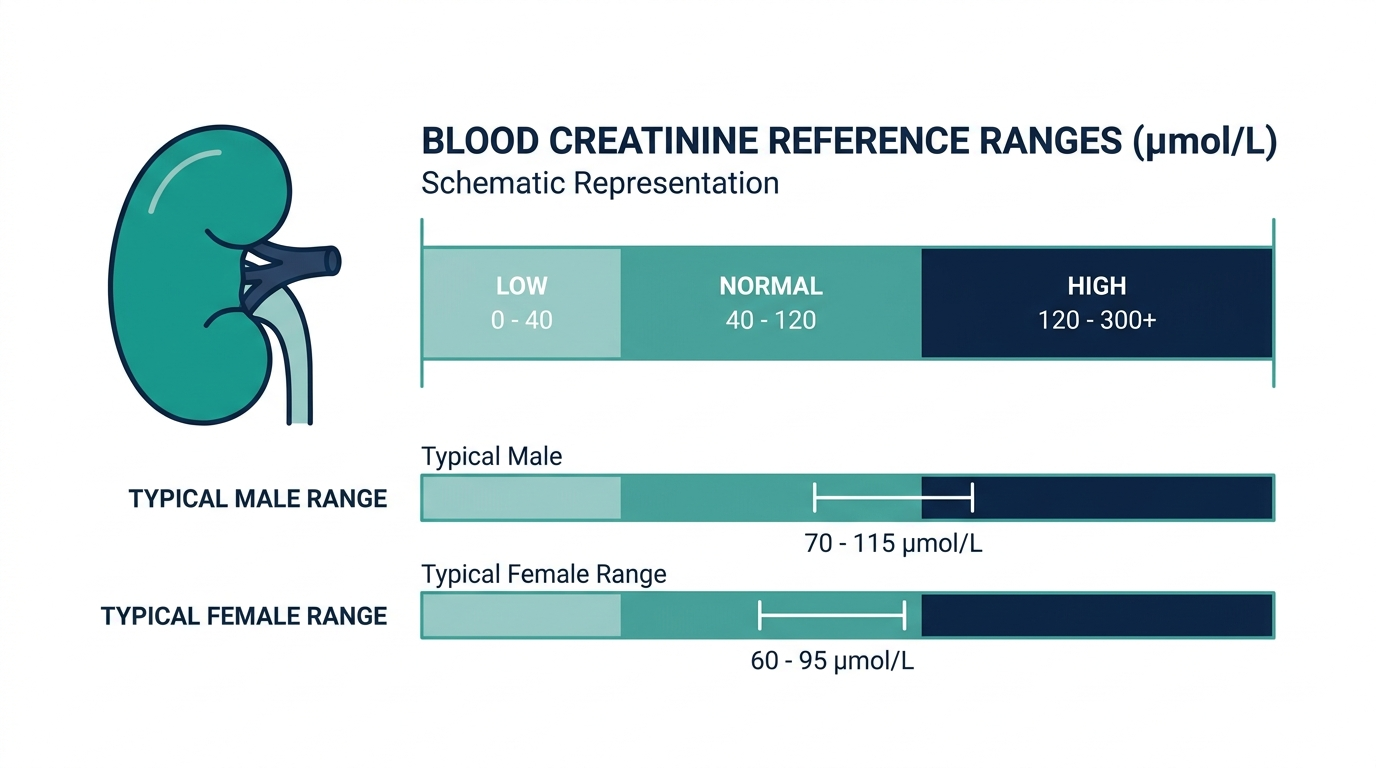
- A normal serum creatinine level is roughly 0.7 to 1.3 mg/dL for adult men and 0.5 to 1.1 mg/dL for adult women, with women running lower mostly because they carry less muscle mass (MedlinePlus, StatPearls).
- Creatinine has no single “by age” number, it rises through childhood as muscle grows, sits in the adult band for decades, then often drifts down or up depending on whether muscle loss or kidney decline dominates in older age.
- One reading slightly outside the lab range is rarely an emergency, but a creatinine that is rising over time, or that drives an estimated glomerular filtration rate (eGFR) under 60 for three months, can signal chronic kidney disease (Cleveland Clinic).
Part of our Comprehensive Metabolic Panel guide.
What is a normal creatinine level?
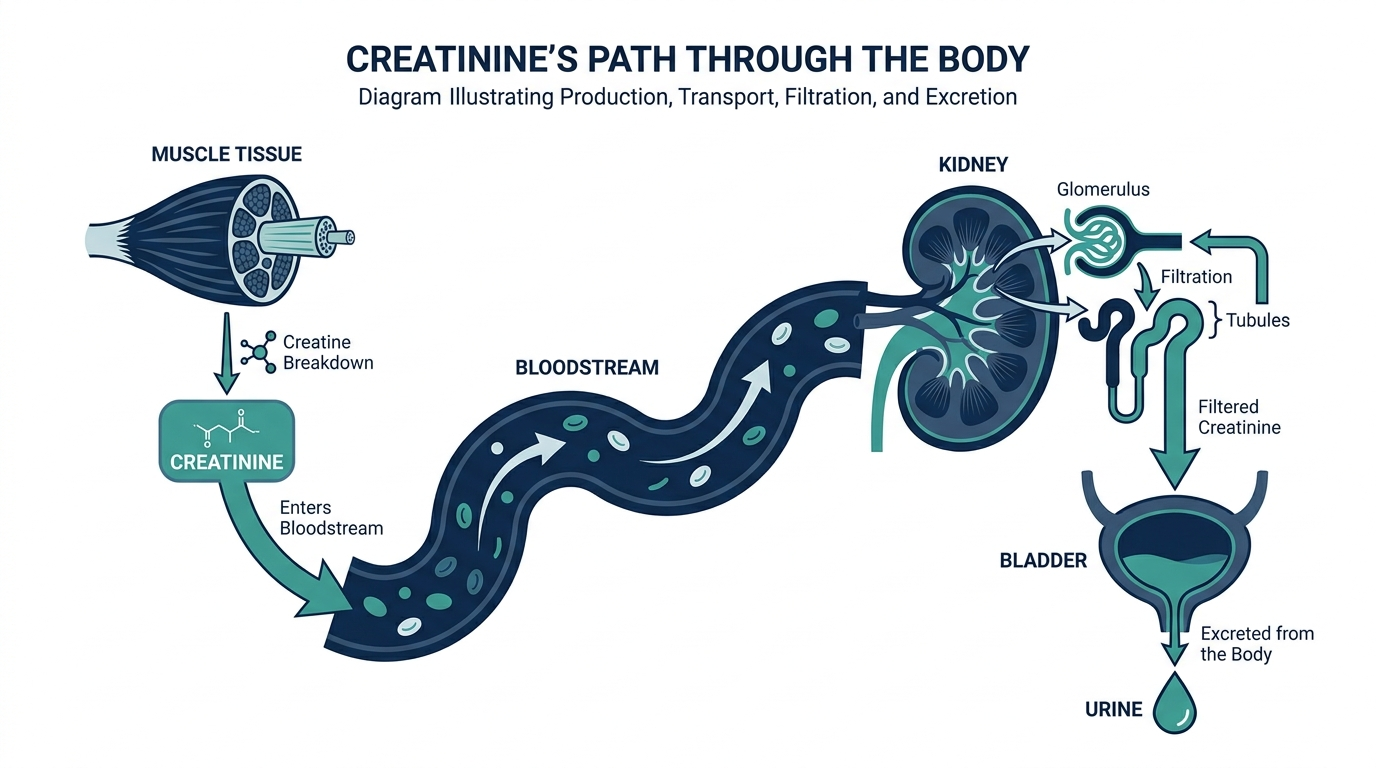
A normal serum creatinine level is about 0.7 to 1.3 mg/dL (62 to 115 micromoles/L) for adult men and 0.5 to 0.95 mg/dL (44 to 84 micromoles/L) for adult women, according to MedlinePlus. StatPearls cites a similar adult span of roughly 0.6 to 1.2 mg/dL for men and 0.5 to 1.1 mg/dL for women. Creatinine is a waste product made when muscle breaks down a compound called creatine, and healthy kidneys filter it out at a steady pace.
Creatinine ranges depend on your muscle mass and sex, so where does your kidney marker actually sit? One at-home Superpower draw checks 100+ biomarkers, physician-reviewed.
Because production tracks muscle mass, the “normal” band is not one fixed point. Your own healthy baseline can sit anywhere inside the reference range printed on your lab report. What matters most is consistency over time, not hitting an exact figure. Always read your result against your specific laboratory’s range, since methods and cutoffs vary slightly between labs.
Creatinine normal range by age
The simplest way to actually get this done
Superpower is a full-body lab membership that runs 100+ biomarkers, has each result reviewed by a doctor, and tracks your numbers year over year (about $199/year). It is what we point readers to when they would rather get one clean, complete draw than chase single tests one at a time. Here is superpower reviewed in full.
Creatinine reference ranges shift across the lifespan: newborns start fairly high from maternal levels, infants drop to a low of about 0.2 to 0.4 mg/dL, then values climb steadily as children build muscle until they reach the adult band in late adolescence. The table below pulls together commonly cited age and sex reference values (MedlinePlus for adults; pediatric and older-adult figures from standard laboratory reference compilations).
| Age group | Typical range (mg/dL) | Approx. micromoles/L |
|---|---|---|
| Newborn (1 to 4 days) | 0.3 to 1.0 | 27 to 88 |
| Infant | 0.2 to 0.4 | 18 to 35 |
| Child | 0.3 to 0.7 | 27 to 62 |
| Adolescent | 0.5 to 1.0 | 44 to 88 |
| Adult man (18 to 60) | 0.7 to 1.3 | 62 to 115 |
| Adult woman (18 to 60) | 0.5 to 0.95 | 44 to 84 |
| Man (60 to 90) | 0.8 to 1.3 | 71 to 115 |
| Woman (60 to 90) | 0.6 to 1.2 | 53 to 106 |
Treat these as guides, not verdicts. Pediatric ranges in particular vary by the testing method and the lab, and any reading near a boundary is best interpreted by a clinician alongside eGFR and your medical history.
Why creatinine alone can mislead: eGFR, cystatin C, and the BUN ratio
Creatinine is cheap and fast, but on its own it is a rough proxy for kidney function. Because production depends on muscle, the same number means different things in a bodybuilder and a frail older adult. Clinicians almost never stop at the raw value. They read it through several companions:
- eGFR (estimated glomerular filtration rate) converts creatinine into an estimate of how much blood your kidneys filter per minute, adjusting for age and sex. A value at or above 90 mL/min is normal, 60 to 89 is mildly reduced, and below 60 for three months or more defines chronic kidney disease. The current equations no longer include a race coefficient, which had overestimated function in Black patients.
- Cystatin C is a second filtration marker that the body makes at a steadier rate, largely independent of muscle mass. When creatinine and eGFR are hard to trust, at the extremes of muscle, in amputees, or in very muscular athletes, a cystatin-C-based eGFR gives a cleaner picture.
- The BUN-to-creatinine ratio. Blood urea nitrogen (BUN) rises with dehydration faster than creatinine does. A high ratio points toward a prerenal cause such as fluid loss, while a normal ratio with high creatinine points more toward the kidney itself. It is a quick way to tell “you are dry” from “your kidneys are struggling.”
- Urine albumin-to-creatinine ratio (uACR). Protein leaking into the urine is often the earliest sign of kidney damage, sometimes years before eGFR drops. A blood creatinine and a urine albumin test together give a far more complete read than either alone.
The takeaway is simple: a creatinine number without eGFR and, when needed, a urine test is only half the story. If someone quotes you a single creatinine value with no context, ask what your eGFR and urine albumin looked like.
How does sex change the range?
Sex shifts the range mainly through muscle mass: men carry more skeletal muscle on average, so they generate more creatinine and sit higher, with an adult male range of about 0.7 to 1.3 mg/dL versus 0.5 to 0.95 mg/dL for women (MedlinePlus). The gap is biological, not a sign that one sex has healthier kidneys.
This is also why eGFR equations include sex as a variable. The same raw creatinine number translates into a different estimated kidney function for a man than for a woman. A creatinine of 1.1 mg/dL might be unremarkable for a muscular man yet sit at the high end for a smaller woman. Reading creatinine without context can mislead, which is why labs report an eGFR alongside the raw value.
What makes creatinine rise or fall with age?
With age, two opposite forces compete: kidney filtration naturally declines (an eGFR of 68 mL/min can be normal in a healthy 65-year-old, per StatPearls), which tends to raise creatinine, while age-related muscle loss tends to lower it. The net result is often a creatinine that looks stable even as true kidney function slips.
- Higher creatinine: dehydration, high-protein or creatine-supplement intake, intense exercise, certain medications, and reduced kidney filtration.
- Lower creatinine: low muscle mass, aging, malnutrition, pregnancy, and conditions like muscular dystrophy or amputation (StatPearls).
This masking effect is the catch in older adults. Because muscle wastes with age, a “normal looking” creatinine can hide meaningful loss of filtering capacity, which is exactly why clinicians lean on eGFR and sometimes cystatin C rather than the raw creatinine number alone.
How to prepare for a creatinine test (and what can skew it)
Creatinine is unusually sensitive to what you did in the day or two before the draw, so a “high” result is frequently a preparation problem rather than a kidney problem:
- Heavy cooked meat. A large serving of cooked red meat shortly before the test can raise blood creatinine for hours, because cooking converts some creatine to creatinine that you then absorb. If your clinician wants a clean baseline, a lighter meal the evening before helps.
- Creatine supplements. The popular gym supplement raises creatinine independently of kidney function. Mention it, because an unaware reader can mistake it for kidney trouble.
- Intense exercise. A hard workout or a long run in the day before can transiently push creatinine up. Keep the day before the draw ordinary.
- Hydration. Being dehydrated concentrates the blood and lifts creatinine, which is why a repeat test after rehydrating often reads lower. Arrive normally hydrated, not fasting-parched.
- Certain medications. Some drugs, including trimethoprim and cimetidine, block the kidney’s secretion of creatinine and raise the blood level without actually lowering filtration. Others can genuinely stress the kidneys. Bring your full medication and supplement list so the number is read correctly.
None of this requires elaborate fasting. The goal is a representative reading: normal food, normal fluids, no unusual workout, and full disclosure of supplements and drugs. When a single value looks off, repeating it under these calm conditions is the standard sanity check before anyone worries.
When is an out-of-range result a concern?
A single creatinine slightly outside the range is usually not an emergency, but a value that drives eGFR below 60 mL/min for three or more months meets the definition of chronic kidney disease (Cleveland Clinic). A normal adult eGFR is about 100 or higher; 60 to 100 suggests mild reduction, and under 60 warrants follow-up.
Context decides everything. A one-off high reading after a hard workout, a protein binge, or a day of poor hydration often corrects on a repeat test. What raises real concern is a creatinine that is trending upward across visits, a sharp jump over days (possible acute kidney injury), or a high value paired with symptoms like swelling, reduced urination, fatigue, or nausea. The National Kidney Foundation recommends interpreting creatinine together with eGFR and a urine albumin test rather than in isolation. If your number is outside range, ask your clinician whether to repeat it and what your trend looks like.
What to do if your creatinine is high
A high creatinine is a prompt to look closer, not a diagnosis by itself. The first job is to separate a temporary cause from a real one by repeating the test and pairing it with eGFR and a urine albumin check. If the rise is genuine and sustained, the priorities are the same levers that protect kidneys over the long run:
- Control blood pressure and blood sugar. High blood pressure and diabetes are the two leading causes of chronic kidney disease, and keeping both in range is the single most effective way to slow kidney decline.
- Review your medications. Regular use of NSAID painkillers such as ibuprofen can stress the kidneys, and some other drugs need dose adjustment when filtration drops. This is a conversation to have with your clinician or pharmacist rather than a solo decision.
- Stay hydrated and be sensible with protein. Chronic dehydration and very high protein intake both add load. Extreme low-protein diets are not for everyone and should be guided by a clinician or dietitian.
- Do not ignore a fast rise. Creatinine that jumps sharply over days, especially with reduced urination, swelling, or nausea, can signal acute kidney injury and needs prompt medical attention.
How chronic kidney disease is staged
When reduced filtration is confirmed, doctors stage it by eGFR: roughly 90 or above with kidney damage is stage 1, 60 to 89 is stage 2, 30 to 59 is stage 3, 15 to 29 is stage 4, and below 15 is stage 5 (kidney failure). Most people in the earlier stages have no symptoms and feel completely well, which is exactly why the blood number matters. Catching it at stage 2 or 3 leaves far more room to slow the trajectory than discovering it late.
A realistic example
A 34-year-old man who lifts weights and takes creatine gets a routine panel showing creatinine of 1.4 mg/dL, just above the male range. On paper it looks like early kidney trouble. His clinician notes the muscle mass and supplement, repeats the test without creatine and after normal hydration, adds a cystatin-C-based eGFR and a urine albumin check, and finds filtration is completely normal. His “high” creatinine simply reflected muscle and supplementation. The same 1.4 mg/dL in a small, sedentary 70-year-old would be read very differently, which is the whole point of context.
Turn what you just learned into action.
Superpower lets you test 100+ biomarkers from home, then re-check them over time so you can actually see progress, physician-reviewed at every step.
Frequently asked questions
What is a dangerous creatinine level?
There is no universal “danger” number, since context matters, but creatinine well above the normal range, or rising quickly, can signal acute kidney injury or advanced chronic kidney disease. Values that push eGFR toward 15 mL/min or lower often point to severe kidney failure and need prompt medical evaluation.
Does creatinine increase with age?
Not always in a simple way. Kidney filtration declines with age, which pushes creatinine up, but muscle loss pushes it down. The two often cancel out, so creatinine can stay flat while true kidney function falls. That is why clinicians rely on eGFR, which factors in age, rather than creatinine alone.
Can I lower my creatinine naturally?
If a high reading reflects dehydration or recent intense exercise, rehydrating and resting often helps it return to baseline. Avoiding excess protein, creatine supplements, and certain medications may also help. But persistently high creatinine reflects kidney function and needs medical management, not just home remedies. Discuss any change with your clinician first.
Why is my creatinine low?
Low creatinine usually reflects lower muscle mass rather than a kidney problem. Common causes include aging, malnutrition, pregnancy, prolonged bed rest, and muscle-wasting conditions like muscular dystrophy or amputation (StatPearls). It is generally less worrying than a high level, but a clinician should still interpret it in context.
What is the difference between creatinine and eGFR?
Creatinine is the raw waste product measured in your blood. eGFR (estimated glomerular filtration rate) is a calculated estimate of how well your kidneys filter, using creatinine plus your age, sex, and body size. eGFR is usually the better measure of kidney function because it adjusts for the factors that skew creatinine.
Does eating meat affect a creatinine test?
Yes. A large serving of cooked meat, especially red meat, can raise blood creatinine for several hours because cooking turns some creatine into creatinine that you absorb. For a clean baseline, keep the meal before your test light and tell your clinician if you ate a big meaty dinner beforehand.
What is cystatin C and when is it used?
Cystatin C is a second kidney-filtration marker the body produces at a steady rate, largely independent of muscle mass. It is used when creatinine is hard to trust, for example in very muscular athletes, amputees, or people with low muscle, to give a more accurate estimate of kidney function than creatinine alone.
Can dehydration raise creatinine?
Yes. Dehydration concentrates the blood and reduces flow to the kidneys, which lifts creatinine. This is a common reason for a one-off high reading, and the level often falls once you rehydrate, which is why a repeat test after normal fluids is a standard next step.
Should I stop creatine before a blood test?
If your creatinine is being checked to assess kidney function, it is reasonable to pause creatine supplements for a few days beforehand and, either way, to tell your clinician you take it. Creatine can raise the number without any change in actual kidney filtration, so disclosing it prevents a false alarm.
What is a normal eGFR by age?
A normal eGFR for a healthy young adult is around 90 to 120 mL/min, and it drifts down gradually with age even in healthy kidneys, so a value in the high 60s can be normal for someone in their late 60s or 70s. Because of that natural decline, clinicians look at whether eGFR is stable and whether there is protein in the urine, not just the single figure.
Sources
- MedlinePlus, Creatinine blood test
- NCBI StatPearls, Creatinine Clearance
- Cleveland Clinic, Estimated Glomerular Filtration Rate (eGFR)
- Cleveland Clinic, Kidney Function Tests
- National Kidney Foundation, Understanding Your Lab Values and CKD Health Numbers
This article is for general educational purposes and is not medical advice. It cannot diagnose or treat you and does not replace your clinician. Always discuss your lab results and any health decisions with a qualified healthcare professional.
Vital Signs Today may earn a commission if you buy through links on this page. It does not affect our editorial assessments.