Quick answer: Cancer causes weight loss through a metabolic syndrome called cachexia, where tumors and the immune system flood the body with inflammatory signals (cytokines like TNF-alpha and IL-6) that crank up calorie burn, break down muscle and fat, and kill appetite at the same time. The result is rapid, unintended weight loss even when you are eating. Losing more than 5 percent of your body weight in 6 to 12 months without trying is the medical threshold that warrants a workup. Most unexplained weight loss is not cancer, but it is never something to ignore.
If you typed “why does cancer cause weight loss” into a search bar, you are probably one of two people: someone who just dropped 10 or 15 pounds without trying and is scared, or someone caring for a person whose body is shrinking despite full plates. Both deserve a straight answer. So here is the real mechanism, the cancers most likely to do it, what counts as a red flag, and the tests that sort it out.
Unintended weight loss like this can signal cachexia, but bloodwork can also catch it early. Ready to see your own numbers? One at-home Superpower draw checks 100+ biomarkers, physician-reviewed.
Does cancer cause weight loss, and how does cancer cause weight loss?
Yes, cancer causes weight loss, and it does it through more than just “not eating.” The core driver is a condition called cancer cachexia, and it is fundamentally different from dieting. On a diet you create a calorie deficit and your body fights to hold onto fat. In cachexia, your body actively dismantles itself, and willpower or extra calories cannot fully stop it.
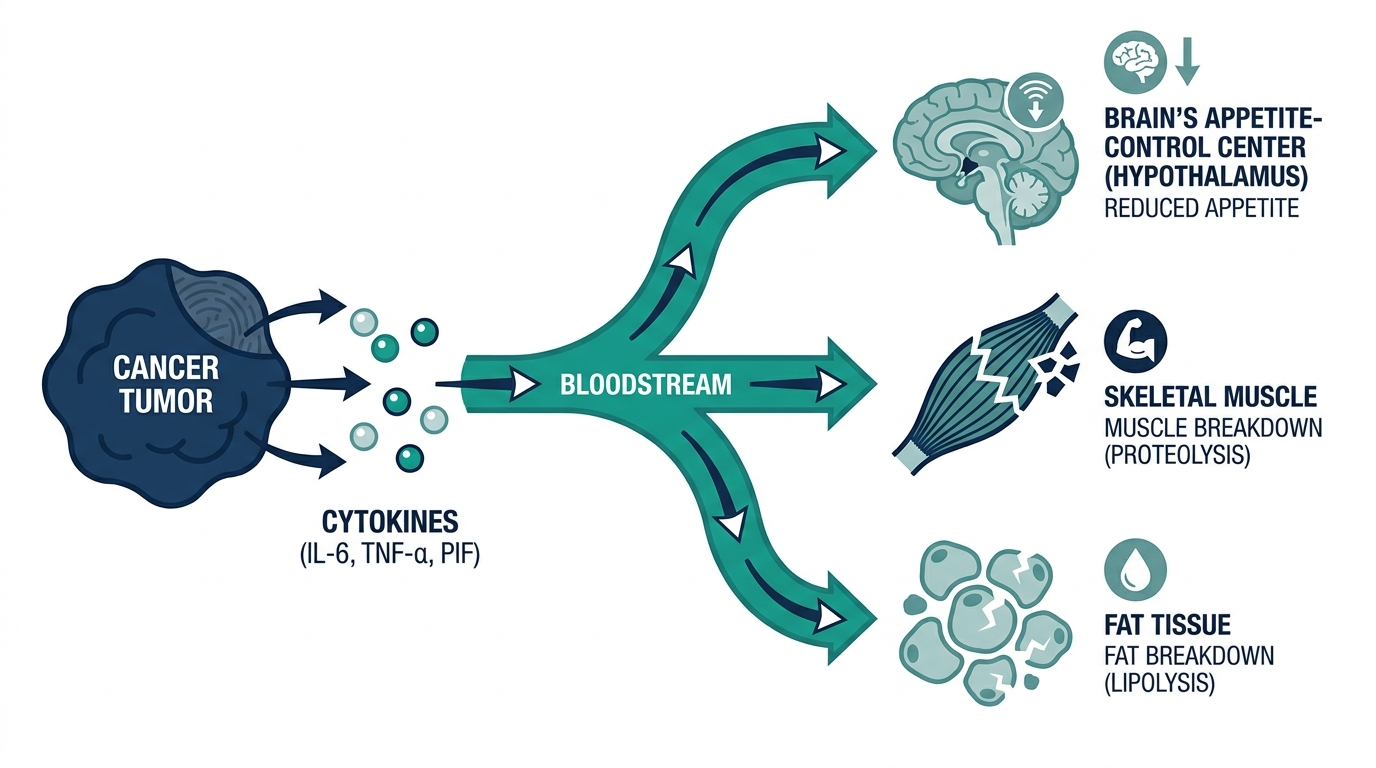
Three things happen at once:
- Inflammation hijacks metabolism. Tumors and the immune cells responding to them release cytokines, chemical messengers including TNF-alpha (once literally called “cachectin”), interleukin-6, and interleukin-1. These signals raise resting energy expenditure, so the body burns more calories doing nothing.
- Muscle and fat are broken down. Cachexia triggers the breakdown of skeletal muscle (proteolysis) and the burning of fat stores (lipolysis), often together. This is why someone with cancer can lose muscle even while still carrying some fat, which is what makes it so dangerous and so different from ordinary slimming.
- Appetite shuts off. The same inflammatory signals act on the hypothalamus, the brain’s hunger control center, suppressing appetite (anorexia). Add nausea, altered taste, and early fullness, and intake drops right when the body needs more.
There is also a metabolic detail worth knowing. Some tumors are heavy users of glucose and run an inefficient energy cycle (the Cori cycle) that wastes calories converting lactate back into glucose in the liver. The body spends energy feeding the tumor, then spends more cleaning up after it.
So when people ask why does cancer cause weight loss, the honest answer is that it is not one mechanism. It is a coordinated metabolic attack: higher burn, active tissue breakdown, and shut-off appetite, all driven by inflammation. That is also why nutrition shakes alone rarely reverse it. You cannot out-eat a furnace that keeps relighting itself.
What cancers cause weight loss most often?
The simplest way to actually get this done
Superpower is a full-body lab membership that runs 100+ biomarkers, has each result reviewed by a doctor, and tracks your numbers year over year (about $199/year). It is what we point readers to when they would rather get one clean, complete draw than chase single tests one at a time. Here is superpower reviewed in full.
The cancers most associated with unintended weight loss are the ones in or near the digestive tract and the ones that drive heavy systemic inflammation. Part of why does cancer cause weight loss is simply location: tumors that sit in the gut hit eating directly. If you are asking which cancers cause weight loss, this is the short list clinicians watch:
- Pancreatic cancer. One of the strongest links. It disrupts digestion and enzyme production and drives intense cachexia, often with weight loss as an early sign before the cancer is found.
- Stomach (gastric) cancer. Directly interferes with eating, fullness, and absorption.
- Esophageal cancer. Difficulty swallowing (dysphagia) cuts intake mechanically on top of cachexia.
- Lung cancer. A classic cause of significant weight loss and a frequent presenting symptom.
- Colorectal cancer. Often paired with changes in bowel habits, blood in stool, or anemia.
- Liver cancer. The liver runs metabolism and protein production, so disease there shows up on the scale.
- Ovarian cancer. Can cause bloating and early fullness that quietly reduce intake.
- Blood cancers (leukemia, lymphoma). Often come with night sweats, fevers, and fatigue alongside the weight loss.
Notice the pattern. Cancers of the GI tract cause weight loss both ways at once: they mechanically block eating or absorption, and they drive cachexia. That is why what cancer causes weight loss most reliably tends to be a digestive one.
Can skin cancer cause weight loss? And other less obvious cases
Localized skin cancer almost never causes weight loss. A basal cell or squamous cell carcinoma, or an early melanoma caught on the skin, is a local problem and does not flood the body with the inflammatory signals that drive cachexia. So if you are asking can skin cancer cause weight loss in an early, contained lesion, the answer is essentially no.
The exception is advanced, metastatic melanoma. Once skin cancer has spread to organs like the liver, lungs, or beyond, it behaves like any advanced cancer and can absolutely cause cachexia and significant weight loss. So does skin cancer cause weight loss? Only when it is no longer just skin cancer. Unexpected weight loss is not a screening tool for a mole. If you have a changing or suspicious spot, you watch the spot, not the scale.
The broader point: weight loss is a feature of cancers that have either reached the gut or gone systemic. A small, local, treatable cancer usually does not announce itself on the bathroom scale at all.
Will cancer cause weight loss in everyone, and how much is a red flag?
No, cancer does not cause weight loss in everyone, and weight loss is rarely the only sign. Many cancers caught through screening, like early breast, prostate, or cervical cancer, cause no weight change at all. So will cancer cause weight loss in your specific case depends entirely on the type and stage.
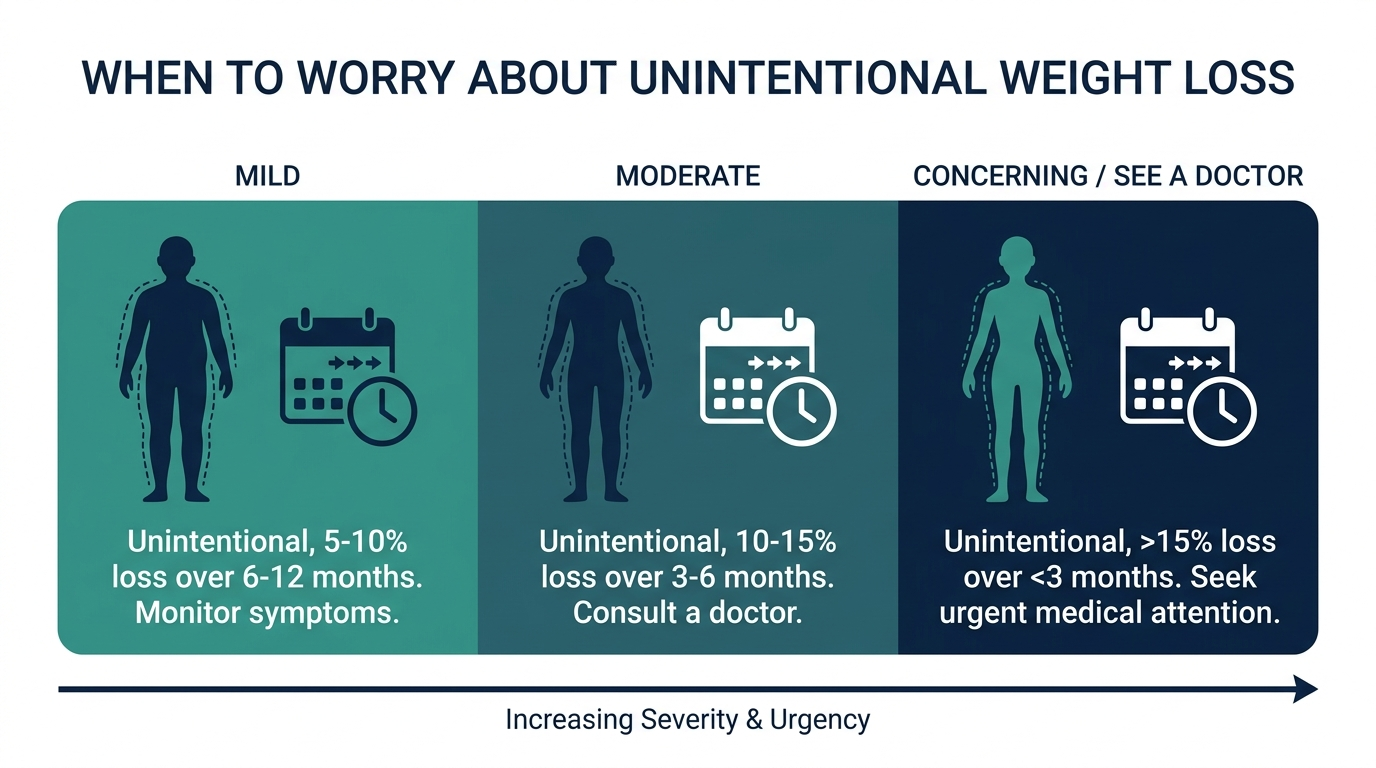
Here is the number that matters. Clinicians flag unintentional loss of more than 5 percent of body weight over 6 to 12 months as significant. For a 180-pound person, that is about 9 pounds you did not try to lose.
| Type of weight change | What it usually looks like | Concern level |
|---|---|---|
| Normal daily fluctuation | 2 to 5 lbs up or down within a day from water, food, salt | None |
| Intentional weight loss | You changed diet or activity, appetite is normal or strong | None |
| Stress or life-change loss | Loss tied to a known stressor, appetite returns when it passes | Low, worth watching |
| Unintentional, less than 5% | Slow drift, no clear cause, appetite mildly off | Mention to a clinician |
| Unintentional, more than 5% in 6 to 12 months | Clothes loose, not trying, often with other symptoms | Get a workup |
Context changes the urgency. Weight loss packaged with other symptoms is far more concerning than a slow drift alone. Watch for blood in stool or urine, a persistent cough or hoarseness, trouble swallowing, drenching night sweats, unexplained fevers, a new lump, jaundice, or fatigue that sleep does not fix. Any of those alongside the weight loss moves you from “mention it” to “see someone soon.”
What causes weight loss with cancer beyond the tumor itself?
Even when a tumor is found, the weight loss is rarely caused by the tumor “using up” calories on its own. The tumor’s mass is usually tiny relative to your body. What causes weight loss with cancer is the body’s whole-system response plus the side effects of treatment:
- The inflammatory cascade (the cachexia driver described above) is the biggest single factor.
- Treatment side effects. Chemotherapy and radiation often cause nausea, mouth sores, taste changes, and diarrhea that gut intake. This is why so many people lose weight during treatment, not just from the disease.
- Mechanical obstruction. A tumor in the esophagus, stomach, or colon can physically block the passage of food.
- Malabsorption. Pancreatic and bowel cancers can stop you from breaking down and absorbing nutrients even when you eat. Chronic diarrhea from this is a real driver, and it works the same way other causes do. If you want the mechanism, see does diarrhea cause weight loss.
- Hormonal and metabolic shifts. Some cancers alter insulin sensitivity and how the body stores fuel.
This is why weight loss in cancer is so hard to reverse with food alone. You are fighting on five fronts, and a calorie shake only addresses one of them. Modern cancer care now treats cachexia as its own problem, with appetite stimulants, anti-inflammatory strategies, protein-forward nutrition, and resistance exercise to protect muscle, not just “eat more.”
The mistake that costs people the most: assuming it is cancer, or assuming it is nothing
Here is what stalls people, and it cuts both ways. People search why does cancer cause weight loss, jump straight to cancer the moment the scale drops, spiral for weeks, and never get a single test done. The opposite error is just as common: brushing off real, unexplained weight loss as “stress” or “getting older” and letting months pass.
The truth in the middle: unexplained weight loss has many causes, and cancer is only one of them, and not the most common one. Far more often, it is something measurable and treatable:
- An overactive thyroid (hyperthyroidism). Revs metabolism and melts weight, often with a racing heart and anxiety. A simple TSH and free T4 panel catches it.
- New or poorly controlled diabetes. When the body cannot use glucose, it burns fat and muscle for fuel and dumps sugar (and calories) into urine.
- Chronic stress or depression. Both can flatten appetite and drive real weight loss. If life has been heavy, that matters. See can stress cause weight loss for how the cortisol mechanism actually works.
- GI conditions like celiac disease, Crohn’s, or chronic infection that quietly block absorption.
- Medication side effects and undiagnosed hormonal shifts.
The fix for the anxiety is not more Googling. It is data. The fastest way to separate “I should relax” from “I need imaging” is to look at your actual numbers: thyroid, blood sugar, inflammation markers, a complete blood count, and a metabolic panel. Those few results rule huge categories in or out in a single afternoon.
Worried about unexplained weight loss? See your actual numbers first.
Superpower is a full-body lab membership that runs 100+ biomarkers including thyroid (TSH, free T4), fasting insulin, A1C, a complete blood count, and inflammatory markers, has each result reviewed by a doctor, and tracks your numbers year over year (about $199/year). For weight loss you cannot explain, a single panel rules out the thyroid and blood-sugar causes that account for most of it, and tells you whether to relax or push for more imaging. Here is Superpower reviewed in full.
To be clear about what a blood panel can and cannot do: routine labs do not diagnose most solid tumors. That takes imaging and biopsy ordered by a physician. But labs are the efficient first filter. They catch the common, treatable causes fast, and a clearly abnormal result (severe anemia, high inflammation, abnormal liver enzymes) is what tells your doctor where to point the scanner next. If your weight loss is real and ongoing, talk to a clinician and let the data lead.
What about loose skin and “water weight” after rapid loss?
Two side topics come up constantly with rapid weight loss, and they are worth separating from disease. First, the early pounds in any fast weight loss are mostly water, not fat. Glycogen (stored carbohydrate) holds about 3 to 4 grams of water per gram, so when you burn glycogen you shed water fast in the first week. That is not a tumor. It is fluid.
Second, people who lose a large amount of weight quickly often notice loose skin afterward. That is a normal mechanical result of the skin not snapping back as fast as fat leaves, not a sign of anything sinister. If that is your situation, see how to tighten loose skin after weight loss and how to tighten skin after weight loss naturally, and if you are planning intentional loss, how to avoid loose skin during weight loss. None of these point to cancer.
Do weight loss injections cause cancer?
This question gets searched a lot, so here is the honest state of the evidence. The FDA-approved GLP-1 medications, semaglutide (Wegovy, and Ozempic used off-label) and tirzepatide (Zepbound, and Mounjaro off-label), carry a boxed warning about thyroid C-cell tumors based on rodent studies. In rats, high doses triggered medullary thyroid tumors. Whether this translates to humans is not established, and human data has not confirmed a meaningful increase. Because of that uncertainty, these drugs are not recommended for people with a personal or family history of medullary thyroid cancer or MEN 2 syndrome.
So do weight loss injections cause cancer in people? There is no proven causal link in humans for the approved drugs. The trials that built their reputation were about weight and heart outcomes: in STEP, semaglutide produced roughly 15 percent average body-weight loss, and in SURMOUNT, tirzepatide reached north of 20 percent. Cancer did not emerge as a clear human risk in those programs.
One real distinction matters more than most people realize. FDA-approved Wegovy and Zepbound are manufactured and regulated. Compounded semaglutide and tirzepatide are not FDA-approved. They are legally prescribed through licensed clinicians and pharmacies, but the product itself has not gone through FDA review for safety, purity, or dosing. If you are going to use a GLP-1, doing it through a supervised clinician who runs baseline labs and monitors you is the difference between a managed medication and a gamble. Talk to a clinician before starting or stopping any of these. And if your goal is simply to find out why your weight is moving in the wrong direction, start with measurement, not medication.
Turn what you just learned into action.
Superpower lets you test 100+ biomarkers from home, then re-check them over time so you can actually see progress, physician-reviewed at every step.
Want a real clinician to run the numbers, not a guess?
Joi + Blokes is a telehealth clinic that prescribes GLP-1 medication (Zepbound, compounded semaglutide and tirzepatide), hormone therapy (TRT, HRT), thyroid care, and peptides after a real lab panel and clinician review, with no membership or consult fee (prescriptions from about $59/month, lab panels from $149). If the scale will not budge, this is where you find out whether insulin, thyroid, or hormones are the real reason. Here is Joi + Blokes reviewed in full.
FAQ
Can cancer cause weight loss before any other symptoms appear?
Yes. With pancreatic, stomach, and lung cancers in particular, unexplained weight loss can be one of the earliest signs, sometimes appearing before pain or other obvious symptoms. That is exactly why losing more than 5 percent of your body weight without trying is worth a workup even when you feel otherwise fine.
How fast does cancer-related weight loss happen?
It varies, but cachexia-driven loss is usually steady and progressive rather than a sudden overnight drop. The medical threshold is more than 5 percent of body weight over 6 to 12 months. Loss that keeps accelerating despite normal eating is the pattern that concerns clinicians most.
Does cancer cause weight loss even if you keep eating?
Yes, and that is the hallmark of cachexia. Unlike dieting, where weight loss requires eating less, cancer cachexia breaks down muscle and fat and raises calorie burn through inflammation, so people lose weight despite eating normally. This is why extra calories alone often fail to reverse it.
Which cancers cause weight loss the most?
Pancreatic, stomach, esophageal, lung, liver, and colorectal cancers are the most strongly associated, because they combine cachexia with direct interference in eating, swallowing, or nutrient absorption. Blood cancers like leukemia and lymphoma also commonly cause weight loss, usually alongside fevers and night sweats.
Is unexplained weight loss always cancer?
No. Cancer is only one cause and not the most common one. Thyroid disorders, new or uncontrolled diabetes, depression, chronic stress, GI conditions like celiac or Crohn’s, and medication side effects all cause unintended weight loss. A basic lab panel rules many of these in or out quickly.
What tests check for the cause of unexplained weight loss?
A clinician typically starts with blood work: a complete blood count, a metabolic panel, thyroid tests (TSH and free T4), blood glucose and A1C, and inflammatory markers. Depending on results, imaging (CT, ultrasound) or endoscopy may follow. Labs are the fast first filter; imaging and biopsy confirm or rule out a tumor.
Can stress cause weight loss that mimics cancer?
Yes. Chronic stress and depression can suppress appetite and raise cortisol, producing real, unintended weight loss that can look alarming. The difference is that stress-related loss usually tracks with a known life event and eases as the stressor resolves, while cancer-related loss tends to continue or worsen regardless.
Should I worry about a small skin cancer causing weight loss?
No. Early, localized skin cancers such as basal cell, squamous cell, or a thin melanoma do not cause weight loss because they do not trigger the systemic inflammation behind cachexia. Only advanced, metastatic melanoma that has spread to organs can cause significant weight loss. Watch the spot itself, not the scale.
Can cancer-related weight loss be reversed?
Cachexia is hard to fully reverse with food alone, but it can be managed. Modern care combines protein-forward nutrition, appetite support, anti-inflammatory strategies, and resistance exercise to protect muscle. The earlier it is addressed, the better the outcome, which is another reason not to wait on unexplained loss.
Vital Signs Today may earn a commission if you buy through links on this page. It does not affect our editorial assessments.