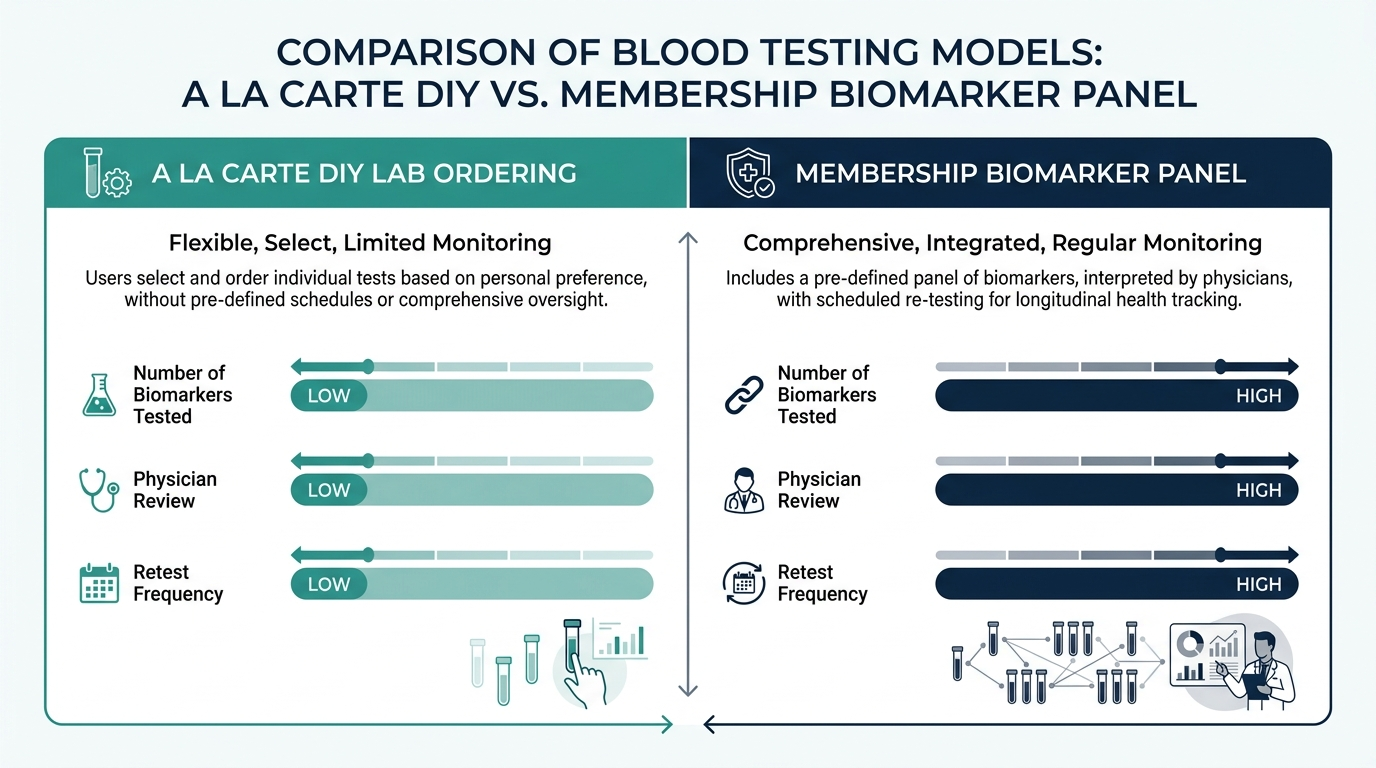
Quick answer: Function Health and Quest Diagnostics solve different problems. Quest (including its direct-to-consumer arm, QuestHealth.com) lets you order individual tests a la carte without a doctor’s order, pay cash, and get results in your patient portal. Function Health is a $499/year membership that runs roughly 100 biomarkers in one coordinated draw, layers in physician review, and stores your results as a longitudinal record. Quest wins on flexibility and insurance compatibility; Function wins on panel depth and guided interpretation. For most people who want a true full-body baseline, the structured membership approach outperforms assembling your own Quest order piece by piece.
What Quest Diagnostics Direct-to-Consumer Actually Offers
Quest Diagnostics operates the largest lab network in the United States, with more than 2,200 patient service centers. Its consumer-facing portal, QuestHealth.com (formerly MyQuest), lets anyone order tests without a physician referral in most states. You pay upfront, walk into a Quest location, get drawn, and receive results usually within one to three business days.
Ordering a la carte tests at Quest is one path. See how a coordinated 150-biomarker membership compares. One at-home Superpower draw checks 100+ biomarkers, physician-reviewed.
The catalog is extensive. You can order a basic metabolic panel for roughly $29 to $50, a lipid panel for $25 to $60, a comprehensive thyroid screen (TSH plus free T3 and free T4) for $60 to $120, or a hemoglobin A1c for $30 to $45. Cash prices at QuestHealth.com are notably lower than what Quest bills to insurers, and HSA and FSA cards are accepted at checkout.
What Quest does not provide: a physician reviewing your specific combination of results, trend tracking across years, or any curation logic that tells you which tests matter for your age, sex, and risk factors. You get a PDF with a green or red flag next to each value, a reference range, and a note to “discuss with your healthcare provider.” That is genuinely useful if you already know what you are ordering and why. If you do not, it is easy to over-order on some markers and miss important ones entirely.
One insider detail most people miss: Quest’s reference ranges are population-based, not optimal-health ranges. A ferritin at 12 ng/mL will show as “normal” (most labs flag below 10 or 12), yet functional medicine clinicians generally consider anything below 30 ng/mL in a woman to be a likely contributor to fatigue. The lab result says fine; the clinical picture says otherwise. This gap between flagged and functional is where interpretation matters most.

What Function Health Is (and What It Costs)
Function Health is a direct-to-consumer membership that grew out of Dr. Mark Hyman’s longevity medicine practice. The $499/year membership (or $399 if you pay in a lump sum at certain promotions) includes two full draws per year, each covering roughly 100 biomarkers, with a physician reviewing your results and flagging anything that needs attention.
The panel is wide by design: standard chemistry and CBC, but also homocysteine, Lp(a), APOB, omega-3 index, uric acid, DHEA-S, free testosterone and SHBG, IGF-1, ferritin, full thyroid cascade (TSH, free T3, free T4, reverse T3, thyroid antibodies), heavy metals, and several inflammation markers beyond basic CRP. That combination is hard to replicate on QuestHealth.com without spending $400 to $700 and knowing each test name in advance.
Results come with interpretation notes written in plain English, plus a physician flag on anything clinically relevant. Function also maintains your longitudinal record, so when you retest six months later you see a trend line, not an isolated number. For a detailed breakdown of what the membership includes, see the function health review.
The key limitation: Function Health uses LabCorp for draws, not Quest. If LabCorp has no convenient location near you, the membership is less practical. Function also does not accept insurance, so you cannot apply the cost toward a deductible.
Quest Blood Test Cost Without Insurance vs Function Health Annual Cost
This comparison is where most people make their decision, so the math needs to be precise.
| Test / Panel | QuestHealth.com cash price (approx.) | Included in Function Health? |
|---|---|---|
| Comprehensive metabolic panel | $29 to $55 | Yes |
| CBC with differential | $28 to $45 | Yes |
| Lipid panel (basic) | $25 to $60 | Yes |
| ApoB | $45 to $90 | Yes |
| Lp(a) | $55 to $110 | Yes |
| Hemoglobin A1c | $30 to $45 | Yes |
| Fasting insulin | $40 to $75 | Yes |
| Full thyroid panel (TSH + fT3 + fT4 + rT3 + antibodies) | $120 to $220 | Yes |
| Testosterone (total + free) + SHBG | $80 to $150 | Yes |
| Homocysteine | $35 to $65 | Yes |
| Ferritin | $28 to $50 | Yes |
| Omega-3 index | $65 to $120 | Yes |
| Heavy metals screen | $70 to $160 | Yes |
| Physician interpretation | Not included | Yes |
| Longitudinal trend tracking | Not included | Yes |
If you priced out a comparable 100-biomarker order through QuestHealth.com, selecting each test individually, a realistic total runs $350 to $650 per draw, depending on which markers you include. At two draws per year you are looking at $700 to $1,300 with zero interpretation built in. Function Health’s $499 annual fee suddenly looks like the efficient option, not the expensive one.
The counterargument: if you only need three or four targeted tests because your doctor already ordered the rest through insurance, Quest a la carte beats a full membership on pure dollar terms. The question is what you actually need.

Do You Need a Doctor for Quest Tests?
In most states, no. QuestHealth.com is a direct-to-consumer service specifically designed to let you order your own labs without a physician referral. You pay online, receive a lab requisition by email, walk into any Quest patient service center, get drawn, and receive results in the same QuestHealth app or portal.
A few states restrict some or all consumer-ordered labs: New York, New Jersey, Rhode Island, and Massachusetts have tighter rules depending on the test category. Certain tests, like controlled-substance panels or certain genetic tests, may still require a physician order nationwide. But for the standard blood chemistry, lipids, hormones, and metabolic markers most people want, you can order without any doctor involvement in roughly 46 states.
Quest also operates QuestHealth “health + wellness” packages that bundle several common tests under themes like heart health or men’s health, ranging from about $75 to $299, which can be a smarter entry point than ordering tests one by one if you are new to DIY labs.
Function Health vs Quest: Panel Depth Side by Side
The core difference between function health vs quest comes down to what gets ordered and why. Quest is a lab; it runs whatever test you ask for. Function Health is a curated clinical program; it decides which tests matter and orders all of them in a coordinated panel optimized for detecting early dysfunction.
Markers that are standard in Function Health but that most people never think to add on QuestHealth.com include:
- ApoB: a more direct measure of atherogenic particle count than LDL-C. Roughly 20 to 30 percent of people with a “normal” LDL have elevated ApoB, indicating meaningful cardiovascular risk the standard lipid panel misses.
- Lp(a): genetically driven cardiovascular risk factor. Elevated in about 20 percent of the population. You will never know without testing, because it does not track with diet or exercise changes.
- Reverse T3: tells you whether your thyroid hormone is converting properly or pooling in an inactive form. Missed on every basic thyroid panel.
- DHEA-S and IGF-1: hormone and growth factor markers that start declining in your late 30s and correlate with lean mass, energy, and metabolic rate.
- Uric acid: rising uric acid predicts insulin resistance and cardiovascular risk years before glucose or A1c shifts. Cheap test, almost always skipped.
- Omega-3 index: most Americans are deficient. The index predicts cardiovascular and cognitive outcomes. Rarely ordered in primary care.
Quest can run all of these. The problem is that most people ordering DIY labs will not know to include them, and a standard primary care visit will not prompt the order either. The panel curation is where Function Health earns its fee.
How QuestHealth.com (Buy Your Own Labs) Actually Works
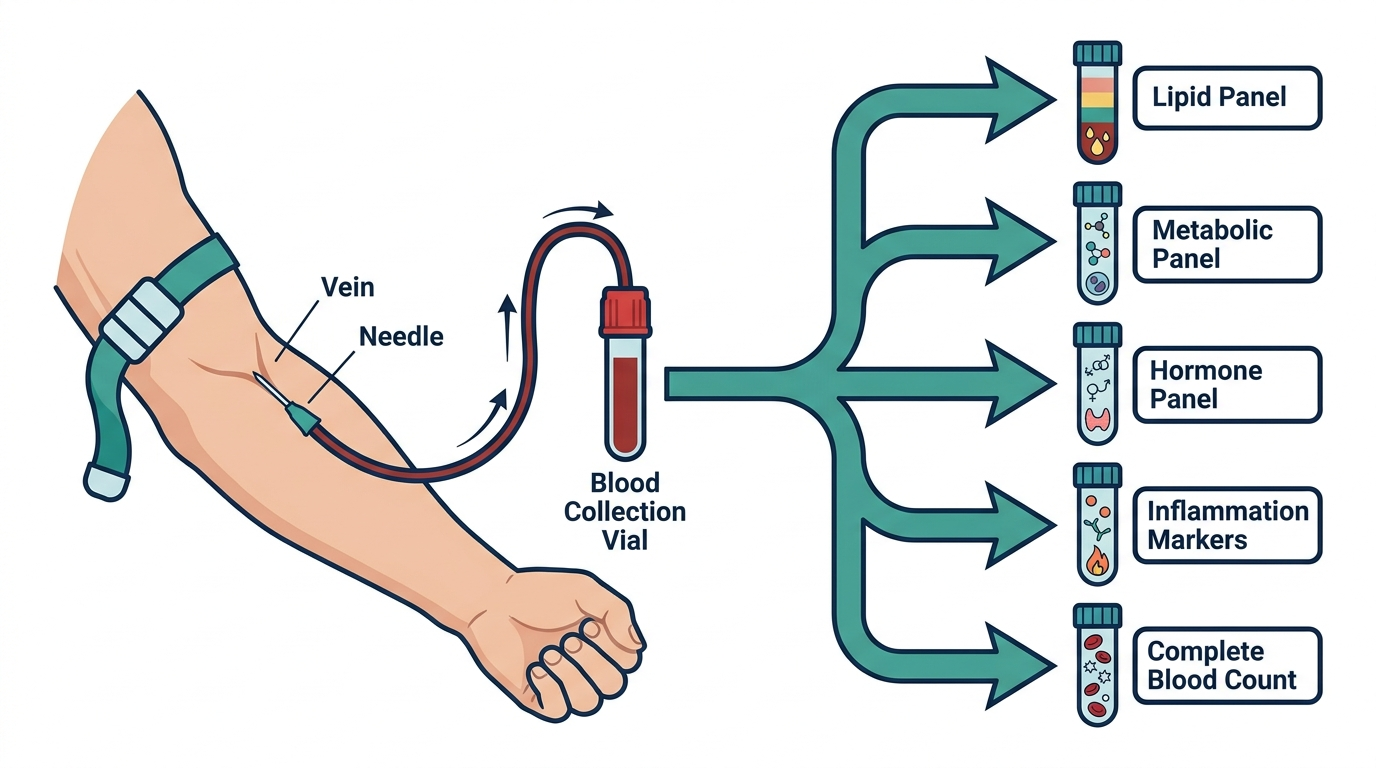
The QuestHealth.com workflow is straightforward once you know it. You create an account, browse tests by name or category, add to cart, pay by credit card or HSA/FSA, and receive a digital lab requisition. You then walk into any Quest patient service center (no appointment required at most locations, though scheduling online skips waiting) and present your requisition. Blood is drawn, processed at a Quest regional lab, and results post to your QuestHealth portal and app, typically within one to three business days for most routine tests.
Turnaround for specialty tests, like heavy metals or advanced hormone panels, can run three to seven business days. Quest emails you when results are ready. You can share results with any clinician directly from the portal.
What QuestHealth does not do: notify you if your results look concerning. A critically low potassium or a very high calcium will still just appear as a red flag in your portal; Quest does not call you, does not have a clinician review your panel, and does not integrate your results into a treatment recommendation. That is not a criticism, it is simply scope. Quest is a lab, not a clinical service.
The simplest way to actually get this done
Superpower is a full-body lab membership that runs 100+ biomarkers, has each result reviewed by a doctor, and tracks your numbers year over year (about $199/year). It is what we point readers to when they would rather get one clean, complete draw than chase single tests one at a time. Here is superpower blood test reviewed in full.
Where Quest Diagnostics Still Wins
Quest is the right tool in several specific situations, and being honest about that makes the comparison more useful.
Insurance billing: Quest accepts most major insurance plans. If your insurer covers an annual lab panel, Quest is the path to getting it billed correctly. Function Health and similar memberships do not bill insurance, though they will provide itemized superbills you can submit for potential HSA/FSA reimbursement or out-of-network claims.
Targeted testing: If your cardiologist wants a repeat ApoB and Lp(a) three months after starting a statin, ordering those two tests on QuestHealth for $80 to $150 combined is far more sensible than paying for a full membership draw.
Medicare patients: Medicare has specific coverage rules for lab tests tied to diagnosis codes and ordering physicians. DIY lab memberships are not structured for Medicare billing. Older adults who want their insurance to cover labs should use Quest or Labcorp through their physician.
Convenience of location: Quest has more patient service centers than LabCorp in many markets, plus partnerships with CVS MinuteClinic locations and some Walmart Health sites. If the nearest LabCorp draw site is inconvenient, Quest’s geographic footprint wins on sheer accessibility.
If you are comparing Function Health to similar curated programs, the function health vs empirical health breakdown and the function health vs 10x health comparison cover the premium-membership side of the market in detail.
Interpretation: The Gap Neither Lab Fills on Its Own
This is the honest part of the function health vs quest diagnostics conversation that most comparison articles skip. Neither a QuestHealth PDF nor a Function Health portal report fully substitutes for a clinician who knows your history.
What both services give you is data. What you do with that data depends on context. A ferritin of 18 ng/mL means something different in a 32-year-old woman with heavy periods than in a 58-year-old man with no GI symptoms. An Lp(a) of 95 nmol/L in someone with a family history of early heart attacks is a red alert; in someone with no risk factors it is a reason to discuss statins with a doctor but not to panic.
Function Health’s physician review adds a meaningful layer: a licensed clinician flags results outside optimal ranges, writes a plain-English explanation, and recommends follow-up if something looks actionable. That is not a telemedicine visit, and it does not replace your primary care relationship, but it does close the gap between “I have a number” and “I know what to do with this number.” Talk to a clinician about any results that concern you before changing medications or supplements.
For more context on what Function Health’s interpretation layer actually covers in practice, the function health cost breakdown explains what you are paying for beyond the draw itself.
How to Decide: A Simple Decision Tree
The choice between function health vs quest is ultimately about what you are trying to accomplish.
- You want a complete health baseline for the first time: a curated membership (Function Health, Superpower, or a comparable program) will capture far more relevant data per dollar than assembling a Quest order yourself.
- You want to retest one or two specific markers your doctor ordered: QuestHealth.com a la carte, cash price, done in two days. No membership needed.
- You have insurance and want it to cover your annual labs: Quest through your insurer or physician, not a direct-to-consumer membership.
- You are on Medicare or Medicaid: use the in-network lab your ordering physician uses, billed to your coverage.
- You want year-over-year trend data with physician oversight: a membership service. Quest’s portal stores your results but does not analyze trends or flag clinical patterns proactively.
- You are building a longevity protocol and want the full cardiovascular, metabolic, and hormonal picture: the superpower blood test review and the function health review both walk through what a complete panel reveals that a standard annual physical misses.
A practical note on price shopping: if you land on a membership program, the how much does superpower cost page compares annual pricing across a few key membership tiers, which can clarify whether the extra features of higher-priced programs are worth it for your specific situation.
How to Build a Smart DIY Quest Order (If You Go the a la Carte Route)
If you decide Quest a la carte fits you better, the skill is knowing what to order so you do not overspend on redundant tests or miss the ones that matter. Here is a tiered approach that mirrors how a thoughtful clinician would build a panel from scratch.
Tier 1, the metabolic foundation (order these first): comprehensive metabolic panel, CBC with differential, HbA1c, and fasting insulin. Together these cover kidney function, liver enzymes, electrolytes, blood cells, and the earliest signals of insulin resistance. This is the highest-yield cluster for the money.
Tier 2, cardiovascular risk (add if heart disease runs in your family): a standard lipid panel plus ApoB, and Lp(a) once in your lifetime. ApoB counts the actual atherogenic particles, which the standard LDL number can undercount. Lp(a) is genetic and stable, so a single measurement usually suffices forever.
Tier 3, thyroid and hormones (add if you have symptoms): TSH with free T4 and free T3 rather than TSH alone, plus thyroid antibodies if autoimmune disease is suspected. For men, total and free testosterone with SHBG. For women, time estradiol, FSH, LH, and progesterone to the cycle.
Tier 4, nutrients and inflammation: ferritin and a full iron panel, vitamin D, vitamin B12, homocysteine, and hsCRP. These explain a large share of fatigue and brain-fog complaints that people wrongly attribute to hormones.
The point of tiering is that you rarely need everything at once. Start with Tier 1, add higher tiers based on symptoms or family history, and avoid paying for the same marker twice across bundled packages.
Reading the Panel as Groups, Not Isolated Numbers
Whether the results come from Quest a la carte or a curated membership, the interpretation skill is the same: markers travel in packs, and the pack tells a story that a single value cannot.
- The insulin-resistance cluster: fasting insulin, HbA1c, triglycerides, HDL, and a falling SHBG move together. A high triglyceride-to-HDL ratio with elevated fasting insulin points to metabolic dysfunction long before glucose crosses into diabetic territory.
- The iron cluster: ferritin, serum iron, transferrin saturation, and hemoglobin. Low ferritin with low saturation and low hemoglobin is iron-deficiency anemia. High ferritin with high saturation raises the question of iron overload.
- The thyroid cluster: TSH, free T4, free T3, and antibodies. A high TSH with low free T4 is overt hypothyroidism. A high TSH with normal free T4 is subclinical. Positive antibodies point to an autoimmune cause.
- The cardiovascular cluster: ApoB, LDL, Lp(a), and hsCRP. ApoB and Lp(a) quantify particle burden; hsCRP adds the inflammation dimension that turns particles into plaque.
This is exactly why curated memberships bundle these markers together and why ordering one test in isolation on QuestHealth can leave you with a number and no context. If you go the DIY route, order the cluster, not the single marker.
Data Ownership and Privacy: A Real Difference Between the Two
People rarely think about where their lab data lives, but it is a genuine point of difference. With QuestHealth.com, your results sit in Quest’s patient portal, and you can download PDFs and share them with any clinician. With a membership like Function Health, your data lives inside that platform’s app, formatted as trend lines and optimal-range flags rather than raw lab printouts.
A few practical implications. First, portability: always download and keep your own copies of raw results, regardless of which service you use, so you own a permanent record independent of any subscription. Second, continuity: if you cancel a membership, confirm you can still export your historical data, because losing years of trend tracking is a real cost. Third, sharing: a standard Quest PDF drops cleanly into any clinician’s workflow, while a proprietary app report sometimes needs to be exported or re-entered.
None of this decides the choice on its own, but if long-term ownership of your health record matters to you, factor it in alongside price and panel depth. Keeping your own downloaded copies is the simplest hedge no matter which path you pick.
Turn what you just learned into action.
Superpower lets you test 100+ biomarkers from home, then re-check them over time so you can actually see progress, physician-reviewed at every step.
FAQ
Is Function Health the same as Quest Diagnostics?
No. Function Health is a direct-to-consumer health membership that curates a 100-biomarker panel, coordinates your draw through LabCorp, and provides physician interpretation. Quest Diagnostics is a commercial laboratory that runs individual tests on request. They operate in different parts of the same market: Quest handles the draw and analysis; Function handles the curation, order, and clinical review layer on top.
Can I order the same tests on QuestHealth.com that Function Health runs?
Most of them, yes. QuestHealth.com has a broad catalog that includes ApoB, Lp(a), full thyroid panels, DHEA-S, and many advanced markers. The challenge is knowing which tests to order and assembling them correctly. When you price it out test by test, the total usually runs $400 to $700 per draw, with no physician review, versus Function Health’s bundled membership price with interpretation included.
Does Quest Diagnostics require a doctor’s order?
For QuestHealth.com direct-to-consumer tests, no. You pay online and walk in. However, a handful of states restrict consumer lab ordering, and certain test categories (controlled substances, some genetic tests) still require a physician order regardless of state. Standard chemistry, metabolic, hormone, and lipid tests are available without a doctor’s order in most of the country.
How long do Quest results take?
Most routine tests (CBC, CMP, lipids, A1c, thyroid TSH) return results within one to three business days. Specialty tests, including heavy metals, advanced hormones, and certain infectious disease markers, can take three to seven business days. Quest sends an email notification when results post to your portal.
Does Quest accept HSA or FSA cards?
Yes. QuestHealth.com accepts HSA and FSA cards at checkout for direct-to-consumer purchases. This makes the after-tax cost meaningfully lower for anyone with a funded health savings account, since you are spending pre-tax dollars. Function Health also accepts HSA/FSA payments for the same reason.
What does Quest blood test cost without insurance?
Cash prices on QuestHealth.com range from about $29 for a basic metabolic panel to $200 or more for a comprehensive hormone panel. Individual tests like a lipid panel run $25 to $60; a full thyroid screen (TSH, free T3, free T4) runs $60 to $120. The QuestHealth.com cash prices are substantially lower than Quest’s list prices billed to insurers, so paying out of pocket through the consumer portal is often cheaper than using insurance if you have not met your deductible.
How does questhealth.com differ from regular Quest Diagnostics?
QuestHealth.com is Quest’s direct-to-consumer brand. You order tests yourself, pay cash or HSA/FSA, and skip the physician referral step. Regular Quest Diagnostics, accessed through a physician order, bills insurance, uses diagnosis codes, and the results go primarily to the ordering clinician. Both use the same Quest labs and draw sites; the difference is ordering path, billing, and who receives the results.
Is Quest or LabCorp better for at-home testing?
Both Quest and LabCorp offer mobile phlebotomy in select markets, where a technician comes to your home or office for an additional fee (typically $50 to $150 on top of test costs). Coverage varies by zip code. Function Health and Superpower also offer home draw upgrades in some areas. For most people, the in-center draw is faster, cheaper, and just as accurate.
Can I use Quest results with a functional medicine doctor?
Yes, absolutely. Quest results are standard CLIA-certified lab results accepted by any clinician, including functional medicine doctors, naturopathic physicians, and integrative practitioners. You can share a PDF or grant portal access directly. Some functional medicine practitioners prefer Labcorp reference ranges for certain markers, but the underlying measurements are interchangeable.
Vital Signs Today may earn a commission if you buy through links on this page. It does not affect our editorial assessments.