Quick answer: Function Health and Empirical Health solve different problems. Function Health is a dedicated lab-testing membership that runs 100-plus biomarkers per year and gives you every result with reference ranges. Empirical Health is a virtual primary care practice powered by AI physicians that happens to order some bloodwork as part of ongoing care. If you want a broad, proactive snapshot of your biology, Function Health wins on sheer panel depth. If you want a relationship with a provider who manages your care over time and can prescribe, Empirical Health is closer to a virtual doctor than a lab service. Many people end up needing both, which is worth understanding before you pay for either.
What Is Function Health and How Does It Work?
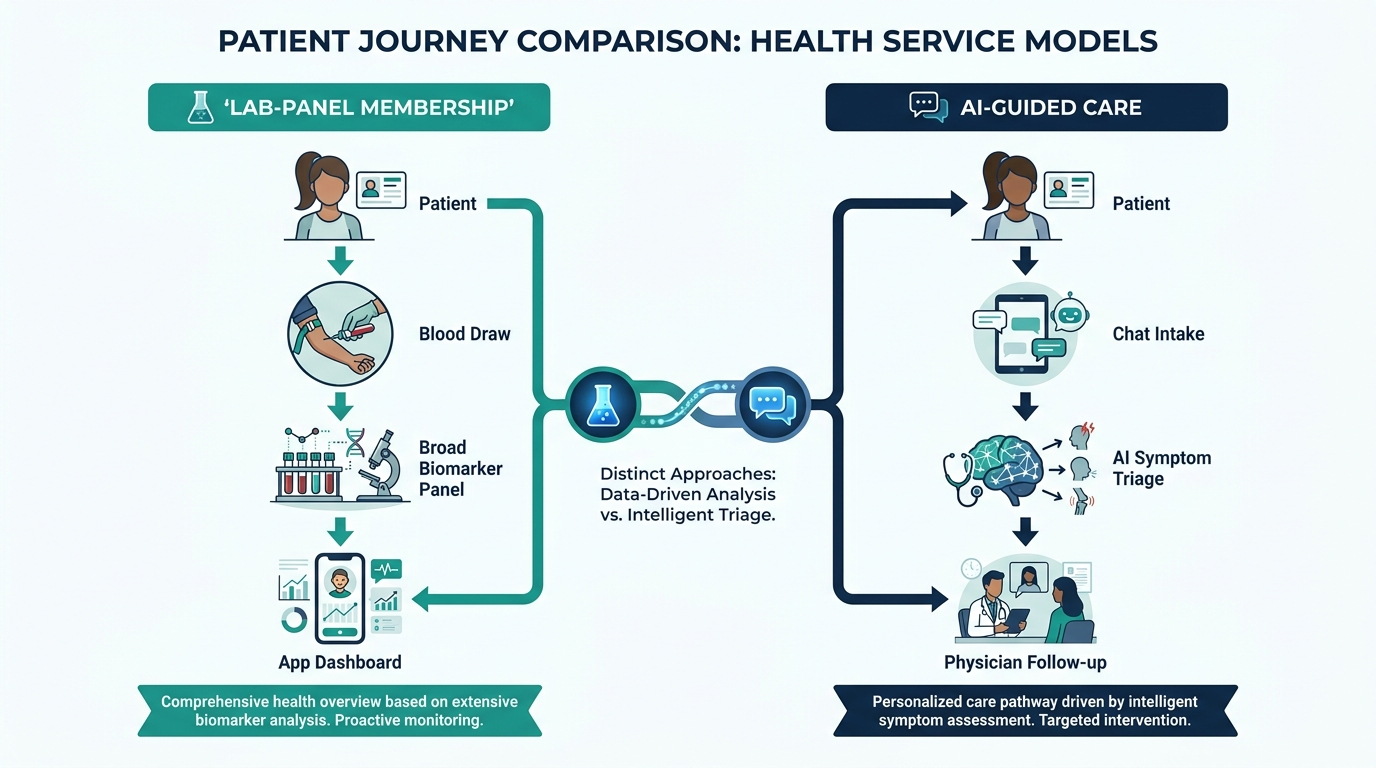
Function Health is a membership lab-testing service co-founded by Dr. Mark Hyman that draws 100-plus biomarkers in a single annual visit to a Quest or Labcorp draw site. Every result comes with a brief explanation and a reference range, and members can trend results year over year through the platform. The core membership costs roughly $499 per year, though pricing has shifted; our function health cost breakdown covers the current tiers in detail. Function does not prescribe, manage medications, or replace a primary care doctor. It is a data layer: a dense annual snapshot you take to your own clinician or use to drive lifestyle decisions.
Weighing an AI-powered virtual doctor against a dedicated lab membership? See what a 100+ biomarker snapshot actually gives you. One at-home Superpower draw checks 100+ biomarkers, physician-reviewed.
The panel covers the usual lipid and metabolic markers but extends into thyroid antibodies, sex hormones, cortisol, nutrient levels like ferritin and vitamin D, heavy metals, and inflammatory markers like hsCRP and homocysteine. That width is what separates it from a standard annual physical lab order, which might cover only twelve to twenty markers. For a deeper look at the platform’s strengths and real-world limitations, see our full function health review.

What Is Empirical Health?
Empirical Health is a virtual primary care service that uses AI to help physicians manage a patient panel more efficiently. It is not primarily a lab company. Members pay a flat monthly fee (reported in the $100 to $200 per month range as of early 2026) and get ongoing access to a care team, AI-assisted triage, and periodic lab orders that the AI flags as relevant for their situation. The pitch is that Empirical’s AI reads your history more thoroughly than a rushed in-person GP and surfaces things a 15-minute appointment would miss.
The bloodwork Empirical orders is real, drawn at standard labs, but the panel is clinician-determined per patient rather than a fixed comprehensive set. A healthy 32-year-old might get a fairly narrow order; someone with metabolic risk factors will get more. This is actually how good primary care works, but it means you cannot assume you will get Function-style breadth by default.
Function Health vs Empirical Health: Side-by-Side Comparison
The two services overlap on one thing: lab results from Quest or Labcorp. Everything else diverges sharply.
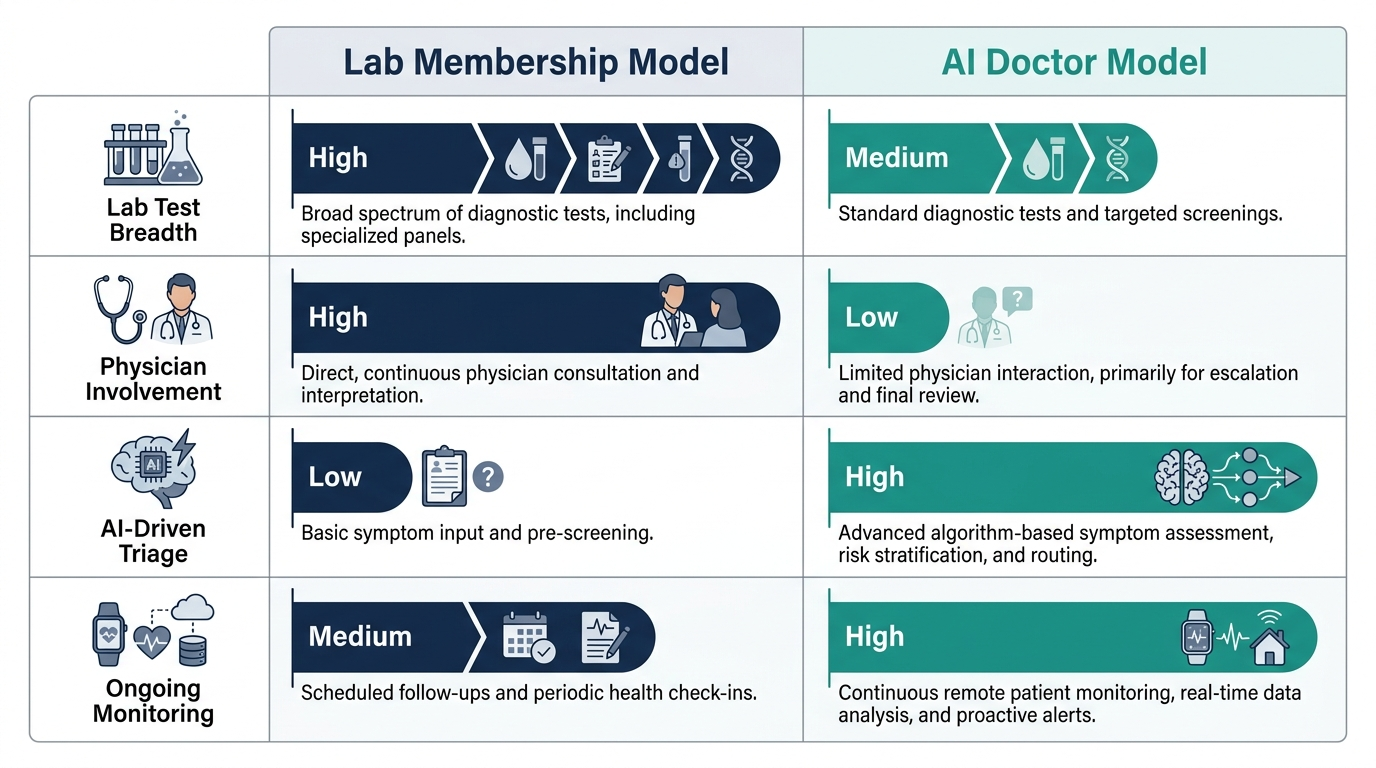
| Feature | Function Health | Empirical Health |
|---|---|---|
| Primary purpose | Broad proactive lab testing | Virtual primary care (AI-assisted) |
| Biomarkers per draw | 100-plus (fixed panel) | Variable, clinician-ordered |
| Can prescribe medications | No | Yes (licensed physicians) |
| Ongoing care relationship | No | Yes |
| Insurance accepted | No (membership fee only) | Limited; check state availability |
| Annual cost (approximate) | Around $499/year | $1,200 to $2,400/year |
| Result trending over time | Yes, built into dashboard | Yes, via patient record |
| AI interpretation | Automated explanations per marker | AI flags patterns, doctor interprets |
| Draw locations | Quest and Labcorp nationally | Quest, Labcorp, or mobile draw |
Empirical Health Cost: What You Actually Pay
Empirical Health’s pricing model is closer to a concierge or direct primary care (DPC) membership than to a lab subscription. As of 2026, reported costs range from roughly $100 to $200 per month depending on plan tier and whether lab costs are bundled. That works out to $1,200 to $2,400 per year before any out-of-pocket lab fees that fall outside what the membership covers.
For comparison, Function Health charges a single annual fee in the $499 range that includes the full lab panel. You are paying for very different things. With Empirical, a meaningful chunk of your fee is buying physician access, AI-powered care management, and the ability to get prescriptions and referrals. The lab testing is a feature of the care relationship, not the product itself.
One practical note: Empirical Health is not free through insurance in the traditional sense, though the service may accept HSA and FSA dollars for eligible expenses. If you have a high-deductible health plan and an HSA, you can likely pay for either membership pre-tax, which softens the real cost by 22 to 37 percent depending on your bracket. Talk to a clinician or benefits advisor about which expenses qualify.

Is Empirical Health Legit? What the Model Gets Right (and Wrong)
Empirical Health is a legitimate, licensed virtual care service staffed by real physicians. The AI component does not replace the doctor; it assists by surfacing patterns in your history before your appointment and flagging anomalies in lab results the doctor might otherwise skim past in a crowded schedule. That model has real clinical value. Studies on physician decision support tools consistently show they catch things that slip through in time-pressured settings.
Where the model has limitations: state licensing laws mean Empirical is not available everywhere. Virtual primary care struggles with anything requiring physical examination, imaging referrals that need local coordination, or acute situations. And because the bloodwork is patient-specific and clinician-ordered rather than a fixed proactive panel, you might go a year before your doctor thinks to check your ferritin or DHEA-S, markers that a service like Function would pull automatically.
The legitimacy question that comes up most often is about prescription access. Empirical can prescribe medications through its platform, but the same telehealth DEA rules apply as anywhere else. Schedule II and III controlled substances are not available through a purely virtual relationship in most states. For standard chronic disease management, thyroid medication, or lifestyle medications, the service functions as intended.
The Biomarker Gap: What Empirical Orders vs. What Function Tests
This is the most practically important difference between the two services, and most comparison articles skip past it. A standard primary care lab order covers roughly 12 to 20 markers: a complete metabolic panel, CBC, lipids, TSH, HbA1c if you have diabetes risk, and maybe a vitamin D if you ask. That is what you get from most virtual primary care relationships, including AI-assisted ones, unless you have a specific condition that warrants more.
Function Health’s fixed panel adds things most GPs never order on a healthy patient: ApoB (a better LDL predictor than standard LDL-C), Lp(a) (a hereditary cardiovascular risk factor that affects roughly 20 percent of the population and requires no lifestyle change to elevate), homocysteine, hsCRP, DHEA-S, free and total testosterone, estradiol, sex hormone binding globulin, ferritin, full thyroid panel including antibodies, heavy metals, omega-3 index, and others. These are not exotic tests. They are markers with strong evidence bases that most insurance-driven care models do not order because a healthy patient has no billing code that justifies them.
The practical result: you could be an Empirical Health member for two years and never see your Lp(a) or ApoB, two markers that cardiologists increasingly call the most important numbers in a cardiovascular risk profile. Function pulls them by default.
The simplest way to actually get this done
Superpower is a full-body lab membership that runs 100+ biomarkers, has each result reviewed by a doctor, and tracks your numbers year over year (about $199/year). It is what we point readers to when they would rather get one clean, complete draw than chase single tests one at a time. Here is superpower blood test reviewed in full.
Who Should Choose Function Health?
Function Health is the right call if your goal is a dense, proactive biomarker snapshot and you already have a primary care relationship (or do not want one). You are buying data, not care. The ideal Function member is someone who is healthy, motivated to optimize rather than just treat, and wants numbers a standard physical would never produce. Athletes monitoring recovery markers, people with a family history of cardiovascular disease who want ApoB and Lp(a) tracked annually, and anyone who just wants a baseline across 100-plus dimensions are the natural users.
Function also makes sense if you have already seen the function health vs 10x health comparison and decided you want breadth over optimization protocols, or if you have looked at options like hormone clinics and decided you want data first before committing to any treatment pathway. Our function health vs joi and blokes comparison covers that territory for hormone-focused buyers.

Who Should Choose Empirical Health?
Empirical Health is the better fit if you need ongoing clinical care and are willing to pay a premium for a smarter virtual doctor. The ideal member does not already have a good primary care relationship, lives somewhere with poor access to in-person care, has multiple chronic conditions that benefit from tight monitoring, or values AI-assisted pattern recognition in their medical history. If you have been frustrated by rushed 15-minute appointments where your doctor has clearly not read your chart since last year, Empirical’s model addresses that specific failure mode.
Empirical is also worth considering if you want prescription access bundled into your membership. Function cannot prescribe. If a result comes back showing low testosterone or a thyroid issue, you need a separate provider to act on it. Empirical closes that loop within one relationship.
Can You Use Both Services Together?
Yes, and it is actually a coherent strategy. Use Function Health or a comparable lab membership to run a broad annual panel, then bring those results to your Empirical Health physician for interpretation, management, and prescriptions if needed. The combination gives you the biomarker depth an AI-driven primary care relationship will not order by default, plus the clinical relationship to act on what you find.
The cost stacks up to roughly $1,700 to $2,900 per year in that scenario, which is not trivial. For a healthier, younger person with no chronic conditions, that may be overkill. A more practical middle path is a single-draw lab membership for the broad baseline, a good telehealth service for acute needs, and an annual in-person physical for anything that requires hands. If cost is a constraint, read through our how much does superpower cost breakdown for a lower-cost alternative that still covers 100-plus markers.
Empirical Health Insurance: Does It Work With Your Plan?
Empirical Health is not a traditional insurance-based practice. Most members pay out of pocket, and the service operates on a flat-fee direct primary care model. HSA and FSA accounts can generally be used for primary care membership fees under IRS rules, though you should confirm your specific plan’s terms. Some PPO plans may reimburse a portion as out-of-network primary care if Empirical provides the right billing codes.
The lab work Empirical orders is a different matter. If the physician sends a lab order to Quest or Labcorp, that draw may process through your insurance depending on your plan and deductible status. A member with a low-deductible plan who has met their deductible might pay little or nothing for standard labs. A member on a high-deductible plan pays retail lab rates, which for a comprehensive order can run $200 to $600 or more cash price before any negotiated rate.
Function Health does not interact with insurance at all. The membership fee is what it is, and the labs are included. That simplicity has real value if insurance lab billing has ever sent you a surprise bill six months after your draw.

How AI Actually Fits Into Each Model
Both services lean on software, but in fundamentally different places, and understanding where the AI sits changes how much you should trust each one. Function uses AI mainly to generate the plain-language explanations attached to each biomarker result. That output is educational and standardized: the same low-ferritin result triggers a similar paragraph for every member. Empirical positions AI further upstream, as a tool that helps a physician surface patterns in a patient’s history, flag drug interactions, and prepare for a visit. In Empirical’s model there is a licensed clinician making the final call, with software as an assistant.
The practical takeaway is that neither service hands medical decisions to an algorithm without a human. But the human’s role differs. At Function, the human wrote a template that the software applies at scale. At Empirical, the human reviews AI-surfaced findings in the context of your specific chart. For anything requiring judgment, a treatment decision, a medication change, an escalation, you want the second arrangement. For raw data breadth you do not need a relationship, the first is enough.
A Decision Framework: Which One Fits Your Situation
Instead of a generic “it depends,” here is a concrete way to route yourself based on your actual circumstances.
- You already have a primary care doctor you trust. Then you mostly need data, not another care relationship. A broad lab membership adds the markers your PCP does not order routinely, and you bring the report to your existing doctor. Empirical would duplicate a relationship you already have.
- You have no primary care access or hate the current one. Then the care relationship is the missing piece, and a virtual practice that can prescribe and manage chronic conditions solves the actual problem. Layer a broad lab panel on top only if you want the extra biomarker depth.
- You manage one or more chronic conditions. Ongoing management, prescriptions, and tight monitoring matter more than a once-a-year 100-marker snapshot. A care-first model is the priority; use targeted labs as your clinician directs.
- You are healthy and optimization-minded. A broad annual panel gives you the baseline and the trend lines. You may not need a bundled care relationship at all until a result flags something worth acting on.
The trap to avoid is buying a care relationship when you only need data, or buying data when your real gap is someone to act on it. Name your actual gap first, then choose.
Data Ownership, Privacy, and Portability
A point buyers rarely consider until it matters: who holds your results, and can you take them with you. With a lab membership, the underlying draw is processed by Quest or Labcorp, which means a copy of the raw values lives in a major lab’s system that you can request directly, independent of the membership app. That portability is useful if you ever cancel, switch services, or want to hand results to a new physician.
Any digital health service that stores and interprets your results is handling protected health information, and it is worth reading how each one describes its data practices before you sign up. Look specifically for whether de-identified data is shared with partners, whether you can export your full history, and how to delete your account and data. The right to download your own results in a standard format is the single feature that protects you from being locked into one dashboard. Before committing to either service, confirm you can export your data and that you understand the privacy terms.
The Risk of Over-Testing and False Alarms
More markers is not automatically better, and a serious review has to say so. Any broad panel run on a healthy person will, by simple statistics, turn up a few values outside the reference range purely by chance, because reference ranges are defined so that a small percentage of healthy people fall outside them. That means a 100-marker panel almost guarantees a handful of “abnormal” flags even in a perfectly healthy adult.
The downstream cost of those flags is real: follow-up tests, imaging, specialist visits, and anxiety, sometimes for a value that would have normalized on a simple recheck. This is the strongest argument for pairing broad testing with someone who can tell a meaningful signal from statistical noise. A standalone data service leaves that filtering to you. A care relationship builds the filter in. When you read your own report, treat isolated mild abnormalities as questions to confirm, not diagnoses to fear, and recheck borderline values under controlled conditions before escalating.
Curious what your own levels look like?
Baseline 100+ biomarkers today and retest as life changes, all in one membership with physician review.
FAQ
What is the main difference between Function Health and Empirical Health?
Function Health is a lab-testing membership: you pay an annual fee and get 100-plus biomarkers drawn at Quest or Labcorp each year. Empirical Health is a virtual primary care practice that uses AI to help physicians manage ongoing patient care and order labs as clinically appropriate. Function gives you data breadth. Empirical gives you a care relationship. They are not direct competitors; they serve different primary needs.
How much does Empirical Health cost in 2026?
Empirical Health plans have been reported in the $100 to $200 per month range as of early 2026, placing annual costs between $1,200 and $2,400. Lab work ordered through the service may or may not be bundled depending on plan tier. Always confirm current pricing directly with Empirical, as virtual primary care pricing shifts frequently as the category matures.
Is Empirical Health available in all states?
No. Like all virtual primary care services, Empirical Health is bound by state medical licensing laws. Coverage has expanded over time but is not universal. Before signing up, verify that licensed physicians are available in your state. Some states also have restrictions on what telehealth providers can prescribe, which affects the service’s usefulness if prescription access is part of your goal.
Does Empirical Health replace a primary care doctor?
For many routine primary care needs, yes. Empirical’s physicians can manage chronic conditions, order labs, interpret results, prescribe medications, and make referrals. They cannot examine you physically, which matters for some diagnostic situations. If you have a complex condition requiring specialist coordination or procedures, you will still need some in-person care. For health maintenance, preventive care, and management of stable chronic conditions, the service functions as a genuine primary care substitute for many people.
Which service gives you more biomarkers?
Function Health, definitively. Its fixed panel of 100-plus markers includes cardiovascular risk markers like ApoB, Lp(a), and homocysteine that most primary care physicians never order on a healthy patient, plus nutrient levels, sex hormones, thyroid antibodies, heavy metals, and inflammatory markers. Empirical’s lab orders vary by patient and clinical judgment, and a healthy person with no symptoms might receive a relatively narrow annual draw.
What is an AI doctor app and how does Empirical Health compare?
AI doctor apps range from symptom checkers with no human oversight to services like Empirical where AI assists licensed physicians in clinical decision-making. Empirical sits at the serious end of that spectrum: the AI is a clinical decision support layer, not a replacement for the doctor. The physician reviews AI-flagged patterns and makes final decisions. That is meaningfully different from an app that gives you a probability score based on your symptoms and tells you to see a doctor.
Can Empirical Health order the same tests as Function Health?
Technically yes, any licensed physician can order any of the markers Function includes. Whether an Empirical physician will order a 100-plus marker panel for a healthy patient without a specific clinical indication is a different question. Insurance-influenced medical culture discourages broad proactive testing on asymptomatic patients. If you want Function-level breadth, the most reliable path is a dedicated lab membership rather than hoping a primary care relationship orders it voluntarily. You can always bring Function results to your Empirical physician for context and management.
Is there a cheaper alternative to Function Health that still tests 100-plus markers?
Yes. Superpower is a competing lab membership at roughly $199 per year that runs 100-plus biomarkers and includes physician review of results. It covers similar territory to Function at a meaningfully lower price point. Our superpower blood test review covers what is included and how it compares on panel depth and result quality.
Vital Signs Today may earn a commission if you buy through links on this page. It does not affect our editorial assessments.