
Last updated June 2026. Educational content, not medical advice. Research peptides sold online are labeled “for research use only” and are not approved for human use. Speak with a licensed clinician before starting any peptide protocol.
Short answer: On March 6, 2026, Peptide Sciences, then generating approximately $7.45 million in monthly online sales, posted a three-sentence farewell and permanently closed, with no refunds, no order processing, and no explanation beyond the word “voluntary.” The shutdown was the predictable endpoint of a 15-month federal enforcement campaign, a January 2025 pharmaceutical-industry exclusion order, independent lab testing that failed the company’s flagship retatrutide product across 37 consecutive batches, and a payment-processor squeeze that forced most grey-market peptide vendors onto crypto-only checkout in their final months.
What exactly happened on March 6, 2026?
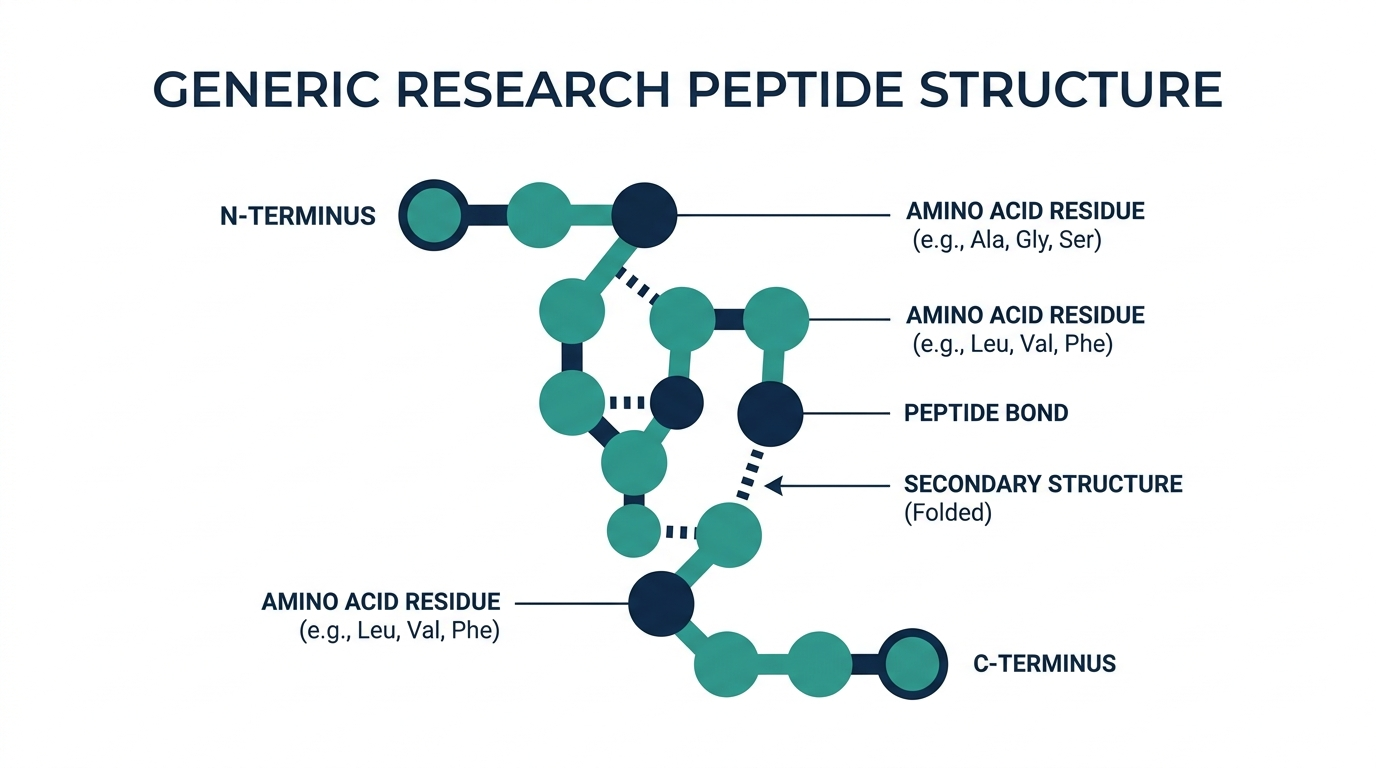
At approximately 2:00 PM Eastern on March 6, 2026, the Peptide Sciences website replaced its storefront with a statement: “After careful consideration, Peptide Sciences has made the decision to voluntarily shut down operations and discontinue the sale of our research products.” Three sentences. No warning, no wind-down period, no refund process, no information about outstanding orders or customer accounts.
The timing was jarring because the scale was not small. The company had recorded 1.15 million website sessions and roughly $7.45 million in sales in December 2025 alone, according to data cited by Peptide Protocol Wiki. A business operating at that volume does not disappear in an afternoon by accident. Customers who had open orders learned about the closure when they tried to check shipping status. The money was gone.
Note the word “voluntarily.” It does not mean the founders woke up one morning and decided to retire. It means they chose to walk out before the federal agents knocked, which is a very different thing.
For anyone still holding an outstanding order or credit from that date: no formal recovery process was ever announced. The shutdown was clean, in the sense that it left no mechanism for customers to get anything back.
Who was Peptide Sciences, and how did the company grow so large?
The company’s origin story was always a little murky. Peptide Sciences claimed to have been established in 1990, but its domain was only registered in December 2009 and the company’s listed address was a virtual mailbox at St. Rose Executive Suites in Henderson, Nevada, not a laboratory or warehouse. Despite the mismatch in founding dates and the minimal physical footprint, a staff of roughly three to five employees ran what would eventually become one of the highest-traffic research peptide operations in the country.
The founder, Daniel Brzezinski, was identified on professional profiles as a biochemist. Beyond that, very little was ever publicly disclosed about the company’s structure, its suppliers, or where the actual peptide synthesis happened. That opacity was not unusual in the grey-market research chemical business, but it matters in retrospect, because the supply chain was never verifiable by customers.
Peptide Sciences grew by being early, consistent, and visible. It published documentation, appeared on every “best peptide vendor” list for years, and maintained a clean-looking e-commerce experience at a time when many competitors looked like they were built in 2007. The company never said so directly, but its branding quietly implied scientific rigor it may not have had behind it.
Full-body lab membership: 100+ biomarkers, doctor-reviewed, tracked over time.
What actually caused the shutdown? The real timeline
The most important thing to understand is that Peptide Sciences was not shut down by one event. It was worn down by a convergence of at least five separate pressures that arrived over 15 months and collectively made the business impossible to continue. Here is the timeline in the order it actually happened.
March 2024: Eli Lilly filed a complaint with the International Trade Commission against 12 vendors selling tirzepatide, alleging trademark infringement. This was not an FDA action; it was Big Pharma protecting its most valuable commercial asset. Tirzepatide (Mounjaro, Zepbound) had become the anchor product for many research peptide vendors, including Peptide Sciences.
January 2025: The ITC issued a General Exclusion Order blocking tirzepatide imports that violated Lilly’s trademark. For vendors sourcing tirzepatide from overseas manufacturers, this did not just create legal risk. It cut off supply chains. Products that had been profitable vanished from catalogs or were replaced with material of increasingly uncertain provenance.
December 2024: The FDA sent warning letters to Prime Peptides, Xcel Peptides, SwissChems, and Summit Research for selling unapproved GLP-1 receptor agonists. Peptide Sciences was not publicly named in that wave, but the signal was clear: the FDA had identified research peptide vendors as a priority enforcement target and was working its way through the industry.
June 18, 2025: FDA agents conducted a physical raid on Amino Asylum’s warehouse in Memphis, Tennessee. The site went offline overnight. This was the moment the industry stopped treating warning letters as manageable administrative nuisances. Physical enforcement meant personal criminal exposure for anyone running a warehouse.
September 2025: The FDA sent more than 50 warning letters to GLP-1 vendors, compounders, and manufacturers in a single wave. Nothing like it had been seen before. Combined with the Amino Asylum raid, this signaled a systematic effort to dismantle the grey-market supply chain, not just tap selected violators on the wrist.
December 10, 2025: Matthew Kawa and Jennifer Stechkober, the founders of Paradigm Peptides, entered guilty pleas in the Northern District of Indiana to federal charges related to selling products labeled as SARMs that actually contained testosterone, a controlled substance. Kawa’s sentencing was scheduled for March 24, 2026. This was the moment “regulatory risk” became “personal federal conviction.”
Throughout late 2025 and early 2026: Payment processors began classifying research peptide sales as prohibited or high-risk activity. Vendors moved to crypto-only checkout. If you were watching the market closely during this period, the shift to crypto was less a feature than a distress signal, the last remaining revenue channel before the lights went out.
January 27, 2026: Science.bio, the second-largest research compound vendor in the market, permanently closed. Like Peptide Sciences, the founders made a voluntary exit rather than wait for enforcement. Two of the biggest names were gone within six weeks of each other.
March 6, 2026: Peptide Sciences closed.
The Finnrick test data: what independent labs found inside the vials
The regulatory pressure was one thing. The quality data was another, and in some ways the more damning story.
Finnrick Analytics, an independent platform that publishes third-party test results on research peptide products, had been systematically testing Peptide Sciences samples before the closure. The results were not uniformly bad, but the failures were severe and concentrated in the company’s most commercially important products.
| Peptide | Finnrick Rating | Samples Tested | Key Finding |
|---|---|---|---|
| Retatrutide | E (Bad) | 37 | Counterfeit detection flagged; purity reported as low as 75% |
| CJC-1295 | E (Bad) | 10 | Average score 4.3/10 |
| Tesamorelin | E (Bad) | — | Average score 4.9/10 |
| Ipamorelin | A (Good) | — | Average score 9.2/10 |
| PT-141 | A (Good) | — | Average score 9.1/10 |
| BPC-157 | A (Good) | 13 | Average score 7.8/10 |
Retatrutide was the most alarming case. Across 37 consecutive samples, the product received a failing E rating, with counterfeit detection flagged in samples collected from November 2025. The same molecule that became commercially important to Peptide Sciences, because of the enormous market interest in next-generation GLP-1 compounds, was the one that failed most catastrophically.
Quantity variance was also flagged across the broader catalog: up to 50% divergence from advertised amounts, which means a vial labeled 5 mg might contain anywhere from 2.5 mg to 7.5 mg. That is not a rounding error. For anything involving dose-sensitive calculations, it makes the product useless as a research material and dangerous as anything else.
Personally, I think the Finnrick data is the part of this story that gets under-reported. The regulatory shutdown gets the headline because it is dramatic and external. But the quality data is the admission, by the numbers, that the company had lost control of its supply chain. Those two things arriving together are why this closure was irreversible.
How did the grey-market model collapse?
Understanding Peptide Sciences requires understanding the legal fiction that held the whole business together.
Research peptide vendors sold products labeled “for research use only.” That label was not consumer protection. It was a legal shield, designed to position the sale as a supply transaction for laboratories rather than a distribution of unapproved drugs to consumers. The FDA had always had the authority to challenge that framing. For years, it mostly did not. That changed.
The specific mechanism was the regulatory interpretation of intended use. When a company’s website includes dosing guidance, before-and-after testimonials, condition-specific marketing, and social media content showing athletes injecting vials, the “research use only” label stops being a defense. Federal investigators evaluate the actual marketing context, not just the label. Peptide Sciences’ website, like most vendors at that scale, had accumulated years of content that pointed squarely at human use.
Do not believe anyone who tells you the “research use only” label ever provided real protection to buyers. It provided legal cover to sellers. The buyer was always exposed. The only thing that changed in 2025 was that sellers became exposed too.
Add the ITC exclusion order cutting off GLP-1 supply chains, the criminal prosecutions creating personal liability for principals, the payment processor exodus, and the Finnrick quality failures, and the model was not just under pressure. It was functionally over.
What happened to the other vendors?
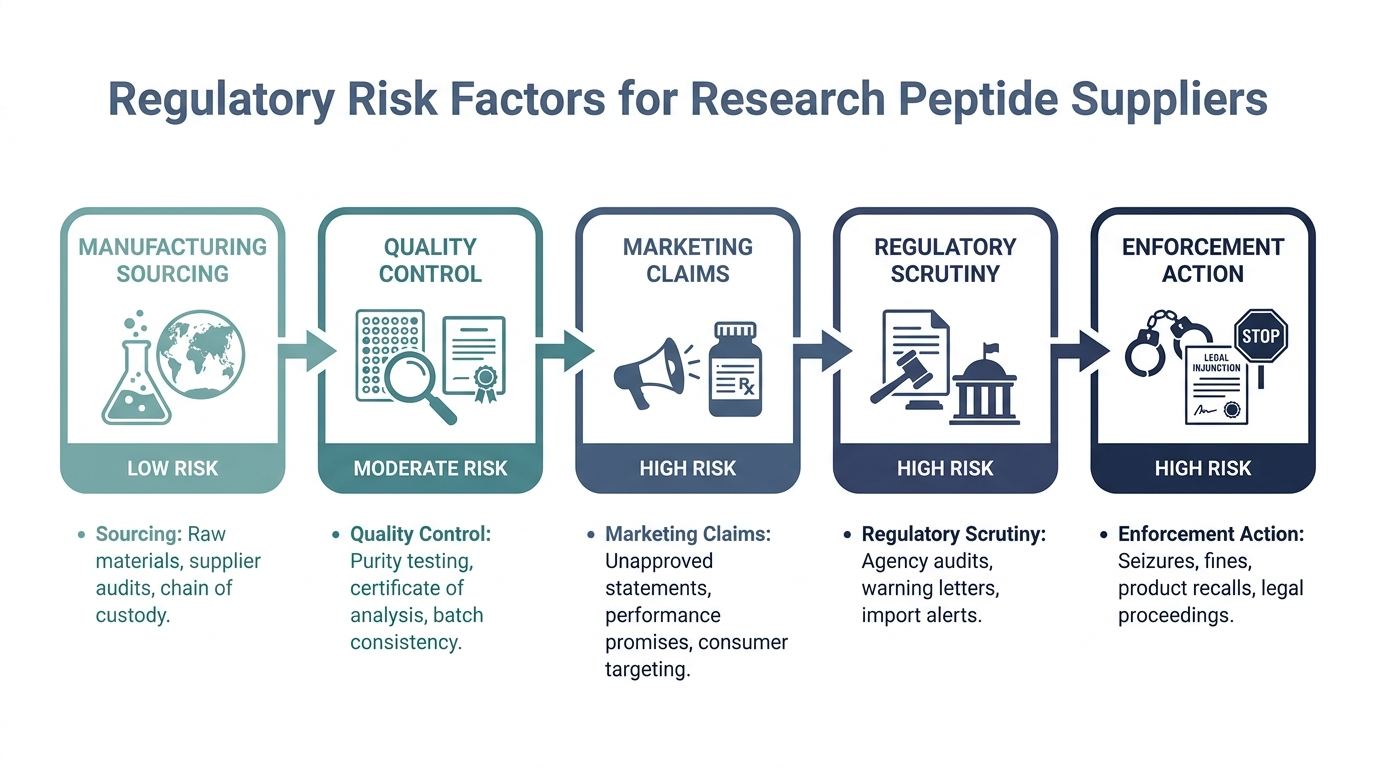
Peptide Sciences was the most prominent closure, but it was part of a wave. By mid-2026, at least eight major grey-market research compound vendors had shut down:
- Amino Asylum (warehouse raid, June 2025, Memphis)
- Paradigm Peptides (DOJ guilty pleas, December 2025, founders charged with distributing mislabeled controlled substances)
- Science.bio (voluntary closure, January 27, 2026)
- Peptide Sciences (voluntary closure, March 6, 2026)
- Royal Research, Peptide Tech Labs, American Research Labs, Unchained Compounds (closed in the same period, lesser-known names)
Tailor Made Compounding, a licensed pharmacy operating in a grey area with peptide therapies, reached a settlement involving a $1.79 million forfeiture. Even the more institutionalized operators in this space were not immune.
The vendors still operating in mid-2026 include names like Ascension Peptides, Proxiva Peptides, and Protide Health, all of which consistently publish independently verified Certificates of Analysis. But the honest answer, post-Peptide Sciences, is that the field has thinned dramatically and every remaining vendor carries some version of the same regulatory exposure that brought down the biggest name in the category.
Full-body lab membership: 100+ biomarkers, doctor-reviewed, tracked over time.
What did the regulatory environment look like in early 2026?
While the FDA was tightening enforcement on grey-market vendors, the regulatory picture for licensed compounding pharmacies was actually moving in the opposite direction.
On February 27, 2026, HHS Secretary Robert F. Kennedy Jr. announced that approximately 14 of the 19 peptides that had been moved to Category 2 in late 2023 were being returned to Category 1, the category that permits compounding pharmacies to produce and dispense them with a prescription. The 14 peptides included BPC-157, TB-500, CJC-1295, Ipamorelin, Sermorelin, and several others that had been among the most popular products in the grey-market catalog.
A Pharmacy Compounding Advisory Committee meeting was scheduled for July 23 to 24, 2026, to formalize the reclassification. Separately, the FDA had already removed BPC-157 from Category 2 on April 22, 2026.
The consequence is worth stating clearly: the peptides that drove most of Peptide Sciences’ revenue are, in 2026, on the path to being fully legal and available through licensed pharmacies with a prescription, for probably similar cost to what a grey-market vial was selling for once you add the full supply kit. The grey-market reason to buy them is narrowing every month.
The regulatory tightening and the regulatory liberalization are not contradictory. They are aimed at different targets: crackdown on unlicensed, unverified vendors; open the door for licensed, verifiable pharmacies.
Is Peptide Sciences coming back?
No. The peptidesexplorer.com analysis notes that Finnrick has flagged any site claiming to sell products as Peptide Sciences after March 2026 as potentially fraudulent. The domain has no active storefront. There has been no announcement from Daniel Brzezinski or any representative of the company indicating a relaunch.
This matters because, in the weeks after a major vendor closes, copycat and scam sites reliably appear under similar names, branding, or SEO positioning. If you encounter any site claiming to be Peptide Sciences, or claiming to sell Peptide Sciences product, treat it as a scam until you have independently verified its Certificate of Analysis and physical legal status. The original company is gone.
What should you do now if you relied on Peptide Sciences?
There are exactly two legitimate paths.
For prescription peptides: sermorelin, tesamorelin, semaglutide, tirzepatide, NAD+, and glutathione are available through licensed telehealth platforms like Defy Medical, Marek Health, and Hone Health. These require a real intake, real lab work, and a real prescription. The monthly cost runs $175 to $399 depending on the therapy, and none of it is covered by insurance. What you get in return is a named pharmacy, a licensed clinician, and actual accountability.
For research peptides, if you insist on that route: the only meaningful standard is a vendor with a recent, batch-specific Certificate of Analysis using both HPLC purity testing (96% minimum) and Mass Spectrometry identity confirmation, from a third-party lab whose key you can verify directly on the lab’s own website. Janoshik Analytical publishes a unique key with every report; you type it into Janoshik’s portal and the original results come back. If the vendor cannot produce that, nothing else about their website, their history, or their forum reputation compensates.
Cross-check every vendor against Finnrick’s live vendor ratings, which now cover more than 8,000 tests across 225 vendors. That database is the closest thing the research community has to a disinterested quality scorecard, and it is how the Peptide Sciences retatrutide failures were documented before anyone else caught them.
The lesson of Peptide Sciences is not that the grey market has gotten more dangerous. The lesson is that it was always this dangerous, and the Finnrick data finally made that visible.
Frequently asked questions
Why did Peptide Sciences shut down?
Peptide Sciences voluntarily closed on March 6, 2026, following a 15-month regulatory campaign that included FDA warning letters in December 2024, the Amino Asylum warehouse raid in June 2025, more than 50 new FDA warning letters in September 2025, and DOJ guilty pleas from Paradigm Peptides founders in December 2025. The company’s flagship retatrutide product also failed independent testing by Finnrick across 37 consecutive batches, with purity as low as 75% and counterfeit detection flagged. A January 2025 ITC General Exclusion Order had also cut off legal tirzepatide supply chains. With personal criminal liability now established by the Paradigm Peptides case, the founders made a voluntary exit before enforcement reached them directly.
When did Peptide Sciences shut down?
March 6, 2026, at approximately 2:00 PM Eastern time. No advance notice was given and no refund or recovery process was announced for customers with outstanding orders.
Will Peptide Sciences come back?
No. There has been no announcement of a relaunch. Any site claiming to sell Peptide Sciences products after March 2026 should be treated as a potential scam. Finnrick has flagged this risk explicitly.
What happened to my Peptide Sciences order?
No formal recovery mechanism was announced. Customers with pending orders at the time of closure have no stated path to refunds. This is consistent with how Science.bio, Amino Asylum, and the other closures played out: customers were left without recourse.
Are any peptide vendors still operating in 2026?
Yes, but the landscape is much thinner. The vendors that consistently clear independent testing as of mid-2026 include Ascension Peptides, Proxiva Peptides, Protide Health, and Felix Chemical Supply. All should still be vetted via Finnrick on a per-batch basis before any purchase.
Is BPC-157 legal now in 2026?
BPC-157 was removed from the FDA’s 503A Category 2 list on April 22, 2026. HHS Secretary Kennedy announced in February 2026 that approximately 14 peptides including BPC-157 are expected to return to Category 1, permitting licensed compounding pharmacies to produce them with a prescription. A final FDA advisory committee meeting is scheduled for July 23 to 24, 2026. It is not yet FDA-approved as a finished drug product.
What is the safest way to get peptide therapy in 2026?
Through a licensed telehealth clinic or compounding pharmacy with a prescription. Named platforms include Defy Medical, Marek Health, and Hone Health. Expect $175 to $399 per month depending on the peptide and monitoring level. None of this is covered by insurance, but it comes with a licensed clinician, a named pharmacy, real product labeling, and someone other than you who is accountable for the dose.
Full-body lab membership: 100+ biomarkers, doctor-reviewed, tracked over time.
Author: Vital Signs Today Editorial Team, [credential]”]. Educational content, not medical advice. Sources linked inline.
Primary sources:
– Peptide Protocol Wiki: Peptide Sciences Shut Down
– PeptideLaws.com: Why Did Peptide Sciences Shut Down? Timeline, FDA Pressure
– PeptidesExplorer: Peptide Sciences Shut Down
– PeptidesExplorer: Is Peptide Sciences Coming Back?
– DOJ Northern District of Indiana: United States v. Matthew Kawa
– Muscle & Brawn: Amino Asylum Raided In 2025
– LifeLink Research: What Happened to Science.bio?
– PeptideJournal.org: FDA Peptide Ban Lifted, 14 Peptides Reclassified 2026
– Finnrick Analytics vendor ratings
Related reading
Vital Signs Today may earn a commission if you buy through links on this page. It does not affect our editorial assessments.