Educational content, not medical advice. Sermorelin is a prescription peptide; ipamorelin is in active regulatory transition. Talk to a licensed clinician before starting any peptide protocol.
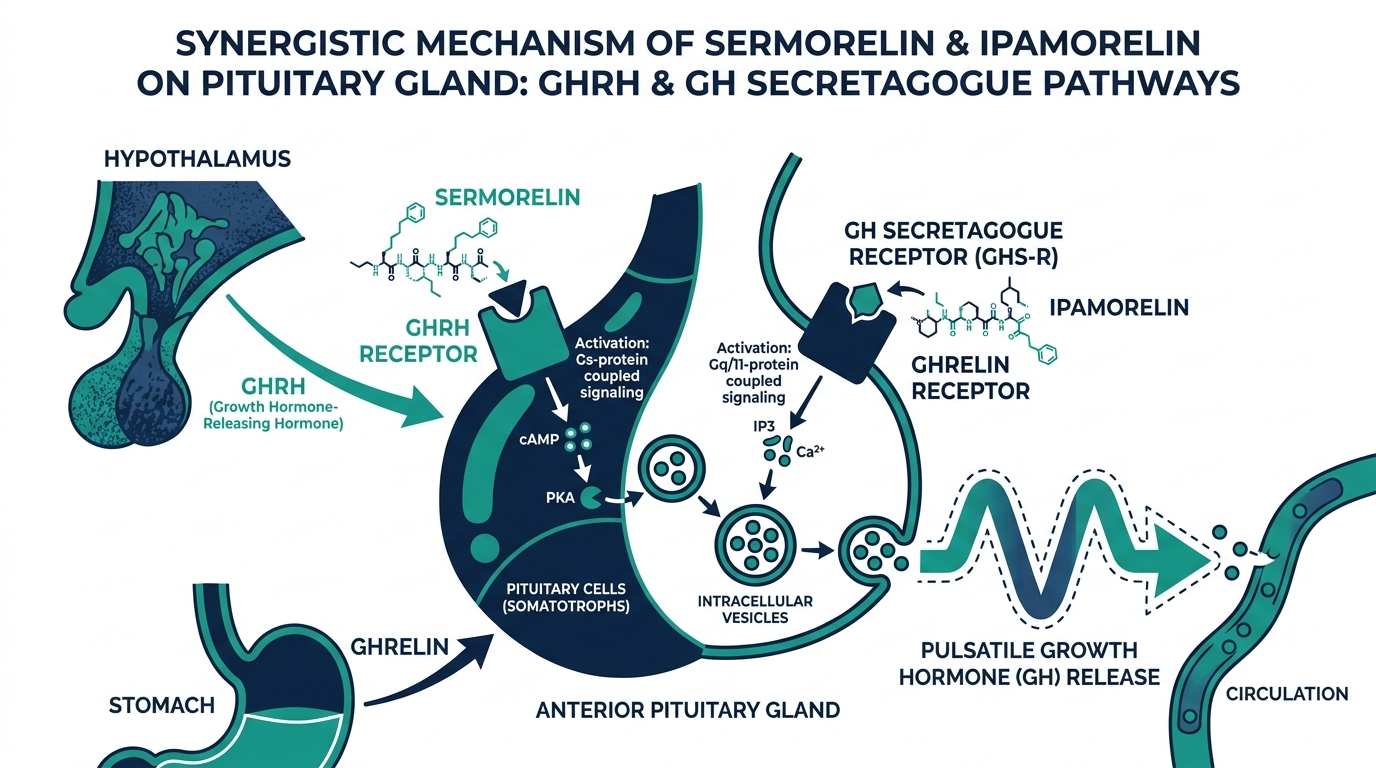
Short answer: The sermorelin/ipamorelin blend combines two peptides that signal the pituitary gland through separate biological pathways to release more of your own growth hormone. Sermorelin stimulates the GHRH receptor; ipamorelin activates the ghrelin receptor. Together they create a GH pulse stronger than either delivers alone, and ipamorelin’s landmark 1998 selectivity study published in the European Journal of Endocrinology confirmed it does this without raising cortisol or ACTH, a clean profile no other GH secretagogue had demonstrated up to that point.
Before stacking a growth hormone peptide blend, see your own hormone axis with a full biomarker panel. One at-home Superpower draw checks 100+ biomarkers, physician-reviewed.
What makes a man’s GH decline, and why does it matter past 35?
Growth hormone does not disappear at 40. It gets quieter. The pituitary still produces it, but the pulses shrink, the frequency drops, and the downstream hormone IGF-1 follows. Research in the PMC review “Beyond the androgen receptor” (PMC7108996) frames this as a compounding problem in men already managing lower testosterone: reduced GH amplifies the body-composition shift toward visceral fat and away from lean muscle, and the two axes reinforce each other in a way testosterone replacement alone does not fully address.
The symptoms men notice first are almost never the ones they attribute to GH. They are the slow creep of worse sleep, the recovery that takes a day longer than it used to, the belly fat that does not respond to the same deficit that worked at 32. GH is a background hormone; its decline looks a lot like “just getting older.”
Full-body lab membership: 100+ biomarkers, doctor-reviewed, tracked over time.
What is sermorelin, exactly?
Sermorelin is a synthetic 29-amino-acid peptide that corresponds to the first 29 amino acids of endogenous GHRH (growth hormone-releasing hormone). The full natural GHRH molecule is 44 amino acids, but the first 29 carry all the biological activity needed to bind the GHRH receptor on pituitary somatotrophs and trigger GH secretion. That shorter chain is also more stable for pharmaceutical production and compounding.
It was originally developed as Geref, an FDA-approved diagnostic and treatment drug for growth hormone deficiency in children. The manufacturer later discontinued it for commercial reasons, not safety concerns. Compounding pharmacies picked up the compound and it became the backbone of most clinical anti-aging GH protocols through the 2010s.
Sermorelin’s half-life in circulation is 10 to 12 minutes whether administered intravenously or subcutaneously, confirmed in clinical pharmacokinetic studies cited by sources like Eden Health. That short window sounds like a disadvantage, but it is actually the mechanism: sermorelin fires a discrete, physiological pulse of GH, then clears before the feedback loop can fully suppress the axis. GH levels typically peak 30 to 60 minutes after injection, and the downstream IGF-1 elevation builds over days of consistent nightly dosing.
The key point nobody explains in the marketing: sermorelin does not add exogenous GH. It asks your pituitary to make more of its own. The pituitary retains its normal feedback brakes, which is why sermorelin does not suppress endogenous GH production the way synthetic HGH does with prolonged use.
What is ipamorelin, and why is its selectivity a big deal?
Ipamorelin is a pentapeptide (five amino acids) that activates the GHS-R1a receptor, also known as the ghrelin receptor. It is classified as a growth hormone secretagogue (GHS), and in 1998, researchers Raun and colleagues published the paper that named it “the first selective growth hormone secretagogue” in the European Journal of Endocrinology (PubMed 9849822). The selectivity they documented was striking: ipamorelin released GH without elevating ACTH or cortisol even at doses more than 200-fold higher than its GH-effective dose (ED50). Earlier GHS compounds like GHRP-2 and GHRP-6 reliably spiked cortisol alongside GH, which matters for men training hard because cortisol is catabolic to muscle tissue.
The other compounds in the GHRP class also triggered prolactin and appetite spikes to varying degrees. Ipamorelin did neither, or did so at clinically insignificant levels. That profile made it the preferred GH secretagogue for protocols where hormonal tidiness is a priority.
What ipamorelin does not do alone is sustain a GH signal. Like sermorelin, it produces a pulse. Unlike CJC-1295 (discussed below), it does not have a multi-day half-life. It needs a partner.
Why blend the two instead of using one alone?
The sermorelin/ipamorelin blend pairs two complementary mechanisms. Sermorelin works through the GHRH receptor and directly stimulates the pituitary’s GH-producing cells. Ipamorelin works through the ghrelin receptor and does two things: it stimulates GH release through a separate intracellular pathway, and it suppresses somatostatin, the hormone that puts the brakes on GH secretion.
That second mechanism is the key insight clinicians cite. Somatostatin suppression means the pituitary’s own “off switch” is temporarily blunted at exactly the moment sermorelin is pulling the “on switch.” The result is a GH pulse that research consistently describes as synergistic, larger than what either peptide achieves when dosed separately at the same quantities. A 2020 review in JCSM Rapid Communications (DOI 10.1002/rco2.9) describes this as the theoretical basis for combination secretagogue protocols: “combined stimulation of GHRH and GHS pathways produces GH responses that are greater than the sum of individual responses.”
Personally, I think the somatostatin angle is underexplained in most clinic write-ups. The marketing focuses on “two pathways” as though it is simply additive. The somatostatin suppression piece is what makes it genuinely synergistic rather than just bigger. It is the mechanism that separates this blend from taking sermorelin twice.
How does the sermorelin/ipamorelin blend compare to CJC-1295/ipamorelin?
This is the comparison every man shopping this category runs into within five minutes, and it is worth slowing down on because clinics often push the CJC-1295 stack without explaining the tradeoff.
| Feature | Sermorelin + Ipamorelin | CJC-1295 (no DAC) + Ipamorelin | CJC-1295 (with DAC) + Ipamorelin |
|---|---|---|---|
| GHRH pathway half-life | ~10-12 min (sermorelin) | ~30 min (Mod GRF 1-29) | ~8 days (CJC-1295 with DAC) |
| GH pulse profile | Short, physiological | Moderate, slightly extended | Prolonged, blunted pulsatility |
| GH suppression risk | Low (feedback intact) | Low to moderate | Higher with DAC form |
| Regulatory status (US, 2026) | Sermorelin: Category 1 (compoundable); Ipamorelin: Category 2, pending Category 1 return | Same for both components | Same |
| Nightly dosing required | Yes, subcutaneous | Yes (no-DAC form) | 1-2x per week possible |
| Cost (telehealth, monthly) | $150 to $300 | $175 to $350 | $200 to $400 |
| Best for | First-timer, sensitive to side effects, sleep focus | Performance, lean mass, moderate experience | Advanced protocols with clinical oversight |
The short version: the sermorelin/ipamorelin blend has the most physiological pulse profile because both components clear quickly and let the pituitary return to baseline between doses. CJC-1295 with DAC (a drug affinity complex that extends half-life to roughly 8 days) produces a more sustained GH elevation, which is more convenient but also flattens the natural pulsatile rhythm GH is supposed to have. Most anti-aging-focused clinics now recommend against the DAC form for men who are not dealing with a diagnosed deficiency, preferring the mimicry of natural rhythms over the convenience of less frequent dosing.
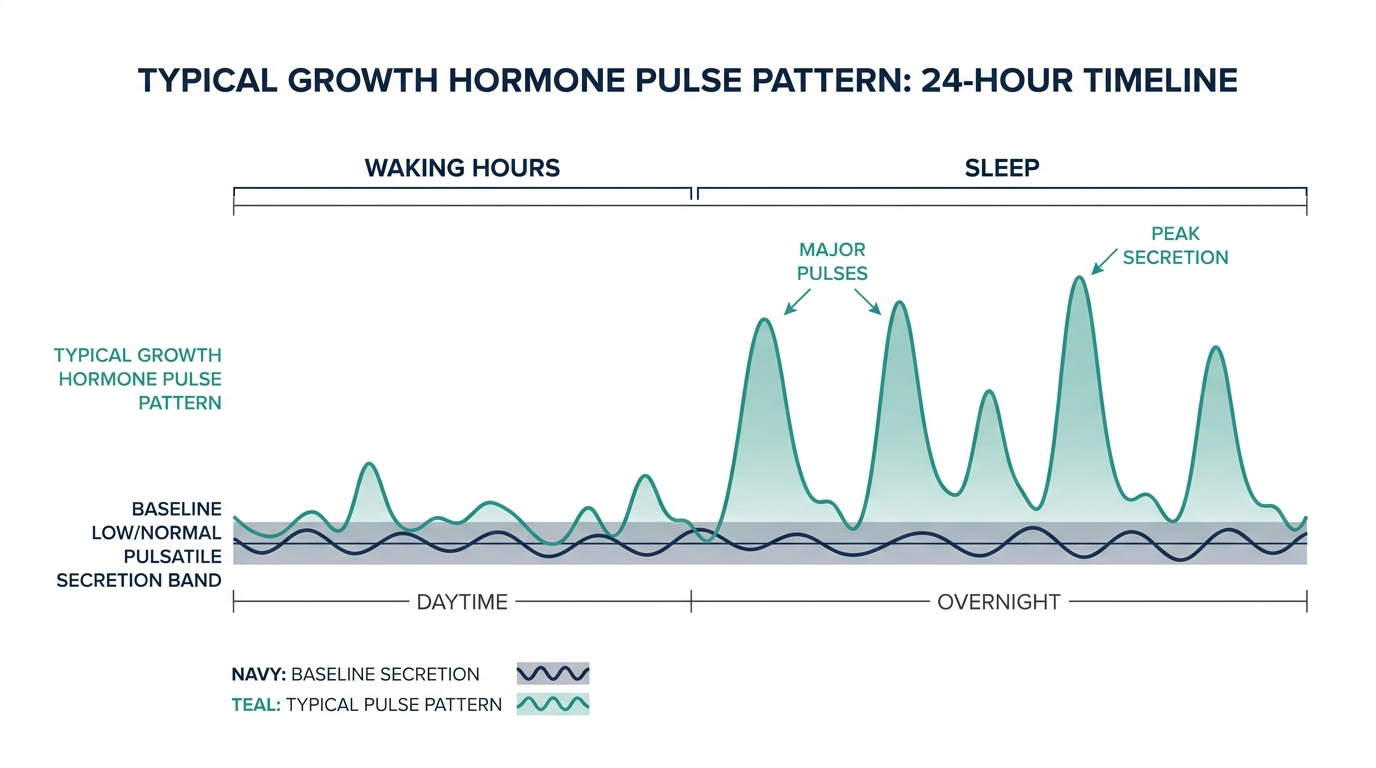
Do not believe any clinic that tells you “more GH elevation” is always better. Pulsatile release is how the body naturally secretes GH, peaking during slow-wave sleep. Sustained flat elevation disrupts that pattern, and natural pulsatility is specifically what makes GH safe and effective for body composition over the long term.
What do men actually notice, and when?
Clinical reports and telehealth patient timelines from providers like Gameday Men’s Health and Alpha Man Clinic are consistent on the sequence, even if the magnitude varies by age and baseline IGF-1.
Weeks 1 to 3: Sleep is the first signal. Most men notice they fall asleep faster and wake fewer times during the night. A 16-week randomized controlled trial in older adults (mean age 67) found nightly sermorelin at 500 mcg increased slow-wave sleep by 34% compared to baseline. Stage 3 sleep (deep sleep) increased by a mean of 28 minutes per night in adults aged 45 to 65, with wake-after-sleep-onset time falling by an average of 18 minutes compared to placebo. These numbers matter because GH secretion is largest during slow-wave sleep; better sleep and more GH become a reinforcing loop.
Weeks 4 to 8: Recovery from training improves. Muscle soreness clears faster, which allows more consistent training. Energy and mood stabilize. No dramatic body change is visible yet, which is why men who expect faster results often quit too early.
Months 3 to 6: Body composition shifts become measurable. The PMC review (PMC7108996) reported that sermorelin produced an increase in lean body mass of 1.26 kg over 16 weeks with no significant adverse events, in a population of older adults. Waist measurements began declining in the 6-month group. IGF-1 levels, tracked by labs, begin to reflect the protocol working.
Beyond 6 months: The improvements compound. Skin quality, collagen density, and joint comfort are commonly reported at this stage. Most providers set 6 to 12 months as the realistic timeline for peak results from a GH secretagogue protocol.
What are the real side effects?
Most men experience few or no side effects at standard clinical doses. The ones that do occur follow a predictable pattern.
The most common are injection-site reactions: mild redness, swelling, or itching at the subcutaneous injection point. These typically resolve within minutes and fade over the first few weeks as technique improves.
The next tier includes temporary headaches (especially in the first 1 to 2 weeks), mild water retention in the extremities, and occasional morning grogginess. These reflect the GH pulse itself: GH causes fluid shifts, and the pituitary is now firing more vigorously than it did before the protocol started. Most men find these side effects disappear by week 4 without any dose adjustment.
Joint discomfort, particularly in the wrists and knees, is the side effect that sometimes surprises people mid-protocol. It is the same mechanism as the GH-induced water retention: fluid accumulates in joint spaces. At clinical doses this is usually mild and resolves if the protocol is cycled (common clinical practice is 5 nights per week rather than 7, with a break every 3 to 6 months). At higher doses or with longer half-life compounds, this can progress to carpal tunnel symptoms. The sermorelin/ipamorelin blend has a milder profile here than CJC-1295 with DAC precisely because the compounds clear quickly.
The contraindications that matter: active or untreated cancer is an absolute stop, because elevated GH and IGF-1 signaling can promote cell proliferation. Uncontrolled diabetes is a second hard stop. Men with complex cardiovascular histories should have a cardiac workup before starting. Any doctor who skips this conversation in the intake is skipping the intake.
What is the regulatory status in June 2026?
This is worth addressing directly because it changed rapidly and the internet has not caught up.
Sermorelin has been on the FDA’s Category 1 list (substances permitted for compounding under 503A) continuously. It is a prescription-only compound but accessible through licensed telehealth providers and compounding pharmacies. Empower Pharmacy, one of the largest 503A compounders in the US, lists sermorelin acetate injection as an active product (Empower Pharmacy). Monthly telehealth pricing for sermorelin runs $150 to $300 depending on provider and dosing, with intake labs adding a one-time cost of $100 to $200.
Ipamorelin is in regulatory transition. In 2023, the FDA placed it on Category 2 (substances that may present significant safety risks), which banned it from compounding. In February 2026, HHS Secretary Robert F. Kennedy Jr. announced plans to move approximately 14 of the 19 Category 2 peptides back to Category 1, with ipamorelin on that list. As of June 2026, a formal FDA rule has not yet been issued, but the policy direction is clear and clinics familiar with the process are preparing. Sources including Medical Specialists MN note that the announcement has not yet become a completed regulatory action.
Practically: if a clinic is currently offering the sermorelin/ipamorelin blend as a compounded injectable, ask which specific pharmacy fills it and under what authority. A compliant clinic can name the 503A pharmacy. One that cannot, or that deflects this question, is either behind on the regulatory shift or outside it entirely.
Who is actually a good candidate for this protocol?
Clinicians who prescribe GH secretagogue protocols most frequently describe the ideal candidate in fairly consistent terms. You are likely a reasonable candidate if you are a man aged 35 to 65 with subjective symptoms of GH decline (poor sleep, slow recovery, creeping visceral fat), a measured IGF-1 in the low-normal or below-normal range for your age, no history of cancer, and no uncontrolled metabolic disease.
You are a less suitable candidate if you are under 30 (your natural GH rhythm is likely still strong), if you have a pituitary tumor or pituitary surgery history (the mechanism requires a functional pituitary), or if your primary goal is rapid muscle gain. GH secretagogues are not a fast path to mass. The men who benefit most are those who would describe their goal as “feeling and performing the way I did five years ago,” not those chasing 10 pounds of new muscle in a quarter.
The men who benefit least are the ones who buy a research vial from an unverified vendor, skip the labs, and dose based on a forum post. The blend is synergistic, meaning small calibration errors in reconstitution compound. A factor-of-10 error in concentration math produces side effects that look alarming and tell you nothing about whether the protocol would have worked correctly.
Telehealth GLP-1 program with provider visits and pharmacy coordination.
Don’t just read about your health, track it.
A single result is a snapshot. Superpower re-tests 100+ markers over time so you can watch them move as you change sleep, food, and training.
Frequently asked questions
Is the sermorelin ipamorelin blend better than CJC-1295 ipamorelin?
It depends on the goal and the patient. The sermorelin/ipamorelin blend has a shorter GHRH half-life (10 to 12 minutes for sermorelin versus 30 minutes for the CJC-1295 no-DAC form or 8 days for the DAC form), which produces a more physiological GH pulse and a gentler side-effect profile. CJC-1295 with DAC produces larger and more sustained GH elevations, which suits some performance-focused protocols but disrupts natural pulsatility. For a first-time user or someone prioritizing sleep and recovery over maximum GH output, sermorelin/ipamorelin is the standard starting recommendation at most evidence-driven clinics.
How long does it take for the sermorelin ipamorelin blend to work?
Sleep improvements typically appear within 1 to 3 weeks. Recovery and energy changes follow at 4 to 8 weeks. Measurable body composition changes (lean mass gain, waist reduction) are consistently reported at 3 to 6 months. Most providers use a 6-month minimum commitment as the reference frame for assessing whether the protocol is working, tracked by follow-up IGF-1 labs.
Do I need to inject sermorelin and ipamorelin separately?
No. The “blend” sold by compounding pharmacies is a single vial containing both peptides in solution, administered as one subcutaneous injection, typically nightly before bed. The standard clinical protocol is 5 nights per week (Monday through Friday), a dosing schedule that preserves pulsatility and reduces the likelihood of water-retention side effects.
Will sermorelin ipamorelin shut down my natural GH production?
This is the most important myth to address. GH secretagogues work by stimulating the pituitary through its own receptors, not by replacing exogenous GH. The pituitary retains its feedback regulation throughout. When sermorelin and ipamorelin clear (within minutes), the axis returns to its baseline state. This is categorically different from synthetic HGH injections, which do suppress endogenous GH production with prolonged use by continuously feeding back on the hypothalamus.
What dose is the sermorelin ipamorelin blend typically prescribed at?
The most commonly reported clinical protocol is 300 mcg of the blend (often 150 mcg sermorelin + 150 mcg ipamorelin) administered as 0.2 mL subcutaneously before bed, five nights per week. Some providers titrate to 500 mcg total depending on body weight, age, and IGF-1 response at follow-up. These are ranges from clinical documentation; a prescribing physician sets the actual dose based on individual labs.
Can I use the sermorelin ipamorelin blend if I am on TRT?
Yes, and many men do. GH secretagogue protocols are commonly run alongside TRT at clinics like Defy Medical and Marek Health because testosterone and GH act on partially separate axes, and the two protocols address different components of the body-composition picture. The PMC review on GH secretagogues in hypogonadal males (PMC7108996) specifically examines this combination and finds the rationale sound, while acknowledging that large-scale clinical trials are still limited.
Is ipamorelin legal in 2026?
As of June 2026, ipamorelin remains on the FDA’s Category 2 list, meaning it cannot be legally compounded. However, HHS Secretary RFK Jr. announced in February 2026 that ipamorelin is among approximately 14 peptides expected to return to Category 1 (permitted for compounding). A formal FDA rule had not yet been issued as of the date of publication. Sermorelin is fully legal and compoundable now.
What I would actually do
If a man in his mid-40s asked me where to start with GH optimization, I would tell him to get an IGF-1 test before any protocol conversation, find out his sleep architecture with a sleep tracker, and then spend 30 minutes with a physician at a telehealth clinic like Defy Medical or Marek Health before buying anything.
The sermorelin/ipamorelin blend is genuinely interesting. The mechanism is clean, the 26-year safety record in compounded clinical use is real, and the sleep improvement data alone is worth the attention. But the men who benefit most are the ones who enter with objective numbers, set a 6-month benchmark, get follow-up labs, and adjust accordingly. The men who waste money and come away skeptical are the ones who sourced a grey vial, dosed by forum post, and called it a trial.
The blend is a signal-nudge to a system that still functions, not a replacement for a system that has failed. That distinction is what separates appropriate use from misuse, and it is the conversation a real clinician will have with you before writing the prescription.
Telehealth GLP-1 program with provider visits and pharmacy coordination.
Author: Vital Signs Today Editorial Team, [credential]”]. Educational content, not medical advice. Sources linked inline.
Primary sources:
– Raun K et al. “Ipamorelin, the first selective growth hormone secretagogue.” European Journal of Endocrinology 139(5):552-561, 1998. PubMed 9849822
– Giannoulis MG et al. “Beyond the androgen receptor: the role of growth hormone secretagogues in the modern management of body composition in hypogonadal males.” PMC7108996. PMC
– Ishida J et al. “Growth hormone secretagogues: history, mechanism of action, and clinical development.” JCSM Rapid Communications 2020. Wiley
– FDA bulk drug substances under 503A (Category 1 and Category 2 lists). FDA
– Empower Pharmacy, sermorelin acetate injection product listing. Empower
– Medical Specialists MN, RFK Jr. peptide legality announcement (March 2026). medicalspecialistsmn.com
– Sermorelin sleep clinical data: TrimRX sermorelin sleep evidence review. TrimRX
– Eden Health, sermorelin half-life. tryeden.com
– Gameday Men’s Health, sermorelin results timeline. gamedaymenshealth.com
– IvyRx, sermorelin cost 2026. ivyrx.com
Related reading
Vital Signs Today may earn a commission if you buy through links on this page. It does not affect our editorial assessments.