
Last updated December 2026. Educational content only, not medical advice. CJC-1295 is not FDA-approved. Talk to a licensed clinician before starting any peptide protocol.
Short answer: CJC-1295 is a synthetic analog of growth hormone-releasing hormone (GHRH) that tells your pituitary gland to release more of your own growth hormone. A single injection raises mean plasma GH 2- to 10-fold for 6 or more days, and IGF-1 stays elevated for up to 9-11 days, according to the landmark Phase I/II trials published in The Journal of Clinical Endocrinology and Metabolism. It does not inject synthetic growth hormone; it signals the body to make more of its own.
A single CJC-1295 injection can raise growth hormone for days, so what’s your GH and IGF-1 doing right now? One at-home Superpower draw checks 100+ biomarkers, physician-reviewed.
Why are people searching for CJC-1295 in the first place?
Growth hormone declines at roughly 14% per decade after age 30, a process endocrinologists call somatopause. By age 60, most adults produce only 20-25% of their peak GH output. The downstream effects are measurable and unpleasant: reduced lean mass, creeping visceral fat, slower recovery from training, thinner skin, and disrupted deep sleep. The numbers are not subtle.
Less than 5% of healthy men aged 20-40 have plasma IGF-1 values below 350 U/L. That figure climbs to 30% of men over 60, according to NIH Endotext data on GH and aging. The drop is real and measurable, which is exactly why GH secretagogues like CJC-1295 attract so much attention.
The appeal is straightforward: instead of injecting synthetic HGH at $600-$1,200 a month and suppressing your own production, CJC-1295 stimulates your pituitary to release GH in pulses that more closely mirror how a younger body behaves. The mechanism is more physiological. The cost, at least for the clinical route, is more manageable.
Full-body lab membership: 100+ biomarkers, doctor-reviewed, tracked over time.
What exactly is CJC-1295, and where did it come from?
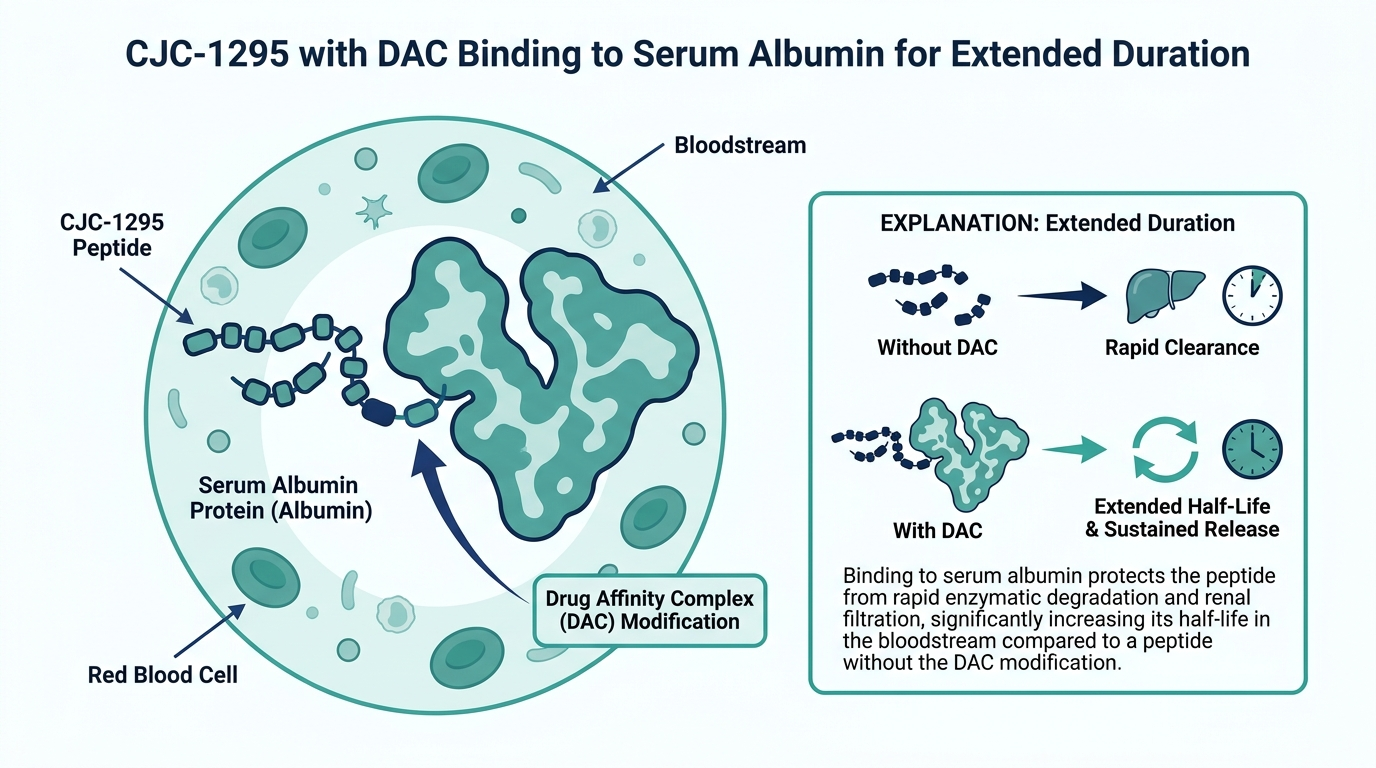
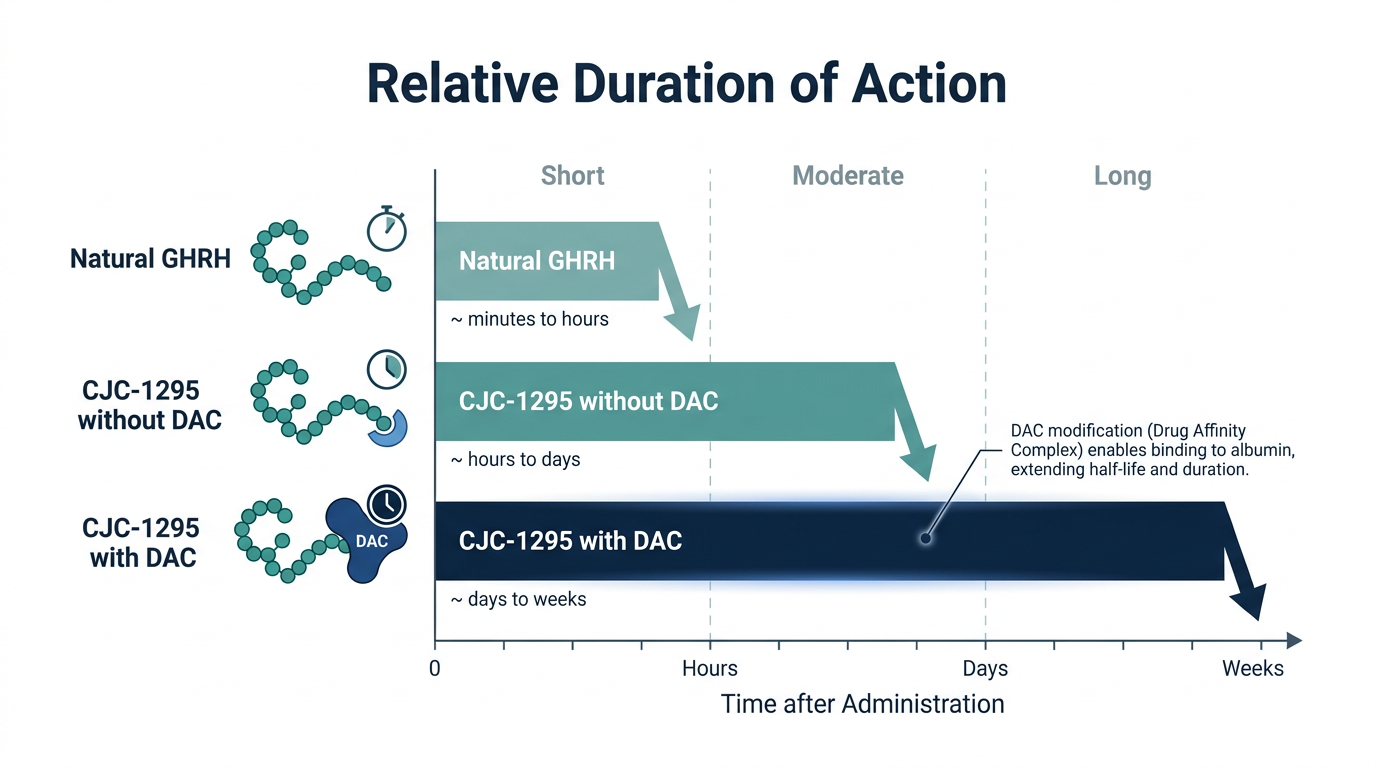
CJC-1295 is a synthetic peptide based on the first 29 amino acids of human growth hormone-releasing hormone (GHRH), the signaling molecule the hypothalamus uses to tell the pituitary to pulse GH. Natural GHRH has a half-life of roughly 7 minutes in the bloodstream; enzymes called dipeptidyl peptidase-4 (DPP-IV) and other endopeptidases tear it apart almost immediately.
ConjuChem Biotechnologies, a Canadian drug company, developed CJC-1295 in the mid-2000s specifically to solve that short-life problem. The compound was first described in a 2005 paper by Jetté et al. in Endocrinology, confirming the albumin-binding mechanism in rats and primates. Phase I human trials followed in 2006, published in JCEM.
The key engineering trick: ConjuChem added a Drug Affinity Complex (DAC) moiety that covalently binds circulating albumin in the blood. Albumin is a large, long-lived plasma protein that essentially turns CJC-1295 into a slow-release depot, extending its half-life to 5.8-8.1 days in the Phase I trials.
Then things get confusing, and most buyers never sort this out properly.
What is the difference between CJC-1295 with DAC and CJC-1295 without DAC?
This is the single most important distinction in the entire compound, and the two versions have completely different use cases.
CJC-1295 with DAC is the original ConjuChem compound. The DAC group binds albumin covalently. Half-life is 5.8-8.1 days. You get a sustained, blunted GH elevation that resembles a plateau more than a pulse. Dosing is weekly. This form was used in the clinical trials and is what endocrinologists mean when they say “CJC-1295.”
CJC-1295 without DAC is sometimes sold under the name “Modified GRF(1-29)” or “Mod GRF 1-29.” It has no albumin binding. Half-life is 30 minutes to 2 hours, similar to natural GHRH. It produces a discrete, sharp GH pulse. This is the form stacked with ipamorelin in the clinical world because the two half-lives match: both clear quickly, and both act on the pituitary simultaneously for a synergistic pulse.
The no-DAC + ipamorelin stack is considered the gold standard among GH secretagogue clinicians precisely because the timing alignment is everything. Using the DAC form with ipamorelin is poor protocol design.
| Feature | CJC-1295 with DAC | CJC-1295 without DAC (Mod GRF 1-29) |
|---|---|---|
| Half-life | 5.8-8.1 days | 30 min – 2 hours |
| GH release pattern | Sustained plateau | Sharp physiological pulse |
| Typical dosing frequency | Once weekly | 3-5x weekly, fasted |
| Pairs well with ipamorelin? | Poor match (misaligned half-lives) | Excellent match (synergistic timing) |
| Phase in human trials | Completed (Phase I and II) | Extrapolated from no-DAC pharmacokinetics |
| Clinical nickname | CJC-1295 DAC | Mod GRF 1-29 or “no-DAC” |
How does CJC-1295 actually work in the body?
CJC-1295 binds to GHRH receptors on somatotroph cells in the anterior pituitary. Those receptors, when activated, trigger a cAMP signaling cascade that pushes somatotroph cells to synthesize and then pulse-release growth hormone into circulation. The body responds in two phases.
The first phase is direct GH release, measurable within hours. The 2006 ConjuChem Phase I trial found dose-dependent GH increases of 2- to 10-fold above baseline, with the effect lasting at least 6 days from a single injection. These numbers come from a randomized, blinded study in healthy adults aged 21-61, not self-reported forum data.
The second phase is IGF-1 elevation. The liver converts rising GH into insulin-like growth factor-1 (IGF-1), the downstream anabolic signal responsible for most of what GH actually does at the cellular level: protein synthesis, satellite cell activation, fat mobilization, bone density. The same trial found mean plasma IGF-1 elevated 1.5- to 3-fold for 9-11 days after a single dose. With repeated weekly dosing, mean IGF-1 remained above baseline for up to 28 days.
Personally, I think the pulsatile argument is the strongest scientific case for the no-DAC form over the DAC form outside of clinical trials. Endogenous GH is released in 8-12 pulses per day, with the largest pulse during slow-wave sleep. A sustained plateau blunts that rhythm. Preserving pulsatility is not a marketing phrase; it is a physiological argument grounded in how somatotroph cells avoid desensitization.
What are the reported benefits of CJC-1295?
The honest answer is that the evidence base is thinner than the forum enthusiasm suggests, and the honest separation of what is proven from what is plausible matters here.
What the clinical data actually shows:
– GH elevation of 2-10x baseline, sustained for 6+ days per injection (Phase I/II human trials, ConjuChem 2006)
– IGF-1 elevation of 1.5-3x baseline for 9-11 days
– No serious adverse reactions in Phase I trials at doses of 30 or 60 mcg/kg
– Cumulative IGF-1 elevation with repeated dosing, remaining above baseline for up to 28 days
What is extrapolated from known GH/IGF-1 biology, not directly proven for CJC-1295 itself:
– Improved body composition (lean mass increase, visceral fat reduction)
– Better slow-wave (Stage 3) sleep architecture
– Faster tissue and muscle recovery
– Improved skin thickness and collagen turnover
Do not believe anyone who quotes specific muscle gain or fat loss percentages attributable to CJC-1295 alone. No completed Phase III efficacy study exists for body composition outcomes, and the 2006 Phase II trial for HIV lipodystrophy was halted after a participant death from what the attending physician assessed as pre-existing coronary artery disease and plaque rupture, not the peptide itself, but clinical development ended there regardless. The clinical program never resumed.
That is the gap most websites skip over: the pharmacokinetic data is real and well-documented. The efficacy data for the outcomes people actually want (muscle, fat, recovery, sleep) is theoretical for this specific compound, even if the GH/IGF-1 mechanism is well-supported in other contexts.
How does CJC-1295 compare to sermorelin and ipamorelin?
These three names appear together constantly in the GH secretagogue space, and they are not interchangeable.
| Peptide | Class | Half-life | GH pattern | Regulatory status (US, mid-2026) |
|---|---|---|---|---|
| Sermorelin | GHRH analog (GRF 1-29, unmodified) | ~10-12 minutes | Brief physiological pulse | Category 1, fully accessible via compounding pharmacy with Rx |
| CJC-1295 (no DAC) | GHRH analog (modified GRF 1-29) | 30 min – 2 hr | Physiological pulse, longer sustained | Regulatory gap (removed from Category 2, not yet on Category 1) |
| CJC-1295 (with DAC) | GHRH analog with albumin-binding | 5.8-8.1 days | Sustained plateau | Regulatory gap, same as above |
| Ipamorelin | Ghrelin mimetic (GHRP) | ~2 hours | Sharp pulse, no cortisol or prolactin spikes | Same regulatory gap as CJC-1295 |
The critical practical difference in 2026: sermorelin is on the FDA 503A Category 1 list, meaning a licensed compounding pharmacy can legally prepare it for a patient with a prescription. CJC-1295 sits in a genuine regulatory gap (see below). Clinicians who want a compliant GHRH approach tend to default to sermorelin for this reason.
The reason clinicians often prefer the no-DAC + ipamorelin stack when they can get it is the synergistic mechanism. CJC-1295 activates the GHRH receptor; ipamorelin simultaneously activates the ghrelin receptor on the same somatotroph cells. Two different signaling pathways converging on the same target creates a synergistic GH pulse reportedly 5-10x larger than either peptide alone. Sermorelin cannot produce that same dual-axis effect.
What is the legal status of CJC-1295 in 2026?
This is where the article most websites give you is simply wrong, because the regulatory ground moved in early 2026 and most content has not caught up.
Here is the accurate picture as of June 2026:
Before April 2026: CJC-1295 and ipamorelin were on the FDA’s 503A Category 2 bulk drug substances list, meaning 503A compounding pharmacies were prohibited from using them. PCAC (the Pharmacy Compounding Advisory Committee) had voted against them in late 2024.
February 27, 2026: HHS Secretary Robert F. Kennedy Jr. announced that approximately 14 of the 19 peptides on Category 2 would be returned to Category 1, with CJC-1295 and ipamorelin named in that group.
April 15-16, 2026: The FDA removed CJC-1295 (and ipamorelin) from the Category 2 prohibited list and published a Federal Register notice scheduling a PCAC meeting for July 23-24, 2026, at which several peptides will be formally reviewed for Category 1 placement.
As of June 2026: CJC-1295 occupies a genuine regulatory gap. It is not prohibited (removed from Category 2). It is not permitted (not on Category 1). Some 503A compounding pharmacies have begun preparing it under the interpretation that removal from Category 2 clears the prohibition. Others are waiting for the July PCAC decision. Neither CJC-1295 nor ipamorelin is FDA-approved, and reclassification does not change that; it governs only compounding pharmacy access.
The bottom line for anyone considering this: if a telehealth clinic is prescribing CJC-1295 + ipamorelin right now, they are operating in ambiguous regulatory territory that a compliant clinic will be transparent about. If they are not transparent about it, that is the red flag.
For most patients who want GHRH-axis support with a clean regulatory state, sermorelin is the unambiguously legal alternative through the same clinical pathway.
Telehealth GLP-1 program with provider visits and pharmacy coordination.
What are the side effects and risks of CJC-1295?
The Phase I data described the compound as “safe and relatively well tolerated” at 30-60 mcg/kg doses, with no serious adverse reactions reported. But that covers a narrow range of doses in a controlled clinical setting. The broader side effect picture from clinical and anecdotal sources includes:
Common and mostly transient:
– Water retention, most prominent in weeks 1-4, which some users confuse for fat gain
– Facial flushing and warmth, often within 30-60 minutes of injection
– Tingling in hands and feet (paresthesia), from GH’s effect on fluid shifts
– Mild headache
– Injection site irritation or redness
Less common, dose-dependent:
– Impaired glucose tolerance: elevated GH and IGF-1 counter insulin action, which matters if you have metabolic syndrome or family history of diabetes
– Elevated cortisol: this is less of a concern with ipamorelin (which is selective for GH release) than with older GHRPs like GHRP-6, but any significant GH elevation has downstream metabolic effects
– Accelerated cellular proliferation: elevated IGF-1 is a known mitogen. Anyone with a personal or family history of cancer should have a thorough clinical conversation before using any GH-axis compound
The immunogenicity issue almost nobody mentions: CJC-1295 can trigger antibody formation against the peptide. The 2009 follow-up study (PMC2787983) noted antibody development in some participants. Clinically, this may blunt long-term response or, in rare cases, cause immune reactions. This is one reason clinicians cycle the compound rather than run it continuously.
The cycle most commonly recommended in clinical settings is 3 months on, 1 month off, specifically to reduce receptor desensitization and the immunogenicity risk. Running it indefinitely without a break is a protocol drift that tends to happen when there is no clinician involved.
Who should actually consider CJC-1295?
Clinics that prescribe GH secretagogues typically use the following profile as their target patient:
- Age 35-65, with documented lab-confirmed low-normal or low IGF-1 levels
- Specific complaints linked to GH decline: progressive loss of lean mass despite training, prolonged recovery, disrupted deep sleep, or body composition changes despite diet
- No active cancer or personal history of cancer (any GH-axis therapy is generally contraindicated)
- No untreated hypothyroidism (thyroid function must be optimized first; GH secretagogues do not work well in a hypothyroid state)
- No uncontrolled diabetes (glucose tolerance is an active concern)
Do not believe the marketing premise that CJC-1295 is a performance enhancer for already-healthy 28-year-olds. The clinical rationale is about restoring declining GH pulsatility toward a younger physiological baseline, not about pushing GH above normal ranges in someone whose axis is already functioning. WADA prohibits it in competitive sport under Section S2 for this reason.
How does a clinic actually prescribe and monitor this?
A legitimate GH secretagogue protocol from a real clinical operation looks different from a vendor checkout page in several important ways.
First, intake requires at minimum IGF-1, fasting insulin, glucose, and comprehensive metabolic panel. A good clinic adds cortisol, thyroid panel, and a full hormone panel. You do not start without knowing where your IGF-1 is, because that is the primary marker you are trying to move and the one you are watching for over-range.
Second, the prescription comes from a named 503A or 503B compounding pharmacy, not a vial with a “research use only” label. The pharmacy name and NABP accreditation number should be visible on the packaging.
Third, follow-up labs at 6-8 weeks check IGF-1 response and fasting glucose. If IGF-1 goes above age-appropriate upper range, the dose comes down. This is the clinical conversation that simply does not happen with grey-market sources.
Telehealth programs at clinics like Defy Medical and Marek Health typically run $200-$500 a month for GH secretagogue protocols, including the compounded peptide, consultation, and follow-up labs. A 3-month cycle at Perfect B in Doral, FL, for example, starts at around $445 for a CJC-1295 / ipamorelin cycle.
Curious what your own levels look like?
Baseline 100+ biomarkers today and retest as life changes, all in one membership with physician review.
Frequently asked questions
Is CJC-1295 the same as HGH?
No. Synthetic HGH (somatropin) directly replaces growth hormone in the bloodstream. CJC-1295 tells your pituitary to release more of its own GH. The clinical significance is that CJC-1295 preserves pulsatility and feedback regulation; exogenous HGH overrides them. This distinction matters for long-term safety: synthetic HGH at supraphysiological doses is associated with acromegaly, carpal tunnel, and insulin resistance when misused.
What is the difference between CJC-1295 with DAC and without DAC?
The DAC (Drug Affinity Complex) moiety causes the peptide to bind circulating albumin, extending its half-life to 5.8-8.1 days and producing sustained GH elevation. Without DAC (also called Mod GRF 1-29), the half-life is 30 minutes to 2 hours and the compound produces a discrete GH pulse, which is the form paired with ipamorelin. Mixing up the two forms is one of the most common errors in grey-market self-dosing.
Is CJC-1295 legal in the US in 2026?
It sits in a genuine regulatory gap. The FDA removed it from the Category 2 prohibited list on April 15, 2026, but has not formally placed it on the Category 1 permitted list. The Pharmacy Compounding Advisory Committee meeting scheduled for July 23-24, 2026 is expected to address this. It is not FDA-approved as a finished drug. Sermorelin, which works through the same receptor, is on Category 1 and fully accessible via licensed compounding with a prescription.
What does CJC-1295 actually do for muscle and fat?
Directly, it raises GH 2-10x and IGF-1 1.5-3x, based on human trial data. GH and IGF-1 support protein synthesis, fat mobilization, and lean mass maintenance through well-established biological pathways. However, no completed clinical trial has measured body composition outcomes for CJC-1295 specifically. Users and clinics extrapolate from GH/IGF-1 biology. The distinction between “GH elevation is proven” and “muscle gain from this specific compound is proven” matters if you are evaluating the evidence honestly.
How long does it take to feel CJC-1295 working?
Sleep quality improvements, particularly deeper Stage 3 sleep, are often the first thing people notice, typically within 2-4 weeks. Measurable body composition changes such as modest lean mass increases or fat reduction tend to appear at 6-12 weeks, because IGF-1 needs consistent pulsatility over time to reach therapeutic concentrations that drive tissue remodeling. Anyone promising dramatic results at 30 days is selling you the anecdote, not the biology.
Can CJC-1295 be taken orally?
No. Like all peptides, it is degraded by stomach acid and digestive enzymes before reaching circulation. It is administered by subcutaneous injection. Anyone selling an “oral CJC-1295” capsule or powder is selling you something that is not CJC-1295 in any clinically meaningful form.
What is the difference between CJC-1295 and sermorelin?
Both are GHRH analogs that activate the same pituitary receptor. Sermorelin is based on the unmodified first 29 amino acids of natural GHRH and has a 10-12 minute half-life. CJC-1295 (no DAC) has structural modifications that extend that to 30 minutes to 2 hours. In 2026, sermorelin has a clean regulatory state (Category 1, compoundable with Rx); CJC-1295 is in regulatory limbo. For most clinical purposes, sermorelin is the unambiguously legal alternative.
Telehealth GLP-1 program with provider visits and pharmacy coordination.
Author: [CAN XAC NHAN: ten + credential]. Educational content, not medical advice. Clinically important decisions about GH-axis therapy should involve a licensed physician with hormone expertise. Sources linked inline.
Primary sources
- Teichman SL et al. (2006). “Prolonged stimulation of growth hormone (GH) and insulin-like growth factor I secretion by CJC-1295, a long-acting analog of GH-releasing hormone, in healthy adults.” J Clin Endocrinol Metab. https://pubmed.ncbi.nlm.nih.gov/16352683/
- Jetté L et al. (2005). “Human growth hormone-releasing factor (hGRF)1-29-albumin bioconjugates activate the GRF receptor on the anterior pituitary in rats: identification of CJC-1295 as a long-lasting GRF analog.” Endocrinology. https://pubmed.ncbi.nlm.nih.gov/15817669/
- Ionescu M, Frohman LA (2006). “Pulsatile secretion of growth hormone (GH) persists during continuous stimulation by CJC-1295.” J Clin Endocrinol Metab. https://pmc.ncbi.nlm.nih.gov/articles/PMC2787983/
- NIH Endotext: Growth Hormone and Aging. https://www.ncbi.nlm.nih.gov/books/NBK279163/
- PMC article: Growth hormone in the aging male. https://pmc.ncbi.nlm.nih.gov/articles/PMC3940699/
- FDA Federal Register notice, PCAC meeting July 23-24, 2026. https://www.fda.gov/media/94155/download
- ClinicalTrials.gov: NCT00267527 (CJC-1295 Phase II, HIV lipodystrophy). https://clinicaltrials.gov/study/NCT00267527
- Pharmacy Times (2026). “The Peptide Reclassification Everyone’s Talking About.” https://www.pharmacytimes.com/view/the-peptide-reclassification-everyone-s-talking-about-a-pharmacist-s-take-on-what-rfk-jr-s-announcement-actually-means
- PepScribe (2026). “Is CJC-1295 Legal? FDA Status, Regulatory Risks & 2026 Update.” https://pepscribe.com/learn/cjc-1295/legal-status
- InnerBody Research (2026). “CJC-1295 + Ipamorelin.” https://www.innerbody.com/cjc-1295-and-ipamorelin
- Perfect B: CJC-1295 Ipamorelin Cost. https://www.perfectb.com/cjc-1295-ipamorelin-cost/
Related reading
Vital Signs Today may earn a commission if you buy through links on this page. It does not affect our editorial assessments.