
Educational content, not medical advice. Talk to a licensed clinician about your results.
Short answer: Brain natriuretic peptide (BNP) is a 32-amino-acid hormone secreted by the heart’s ventricles when they are under mechanical stress from overfilling or damage. A BNP below 100 pg/mL is normal in most adults; above 400 pg/mL strongly suggests heart failure is present. The name “brain” is a historical accident from the 1988 pig-brain discovery; in humans, nearly all clinically relevant BNP comes from the heart.
A BNP above 400 pg/mL points to heart failure, so do you actually know where your own number sits? One at-home Superpower draw checks 100+ biomarkers, physician-reviewed.
Wait, why does the heart make a “brain” peptide?
The name is one of the most persistent confusions in cardiology, and the answer is worth knowing because it changes how you think about the test.
In 1988, Japanese researcher Toshio Sudoh and colleagues extracted a novel natriuretic peptide from porcine brain tissue and published the finding in Nature. They named it brain natriuretic peptide. The problem: pigs are unusual. In humans, BNP gene expression is concentrated almost entirely in ventricular cardiomyocytes, not neural tissue. By the early 1990s, research had established that the human heart, specifically the left and right ventricles, is the dominant source of BNP in circulation.
Clinical guidelines now prefer the term “B-type natriuretic peptide” to sidestep the confusion. Both abbreviations land you in the same blood test, but understanding the nomenclature stops a lot of unnecessary alarm when patients read their lab report and wonder why their cardiologist is testing something called a brain chemical.
The takeaway: BNP is named for where it was found first, not for where it matters most.
Full-body lab membership: 100+ biomarkers, doctor-reviewed, tracked over time.
How does the heart actually produce BNP?
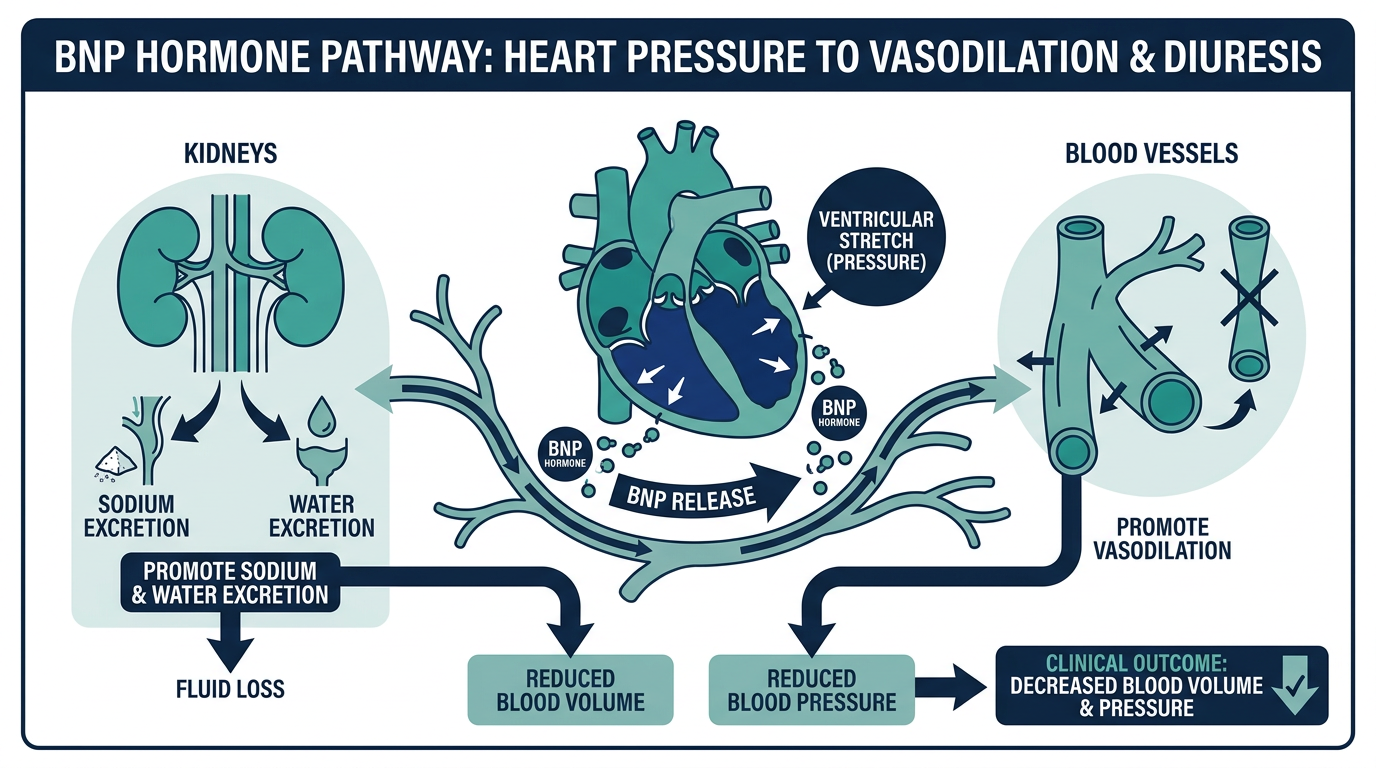
The trigger is mechanical stretch. When ventricular filling pressure rises, cardiomyocytes detect the change in wall tension and rapidly upregulate transcription of the BNP gene on chromosome 1. The process runs in stages:
- Cardiomyocytes synthesize a precursor called pre-proBNP (134 amino acids), which is cleaved to proBNP (108 amino acids) during cell processing.
- The protease furin splits proBNP into two fragments: the active hormone BNP (32 amino acids) and the inactive fragment NT-proBNP (76 amino acids). Both enter the bloodstream at an approximately 1:1 molar ratio.
- BNP binds natriuretic peptide receptor A (NPR-A) in target tissues, triggering a cGMP second-messenger cascade that drives vasodilation, natriuresis (sodium excretion by the kidney), diuresis, and suppression of renin, angiotensin, and aldosterone.
In practical terms, BNP is the body’s own pressure-relief valve. It lowers blood volume, dilates blood vessels, and pushes back against the renin-angiotensin-aldosterone system (RAAS) that would otherwise constrict vessels and retain fluid. When the heart is healthy, BNP levels stay low because the valve rarely needs to open wide. When pressure inside the ventricles climbs, the valve opens and BNP floods the circulation as a detectable signal.
Because NT-proBNP is biologically inert and BNP is the active molecule, a useful shorthand is: BNP does the work, NT-proBNP keeps the receipt.
What does a BNP test actually measure?
A standard BNP test is a routine venous blood draw measuring the concentration of BNP in plasma, reported in picograms per milliliter (pg/mL). Emergency departments can run it in roughly 15 minutes; an outpatient send-out lab typically returns results in one to two days.
The test is highly sensitive for elevated ventricular filling pressure, which is why it became a staple of emergency chest-pain and dyspnea workups. If someone walks into an ER short of breath and BNP is normal, cardiac-origin dyspnea is unlikely. If BNP is high, the workup pivots hard toward the heart.
Here is the standard clinical reference framework, following guidelines from the American Heart Association and confirmed by Cleveland Clinic’s published reference ranges:
| BNP level (pg/mL) | Interpretation |
|---|---|
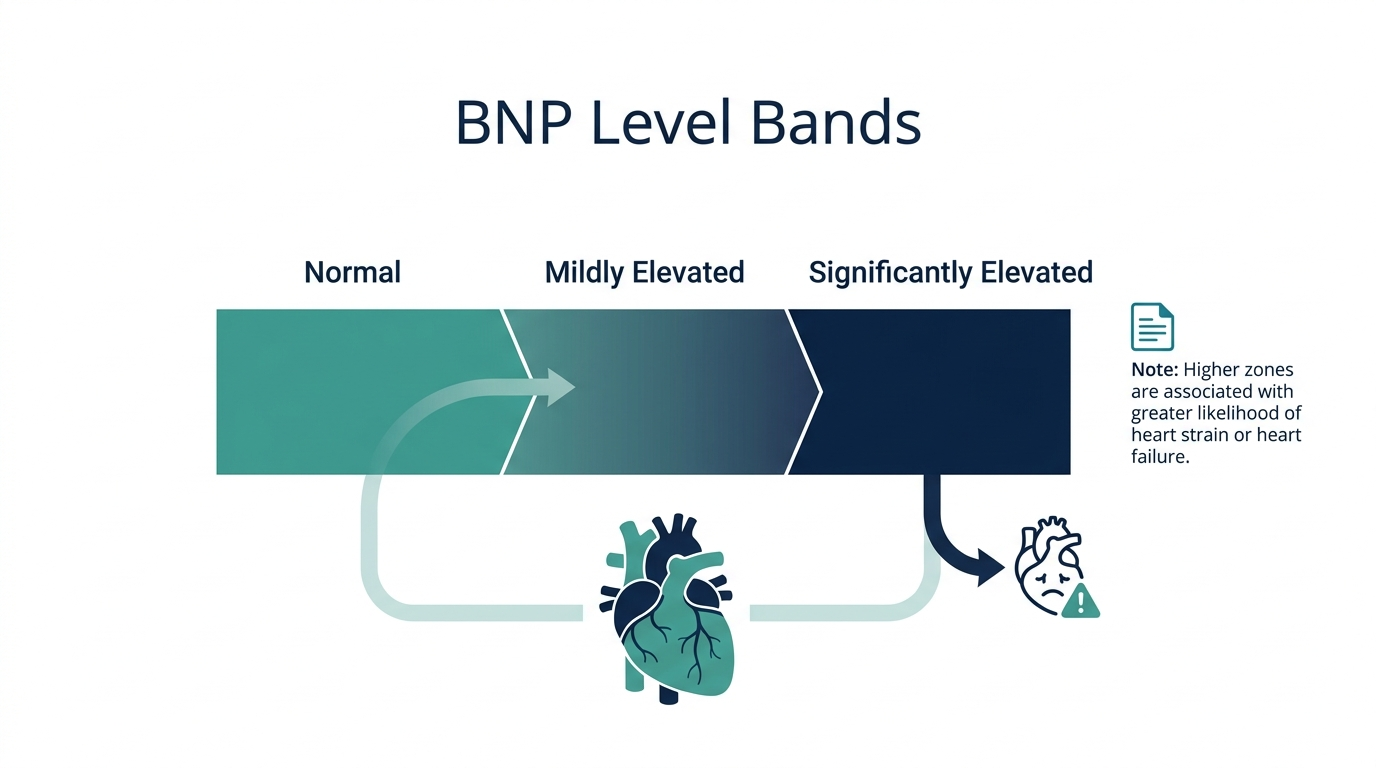
| Below 100 | Normal; heart failure unlikely |
| 100 to 400 | Borderline; heart failure possible, other causes common |
| Above 400 | Elevated; high probability of heart failure |
| Above 3,000 | Severely elevated; consistent with acute decompensated heart failure requiring immediate treatment |
NT-proBNP uses different cutoffs. Under 125 pg/mL is normal for adults under 75; under 450 pg/mL is the accepted upper limit for adults over 75, per ESC guidelines. The 900 pg/mL NT-proBNP threshold is commonly cited as the rule-in cutoff for heart failure regardless of age.
Why is BNP hard to read in isolation?
This is where the real clinical complexity lives, and it is the section most lab reports leave out entirely.
Obesity pushes BNP artificially low. In a well-documented phenomenon called the “natriuretic handicap,” people with obesity have BNP levels 20 to 40% lower than lean individuals with equivalent cardiac stress. Average BNP in lean adults sits around 21.4 pg/mL; in adults with obesity, the population average drops to approximately 12.7 pg/mL, according to published cardiovascular research. The mechanism involves increased clearance through NPR-C receptors and elevated neprilysin activity in adipose tissue. The clinical consequence is stark: a heavy patient with early heart failure can present with a BNP of 85 pg/mL, technically “normal,” while the heart is already in distress. Standard cutoffs were validated in leaner populations.
Kidney disease pushes BNP artificially high. When glomerular filtration rate falls, BNP clearance slows and levels climb even without any cardiac abnormality. A patient with CKD stage 4 or 5 can show BNP over 200 pg/mL from renal causes alone, per 2024 research in Hypertension Research. Clinicians treating CKD patients routinely apply a much higher threshold before attributing an elevation to the heart.
The ARNI drug problem. Millions of heart failure patients now take sacubitril/valsartan (Entresto), a neprilysin inhibitor. Neprilysin is one of the enzymes that degrades BNP. Block neprilysin, and BNP accumulates in blood even as the heart improves. The PARADIGM-HF trial found BNP rose roughly 20% on average after ARNI initiation, with about 20% of patients experiencing a doubling of their baseline value, per JACC 2019. Because NT-proBNP is not degraded by neprilysin, the major clinical cardiology societies now recommend NT-proBNP as the preferred monitoring biomarker in patients on ARNIs.
Personally, the ARNI interference issue is one of the most underappreciated traps in cardiac testing. A patient starts a new heart failure drug, BNP doubles, and without knowing the mechanism you would assume the heart is getting worse, when the drug is actually working.
What conditions cause high BNP besides heart failure?
Do not believe that an elevated BNP means heart failure until you have ruled out the other causes. Non-cardiac conditions that raise BNP include:
- Pulmonary hypertension and pulmonary embolism (the right ventricle is stressed, not just the left)
- Atrial fibrillation (atrial stretch contributes independent of ventricular function)
- Chronic kidney disease (reduced clearance, as described above)
- Sepsis and critical illness (systemic inflammation stimulates proBNP synthesis via interleukin-1, interleukin-6, and TNF-alpha)
- Liver cirrhosis with portal hypertension (fluid shifts and RAAS activation)
- Hypothyroidism (reduced cardiac output raises filling pressures)
- Normal aging (BNP rises physiologically with age, particularly in women)
Women have consistently higher BNP levels than age-matched men, an effect most pronounced in the premenopausal years and thought to reflect estrogen’s influence on natriuretic peptide expression. The sex gap narrows after menopause but never disappears entirely. This means a 68-year-old woman with a BNP of 130 pg/mL is in a different risk category than a 68-year-old man with the same number.
BNP vs. NT-proBNP: which test is better?
Neither is universally “better.” They measure the same upstream event through different windows. The practical differences are real and clinicians choose between them based on context.
| Feature | BNP | NT-proBNP |
|---|---|---|
| Biologically active? | Yes (vasodilator, natriuretic) | No (inert fragment) |
| Half-life in blood | ~20 minutes | 60 to 120 minutes |
| Stability in sample | Lower (must be processed quickly) | Higher (survives delay) |
| Normal range (under 75) | Under 100 pg/mL | Under 125 pg/mL |
| Normal range (over 75) | Under ~130 pg/mL (age-adjusted) | Under 450 pg/mL |
| Affected by ARNI therapy? | Yes (rises with neprilysin inhibition) | No |
| Affected by obesity? | Yes (falsely low) | Yes (similar effect, somewhat less pronounced) |
| Preferred in ARNI patients | No | Yes |
| Preferred for rapid ER triage | Either (both validated) | Either |
The College of American Pathologists (CAP guidance document) notes that clinicians should not switch between BNP and NT-proBNP mid-monitoring for the same patient, because the conversion between values is not linear and a trend on one assay does not reliably translate to the other.
What happens to BNP when you treat heart failure?
Here is an insider detail most patients never learn: in evidence-based heart failure treatment, watching BNP trend down over weeks is a quality-of-care signal, not just a lab footnote. Cardiologists and heart failure nurses practice what is called BNP-guided therapy: titrating diuretics, ACE inhibitors, beta blockers, and ARNIs against a falling BNP, rather than just chasing symptom relief.
The 2024 European Society of Cardiology (ESC) guidelines and the AHA/ACC heart failure guidelines both list serial BNP or NT-proBNP monitoring as a Class I recommendation for hospitalized decompensated heart failure patients. A drop of more than 30% in BNP during a hospitalization is associated with lower readmission risk at 30 days.
In outpatient settings, some cardiology practices set a personal “dry weight BNP” for each stable patient, typically the lowest value achieved during optimal treatment. Any future BNP that climbs more than 50% above that dry-weight baseline triggers an early clinic call before symptoms escalate into a hospital admission.
Can BNP be used as a therapy, not just a test?
Yes, and this is one of the most underappreciated chapters in peptide pharmacology.
The FDA approved nesiritide (brand name Natrecor) in August 2001, a recombinant human BNP identical in structure to the endogenous 32-amino-acid hormone, for intravenous treatment of acutely decompensated heart failure. Nesiritide reduced pulmonary capillary wedge pressure and improved dyspnea faster than standard diuretics alone in controlled trials, driving sales to $400 million annually by 2004.
The story did not end cleanly. Subsequent meta-analyses found nesiritide was associated with transient rises in serum creatinine and a borderline significant increase in 30-day mortality (7.2% vs. 4.0%, p = 0.059), raising safety concerns. Sales collapsed, and by 2018 the manufacturer had discontinued the product entirely. Nesiritide is no longer clinically available in the US, but the arc is instructive: BNP went from biomarker to drug to cautionary tale in under two decades, illustrating both the promise and limits of therapeutic peptide translation from bench to bedside.
What does HFpEF do to BNP, and why does it matter?
The biggest emerging diagnostic blind spot in cardiology right now involves heart failure with preserved ejection fraction (HFpEF), a form of heart failure where the ventricle contracts normally but stiffens and does not relax properly between beats. It now accounts for more than half of all heart failure cases and is epidemic in older, obese patients with hypertension.
The problem with BNP in HFpEF: levels are often disproportionately low, because wall stress, the primary stimulus for BNP release, is less severe when the ventricle is stiff rather than dilated. A 2025 study in JAHA confirmed that patients with HFpEF and BNP below 100 pg/mL suffer similar symptom burden and functional limitation as patients with higher levels. In other words, a “normal” BNP does not rule out clinically significant HFpEF, particularly in older, obese women, the demographic most likely to have it.
This is the myth worth busting directly: a normal BNP does not mean your heart is fine. It means the ventricles are not severely volume-overloaded right now. It says nothing about diastolic stiffness, coronary disease, valve problems, or early structural changes. BNP is a tool, not a verdict.
How do you get a BNP test, and what should you do with the result?
BNP is a clinical test ordered by a physician or clinician. It is not a standard part of routine annual wellness bloodwork at most primary care practices, though that is slowly changing with the rise of comprehensive biomarker panels. Comprehensive at-home panels from services like Superpower now include cardiac biomarkers alongside metabolic, inflammatory, hormonal, and kidney markers, giving the kind of contextual picture that makes a single BNP value actually interpretable.
If your BNP comes back elevated:
- Do not interpret it alone. Ask your clinician whether your kidney function, body weight, medications, or any active non-cardiac illness could be contributing to the elevation.
- Request a repeat test if the first result is borderline (100 to 400 pg/mL) and you feel well. BNP fluctuates with hydration, physical exertion, and sleep quality.
- If symptoms are present (shortness of breath with mild exertion, ankle swelling, waking at night to breathe), an elevated BNP with symptoms warrants same-day or next-day clinical evaluation, not watchful waiting.
- Establish your personal BNP baseline when you are healthy. Having a longitudinal trend is far more useful than a single cross-sectional value against a population average.
Full-body lab membership: 100+ biomarkers, doctor-reviewed, tracked over time.
Don’t just read about your health, track it.
A single result is a snapshot. Superpower re-tests 100+ markers over time so you can watch them move as you change sleep, food, and training.
Frequently asked questions
What is brain natriuretic peptide and where does it come from?
BNP is a 32-amino-acid peptide hormone secreted by ventricular cardiomyocytes in response to increased wall stress from elevated filling pressure. Despite the “brain” in the name, it originates almost entirely from the heart in humans. The name stuck from a 1988 discovery in porcine brain tissue.
What is a normal BNP level?
Below 100 pg/mL is considered normal for most adults. Levels from 100 to 400 pg/mL are borderline and require clinical context. Above 400 pg/mL is considered elevated with high likelihood of heart failure. These numbers shift with age, sex, kidney function, and body weight, so they should never be read as absolute cutoffs without those variables factored in.
What does a high BNP mean?
An elevated BNP signals that the heart’s ventricles are under increased mechanical stress. The most common cause is heart failure, but it can also reflect pulmonary hypertension, atrial fibrillation, significant kidney disease, sepsis, or liver disease. Context and clinical examination are required before attributing an elevated result to any single cause.
What is the difference between BNP and NT-proBNP?
Both are fragments of the same precursor molecule proBNP. BNP is the biologically active hormone with a half-life of about 20 minutes. NT-proBNP is the inactive co-fragment with a half-life of 60 to 120 minutes, making it more stable in a blood sample. NT-proBNP is the preferred test in patients taking sacubitril/valsartan (Entresto) because ARNI therapy elevates BNP artificially. Clinicians should not switch between the two tests mid-treatment, as the values do not convert linearly.
Can BNP be low and still have heart failure?
Yes. Patients with heart failure with preserved ejection fraction (HFpEF) often have BNP levels below the standard 100 pg/mL threshold, especially if they have obesity or are on a diuretic that has partially relieved fluid overload. A normal BNP does not rule out HFpEF, and clinicians increasingly use additional tests (echocardiogram, exercise testing, diastolic filling measurements) in symptomatic patients with normal BNP.
Does obesity affect BNP levels?
Yes, substantially. Adipose tissue expresses increased levels of the NPR-C clearance receptor and neprilysin, both of which degrade BNP. People with obesity have BNP levels roughly 20 to 40% lower than lean individuals under equivalent cardiac conditions, creating real risk that early heart failure is missed by standard cutoffs in heavier patients.
Is BNP used as a treatment?
It was. Nesiritide (Natrecor), a synthetic recombinant BNP, was FDA-approved in 2001 for acute decompensated heart failure. It reduced filling pressures effectively but raised concerns about renal function and borderline excess mortality in meta-analyses. The manufacturer discontinued it in 2018. It is no longer clinically available in the US.
Full-body lab membership: 100+ biomarkers, doctor-reviewed, tracked over time.
Author: Vital Signs Today Editorial Team, [credential]”]. Educational content, not medical advice. Sources linked inline.
Primary sources:
– Sudoh T, et al. “A new natriuretic peptide in porcine brain.” Nature 332, 1988. https://www.nature.com/articles/332078a0
– Cleveland Clinic. “B-Type Natriuretic Peptide (BNP) Test.” https://my.clevelandclinic.org/health/diagnostics/22629-b-type-natriuretic-peptide
– MedlinePlus. “Natriuretic Peptide Tests.” https://medlineplus.gov/lab-tests/natriuretic-peptide-tests-bnp-nt-probnp/
– JACC. “B-Type Natriuretic Peptide During Treatment With Sacubitril/Valsartan: The PARADIGM-HF Trial.” https://www.jacc.org/doi/10.1016/j.jacc.2019.01018
– JAHA. “Heart Failure With Preserved Ejection Fraction and Lower Natriuretic Peptide.” https://www.ahajournals.org/doi/10.1161/JAHA.125.041208
– Hypertension Research. “Comparative analysis of plasma BNP and NT-proBNP levels in CKD.” https://www.nature.com/articles/s41440-025-02272-2
– Cardiovascular Medicine. “B-type natriuretic peptide and obesity in heart failure.” https://cvm.swisshealthweb.ch/en/article/doi/cvm.2020.02095/
– College of American Pathologists. BNP Clinician Handout. https://documents.cap.org/documents/BNP-ClinicianHandout-112923.pdf
– Superpower. “BNP Normal Range: Heart Strain Levels Explained.” https://superpower.com/guides/bnp-normal-range
– Superpower. “Heart Failure Biomarker Testing.” https://superpower.com/diseases/heart-failure-biomarker-test
– PMC. “Brain Natriuretic Peptide Biomarkers in Current Clinical and Therapeutic Scenarios of Heart Failure.” https://pmc.ncbi.nlm.nih.gov/articles/PMC9181765/
Related reading
Vital Signs Today may earn a commission if you buy through links on this page. It does not affect our editorial assessments.