
Educational content only, not medical advice. Talk to a licensed clinician before starting any peptide supplement or therapy.
Short answer: A peptide link (also called a peptide bond) is the covalent amide bond that forms when the carboxyl group of one amino acid reacts with the amino group of the next, releasing one water molecule. It is the single most common bond in biology, the structural repeat unit of every protein in your body, and the reason a drug like semaglutide (Ozempic) can fit exactly into a hormone receptor after surviving the bloodstream.
The peptide bond is the single most common bond in biology, so what do the peptides and proteins in your own blood look like? One at-home Superpower draw checks 100+ biomarkers, physician-reviewed.
Why should anyone who is not a chemist care about a peptide link?
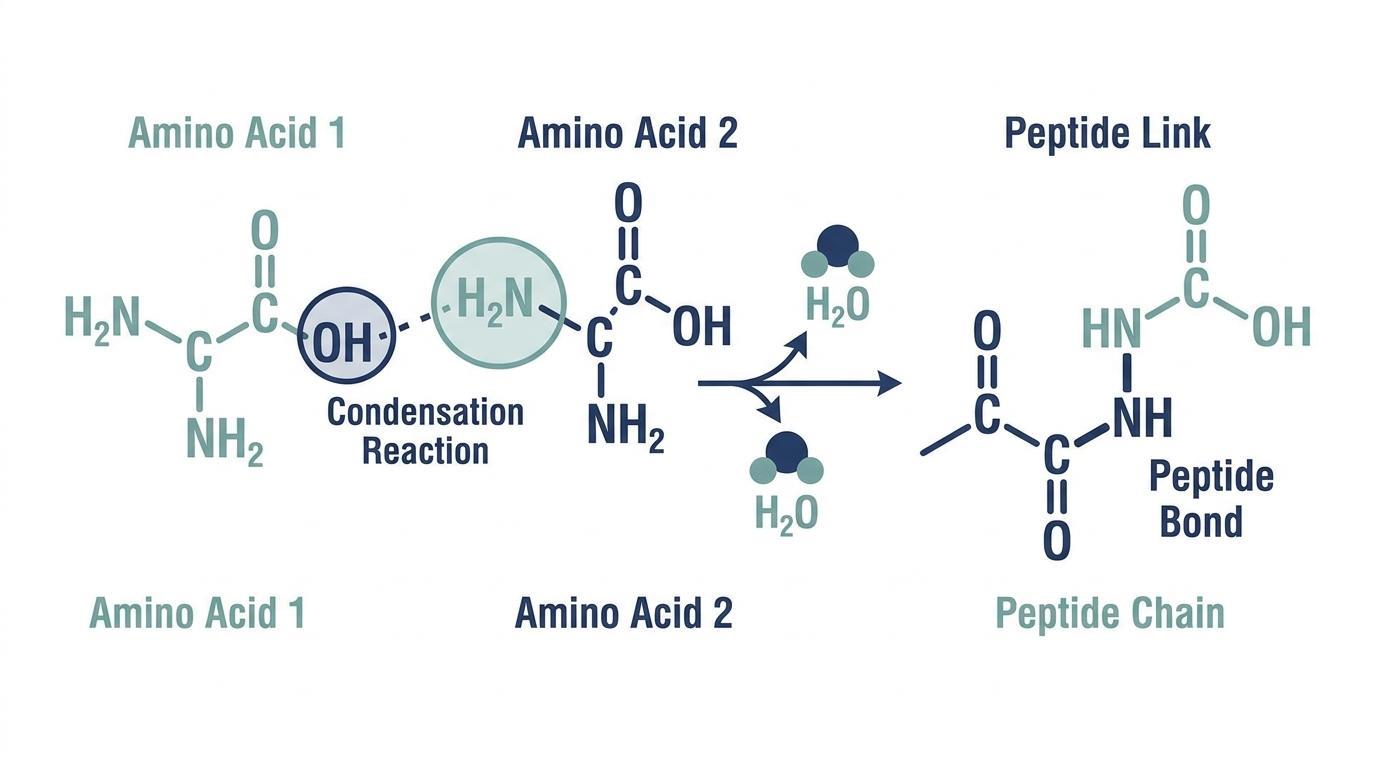
Because you are made of them. Your muscle fibers, skin collagen, insulin, antibodies, digestive enzymes, and the GLP-1 drugs now prescribed to tens of millions of people globally: all of them depend on peptide links holding the right amino acids in the right sequence at the right angle. Understanding that bond is not a chemistry trivia exercise. It answers practical questions: why collagen powder must be hydrolyzed to absorb, why peptide drugs need injections instead of pills, and what exactly is happening when a compounding pharmacy formulates a peptide therapy versus why a random vendor sells the “same molecule” for a fraction of the price.
There are roughly 130 FDA-approved peptide drugs on the market as of 2026, with 34 new approvals in the eight years from 2016 to 2024 alone. Every single one of those drugs exists because chemists learned to control how peptide links form, bend, and break. The bond is where the story starts.
Full-body lab membership: 100+ biomarkers, doctor-reviewed, tracked over time.
What exactly is a peptide link?
A peptide link is an amide bond. Chemically, it forms when the carboxyl group (-COOH) at the C-terminus of one amino acid loses its hydroxyl (-OH), and the amino group (-NH2) at the N-terminus of the next amino acid loses one hydrogen. The two fragments join; a water molecule (H2O) is expelled as a byproduct. What remains is a C(=O)-NH group connecting the carbon backbone of the first residue to the nitrogen of the second.
This reaction is called a condensation reaction (or dehydration synthesis) because it releases water. Each new peptide bond added to a growing chain consumes energy, which in living cells is supplied by ATP through the ribosome’s peptidyl transferase center, an entirely RNA-based catalytic machine that accelerates the reaction roughly 10 million-fold compared to an uncatalyzed reaction in water.
That last detail matters more than most textbooks acknowledge: the ribosome is the largest known ribozyme, meaning an RNA molecule with catalytic power, not a protein enzyme. The fact that an RNA machine builds all proteins using peptide bonds is one of the strongest pieces of evidence for the RNA World hypothesis of life’s origin.
The bond has a precise geometry. Although written as a single bond on paper, it carries significant partial double-bond character due to electron resonance between the carbonyl oxygen and the nitrogen. This resonance shortens the C-N bond length to approximately 1.32 angstroms, versus 1.47 angstroms for a pure single C-N bond. The practical result: rotation around the peptide bond is strongly restricted, and the six atoms forming the unit (the carbonyl carbon, oxygen, nitrogen, hydrogen, and the two flanking alpha-carbons) are nearly locked into a flat, planar arrangement.
That planarity is not cosmetic. It is what gives proteins their reproducible three-dimensional shapes.
How does the flat structure of a peptide link control protein shape?
Think of each peptide link as a rigid tile in a chain of tiles connected by flexible hinges at either side. The hinges are the phi (phi) and psi (psi) angles at each alpha-carbon. The tile itself, the peptide bond plane, barely moves. Because each tile is locked, the only degrees of freedom available to the protein are at those hinges. A limited set of allowed hinge positions corresponds to the secondary structures: alpha-helices, beta-sheets, and turns.
In folded proteins, roughly 99.9% of peptide bonds adopt the trans configuration, where the two alpha-carbon atoms on either side of the bond sit on opposite sides of the C-N axis. This minimizes steric clashes between side chains. The exception is bonds immediately preceding a proline residue (called X-Pro bonds), where the cyclic ring structure of proline’s side chain partially equalizes the steric penalty, allowing cis bonds to occur about 5 to 10% of the time. Many functional protein sites exploit this proline cis-trans switch as a molecular on-off mechanism.
Collagen illustrates the structural consequence of peptide-link geometry at its most extreme. The entire triple helix depends on a repeating Gly-X-Y sequence, where glycine (the smallest amino acid, with just a single hydrogen as its side chain) occupies every third position inside the helix. If any position is replaced by a larger amino acid, the peptide backbone cannot pack tightly enough, and the helix falls apart. Osteogenesis imperfecta, a genetic disorder causing brittle bones, is often caused by a single glycine substitution in collagen’s Gly-X-Y repeat: one wrong amino acid at one peptide link disrupting a structure that runs for hundreds of nanometers.
How stable is a peptide link? The 500-year half-life nobody mentions
Peptide bonds are thermodynamically unstable. Hydrolysis (the reverse of formation, adding water back across the bond) is exergonic, meaning it releases energy. Nature should spontaneously break every peptide you consume.
It does not, at least not quickly. The kinetic barrier is enormous. At neutral pH and room temperature (25 degrees C), the uncatalyzed half-life of a simple peptide bond in water is approximately 500 to 600 years. The water molecule cannot attack the carbonyl carbon fast enough without help.
Personally, I think this is one of the most underappreciated facts in biochemistry. The bond that life uses to build everything is chemically set to last longer than most civilizations. That is exactly why cells need protease enzymes to do the breaking: trypsin, chymotrypsin, pepsin, and dozens of others lower the activation energy enough to accomplish in milliseconds what pure chemistry would need centuries to do.
Do not believe the claim that “acidic environments digest peptides” in the context of oral supplements. Your stomach does hydrolyze peptide bonds, but it is the enzyme pepsin doing the work, not the hydrochloric acid itself. The acid creates the pH that activates pepsin and denatures protein structure, making bonds accessible. Without the enzyme, even gastric acid would leave a peptide largely intact.
Dipeptide, tripeptide, polypeptide: what the naming system tells you
A chain of amino acids joined by peptide links is named by counting the residues:
| Chain name | Amino acid count | Peptide bonds | Common examples |
|---|---|---|---|
| Dipeptide | 2 | 1 | Carnosine (Ala-His), aspartame (Asp-Phe methyl ester) |
| Tripeptide | 3 | 2 | Glutathione (Glu-Cys-Gly), thyrotropin-releasing hormone |
| Oligopeptide | 2-20 | 1-19 | GHK-Cu copper peptide (Gly-His-Lys), oxytocin (9 residues) |
| Polypeptide | 20-50ish | 19-49ish | Glucagon (29 AA), GLP-1 (30 AA), calcitonin (32 AA) |
| Protein | 50+ | 49+ | Insulin (51 AA, 50 bonds), HGH (191 AA, 190 bonds), collagen chains (>1000 AA) |
The rule is simple: for any chain with N amino acids, there are exactly N-1 peptide bonds. A 100-residue peptide has 99 peptide links. Human growth hormone, with 191 amino acid residues, contains exactly 190 peptide links, and each of those bonds must adopt its correct trans configuration for the hormone to fold into a shape the pituitary receptor recognizes.
The naming convention also tells you something about oral absorption. Dipeptides and tripeptides can be transported across intestinal cells using the PepT1 transporter, which is why small hydrolyzed collagen fragments (often Pro-Hyp and Hyp-Gly dipeptides) actually reach the bloodstream after oral supplementation. A full-length protein cannot use that pathway; it must be fully digested to free amino acids first. This is why hydrolyzed collagen powders are not just marketing: the shorter peptide chains genuinely absorb differently than intact collagen.
What is the difference between a peptide link and other bonds in proteins?
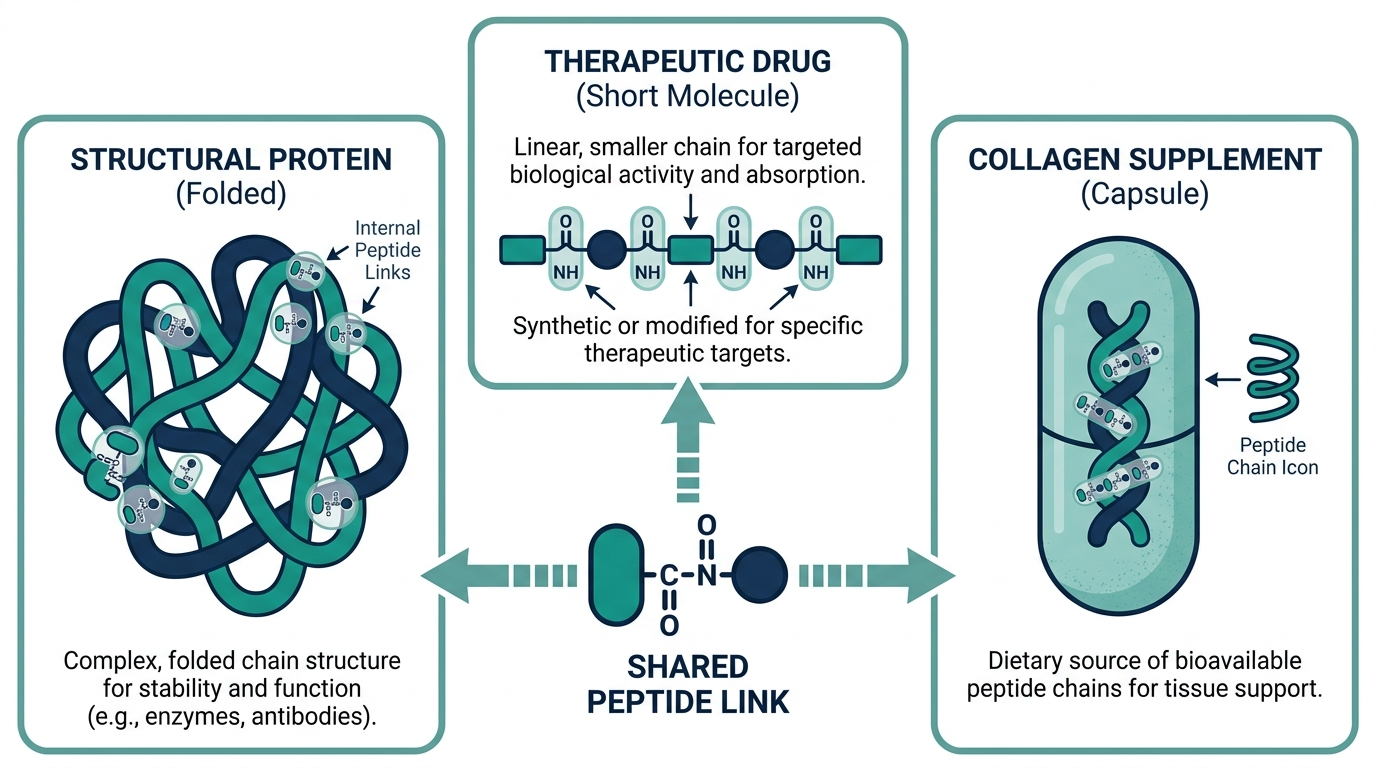
Proteins contain more than just peptide links. Confusing the bond types leads to real mistakes when reading supplement labels or clinical literature.
| Bond type | What it connects | Covalent or non-covalent | How it forms | Role |
|---|---|---|---|---|
| Peptide bond (amide bond) | Adjacent amino acids in chain | Covalent | Condensation reaction (ribosome) | Primary structure, the backbone |
| Disulfide bond | Cysteine side chains (SH groups) | Covalent | Oxidation of two thiol groups | Locks 3D folds, stabilizes secreted proteins (insulin, antibodies) |
| Isopeptide bond | Lysine + asparagine or glutamine | Covalent | Specific enzymes or heat | Cross-links within or between chains, extreme stability |
| Hydrogen bond | Carbonyl O to amide N-H | Non-covalent | Electrostatic attraction | Drives alpha-helix and beta-sheet formation |
| Hydrophobic interaction | Non-polar side chains | Non-covalent | Entropy-driven clustering | Core packing in globular proteins |
Insulin illustrates several at once. Its two peptide chains (A chain with 21 residues, B chain with 30 residues) are held together by two disulfide bonds between cysteine pairs, plus one more disulfide within the A chain. Remove those disulfide bonds and insulin unfolds, even though every one of its 50 peptide links remains intact. The peptide link is the spine; the disulfide bonds are the rivets.
How does peptide-link chemistry shape the drugs you take?
Here is the insider view that most “what is a peptide” articles skip entirely: the peptide bond is simultaneously a drug designer’s most powerful tool and their most frustrating constraint.
Why peptide drugs need injections. Most therapeutic peptides cannot be taken orally at meaningful doses because proteases in the gut hydrolyze the peptide bonds before the drug can reach the bloodstream. Semaglutide (Ozempic, Wegovy) is a 31-amino acid GLP-1 analog with 30 peptide bonds. The injectable version works well. Oral semaglutide (Rybelsus) requires a special absorption enhancer (sodium caprate) at a fixed 300 mg dose to force enough uptake through the stomach lining before gastric enzymes attack it. Even so, oral bioavailability is roughly 0.4 to 1%, which is why the oral dose (7-14 mg) is far higher than the injectable dose (0.25-2.4 mg weekly). The oral semaglutide pill launched in the US in early 2026 represents years of formulation work specifically to protect those 30 peptide bonds from hydrolysis long enough for absorption.
Why modifications matter. Drug developers routinely tweak peptide links to resist proteolysis. Common strategies include replacing L-amino acids with D-amino acids (proteases evolved for L-forms cannot cut mirror-image bonds), using N-methylation of the amide nitrogen (blocks the resonance geometry that proteases recognize), adding PEGylation, or attaching a fatty acid chain (semaglutide’s C18 diacid modification extends its half-life from minutes to a week by binding to albumin in the blood and slowing renal clearance). Every modification is designed around the peptide bond.
What “research grade” really means. The approximately 130 FDA-approved peptide drugs went through manufacturing quality controls that verify, batch by batch, that every peptide bond in the synthesized chain is in the right position, with the right configuration, at sufficient purity. HPLC mass spectrometry can detect a chain where one bond formed incorrectly (wrong isomer, wrong sequence). Grey-market “research use only” peptides skip those controls. A 2024-2026 independent analysis by Finnrick found some batches from even the highest-profile vendors testing below 75% purity, meaning a significant fraction of what was in the vial either lacked the correct sequence or had degraded bonds. You cannot see a broken peptide link in a vial.
Full-body lab membership: 100+ biomarkers, doctor-reviewed, tracked over time.
The peptide link in skincare: why the label means less than you think
Skincare brands have discovered that “peptide” sells, which has produced a category ranging from legitimately effective topical actives to pure marketing noise. The peptide link is central to understanding which is which.
Collagen in its full-chain form (molecular weight around 300,000 daltons) cannot penetrate skin. Its peptide backbone is too large. Cosmetic brands solve this by either using hydrolyzed collagen (broken into small fragments by enzymatic cleavage of peptide bonds) or by synthesizing short functional peptides specifically designed to signal to cells. The Ordinary’s Multi-Peptide Serum, for example, contains Matrixyl (Palmitoyl Pentapeptide-4), a synthetic lipopeptide where five amino acids are linked by four peptide bonds to a palmitoyl fatty acid. The fatty acid helps penetration; the peptide sequence mimics a collagen fragment to stimulate production.
GHK-Cu (glycyl-L-histidyl-L-lysine copper complex) is a tripeptide: three amino acids, two peptide links, plus a copper ion coordinated through the histidine nitrogen. At topical concentrations, it shows evidence for stimulating collagen synthesis in fibroblast studies. The peptide link matters here because the specific sequence Gly-His-Lys is what positions the copper ion at the correct geometry; a scrambled sequence of the same three amino acids would not bind copper the same way and would not work.
The insider fact: most consumers have no idea that “peptide serum” has a completely different molecular reality than “injectable peptide.” A topical peptide with 3 to 5 residues costs cents to synthesize and carries essentially no safety concern. An injectable peptide with 30 to 40 residues that bypasses the gut entirely is a categorically different proposition. Lumping them together under the word “peptide” is how marketing erases a thousand-fold difference in complexity.
How the ribosome builds peptide links: the most remarkable factory on Earth
Every second, the roughly 10 million ribosomes in a single human cell each add two to twenty new amino acids to growing chains, forming two to twenty new peptide bonds. For a full-length protein of 300 amino acids, that is 299 peptide links built in sequence, each one placed correctly, in under a minute.
The catalytic site, the peptidyl transferase center (PTC), is made entirely of ribosomal RNA (rRNA), not protein. It works by positioning the incoming amino acid and the growing peptide chain so that the amino group of the new amino acid attacks the carbonyl carbon of the last-added residue in a nucleophilic substitution. The ribosome does not supply chemical energy for each bond; it supplies geometrical precision, orienting substrates within fractions of an angstrom to lower the activation barrier. The estimated rate acceleration over an uncatalyzed reaction in solution is 10 million-fold.
This matters for a practical reason: synthetic peptide manufacturers cannot match that precision at scale. Solid-phase peptide synthesis (SPPS), the method used to make most research and pharmaceutical peptides, couples amino acids one at a time using chemical activating agents. Each coupling step is roughly 99.5% efficient. For a 30-residue peptide, 29 coupling steps at 99.5% efficiency each yields a theoretical yield of about 0.995^29, or roughly 86% full-length correct product before purification. For a 100-residue peptide, the math drops to 60%. This is why longer synthetic peptides are more expensive, harder to purify to high purity, and more prone to containing truncated fragments with incomplete peptide link sets. The ribosome achieves 99.99%+ accuracy per residue through proofreading mechanisms that no synthetic chemistry currently replicates.
Don’t just read about your health, track it.
A single result is a snapshot. Superpower re-tests 100+ markers over time so you can watch them move as you change sleep, food, and training.
Frequently asked questions
What is a peptide link in simple terms?
A peptide link is the chemical bond that joins two amino acids together. It forms when a carboxyl group on one amino acid reacts with an amino group on the next, releasing a water molecule. Chains of amino acids connected by multiple peptide links are called peptides or proteins.
Is a peptide link the same as a peptide bond?
Yes. “Peptide link” and “peptide bond” are the same thing, the amide bond between adjacent amino acids. “Peptide link” is the term more commonly used in British biochemistry textbooks; “peptide bond” is more common in American usage. Both refer to the CO-NH group connecting amino acid residues in a chain.
Why is the peptide link called an amide bond?
Because the chemical group formed (CO-NH) is the definition of an amide: a carbonyl carbon (C=O) bonded directly to a nitrogen atom. A peptide bond is a specific subtype of amide bond, one that appears at regular intervals in the backbone of every protein and peptide.
How many peptide links are in a protein?
Always one fewer than the number of amino acids. A dipeptide (2 amino acids) has 1 peptide link. Insulin with 51 amino acids has 50. Human growth hormone with 191 amino acids has 190. A large structural protein like titin, the longest known human protein at approximately 34,350 amino acid residues, contains roughly 34,349 peptide bonds.
Why do some peptide supplements need to be hydrolyzed?
Full-length protein chains are too large to cross the intestinal wall intact. Digestive proteases break peptide links into shorter fragments. Hydrolyzed collagen is pre-digested: the manufacturer uses enzymes to cleave enough peptide bonds to produce small di- and tripeptides that the intestinal PepT1 transporter can carry directly into the bloodstream. Studies show Pro-Hyp and Hyp-Gly dipeptides from hydrolyzed collagen reach measurable blood concentrations within 60 to 120 minutes of oral intake.
What breaks a peptide link in the body?
Protease enzymes: pepsin in the stomach, trypsin and chymotrypsin from the pancreas, and brush-border peptidases in the small intestine. Each protease cuts peptide bonds at specific amino acid sequences (trypsin at the carboxyl side of lysine and arginine; chymotrypsin at aromatic residues like phenylalanine and tryptophan). Without enzymes, a peptide bond left in neutral water at body temperature has a half-life of hundreds of years.
Does a peptide link form between any two amino acids?
Yes, in terms of basic chemistry. The condensation reaction works regardless of what side chains the amino acids carry. However, the ribosome has specific rules: it only works with L-amino acids in natural protein synthesis, and some amino acid sequences form slowly (D-amino acids next to proline cause measurable pauses). Drug developers deliberately use D-amino acids in synthetic therapeutic peptides because proteases evolved for L-form peptide bonds cannot cleave the D-form bonds, extending drug half-life.
Author: Vital Signs Today Editorial Team. Educational content only, not medical advice. Sources linked inline.
Full-body lab membership: 100+ biomarkers, doctor-reviewed, tracked over time.
Primary sources
- Peptide bond, Wikipedia: bond length, planarity, cis-trans ratio
- Rates of Uncatalyzed Peptide Bond Hydrolysis, JACS (Radzicka & Wolfenden, 1996): 500-600 year half-life data
- Ribosomal peptidyl transferase two-step mechanism, PMC (Wallin & Aqvist, 2010): 10 million-fold rate acceleration
- Peptidyl transferase center, Wikipedia: RNA-only catalysis, RNA World evidence
- Absorption of bioactive peptides following collagen hydrolysate, Frontiers in Nutrition 2024, PMC: Pro-Hyp peak plasma absorption time
- FDA Approved Peptides list, Purdue CDEK: 130+ approved peptide drugs
- Oral semaglutide FDA approval, AJMC 2025: oral vs injectable bioavailability context
- 2025 FDA TIDES Harvest, PMC / MDPI Pharmaceutics: 34 peptide approvals 2016-2024, 2025 pipeline
- Finnrick independent testing database: purity data for grey-market peptide vendors
- Proline provides site-specific flexibility for in vivo collagen, Scientific Reports 2018: collagen triple helix and proline geometry
- Cis-trans isomerization of omega dihedrals in proteins, ResearchGate 2013: 99.9% trans peptide bonds, proline exceptions
Related reading
Vital Signs Today may earn a commission if you buy through links on this page. It does not affect our editorial assessments.