
Last updated June 2026. Educational content, not medical advice. Regulatory status is actively shifting in 2026. Consult a licensed clinician before starting any peptide protocol.
Short answer: Over 80 peptide drugs are FDA approved, including semaglutide (Ozempic/Wegovy), tirzepatide (Mounjaro/Zepbound), sermorelin, and tesamorelin. But “peptide therapy” as most people mean it, the BPC-157, TB-500, CJC-1295, and ipamorelin protocols offered by wellness clinics, is not FDA approved. Those compounds are either compounded under a physician prescription (legal but off-label) or sold as research chemicals (legal to sell, not legal to inject on yourself). In February 2026, HHS announced a major reclassification that will move roughly 14 previously restricted peptides back into the legal compounding lane, with a formal FDA committee vote scheduled for July 23 and 24, 2026.
Over 80 peptide drugs are FDA approved, but most peptide therapy isn’t. Want real data on your body instead of grey-market guesses? One at-home Superpower draw checks 100+ biomarkers, physician-reviewed.
What does “FDA approved” actually mean for a peptide?
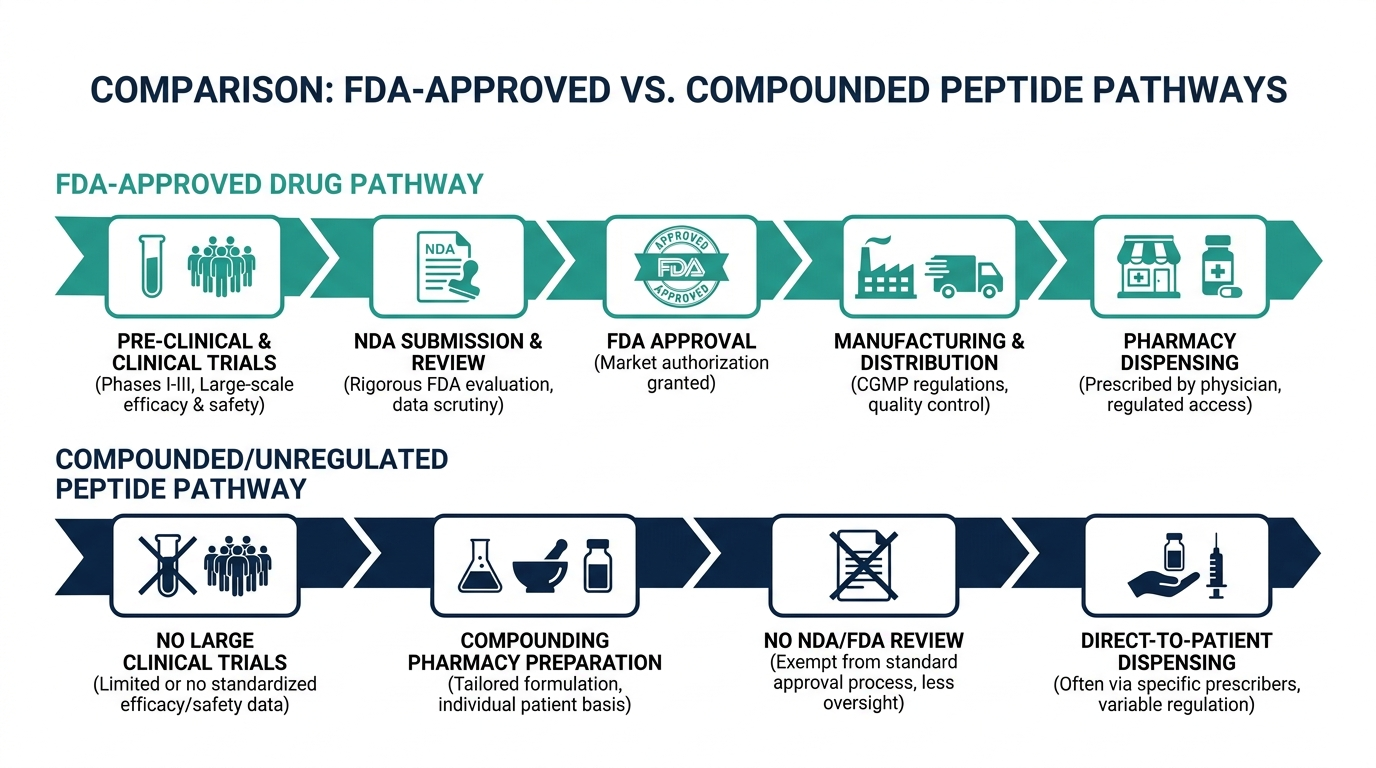
The question sounds simple, but three completely different answers live underneath it, and most people asking get handed the wrong one.
When the FDA approves a drug, it has reviewed clinical trial data proving safety and efficacy for a specific indication, assigned it a brand name, required a specific manufacturer to meet current good manufacturing practice standards, and authorized it only for labeled uses. Ozempic is FDA approved for type 2 diabetes. Wegovy is FDA approved for chronic weight management. Those are two separate approvals for the same molecule, semaglutide, because the indications differ.
Compounded peptides are entirely different. When a licensed 503A compounding pharmacy prepares BPC-157 or CJC-1295 with a physician’s prescription, that preparation is not “FDA approved.” It is legal under the Federal Food, Drug, and Cosmetic Act because the law permits pharmacies to compound drugs for individual patients. The compound itself never went through the approval gauntlet. The physician is prescribing off-label, and the pharmacy is filling it under a different legal framework.
Research peptides are a third category. Selling a compound “for laboratory research, not for human use” is legal. Using it on yourself is not covered by that label at all. The “research use only” language is legal positioning by the vendor, not a safety certification, and no physician, pharmacist, or regulator stands behind it.
Full-body lab membership: 100+ biomarkers, doctor-reviewed, tracked over time.
Which peptides are actually FDA approved right now?
The simplest way to actually get this done
Superpower is a full-body lab membership that runs 100+ biomarkers, has each result reviewed by a doctor, and tracks your numbers year over year (about $199/year). It is what we point readers to when they would rather get one clean, complete draw than chase single tests one at a time. Here is superpower reviewed in full.
As of mid-2026, over 80 peptide drugs have received FDA approval across multiple therapeutic categories. The number surprises most people because they think of “peptides” as the grey-market vials on biohacking forums. In clinical medicine, peptides have been foundational for decades.
Here is the honest map by category:
| Category | Key Approved Peptides | Brand Names | Year |
|---|---|---|---|
| GLP-1 weight/diabetes | Semaglutide | Ozempic, Wegovy, Rybelsus | 2017-2021 |
| GLP-1/GIP dual agonist | Tirzepatide | Mounjaro, Zepbound | 2022-2023 |
| GLP-1 (older) | Liraglutide, Exenatide, Dulaglutide | Victoza, Saxenda, Byetta, Trulicity | 2005-2014 |
| Growth hormone / GHRH | Tesamorelin | Egrifta SV | 2010 |
| Growth hormone secretagogue | Sermorelin | Geref (discontinued brand; compounding continues) | 1990 |
| Somatostatin analogs | Octreotide, Lanreotide, Pasireotide | Sandostatin, Somatuline, Signifor | 1988-2012 |
| GnRH agonists (oncology) | Leuprolide, Goserelin, Triptorelin | Lupron, Zoladex, Trelstar | 1985-2000 |
| Osteoporosis | Teriparatide, Abaloparatide | Forteo, Tymlos | 2002-2017 |
| Erythropoietic protoporphyria | Afamelanotide | Scenesse | 2019 |
| GI motility | Linaclotide, Plecanatide | Linzess, Trulance | 2012-2017 |
| Hypoparathyroidism | Palopegteriparatide | Yorvipath | 2024 |
| Insulin (all analogs) | Multiple | Humalog, Lantus, Tresiba, etc. | 1982-2015 |
Two things about this table that the wellness world rarely states clearly. First, tirzepatide (Mounjaro/Zepbound) achieved a mean body weight reduction of 22.5% in the SURMOUNT-1 trial, the highest figure ever recorded for a non-surgical intervention. That is an FDA-approved peptide. Second, sermorelin lost its branded approval when the manufacturer voluntarily withdrew Geref from the market, but the compound itself is not banned, and physicians can prescribe compounded sermorelin legally through licensed 503A pharmacies.
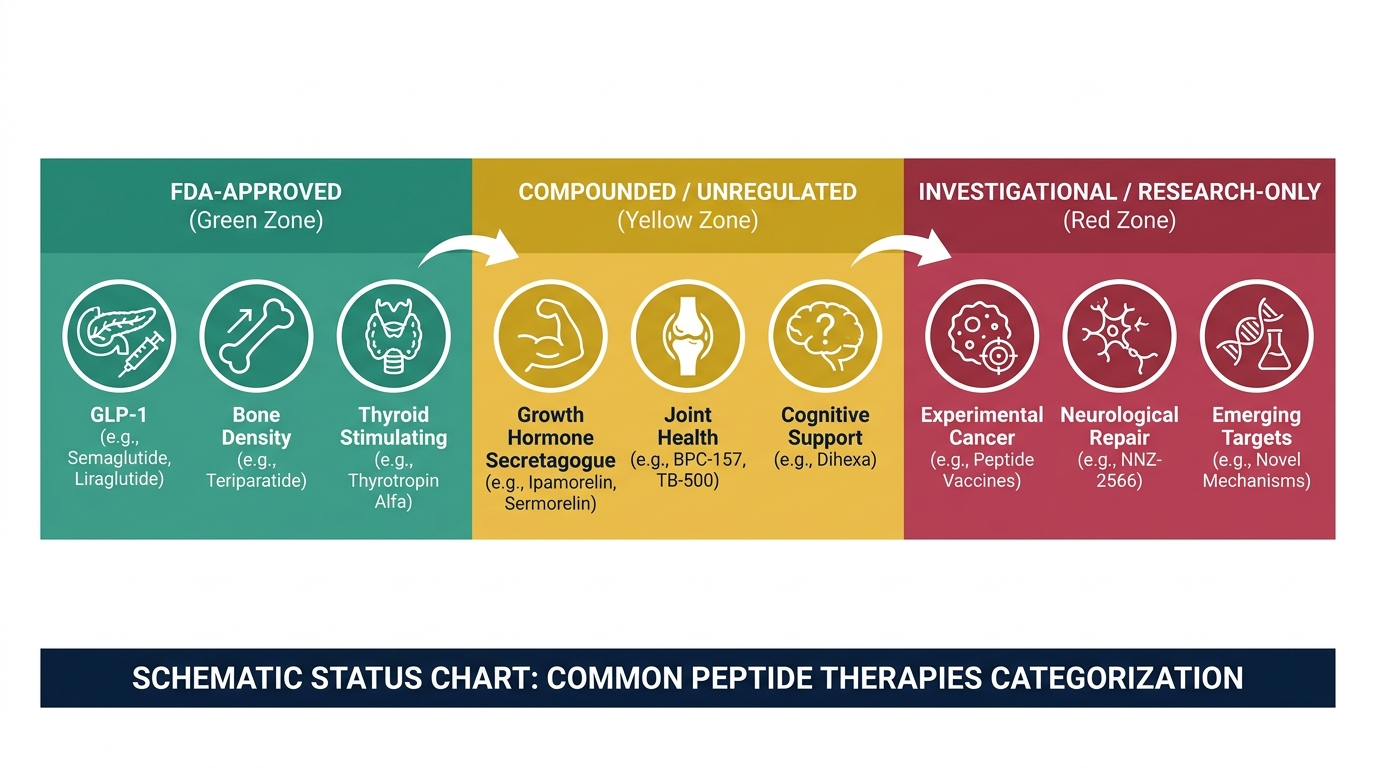
The important subtext: “peptide therapy” as a category is not a single regulatory bucket. It’s a range spanning fully approved drugs, legal but off-label compounds, grey-zone research chemicals, and outright prohibited substances, all sold under the same vocabulary.
Why is “peptide therapy” so confusing to categorize?
The confusion has a specific origin. When most people search “is peptide therapy FDA approved,” they are thinking about the protocols they have seen advertised at longevity clinics: BPC-157 for tendon repair, CJC-1295 plus ipamorelin for growth hormone support, TB-500 for recovery, or sermorelin for anti-aging. None of those are FDA-approved drug products, even though some are legally available through licensed channels.
Personally, I think this is the single most exploited gap in health marketing. A clinic can technically claim to offer “FDA-approved peptide therapy” by including semaglutide or tesamorelin on the menu, while the protocols that drew patients in (BPC-157, the GH-secretagogue stacks) sit in a completely different regulatory lane. The distinction rarely appears in the headline.
The language breakdown matters:
- “FDA approved for [indication]” = full approval, labeled use, clinical trial data on file.
- “Available through a licensed compounding pharmacy” = legal, off-label, not FDA approved.
- “Research use only” = legal to sell, not legal for human use, zero regulatory backing.
- “For informational purposes only” on a vendor page = the vendor’s liability shield, not yours.
Do not believe any source that calls BPC-157 or TB-500 “FDA approved.” They are not. The accurate phrase is “no longer prohibited from compounding” or “pending PCAC review,” and even that only became true in 2026.
What changed in 2026? The reclassification explained.
This year brought the biggest shift in US peptide regulation since the 2023 crackdown. The timeline is specific enough to matter:
November 2023: The FDA added 19 peptides to the 503A Category 2 list, designating them as substances that may present significant safety risks when compounded. This effectively banned licensed compounding pharmacies from preparing them, pushing the entire market toward grey-market vendors.
February 27, 2026: HHS Secretary Robert F. Kennedy Jr. announced on a public platform that approximately 14 of those 19 restricted peptides are expected to move back to Category 1 status, reopening the legal compounding pathway for each one. The compounds most discussed include BPC-157, TB-500, GHK-Cu, CJC-1295, Ipamorelin, Selank, Semax, Epitalon, KPV, MOTS-C, AOD-9604, and Thymosin Alpha-1.
April 15-23, 2026: The FDA formally removed BPC-157 (both acetate and free base forms) from Category 2, effective April 23, 2026. The nominations to restrict those compounds had been withdrawn by the companies that originally submitted them. This is a regulatory distinction worth understanding: the FDA did not affirmatively approve BPC-157. It stopped actively restricting it. The compound moved from “explicitly prohibited for compounding” to “in a review queue,” not from “prohibited” to “approved.”
July 23-24, 2026: The FDA’s Pharmacy Compounding Advisory Committee (PCAC) is scheduled to meet and vote on whether seven peptides, BPC-157, TB-500, KPV, MOTS-C, Emideltide, Semax, and Epitalon, should be officially placed on the Category 1 permitted list. The PCAC vote is advisory, meaning the FDA is not legally bound by the outcome, but the agency follows committee recommendations in the vast majority of cases. A positive vote would allow licensed 503A pharmacies to compound and dispense these peptides with a physician prescription.
What remains restricted: Five peptides are expected to stay on Category 2 regardless of the reclassification wave, due to ongoing safety concerns. Melanotan II, GHRP-2, GHRP-6, LL-37, and PEG-MGF are the names appearing most consistently in regulatory analysis as likely to remain prohibited for compounding.
The practical meaning for a patient: if the PCAC votes to add BPC-157 to Category 1 in late July, a licensed telehealth physician could prescribe it and a licensed pharmacy could compound it, probably by Q4 2026 after the FDA finalizes a rule. That would be the first time BPC-157 is accessible through a fully legitimate clinical channel in the US since 2023.
The three lanes, and which one you are actually in
Understanding FDA approval for peptide therapy requires knowing which of three regulatory lanes applies to the specific compound you are asking about. Most conversations collapse all three into “legal” or “illegal,” which obscures more than it reveals.
Lane 1: Fully FDA-approved peptide drugs. These are prescribed by a physician, dispensed by a licensed pharmacy, labeled with an approved indication, and backed by clinical trials. Semaglutide, tirzepatide, tesamorelin, and leuprolide live here. Compounded versions of brand-name GLP-1 drugs had a narrow window during periods of declared drug shortages, but that window closed for tirzepatide on October 2, 2024, and for semaglutide on February 21, 2025, after the FDA declared supplies were no longer insufficient.
Lane 2: Compounded peptides with a prescription. Sermorelin is the clearest example, a compound the FDA once approved as Geref, then saw voluntarily withdrawn from the market, and that has been legally compounded ever since. Tesamorelin compounded by a 503A pharmacy for a patient who cannot access or afford Egrifta SV is another example. As of the 2026 reclassification process, BPC-157, TB-500, and about a dozen others are migrating back toward this lane. Legal, off-label, not FDA approved, but manufactured to pharmacy standards with a real prescription from a real clinician.
Lane 3: Research-use-only compounds. This lane has never changed. These are sold legally as “not for human use” and used by individuals anyway. The regulatory crackdown starting in 2024 reduced the number of vendors and the quality of what remained, but it did not eliminate the lane. Melanotan II, GHRP-2, and retatrutide (which is still investigational with no approved indication) continue to be sold this way.
Telehealth GLP-1 program with provider visits and pharmacy coordination.
What getting legal peptide therapy actually costs in 2026
The price comparison that ends most conversations before it should start: a grey-market research vial runs $40 to $120. A telehealth peptide therapy program runs $199 to $399 a month. People call the vial cheap. That framing ignores what the vial does not include.
For context on what “legal” actually costs:
- Sermorelin via telehealth: $175 to $225 per month all-inclusive, compared to $600 to $1,200 per month for synthetic human growth hormone. Telehealth brought the cost within reach of a meaningful patient population.
- BPC-157 via licensed clinic: $200 to $350 per month for a single-peptide telehealth protocol. A supervised “Wolverine Stack” combining BPC-157 with TB-500 runs approximately $795 per cycle at clinics that currently offer it.
- GLP-1 drugs via telehealth: Compounded semaglutide programs that operated in the shortage window ran $99 to $299 per month. Post-shortage, brand-name Wegovy and Zepbound carry list prices of $1,000 to $1,400 per month without insurance, though manufacturer coupons and GoodRx can lower the real out-of-pocket significantly.
None of this is covered by insurance for longevity or optimization use. Compounded peptides for anti-aging, recovery, or body composition are classified as elective or experimental regardless of the clinical logic behind them. The rare exceptions are tesamorelin (Egrifta SV) for documented HIV-associated lipodystrophy and GLP-1 drugs when a patient’s diagnosis and formulary align.
The vial comparison also ignores the reconstitution cost: bacteriostatic water, U-100 insulin syringes, and the cognitive overhead of calculating concentration math correctly, where a decimal error changes the dose by a factor of ten.
Which peptide therapy is right for your goal?
Not every peptide belongs in the same conversation. Here is where FDA-approval status and clinical evidence actually map to the goals people have:
| Goal | Peptides Most Used | FDA Status | Recommended Route |
|---|---|---|---|
| Type 2 diabetes | Semaglutide, tirzepatide, liraglutide | Fully approved | Prescription + licensed pharmacy |
| Weight loss | Tirzepatide (22.5% loss in SURMOUNT-1), semaglutide | Fully approved | Prescription + licensed pharmacy |
| HIV lipodystrophy | Tesamorelin (Egrifta SV) | Fully approved for this indication | Prescription only |
| GH support / anti-aging | Sermorelin, CJC-1295 + ipamorelin | Compounded, off-label (legal with Rx) | Licensed telehealth |
| Tendon / gut recovery | BPC-157 | Compounding lane re-opening mid-2026 | Licensed telehealth (by Q4 2026) |
| Soft-tissue recovery | TB-500 | Same as BPC-157 | Licensed telehealth (by Q4 2026) |
| Skin and hair | GHK-Cu topical | Cosmetic, no approval needed | Brand or major retailer |
| Skin and hair (injectable) | GHK-Cu injectable | Compounding (pending 2026 review) | Licensed telehealth |
One nuance that almost nobody explains: sermorelin has had a more complicated legal history than most clinicians acknowledge. The FDA approved it as Geref in 1990 for growth hormone deficiency diagnosis. The manufacturer withdrew Geref voluntarily in 2008, which means the approval technically exists but no branded product ships against it. Compounding pharmacies have filled that gap legally for 16 years. In January 2026, the FDA issued updated guidance requiring prescribers to document specific medical necessity criteria before prescribing compounded sermorelin acetate, including evidence that FDA-approved alternatives were clinically inappropriate. That is a tightening of process, not a ban, and compounded sermorelin remains legal through legitimate telehealth channels.
The insider distinction: “FDA approved” vs “FDA cleared” vs “regulated”
Clinics marketing peptide therapy often use regulatory language loosely, and the distinctions can cost you. A few terms to know before you evaluate a provider:
“FDA approved” means a specific product (molecule plus formulation plus manufacturer) received a full approval decision after clinical trials. Very few peptides used in wellness have this status.
“FDA cleared” typically applies to medical devices (like a laser or diagnostic kit), not drugs. A clinic claiming an “FDA-cleared” peptide protocol is applying device language to a drug context, which is either a mistake or deliberate misdirection.
“Compounded by an FDA-registered pharmacy” is the technically accurate phrase for what most legitimate peptide clinics offer. It means a licensed pharmacist prepared the compound for an individual patient under a physician’s order, from a facility that has registered with the FDA. That is a real quality distinction from a grey-market vial. It is not the same as FDA approval of the compound.
“GMP-manufactured” means the facility follows current good manufacturing practice regulations, which apply to both FDA-approved drugs and some compounding facilities (primarily 503B outsourcing facilities). This is a meaningful quality signal but not synonymous with approval.
Personally, when I see a wellness clinic’s FAQ page use “FDA approved” as a blanket description for their peptide menu, I treat it as a yellow flag for the rest of their claims. A clinic with a rigorous compliance team knows the distinction and uses language carefully.
Turn what you just learned into action.
Superpower lets you test 100+ biomarkers from home, then re-check them over time so you can actually see progress, physician-reviewed at every step.
Frequently asked questions
Is BPC-157 FDA approved?
No. BPC-157 has no FDA-approved indication as a finished drug product. In April 2026, the FDA removed it from the Category 2 restricted list, meaning licensed compounding pharmacies are no longer explicitly prohibited from preparing it. The FDA’s Pharmacy Compounding Advisory Committee will vote on whether to formally permit compounding of BPC-157 at its July 23-24, 2026 meeting. If the vote is positive, licensed clinics could begin prescribing and dispensing it through registered pharmacies, likely by late 2026.
Is sermorelin FDA approved?
The compound received FDA approval as Geref in 1990 for GH deficiency diagnosis. The manufacturer voluntarily withdrew the brand from the market in 2008. The approval record still exists, but no brand-name product ships. Compounded sermorelin is legal under a physician prescription from a licensed 503A pharmacy, which is how virtually all sermorelin is dispensed today. In 2026, the FDA requires prescribers to document medical necessity before ordering it.
What about tesamorelin?
Tesamorelin (Egrifta SV) is fully FDA approved for HIV-associated lipodystrophy in adults. Off-label compounding of tesamorelin for other uses, like general body composition or GH support, is legal with a prescription but is not covered by the FDA approval.
Can compounded peptides be considered FDA approved?
No. A compounded preparation is legal under 503A of the FD&C Act, but it is explicitly exempt from FDA approval requirements under that same law. The trade-off is that the compound does not carry the safety and efficacy data backing that an approved drug does. A pharmacy-grade compounded peptide is safer and more reliably dosed than a grey-market vial, but “legal with a prescription” and “FDA approved” are different things.
What peptides are fully off limits in the US?
Melanotan II, GHRP-2, GHRP-6, LL-37, and PEG-MGF are expected to remain on the FDA’s Category 2 restricted list even after the 2026 reclassification. Retatrutide is investigational, not approved, and not available through any legal clinical channel. Injecting any of these in a clinical context is outside the law.
Does telehealth peptide therapy use FDA-approved products?
It depends entirely on the protocol. A telehealth clinic prescribing Wegovy or Mounjaro is using an FDA-approved drug. A clinic prescribing compounded sermorelin or CJC-1295/ipamorelin is prescribing a compounded preparation, legal with a valid prescription but not FDA approved. Any clinic calling all of its protocols “FDA approved” without distinguishing between the two is being imprecise at best.
Will peptide therapy ever get full FDA approval?
Some may. Retatrutide is in Phase 3 trials and could receive approval for weight loss by 2027. Kisspeptin-10 is in clinical development for reproductive endocrinology. But most longevity-focused peptides (BPC-157, GHK-Cu, MOTS-C) are unlikely to go through the full approval process because no pharmaceutical company holds the patent and no company can recover the cost of trials for an off-patent compound. The compounding route will remain the realistic legal pathway for the majority of these substances.
Telehealth GLP-1 program with provider visits and pharmacy coordination.
Author: Vital Signs Today Editorial Team, [credential]”]. Educational content, not medical advice. Sources linked inline.
Primary sources:
– FDA 503A Bulk Drug Substances list and Category 2 designations
– FDA PCAC July 2026 meeting announcement
– Foley & Lardner: FDA to Consider Lifting Restrictions on Compounded Peptides (2026)
– Pharmacy Times: Pharmacist’s Take on RFK Jr. Peptide Reclassification
– HealingMaps: FDA to Review 7 Peptides PCAC July 2026
– guidetopeptide.com: FDA-Approved Peptides Complete 2026 List
– IvyRx: Sermorelin Cost 2026
– PeakedLabs: BPC-157 Cost Guide 2026
– OpenLoop Health: FDA PCAC Peptide Meeting July 2026
– Amanecia Health: FDA Peptide Reclassification 2026
– SURMOUNT-1 trial: tirzepatide 22.5% mean body-weight reduction
Want a real clinician to run the numbers, not a guess?
Joi + Blokes is a telehealth clinic that prescribes GLP-1 medication (Zepbound, compounded semaglutide and tirzepatide), hormone therapy (TRT, HRT), thyroid care, and peptides after a real lab panel and clinician review, with no membership or consult fee (prescriptions from about $59/month, lab panels from $149). If the scale will not budge, this is where you find out whether insulin, thyroid, or hormones are the real reason. Here is Joi + Blokes reviewed in full.
Related reading
Vital Signs Today may earn a commission if you buy through links on this page. It does not affect our editorial assessments.