Last updated June 2026. Educational content, not medical advice. Consult a licensed dermatologist or clinician before changing your skincare or hair-care routine.
Short answer: Yes, with conditions. The Ordinary’s Multi-Peptide + Copper Peptides 1% skin serum (previously called “Buffet + Copper Peptides”) packs nine clinically studied peptide ingredients into a $32 bottle, including 1% GHK-Cu, Acetyl Hexapeptide-8, and three Matrixyl-family peptides, delivering real but modest anti-aging support at a price that undercuts nearly every branded competitor. The Multi-Peptide Serum for Hair Density is a separate, similarly priced product built for scalp use. Both are worth buying for the right person. Neither is a replacement for prescription actives when those are indicated.
The Ordinary’s peptide serum packs nine studied ingredients into one bottle. Want to see what’s happening under your skin, not just on it? One at-home Superpower draw checks 100+ biomarkers, physician-reviewed.
Wait, which “Multi-Peptide Serum” do you actually mean?
This is the first question to answer, because The Ordinary sells two very different products under the Multi-Peptide name, and search results jumble them constantly.
Multi-Peptide + Copper Peptides 1% (formerly “Buffet + Copper Peptides”) is a face serum targeting wrinkles, firmness, and elasticity. It retails for $32.00 for 30 mL and has a recognizable blue tint from the copper ions. This is what most people mean when they ask “is the Ordinary multi-peptide serum good?” in a skincare context.
Multi-Peptide Serum for Hair Density is a leave-in scalp treatment retailing for roughly $22 for 60 mL, built around REDENSYL, Procapil, CAPIXYL, BAICAPIL, and AnaGain. It is completely different in mechanism and is designed to be applied to the scalp, not the face.
Both products exist in the same brand ecosystem and both use “multi-peptide” in the name. This article covers both, but the skin serum gets the deeper treatment because it is the more commonly searched one.

What is actually in the Multi-Peptide + Copper Peptides 1% skin serum?
This is where The Ordinary earns its reputation, and also where the caveats start. Nine active technologies in one serum sounds impressive, and the ingredient list is genuinely well-constructed for the price. Here is what each one does.
Copper Tripeptide-1 (GHK-Cu) at 1% is the headline ingredient. GHK-Cu is a naturally occurring copper-binding tripeptide first identified in human plasma. A 12-week facial study by Leyden and colleagues applied a GHK-Cu cream twice daily to 71 women with mild to advanced photoaging and found improved skin laxity, clarity, and firmness, reduced fine lines and wrinkle depth, increased skin density and thickness, and reduced mottled pigmentation. A companion 12-week study on 41 women with photoaged eye-area skin found GHK-Cu eye cream outperformed both placebo and vitamin K cream for reducing periorbital lines and improving skin density. It is the most research-backed ingredient in the formula and the main reason to choose this version over the original “Buffet.”
Acetyl Hexapeptide-8 (Argireline) is the so-called “topical Botox” peptide, though that nickname overpromises. It works by competing with SNAP-25, a protein in the SNARE complex, to modulate acetylcholine release at the neuromuscular junction, which softens repetitive facial muscle contractions over time. Controlled clinical studies have shown up to 30% reduction in periorbital wrinkle depth after 28 to 30 days of topical Argireline at 10%. The concentration in this serum is not disclosed, which is a real limitation.
Palmitoyl Tripeptide-1, Palmitoyl Tetrapeptide-7, and Palmitoyl Tripeptide-38 are the Matrixyl family. Palmitoyl Tripeptide-38, sold commercially as Matrixyl Synthe’6, stimulates synthesis of six major matrix constituents including collagen I, III, IV, fibronectin, hyaluronic acid, and laminin-5. A 2024 study in Skin Research and Technology by Yang and colleagues evaluated a multi-component formulation containing Palmitoyl Tripeptide-1 and Palmitoyl Tetrapeptide-7 and demonstrated significant fibroblast proliferation and collagen and elastin synthesis stimulation. These three peptides working together represent a solid collagen-support stack.
Pentapeptide-18 and Dipeptide Diaminobutyroyl Benzylamide Diacetate (SYN-AKE) are relaxant peptides with mechanisms similar to Argireline. SYN-AKE mimics waglerin-1, a compound from Temple Viper venom, to block acetylcholine receptors; the research is limited but intriguing.
Lactococcus Ferment Lysate is a postbiotic that supports the skin microbiome and has anti-inflammatory properties.
Sodium Hyaluronate in multiple forms provides layered hydration from the skin surface to deeper layers.
The formula pH sits at 6.0 to 7.0, which is slightly higher than the physiological ideal of 4.5 to 5.5. That matters because a more alkaline environment can accelerate peptide hydrolysis, potentially degrading active peptides before they reach target skin layers.
The absorption problem nobody talks about at the drugstore
Here is the insider truth that most peptide serum marketing leaves out entirely.
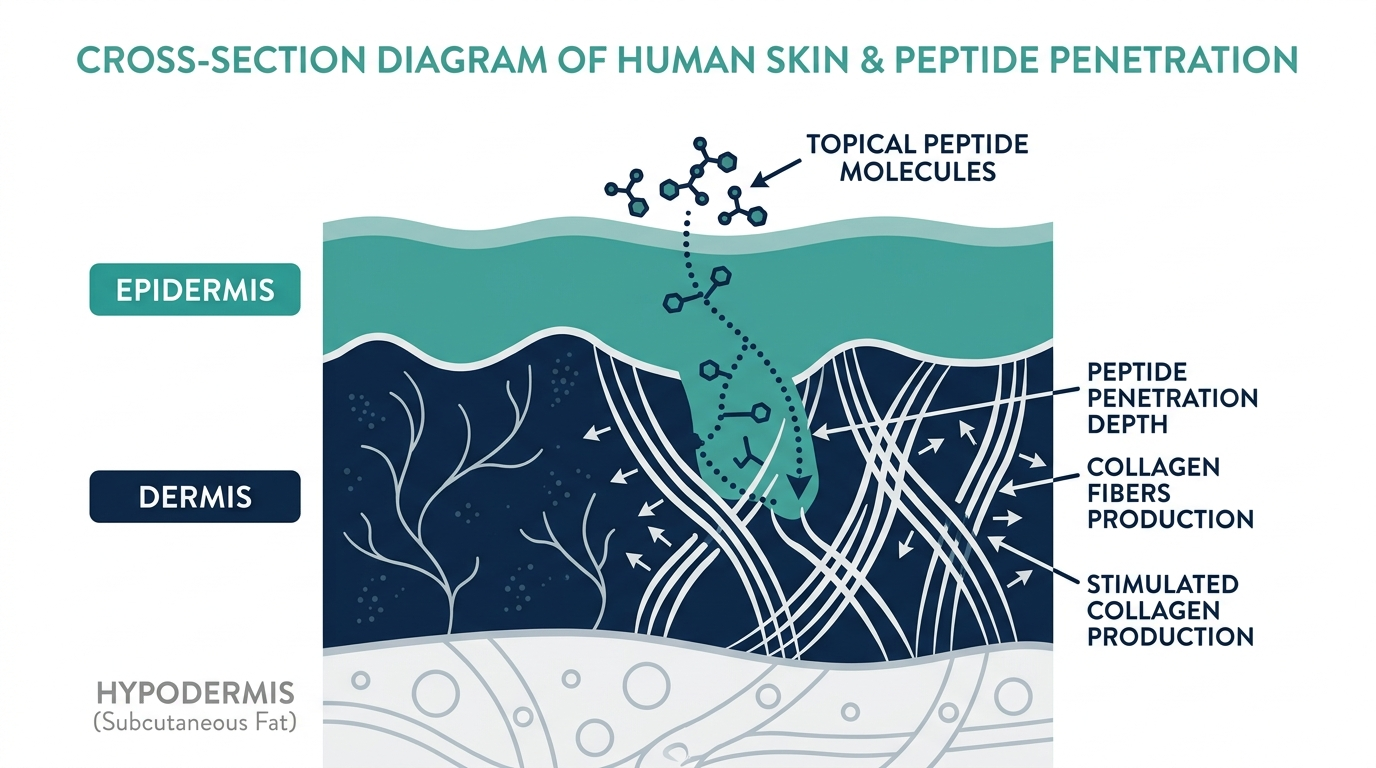
Peptides face a fundamental skin-penetration challenge: the “500 Dalton rule.” Research consistently shows that molecules above roughly 500 Da struggle to cross the stratum corneum barrier autonomously. Most cosmetic peptides, including GHK-Cu and the Matrixyl family, sit above that threshold. A 2025 review in the Journal of Cosmetic Dermatology confirmed that penetration enhancers, lipid bilayer disruption, and carrier-vehicle design are the primary levers that separate effective transdermal peptide delivery from an expensive rinse.
The Ordinary addresses this partly via lipid-conjugation in the palmitoyl peptides (the “palmitoyl” fatty-acid chain improves membrane affinity and uptake) and via Dimethyl Isosorbide in the formulation, which acts as a penetration enhancer. It also uses Hydroxypropyl Cyclodextrin as a carrier for GHK-Cu. These are the right tools, but clinical testing results for this specific product are not publicly available, which means performance is inferred from ingredient science rather than product-level trial data.
Personally, I would still use this serum, because the ingredient selection is defensible and the price makes the uncertainty tolerable. Do not believe any brand, including premium ones at five times the price, that claims definitive clinical proof for their specific multi-peptide formula when those trials are not published in peer-reviewed journals. Almost none of them are.

How does The Ordinary Multi-Peptide Serum compare to the competition?
At $32 for 30 mL, it undercuts almost every branded copper-peptide option.
| Product | Key Peptide(s) | Price per 30 mL | GHK-Cu % disclosed? | pH disclosed? |
|---|---|---|---|---|
| The Ordinary Multi-Peptide + Copper Peptides 1% | GHK-Cu 1%, Argireline, 3x Matrixyl family | $32 | Yes, 1% | Yes, 6.0-7.0 |
| NIOD Copper Amino Isolate Serum 3:1:1 (CAIS3) | GHK-Cu isolate, concentrated | ~$80+ for 15 mL | Partially | Not disclosed |
| Paula’s Choice Pro-Collagen Multi-Peptide Booster | Palmitoyl tripeptide-1, -3, -5 | ~$45 for 20 mL | No copper | Not disclosed |
| SkinMedica TNS Advanced+ | Growth factors + peptides | ~$350 for 28 g | No | No |
The clear winner on value is The Ordinary. NIOD (also a Deciem brand) uses a more concentrated and specifically isolated copper peptide complex, which likely outperforms on the GHK-Cu axis, but at a price point most people cannot sustain. SkinMedica TNS Advanced+ has published physician-backed clinical data but costs over 10x as much.
Full-body lab membership: 100+ biomarkers, doctor-reviewed, tracked over time.
What about the hair density serum? Is that any good?
The Multi-Peptide Serum for Hair Density sits in a different category and deserves a direct answer. At around $22 for 60 mL, it contains six trademarked actives: REDENSYL, Procapil, CAPIXYL, BAICAPIL, AnaGain, and high-solubility caffeine.
REDENSYL, the most-studied of the group, targets DHLA (dihydrolipoic acid), which stimulates hair follicle stem cells. A 2019 comparative study published by Hilaris found the RCP (Redensyl, Capixyl, Procapil) combination showed significantly better clinical recovery in terms of hair growth than topical 5% minoxidil in a sample of over 50 men per group. That is a striking result. It also comes with a significant caveat: almost all the research on these trademarked ingredients was conducted or funded by the companies that hold the patents on them. No large-scale independent, peer-reviewed randomized controlled trial has confirmed the effect.
A practical note from real-world testing: Today.com editors testing the serum for eight weeks reported above-average hair growth of roughly 1.75 inches across that period, versus an average of about 0.5 to 1 inch per month for most people. The serum is fragrance-free, absorbs without a trace, and tolerates well even on sensitive scalps.
Here is where I land: the hair density serum is worth trying if you have mild diffuse thinning and you cannot or will not use minoxidil. It is not a replacement for prescription finasteride or minoxidil if androgenic alopecia is confirmed by a dermatologist or trichologist. The price is low enough that the experiment costs less than one follow-up appointment.
The layering rules The Ordinary’s own website buries
Most people get less from their peptide serum than they should, not because the formula is bad but because they layer it wrong. These rules apply to the skin serum specifically.
Do not mix with direct acids or L-ascorbic acid vitamin C in the same application. A low pH environment from acids or ascorbic acid accelerates peptide hydrolysis, which means the actives break down before they can work. The Ordinary explicitly confirms this: use vitamin C in the morning and peptides in the evening, or on alternate days.
Apply on slightly damp skin after cleansing, before oils and creams. The multi-peptide serum is water-based. Applying it onto a dry face is fine, but layering it under a hydrating toner or mist first can help with absorption. Applying it after an oil or cream essentially buries it.
You can layer retinol on top in the PM routine. Peptides and retinoids do not conflict. The Ordinary recommends the peptide serum in the Treat step, followed by retinol.
The copper serum should not share a session with pure vitamin C (L-ascorbic acid). Copper ions oxidize ascorbic acid, degrading the vitamin C before it can act. This is chemistry, not brand policy.
One more thing: the blue tint fades within a minute of application on most skin tones. If you are patch-testing, do it on your inner forearm for 24 hours first. A small subset of users report a metallic smell that lingers for several hours, which is documented in independent reviews and worth knowing before you apply it before a meeting.
When the serum is enough, and when it is not
The Multi-Peptide + Copper Peptides 1% is the right choice for:
- Maintenance anti-aging from your late 20s or 30s onward, when collagen production starts declining (roughly 1% per year after age 25).
- Mild dynamic lines (forehead, crow’s feet) where a relaxant peptide like Argireline has its best evidence.
- Hydration and barrier support with a side of anti-aging signaling.
- Anyone who has been using the original “Buffet” serum and wants the copper-peptide upgrade at the same price tier.
It is not the right primary tool for:
- Moderate to deep static wrinkles, which require either prescription retinoids, in-office procedures, or both.
- Significant photoaging, where the evidence base points to tretinoin, niacinamide, and sunscreen as the proven cornerstones.
- Active inflammatory skin conditions. The GHK-Cu has anti-inflammatory properties but is not a treatment for rosacea, acne, or eczema.
Myth worth busting directly: peptides do not “replace” collagen by going into your skin and turning into collagen. They act as signaling molecules that prompt fibroblasts to upregulate their own collagen production. The effect is real but indirect and cumulative over weeks and months, not days. Anyone claiming visible collagen rebuilding in 72 hours is selling a timeline the biology does not support.
Hydrolyzed type I & III collagen peptides, third-party tested, unflavored.
Who should buy each version?
| You are… | Recommended pick | Why |
|---|---|---|
| 30s-40s, first anti-aging serum, budget-conscious | Multi-Peptide + Copper Peptides 1% | Best peptide density per dollar, low risk |
| Concerned about mild hair thinning, scalp-focused | Multi-Peptide Serum for Hair Density | Trademarked actives, no prescription needed |
| Already using tretinoin or retinoids | Multi-Peptide + Copper Peptides 1% in AM | Peptides + prescription retinoid = strong synergy |
| Managing moderate to deep wrinkles | Start with a derm, add peptide serum for maintenance | Peptides alone will underperform expectations |
| Sensitive skin, patch-test-first person | Multi-Peptide + Copper Peptides 1%, fragrance-free | No added fragrance, well-tolerated by most |
| Wants maximum copper peptide potency | NIOD CAIS3 (same parent brand, higher concentration) | Costs more, but copper complex is more concentrated |
Building a full routine around the peptide serum
A peptide serum performs only as well as the routine it sits inside. The most common reason people conclude it “did nothing” is that they slotted it into a routine that either canceled it out or gave it nothing to build on. Here is a clean, conflict-free structure that lets the actives do their job.
Morning: cleanse, then apply an antioxidant if you use one, then the peptide serum on damp skin, then a moisturizer, and finish with a broad-spectrum sunscreen. Sunscreen is not optional here. Peptides signal your fibroblasts to build collagen, and unprotected ultraviolet exposure degrades collagen faster than any serum can rebuild it, so skipping sunscreen quietly undoes the work.
Evening: cleanse, apply the peptide serum, let it absorb for a minute, then layer a retinoid if you use one, and seal with moisturizer. This is where peptides and retinoids pair well, because the retinoid drives turnover while the copper peptide brings anti-inflammatory support that can soften the early retinoid adjustment period.
If you also use a direct acid exfoliant or a pure vitamin C, give it its own session, either a different time of day or an alternating night, so the low pH does not degrade the peptides. The simplest reliable split for most people is vitamin C in the morning, peptides plus retinoid at night, and acids on two or three nights a week in place of the retinoid.
Side effects, tolerability, and who should be cautious
Copper peptide serums are among the better-tolerated actives in skincare, which is part of the appeal for sensitive skin. Most people experience nothing beyond the transient blue tint and, occasionally, a faint metallic smell. Still, a few groups should proceed thoughtfully.
- Very reactive or compromised barriers: if your skin is currently irritated, over-exfoliated, or mid-flare, introduce any new serum one at a time and space out other actives so you can tell what your skin is reacting to.
- Known copper or ingredient sensitivity: patch test on the inner forearm for 24 hours before applying to the face. Discontinue if you see redness, itching, or small bumps that do not settle.
- Pregnancy or breastfeeding: topical peptides are generally considered low risk, but the responsible move is to clear any new active with your obstetrician or dermatologist rather than assume.
- Layering with too much at once: the most common “reaction” is actually irritation from stacking a strong retinoid, an acid, and a new serum simultaneously. Add one active at a time over a couple of weeks.
If you develop persistent stinging, spreading redness, or breakouts that do not resolve within a week or two of stopping the product, that is your cue to see a dermatologist rather than push through.
Storage, shelf life, and keeping the actives alive
Peptides and copper complexes are not indestructible, and how you store the bottle affects whether you get the formula you paid for. A few habits protect the actives.
- Keep it cool and out of direct light. Heat and sunlight accelerate degradation of both peptides and delicate copper complexes. A bathroom shelf that bakes in afternoon sun is the worst spot; a cool drawer or cabinet is better.
- Close the cap promptly and avoid contaminating the dropper. Repeated air and skin contact can shorten a water-based serum’s usable life and invite microbial growth.
- Mind the period-after-opening symbol. Most serums list an open-jar icon with a number of months once opened. Buying one bottle at a time you will actually finish beats stockpiling several that expire on the shelf.
- Watch for change. A noticeable shift in color, separation, or an off smell is a signal the formula has turned. Peptide serums that have degraded will not necessarily look dramatically different, which is another reason not to hoard bottles for years.
None of this is exotic. Treat the serum like the perishable active it is, and you avoid quietly rubbing a degraded formula into your skin and blaming the product for underperforming.
How to actually measure whether it is working
Peptide results are cumulative and subtle, which makes them easy to miss and easy to imagine. A little structure keeps you honest and prevents both premature quitting and wishful thinking.
- Take a baseline photo set. Same lighting, same angle, no makeup, in the morning. Repeat every two weeks. Memory is a terrible instrument for tracking gradual change; a photo series is not.
- Give it a fair trial window. Hydration and surface smoothness can improve within the first few weeks, but the collagen-signaling benefits track with the multi-week timelines seen in peptide research, so judge firmness and fine lines at the two to three month mark, not at two weeks.
- Change one variable at a time. If you start the peptide serum, a new retinoid, and a new moisturizer in the same week, you will never know which one earned the credit or caused the irritation.
- Track tolerability, not just results. Note any stinging, breakouts, or redness alongside the photos, so you can separate a genuine reaction from unrelated skin fluctuations.
Set expectations to match the biology: this is maintenance and gradual improvement, not a dramatic overnight transformation. Anyone promising visible collagen rebuilding in days is selling a timeline the science does not support.
Turn what you just learned into action.
Superpower lets you test 100+ biomarkers from home, then re-check them over time so you can actually see progress, physician-reviewed at every step.
Frequently asked questions
Is The Ordinary Multi-Peptide Serum the same as the “Buffet” serum?
Not exactly. The Ordinary renamed its original Buffet serum to Multi-Peptide + HA, and the Buffet + Copper Peptides version became Multi-Peptide + Copper Peptides 1%. The formulas are the same as the products they replaced, just with clearer names. If you were buying “Buffet + Copper Peptides,” you are now buying Multi-Peptide + Copper Peptides 1%.
Can I use The Ordinary Multi-Peptide Serum twice a day?
Yes. The Ordinary recommends AM and PM use. The only adjustment is to avoid applying it in the same session as direct acids or vitamin C, which degrade peptides via pH conflict or oxidation. A common setup is peptide serum in the PM with retinol on top, and vitamin C in the AM.
Does The Ordinary Multi-Peptide Serum work for hair loss?
The hair density serum may help with mild diffuse thinning, based on limited but promising clinical data for REDENSYL and the RCP complex. It is not clinically validated for androgenic alopecia (pattern baldness) and is not a replacement for minoxidil or finasteride when those are indicated.
Why does The Ordinary Multi-Peptide + Copper Peptides 1% have a blue color?
The blue tint comes from copper ions in the GHK-Cu complex. Copper forms a characteristic blue-green color in aqueous solution. The tint fades within seconds to a minute of application and does not stain skin.
Can I use peptides with retinol?
Yes, and the combination is synergistic. Retinoids accelerate cell turnover and can cause temporary irritation and barrier disruption; peptides, particularly GHK-Cu, have anti-inflammatory and wound-repair properties that can help offset some of the initial retinoid adjustment. Apply the peptide serum first, let it absorb, then apply your retinoid.
How long before I see results from the Multi-Peptide Serum?
Realistic timeline for visible change: skin hydration and smoothness improve within 2 to 4 weeks. Fine-line softening from relaxant peptides like Argireline shows up around 4 weeks. Meaningful collagen-signaling effects from GHK-Cu and Matrixyl peptides take 10 to 12 weeks of consistent use, matching the clinical study timelines in the published literature.
What should I not mix with The Ordinary Multi-Peptide + Copper Peptides 1%?
Avoid using it in the same routine as direct acids (AHAs, BHAs), L-ascorbic acid vitamin C, resveratrol, and pure vitamin C derivatives with low pH. Mixing copper ions directly with vitamin C also causes oxidation. These are not dangerous combinations, just wasteful ones that degrade the actives before they can work.
Author: Vital Signs Today Editorial Team, [credential]”]. Educational content, not medical advice. Sources linked inline.
Hydrolyzed type I & III collagen peptides, third-party tested, unflavored.
Primary sources
- The Ordinary Multi-Peptide + Copper Peptides 1% product page
- The Ordinary Multi-Peptide Serum for Hair Density product page
- Regenerative and Protective Actions of the GHK-Cu Peptide in the Light of New Gene Data, PMC
- Investigating the Effects of Argireline in a Skin Serum, PMC
- Enhancing Dermal Absorption of Cosmeceuticals, Journal of Cosmetic Dermatology 2025
- Comparative Study: RCP vs. 5% Minoxidil, Hilaris Publisher
- Matrixyl Clinical Studies: Anti-Wrinkle Evidence, PeptideJournal
- Best Copper Peptide Serum 2026, Innerbody
- The Ordinary Skincare Layering Guide
- IncIDecoder: The Ordinary 1% Multi-Peptide + Copper Peptides 1% Serum ingredients
Related reading
Vital Signs Today may earn a commission if you buy through links on this page. It does not affect our editorial assessments.