
Educational content, not medical advice. Speak with a licensed clinician before beginning any supplementation or therapy program.
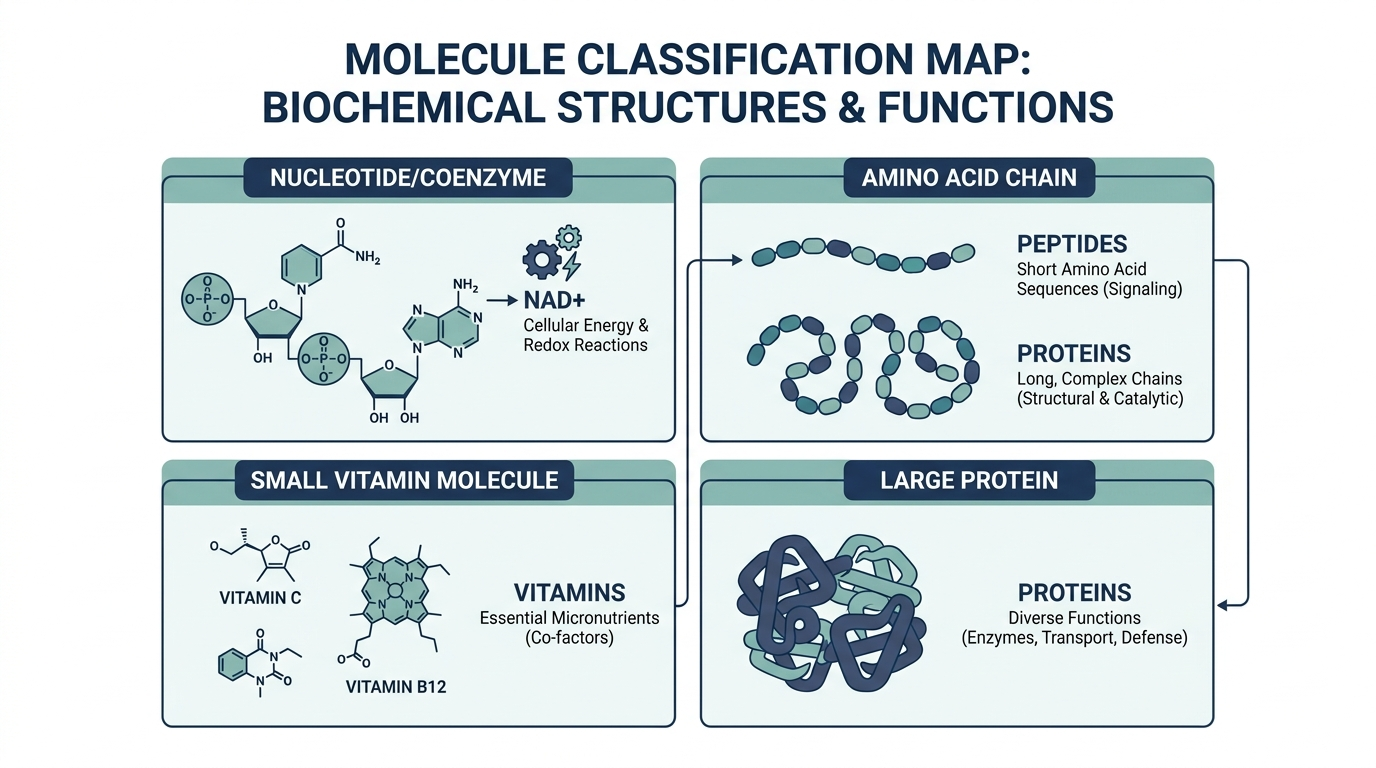
Short answer: No. NAD (nicotinamide adenine dinucleotide) is not a peptide. It is a coenzyme, a dinucleotide built from nucleotides, the same family of building blocks that make up DNA, not from amino acids. Calling NAD a peptide is like calling vitamin B12 a protein: understandable confusion given where they show up, but chemically wrong in a way that changes every decision you make about them.
NAD isn’t even a peptide, it’s a coenzyme your cells depend on. Curious what your own cellular and metabolic markers show? One at-home Superpower draw checks 100+ biomarkers, physician-reviewed.
The confusion is not random. Wellness clinics bundle NAD+ infusions alongside peptide therapy on the same menu. Podcasts name-drop both in the same breath. Telehealth platforms prescribe both through the same compounding pharmacy. Proximity in the longevity space created an association in the market that chemistry does not support, and that gap matters when you are trying to decide whether NAD+ is right for you, what form to take, and whether it operates through the same mechanisms as the peptides you have been reading about.
Full-body lab membership: 100+ biomarkers, doctor-reviewed, tracked over time.
What exactly is NAD, and why is it not a peptide?
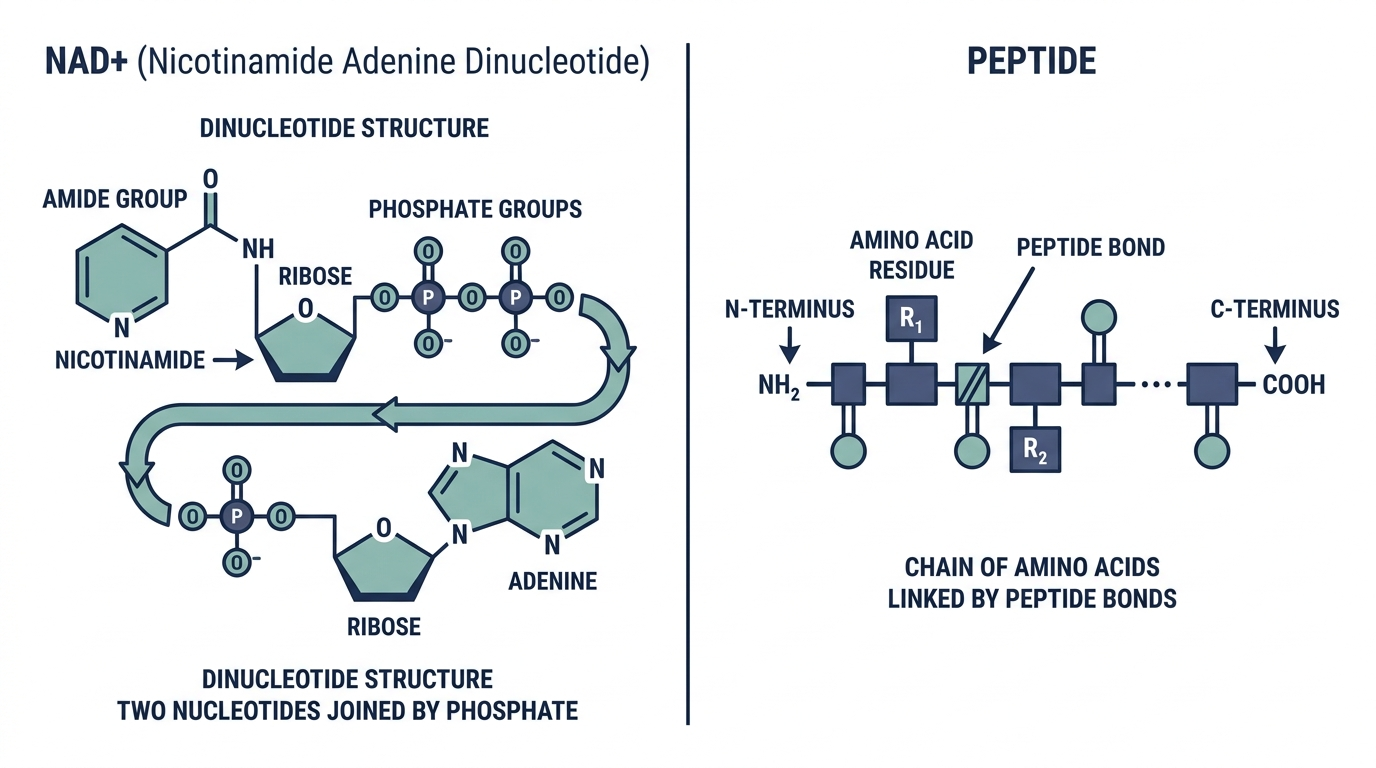
The definition of a peptide is strict: a chain of two or more amino acids linked by peptide bonds. That is it. Collagen peptides, BPC-157, GHK-Cu, sermorelin, CJC-1295, the GLP-1 drugs semaglutide and tirzepatide: all peptides, all chains of amino acids, all working by binding to receptors or triggering cell signaling cascades.
NAD is built from a completely different set of ingredients. Its full name, nicotinamide adenine dinucleotide, is a description of its structure: two nucleotides (nicotinamide and adenine) joined by a phosphate bridge. One nucleotide is built around nicotinamide, a form of vitamin B3. The other is adenine, the exact same base found in your DNA. There is not a single amino acid in the structure.
This puts NAD in the same chemical family as ATP (the molecule your cells use to run nearly every energy-requiring reaction), FAD (flavin adenine dinucleotide, another redox coenzyme), and coenzyme A. These are nucleotide-based helper molecules for metabolism, not signaling chains of amino acids.
The simplest test: peptides get digested into amino acids. NAD, if you took it orally as the intact molecule, would be broken apart into its nucleotide components. That is why oral NAD+ supplementation does almost nothing useful, and why the field has moved to precursors that can enter cells and be reassembled inside.
The difference is not just chemistry trivia. It changes everything about how NAD+ reaches your tissues, what you measure to know it is working, how the regulatory system treats it, and which delivery method is worth paying for.
Why does NAD matter enough to appear on every longevity clinic menu?
The simplest way to actually get this done
Superpower is a full-body lab membership that runs 100+ biomarkers, has each result reviewed by a doctor, and tracks your numbers year over year (about $199/year). It is what we point readers to when they would rather get one clean, complete draw than chase single tests one at a time. Here is superpower reviewed in full.
NAD+ participates in more than 500 enzymatic reactions in the human body, more than any other coenzyme. The two most consequential roles are redox metabolism and longevity signaling.
In redox metabolism, NAD+ accepts electrons from the breakdown of carbohydrates, fats, and proteins, cycling between its oxidized form (NAD+) and reduced form (NADH). This electron shuttle is the core of cellular respiration, the process that turns food into ATP inside your mitochondria. Without NAD+, your cells cannot extract energy from the food you eat.
In longevity signaling, NAD+ is the required fuel for two enzyme families with direct links to aging: sirtuins and PARPs.
Sirtuins (SIRT1 through SIRT7) are sometimes called longevity genes. They regulate DNA repair, gene expression, mitochondrial quality control, and the inflammatory response. The catch: every catalytic cycle burns one molecule of NAD+. No NAD+, no sirtuin activity. Research published in npj Aging describes the sirtuin-NAD+ relationship as a direct dial on cellular aging rather than a passive downstream consequence of it, though the authors note that most mechanistic evidence remains from animal models rather than completed human trials.
PARPs (poly ADP-ribose polymerases) are DNA repair enzymes that also consume NAD+ with every repair cycle. The “hyperactive PARP” hypothesis holds that accumulated DNA damage with age drives PARPs to run continuously, siphoning the shared NAD+ pool and starving sirtuins. Studies in human fibroblasts and tissue samples show PARP activity rises with donor age, which is consistent with this picture.
The combined result: by midlife, human NAD+ levels have declined roughly 40 to 50% compared to young adulthood, and the downstream effect on sirtuin and PARP activity is measurable. That is the biological case behind the clinical interest, even before getting to the question of whether any supplement or infusion can reverse it.
What does low NAD+ actually feel like?
There is no clean symptom checklist for low NAD+, and anyone who hands you one is overselling. NAD+ decline is a slow background process, not a disease with a signature you can point to. What research associates with falling NAD+ is nonspecific: lower energy, slower recovery from exertion, reduced exercise tolerance, and the general metabolic slowdown that shows up in midlife. You cannot feel your NAD+ level the way you feel low blood sugar.
This is exactly why the measurable-biomarker angle matters here. Rather than chase a vague sense of being tired, the useful move is to establish whether your levels have actually dropped, and whether raising them changes anything you can track. Fatigue has a hundred causes, and most of them, poor sleep, low iron, an underactive thyroid, low mood, are more common and cheaper to fix than an NAD+ deficit. Rule those out first before you spend money on an infusion chasing a number you never measured.
How does NAD+ compare to actual peptides in clinical use?
This is where knowing the chemistry has practical value. The table below shows where each sits in terms of evidence, delivery, and regulatory status.
| Compound | Type | Mechanism | Evidence level | Legal route (US, 2026) |
|---|---|---|---|---|
| NAD+ | Coenzyme (dinucleotide) | Redox substrate, sirtuin/PARP fuel | Multiple human RCTs (precursors); IV pharmacokinetics well characterized | IV/injection via compounding; oral precursors (NMN, NR) available as supplements |
| NMN | NAD+ precursor (nucleotide) | Converts to NAD+ inside cells | 2022 trial (66 adults, 300 mg/day, 60 days) showed raised blood NAD+ and improved 6-minute walk distance | FDA reversed 2022 exclusion in September 2025; now lawful as dietary supplement |
| BPC-157 | Peptide (15 amino acids) | Receptor binding, tissue repair signaling | Strong preclinical; minimal human RCTs | Removed from FDA 503A Category 2 list in April 2026; compounding status pending July 2026 PCAC meeting |
| Sermorelin | Peptide (29 amino acids) | GH-releasing hormone receptor agonist | Moderate human evidence; multiple clinical studies | Prescription; available via licensed telehealth |
| CJC-1295 + Ipamorelin | Peptides | GH secretagogue stack | Mostly animal/small human studies | Research / grey zone; regulatory status unclear |
| GHK-Cu | Peptide (3 amino acids + copper) | Gene expression across 4,000+ human genes | Moderate evidence for topical; injectable limited | Topical cosmetic sold openly; injectable research grade |
The asymmetry that stands out: NAD+ is the only compound in the longevity stack you can objectively measure before and after treatment with a standard blood test. Most peptides lack an equivalent biomarker readout. That alone changes the clinical accountability picture.
Personally, I find it telling that the compound with the clearest measurable mechanism, NAD+, is the one most people still misclassify as a peptide because of where it appears on the menu.
Does the delivery method matter as much as the marketing says?
Yes, but in a specific way most clinics understate.
The fundamental problem with oral NAD+ as the intact molecule is that it does not cross the gut lining efficiently. Bioavailability is roughly 5 to 30%, which means the majority of what you swallow gets broken down before reaching systemic circulation. This is not a flaw in a particular brand; it is a property of the molecule’s size and structure.
IV NAD+ infusion bypasses this entirely, achieving near-100% bioavailability. Plasma NAD+ levels begin rising at approximately 2 hours into an IV session, and elevated levels persist for 24 to 48 hours post-infusion. Sessions run 2 to 4 hours depending on dose. Side effects during infusion, primarily flushing, chest tightness, nausea, and lightheadedness, are rate-dependent and resolve within minutes of slowing the drip.
The smarter alternative for ongoing use is oral precursors, specifically nicotinamide riboside (NR) and nicotinamide mononucleotide (NMN). These are not NAD+ itself. They are upstream building blocks that enter cells through their own transport mechanisms and get converted into NAD+ internally. NR crosses cell membranes via equilibrative nucleoside transporters. NMN must first be converted to NR at the cell surface before entering.
A 2022 trial published in PMC with 66 healthy adults ages 40 to 65 found that 300 mg/day of NMN over 60 days significantly raised blood NAD+ levels versus placebo and improved performance on a 6-minute walking test. NR studies show 22 to 142% increases in blood NAD+ after 2 to 4 weeks at 300 to 1,000 mg/day. These are real, measurable changes.
Do not believe anyone who tells you daily oral supplements and monthly IV infusions are interchangeable. The evidence base, cost structure, and patient profile for each are genuinely different. IV therapy is appropriate for acute loading or for people with absorption issues who have not responded to oral precursors. For most people building a long-term protocol, a high-quality oral NR or NMN product at clinically tested doses is a better starting point on the cost-benefit curve.
The delivery debate also has a subcutaneous middle ground. Several compounding pharmacies and telehealth platforms now offer self-administered NAD+ subcutaneous injections at home, typically $50 to $200 per injection or $350 for a 20-shot monthly plan. Subcutaneous injections avoid the 2 to 4-hour clinic session and the rate-dependent side effects of IV infusion while achieving higher bioavailability than oral NAD+. This is the option many telehealth longevity programs, including Sprout Health and Defy Medical, are leading with in 2026.
Telehealth GLP-1 program with provider visits and pharmacy coordination.
What does NAD+ therapy actually cost in 2026?
The pricing range is wide because delivery method and clinical overhead vary so much.
IV infusions (in-clinic):
A standard 250 mg session runs $250 to $400 at most US clinics. A 500 mg session runs $400 to $700. High-dose 1,000 mg protocols reach $800 to $1,500 per session. In Los Angeles, in-clinic sessions range from $429 to $879, with mobile concierge IV adding $200 or more on top. A typical loading phase of 3 to 4 sessions costs $1,500 to $2,000. Annual maintenance ranges from $1,600 to $7,200 depending on frequency.
Subcutaneous injections (at-home, telehealth):
Sprout Health’s introductory pricing is $149 for the first month. Ongoing plans run approximately $350 for 20 shots (a one-month supply at daily dosing) or $450 for 40 shots. Telehealth consultations add a onetime or annual fee depending on the platform.
Oral precursors (supplement):
Quality NR supplements (Tru Niagen, Thorne NiaCel) run $40 to $60 for a 30-day supply at 300 to 500 mg/day. Quality NMN supplements run $50 to $80 per month. The FDA’s September 2025 ruling restoring NMN’s lawful dietary supplement status has already increased competition and is pushing prices down.
Insurance does not cover any of this. NAD+ therapy for longevity or optimization is elective and out of pocket across the board. A small subset of HSA/FSA plans may cover it when prescribed by a clinician with documented clinical rationale, but verify with your plan before assuming.
The question to ask before committing to IV therapy at $300 a session is whether you have tried oral precursors at a clinically validated dose first. For most people building a longevity stack from scratch, NMN or NR at 300 to 500 mg/day for 8 to 12 weeks, with baseline and follow-up blood NAD+ testing, is the right first move. It is measurable, reversible, and a fraction of the IV cost. If blood levels do not respond, subcutaneous injection or IV becomes the evidence-based next step.
How would you build a starter NAD+ protocol?
If you have read this far and want a defensible starting point rather than the most expensive one, here is the sequence the evidence actually supports.
1. Establish a baseline. Test blood NAD+ before you change anything, and pull a general metabolic panel so you know what else is going on underneath the fatigue.
2. Start with an oral precursor. NR at 300 to 500 mg/day, or NMN at 250 to 500 mg/day, for 8 to 12 weeks. These are the doses the human trials used, not a megadose invented by a supplement brand.
3. Support the pathway with lifestyle, not just pills. NAD+ synthesis responds to regular exercise, which raises it on its own, while poor sleep and heavy alcohol drain it. The supplement works better on top of those basics than in place of them.
4. Retest and decide. If blood NAD+ rose and you notice a difference worth the cost, continue. If levels did not budge, that is your signal to consider subcutaneous injection or a supervised IV course, not to blindly double the oral dose.
The point of the sequence is accountability. Each step produces a number you can check, which is the single biggest advantage NAD+ holds over the peptides it gets grouped with. Consider a 55-year-old who feels flat and books a $400 IV on impulse. He feels great for a day, mostly from the fluids and the setting, then cannot tell whether the next month is any different. The man who tested first, took NR for ten weeks, and retested knows exactly whether his money bought a real change.
Is NAD+ therapy safe, and who should be careful?
For most healthy adults, oral precursors have a strong safety record across the trials, with side effects limited to mild nausea or flushing at higher doses. IV NAD+ carries the rate-dependent reactions already described: flushing, chest tightness, and nausea that ease as soon as the drip is slowed.
The people who should not freelance this are clearer cut. Anyone with active cancer should stay away without oncology guidance, because the same sirtuin and DNA-repair pathways NAD+ fuels are studied in tumor biology and the risk-benefit is genuinely unsettled. Pregnant and breastfeeding women lack safety data and should skip it. Anyone on prescription medication or managing a chronic condition should route this through their own clinician rather than a wellness-clinic upsell. The honest limitation across the entire category is the missing long-term human outcome data: raising a biomarker is not the same as proving you live longer, and the strongest longevity claims still rest largely on animal work.
Why do clinics keep calling NAD+ a “peptide therapy”?
This is the myth worth naming directly.
Wellness clinics call NAD+ part of “peptide therapy” because it is prescribed through the same compounding pharmacy relationship, administered via the same subcutaneous or IV route, and marketed to the same longevity-focused patient. The category is a commercial one, not a chemical one. From a purchasing standpoint, NAD+ and BPC-157 both arrive as a compounded product that requires a prescription. From a chemistry standpoint, they have almost nothing in common.
The practical consequence is that when a clinic says it offers “peptide and NAD+ therapy,” it is accurately listing two separate product categories. When it calls the NAD+ a peptide, it has made an error. That error would matter if it led you to assume that NAD+ works via receptor binding like sermorelin or BPC-157, that it requires the same storage or reconstitution process as a lyophilized peptide vial, that the same regulatory changes affecting research peptides automatically apply to it, or that injectable NAD+ has the same grey-market legal ambiguity as research-use-only BPC-157. None of those are true.
NAD+ delivered as a compounded injectable has been available through licensed compounding pharmacies for years without the regulatory turbulence that hit peptides like BPC-157 and TB-500 in 2023 and 2024. It is not on the FDA’s 503A Category 2 list and was not swept up in the 2025 to 2026 crackdown the same way research peptides were. Its path to a licensed clinic is cleaner, and calling it a peptide is a shortcut that obscures that advantage.
Curious what your own levels look like?
Baseline 100+ biomarkers today and retest as life changes, all in one membership with physician review.
Frequently asked questions
Is NAD+ a peptide?
No. NAD+ (nicotinamide adenine dinucleotide) is a coenzyme, a dinucleotide built from two nucleotide units, nicotinamide and adenine, joined by a phosphate bridge. It contains no amino acids, which is the defining building block of peptides. NAD+ is chemically closer to a segment of DNA than to any peptide.
Why do clinics lump NAD+ and peptides together?
Because they share delivery infrastructure: both are often compounded, prescribed by the same telehealth provider, and administered via injection or IV. The bundling is commercial and procedural, not scientific. NAD+ and peptides like BPC-157 or sermorelin work through fundamentally different mechanisms and belong to different chemical classes.
What is the difference between NAD+, NMN, and NR?
NAD+ is the active coenzyme your cells use. NMN (nicotinamide mononucleotide) and NR (nicotinamide riboside) are upstream precursors that your body converts into NAD+. Taking oral NAD+ directly does little because the molecule is too large to cross the gut lining efficiently. NMN and NR enter cells via their own transport pathways and raise intracellular NAD+ levels more effectively. NR was restored to lawful dietary supplement status by the FDA in September 2025. NMN is also now lawful as a supplement after the FDA reversed its 2022 exclusion.
How much does NAD+ therapy cost in 2026?
IV infusions run $250 to $400 for a 250 mg session and $800 to $1,500 for 1,000 mg. At-home subcutaneous injection plans start around $149 for the first month through telehealth platforms, with ongoing plans around $350 for 20 shots. Quality oral NMN or NR supplements cost $40 to $80 per month. None of this is covered by insurance.
Can you test your NAD+ levels?
Yes, and this is one of NAD+’s advantages over most peptides. Blood-based NAD+ testing is commercially available through labs and services like Jinfiniti, with at-home finger-stick options. A 2026 study raised questions about whole-blood NAD+ as an aging biomarker specifically, finding no age-related difference, but it remains a useful tool for confirming that a supplement or infusion is actually raising your levels before committing to an ongoing protocol.
Does oral NAD+ supplementation work?
Taking NAD+ as the intact molecule orally does not raise intracellular levels effectively because bioavailability is roughly 5 to 30%. The well-supported oral route is through precursors: NMN at 250 to 500 mg/day or NR at 300 to 1,000 mg/day. A 2022 human trial with 66 adults found 300 mg/day NMN raised blood NAD+ and improved a walking performance test at 60 days. Multiple NR trials show 22 to 142% increases in blood NAD+ after 2 to 4 weeks.
Is NAD+ affected by the 2025 to 2026 peptide crackdown?
Not directly. The FDA’s 503A enforcement campaign targeted specific peptides like BPC-157, TB-500, and CJC-1295, not NAD+. Compounded injectable NAD+ has been available through licensed pharmacies without the same category-level restrictions. The crackdown does not make NAD+ harder to access through legitimate telehealth channels.
Will NAD+ give me more energy right away?
Some people report a subjective lift within a day of an IV session, but a large part of that is the hydration and the placebo of a clinical setting. Oral precursors work slowly and quietly, raising levels over weeks rather than producing an acute jolt. If you want an honest test, track sleep, recovery, and workout performance over two months, not how you feel the afternoon of an infusion.
Is NMN or NR the better precursor?
Both raise blood NAD+ in human trials. NR has a longer track record and more published safety data; NMN has strong recent trial support and regained lawful supplement status in 2025. There is no clean head-to-head winner. Pick one, use a clinically tested dose, and judge it by your own before-and-after levels rather than by which one a podcast host is selling that week.
Can I just take niacin (vitamin B3) instead?
Niacin does raise NAD+ and is far cheaper, but at effective doses it causes an intense flushing reaction most people cannot tolerate daily. That flushing problem is a big reason the field moved to NR and NMN, which raise NAD+ without it. Nicotinamide, another B3 form, avoids the flush but is less effective at boosting NAD+ than the dedicated precursors.
Telehealth GLP-1 program with provider visits and pharmacy coordination.
Author: Vital Signs Today Editorial Team, [credential]”]. Educational content, not medical advice. Sources linked inline.
Primary sources:
– Jinfiniti: NAD+ vs Peptides
– PMC: Oral NMN in healthy subjects raises blood NAD+, 2022
– PMC: NAD+-boosting supplementation in humans, review
– Nature npj Aging: NAD+ and sirtuins in aging
– IAPAM: IV NAD+ Therapy for Aesthetic Providers 2026
– FDA NMN supplement status reversal, nmn.com
– WV University Healthcare: NAD+ IV Therapy 2026
– Yahoo Finance: Best NAD+ Injection 2026, Sprout Health pricing
– InnerBody: NMN vs NAD comparison 2026
– The Scientist: Blood NAD+ as aging biomarker limitations, 2026
Related reading
Vital Signs Today may earn a commission if you buy through links on this page. It does not affect our editorial assessments.