
Educational content, not medical advice. Talk to a licensed clinician before making any treatment decisions.
Short answer: HGH is definitively a peptide hormone, built from a chain of 191 amino acids with a molecular weight of 22,124 daltons. Steroids are lipid-based molecules derived from cholesterol. The two share no chemistry whatsoever. The confusion exists because both substances are misused in sports for similar performance goals, not because they are biologically related.
HGH is a peptide hormone, not a steroid, built from 191 amino acids. Want to see what your own hormone panel actually reads? One at-home Superpower draw checks 100+ biomarkers, physician-reviewed.
The distinction is not semantic. It changes how the hormone travels through your blood, where its receptor sits on your cells, how fast it acts, what happens to it in your liver, what detection methods catch it, and, most practically, what legal and medical framework governs its use. Getting this wrong leads to bad comparisons, bad decisions, and a lot of bad forum advice.
Full-body lab membership: 100+ biomarkers, doctor-reviewed, tracked over time.
What exactly is HGH made of?
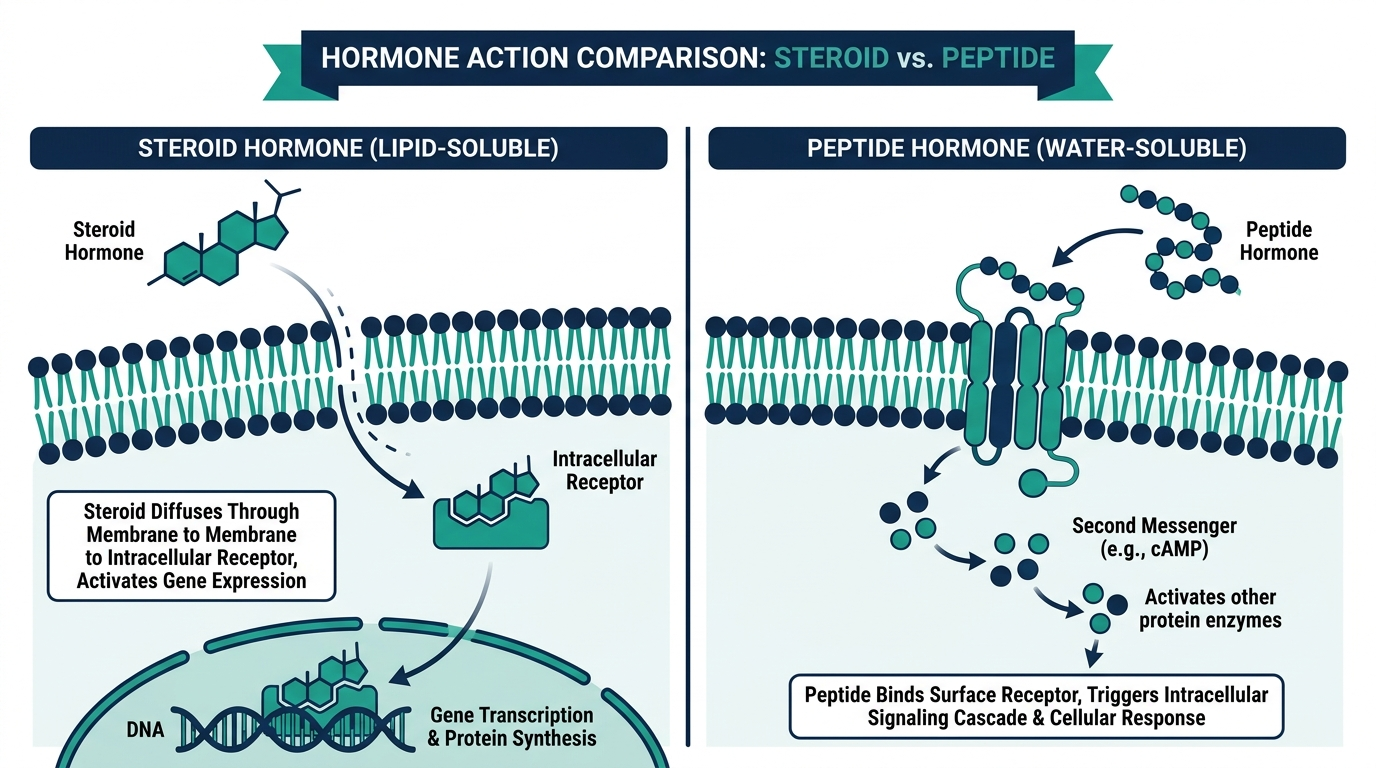
Human growth hormone (HGH), also called somatotropin, is a single-chain polypeptide produced by somatotroph cells in the anterior pituitary gland. Its primary isoform consists of 191 amino acids connected by peptide bonds, stabilized by two intramolecular disulfide bridges: one connecting cysteine residues at positions 53 and 165, and another connecting positions 182 and 189. The molecular weight of the dominant form is 22,124 daltons.
There is also a minor isoform of 20 kDa, missing residues 32 to 46, that accounts for roughly 15% of circulating growth hormone. Both isoforms have similar growth-promoting activity. The point is structural: this molecule is a polypeptide chain, the same category of molecule as insulin, glucagon, and the GLP-1 drugs you have seen advertised on television.
Steroids are not amino acid chains. They are not even close.
What makes something a steroid hormone?
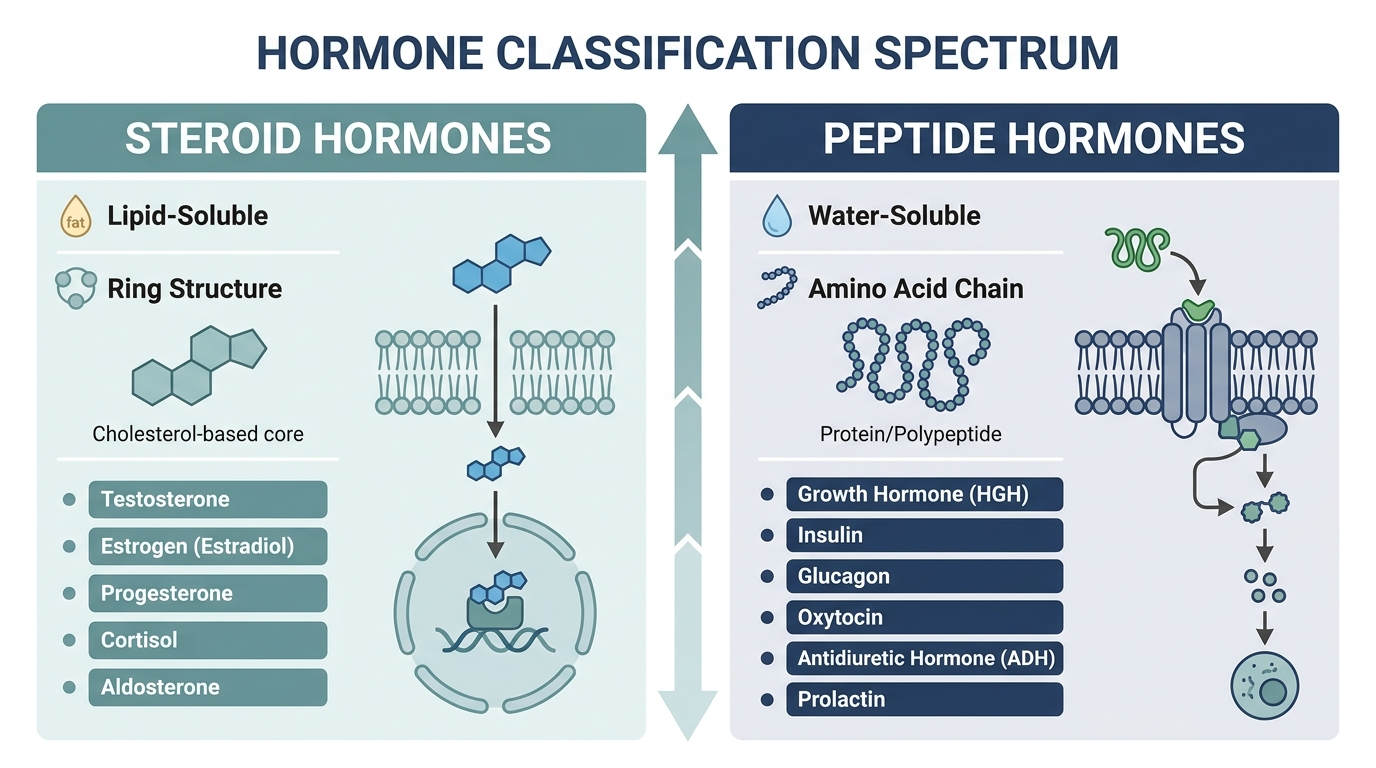
Steroid hormones are synthesized from cholesterol, a lipid. The structural core is a four-ring carbon skeleton called the cyclopentanoperhydrophenanthrene ring system, and every steroid hormone shares this backbone. The body synthesizes steroids in the adrenal glands (cortisol, aldosterone), the gonads (testosterone, estrogen, progesterone), and the placenta.
Because steroids are lipophilic, meaning fat-soluble, they do something peptide hormones cannot: they cross the cell membrane directly, without needing a surface receptor. Once inside the cell, they bind to intracellular receptors in the cytoplasm or nucleus. The hormone-receptor complex then travels to the DNA and directly influences gene transcription. This is why steroid effects are slow-building, lasting, and hard to reverse quickly.
HGH does the opposite. Because peptide hormones are hydrophilic (water-soluble), they cannot cross the cell membrane. They bind to a receptor on the outer surface of target cells and trigger an intracellular signaling cascade, typically through a secondary messenger like cyclic AMP. The cell response is faster, more tightly regulated, and limited by the hormone’s short half-life in circulation, roughly 15 to 20 minutes for the 22 kDa isoform.
The bottom line: two different chemistries, two different receptors, two different clocks.
Why do people keep confusing HGH with steroids?
This is worth addressing directly, because the confusion has real consequences for how people research their options.
The mix-up comes from context, not from chemistry. Elite athletes have been combining injectable HGH with anabolic steroids since at least the 1980s, and the phrase “he’s on gear” often bundled both substances together. Media coverage of doping scandals rarely stopped to explain that “HGH and steroids” meant two completely different categories of molecule. The lumping happened at the cultural level, and it stuck.
There is also a legal conflation that muddies the water. Anabolic steroids are Schedule III controlled substances under the Controlled Substances Act. HGH is not scheduled at all, but the law governing it is unusually strict in a different way: the FDA makes it illegal to prescribe, possess, or distribute HGH for any purpose other than the specific medical indications the agency has approved. Prescribing it for “anti-aging,” bodybuilding, or athletic enhancement is explicitly prohibited, even with a valid prescription. That restriction sounds similar to the steroid rules but operates through an entirely different legal mechanism.
Finally, WADA’s Prohibited List classifies HGH under Section S2, “Peptide Hormones, Growth Factors, Related Substances and Mimetics,” while anabolic steroids appear under Section S1, “Anabolic Agents.” Both are prohibited at all times. The fact that they sit in adjacent sections of the same banned list is probably the single largest contributor to casual conflation.
Personally, I find it frustrating that the category error persists so widely, because it leads people to assume the risks, legal status, and mechanisms of the two substances are interchangeable. They are not.
How does HGH actually work in the body?
HGH does not act on muscle tissue directly in the way that testosterone and its synthetic derivatives do. Its primary downstream mechanism runs through insulin-like growth factor 1, or IGF-1. When HGH binds to receptors in the liver, the liver secretes IGF-1 into the bloodstream. IGF-1 then acts on muscle, bone, fat tissue, and other organs.
This two-step pathway matters clinically. When a doctor orders labs to assess growth hormone status, they typically measure IGF-1, not HGH itself, because HGH is secreted in pulses and its half-life is too short for a single blood draw to be informative. IGF-1, by contrast, is stable in the blood over 24 hours and reflects the integrated effect of GH secretion.
The physiological roles of adequate GH/IGF-1 include:
– Maintaining lean muscle mass and reducing visceral fat
– Supporting bone mineral density
– Regulating protein and fat metabolism
– Influencing sleep quality, particularly slow-wave sleep
– Contributing to skin thickness and elasticity
None of these are steroid-class mechanisms. Testosterone and its analogs work by binding androgen receptors that directly upregulate protein synthesis genes inside muscle cells. HGH takes a detour through a different organ and a different hormone before it reaches muscle tissue at all.
What is the real difference between HGH and anabolic steroids for health?
The risk profiles diverge sharply, and conflating the two leads to underestimating the specific dangers of each.
| Feature | HGH (Peptide Hormone) | Anabolic Steroids (Synthetic Androgens) |
|---|---|---|
| Chemical origin | 191 amino acids (polypeptide) | Cholesterol-derived lipid |
| Receptor location | Cell surface (GPCR/JAK-STAT) | Intracellular (androgen receptor) |
| Route to muscle | Indirect, via IGF-1 in liver | Direct, via androgen receptor in muscle cells |
| Half-life in blood | 15 to 20 minutes | Hours to weeks depending on ester |
| Aromatizes to estrogen | No | Yes (many synthetic androgens do) |
| Liver toxicity (oral) | Not applicable (injectable only) | High risk with 17-alpha-alkylated orals |
| Signature excess risk | Acromegaly, carpal tunnel, organ growth, type 2 diabetes | HPTA suppression, gynecomastia, cardiovascular strain |
| Controlled substance | No (but legally restricted use) | Yes, Schedule III (US) |
| WADA class | S2 Peptide Hormones | S1 Anabolic Agents |
| FDA-approved use | Adult/pediatric GH deficiency, HIV wasting | Hypogonadism, certain anemias (limited) |
| Approximate Rx cost | $2,400 to $4,800 per month | Much lower for testosterone |
The signature risk of excessive HGH deserves specific attention. When HGH is used at supraphysiological doses over years, the classic outcome is acromegaly: enlargement of the hands, feet, jaw, and facial features, joint pain, carpal tunnel syndrome, and, most seriously, cardiovascular complications including cardiomegaly and left ventricular hypertrophy. Chronic HGH excess also induces insulin resistance, raising the risk of type 2 diabetes. Cancer risk, particularly colorectal cancer, is elevated in patients with acromegaly, though the magnitude remains debated in the literature.
None of these are steroid risks. They are HGH-specific consequences of pushing a different biological axis too hard. The person who conflates the two substances and dismisses HGH concerns because “steroids do much worse damage” is operating on a false comparison.
HGH vs. growth hormone-releasing peptides: a second confusion to clear up
Within the peptide therapy world, there is a second common confusion: “HGH peptides” versus HGH itself. These are entirely different interventions.
HGH (recombinant somatropin) is the actual hormone, synthesized in a bioreactor and injected to replace or supplement your body’s own output. Brands include Norditropin (Novo Nordisk), Genotropin (Pfizer), Humatrope (Eli Lilly), Omnitrope (Sandoz), and several others.
Growth hormone-releasing peptides, often called GH secretagogues, are a completely different approach. They do not add HGH to your system. They signal your pituitary to release more of its own stored HGH. The best-known are:
- Sermorelin: a 29-amino acid analog of GHRH, the body’s natural growth-hormone-releasing hormone. FDA-approved (though the branded version is discontinued; it is available through compounding).
- Ipamorelin: a pentapeptide GHRP that binds ghrelin receptors, triggering GH release with minimal effect on cortisol or prolactin, which makes it one of the cleaner options in the class.
- CJC-1295: a longer-acting GHRH analog, commonly combined with ipamorelin.
- Tesamorelin: FDA-approved (Egrifta) specifically for HIV-associated lipodystrophy.
The practical distinction: secretagogues preserve your pituitary function and stay within the body’s own feedback loop. Exogenous HGH bypasses that loop and, at higher doses, suppresses natural production. For most people seeking recovery, body composition, and sleep benefits, secretagogues can deliver 70 to 80% of the benefit of HGH at 10 to 20% of the cost, with a meaningfully safer risk profile.
Do not believe the marketing that treats these as interchangeable. They act on completely different steps of the same pathway, at very different price points, with different regulatory histories.
Telehealth GLP-1 program with provider visits and pharmacy coordination.
What does legitimate HGH therapy actually look like?
FDA-approved uses of HGH are narrowly defined. For adults, that means documented growth hormone deficiency confirmed by provocative stimulation testing or, in cases of pituitary disease, a serum IGF-1 below the laboratory reference range, plus documented short bowel syndrome and HIV-associated wasting (Serostim). For children, the approved list is broader: growth failure from chronic kidney disease, GH deficiency, idiopathic short stature, Noonan syndrome, Prader-Willi syndrome, SHOX deficiency, small for gestational age, and Turner syndrome.
If you do not have one of those diagnoses, you cannot legally receive prescription HGH in the United States, and a provider who prescribes it for “anti-aging” or “optimization” without documented deficiency is operating outside the law. This is a meaningful practical constraint. The cost without a diagnosable condition is also prohibitive. Pharmaceutical-grade HGH runs between $2,400 and $4,800 per month, with annual supervised therapy reaching $30,000 to $60,000 when monitoring, labs, and supplies are included. Insurance covers pediatric GH deficiency reliably but is restrictive for adult coverage, typically requiring IGF-1 levels below 84 ng/mL.
The more accessible route for people interested in GH-axis support but who lack a formal deficiency diagnosis is telehealth-prescribed secretagogue therapy. Through licensed platforms like Hone Health, Defy Medical, or Marek Health, sermorelin and ipamorelin are available after an intake and lab review. Pricing runs $300 to $600 per month for sermorelin, or $400 to $800 per month for combination ipamorelin-CJC-1295 protocols. That is a large gap below pharmaceutical HGH, reflecting the fact that the secretagogues are not the finished hormone itself.
One insider detail most people miss: as of April 2026, the FDA removed CJC-1295 and ipamorelin from its 503A Category 2 restricted list, with formal compounding eligibility review scheduled for July 2026. Sermorelin already has a clear Category 1 compounding pathway. This means the telehealth route for GH-axis therapy is becoming progressively more compliant, not less. The grey-market vials floating around various vendor sites are not the only way to access this class of therapy, and they are becoming less necessary by the month.
What happens if you take HGH without a medical need?
The risks of self-administered HGH are dose- and duration-dependent, and none of them appear on the label of a research vial because those products are not labeled for human use at all.
At moderate doses, common reported side effects include fluid retention (edema in the hands and feet), joint pain, carpal tunnel syndrome, and headaches. These are largely dose-related and reversible. At higher doses or with long-term use, more serious sequelae emerge: persistent insulin resistance, glucose intolerance progressing to type 2 diabetes, soft-tissue and organ growth, and the early hallmarks of acromegaly. Cardiovascular effects of excess HGH include left ventricular hypertrophy and, in severe cases, cardiomegaly; cardiovascular disease is the leading cause of mortality in patients with untreated acromegaly.
Acromegaly from HGH abuse is not common, but it is documented. It is also largely irreversible; bone changes do not resolve when HGH is stopped. The skeletal features are permanent.
The IGF-1 link to cancer is more contested. Acromegaly is associated with elevated colorectal cancer incidence in some registry data, though the magnitude is debated, and the question of whether HGH-induced IGF-1 elevation promotes cancer in otherwise healthy people remains unresolved in the literature. This is not a reason to avoid legitimate prescribed therapy for true deficiency. It is a reason not to use supraphysiological doses for performance goals that do not require a prescription.
The risk is real enough that anyone running GH-axis therapy should be tracking IGF-1 levels, not flying blind.
Turn what you just learned into action.
Superpower lets you test 100+ biomarkers from home, then re-check them over time so you can actually see progress, physician-reviewed at every step.
Frequently asked questions
Is HGH a steroid?
No. HGH (human growth hormone) is a peptide hormone composed of 191 amino acids. Steroids are lipid molecules derived from cholesterol. They differ in chemical structure, cell receptor location, mechanism of action, half-life, and risk profile. The confusion comes from their co-use in sports doping, not from any biochemical similarity.
Is HGH a controlled substance?
No, HGH is not a controlled substance under the Controlled Substances Act. However, it is illegal under federal law to prescribe, distribute, or possess HGH for any purpose other than the FDA-approved medical indications: specific pediatric growth disorders and adult growth hormone deficiency, HIV wasting, and short bowel syndrome. Prescribing it for bodybuilding or anti-aging is explicitly prohibited.
What is the difference between HGH and HGH peptides?
Recombinant HGH (somatropin) is the actual growth hormone molecule, synthesized and injected to supplement or replace the body’s output. “HGH peptides” or GH secretagogues (sermorelin, ipamorelin, CJC-1295) signal the pituitary to release its own stored GH. They work on a different step of the same pathway, cost significantly less, preserve pituitary function, and have a different safety and regulatory profile.
How much does HGH therapy cost?
Pharmaceutical-grade HGH runs $2,400 to $4,800 per month depending on brand (Norditropin, Genotropin, Humatrope, Saizen) and dosage. With monitoring, annual cost reaches $30,000 to $60,000. GH secretagogue therapy via telehealth (sermorelin, ipamorelin) costs $300 to $800 per month. Insurance covers pediatric deficiency reliably but is restrictive for adults.
Is HGH banned in sports?
Yes. WADA classifies HGH under Section S2 (Peptide Hormones, Growth Factors, Related Substances and Mimetics), prohibited at all times, both in and out of competition. All forms of growth hormone, all analogs, and GH fragments are banned. Anabolic steroids fall under the separate Section S1. Both categories carry maximum sanctions.
Can HGH cause acromegaly?
Chronic supraphysiological HGH use can produce acromegaly-like changes: enlargement of the hands, feet, and facial features, joint damage, carpal tunnel, insulin resistance, and cardiovascular complications including left ventricular hypertrophy. Some skeletal changes are irreversible. This risk applies specifically to excessive doses; properly dosed therapy for documented deficiency does not replicate the hormone excess seen in pituitary tumors.
What is the legitimate way to access growth hormone therapy in 2026?
Through a licensed telehealth provider or endocrinology clinic, with baseline labs confirming deficiency (IGF-1, IGF-BP3, stimulation testing if indicated), a prescription from a licensed physician, and medication dispensed by a named, verifiable compounding pharmacy or brand-name manufacturer. Secretagogue therapy (sermorelin, ipamorelin) is accessible through telehealth after intake labs and is generally the appropriate starting point for most adults without diagnosed pituitary failure.
Telehealth GLP-1 program with provider visits and pharmacy coordination.
Author: Vital Signs Today Editorial Team, [credential]”]. Educational content, not medical advice. Sources linked inline.
Primary sources:
– Biosyn: Human Growth Hormone structure: https://www.biosyn.com/tew/human-growth-hormone-or-hgh.aspx
– Pediaa: Steroid vs Peptide Hormones: https://pediaa.com/difference-between-steroid-and-steroid-hormones/
– DEA: HGH legal status: https://www.deadiversion.usdoj.gov/drug_chem_info/hgh.pdf
– WADA Prohibited List: https://www.wada-ama.org/en/prohibited-list
– RethinkPeptides: WADA prohibited peptides: https://rethinkpeptides.com/articles/wadas-prohibited-peptide-list-every-banned-peptide-in-sports
– OPSS: Is HGH legal: https://www.opss.org/article/hgh-human-growth-hormone-it-legal
– PeptideFox: GH Secretagogue Comparison: https://peptidefox.com/content/gh-secretagogue-comparison
– Hone Health: Sermorelin vs Ipamorelin: https://honehealth.com/edge/sermorelin-vs-ipamorelin/
– Formblends: Growth Hormone Therapy Cost 2026: https://formblends.com/articles/cost-hub/growth-hormone-therapy-cost
– NCBI PMC: Long-term safety of rGH therapy: https://pmc.ncbi.nlm.nih.gov/articles/PMC3678547/
– NCBI PMC: Cardiovascular effects of excess GH: https://www.ncbi.nlm.nih.gov/pmc/articles/PMC11273026/
– Western Health: Somatropin brand names: https://www.westernhealth.com/provider/prior-authorization-archive/growth-hormone-somatropin/
Related reading
Vital Signs Today may earn a commission if you buy through links on this page. It does not affect our editorial assessments.