Quick answer: The fastest place to get a drug test is a national lab collection site (Quest or Labcorp), an urgent care or occupational clinic, or a retail pharmacy clinic. For an employer or court test you need a certified collection site that keeps a chain of custody, so a Quest or Labcorp Patient Service Center is the safe choice and usually runs $30 to $75 cash for a standard urine panel. For a personal check, an at-home kit from a pharmacy works for under $20. Free or low-cost testing is available through county health departments and some community clinics.
Knowing where to get a drug test depends almost entirely on why you are testing. A pre-employment screen, a court-ordered test, and a curious self-check go to three different places, and walking into the wrong one wastes time and money. The single biggest mistake people make is treating all drug tests as interchangeable. They are not. A $15 cup from the pharmacy and a $60 chain-of-custody collection at Quest can detect the exact same drugs, but only one of them counts when a third party is going to act on the result. Below is every legitimate option, what each costs in 2026, how the process actually works step by step, and how to pick the right one without getting your sample rejected.
Where to get a drug test near you, by purpose
Match the setting to the reason, because a result that is not collected correctly is worthless. Here is the short version: legal and employment tests need a certified site with chain of custody, while a personal test can happen at your kitchen sink. The reason for testing dictates not just the location but the paperwork, the supervision level, and whether anyone will believe the number that comes back.
- Employer or pre-employment: Most companies send you to Quest Diagnostics or Labcorp with an electronic chain-of-custody order (an eCCF). You show ID, the collector documents the sample, and results route to a Medical Review Officer. Some larger employers use on-site occupational clinics like Concentra or a local occupational-medicine provider.
- Court, probation, or custody: Always a certified collection site with strict chain of custody, often observed. Courts frequently specify the exact lab. Do not use an at-home kit for anything legal, it will not be accepted.
- DOT or commercial driving: A federally certified collector following 49 CFR Part 40 rules. Quest, Labcorp, and Concentra all run DOT-compliant collections, and the result must be reviewed by a qualified Medical Review Officer before it is reported.
- Personal or parenting peace of mind: A drugstore kit or a no-questions-asked cash test at a lab. No chain of custody needed because no one but you is relying on the answer.
- Free or low-cost: County health departments, substance-use treatment programs, and some community health centers, especially if testing ties into a treatment plan.
This table maps the common reasons to the right place and the supervision you should expect.
| Reason for testing | Where to go | Chain of custody? | Who pays |
|---|---|---|---|
| Pre-employment screen | Quest, Labcorp, or occupational clinic | Yes | Employer |
| Court or probation | The lab the court names, or a certified site | Yes, often observed | You, sometimes the court |
| DOT commercial driver | DOT-certified collector (Quest, Labcorp, Concentra) | Yes, federally regulated | Employer |
| Personal curiosity | Pharmacy kit or self-pay lab test | No | You |
| Treatment monitoring | Treatment program or health department | Sometimes | Often free or low-cost |
Where to get a drug test for a job
The simplest way to actually get this done
Superpower is a full-body lab membership that runs 100+ biomarkers, has each result reviewed by a doctor, and tracks your numbers year over year (about $199/year). It is what we point readers to when they would rather get one clean, complete draw than chase single tests one at a time. Here is superpower reviewed in full.
For almost any employment screen you do not pick the lab, your employer does. After a job offer, the company gives you an electronic chain-of-custody form (eCCF) or a paper authorization with a code, then directs you to the nearest Quest Diagnostics or Labcorp Patient Service Center, a Concentra, or a contracted occupational-medicine clinic. You bring a government photo ID, the collector pulls up the order tied to your name, and you provide the sample on the spot. The employer pays the lab directly, so you walk out owing nothing.
Two practical notes save people a lot of grief. First, most employers give you a window, commonly 24 to 72 hours, to complete a post-offer test, and missing it can be treated as a failed test. Go the same day if you can. Second, the eCCF system means the collector cannot run a test that is not in the order. If you show up at a random walk-in clinic without the employer’s authorization, you cannot just ask them to bill your future boss. Use the site and the order they sent you, or call HR and ask for it before you go.
Large employers that hire in volume, like warehouses, hospitals, and logistics companies, sometimes set up on-site or mobile collection on hiring day so candidates never leave the building. If that is the case you will be told. When it is not, the default is Quest or Labcorp because their collection-site networks are the largest in the country and almost every employer’s lab account routes there.
Where to get a drug test for court or probation
Court, probation, and custody tests go to a certified collection site, and you should treat the instructions as exact. Judges and probation officers frequently name a specific lab or a specific program, sometimes with a phone-in color-code system where you call each morning and report only if your color is called. Show up at the wrong place or on the wrong day and it can count against you, so read the order literally.
These tests are the ones most likely to be observed, meaning a same-gender collector watches the sample being produced. That feels invasive, and it exists for a reason: substitution and adulteration are common when the stakes are a custody hearing or a probation violation. Observed collections also use temperature strips on the cup, because a sample that is not body temperature within four minutes is presumed not to be yours. For court matters, the lab usually runs an initial immunoassay screen and then confirms any positive with gas chromatography-mass spectrometry (GC-MS) or liquid chromatography (LC-MS/MS), the gold-standard confirmation that holds up in a hearing.
Never use a pharmacy kit for anything legal. A home cup test has no chain of custody, no confirmation step, and no independent witness, so it carries zero evidentiary weight. If you want personal reassurance before a court date, a kit is fine for that private purpose, but the result the judge sees has to come from the certified site they designated.
Does CVS drug test, and what about Walgreens?
Yes and no, and the distinction matters. CVS and Walgreens both sell at-home drug test kits on the shelf, usually $10 to $25, so the answer to “does CVS have drug tests” is yes for the take-home product. But a standard CVS pharmacy counter does not perform a supervised, lab-confirmed drug screen, and CVS MinuteClinic generally does not offer employment or legal drug testing either. So if you are asking “does CVS do drug screening” for a job or a court, the honest answer is no, you need a real collection site.
This trips people up constantly. They buy a kit at CVS, pass it, then learn their employer requires a lab-confirmed result with chain of custody. The cup test you bought is a screening tool, not legal proof. If a third party is going to rely on the result, skip retail and go straight to Quest, Labcorp, or an occupational clinic.
Walgreens works the same way. The shelf kit is a real, FDA-cleared screening device for personal use, and it will tell you whether a class of drug is likely present. What it cannot do is generate the documented, witnessed, confirmation-tested result that an employer or court demands. Think of the retail kit as a smoke detector and the lab collection as the fire marshal’s official report. One warns you privately, the other is what gets written into the record.
How much is a Labcorp drug test (and Quest)?
A standard urine panel at a national lab runs roughly $30 to $75 cash when you order it yourself, and Labcorp and Quest price similarly. The “how much is a Labcorp drug test out of pocket” answer climbs with the panel and the matrix. Here is what to expect.
| Test type | Typical cash price | Notes |
|---|---|---|
| 5-panel urine (standard) | $30 to $60 | Most common pre-employment screen |
| 10-panel urine | $50 to $90 | Adds more prescription and street drugs |
| Hair follicle test | $100 to $200 | Detects use over about 90 days |
| Alcohol (EtG) urine | $50 to $90 | Common in court and probation testing |
| Oral fluid (saliva) test | $40 to $80 | Short detection window, harder to cheat |
| At-home retail kit | $10 to $25 | Screening only, no chain of custody |
When an employer pays, you owe nothing, the bill goes to them. When you order through a self-pay service like Labcorp OnDemand or a third-party reseller, you pay the cash price, register online, then walk into a Patient Service Center to give the sample. Health insurance almost never covers employment or legal drug testing because it is not medically necessary, so plan to pay out of pocket. To understand turnaround, see Drug Test Results: How Long They Take and How They Work.
A worked example helps here. Say you need a 10-panel urine test for a new job. If the employer orders it, you pay $0 and the lab bills their corporate account. If you order the identical panel yourself through Labcorp OnDemand or a reseller for peace of mind before the official test, you pay roughly $50 to $90 out of pocket. The drug list and the lab equipment are the same. The only thing that changed is who placed the order and who is on the hook for the bill. That is why “how much is a drug test” never has one answer: the price follows the paperwork, not the chemistry.
Watch the markup at the high end. A hair follicle test that costs $120 self-pay at a national lab can be quoted at $200 or more through certain occupational clinics that bundle in a collection fee. If you are paying yourself and have a choice of site, call two and compare, because the same test can vary by $50 to $100 depending on who is collecting it.
How a drug test actually works, step by step
Whether it is for a job or a court, a certified collection follows the same script, and knowing it ahead of time keeps you from doing something that voids the sample. Here is the walkthrough for a standard urine collection.
- Check in with ID. The collector verifies your photo ID against the order. No ID, no test in most cases.
- Secure your belongings. You empty your pockets and leave bags, coats, and sometimes your phone outside the restroom. This is to prevent you from smuggling in a substitute sample.
- Water sources are disabled. The collector adds bluing dye to the toilet and may tape the tank, so you cannot dilute the sample with toilet water. Do not flush before handing over the cup.
- Provide the sample. You produce at least the minimum volume, usually 45 milliliters for a regulated test. Too little, called a shy bladder, means you wait and drink water under supervision until you can produce enough.
- Temperature and seal. Within four minutes the collector reads the temperature strip (it should be 90 to 100 degrees Fahrenheit), then pours into vials, caps them, and seals them with tamper-evident tape that you initial and date.
- Chain of custody form. Both of you sign the eCCF or paper form documenting the handoff. This is the legal record.
- Lab analysis. The lab runs an immunoassay screen first. Anything that screens positive is confirmed by GC-MS or LC-MS/MS, which identifies the exact substance and rules out cross-reactions.
- Medical Review Officer. For DOT and many employer and court tests, a licensed MRO reviews any non-negative result and calls you to ask about prescriptions before the result is reported as positive.
The whole collection takes about 10 to 15 minutes. Results for a clean screen often post within one to two business days, while a positive that needs confirmation and MRO review can take three to five.
Chain of custody: the detail that makes or breaks a legal test
Chain of custody is the documented paper trail proving your sample was never tampered with, and it is the single thing that separates a valid employment or court test from a useless one. The collector checks your photo ID, has you empty your pockets, secures the sample with a tamper-evident seal, and records every handoff from the collection cup to the lab analyzer. For DOT and many court tests, a positive screen then goes to a Medical Review Officer who calls you to ask about legitimate prescriptions before anything is reported.
This is also why observed collections exist. Probation and some safety-sensitive jobs use them specifically because adulteration and substitution are common, and a same-temperature, witnessed sample is hard to fake. If a court or employer specified a collection site, use exactly that one, because they have already arranged for results to route back to them.
The MRO step is the part most people underestimate. A poppy-seed bagel can trigger an opiate screen, a legitimate Adderall prescription reads as amphetamine, and certain cold medicines cross-react. The Medical Review Officer exists precisely to catch these, which is why you should never panic over a screening positive and never skip the MRO’s phone call. Have your prescription bottles or pharmacy records handy. If you have a valid prescription, a true positive on the screen is converted to a verified negative report, and your employer never sees a flag.
Urine, hair, saliva, or blood: which sample and where
The sample type changes both where you go and what window the test looks back on. Most employment and legal tests use urine because it is cheap, well-validated, and catches recent use. But you should know the trade-offs, because some employers and courts choose hair or saliva on purpose.
| Sample type | Detection window | Where collected | Best for |
|---|---|---|---|
| Urine | About 1 to 4 days (longer for heavy cannabis use) | Lab, clinic, home kit | Standard employment and legal screens |
| Hair follicle | Up to about 90 days | Lab or clinic | History of use, some pre-employment |
| Oral fluid (saliva) | Hours to about 2 days | Lab, clinic, on-site | Recent or suspected current use |
| Blood | Hours to about 1 day | Lab or clinic | Impairment, post-accident testing |
Hair testing is the long memory. It cannot catch use from the last few days because hair takes about a week to grow out from the root, but it sees the prior three months, which is why some employers use it to screen out chronic users. Saliva is the opposite: a very short window, but it is collected in the open with little chance to substitute, so it is gaining ground for reasonable-suspicion and current-impairment testing. Blood is rare outside post-accident or DUI situations because it is invasive and the window is tiny. For the great majority of readers asking where to get a drug test, the answer is a urine collection at a lab, and only the specific employer or court that demands hair or saliva will route you elsewhere.
At-home drug tests and free options
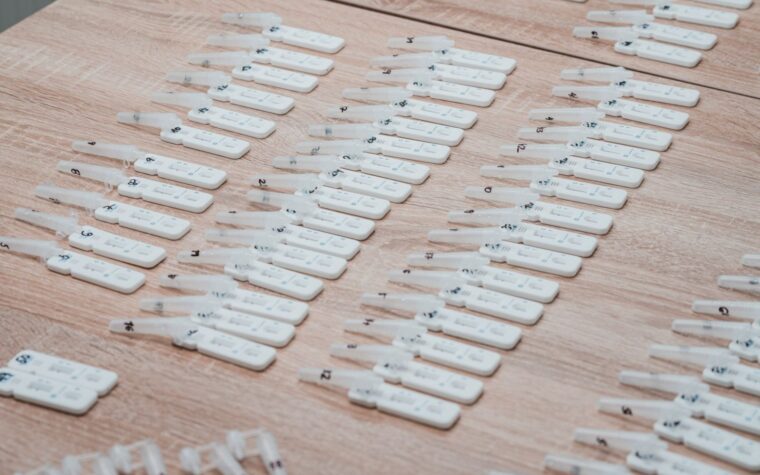
For personal use, an at-home kit is fine and fast. You buy it at a pharmacy, follow the lines like a home pregnancy test, and read the result in minutes. The catch is that home kits are screening devices with real false-positive and false-negative rates, so a surprising result deserves a lab confirmation. For a deeper look at reliability, read At-Home Drug Test Kits: Accuracy and How to Use Them.
If cost is the obstacle and you want to know where to get drug tested for free, start with your county or city health department, which often tests at no or low cost when it connects to treatment or public-health programs. Community health centers on a sliding fee scale are the next stop. None of these are designed for employment paperwork, but they answer the personal question without a bill.
One honest note from years of reading lab printouts: people obsess over beating a test instead of understanding it. What actually moves a result is detection window, hydration, and the specific cutoff used, not the gas-station detox drinks. We separate the real factors from the myths in Drug Test Prep: What Actually Affects Results (and Myths). And if you are already booking a draw and thinking about your broader health, anyone getting one test is often better served by a single full baseline draw, which is the case we make in the Superpower blood test review.
Edge cases: uninsured, minors, Medicare, and remote testing
The standard advice covers most people, but a few situations need their own answer.
- Uninsured and paying cash: Self-pay lab services like Labcorp OnDemand let you order online without a doctor and pay the cash price, then walk into a collection site. County health departments and federally qualified health centers (FQHCs) on a sliding scale are the cheapest path if the test ties to care.
- Minors: A parent or legal guardian generally must consent and be present for a minor’s drug test, and many home kits are explicitly marketed for parents testing teens. For anything that will be acted on, like a school athletics program or a court matter, use the site that program designates, not a kitchen-table kit.
- Medicare and Medicaid: These cover drug testing only when it is medically necessary, for example monitoring a prescribed controlled substance or as part of addiction treatment. They do not cover employment or court testing, which is never considered medically necessary.
- Remote or telehealth jobs: Some employers now use mail-in saliva kits or send you to a local Quest or Labcorp with a remote eCCF. Observed video collection exists for some monitoring programs, but it is not yet standard for routine pre-employment.
- Reasonable suspicion or post-accident at work: The employer arranges the collection on short notice, often at an occupational clinic, and for safety-sensitive roles the clock matters, so go immediately when told.
If your prescriptions are the worry, the answer is the same across all of these: tell the collector and the Medical Review Officer, with documentation. The system is built to clear legitimate medication, and hiding a prescription is the surest way to turn an explainable screen into a problem.
Common mistakes people make
After enough years around this, the same handful of errors show up again and again. Avoiding them is most of the battle.
- Using a home kit for an official test. The number one mistake. A pharmacy cup has no chain of custody and will not be accepted by any employer or court. It is for your eyes only.
- Over-hydrating before the test. Chugging water to flush out does not erase metabolites, it dilutes the sample, and a creatinine-low, dilute specimen is flagged and often counts as a refusal, forcing a retest under observation.
- Skipping the eCCF site. Showing up at a walk-in clinic without the employer’s order means there is nothing to collect against, so you waste the trip.
- Ignoring the MRO call. If the Medical Review Officer phones and you do not answer, an explainable result can be reported as a confirmed positive simply because you never explained it. Pick up.
- Forgetting ID. No government photo ID, no collection at most certified sites. Bring it.
- Buying “detox” products. Detox drinks and synthetic urine are detected by adulteration and validity checks (temperature, creatinine, pH, specific gravity), and getting caught is far worse than a positive.
How to choose the right place in 60 seconds
Pick based on who needs to trust the result.
- Someone else relies on it (employer, court, license): certified collection site with chain of custody. Use the exact lab they name, otherwise default to Quest or Labcorp.
- Only you need to know: retail at-home kit, or a cash self-pay test at a lab if you want lab-grade accuracy.
- You cannot pay: county health department or a community clinic, ideally tied to a treatment program.
When in doubt about a job or legal test, ask the requesting party for the order or the specific site. It is faster than guessing and getting turned away. If you are unsure whether your prescriptions will flag, mention them to the collector, that is what the Medical Review Officer step is for. And if a result ever surprises you, talk to a clinician before drawing conclusions, because a single screening number rarely tells the whole story.
FAQ
Where can I get a drug test done same day?
Walk-in urgent care, occupational clinics like Concentra, and Quest or Labcorp Patient Service Centers can usually collect a sample the same day, often without an appointment. Lab-confirmed results then take one to three business days. For an employer test, complete it within the window HR gives you, usually 24 to 72 hours.
Does CVS do drug tests for employment?
No. CVS sells at-home kits and MinuteClinic does not run certified employment or legal drug screens. For a job test you need a lab collection site with chain of custody, such as Quest or Labcorp, using the order your employer provides.
Where can I get a drug test for free?
County and city health departments, substance-use treatment programs, and community health centers on a sliding scale often test at little or no cost, especially when it supports a treatment plan. These are not set up for employment paperwork, so they will not give you a chain-of-custody result for a job.
How much is a Labcorp drug test out of pocket?
A standard urine panel ordered as self-pay generally runs $30 to $75, with 10-panel and hair tests costing more, up to about $200 for hair follicle. Insurance rarely covers employment or legal testing, so expect to pay cash. Quest prices are very similar.
Can I order my own drug test without a doctor?
Yes. Self-pay services like Labcorp OnDemand and various third-party resellers let you order a panel online, pay the cash price, and walk into a collection site without a physician referral. The result is lab-grade, but it carries chain of custody only if you order a chain-of-custody collection specifically.
Do I need an appointment at Quest or Labcorp for a drug test?
Many Patient Service Centers accept walk-ins, but booking online reduces your wait and confirms the site handles drug collections, since not every location does. For employer tests, the order they send usually points you to a site that is set up for it.
What is the difference between a 5-panel and a 10-panel drug test?
A 5-panel screens for the common five: marijuana, cocaine, amphetamines, opiates, and PCP. A 10-panel adds more substances such as benzodiazepines, barbiturates, methadone, propoxyphene, and Quaaludes. Employers pick the panel based on their policy and the role, and the price rises with the panel size.
Will a prescription medication make me fail a drug test?
It can trigger a positive screen, but a legitimate prescription is cleared by the Medical Review Officer before the result is reported. Disclose your medications to the collector and have documentation ready. A true positive from a valid prescription is converted to a verified negative, so your employer never sees a flag.