
Last updated June 2026. Educational content, not medical advice. BPC-157 is not FDA-approved for human use. Consult a licensed clinician before starting any peptide protocol.
Short answer: Most animal research and clinical protocols use once-daily subcutaneous injection, with some acute-injury programs moving to twice daily for the first two to four weeks before tapering back to once daily. There is no large randomized human trial establishing an optimal frequency. Every schedule you read on a forum is extrapolated from rodent studies or small pilot data, and your safest path to injectable BPC-157 in 2026 is through a licensed telehealth clinic now that the regulatory door is reopening.
Tracking injection frequency is only half the picture. Do you know what’s happening inside your body between doses? One at-home Superpower draw checks 100+ biomarkers, physician-reviewed.
That one paragraph covers what 90% of guides never say plainly. Everything below gives you the full, honest context: what the actual research tested, why frequency depends on what you are treating, how the injection route changes the calculus, what “cycling” really means, and where the 2026 regulatory shift leaves you if you want to use this peptide without guessing at every step.
Why does everyone give a different injection frequency for BPC-157?
Because nobody is working from an FDA-approved prescribing insert. BPC-157 has no such document. Every frequency recommendation you encounter, including the ones on clinic websites, traces back to animal research, mostly from the lab of Croatian pharmacologist Predrag Sikiric, whose group has published over 100 BPC-157 studies in rodent models over three decades.
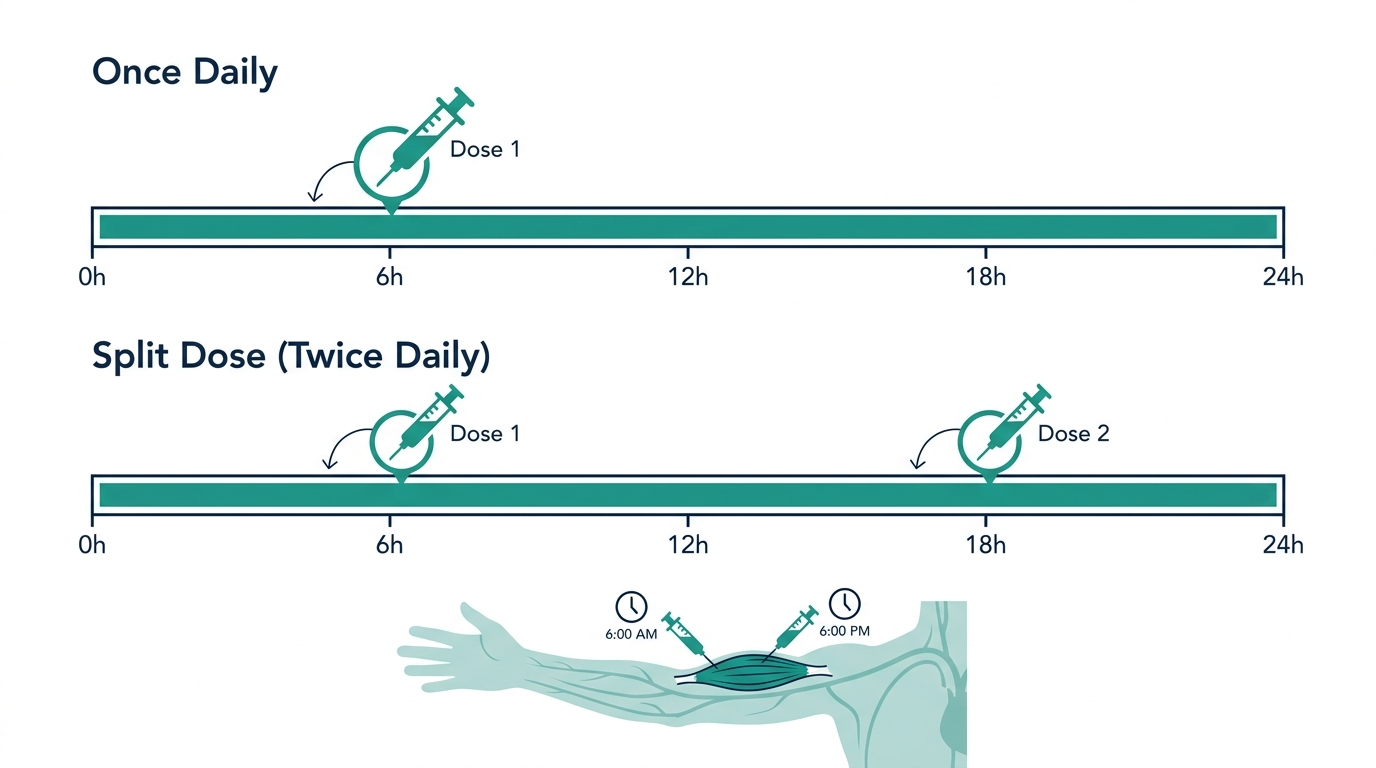
Those rodent studies typically administered the peptide once daily, injected intraperitoneally, for periods ranging from 7 to 90 days depending on the injury model (PMC12446177). When the longevity and recovery communities translated that into human protocols, the once-daily schedule survived mostly intact, with twice-daily added as an intuitive escalation for acute injuries where faster tissue repair seemed desirable.
The human evidence base is genuinely thin. As of early 2026, only three published human studies exist, all from the same Florida research group. One enrolled 16 patients for intra-articular knee injections, one enrolled 12 patients with interstitial cystitis, and one administered intravenous BPC-157 to just two healthy adults, finding it “well tolerated” with plasma levels returning to baseline within 24 hours (PMC12446177). None reported enough dosing detail to establish an optimal frequency. One actively recruiting trial, NCT07437547 on ClinicalTrials.gov, is testing subcutaneous BPC-157 injections once daily for 14 days specifically for acute hamstring strain repair, which at least anchors one human frequency in a controlled setting.
Personally, I find the frequency question more interesting than the dose question, because it is the variable almost nobody thinks carefully about, yet it changes how much time the peptide spends at a therapeutic concentration, which in a peptide with a short plasma half-life matters a great deal.
Full-body lab membership: 100+ biomarkers, doctor-reviewed, tracked over time.
What does “once daily” actually mean in practice for BPC-157?
Once-daily subcutaneous injection, administered in the morning, is the default schedule in most published protocols and what the majority of telehealth providers currently prescribe when injectable BPC-157 is clinically appropriate. The pharmacological logic is straightforward: BPC-157 has a short plasma half-life in rodent models, meaning it clears relatively quickly, but its downstream effects, upregulating VEGFR2 activity, activating the Src-caveolin-1-eNOS nitric oxide pathway, and stimulating angiogenesis, appear to persist well beyond the plasma clearance window (Nature Scientific Reports, 2020).
That persistence is why once daily works for most applications. You are not trying to maintain a constant serum level; you are triggering a signaling cascade whose effects outlast the peptide’s own presence in circulation. The canonical rodent dose of 10 mcg per kilogram administered once daily produced meaningful tendon and ligament repair across study windows of 21 to 72 days (PMC12446177). Doubling the frequency did not consistently double the outcomes in those animal models, which is an underappreciated data point when people assume “more often = more healing.”
Timing within the day appears to matter less than consistency. Unlike growth hormone peptides such as CJC-1295 and Ipamorelin, which are specifically timed to fasted, pre-sleep states to amplify natural GH pulses, BPC-157 has no documented requirement to be administered fasted or to be timed around meals. Most practitioners default to morning administration for the simple practical reason that it builds habit compliance.
When does twice-daily injection make sense?
The twice-daily protocol, typically 250 to 300 mcg in the morning and again in the evening, roughly 12 hours apart, appears in most acute-injury contexts where practitioners want to sustain tissue-level signaling across a longer daily window. The logic is not that once daily fails; it is that for a fresh soft-tissue injury, a grade II muscle tear, a newly strained tendon, or a ligament sprain in the first two weeks, maintaining more consistent peptide exposure during the active repair phase may accelerate the initial phase of tissue remodeling.
What the clinical community generally recommends:
| Context | Injection Frequency | Duration | Typical Taper |
|---|---|---|---|
| Acute soft-tissue injury (first 2 weeks) | Twice daily, 12 hours apart | 2 to 4 weeks | Taper to once daily as acute phase resolves |
| Subacute / ongoing recovery | Once daily | 4 to 8 weeks | Maintain until clinically reassessed |
| Gut healing (IBD, NSAID damage) | Once daily subcutaneous or oral | 8 to 12 weeks | No standard taper protocol in human data |
| General longevity / maintenance | Once daily | 8 weeks on, 4 weeks off | Cycle off fully before reassessing |
| Chronic tendinopathy | Once daily near injury site | 6 to 12 weeks | Dependent on clinical response |
Do not believe anyone who tells you that twice-daily injections are universally superior. The dose-response curve for BPC-157 flattens above roughly 500 mcg per day in rodent models, meaning that injecting more often above that threshold does not reliably produce more healing; it increases your impurity exposure and the probability of injection-site reactions (PeakedLabs, 2026). The twice-daily protocol is an acute-phase tool, not a permanent state.
Does the injection site change how often you need to inject?
Yes, in a specific and important way. Subcutaneous injection near the injury site, called proximal or perilesional injection, delivers BPC-157 into the tissue immediately surrounding the damage. The peptide does not need to make a full systemic circuit before reaching its target. Distant subcutaneous injection, typically in the abdomen, delivers the peptide systemically and relies on circulation to bring it to the site.
The practical implication for frequency: proximal injection near the injury site at once-daily dosing often produces results faster in animal models than the same dose injected distally. This is why practitioners who use BPC-157 for a specific injury, a torn rotator cuff, an Achilles tendinopathy, a knee ligament, typically inject as close as is safely possible to the target tissue. When that is not feasible, the abdomen injection provides systemic delivery, and some practitioners add the second daily injection to compensate for the less targeted route.
Intramuscular injection, going directly into muscle tissue rather than subcutaneous fat, is less common for BPC-157 than for many other peptides. It is sometimes used for deep joint or muscle injuries where the practitioner wants the peptide at depth, but the technique requires more precision and, for self-administration, a different needle length than standard subcutaneous. Most telehealth programs prescribe subcutaneous only.
What is the right cycle length, and why does it matter as much as daily frequency?
Injection frequency is only one variable in the schedule. How long you run the protocol, and whether you take structured breaks, shapes the total outcome as much as injections per day.
The animal studies ran BPC-157 for as few as 7 days and as long as 90 consecutive days without published evidence of safety concerns in the rodent models. In the three published human studies, treatment windows ranged from two weeks of daily injections to a single-session treatment followed by 6 to 12 months of follow-up. None reported tolerance, desensitization, or adverse events attributable to duration.
What drives the cycling recommendation in clinical practice is not evidence of harm from continuous use. It is the absence of evidence that continuous use is safe. The general framework applied by most practitioners:
- Acute protocol (injury-specific): 4 to 6 weeks, then full stop and reassessment. If the injury has resolved, no continuation.
- Subacute or recovery protocol: 8 to 12 weeks on, followed by a 4 to 8 week break before a second cycle if needed.
- Long-term optimization or gut healing: 8 weeks on, at minimum 4 weeks off, with labs before each new cycle to assess systemic markers.
The break is not pharmacologically mandatory based on current data. It is a risk-management decision under conditions of genuine uncertainty about long-term human immunogenicity and receptor behavior. Given that BPC-157 is a peptide that triggers angiogenic pathways including VEGF signaling, extended uninterrupted use in someone with undiagnosed tissue abnormalities carries a theoretical concern that no current human study has addressed. Until the July 23 to 24, 2026 Pharmacy Compounding Advisory Committee meeting produces a recommendation on BPC-157’s return to the 503A Category 1 list, and the subsequent regulatory process plays out over late 2026, the conservative cycling approach is the more defensible one (FDA PCAC Calendar, 2026).
What is actually changing about BPC-157 access in 2026?
This is the piece that changes the strategy for anyone thinking about injection frequency, because the answer to “how often should I inject BPC-157” depends partly on whether you are using pharmacy-grade compounded peptide under clinical supervision or a research-chemical vial with unknown purity.
In November 2023 the FDA placed BPC-157 on the 503A Category 2 list, flagging it for “potential significant safety risks” and effectively cutting off licensed compounding pharmacies from producing it. Then in February 2026 HHS Secretary Robert F. Kennedy Jr. announced that 14 peptides previously restricted under Category 2, including BPC-157, were being considered for return to Category 1 status. The FDA removed BPC-157 from Category 2 on April 22, 2026. The formal PCAC review, required before any substance can officially rejoin the 503A permitted list, is scheduled for July 23 to 24, 2026, where the committee will evaluate BPC-157 free base and BPC-157 acetate as two separate nominations (FDA PCAC Calendar; HealingMaps, 2026).
A positive PCAC recommendation at that meeting still requires a Notice of Proposed Rulemaking and public comment period, making the earliest realistic date for licensed compounding pharmacies to freely dispense BPC-157 late 2026 at the very earliest. Some telehealth platforms that had already been working with compliant 503A pharmacies during the gray-zone period are further along than others.
The practical takeaway for injection frequency: if you are planning a structured protocol with twice-daily acute-phase dosing, a six-week program, and a follow-up cycle, you want pharmacy-grade peptide of known concentration and purity. The dose math for twice-daily vs once-daily only matters if you know with confidence what is in the syringe. A vial from a research-chemical vendor has no pharmacist verifying the concentration, which means every decision about frequency is built on a foundation you cannot independently verify.
Telehealth GLP-1 program with provider visits and pharmacy coordination.
What are the practical injection mistakes that undermine any frequency schedule?
Frequency is meaningless if the injection technique introduces variables that affect what the peptide actually does. Three mistakes account for most of the failed results people report.
Inconsistent reconstitution concentration. BPC-157 arrives as a freeze-dried powder. You add bacteriostatic water to reconstitute it, and the ratio you use determines concentration. A 5 mg vial reconstituted with 1 mL of bacteriostatic water gives 5,000 mcg per mL. Add 2 mL and you get 2,500 mcg per mL. If you are drawing “25 units on a U-100 syringe” without knowing what concentration you made, your twice-daily protocol has a real dose of anywhere from 125 mcg to 625 mcg per injection depending on the dilution. Consistent frequency with inconsistent concentration is not a protocol; it is a variable.
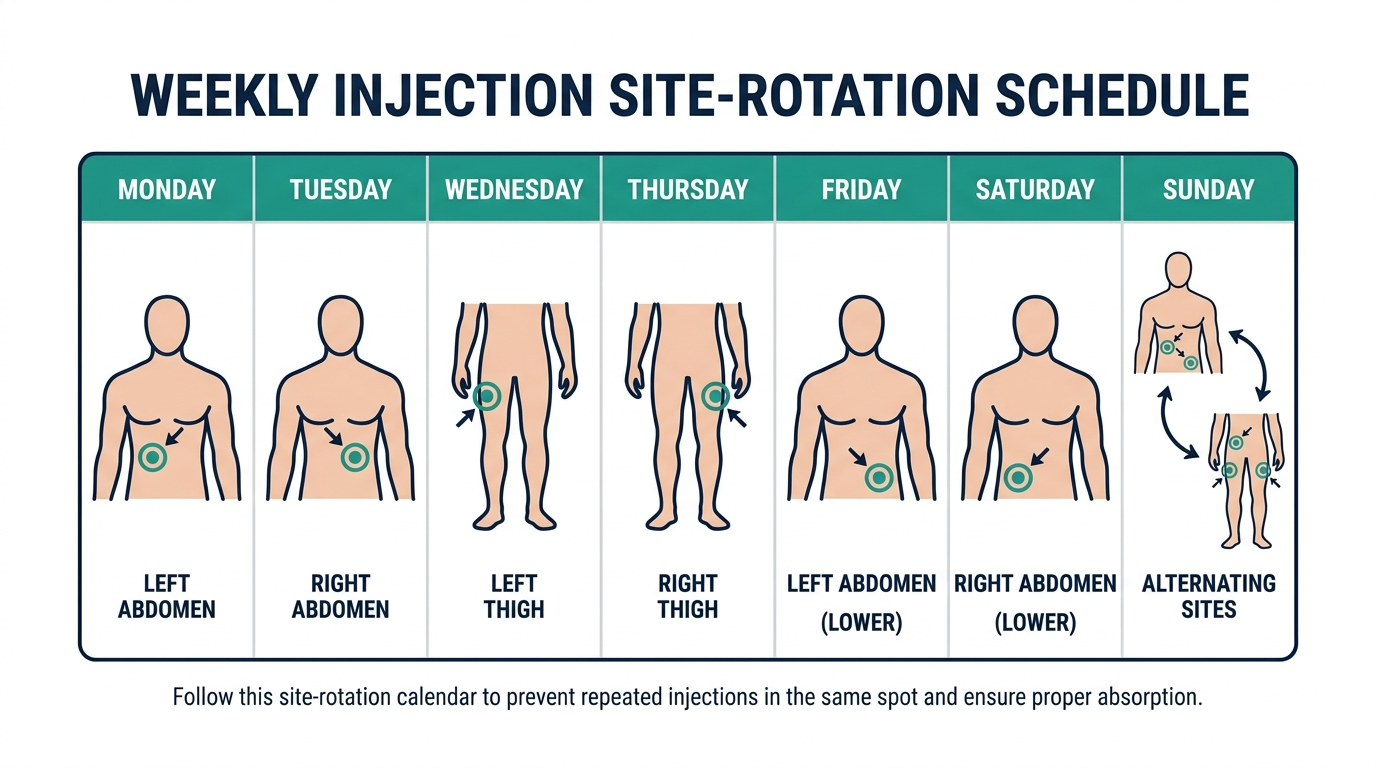
Not rotating injection sites. Injecting at the same subcutaneous site repeatedly causes local fibrosis, scar tissue, and reduced absorption from that spot. Most practitioners recommend rotating through at least four sites: left and right abdomen, left and right thigh. When you are injecting twice daily, site rotation becomes more important, not less, because you are using the available surface area at twice the rate.
Treating the vial as infinitely stable. A reconstituted BPC-157 vial, properly stored at 4 degrees Celsius with bacteriostatic water, is generally considered stable for about 28 to 30 days. A twice-daily protocol that runs six weeks draws down a vial faster, but it does not extend the stability window. Starting a second vial four weeks in is not optional; a degraded peptide injected twice daily is not giving you twice the therapeutic signal.
The supply chain detail nobody talks about: a six-week twice-daily program uses roughly twice the volume of peptide as a once-daily run, which means the cost difference between the two frequency schedules is a direct multiple, not a footnote.
Turn what you just learned into action.
Superpower lets you test 100+ biomarkers from home, then re-check them over time so you can actually see progress, physician-reviewed at every step.
Frequently asked questions
How often do you inject BPC-157 for an injury?
For acute injuries in the first two to four weeks, most clinical protocols use twice-daily subcutaneous injection (roughly 250 to 300 mcg per injection, 12 hours apart) before tapering to once daily as the acute phase resolves. For subacute and chronic injuries, once-daily injection is the standard schedule, typically running four to eight weeks before a structured break.
Can you inject BPC-157 once a week instead of daily?
No published data supports once-weekly as an effective frequency for BPC-157. Given its short plasma half-life and the fact that its tissue-remodeling effects appear to require repeated signaling rather than a single dose, once-weekly would likely produce insufficient cumulative exposure for most indications. The active clinical trial NCT07437547 uses once-daily dosing for 14 consecutive days for acute hamstring repair, which is the closest thing to a formally validated human frequency.
Is there a best time of day to inject BPC-157?
No strong clinical evidence supports any specific time of day for BPC-157 injection, unlike growth hormone secretagogues such as CJC-1295 and Ipamorelin, which are timed to fasted pre-sleep windows. Morning administration is the default in most protocols for habit-building purposes. For twice-daily protocols, a 12-hour split (morning and evening) is standard.
How long do you stay on BPC-157 before taking a break?
Most practitioners recommend four to eight weeks for acute injury protocols followed by full cessation once the injury resolves. For recovery or maintenance protocols, eight weeks on and four weeks off is the typical cycling structure, with baseline labs before each new cycle. No human data establishes a minimum mandatory break; the cycling recommendation is a precautionary one given the absence of long-term human safety data.
Does injecting closer to the injury improve outcomes?
Animal models consistently show that proximal subcutaneous injection near the injured tissue produces more targeted local effects than distant injection. This does not mean distant injection fails; it means the peptide has to travel further to reach the site. Practitioners generally recommend injecting as close to the injury as safely possible for musculoskeletal targets, and using abdominal subcutaneous injection for systemic or gut-related indications.
What happens if you skip an injection day?
Missing a single injection in a daily protocol is not catastrophic. BPC-157 works through sustained signaling over weeks, not through single-dose threshold effects. Simply resume the next scheduled injection; do not double-dose to compensate. If you are on a twice-daily acute protocol, missing one of the two daily injections is similarly manageable, though consistent twice-daily administration is the intention.
How does BPC-157 injection frequency compare to TB-500?
TB-500, a synthetic fragment of thymosin beta-4 often stacked with BPC-157 for connective tissue recovery, is typically injected on a once-weekly or twice-weekly schedule rather than daily. The two peptides have different half-lives and different primary mechanisms, BPC-157 working more through angiogenesis and NO signaling while TB-500 focuses on actin regulation and cell migration. Their combined use in a stack does not require that they be injected at the same frequency; each follows its own schedule.
The one thing about BPC-157 frequency nobody says out loud
Here it is: frequency optimization is a second-order problem if you do not know what concentration you are actually injecting. The entire discussion of once-daily versus twice-daily, proximal versus distal, 8-week versus 12-week cycles, assumes you have a peptide of verified identity and purity where the concentration you calculated is the concentration that is actually in the syringe.
That assumption is safe when you are working with a licensed compounding pharmacy under a clinician’s prescription. It is not safe with a research-chemical vial, where independent testing platforms like Finnrick have flagged batch-to-batch purity variation as a persistent problem even with vendors who had previously strong reputations. A vial that tests at 80% purity does not deliver 80% of your intended dose on a linear scale; it delivers 80% of the target molecule plus 20% of whatever the remaining impurities are, and you are injecting that mixture at the frequency you optimized.
This is the real argument for the licensed clinical route that gains traction every time someone does the math carefully. You are not paying a telehealth clinic $199 to $399 per month for the convenience of a PDF prescription. You are paying for a pharmacist whose license depends on that vial containing what the label says, a clinician who adjusts your frequency and dose based on your actual labs, and an accountable chain of custody for every injection you take. Frequency decisions made inside that system are real frequency decisions. Frequency decisions made outside it are frequency-shaped guesses.
Telehealth GLP-1 program with provider visits and pharmacy coordination.
Author: [CAN XAC NHAN: ten + credential]. Educational content, not medical advice. Sources linked inline.
Primary sources:
– PMC12446177: “Regeneration or Risk? A Narrative Review of BPC-157 for Musculoskeletal Healing” https://pmc.ncbi.nlm.nih.gov/articles/PMC12446177/
– Nature Scientific Reports 2020: “Modulatory effects of BPC 157 on vasomotor tone and the activation of Src-Caveolin-1-endothelial nitric oxide synthase pathway” https://www.nature.com/articles/s41598-020-74022-y
– ClinicalTrials.gov NCT07437547: “BPC 157 for Acute Hamstring Muscle Strain Repair” https://clinicaltrials.gov/study/NCT07437547
– FDA Pharmacy Compounding Advisory Committee Calendar (July 23-24, 2026) https://www.fda.gov/advisory-committees/advisory-committee-calendar/july-23-24-2026-meeting-pharmacy-compounding-advisory-committee-07232026
– HealingMaps (2026): “FDA to Review 7 Peptides for Compounding List in July 2026” https://healingmaps.com/fda-peptides-503a-bulks-list-pcac-july-2026/
– PeakedLabs (2026): “BPC-157 Dosage and Protocol Guide (2026)” https://peakedlabs.com/blog/bpc-157-dosage-protocol-guide
– Finnrick independent peptide testing database https://www.finnrick.com/
Related reading
Vital Signs Today may earn a commission if you buy through links on this page. It does not affect our editorial assessments.