
Last updated 18 June 2026. Educational content, not medical advice. Peptides vary widely in legal status, from FDA-approved prescription drugs to unapproved research compounds. Always consult a licensed clinician before starting any peptide therapy.
Short answer: Tirzepatide (Zepbound) is currently the best clinically proven peptide for fat loss available by prescription, producing a mean 20.2% body-weight reduction versus semaglutide’s 13.7% in the first head-to-head SURMOUNT-5 trial published in the New England Journal of Medicine in May 2025. Retatrutide, a triple-agonist investigational peptide, showed 28.3% average loss at the 12 mg dose in the Phase 3 TRIUMPH-1 trial reported on 21 May 2026, but FDA approval is not projected before late 2027.
Tirzepatide ranks highest for fat loss in trials. See how your own metabolic markers compare before you start. One at-home Superpower draw checks 100+ biomarkers, physician-reviewed.
Why does “best peptide for fat loss” get such a muddled answer online?
Because the word “peptide” covers three completely different categories of molecule, and most content online blurs them together.
There are FDA-approved drugs like semaglutide and tirzepatide, which are GLP-1 class peptides with the most rigorous human trial data ever assembled for an obesity treatment. There are FDA-approved but narrower-indication peptides like tesamorelin, which selectively melts visceral fat but is currently approved only for HIV-associated lipodystrophy. And there is the grey-market world of CJC-1295, ipamorelin, and AOD-9604, which wellness clinics market aggressively but which lack the large randomized trials that would let you know what you are actually getting.
Personally, I think the wellness industry does real harm when it presents an unproven research compound alongside a Phase 3 drug as if they sit on the same shelf. They do not. The gap in evidence is enormous, and your fat cells cannot read a marketing page.
Before ranking anything, the honest move is to separate what the human data actually shows from what a vendor wants it to show.
Full-body lab membership: 100+ biomarkers, doctor-reviewed, tracked over time.
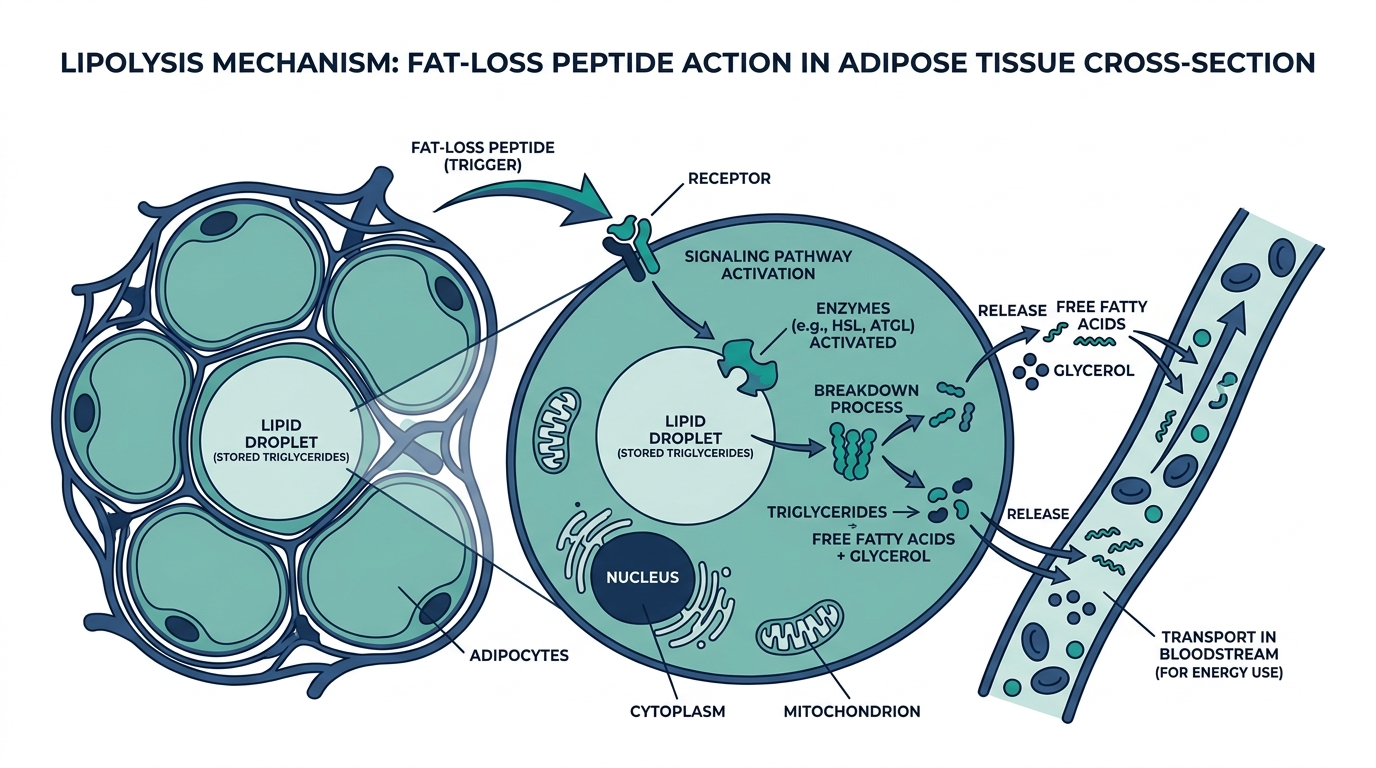
How do peptides actually cause fat loss?
The simplest way to actually get this done
Superpower is a full-body lab membership that runs 100+ biomarkers, has each result reviewed by a doctor, and tracks your numbers year over year (about $199/year). It is what we point readers to when they would rather get one clean, complete draw than chase single tests one at a time. Here is superpower reviewed in full.
The mechanisms are genuinely different across categories, and the difference matters for choosing which one fits your situation.
GLP-1 receptor agonists (semaglutide, tirzepatide, retatrutide) work by signaling through receptors in the hypothalamus and brainstem to reduce appetite, increase satiety after meals, and slow gastric emptying so food stays with you longer. A 2025 review in The American Journal of Medicine showed these drugs also decrease orexigenic neuropeptides (the ones that drive hunger) while increasing anorexigenic peptides like pro-opiomelanocortin. The result is not willpower, it is a pharmacological reset of the hunger signal itself.
Growth hormone secretagogues (tesamorelin, sermorelin, CJC-1295 + ipamorelin) work through a completely different pathway. They signal the pituitary gland to release more of your own growth hormone in the natural pulsatile pattern your body already uses. The downstream effect is an increase in IGF-1, which drives lipolysis, particularly in visceral adipose tissue. They do not suppress appetite the way GLP-1s do. Instead, they shift your metabolism toward fat utilization and lean mass preservation.
The insight most articles skip: these two mechanisms are not interchangeable. If your main problem is uncontrolled appetite and food-noise, a GLP-1 is addressing the actual root cause. If your problem is excess visceral fat with reasonably normal eating but declining growth hormone (common after 40), a GHRH analog like tesamorelin may be more targeted than a GLP-1 that will also shrink your appetite.
Clinicians who work with both classes regularly say the evaluation question is not “which is stronger” but “where is the metabolic bottleneck for this specific person.”
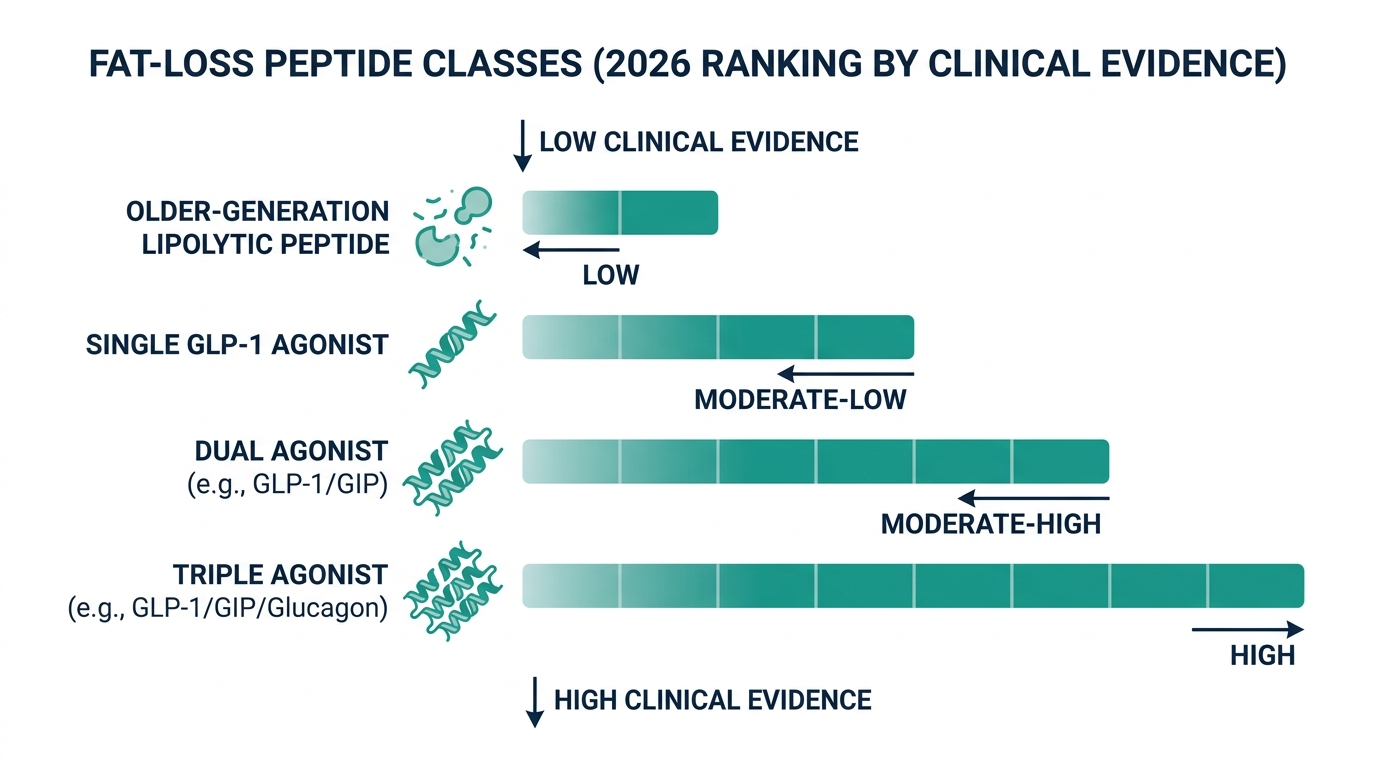
The ranked comparison: which peptide has the most fat-loss evidence?
| Peptide | Mechanism | Best trial result | FDA status | Legal route |
|---|---|---|---|---|
| Retatrutide 12 mg | Triple agonist: GLP-1, GIP, glucagon | 28.3% mean weight loss at 68 weeks (TRIUMPH-1, May 2026) | Investigational; NDA expected Q4 2026 | Clinical trials only as of June 2026 |
| Tirzepatide 15 mg | Dual agonist: GLP-1 + GIP | 22.5% in SURMOUNT-1; 20.2% vs semaglutide’s 13.7% in SURMOUNT-5 | FDA-approved (Zepbound for obesity, Mounjaro for T2D) | Telehealth or in-person prescription |
| Semaglutide 2.4 mg | GLP-1 agonist | 15% average (STEP-1); 16.6% in OASIS 4 oral trial | FDA-approved (Wegovy injection + pill Dec 2025) | Telehealth or in-person prescription |
| Tesamorelin 2 mg | GHRH analog | 15 to 20% visceral fat reduction at 26 weeks in HIV lipodystrophy trials | FDA-approved for HIV-associated lipodystrophy only | Telehealth prescription (off-label for general visceral fat) |
| CJC-1295 + Ipamorelin | GHRH + GHRP | Elevated GH 2 to 10x for up to 6 days per injection; no large obesity trials | Not approved; compounding status thawing (FDA July 2026 review) | Research / licensed telehealth (limited) |
| AOD-9604 | GH fragment | Phase 2b in 536 subjects failed to show significant weight loss at 24 weeks | Not approved, no Phase 3 advancement | Research only; weak evidence |
Three things stand out in that table. Retatrutide’s 28.3% number is extraordinary, but the FDA approval timeline means it will not be legally accessible until late 2027 at the earliest, and “research” vials sold today carry all the risks of an unregulated supply chain. Tirzepatide is the current prescription standard, with two large Phase 3 programs and a head-to-head win over semaglutide. And AOD-9604, one of the most heavily marketed “fat-burning peptides” at wellness clinics, failed its pivotal Phase 2b and was never advanced to Phase 3.
Why tirzepatide beats semaglutide for most people right now
The SURMOUNT-5 trial, published in the New England Journal of Medicine in May 2025, was the first head-to-head randomized comparison of the two leading GLP-1 drugs in 751 adults with obesity. At 72 weeks, tirzepatide produced a mean weight reduction of 20.2% versus 13.7% for semaglutide. For a person starting at 250 lb, that translates to roughly 50 lb lost versus 34 lb.
The waist circumference data is equally clear: tirzepatide cut waist circumference by 18.4 cm compared to 13.0 cm for semaglutide. And the discontinuation rate due to gastrointestinal side effects was actually lower on tirzepatide (2.7%) than on semaglutide (5.6%).
Do not believe the claim that semaglutide is “gentler” for first-time users. The data shows it causes more side-effect-driven dropouts than tirzepatide, not fewer.
The extra mechanism is the reason: tirzepatide hits both GLP-1 and GIP receptors. GIP activation appears to improve insulin sensitivity and may have direct effects on adipose tissue, giving tirzepatide a second lane for fat loss that semaglutide simply does not have.
For most people starting a medically supervised fat-loss program in 2026, tirzepatide is the evidence-based first choice unless there is a specific contraindication.
Telehealth GLP-1 program with provider visits and pharmacy coordination.
What about retatrutide, the triple agonist?
Retatrutide is the most exciting number in obesity medicine right now, and also the most misunderstood. The Phase 3 TRIUMPH-1 trial, which reported on 21 May 2026 with 2,339 patients at the 12 mg dose, showed 28.3% mean weight loss at 68 weeks, with 45.3% of participants achieving 30% or greater body-weight reduction. In practical terms, that is roughly 70 lb for the average trial participant.
The mechanism adds a third receptor target, glucagon (GCGR), to the GLP-1 and GIP dual agonism of tirzepatide. Glucagon receptor activation increases resting metabolic rate and drives lipid mobilization from the liver, which is why retatrutide also shows strong signals for reducing metabolic-dysfunction-associated steatotic liver disease (MASLD).
Here is the part vendors selling “research retatrutide” will not emphasize: Eli Lilly expects to file an NDA in Q4 2026, and with a standard FDA review cycle, approval is projected for late 2027 at the earliest. The retatrutide vials circulating in research-chemical marketplaces today are unverified copies of an investigational compound, and independent testing by Finnrick found retatrutide batches from grey-market vendors failing purity standards with some samples carrying a counterfeit flag.
The wait is real. The alternative on offer is not.
Tesamorelin: the overlooked prescription option for visceral fat
Most fat-loss peptide conversations are dominated by the GLP-1 drugs, and tesamorelin gets underreported despite having genuine Phase 3 human data. It is worth understanding what it does differently.
Tesamorelin is a synthetic analogue of growth hormone-releasing hormone (GHRH). It binds to GHRH receptors in the anterior pituitary and triggers pulsatile growth hormone release. The downstream increase in IGF-1 drives selective lipolysis in visceral adipose tissue, the metabolically dangerous fat that sits around the organs, without meaningfully reducing subcutaneous fat or lean mass.
A 2026 meta-analysis in ScienceDirect covering randomized controlled trials found tesamorelin produced a mean visceral adipose tissue reduction of 27.71 cm², a lean body mass increase of 1.42 kg, and a significant decrease in hepatic fat percentage, all without a calorie-restricted diet.
Two insider points that most clinic websites skip. First, tesamorelin is only FDA-approved for HIV-associated lipodystrophy. When a telehealth clinic prescribes it for general visceral fat reduction, they are prescribing off-label, which is legal but means the clinic is taking clinical responsibility for that decision. Ask specifically what protocol and monitoring are included. Second, unlike GLP-1 drugs, tesamorelin does not suppress appetite. If your fat problem is primarily driven by overconsumption rather than metabolic dysfunction, a GLP-1 will likely produce better overall scale results.
The best candidate for tesamorelin is someone with high visceral fat, relatively normal caloric intake, and declining growth hormone, which tends to describe many people over 45 with metabolic syndrome.
What about the popular gym peptides: CJC-1295 and ipamorelin?
These two are the most widely marketed “fitness peptides” for body recomposition, and they deserve an honest evaluation rather than either a cheerleader or a dismissal.
CJC-1295 is a GHRH analog. A randomized, placebo-controlled study in healthy adults showed a single injection produced 2 to 10-fold increases in growth hormone for up to six days and 1.5 to 3-fold increases in IGF-1 for up to 11 days. That is a real biological effect. What no large trial has demonstrated is that this translates into meaningful weight reduction in a general population. The fat-loss claim extrapolates from GH physiology; it has not been directly proven at scale.
Ipamorelin is a growth hormone-releasing peptide (GHRP) that stimulates the pituitary through a different receptor than GHRH analogs. The combination with CJC-1295 is popular because they hit two different receptor systems and produce a stronger, more sustained GH pulse than either alone. Clinics describe the mechanism well. The clinical evidence for fat loss from the combination is not robust.
The regulatory picture is shifting: the FDA is expected to move CJC-1295 and ipamorelin toward Category 1 (permitted compounding) status following a Pharmacy Compounding Advisory Committee meeting set for 23 to 24 July 2026. That will make them more cleanly accessible through licensed compounding pharmacies, which is a genuine improvement in safety and accountability, regardless of where the evidence base ultimately lands.
What does getting a peptide for fat loss actually cost?
Costs split along legal lanes, and the cheap number consistently means something was removed from the equation.
FDA-approved GLP-1 prescription (brand name): Zepbound (tirzepatide) lists at approximately $1,060 a month; Wegovy (semaglutide injection) at approximately $1,350 a month. These are the brand prices without insurance. Medicare’s GLP-1 Bridge Program launched July 1, 2026, covers Wegovy, Zepbound, and Foundayo for eligible members at $50 a month through December 2027.
Telehealth + compounded GLP-1: Compounded semaglutide or tirzepatide through a 503A pharmacy via telehealth runs roughly $200 to $500 a month depending on dose and program. Note that the FDA’s enforcement of the GLP-1 shortage resolution (tirzepatide finalized October 2024, semaglutide February 2025) closed the compliant compounding window. Programs still advertising “$99 compounded semaglutide” in mid-2026 are operating in legally precarious territory.
Tesamorelin via telehealth: approximately $175 to $350 a month at legitimate clinics, with monitoring included.
Research-chem vials: $40 to $120 a vial, with no prescriber, no pharmacy accountability, no reconstitution instructions, and no labs. The delta to a telehealth program is not the peptide cost, it is the absence of everything that makes the molecule safe to use.
None of this is covered by most commercial insurance outside of branded drugs with qualifying diagnoses. Budget for out-of-pocket costs before you start.
Three myths about fat-loss peptides that need clearing up
Myth 1: “AOD-9604 is a proven fat burner.”
AOD-9604 is a fragment of the growth hormone molecule that showed a 2.6 kg advantage over placebo in a 12-week trial, but then failed to produce significant weight loss in a 536-subject Phase 2b trial at 24 weeks. The company, Metabolic Pharmaceuticals, never advanced it to Phase 3 and never published the pivotal trial in a peer-reviewed journal. Wellness clinics continue marketing it heavily. The evidence does not support the claims.
Myth 2: “Research peptides and prescription peptides are the same molecule, just different wrappers.”
The molecule may be chemically identical on paper, but the wrapper is most of what you are paying for: verified purity, sterility, accurate concentration, stable storage, a clinician’s oversight, and the legal and professional accountability that sits behind a pharmacy dispensing label. Independent testing of grey-market peptide vials routinely finds purity below 96%, wrong identity on mass spec, or bacterial contamination. The wrapper is not packaging, it is quality control.
Myth 3: “Higher GH means more fat loss.”
Growth hormone promotes lipolysis, particularly visceral lipolysis, but GH physiology does not operate in a simple linear dose-response for fat loss. Supraphysiologic GH levels can cause insulin resistance, water retention, joint pain, and, in long-term abuse, acromegalic changes. The reason tesamorelin is considered safer than synthetic HGH injections is precisely that it works through the pituitary’s own feedback system, keeping levels physiologic rather than pharmacologic. “More GH” is not a strategy.
Telehealth GLP-1 program with provider visits and pharmacy coordination.
Don’t just read about your health, track it.
A single result is a snapshot. Superpower re-tests 100+ markers over time so you can watch them move as you change sleep, food, and training.
Frequently asked questions
What is the best peptide for fat loss in 2026?
By clinical evidence, tirzepatide (Zepbound, FDA-approved) produces the best fat loss of any currently accessible peptide, with a mean 20.2% body-weight reduction in SURMOUNT-5. Retatrutide shows even stronger Phase 3 data (28.3% in TRIUMPH-1) but is not yet FDA-approved and is not legally accessible outside of trials. For visceral-fat-specific reduction with lean mass preservation, tesamorelin has the strongest evidence after GLP-1 drugs.
Can I get a fat-loss peptide without a prescription?
Only if it is a cosmetic or supplement-grade product, such as collagen peptides or topical peptide serums. All therapeutic fat-loss peptides, including GLP-1 drugs, tesamorelin, and growth hormone secretagogues, require a prescription from a licensed clinician. Research-chemical vendors sell these compounds labeled “for research use only,” which transfers all legal and safety risk to the buyer.
Is tirzepatide better than semaglutide for fat loss?
Yes, by the SURMOUNT-5 head-to-head trial: 20.2% mean weight loss versus 13.7% for semaglutide at 72 weeks, with fewer side-effect-driven dropouts on tirzepatide (2.7% versus 5.6%). Both are FDA-approved and available via telehealth prescription.
What is retatrutide and when will it be available?
Retatrutide is Eli Lilly’s triple-agonist investigational drug (GLP-1 + GIP + glucagon receptors). It showed 28.3% mean weight loss in the Phase 3 TRIUMPH-1 trial (May 2026). Lilly expects to file an NDA in Q4 2026, with FDA approval projected for late 2027 and market launch in early 2028. It is not legally available outside of clinical trials as of June 2026.
Does tesamorelin work for fat loss without a prescription?
Tesamorelin has real human trial data for visceral fat reduction (roughly 15 to 20% of visceral adipose tissue at 26 weeks), but it requires a prescription. It is FDA-approved only for HIV-associated lipodystrophy; use for general metabolic fat loss is off-label. Grey-market tesamorelin vials carry the same quality-control risks as any unverified research peptide.
What about CJC-1295 and ipamorelin for fat loss?
These two growth hormone secretagogues produce documented GH increases but lack large human trials confirming meaningful fat loss. They are expected to gain clearer compounding pharmacy access following an FDA Pharmacy Compounding Advisory Committee review scheduled for July 23 to 24, 2026. Until then, they sit in a regulatory grey zone. They are not the same category of evidence as tirzepatide or semaglutide.
How much does a peptide fat-loss program cost?
Expect $200 to $500 a month for telehealth programs prescribing compounded GLP-1 drugs. Brand-name Zepbound runs roughly $1,060 a month at list price; Medicare members may qualify for the $50-a-month GLP-1 Bridge Program starting July 2026. Tesamorelin programs via telehealth typically run $175 to $350 a month. None of this is covered by most commercial insurance outside of qualifying diagnoses with branded drugs.
Author: Vital Signs Today Editorial Team, MD, [specialty]”]. Educational content, not medical advice. Talk to a licensed clinician before starting any peptide or weight-loss medication.
Primary sources:
– Eli Lilly SURMOUNT-5 press release (NEJM, May 2025): https://investor.lilly.com/news-releases/news-release-details/zepbound-tirzepatide-showed-superior-weight-loss-over-wegovy
– Eli Lilly TRIUMPH-1 retatrutide Phase 3 results (May 2026): https://www.prnewswire.com/news-releases/lillys-triple-agonist-retatrutide-delivered-powerful-weight-loss-in-pivotal-phase-3-obesity-trial-302778859.html
– Lilly SURMOUNT-1 tirzepatide trial summary: https://investor.lilly.com/news-releases/news-release-details/lillys-tirzepatide-delivered-225-weight-loss-adults-obesity-or
– FDA oral semaglutide (Wegovy pill) approval, December 22, 2025: https://www.hcplive.com/view/fda-approves-semaglutide-wegovy-pill-as-first-oral-glp-1-for-weight-loss
– American Journal of Medicine GLP-1 mechanism review (2025): https://www.amjmed.com/article/S0002-9343(25)00059-2/fulltext
– Tesamorelin meta-analysis, ScienceDirect (2026): https://www.sciencedirect.com/science/article/abs/pii/S1871403X26000025
– Retatrutide NDA/approval timeline: https://peptidenerds.com/blog/retatrutide-fda-approval-timeline
– Retatrutide TRIUMPH-1 detailed analysis: https://lolahealth.com/blogs/longevity/retatrutide-clinical-trials
– FDA bulk drug substances under 503A (compounding status): https://www.fda.gov/drugs/human-drug-compounding/bulk-drug-substances-used-compounding-under-section-503a-fdc-act
– Finnrick independent peptide testing database: https://www.finnrick.com/
Want a real clinician to run the numbers, not a guess?
Joi + Blokes is a telehealth clinic that prescribes GLP-1 medication (Zepbound, compounded semaglutide and tirzepatide), hormone therapy (TRT, HRT), thyroid care, and peptides after a real lab panel and clinician review, with no membership or consult fee (prescriptions from about $59/month, lab panels from $149). If the scale will not budge, this is where you find out whether insulin, thyroid, or hormones are the real reason. Here is Joi + Blokes reviewed in full.
Related reading
Related: which GLP-1 telehealth service fits you.
Vital Signs Today may earn a commission if you buy through links on this page. It does not affect our editorial assessments.