
Last updated 18 June 2026. Educational content, not medical advice. Some peptides discussed here are prescription-only or investigational. Talk to a licensed clinician before starting anything.
Short answer: Tirzepatide (Zepbound) leads the FDA-approved field at 22.5% mean body-weight loss over 72 weeks in SURMOUNT-1. Retatrutide, still investigational, hit 28.3% in TRIUMPH-1 with Phase 3 NDA filing expected late 2026. Tesamorelin is the only FDA-approved peptide for visceral fat reduction. Everything else, including CJC-1295/Ipamorelin, AOD-9604, and the research-chem GH stacks, operates off-label or in a grey zone, with far thinner evidence and real legal complexity to navigate.
Tirzepatide and retatrutide lead the 2026 weight-loss rankings. See where your own metabolic markers stand. One at-home Superpower draw checks 100+ biomarkers, physician-reviewed.
Why do “peptides for weight loss” mean completely different things?
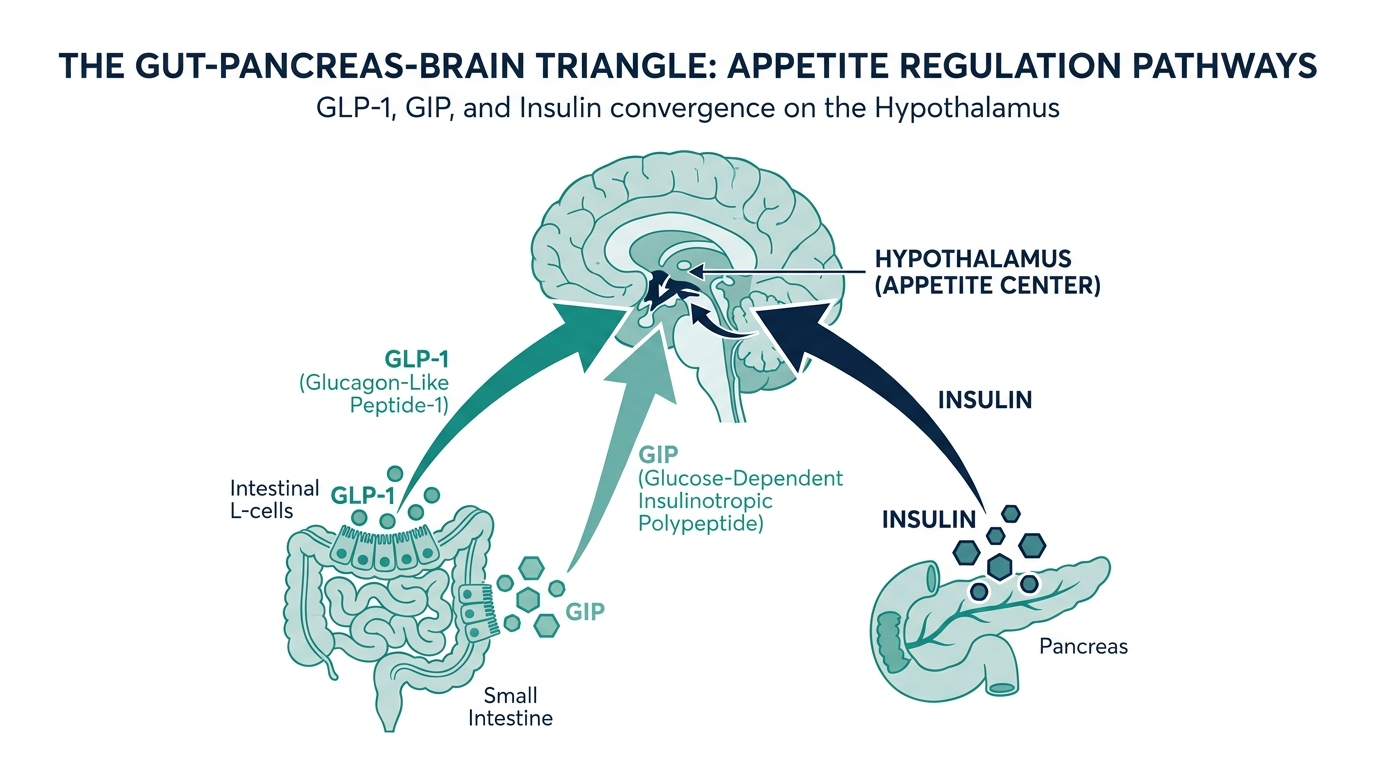
The phrase covers a spectrum that stretches from an FDA-approved injectable you get through a licensed telehealth clinic to a freeze-dried powder from a website that calls itself a “research supplier.” The molecule matters, but the lane you buy it through matters just as much, and the two are not interchangeable.
There are three real lanes in 2026. First: FDA-approved prescription peptides, dispensed through pharmacies with a clinician’s sign-off. Second: prescription-eligible peptides that have not gone through FDA approval but are available through licensed compounding pharmacies off-label, in an evolving regulatory environment. Third: “research use only” peptides, legal to sell for lab work, not legal for self-injection, with no oversight on identity or purity.
Understanding which lane a given peptide sits in tells you more about real-world safety than any forum review. This article ranks them by clinical evidence, then explains the lane.
Full-body lab membership: 100+ biomarkers, doctor-reviewed, tracked over time.
How does the evidence stack actually rank?
The simplest way to actually get this done
Superpower is a full-body lab membership that runs 100+ biomarkers, has each result reviewed by a doctor, and tracks your numbers year over year (about $199/year). It is what we point readers to when they would rather get one clean, complete draw than chase single tests one at a time. Here is superpower reviewed in full.
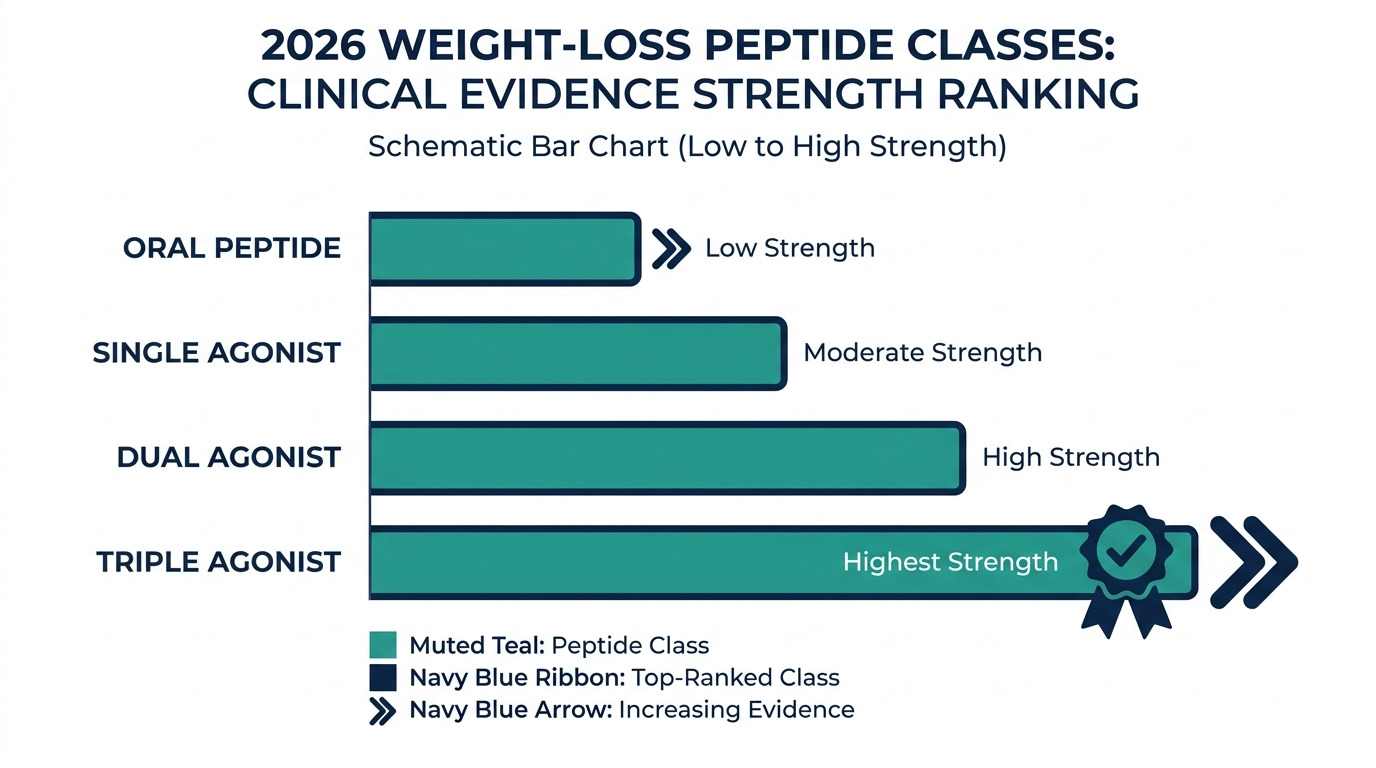
Not all peptides are created equal. Here is the honest rankings table, ordered by documented weight-loss magnitude:
| Peptide | Mechanism | Best documented weight loss | FDA status | Lane |
|---|---|---|---|---|
| Retatrutide | GLP-1 + GIP + glucagon triple agonist | 28.3% body weight (TRIUMPH-1, 2026) | Investigational (NDA expected Q4 2026) | Research / investigational |
| Tirzepatide (Zepbound) | GLP-1 + GIP dual agonist | 22.5% body weight (SURMOUNT-1, 72 wks) | FDA-approved for obesity | Prescription only |
| Semaglutide (Wegovy, oral) | GLP-1 agonist | 16.6% body weight (OASIS 4, 64 wks) | FDA-approved (oral Wegovy Dec 2025) | Prescription only |
| Semaglutide injectable (Wegovy) | GLP-1 agonist | 14.9% body weight (STEP 1, 68 wks) | FDA-approved | Prescription only |
| Tesamorelin (Egrifta) | GHRH analog | ~15–18% visceral adipose tissue reduction (26 wks) | FDA-approved for HIV lipodystrophy; off-label for others | Prescription / compounding off-label |
| CJC-1295 + Ipamorelin | GH secretagogue stack | No large RCT; GH pulse increase 3-5x observed | Not FDA-approved; compounding grey zone | Research / off-label compounding |
| AOD-9604 | GH fragment (aa 176-191), beta-3 agonist | Measurable fat mass reduction at 1 mg/day; large-scale trials failed 2007 | Withdrawn from FDA development; nominated/withdrawn from 503A | Research only |
One thing this table makes clear: the further down you go, the thinner the evidence and the murkier the legal status. The peptides with the biggest internet buzz are often the ones with the fewest completed human trials.
Tirzepatide: the current clinical champion
Tirzepatide (brand name Zepbound for obesity, Mounjaro for diabetes) is a dual agonist hitting both GLP-1 and GIP receptors simultaneously, which gives it a meaningful edge over semaglutide alone. In the SURMOUNT-1 trial published in the New England Journal of Medicine, 2,539 adults with obesity received weekly injections over 72 weeks. The 15 mg dose produced 22.5% mean body-weight loss, versus just 2.4% for placebo. Ninety-six percent of participants at the highest dose achieved at least 5% weight loss.
A 2024 JAMA cohort study of 18,386 real-world patients confirmed that tirzepatide outperformed semaglutide at every time point measured. That is the second real-world dataset supporting what the trial showed, which matters more than a single perfect-conditions study.
Body composition analysis from SURMOUNT-1 adds an important nuance: tirzepatide produced approximately three times greater reduction in fat mass than lean mass (33.9% vs. 10.9%). For anyone thinking about these drugs in terms of how their body actually changes, not just pounds on a scale, that ratio is significant.
The access question has also changed fast. Starting July 1, 2026, eligible Medicare Part D beneficiaries can access Zepbound through the CMS GLP-1 Bridge program for $50 a month, a program running through December 2027. For everyone else without insurance coverage, compounded tirzepatide through telehealth starts around $299 a month, though the compounding window has narrowed significantly since the FDA declared the shortage resolved in October 2024.
Semaglutide: the proven standard that just got a pill
Semaglutide has the longest clinical safety record in this category, including the SELECT cardiovascular outcomes trial showing a 20% reduction in major adverse cardiovascular events in people with obesity but without diabetes. That cardiovascular benefit is why Wegovy carries FDA approval for reducing heart attack and stroke risk, not just weight.
The bigger development in late 2025 was the FDA approval of oral Wegovy. The OASIS 4 trial showed 16.6% mean weight loss at 64 weeks for adherent participants, with one-third achieving at least 20% loss. Novo Nordisk launched the pill commercially in January 2026. It does not require refrigeration, starts at $149/month for lower doses through GoodRx’s telemedicine platform, and removes the injection barrier that kept some people from starting.
Personally, I think the oral formulation changes the long-term use case more than most headlines acknowledge. Injections are not difficult, but compliance over a multi-year horizon is a real-world consideration, and a daily pill has a familiar ritual that a weekly shot does not. Whether efficacy holds over longer periods at the same rate will require more data, but the OASIS 4 numbers are genuinely strong.
Retatrutide: not approved yet, but the data is remarkable
Retatrutide is Eli Lilly’s triple agonist, hitting GLP-1, GIP, and glucagon receptors. The glucagon receptor addition is what makes it distinct: activating glucagon thermogenesis increases energy expenditure, not just appetite suppression, which may explain the outsized results.
In TRIUMPH-1, the pivotal Phase 3 trial reporting positive results on May 21, 2026, 2,339 general obesity patients on the 12 mg dose achieved 28.3% average body-weight loss. Forty-five percent of participants lost 30% or more of their starting weight. That is not a rounding error on tirzepatide; it is a meaningfully different outcome floor.
Lilly now has the primary efficacy dataset required for an NDA filing, expected before end of 2026. The most likely approval timeline, if nothing unusual disrupts the FDA review clock, is late 2027 to early 2028. Retatrutide is not available through any legal channel in the United States right now, not through telehealth, not through compounding, not at any price. What is being sold as “retatrutide” through research-chemical vendors is unverified powder. Independent testing by Finnrick found Peptide Sciences’ retatrutide failing quality checks across 37 batches before the company shut down in March 2026, some samples testing as low as 75% purity.
The lesson: the highest-performing molecule on paper is also the one with the highest counterfeit and contamination risk in the grey market, because demand outstrips any legitimate supply.
Tesamorelin: the one FDA-approved peptide targeting visceral fat specifically
Tesamorelin (brand name Egrifta) holds the only FDA approval of any peptide for visceral fat reduction. It is a synthetic GHRH analog originally developed and approved in 2010 for HIV-associated lipodystrophy, a condition causing dangerous visceral fat accumulation in HIV patients on antiretrovirals.
Phase 3 trials showed approximately 15% to 18% reduction in visceral adipose tissue over 26 weeks at 2 mg daily subcutaneous dosing, measured by CT scan, versus a roughly 5% increase in the placebo group. The mechanism is straightforward: tesamorelin stimulates the pituitary to release more GH, which preferentially mobilizes visceral fat without significantly affecting subcutaneous fat.
What makes tesamorelin interesting off-label is that visceral fat is the metabolically active, cardiovascular-risk-relevant fat, not the stuff you can pinch. Reducing it is more important to longevity markers than the number on a scale. Licensed telehealth clinics prescribe it off-label for this reason.
Do not confuse tesamorelin with the growth hormone secretagogue stacks below. It has actual Phase 3 human data. The GH stack peptides do not.
CJC-1295 and Ipamorelin: the most requested stack without large-scale trial data
CJC-1295 is a modified GHRH analog with an extended half-life. Ipamorelin is a selective growth hormone secretagogue that acts directly on the pituitary. Stacked together, they produce a 3 to 5 times greater GH pulse compared to either compound alone, according to clinic-level observations and smaller studies, not large RCTs.
The claimed weight-loss mechanism is indirect: higher GH pulses during sleep promote fat oxidation and preserve lean mass. Real-world users report improvements in body composition over 12 to 24 weeks, particularly visceral fat and sleep quality. Recovery, not pure weight loss, tends to be the primary driver for most people using this stack.
The regulatory situation is messy. Neither peptide has FDA approval for any indication. CJC-1295 and Ipamorelin are in HHS’s February 2026 list of peptides expected to move toward Category 1 compounding status, pending the July 23 to 24, 2026, Pharmacy Compounding Advisory Committee meeting. If the committee supports that move, licensed compounding pharmacies will be able to dispense them legally. Until then, any clinic offering them is operating in a grey zone.
Search volume for this stack grew from roughly 27,000 monthly searches in late 2025 to over 60,000 in 2026, per data published by Perfect B. Popularity is not the same as evidence, but it tells you this is the peptide category where demand is outpacing the regulatory structure to support it.
AOD-9604: the peptide that failed its own development program
AOD-9604 is a synthetic fragment of human growth hormone (amino acids 176 to 191) that was specifically designed to retain GH’s fat-burning properties without triggering IGF-1-related growth effects. The mechanism is real: it binds beta-3 adrenergic receptors on fat cells and activates hormone-sensitive lipase, breaking triglycerides into free fatty acids.
The inconvenient fact is that the developer, Metabolic Pharmaceuticals, halted clinical development in 2007 after large-scale trials failed to demonstrate consistent efficacy. The FDA subsequently received a 503A nomination for AOD-9604 and the compound has since been listed as withdrawn. Smaller studies and anecdotal reports continue, and the 1 mg daily subcutaneous dose does produce measurable fat mass changes in some participants over 8 to 12 weeks, but it is not a compound with a credible approval trajectory.
Do not believe the marketing copy that frames it as “the fat-loss peptide doctors are switching to.” That framing is not supported by the development history.
Telehealth GLP-1 program with provider visits and pharmacy coordination.
What does the cost actually look like across these options?
Pricing varies dramatically by lane, and the gaps are not arbitrary.
| Option | Monthly cost | What is included |
|---|---|---|
| Brand Wegovy (injectable semaglutide) | ~$1,350 | Medication only; insurance copay typically $25 if covered |
| Brand Zepbound (injectable tirzepatide) | ~$1,060 | Medication only |
| Oral Wegovy (25 mg semaglutide pill) | $149 to $299 | Medication via GoodRx / telehealth |
| Medicare GLP-1 Bridge (Wegovy, Zepbound, Foundayo) | $50 | Eligible Part D members only, July 2026 to Dec 2027 |
| Compounded semaglutide via telehealth | $169 to $499 | Medication + clinical consult; compounding window narrowing |
| Compounded tirzepatide via telehealth | $299 to $499 | Same as above |
| Tesamorelin via telehealth | ~$250 to $400 | Off-label prescription, monitoring included |
| CJC-1295/Ipamorelin via licensed clinic | ~$175 to $300 | Prescription, grey-zone regulatory status |
| Research-chem vials (any of the above) | $40 to $120/vial | No oversight, no dose verification, no accountability |
The grey-market vial price looks attractive until you add what it does not include: identity confirmation, purity testing, bacteriostatic water and syringes purchased separately, the math of reconstituting a lyophilized powder yourself, and the absence of any recourse if the product is mislabeled. A decimal error in reconstitution math changes your dose by a factor of ten.
One thing clinics will tell you that vendors will not: none of these treatments is covered by standard insurance as elective weight management. The Medicare bridge is the first mass-market exception, and it covers only brand-name FDA-approved drugs, not compounded or research versions.
What about the peptides that work differently from GLP-1?
Not every weight-loss peptide works by suppressing appetite. Two mechanisms worth understanding sit outside the GLP-1 category:
Growth hormone secretagogues (tesamorelin, CJC-1295/Ipamorelin, sermorelin) work upstream: they trigger the pituitary gland to release its own GH in a pattern closer to what younger bodies produce. GH shifts substrate oxidation toward fat, preserves lean mass during a caloric deficit, and improves sleep architecture, which itself affects hunger hormones. This is a real, measurable mechanism, just a slower and less dramatic one than GLP-1 receptor agonism.
AOD-9604 and metabolic peptides work at the fat cell level directly rather than through appetite regulation or the pituitary axis. The gap in this category is large-scale human evidence, not mechanism. Mechanisms are easy to propose; showing they work at clinical scale in randomized trials is the hard part, and most of these peptides have not done it.
The honest framing for anyone considering the non-GLP-1 route: these are adjuncts to a solid metabolic foundation, not replacements for it. The GLP-1 evidence is why those drugs dominate the clinical literature.
Three things about weight-loss peptides that most sources will not tell you
1. The oral Wegovy pill changes the compliance math permanently. Injectable GLP-1s have strong efficacy data, but injection fatigue is real over a multi-year horizon. A daily pill, FDA-approved December 2025, launched January 2026, with 16.6% mean weight loss and no refrigeration requirement, is a different product for a different population than the forum-optimized injectable protocol crowd. The people who would not start on injectables will start on the pill, and that group is enormous.
2. Retatrutide’s 28.3% result includes a signal nobody is talking about carefully enough. With 45% of participants losing 30%+ of body weight in 80 weeks, some of those people are approaching outcomes that would historically require bariatric surgery. The Scientific American piece on TRIUMPH-1 raises the question of what losing that much lean mass that quickly does to muscle function, bone density, and long-term metabolic rate. That question does not have a complete answer yet, and anyone chasing the highest-number drug should know it.
3. The FDA advisory committee meeting July 23 to 24, 2026, matters more than any single drug announcement. The Pharmacy Compounding Advisory Committee is reviewing roughly 14 peptides, including BPC-157, CJC-1295, Ipamorelin, and TB-500, for Category 1 (permitted) compounding status. If they move, the grey-market reason to buy those from unregulated vendors largely disappears. The clinically appropriate version becomes the accessible version. The race between the legal route and the grey route is not permanent; the legal route is catching up.
How to actually access weight-loss peptides legally in 2026
Step 1: Get a baseline metabolic and hormonal panel first. Any peptide that touches GLP-1 signaling, GH axis, or fat metabolism will change numbers you cannot feel. Knowing your baseline HbA1c, fasting insulin, triglycerides, IGF-1, and visceral fat proxy (via waist circumference or DEXA if accessible) transforms a treatment into an experiment you can read.
Step 2: Choose the right lane for your situation. If you have obesity (BMI 30+) or overweight with a co-morbidity, FDA-approved tirzepatide or semaglutide through a licensed telehealth platform is the clinically supported choice. If Medicare-eligible, the $50/month bridge program starting July 1, 2026, is available for Wegovy, Zepbound, and Foundayo. If your goal is visceral fat specifically and you are a candidate for tesamorelin, find a clinic that prescribes it off-label with monitoring.
Step 3: For anything not yet FDA-approved, wait for the July 2026 advisory committee. The CJC-1295/Ipamorelin grey zone is about to either clarify or harden. Buying grey-market now is a regulatory timing bet, and the legal lane is weeks away from potentially resolving.
Step 4: Verify the telehealth clinic before you sign up. A legitimate provider requires labs before the first prescription, names the compounding pharmacy, includes monitoring in the fee, and does not offer same-day prescriptions without clinical review. A clinic offering injectable BPC-157 or CJC-1295 in 2026 without naming the compounding pharmacy is operating in territory you should question.
Don’t just read about your health, track it.
A single result is a snapshot. Superpower re-tests 100+ markers over time so you can watch them move as you change sleep, food, and training.
Frequently asked questions
What peptide causes the most weight loss?
In clinical trials, retatrutide produced 28.3% mean body-weight loss in TRIUMPH-1 (2,339 patients, 80 weeks), making it the most potent weight-loss peptide with Phase 3 data. It is not yet FDA-approved, with NDA filing expected Q4 2026 and approval likely late 2027 to early 2028. Among currently approved options, tirzepatide (Zepbound) at 15 mg produced 22.5% mean loss in SURMOUNT-1.
Is semaglutide or tirzepatide better for weight loss?
Tirzepatide consistently outperforms semaglutide in head-to-head real-world data. A 2024 JAMA cohort study of 18,386 patients found tirzepatide produced significantly greater weight loss at all time points. Both are FDA-approved, both are available through telehealth, and tirzepatide is now part of the Medicare GLP-1 Bridge at $50/month for eligible enrollees.
What are growth hormone peptides for weight loss?
Growth hormone peptides like CJC-1295, Ipamorelin, sermorelin, and tesamorelin stimulate the pituitary to release GH rather than replacing it. Higher GH shifts the body toward fat oxidation and lean mass preservation. Tesamorelin is the only FDA-approved option in this class, specifically for visceral fat. CJC-1295 and Ipamorelin are not FDA-approved but are widely prescribed off-label, with regulatory status expected to clarify after the July 2026 advisory committee meeting.
Can you buy weight-loss peptides without a prescription?
GLP-1 medications (semaglutide, tirzepatide) and tesamorelin require a prescription. Research-chem websites sell peptides labeled “for research use only,” which is legal to purchase but not legal for human self-injection. A telehealth clinic consultation typically takes one to three business days and costs less than one month of a grey-market supply when monitoring and clinical oversight are factored in.
How long does it take for weight-loss peptides to work?
In GLP-1 trials, clinically meaningful weight loss (5%+ of body weight) begins appearing around weeks 8 to 12 in most participants, with maximal effect reached at 52 to 72 weeks depending on the drug and dose. The peptide is doing its work from week one; the visible results typically arrive later. GH secretagogues like CJC-1295/Ipamorelin are slower, with most body composition changes reported over 12 to 24 weeks.
Are weight-loss peptides covered by insurance?
Standard insurance does not cover peptides prescribed for elective weight loss. The Medicare GLP-1 Bridge starting July 1, 2026, covers Wegovy, Foundayo, and the KwikPen version of Zepbound at $50/month for eligible Part D enrollees. Employer-sponsored plans with obesity coverage may cover Wegovy and Zepbound, but coverage varies widely and requires documentation of obesity diagnosis with co-morbidities.
What are the side effects of GLP-1 weight-loss peptides?
The most common side effects of semaglutide and tirzepatide are gastrointestinal: nausea, vomiting, diarrhea, and constipation, occurring in 20 to 40% of users at dose-escalation phases and typically improving as the body adjusts. More rarely, pancreatitis and gallbladder complications have been reported. GLP-1 medications are contraindicated in people with a personal or family history of medullary thyroid carcinoma or MEN2 syndrome.
Author: Vital Signs Today Editorial Team. Educational content, not medical advice. Sources linked inline.
Telehealth GLP-1 program with provider visits and pharmacy coordination.
Primary sources:
– SURMOUNT-1 tirzepatide trial, Eli Lilly investor release and NEJM publication
– TRIUMPH-1 retatrutide Phase 3 results, Scientific American, May 2026
– FDA approves oral Wegovy, Applied Clinical Trials Online, December 2025
– Novo Nordisk oral Wegovy press release, December 2025
– CMS Medicare GLP-1 Bridge program page
– Tesamorelin visceral fat Phase 3 data summary, The Peptide Catalog
– CJC-1295/Ipamorelin clinical overview, Perfect B
– Retatrutide FDA status and TRIUMPH-1, RetaWeightLoss.com
– SELECT cardiovascular outcomes trial (semaglutide), NEJM
– Finnrick independent peptide testing database
– GLP-1 meta-analysis, obese patients without diabetes, PMC
– Johns Hopkins GLP-1 efficacy across demographics, Bloomberg School of Public Health, 2026
Want a real clinician to run the numbers, not a guess?
Joi + Blokes is a telehealth clinic that prescribes GLP-1 medication (Zepbound, compounded semaglutide and tirzepatide), hormone therapy (TRT, HRT), thyroid care, and peptides after a real lab panel and clinician review, with no membership or consult fee (prescriptions from about $59/month, lab panels from $149). If the scale will not budge, this is where you find out whether insulin, thyroid, or hormones are the real reason. Here is Joi + Blokes reviewed in full.
Related reading
Related: best GLP-1 telehealth providers for 2026.
Vital Signs Today may earn a commission if you buy through links on this page. It does not affect our editorial assessments.