
Last updated 18 June 2026. Educational content only, not medical advice. Retatrutide is an investigational drug that is not FDA-approved. Talk to a licensed clinician before considering any weight-loss medication.
Short answer: In Eli Lilly’s TRIUMPH-1 trial, retatrutide was taken as a once-weekly subcutaneous injection starting at 2 mg, escalating every four weeks to a maximum of 12 mg, producing 28.3% average body-weight loss at 80 weeks. There is currently no legal prescription pathway for retatrutide outside of authorized clinical trials. Anything sold online is unregulated, and two criminal prosecutions related to its distribution are active in 2026.
Retatrutide trial data shows big numbers, but what do your own metabolic markers look like right now? One at-home Superpower draw checks 100+ biomarkers, physician-reviewed.
Most articles about how to take retatrutide are actually dosing guides for grey-market research vials. This one is not. The distinction matters because the drug that circulated in those vials failed independent purity testing across 37 batches before the biggest vendor shut down. What you need to understand before anything else is why “how to take retatrutide” and “where to get it safely” are the same question right now, and why the honest answer to both routes back to the same place: a clinical trial, or waiting.
Here is everything the trial data actually tells us about the drug, the titration schedule the researchers used, what the injections involve in practice, and what the legal landscape looks like in June 2026.
Full-body lab membership: 100+ biomarkers, doctor-reviewed, tracked over time.
What makes retatrutide different from every other weight-loss drug?
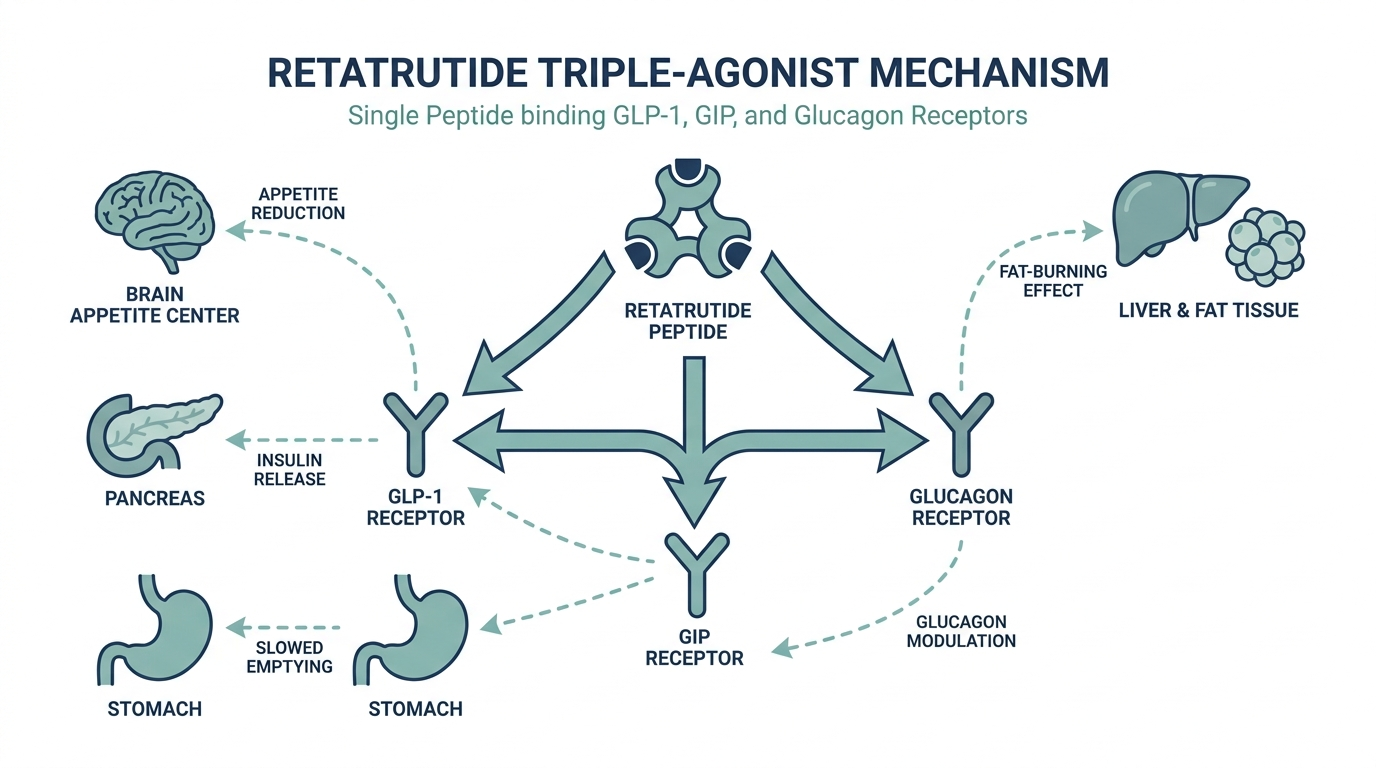
Retatrutide is a triple hormone receptor agonist, meaning it activates three distinct receptors at the same time: GLP-1R (glucagon-like peptide-1 receptor), GIPR (glucose-dependent insulinotropic polypeptide receptor), and GCGR (glucagon receptor). Semaglutide, sold as Wegovy and Ozempic, hits only one receptor. Tirzepatide, sold as Mounjaro and Zepbound, hits two.
The GLP-1 component suppresses appetite and slows gastric emptying. The GIP component enhances insulin secretion and may improve insulin sensitivity. The glucagon receptor activation is the piece that sets retatrutide apart from everything currently approved: glucagon receptor signaling is hypothesized to increase energy expenditure through thermogenesis and enhance hepatic fat oxidation, effectively raising the metabolic rate while the drug simultaneously suppresses intake.
That third receptor is almost certainly why the weight-loss numbers are bigger than anything approved to date. It is also why a unique side effect shows up that no other GLP-1 drug produces, which I will cover in the side effects section.
Structurally, retatrutide carries a C18 fatty diacid side chain that binds non-covalently to serum albumin after injection. Albumin acts as a carrier protein, shielding the peptide from enzymatic breakdown and creating a subcutaneous depot effect at the injection site. The result is a half-life of approximately six days, which is what makes once-weekly dosing possible and what distinguishes it pharmacokinetically from shorter-acting agents that require daily injection.
What do the Phase 3 TRIUMPH trials actually show?
The simplest way to actually get this done
Superpower is a full-body lab membership that runs 100+ biomarkers, has each result reviewed by a doctor, and tracks your numbers year over year (about $199/year). It is what we point readers to when they would rather get one clean, complete draw than chase single tests one at a time. Here is superpower reviewed in full.
The clinical picture for retatrutide is now the strongest in obesity pharmacology. Two large Phase 3 trials have reported, and the numbers are genuinely different from anything the field has seen before.
TRIUMPH-4, reported in December 2025, studied adults with obesity and knee osteoarthritis. At 68 weeks, the 12 mg dose produced 28.7% mean body-weight reduction, the 9 mg dose produced 26.4%, and placebo produced 2.1%.
TRIUMPH-1, Lilly’s pivotal obesity trial, reported on May 21, 2026, in 2,339 participants randomized 1:1:1:1 to retatrutide 4 mg, 9 mg, 12 mg, or placebo. Results at 80 weeks:
| Dose | Mean weight loss (lbs) | Mean weight loss (%) | Achieved 30%+ loss |
|---|---|---|---|
| 4 mg | 47.2 lbs | 19.0% | 15.3% |
| 9 mg | 64.4 lbs | 25.9% | 37.9% |
| 12 mg | 70.3 lbs | 28.3% | 45.3% |
| Placebo | 5.5 lbs | 2.2% | 0.5% |
A blinded 104-week extension for participants with BMI 35 or above showed that the 12 mg group reached 30.3% average weight loss, or 85 pounds. 45.3% of individuals in the 12 mg cohort hit 30% or greater weight loss, a threshold historically associated with bariatric surgery.
Those numbers explain the hype. They also explain why a drug still in trials is already on every longevity forum and black-market vendor catalog.
Personally, I think the 19% result for the 4 mg dose is the most interesting finding for long-term clinical strategy. It is closer to tirzepatide’s Phase 3 result, achievable with dramatically lower side effect rates, and may represent the sweet spot for people who want meaningful weight loss without the discontinuation risk that climbs at 12 mg.
What is the TRIUMPH-1 titration schedule?
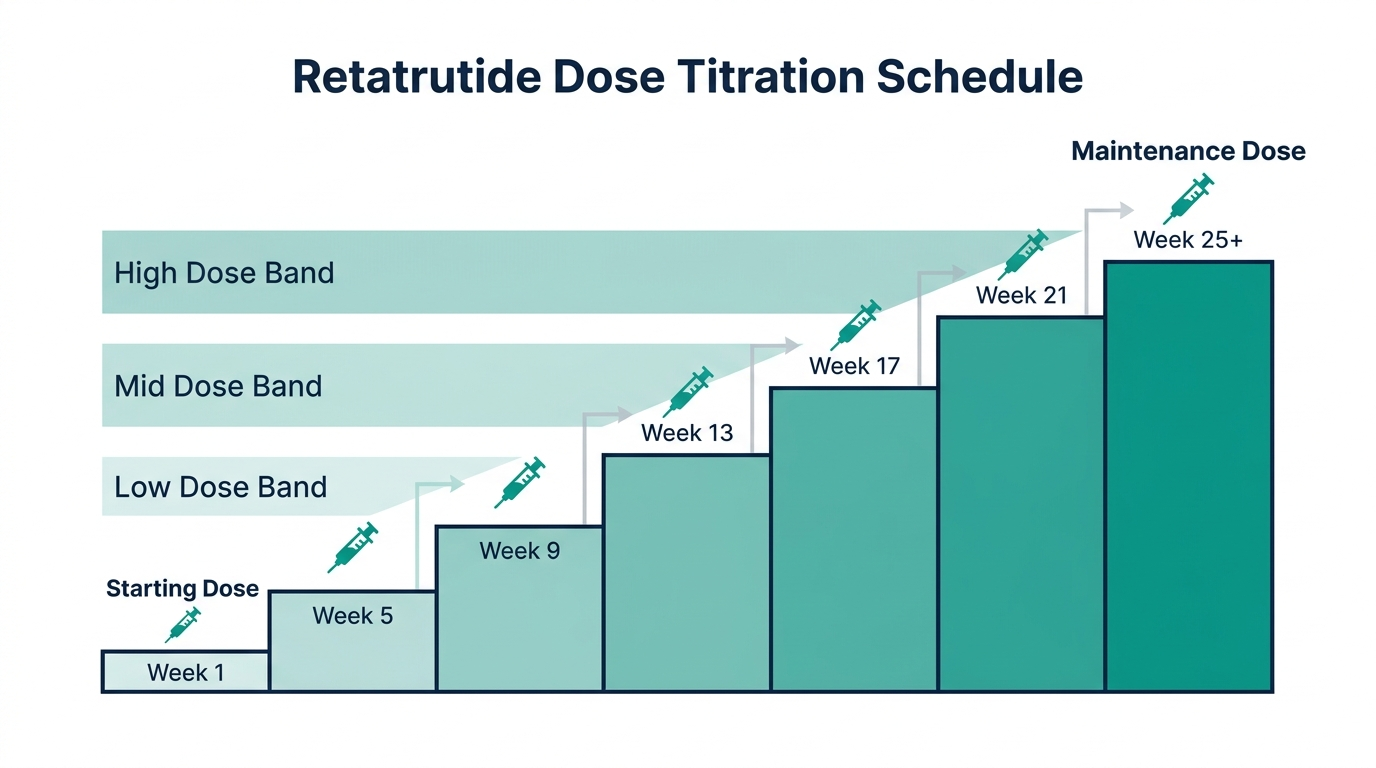
The dosing protocol used across the TRIUMPH trials was consistent. All groups started at 2 mg and escalated in steps every four weeks. This is the schedule the trial data is built on:
- Weeks 1 to 4: 2 mg once weekly
- Weeks 5 to 8: 4 mg once weekly (4 mg target group stops here)
- Weeks 9 to 12: 8 mg once weekly (9 mg target group steps to 9 mg next)
- Weeks 13 onward: maintenance at target dose (4 mg, 9 mg, or 12 mg)
The four-week hold at each step exists because GI side effects are dose-dependent and front-loaded. Rushing the escalation compresses the adaptation window and significantly increases the risk of nausea, vomiting, and early discontinuation. In TRIUMPH-1, discontinuation due to adverse events at 12 mg was 11.3%, compared to 4.1% at 4 mg. That gap is almost entirely explained by how the dose ramp was managed, not by the drug itself.
Retatrutide’s six-day half-life means steady-state plasma concentration is not reached until four to five weeks into any given dose level. So each escalation step is not just “increasing the dose.” It is waiting for the pharmacokinetics to stabilize before asking the body to handle more. The four-week holds are not arbitrary patience.
Do not believe anyone who says you can skip escalation steps to reach results faster. The evidence from the TRIUMPH trials does not support that, and the math on retatrutide’s accumulation profile means dose-stacking before steady state is reached will spike plasma levels unpredictably.
How is retatrutide injected in the trials?
In TRIUMPH-1, retatrutide was administered as a once-weekly subcutaneous injection. The pre-filled pen device used in trials is similar in design to those used for tirzepatide (Mounjaro/Zepbound) and semaglutide (Ozempic/Wegovy). This matters because, if and when retatrutide receives FDA approval, the injection experience for patients already on a GLP-1 pen will be familiar.
The three approved injection sites used in GLP-1 class trials are the abdomen, the outer thigh, and the back of the upper arm. The abdomen is the most commonly recommended because it has abundant subcutaneous tissue, reliable absorption, and is the easiest to self-administer. Rotation across sites is encouraged to prevent localized tissue changes.
Standard technique for subcutaneous peptide injections in the GLP-1 class involves a 90-degree angle, a 4 to 6 mm needle, swabbing the site with an alcohol wipe and allowing it to dry completely before injecting, and holding the pen in place for three to five seconds after delivery to ensure the full dose is released. Cold medication from the refrigerator should be allowed to reach room temperature for at least 30 minutes before injecting.
One practical note worth knowing: the once-weekly schedule means the day matters less than the consistency. Rotating within the same 24-hour window each week maintains a more stable plasma concentration than drifting by two or three days. Missing a dose by more than three days is handled by skipping and resuming the next scheduled day rather than making up the missed dose, which would stack a partial accumulation on top of the normal weekly rise.
What are the actual side effects? (Including the one nobody expected)
The side effect profile for retatrutide is largely shared with the GLP-1 class: nausea, diarrhea, constipation, vomiting, and abdominal discomfort. These are dose-dependent, most intense during escalation, and typically mild to moderate with the majority resolving during treatment. In TRIUMPH-1 at the 12 mg dose versus placebo, the frequency was:
- Nausea: 42.4% vs. 14.8%
- Diarrhea: 32.0% vs. 13.5%
- Constipation: 26.1% vs. 10.9%
- Vomiting: 25.3% vs. 4.8%
Those numbers look alarming as a static table. Context: they are highest during escalation, they decrease substantially at stable dose, and 11.3% discontinuation at 12 mg means 88.7% of participants tolerated the drug well enough to complete the trial.
Then there is dysesthesia: abnormal sensations including tingling, burning, skin sensitivity, and heightened sensitivity to touch or pressure. Dysesthesia appeared in 12.5% of participants on 12 mg versus 0.9% on placebo in TRIUMPH-1. In TRIUMPH-4, the rate was higher at 20.9% on 12 mg and 8.8% on 9 mg.
This is a retatrutide-specific finding, not seen with semaglutide or tirzepatide, and the likely culprit is the glucagon receptor activation. The TRIUMPH investigators noted that cases were generally mild, most resolved during treatment, and it rarely drove discontinuation. But it is clinically novel and worth taking seriously. A clinician who has prescribed GLP-1 and GIP/GLP-1 dual agonists will not have seen this before.
No independent researcher has proposed a clear mechanistic explanation for why glucagon receptor agonism produces this sensory effect. That uncertainty is a reason for medical monitoring, not a reason to panic, but it is not nothing.
What is the legal reality of taking retatrutide in June 2026?
This is where the “how to take retatrutide” conversation has to get honest, because the question of how to take it is inseparable from where you got it.
Retatrutide has no FDA approval as of June 2026. An NDA submission is expected in Q4 2026 or Q1 2027, with FDA review taking 10 to 12 months after filing. The earliest realistic commercial availability is Q1 to Q2 2028.
The FDA has stated explicitly that retatrutide cannot be legally compounded under either Section 503A or 503B of the Food, Drug, and Cosmetic Act. Unlike semaglutide and tirzepatide, which had FDA-approved versions before compounders could argue a shortage exception, retatrutide has never been approved. There is no shortage exception available because there is no approved product to be in shortage of. This is not a legal grey area. It is a bright line.
The FDA issued warning letters to six companies distributing compounded retatrutide in 2025, and the Justice Department has opened criminal prosecutions in Utah and Florida involving its distribution and prescription. A Florida-based compounding pharmacy, Brooksville Pharmaceuticals, paid a $250,000 settlement to Ohio’s Board of Pharmacy after shipping 153 retatrutide prescriptions into the state.
US Customs and Border Protection seized more than 5,000 China-direct peptide shipments between December 2025 and March 2026. Retatrutide was the most problematic compound in the Finnrick independent testing database, failing across 37 tested batches, including at least one counterfeit detection, with purity reported as low as 75%.
That is the actual landscape. The online listings are still there. The pricing ($100 to $1,000 per vial, depending on the vendor and how dramatic the lab branding looks) is visible everywhere. What is not visible is what is actually in those vials, and the independent testing record is not encouraging.
Telehealth GLP-1 program with provider visits and pharmacy coordination.
The one legal route for getting retatrutide in 2026
Clinical trial enrollment. This is not a workaround. It is genuinely the only pathway where retatrutide is legal, monitored, and free.
Lilly’s TRIUMPH program currently includes seven or more active trials spanning obesity, type 2 diabetes, cardiovascular outcomes (TRIUMPH-Outcomes), kidney disease, and sleep apnea. TRIUMPH-2, studying retatrutide in adults with type 2 diabetes, and TRIUMPH-3, studying cardiovascular outcomes, are both expected to report results in 2026.
To find an enrolling trial:
- Go to ClinicalTrials.gov and search “retatrutide.” Filter by “Recruiting” status and your location.
- Read the eligibility criteria. Most trials require BMI 30 or above, or BMI 27 or above with a weight-related comorbidity, stable weight for at least three months, and no prior bariatric surgery.
- Call Lilly’s clinical trial line at 1-877-CTLILLY to ask about sites near you.
- Expect randomization: most trials include a placebo arm, so there is roughly a 25% chance you receive placebo given the 4-arm design in TRIUMPH-1.
What clinical trial participation includes that a grey-market vial does not: verified compound from Lilly’s manufacturing facility, titration managed by a licensed clinical investigator, regular lab monitoring, full safety tracking, and zero cost to the participant. For TRIUMPH-Outcomes (NCT06383390), the study even covers cardiovascular endpoint monitoring over a multi-year horizon.
How does retatrutide compare to tirzepatide and semaglutide on weight loss?
The trial data by the numbers:
| Drug | Mechanism | Approval | Best trial result | Key trial |
|---|---|---|---|---|
| Semaglutide (Wegovy) | GLP-1 mono-agonist | FDA-approved (obesity) | 15.3% at 68 weeks | STEP-1 |
| Tirzepatide (Zepbound) | GLP-1 + GIP dual agonist | FDA-approved (obesity) | 22.5% at 72 weeks | SURMOUNT-1 |
| Retatrutide | GLP-1 + GIP + glucagon triple agonist | Not approved | 28.3% at 80 weeks (30.3% at 104 weeks) | TRIUMPH-1 |
Retatrutide’s 12 mg result at 80 weeks is roughly 25 to 30% better than tirzepatide’s best Phase 3 number. The 104-week extension reaching 30.3% puts it squarely in bariatric surgery territory (which typically produces 25 to 35% excess weight loss).
The trade-off is the side effect burden. Tirzepatide’s discontinuation rate in SURMOUNT-1 was 6.2% at its highest dose. Retatrutide in TRIUMPH-1 was 11.3% at 12 mg. Dysesthesia is absent from the tirzepatide and semaglutide profiles entirely. The bigger weight-loss number comes with a higher pharmacological cost, and for some patients, the 4 mg or 9 mg doses, with notably cleaner tolerability, may be the more appropriate clinical target.
Do not believe the framing that retatrutide “replaces” semaglutide or tirzepatide. Those drugs work, they are available today through licensed channels, they are safe in the clinical sense of that word, and for the majority of candidates, the appropriate conversation right now is about what is accessible and proven, not what is theoretical and unregulated. Retatrutide may well be the best weight-loss drug ever tested. It is also not available.
What will happen when retatrutide is approved?
Based on the current regulatory timeline, this is the reasonable projection:
- Q4 2026 / Q1 2027: Lilly files NDA. TRIUMPH-2 and TRIUMPH-3 results will either accompany the filing or follow closely after.
- Q3 to Q4 2027: FDA review completes (standard 10 to 12-month timeline for priority review, potentially faster if breakthrough therapy designation holds).
- Q1 to Q2 2028: First commercial availability, most likely as a once-weekly subcutaneous pen.
- Compounding window: Unlike semaglutide and tirzepatide, retatrutide has no precedent of shortage-based compounding exemptions. The odds of a low-cost compounded version in the early post-approval period are low.
- Insurance coverage: This remains uncertain. Tirzepatide’s insurance coverage for obesity remained patchy two years after approval. Retatrutide will face the same coverage fight.
Personally, the smart preparation for anyone serious about retatrutide right now is not hunting for a vendor. It is the foundation work: metabolic baseline labs, lifestyle changes that improve response to any GLP-1 class drug (specifically reducing ultra-processed food intake and adding resistance training, both of which compound the pharmacological effect), and getting into a conversation with a licensed clinician now so the prescription pathway is ready the day it opens.
Curious what your own levels look like?
Baseline 100+ biomarkers today and retest as life changes, all in one membership with physician review.
Frequently asked questions
What is the starting dose of retatrutide?
In the TRIUMPH Phase 3 trials, all participants started at 2 mg once weekly, regardless of which target dose they were assigned to (4 mg, 9 mg, or 12 mg). Dose escalation stepped up every four weeks. Starting at a lower dose and escalating slowly is central to managing the GI side effects that peak during ramp-up.
How is retatrutide taken?
As a once-weekly subcutaneous injection, administered with a pre-filled pen device similar to the ones used for tirzepatide and semaglutide. Injection sites are the abdomen, outer thigh, or back of the upper arm. The pen is stored in the refrigerator but should be brought to room temperature 30 minutes before use.
Is retatrutide legal to buy in 2026?
No. Retatrutide is an investigational drug with no FDA approval and no legal compounding pathway. The FDA has issued warning letters to vendors distributing it, the DOJ has opened criminal prosecutions in Utah and Florida, and independent testing found purity failures across 37 grey-market batches. The only legal route is clinical trial enrollment.
What is the maximum retatrutide dose tested?
12 mg once weekly, the highest dose used in TRIUMPH-1 and TRIUMPH-4. At 80 weeks, the 12 mg group lost an average of 70.3 lbs (28.3% of body weight). A 104-week extension reached 85 lbs (30.3%) in participants with BMI 35 or above.
What is dysesthesia and why does retatrutide cause it?
Dysesthesia is an abnormal sense of touch characterized by tingling, burning, or heightened skin sensitivity. It appeared in 12.5% of TRIUMPH-1 participants on the 12 mg dose, versus 0.9% on placebo. It is unique to retatrutide among GLP-1 class drugs and is hypothesized to relate to glucagon receptor activation. Most cases were mild, the majority resolved during treatment, and it rarely caused discontinuation.
When will retatrutide be available by prescription?
Lilly is expected to file the NDA in Q4 2026 or Q1 2027. With standard FDA review, commercial availability is projected for Q1 to Q2 2028. No generic or compounded version is expected in the early launch period.
How does retatrutide compare to tirzepatide for weight loss?
Retatrutide’s TRIUMPH-1 result (28.3% at 80 weeks, 30.3% at 104 weeks) exceeds tirzepatide’s SURMOUNT-1 result (22.5% at 72 weeks) by a meaningful margin. However, retatrutide has a higher discontinuation rate due to adverse events at maximum dose (11.3% vs. 6.2%) and produces dysesthesia, which tirzepatide does not. Both drugs are substantially more effective than semaglutide alone.
Telehealth GLP-1 program with provider visits and pharmacy coordination.
Author: [CAN XAC NHAN: ten + credential tac gia/reviewer health cua Vital Signs Today, vd “Medically reviewed by [name], [credential]”]. Educational content, not medical advice. Sources linked inline.
Primary sources:
– TRIUMPH-1 Phase 3 topline results, Eli Lilly press release, May 2026
– Phase 2 NEJM trial: Triple-Hormone-Receptor Agonist Retatrutide for Obesity, June 2023
– TRIUMPH-4 Phase 3 osteoarthritis results, Eli Lilly, December 2025
– FDA warning letters on compounded retatrutide, Lengea Law summary
– Pharmacy Compounding Advisory Committee bulletin on retatrutide, A4PC
– Retatrutide approval timeline and NDA status, PeptideNerds June 2026
– TRIUMPH clinical trials registry, ClinicalTrials.gov
– Retatrutide dysesthesia analysis, retaweightloss.com
– Finnrick independent peptide testing database
– AJMC coverage: Retatrutide achieves up to 30.3% average weight loss in TRIUMPH-1
Want a real clinician to run the numbers, not a guess?
Joi + Blokes is a telehealth clinic that prescribes GLP-1 medication (Zepbound, compounded semaglutide and tirzepatide), hormone therapy (TRT, HRT), thyroid care, and peptides after a real lab panel and clinician review, with no membership or consult fee (prescriptions from about $59/month, lab panels from $149). If the scale will not budge, this is where you find out whether insulin, thyroid, or hormones are the real reason. Here is Joi + Blokes reviewed in full.
Related reading
Related: which GLP-1 telehealth service fits you.
Vital Signs Today may earn a commission if you buy through links on this page. It does not affect our editorial assessments.