
Last updated 18 June 2026. Educational content, not medical advice. Consult a licensed clinician before using any peptide for therapeutic purposes.
Short answer: Apply 3 to 4 drops of a 1% GHK-Cu serum to clean, damp skin in the evening, wait 2 minutes for it to absorb, then follow with moisturizer. Keep vitamin C in your morning routine and retinol on alternating nights. Start three times per week, not daily, or you risk the “copper uglies,” the frustrating skin-worsening phase that happens when collagen breakdown outruns collagen synthesis.
You’re applying GHK-Cu to your skin every night, but do you know what your skin and inflammation markers actually say? One at-home Superpower draw checks 100+ biomarkers, physician-reviewed.
GHK-Cu is one of the most research-backed actives in skincare right now, and one of the most misused. The molecule itself is genuinely impressive: discovered in 1973 by biochemist Loren Pickart at UCSF while investigating what makes young blood rejuvenate old liver tissue, it turned out to be a copper-chelating tripeptide naturally present in human plasma at roughly 200 ng/mL at age 20, a level that falls to around 80 ng/mL by age 60. That 60% decline over four decades tracks almost exactly with the timeline of visible skin aging, which is why dermatologists and researchers kept studying it for fifty years.
What they found is more interesting than most marketing copy admits. What you actually need to know is how the application details determine whether GHK-Cu works for you or slowly ruins your skin texture for three frustrating months. This guide covers that gap.
Full-body lab membership: 100+ biomarkers, doctor-reviewed, tracked over time.
What exactly is GHK-Cu and why does concentration matter so much?
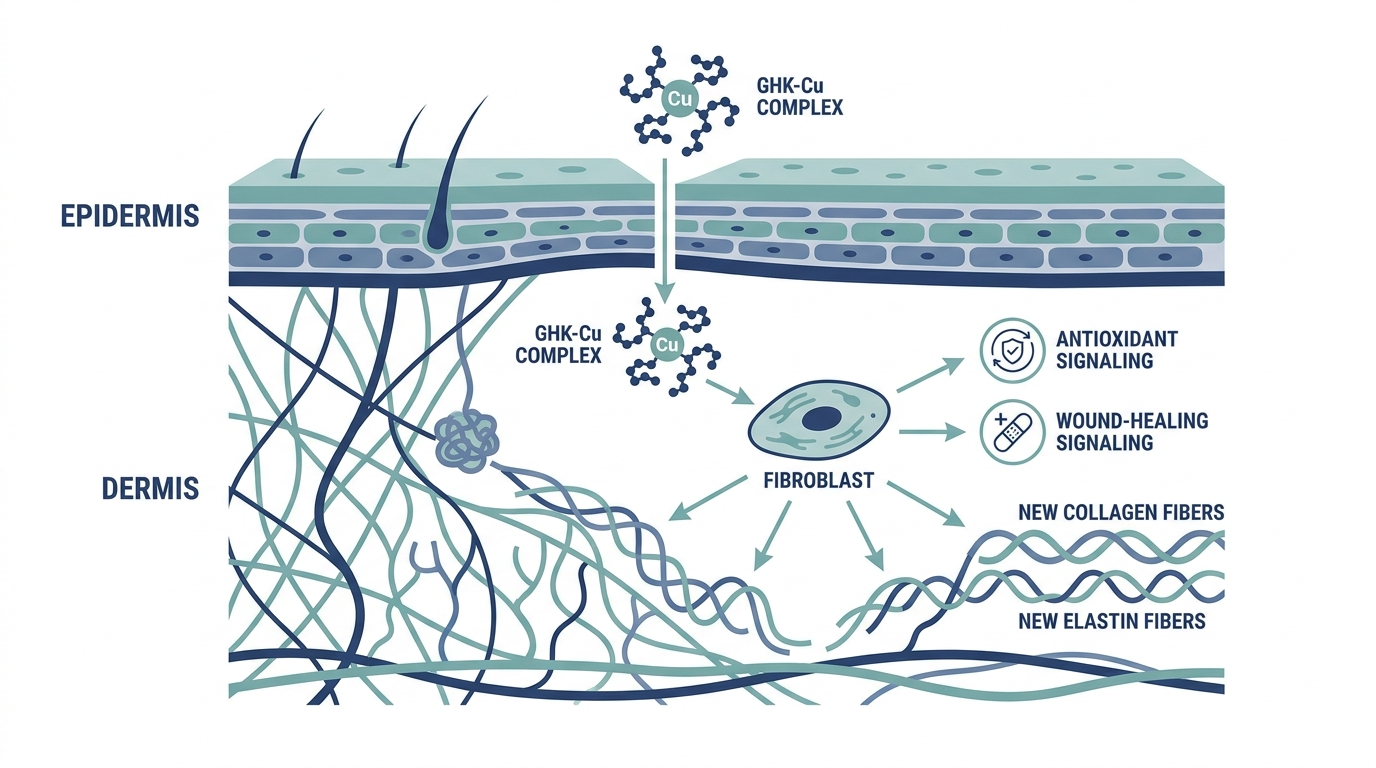
GHK-Cu is the abbreviation for glycyl-L-histidyl-L-lysine copper, a tripeptide that chelates (binds) a copper ion in a 1:1 ratio. The copper is not decoration. Without it, the peptide is biologically inert for most of its documented skin benefits. The chelated complex is what binds to specific skin receptors, modulates gene expression, and activates fibroblasts to produce collagen and elastin.
The gene expression data behind GHK-Cu is striking enough that it deserves a direct mention: a 2018 analysis published in PMC found that GHK affects expression of 31.2% of human genes by at least 50%, stimulating 1,569 genes while suppressing 583. For skin specifically, the most relevant effects are upregulation of collagen type I and III synthesis, activation of the ubiquitin-proteasome system for clearing damaged proteins, and suppression of inflammatory cytokines including TNF-alpha and IL-6.
The concentration question matters because GHK-Cu operates on a curve, not a straight line. In fibroblast culture studies, lower concentrations (around 0.05%) are actually sufficient to stimulate collagen synthesis, while very high concentrations can paradoxically activate matrix metalloproteinase-1 (MMP-1) faster than the skin can lay down new collagen. This is the biological mechanism behind the “copper uglies.” More GHK-Cu is not automatically better. Effective topical concentrations range from 0.05% to 2%, and most well-formulated serums land between 0.1% and 1%.
A note on ingredient label decoding: look for “Copper Tripeptide-1” in the INCI name. That is the standardized cosmetic chemistry name for GHK-Cu. If it appears in the first third of the ingredient list, you are likely getting a meaningful dose. If it sits near the bottom alongside the preservatives, it is probably decorative.
How to take GHK-Cu as a topical serum: the exact steps
The application mechanics are simple but the details matter more than most routine guides admit.
Step 1: Start with a pH-balanced cleanser. GHK-Cu absorbs best at a skin surface pH between 5.0 and 7.5. A harsh alkaline cleanser disrupts the acid mantle and can interfere with peptide stability before you even apply it. A gentle, pH-balanced cleanser (most foam-free options land in the 5.0 to 6.0 range) creates the right starting environment.
Step 2: Apply to damp skin, not dry. This is the one step most people skip and it genuinely changes how well copper peptides penetrate. Hydrated stratum corneum allows the tripeptide complex to diffuse more effectively. Pat your face with a towel to leave it slightly damp, then apply immediately. If you use a hyaluronic acid serum, apply it first, while the skin is wet, then layer GHK-Cu on top while the HA is still tacky.
Step 3: Use 3 to 4 drops, press gently, do not rub. Rubbing can cause friction-related irritation on sensitized or post-procedure skin. Press the serum into the skin with fingertips or your palm, working outward from the center of the face. Coverage over the full face and neck takes about 3 to 4 drops of a standard serum.
Step 4: Wait 2 minutes, then moisturize. GHK-Cu needs a short window to begin binding to receptors before you layer an occlusive moisturizer over it. Two minutes is enough. Follow with your regular moisturizer to seal in hydration and support the skin barrier.
Step 5: Apply SPF in the morning. GHK-Cu does not increase UV sensitivity the way retinoids do, which means it is technically safe for daytime use. However, many formulations work better in the evening because you are not competing with sunscreen layering and there is no UV-driven oxidation exposure. If you do apply it in the morning, SPF 30 or higher over the top is non-negotiable.
The layering order question: GHK-Cu with retinol, vitamin C, and acids
This is where most routines go wrong, because the internet oversimplifies a chemistry compatibility problem. Here is the actual picture.
GHK-Cu with vitamin C (L-ascorbic acid): separate by time of day. This is not optional. Ascorbic acid is a reducing agent that works at a low pH, typically 2.5 to 3.5. Copper ions are pro-oxidants that accelerate the oxidation of vitamin C, degrading it before it can work. Simultaneously, the acidic pH disrupts the copper-peptide bond, reducing GHK-Cu stability. Neither ingredient is dangerous to your skin when both are present, but both ingredients become less effective. The clean solution is vitamin C in the morning routine, GHK-Cu in the evening. You capture the full benefit of both without degrading either.
GHK-Cu with retinol: compatible on the same night with a gap. These two actives operate through entirely separate pathways, and research from the Asterwood skincare guide notes that GHK-Cu may actually reduce retinol-related irritation because of its anti-inflammatory properties and its ability to support barrier repair during retinoid-induced skin turnover. Apply retinol first, wait 10 to 15 minutes for it to absorb and for skin pH to normalize, then layer GHK-Cu. Alternatively, use retinol Monday-Wednesday-Friday and GHK-Cu Tuesday-Thursday, then combine both on weekend nights as your skin builds tolerance.
GHK-Cu with AHA/BHA exfoliants: alternate nights or wait for pH normalization. Glycolic, lactic, and salicylic acids work at low pH, and applying GHK-Cu directly on top of an exfoliant extends the low-pH window, which degrades the peptide complex. Either alternate entirely, or wait 20 minutes after applying an acid toner before applying GHK-Cu.
GHK-Cu with niacinamide: fully compatible. Despite a persistent rumor that niacinamide and copper peptides react to form yellow nicotinamide-copper complexes that stain skin, this reaction occurs only under laboratory conditions, not at typical skincare concentrations. Apply niacinamide before or after GHK-Cu without concern.
| Ingredient | Can you combine? | How |
|---|---|---|
| L-ascorbic acid (vitamin C) | Separate by time of day | Vitamin C AM, GHK-Cu PM |
| Retinol / retinoids | Yes, same evening | Retinol first, 10-15 min gap, then GHK-Cu |
| AHA/BHA exfoliants | With caution | Alternate nights, or wait 20 min after acid |
| Hyaluronic acid | Yes, layer first | HA on damp skin, GHK-Cu while HA is still tacky |
| Niacinamide | Yes, freely | Any order |
| Peptide serums (Matrixyl, argireline) | Yes | Apply by texture, lightest first |
| Benzoyl peroxide | Avoid | Oxidizes copper, deactivates peptide |
The “copper uglies”: what they are and how to avoid them
Personally, this is the single most important thing I would want someone to read before starting GHK-Cu, because the copper uglies are real, documented, and preventable.
The mechanism: GHK-Cu stimulates collagen synthesis, but it also activates matrix metalloproteinases, particularly MMP-1 and MMP-2, to break down old, disorganized collagen before rebuilding it. This is how normal tissue remodeling works. The problem is that when you apply GHK-Cu too frequently too early, MMP activity accelerates the breakdown phase faster than the synthesis phase can keep up. The result is a 2 to 6 week period where skin looks worse: dull, slightly looser, with more visible fine lines and sometimes a patchy, uneven texture.
The Peptide Breakdown analysis from March 2026 describes this as the most common reason users abandon GHK-Cu before it works, and they abandon it right when they should push through. But the answer is not to push through at full frequency. The answer is to titrate up correctly so the breakdown phase is less severe.
The slow-start protocol:
– Weeks 1 to 2: apply 3 times per week (every other night roughly), never two nights in a row.
– Weeks 3 to 4: move to 4 to 5 nights per week if no irritation.
– Month 2 onward: daily or twice daily if skin tolerates.
If you already have the copper uglies, stop application for 5 to 7 days, focus on barrier repair (ceramide-heavy moisturizer, no actives), and restart at 2 to 3 times per week. Most reactions resolve within 2 to 4 weeks of reducing frequency.
Do not believe the idea that a higher concentration gets faster results. The clinical comparison data from InnerBody’s 2026 review shows that a 0.05% GHK-Cu serum in a 12-week double-blind study achieved a 22% increase in skin firmness and 16% reduction in fine lines at a concentration most people would consider modest. The results are in the consistency and the delivery system, not the concentration arms race.
How GHK-Cu works differently for specific skin goals
For anti-aging and collagen support: The most clinically validated use case. A trial in 71 women with photoaging who applied a GHK-Cu facial cream daily for 90 days showed statistically significant increases in skin density and thickness, with measurable reductions in fine line depth and sagging. A parallel 41-woman eye cream trial outperformed both placebo and vitamin K cream. In a head-to-head comparison of GHK-Cu against Matrixyl for collagen production, GHK-Cu produced a 2.1-fold increase versus Matrixyl’s 1.4-fold. Separately, GHK-Cu increased collagen in 70% of women treated, compared to 50% for vitamin C and 40% for retinoic acid in the same study population.
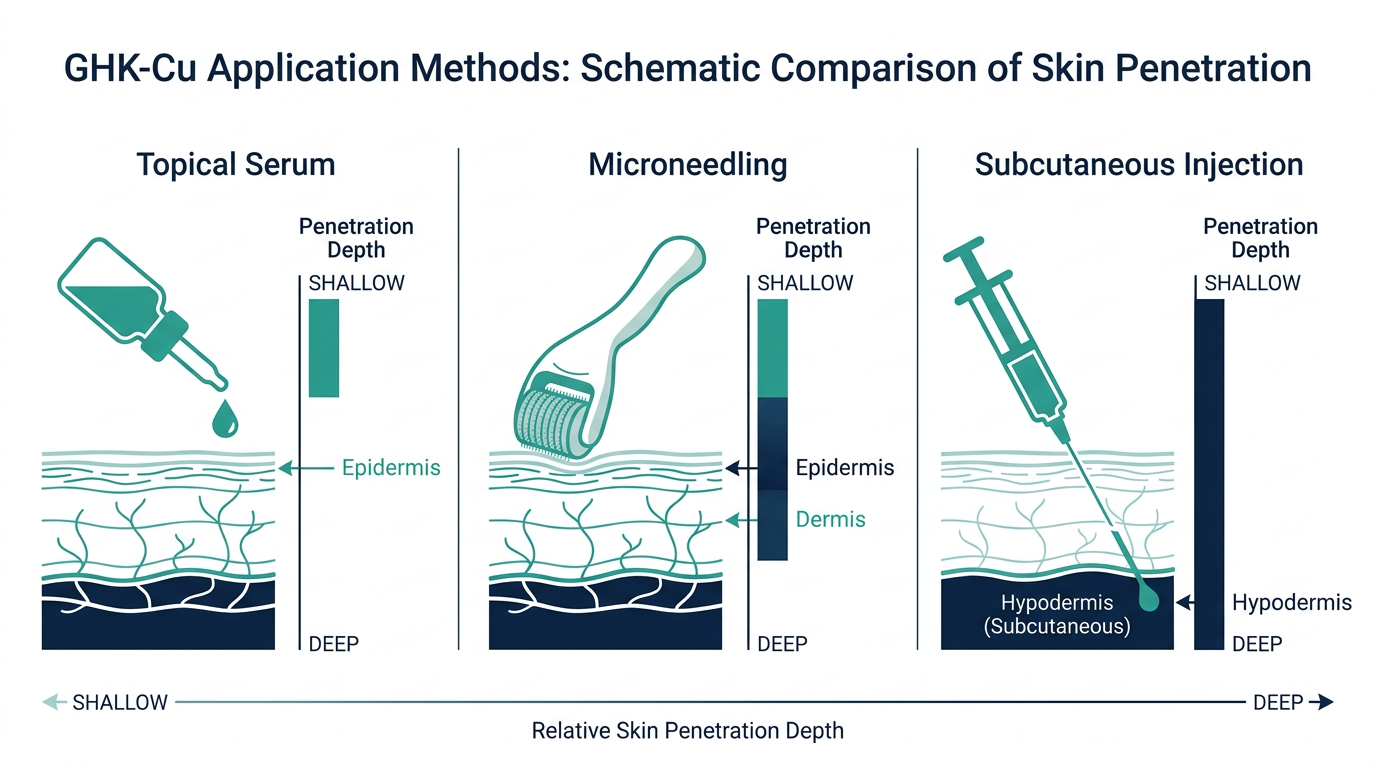
For post-procedure recovery: This is an insider use case that clinic aestheticians know well and general skincare consumers rarely hear about. GHK-Cu can be applied 24 to 48 hours after microneedling, fractional laser, or a chemical peel to accelerate the healing phases. Studies document wound healing acceleration of 30 to 50% compared to standard wound care. The mechanism spans all three healing phases: GHK-Cu shortens the inflammatory phase, speeds granulation tissue formation in the proliferative phase, and organizes collagen deposition in the remodeling phase to reduce scar formation. Medical aesthetics providers at clinics like MDPen incorporate it specifically for post-microneedling protocols.
During the post-procedure window, skip retinoids, AHAs, BHAs, and alcohol-based toners until the skin barrier has recovered (typically 5 to 7 days). GHK-Cu, hyaluronic acid, and ceramide moisturizer form the standard post-procedure recovery trio.
For hair and scalp: The evidence base here is thinner but real. A 2025 microneedling-assisted copper peptide study using a 5-session protocol showed a median 26.5% regrowth in scalp coverage assessed by blinded dermatologists. GHK-Cu works on hair through three parallel mechanisms: stimulating fibroblasts to grow new blood vessels that feed follicles, inhibiting TGF-beta to prevent premature follicle regression, and supporting dermal papilla cell activity. Scalp results require patience. Hair growth studies consistently require 3 to 4 months before meaningful visible changes appear. For scalp application, use a dropper directly onto the part line and massage in for 60 seconds. Neurogan Health’s GHK-Cu Hair Scalp Serum at 4% (2400mg) is formulated specifically for scalp delivery, which is a different problem than facial skin delivery.
Hydrolyzed type I & III collagen peptides, third-party tested, unflavored.
Choosing the right GHK-Cu serum: what the price tiers actually reflect
The retail copper peptide market in 2026 covers a wide price range, and the price differences are not random.
Budget tier, $20 to $35: The Ordinary Multi-Peptide + Copper Peptides 1% Serum at $32 for 30mL ($0.96 per mL on subscription at $28.80) is the default entry point. It delivers 1% copper peptides alongside 7 additional peptide ingredients. The formula is slightly basic and the packaging is no-frills, but the concentration is meaningful and the price-to-efficacy ratio is hard to argue with for someone starting out.
Mid-range, $40 to $65: INNBEAUTY Project Elastic Skin at $46 pairs GHK-Cu with ceramides and vegan collagen amino acids, which makes it better suited to dry or compromised skin types. NIOD CAIS3 at $62 for 15mL ($93 for 30mL) is the premium single-ingredient copper isolate option, using a 1:1 ratio of GHK-Cu to the free GHK tripeptide, which the brand argues improves delivery. COSRX’s Blue Peptide Bakuchiol Plump Glow Serum at approximately $35 to $45 pairs 0.5% copper peptide with bakuchiol, a retinol-alternative, making it a smart combination for those who want to consolidate steps.
Professional tier, $100 and above: Allies of Skin Copper Tripeptide and Ectoin Advanced Repair Serum at $199 for 30mL combines GHK-Cu with ectoine (an extremophile-derived stress-protectant) and acetyl hexapeptide-8. The InnerBody review rates it best overall for anti-aging. Whether that gap over NIOD is worth $106 per 30mL depends entirely on your skin’s response to ectoine synergy, and that varies person to person.
What the price does NOT buy you: purity guarantees. Unlike injectable peptides, which require Certificate of Analysis verification for identity and purity, cosmetic serums in the US are regulated as cosmetics, not drugs. The FDA does not pre-approve them. For topical use with a well-documented safety profile, this is not the crisis it would be for an injectable, but it does mean that “third-party tested” on a cosmetic label still matters. Look for brands that publish specific batch testing.
Packaging tells you something real. GHK-Cu is light-sensitive and oxidizes in open-air environments. An airless pump or opaque dropper bottle is not marketing. The characteristic blue-green color of a copper peptide serum turning brown is a visible sign of oxidation and degradation. Buy from brands that understand this.
GHK-Cu injectable: the separate risk class you need to understand
This is the myth-buster this article has to include, because forum discussions and research-peptide vendor pages have blurred the line between topical GHK-Cu (a cosmetic ingredient with a clean safety record) and injectable GHK-Cu (a different category entirely).
Topical copper peptides are cosmetic ingredients. They cannot and do not need FDA drug approval. Selling a GHK-Cu serum is entirely legal, and the ingredient has been in commercial skincare since the late 1980s.
Injectable GHK-Cu is a different story. The FDA placed injectable GHK-Cu on its Category 2 bulk drug substance list in 2023, meaning compounding pharmacies were prohibited from preparing it for injection. On April 15, 2026, GHK-Cu was removed from Category 2, but it has not yet been added to Category 1 (permitted for compounding). The FDA has announced a Pharmacy Compounding Advisory Committee review before the end of February 2027. That means, as of mid-2026, licensed compounding pharmacies cannot legally prepare GHK-Cu for injection under the 503A framework. It is in a regulatory limbo between banned and permitted.
This matters because some research-chemical vendors and certain “telehealth” platforms are currently marketing injectable GHK-Cu as if the April 2026 removal from Category 2 equals a green light for injection. It does not. Being removed from “prohibited” is not the same as being on the “permitted” list.
The smart, legal route if you want more than topical delivery: wait for the PCAC review outcome in early 2027, then work with a licensed compounding pharmacy that operates through a prescribing clinician. If a telehealth platform is offering injectable GHK-Cu today with no mention of the regulatory status, ask which compounding pharmacy is supplying it and request the pharmacy’s name and 503A compliance documentation. A compliant provider will have that ready immediately.
Don’t just read about your health, track it.
A single result is a snapshot. Superpower re-tests 100+ markers over time so you can watch them move as you change sleep, food, and training.
Frequently asked questions
How long does GHK-Cu take to work?
Expect the first visible improvements in hydration and skin texture within 1 to 2 weeks. Measurable reductions in fine lines and improvements in firmness typically show up between weeks 6 and 12, matching the published clinical study timelines. Maximum collagen-building benefits accumulate over 3 to 6 months of consistent use. Hair growth applications require a minimum of 3 to 4 months before meaningful regrowth is visible.
Can I use GHK-Cu every day?
Most people should not start daily. The safest approach is 3 times per week for the first two weeks, then 4 to 5 nights per week through week four, then daily if there is no irritation. Daily application from day one is the single most common cause of the copper uglies, the temporary skin-worsening phase driven by MMP-mediated collagen breakdown outpacing synthesis. If you hit the copper uglies, reduce frequency rather than stopping entirely.
Should I use GHK-Cu in the morning or evening?
Evening is the default recommendation. It avoids the interaction conflict with vitamin C (which belongs in the morning) and sidesteps UV-related oxidation concerns. GHK-Cu does not increase photosensitivity the way retinoids do, so morning use is not dangerous, but the evening slot is cleaner and easier to maintain.
Is GHK-Cu safe for sensitive skin?
Yes, with a slow introduction. A 2023 safety review of 12 studies found the most common adverse reactions were transient redness (4.2% of users) and mild itching (2.8%), both typically resolving within 1 to 2 weeks. GHK-Cu is generally better tolerated than retinoids or exfoliating acids. Begin with a 0.5% concentration product and a 2 to 3 times per week schedule before moving to 1% daily.
Can GHK-Cu replace retinol?
No, and it should not try to. GHK-Cu and retinoids work through different mechanisms. Retinoids directly regulate cell turnover through nuclear receptors. GHK-Cu modulates collagen synthesis, inflammation, and MMP activity through growth factor and gene expression pathways. They are complementary, not competitive. For someone who cannot tolerate retinoids at all, GHK-Cu provides a meaningful but different set of anti-aging effects.
Does GHK-Cu really affect genes?
The PMC study data is real. GHK affects expression of 31.2% of human genes by at least 50% in cell culture models, stimulating 1,569 genes and suppressing 583. The skin-relevant genes are the ones governing collagen synthesis, inflammation suppression, and the ubiquitin proteasome system for clearing damaged proteins. These are fibroblast culture studies, not live human skin studies at those doses, so the direct translation to topical cosmetic use has limits. But the mechanism is not invented.
Is injectable GHK-Cu legal in 2026?
Not currently, in the US via licensed compounding pharmacies. The FDA removed injectable GHK-Cu from its Category 2 prohibited list on April 15, 2026, but has not yet added it to the Category 1 permitted list. A Pharmacy Compounding Advisory Committee review is expected before February 2027. Selling or using it via research-chemical vendors remains legally and medically risky, with no pharmacist, clinician, or verified purity standard behind the product.
Hydrolyzed type I & III collagen peptides, third-party tested, unflavored.
Author: Vital Signs Today Editorial Team. Educational content, not medical advice. Sources linked inline.
Primary sources:
– PMC / NCBI: Regenerative and Protective Actions of the GHK-Cu Peptide
– InnerBody: Best Copper Peptide Serum 2026
– InnerBody: GHK-Cu Peptide Guide
– Peptide Dossier: GHK-Cu Serum Guide 2026
– Asterwood Skincare: Copper Peptides Guide 2026
– The Peptide Breakdown: Copper Uglies March 2026
– Hairgenetix: Copper Peptide Microneedling Hair Regrowth 2025 Study
– Salhab Pharmacy: GHK-Cu FDA Legal Status 2026
– GrandIngredients: Copper Peptides Clinical Benefits
– Neurogan Health: GHK-Cu Hair Scalp Serum 4%
– MDPen: Copper Tripeptide-1 Skin Benefits
– Wikipedia: Copper peptide GHK-Cu
Related reading
Vital Signs Today may earn a commission if you buy through links on this page. It does not affect our editorial assessments.