
Last updated 18 June 2026. Educational content, not medical advice. Semax is not FDA-approved for human use in the United States. Talk to a licensed clinician before starting any peptide protocol.
Short answer: A sensible starting intranasal dose for Semax is 200 mcg once daily in the morning, using a 0.1% solution (roughly 100 mcg per drop, or 1-2 drops per nostril). Most cognitive enhancement research protocols land between 200 and 600 mcg per day, split across one or two administrations, cycled in 2-to-4-week blocks with a break of equal length.
Semax dosing targets cognitive enhancement, but do you know your baseline brain and metabolic markers? One at-home Superpower draw checks 100+ biomarkers, physician-reviewed.
That number sounds precise. The complication is everything underneath it: which form of Semax you have, whether it is the 0.1% or 1% nasal solution (a tenfold concentration difference), whether you are looking at base Semax or one of the acetylated variants, and whether you are a 60 kg individual or a 100 kg one. Get any of those variables wrong and you are not “slightly off,” you are starting from the wrong floor entirely.
This article walks through the complete dosing picture, the mechanisms that make timing matter, the cycling logic, the side effects that appear specifically at higher doses, and the 2026 regulatory shift that is changing how US residents can legally access pharmaceutical-grade Semax before the end of this year.
Full-body lab membership: 100+ biomarkers, doctor-reviewed, tracked over time.
What exactly is Semax, and why does the dose look so small?
Semax is a synthetic heptapeptide with the amino acid sequence Met-Glu-His-Phe-Pro-Gly-Pro. It was developed at the Russian Institute of Molecular Genetics in the 1980s as an analog of the ACTH(4-10) fragment of adrenocorticotropic hormone. Unlike full-length ACTH, which tells the adrenal glands to release cortisol, the Semax fragment carries no hormonal activity at all. It was engineered specifically to preserve the central nervous system effects while stripping out the adrenal signaling.
Russia approved Semax in 1994 and it remains on the country’s List of Vital and Essential Drugs, prescribed for ischemic stroke recovery, transient ischemic attack, cognitive disorders, and optic nerve atrophy (Peptide Intelligence Hub, iRemedy Healthcare). Decades of clinical use in Russia means there is more real-world dosing data for Semax than for most Western nootropics, though nearly all of it was published in Russian journals and has not been independently replicated in large randomized Western trials.
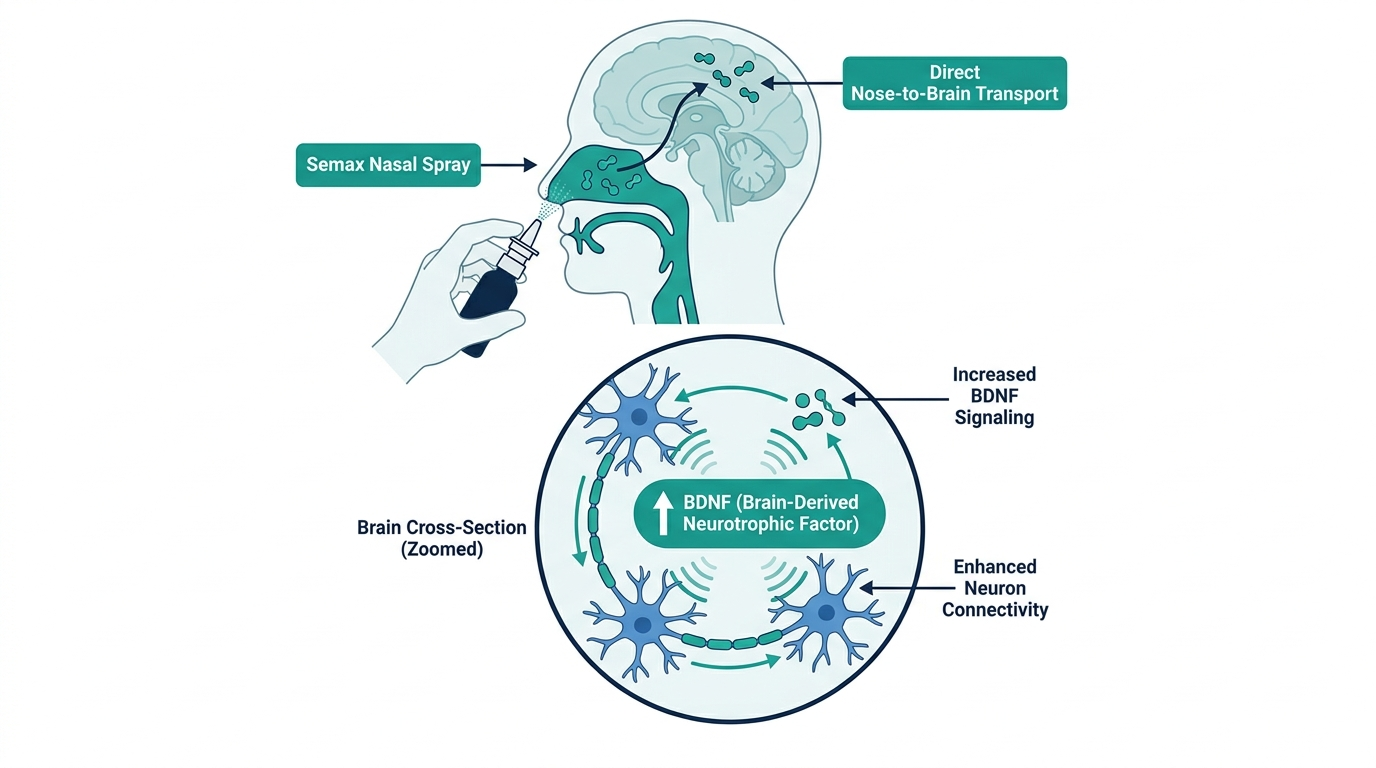
The doses look small because they work at the receptor level. A 2006 study by Dolotov et al. (published in Brain Research) found a 1.4-fold increase in BDNF protein in rat hippocampus after a single intranasal administration. A subsequent series of studies found BDNF mRNA in the hippocampus, frontal cortex, and basal forebrain triples within hours of administration, with effects remaining elevated for 24 hours. You do not need milligrams to move that dial; you need the right receptor engagement, at the right time, delivered through the right route.
Why does the route of administration change the dose so dramatically?
This is the piece most dosing calculators bury in a footnote, and it is one of the most important practical facts about Semax.
Intranasal delivery is the only route validated in published human clinical research on Semax. When you administer Semax as nasal drops or a nasal spray, the peptide contacts the olfactory epithelium and the trigeminal nerve endings in the nasal mucosa, giving it a direct pathway to the central nervous system without having to cross the blood-brain barrier via systemic circulation. That olfactory-to-CNS route is why Semax produces noticeable cognitive effects within 15 to 30 minutes of intranasal dosing.
Subcutaneous injection bypasses that direct CNS route entirely. It sends the peptide into systemic circulation first, meaning it must still find its way into the brain through standard mechanisms. The bioavailability profile is different enough that research communities treat intranasal and subcutaneous Semax as functionally different protocols, not interchangeable ones, and note that published clinical data almost exclusively supports the intranasal route (Valhalla Vitality comparison guide). If you are comparing numbers from injection-route research to an intranasal user experience, or vice versa, you are mixing reference frames that do not translate cleanly.
Oral bioavailability is essentially zero. Semax is a peptide; the digestive system breaks the amide bonds before it has any meaningful chance of reaching the bloodstream intact. Any “oral Semax” product is relying on that fact not being mentioned prominently.
What are the actual dose numbers for intranasal Semax?
Here is the clearest breakdown of current community and clinical-practice ranges, organized by goal and experience level. These are not medical prescriptions; they are the parameters that surface repeatedly in the peer-reviewed Russian literature and in verified third-party dosing resources (PeptideWiki Dosage Guide):
| Goal | Daily Dose Range | Frequency | Notes |
|---|---|---|---|
| Cognitive enhancement (beginners) | 200-300 mcg | Once, morning | Start here; assess 5-7 days |
| Cognitive enhancement (intermediate) | 300-600 mcg | 1-2x daily | Split morning + early afternoon |
| Neuroprotection / mood | 300-600 mcg | 1-2x daily | Second dose before 2 PM |
| Clinical rehabilitation (stroke, supervised) | 600-3,000 mcg | 2-3x daily | Requires medical supervision |
| N-Acetyl Semax (NA-Semax) | 100-300 mcg | 1-2x daily | 2-3x more potent than base |
| N-Acetyl Semax Amidate (NASA) | 50-200 mcg | 1-2x daily | 3-5x more potent than base |
The rehabilitation doses in that final row come from a specific clinical context. Superpower.com cites one protocol of 6,000 mcg per day intranasally, administered in two 10-day courses separated by a 20-day interval, specifically for post-stroke neurological recovery under hospital supervision (Superpower Semax Guide). That number has no relevance to a healthy person experimenting with cognitive optimization.
What does 0.1% vs 1% concentration actually mean for your dropper?
This is where more dosing errors happen than anywhere else, and the existing Russian pharmaceutical literature does not help matters because it uses both concentrations depending on indication.
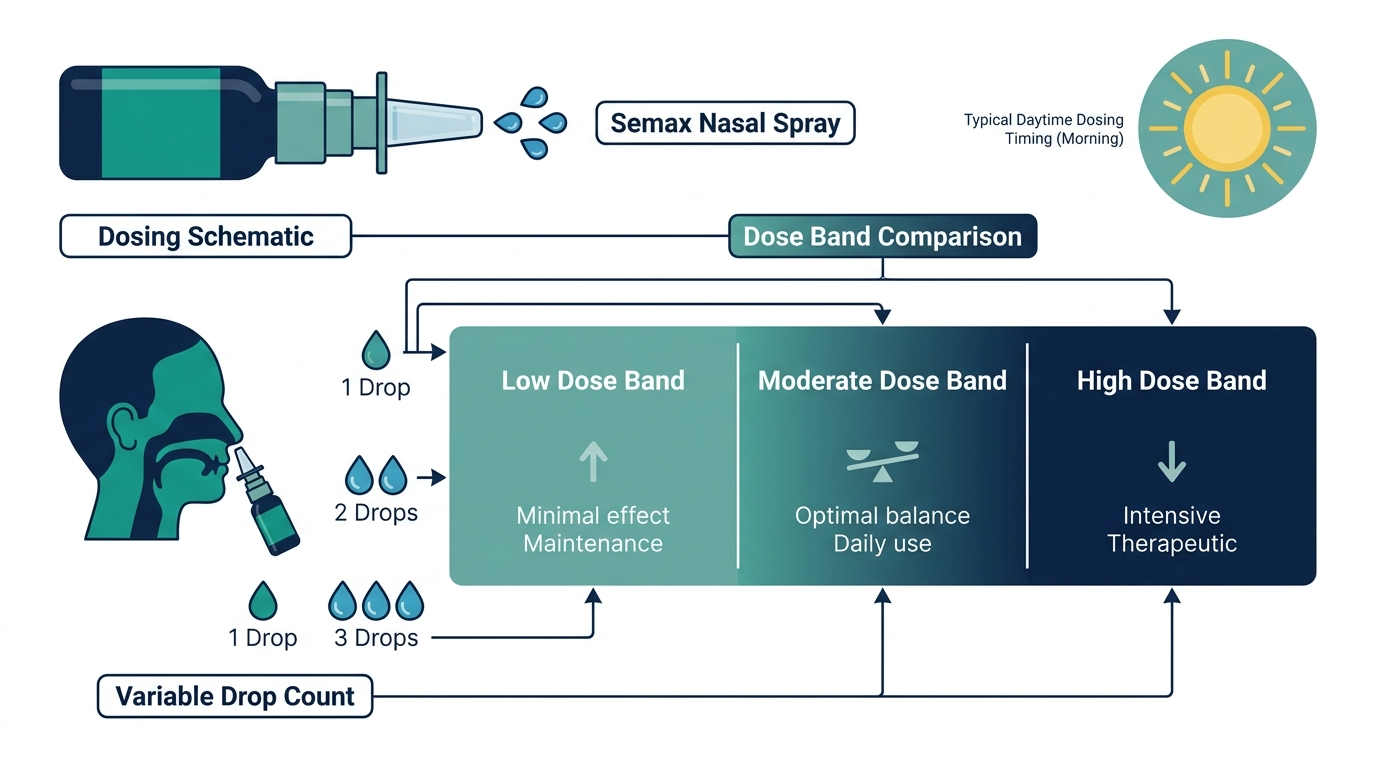
0.1% solution means 1 mg per mL. A standard dropper delivers approximately 0.05 mL per drop, which equals about 50 mcg per drop at 0.1% concentration. A nasal spray pump typically delivers 0.1 mL per actuation, which equals 100 mcg per actuation at 0.1% concentration.
1% solution means 10 mg per mL. The same dropper now delivers approximately 500 mcg per drop. The same pump delivers approximately 1,000 mcg per actuation.
The 1% formulation was developed in Russia specifically for clinical stroke treatment, where the doses are an order of magnitude higher than what anyone uses for nootropic purposes. If a grey-market product does not clearly label its concentration, you have no reliable way to know which floor you are on. Personally, I would not use any Semax product that does not explicitly state both the total peptide mass and the volume in the bottle. The arithmetic has to close.
What is the correct timing, and why does it matter?
Timing for Semax is not arbitrary, and it is one of the insider details most summary articles skip.
Semax activates dopaminergic pathways in the prefrontal cortex and striatum. That is a significant part of how it generates focus and motivation effects. Dopaminergic stimulation late in the day runs directly counter to the neurochemistry of healthy sleep, specifically the adenosine-clearing, melatonin-rising process that winds the brain down over the course of an afternoon and evening.
The practical consequence: do not dose Semax after 3 PM. If you are using a split protocol, the second dose should land no later than early afternoon, ideally before 2 PM. The first dose should be taken in the morning, without food being a hard requirement (unlike some secretagogue peptides that require a fasted state). The third dose in any advanced protocol should be no later than 4 PM, and most practitioners would say even that is cutting it close for people sensitive to sleep disruption.
One more timing detail rarely stated plainly: morning dosing right after waking aligns with the natural cortisol awakening response, a 30-to-45-minute window in which cortisol peaks to begin the day. Adding a BDNF-upregulating compound in that window gives you a neurological state primed for neuroplasticity. That is not accidental; it is the same logic behind why most high-performance cognitive protocols front-load stimulus in the first half of the day.
How do cycling schedules work, and why is the off-period non-negotiable?
Semax builds tolerance relatively quickly. One week off resets sensitivity enough that the next cycle tends to feel similar to the first. That is not a weakness of the compound; it is consistent with the mechanism. BDNF upregulation is not a steady-state effect; it is a triggered response. Run the trigger continuously and the system habituates.
The practical cycling options, from conservative to extended (PeptideWiki Protocol Comparison):
| Protocol | On-Cycle | Off-Cycle | Best Suited For |
|---|---|---|---|
| Conservative | 2 weeks | 1 week | First-time users |
| Standard | 3-4 weeks | 1-2 weeks | Ongoing cognitive work |
| Extended | 4-6 weeks | 2-3 weeks | Neuroprotection goals |
| Russian Clinical | 10-14 days | Varies by indication | Medical supervision context |
One property of Semax that is often misunderstood: it does not produce physical withdrawal when discontinued. Unlike stimulants, benzodiazepines, or SSRIs, stopping Semax does not trigger a rebound crash. What happens instead is a gradual return to baseline over several days as BDNF expression normalizes. The off-cycle exists to prevent tolerance and allow neurological consolidation of any adaptive changes from the on-cycle. That is a fundamentally different reason from withdrawal management.
What side effects appear specifically at higher doses?
The most common side effects at any dose are nasal irritation and mild headache in the first one to three days. These are tied to the nasal mucosa adjusting and typically resolve on their own.
At doses above 600 mcg per day, a different side effect cluster appears: overstimulation (anxiety, irritability, restlessness), sleep disruption that is independent of timing, and in a subset of users, temporary hair shedding. That last one surprises people and deserves a direct explanation.
BDNF plays a role in hair follicle cycling, specifically in regulating the transition between anagen (growth) and telogen (resting) phases. Significant BDNF upregulation can temporarily shift more follicles into the resting phase at once, producing diffuse shedding that looks alarming but is reversible upon discontinuation. It is a dose-dependent effect, meaning it appears most commonly at 900+ mcg per day. It is not reported at typical nootropic doses of 200 to 600 mcg.
Do not believe the claim that “more Semax is always better.” Every additional 100 mcg above the 600 mcg daily ceiling adds more stimulatory load without proportionally increasing BDNF output, because the BDNF response has an effective ceiling in the receptor engagement model. The gain curve flattens while the side effect curve continues rising.
The other population-specific caution: anyone with a personal or family history of bipolar disorder, psychosis, or severe anxiety disorder should not use Semax without explicit guidance from a psychiatrist. The dopaminergic activation mechanism is specifically the issue.
How does base Semax compare to NA-Semax and NASA?
These are not the same compound, and treating them as interchangeable is a dosing error waiting to happen.
Base Semax (Met-Glu-His-Phe-Pro-Gly-Pro) is the original formulation, the one used in Russian clinical trials and the one most well-characterized in both animal and human research.
N-Acetyl Semax (NA-Semax) has an acetyl group added at the N-terminus. This modification slows the enzymatic breakdown of the peptide, extending the half-life and increasing effective potency by roughly 2 to 3 times compared to base Semax. A 200 mcg dose of NA-Semax is therefore closer in effect to 400 to 600 mcg of base Semax.
N-Acetyl Semax Amidate (NASA) adds both the N-terminal acetyl group and C-terminal amidation. The double modification extends duration and potency further. Community comparisons, though not head-to-head clinical trials, estimate 3 to 5 times greater potency than base Semax. Start at 50 to 100 mcg when trying NASA for the first time.
The practical rule: when switching from base Semax to either acetylated variant, halve your dose first and re-titrate upward. The adjustment is not optional. Several reports of people experiencing significant anxiety, insomnia, and emotional dysregulation from NA-Semax trace back to one cause: they applied their base Semax dose to a compound two to three times as potent.
What is Semax’s legal status in the US in 2026?
This section matters because it directly affects how you can access pharmaceutical-grade Semax, which is the only version where the concentration is guaranteed.
Semax is not FDA-approved for any indication in the United States and has never been submitted for FDA review. For several years, it sat on the FDA’s 503A Category 2 list, which flags substances believed to present “significant safety concerns” for compounding, effectively barring licensed US compounding pharmacies from preparing it.
On April 15, 2026, the FDA removed Semax from the Category 2 list and scheduled it for independent review by the Pharmacy Compounding Advisory Committee (PCAC) on July 24, 2026, alongside Emideltide and Epitalon (Newtropin FDA Status Report). If the PCAC recommends Category 1 status, US compounding pharmacies would be permitted to legally prepare pharmaceutical-grade Semax, and licensed clinicians could prescribe it.
That decision lands on July 24, 2026. Watch for it, because a positive outcome changes the access picture entirely. The grey-market reason to buy research-grade vials disappears the day a licensed compounding pharmacy can fill a prescription at a verified concentration from a named 503A or 503B facility.
For now, the options are: a small number of compounding pharmacies and telehealth clinics that are operating in the pre-approval window with physician oversight, or the research-chemical market with all of its concentration uncertainty.
Telehealth GLP-1 program with provider visits and pharmacy coordination.
What should you actually do before you start?
Personally, I would not begin a Semax protocol without two things in place: a baseline cognitive and neurological biomarker panel, and a clear plan for the off-cycle before the on-cycle starts.
The first point is practical. Semax upregulates BDNF, modulates dopamine and serotonin turnover simultaneously, and has measurable effects on prefrontal and hippocampal function. Without a pre-protocol baseline, you cannot attribute anything you observe, positive or negative, to the peptide with confidence. Brain fog that clears after two weeks might be Semax, or it might be a sleep improvement you also made that week. The baseline is the only way to separate signal from noise.
The second point addresses a mistake that appears repeatedly in community forums: people start a Semax cycle without scheduling the off-cycle, and then extend indefinitely because “it is working.” The extended cycle produces tolerance, and the response flattens. The BDNF mechanism needs the pulse-and-rest structure to maintain responsiveness. Decide on the cycle length and the rest period before your first dose, and treat the rest period as non-negotiable.
One thing worth saying directly: the regulatory door opening in July 2026 means the window between “this is a grey-market compound” and “this is a compounding pharmacy product with a real concentration label” may close faster than expected. If the PCAC approves it for Category 1, the sensible move is to wait for the licensed route rather than continuing to calculate doses from a vial that may or may not be the concentration on the label.
Turn what you just learned into action.
Superpower lets you test 100+ biomarkers from home, then re-check them over time so you can actually see progress, physician-reviewed at every step.
Frequently asked questions
How much Semax should a beginner take?
Start with 200 mcg intranasally, once in the morning, using a 0.1% solution. That delivers approximately 50 mcg per drop, so four drops split across both nostrils. Assess your response over five to seven days before considering any increase. The most common beginner error is increasing too quickly, before the first-week adaptation is complete.
Is 0.1% or 1% Semax solution correct for nootropic use?
The 0.1% solution is the appropriate starting point for cognitive optimization. The 1% solution was developed for clinical stroke rehabilitation, where doses are an order of magnitude higher and the protocol operates under direct physician supervision. Applying a 1% concentration to a nootropic dose creates a tenfold overshoot.
Can you take Semax every day without a break?
Daily use without cycling will produce tolerance within two to four weeks, meaning you will need progressively higher doses for the same effect. The recommended approach is two to four weeks on followed by one to two weeks off, which allows BDNF receptor sensitivity to normalize between cycles.
What happens if you take too much Semax?
Above 600 to 900 mcg per day, the most common effects are anxiety, irritability, sleep disruption, and in a smaller subset of users, temporary hair shedding. These are dose-dependent and typically resolve when the dose is reduced or the compound is discontinued. There are no published reports of serious adverse events from intranasal Semax at nootropic doses in otherwise healthy adults.
Does Semax stack well with other nootropics?
Semax is commonly paired with Selank (a related anxiolytic peptide) to balance the stimulatory effects, and with racetams or cholinergics in forums focused on cognitive enhancement. These stacks are documented in community research, not clinical trials. Selank is worth mentioning because it also has Russian clinical approval and a complementary mechanism, anxiolytic and GABAergic versus Semax’s dopaminergic and BDNF-upregulating profile.
When will Semax be legally available from US compounding pharmacies?
The PCAC review is scheduled for July 24, 2026. If the committee recommends Category 1 status, a rulemaking process follows before compounding pharmacies can legally prepare it. The timeline from recommendation to availability typically runs three to six months. A realistic window for legal US pharmacy access is late 2026 to early 2027 if the July review is favorable.
Is intranasal Semax better than subcutaneous injection?
For the cognitive and neuroprotective effects Semax is known for, the intranasal route is supported by the published clinical literature and has the faster onset through the olfactory-to-CNS pathway. Subcutaneous injection has a different bioavailability profile and almost no published human trial data specific to Semax. The community that uses subcutaneous Semax is working with essentially no clinical reference points for dose selection.
Author: Vital Signs Today Editorial Team, [credential]”]. Educational content, not medical advice. Sources linked inline.
Primary sources:
– Newtropin: Semax FDA Status 2026
– PeptideWiki: Semax Dosage Guide
– Superpower.com: Semax ACTH Peptide Guide
– PeakedLabs: Semax Peptide and Cognitive Function
– iRemedy Healthcare: Semax Peptide Evidence Score
– Dolotov et al. (2006): BDNF and trkB expression, Brain Research
– Newtropin: 5 Peptides the FDA Is Reviewing in July 2026
– The Sol Report: Semax Cognitive Enhancement Peptide
– KlearMind Clinics: Semax Dosing Guide
– Brainflow: Semax Peptide Guide 2026
Related reading
Vital Signs Today may earn a commission if you buy through links on this page. It does not affect our editorial assessments.