
Last updated 18 June 2026. Educational content, not medical advice. Most peptides sold online are labeled “for research use only” and are not approved for human use. Talk to a licensed clinician before starting anything.
Short answer: After the 2025 to 2026 FDA crackdown erased a wave of grey-market sellers, including Peptide Sciences and Science.bio, the safest way to get a peptide you actually intend to use is a licensed telehealth clinic or compounding pharmacy with a prescription, usually $199 to $399 a month with labs and monitoring included. For collagen and topical copper peptides, buy from the brand or a major retailer. For “research use only” vendors, the only thing standing between you and a counterfeit is a recent, batch-matched, independently verifiable third-party Certificate of Analysis, and almost nobody checks it correctly.
After the FDA crackdown on grey-market peptide sellers, wouldn’t you rather start with a legitimate, physician-reviewed panel? One at-home Superpower draw checks 100+ biomarkers, physician-reviewed.
On March 6, 2026, the biggest name in peptides just vanished
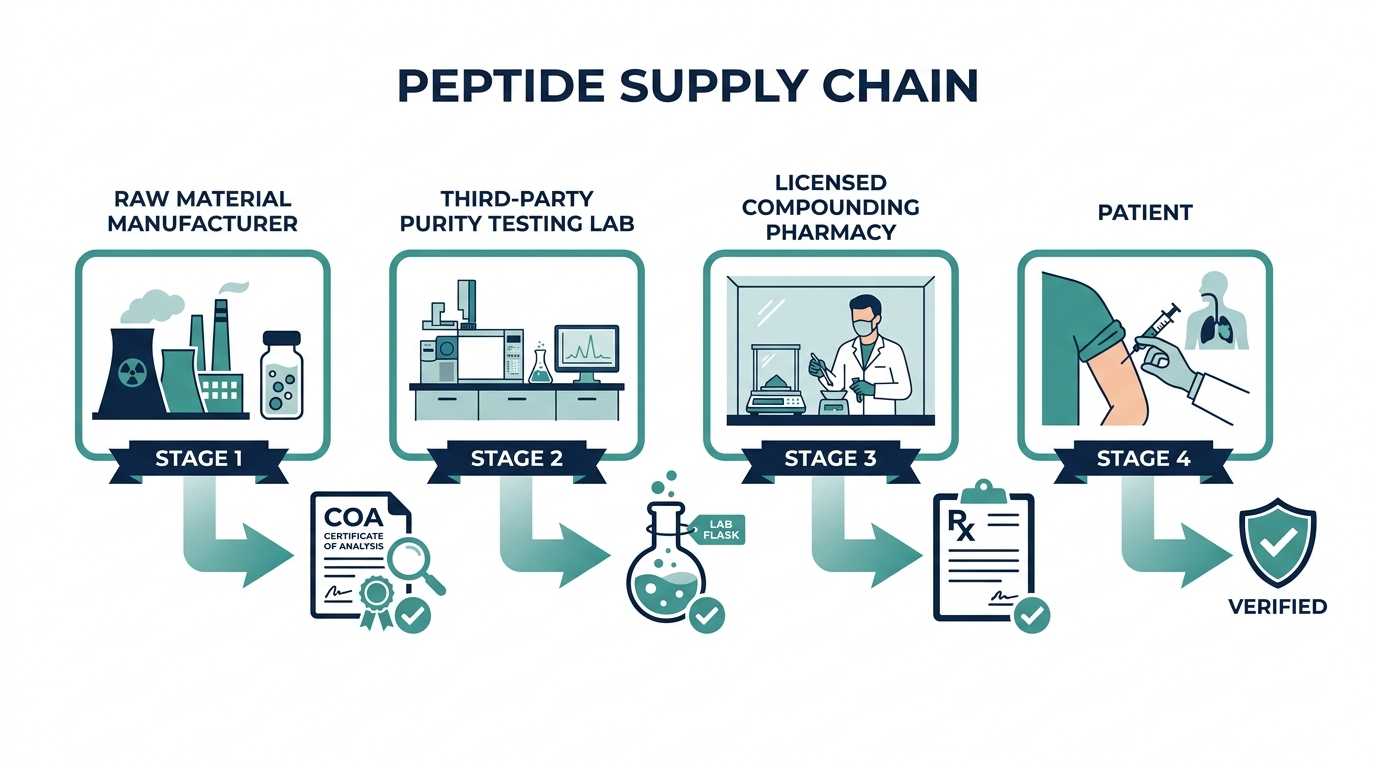
No warning. No explanation. Peptide Sciences, for years the default recommendation in every forum thread, posted a one-paragraph notice that it had voluntarily closed all operations and stopped selling every product. Outstanding orders, refunds, the half-paid invoices sitting in people’s inboxes: nothing. Two months earlier, in January 2026, Science.bio had done almost the same thing. The room had been filling with smoke for over a year, and the biggest players walked out before it collapsed.
That is why “where to buy peptides” and “why did peptide sciences shut down” are trending in the same week, and it is the single most important thing to understand before you spend a dollar. The peptide market did not get safer in 2026. It got thinner, and the survivors are harder to tell from the ones about to disappear.
I have followed this corner of the longevity world long enough to recognize the pattern, because it just ran end to end in public. So here is what the vendor pages will not give you: how we got here, what is genuinely legal right now, which sellers are still standing, what buying actually involves down to the syringe, and the exact checks that separate a real supplier from one whose product tested at 75% purity on the way out the door.
Full-body lab membership: 100+ biomarkers, doctor-reviewed, tracked over time.
Why did Peptide Sciences shut down?
Peptide Sciences was not killed by one warning letter. It was squeezed out by a 15-month enforcement campaign, and the timeline matters because it tells you exactly what is coming for whoever you buy from next.
- December 2024: the FDA sent its first wave of warning letters to grey-market peptide vendors, the shift from looking away to active enforcement.
- June 2025: federal agents raided the warehouse of Amino Asylum, one of the largest research-chemical sellers, and took it offline overnight. That was the moment the community learned warning letters were not the ceiling.
- September 2025: more than 50 warning letters went out at once, to vendors, compounding pharmacies, and telehealth platforms together.
- Late 2025: the Department of Justice secured guilty pleas in cases involving illegal peptide distribution, moving the whole thing from civil penalty to federal crime.
- Throughout: payment processors began flagging research-peptide sales as prohibited, choking off card revenue and pushing vendors to crypto-only checkout, which is its own warning sign.
Then the quality verdict landed separately. The independent testing platform Finnrick analyzed 123 Peptide Sciences samples and failed their retatrutide with an “E” rating across 37 batches collected between December 2024 and March 2026, including a counterfeit flag, and reported purity dipping as low as 75% before the shutdown (Finnrick). So even the “trusted” incumbent was, by the end, shipping product an independent lab would not pass.
Here is what nobody selling you peptides will say out loud: the shutdown was not a tragedy for buyers, it was a revealed truth. A vendor that can vanish in one afternoon with your money and zero accountability was never a safe place to buy something you put in your body. The closures did not create the risk. They exposed it.
Is it legal to buy peptides in the US right now?
It depends entirely on the peptide and what you intend to do with it, and the ground is moving fast in 2026. Three different legal realities sit under the single word “peptide,” and most buyers never realize they are choosing between them.
Lane 1, prescription peptides, fully legal. GLP-1 drugs like semaglutide (Ozempic, Wegovy) and tirzepatide (Mounjaro, Zepbound), plus sermorelin and tesamorelin, are FDA-approved and dispensed through licensed channels. The catch on the cheap route: once the FDA declared the GLP-1 shortages resolved (tirzepatide on 2 October 2024, semaglutide on 21 February 2025), the window for compounding pharmacies to sell low-cost copies closed, with 503A enforcement deadlines hitting in February and April 2025 (FDA). The Outsourcing Facilities Association sued; courts denied the injunctions; the deadlines held. So the “$99 compounded semaglutide” ads still floating around are mostly running on borrowed time or outside the rules.
Lane 2, therapy peptides, an active grey zone that is thawing. BPC-157 is the bellwether. The FDA put it on the 503A Category 2 list (substances that “may present significant safety risks”) in November 2023, effectively banning it from compounding. Then on 22 April 2026 the FDA removed it from Category 2, and in February 2026 HHS signaled that roughly 14 peptides, including BPC-157, TB-500, CJC-1295, Ipamorelin, and Sermorelin, are expected to return to Category 1 (permitted) status, pending a Pharmacy Compounding Advisory Committee meeting set for 23 to 24 July 2026 (FDA bulk substances list). Read that carefully, because it changes the smart move: the door slammed in 2023 is being pried back open through licensed pharmacies. The legal route for the popular therapy peptides is becoming the easy route too.
Lane 3, research-use-only peptides, legal to sell, not legal to use on yourself. This is the BPC-157, TB-500, retatrutide, melanotan corner. Selling them “for laboratory research” is allowed. The “research use only” label is not fine print you can wave off; it is the legal fiction that lets the entire market exist while transferring 100% of the risk onto you. The day you draw it into a syringe, you have left every protection the label pretended to offer.
Nobody is prosecuting an individual for buying one vial. That has never been the risk. The risk is what is in the vial, and the fact that not one pharmacist, doctor, or regulator has stood behind it.
Which peptides do people actually buy, and for what?
“Where to buy peptides” hides a dozen different shopping trips, because the peptide decides the lane. Here is the real map of what people search for and the honest status of each.
| Peptide | What people use it for | Lane | Reality check |
|---|---|---|---|
| Semaglutide / Tirzepatide | Weight loss | Prescription | Tirzepatide hit 22.5% mean body-weight loss in the SURMOUNT-1 trial; the legit route is telehealth, not a vial |
| Sermorelin | GH support, sleep, recovery | Prescription (telehealth now) | $175 to $225/mo, far below old synthetic HGH |
| BPC-157 | Injury, tendon, gut repair | Thawing grey zone | The single most-bought research peptide; legal status shifting toward compounding |
| TB-500 (TB-4) | Recovery, often stacked with BPC-157 | Research / grey | Frequently paired with BPC-157 for soft-tissue recovery |
| CJC-1295 + Ipamorelin | Muscle, GH pulse, lean mass | Research / grey | The most widely used GH-secretagogue stack; requires fasted dosing |
| GHK-Cu (copper) | Skin, hair, anti-aging | Cosmetic (topical) / research (injectable) | Topical is sold openly; injectable is a different risk class |
| Retatrutide | Next-gen weight loss | Investigational | Not approved; the exact compound that failed Peptide Sciences’ lab tests |
Two things jump out of that table. First, the most popular research peptides (BPC-157, CJC-1295, Ipamorelin) are precisely the ones HHS just flagged to move back into legal compounding, which means the grey-market reason to buy them is shrinking by the month. Second, retatrutide, the trendiest weight-loss molecule on the forums, is investigational and was the very product caught failing batch after batch. Popularity and safety are not the same axis.
How do you read a peptide Certificate of Analysis? (the check 90% skip)
If you are going to buy from a research vendor anyway, this one skill matters more than the price, the reviews, and the brand combined. A Certificate of Analysis (COA) is an independent lab’s report on what is actually in a specific batch. Most buyers glance at it, see a big number, and check out. That is not reading it.
A real COA clears four bars:
- It uses HPLC and Mass Spec, both. HPLC (high-performance liquid chromatography) measures purity, how much of the vial is the target peptide versus impurities. Mass Spectrometry confirms identity, that the molecule is the one named on the label and not a cheaper lookalike. Purity without identity is meaningless; you can be sold something 99% pure that is 99% the wrong compound.
- The purity clears the bar. The community minimum for research-grade peptides is HPLC purity of 96% or higher; 99% or above is considered excellent. Anything under 96% is a pass.
- It is batch-specific and dated. The batch number on the COA must match the number printed on the vial you actually receive, and the test should be recent. One generic PDF reused across the whole catalog is theater.
- It is third-party and independently verifiable. The labs the community actually trusts are Janoshik Analytical, MZ Biolabs, and Colmaric Analyticals. A Janoshik report carries a unique key you type into Janoshik’s own site to confirm the report is real and not Photoshopped. A COA from the vendor’s “in-house lab” is worth nothing, because there is no way to independently confirm it.
(Want to see how seriously the real community takes this? On r/peptides, the verdicts are not about whose website looks nicest. They are about whose Janoshik key checks out, whose batch just got an E on Finnrick, and whose purity slipped under 96%. That is the actual currency of trust here, and it is a different language from the testimonials on the vendor’s own homepage.)
Which peptide vendors are still standing in 2026?
After the cull, the honest answer is “fewer, and you still have to verify each one yourself, every batch.” I am not going to hand you a buy link, because the entire lesson of Peptide Sciences is that today’s top-rated vendor can be next quarter’s goodbye note. What I will give you is the names that consistently surface on independent ratings and the method to vet them.
As of mid-2026, the research vendors that repeatedly clear third-party testing include Ascension Peptides (US-based, publishes a third-party COA on every product), Proxiva Peptides (independent lab with no financial tie to the company, public COA set), Protide Health (GMP-compliant manufacturing, strict third-party verification), and Felix Chemical Supply (domestic, affordably priced, comprehensively tested). The single best cross-check is not any review site, including this one: it is Finnrick’s vendor ratings, which now span more than 8,000 tests across 225 vendors and are not paid for by the sellers.
The method, in order:
1. Look the vendor up on Finnrick before you trust any “best vendor” listicle (including listicles that conveniently link to a discount code).
2. Pull the COA for the specific product you want, confirm HPLC ≥96% and a Mass Spec identity match.
3. Verify the COA’s key on the testing lab’s own site.
4. Check that they ship domestically and accept a real payment method. Crypto-only is a sign they expect to lose their processor.
If a vendor fails any one of those, the price does not matter.
What does the legitimate telehealth lane actually look like?
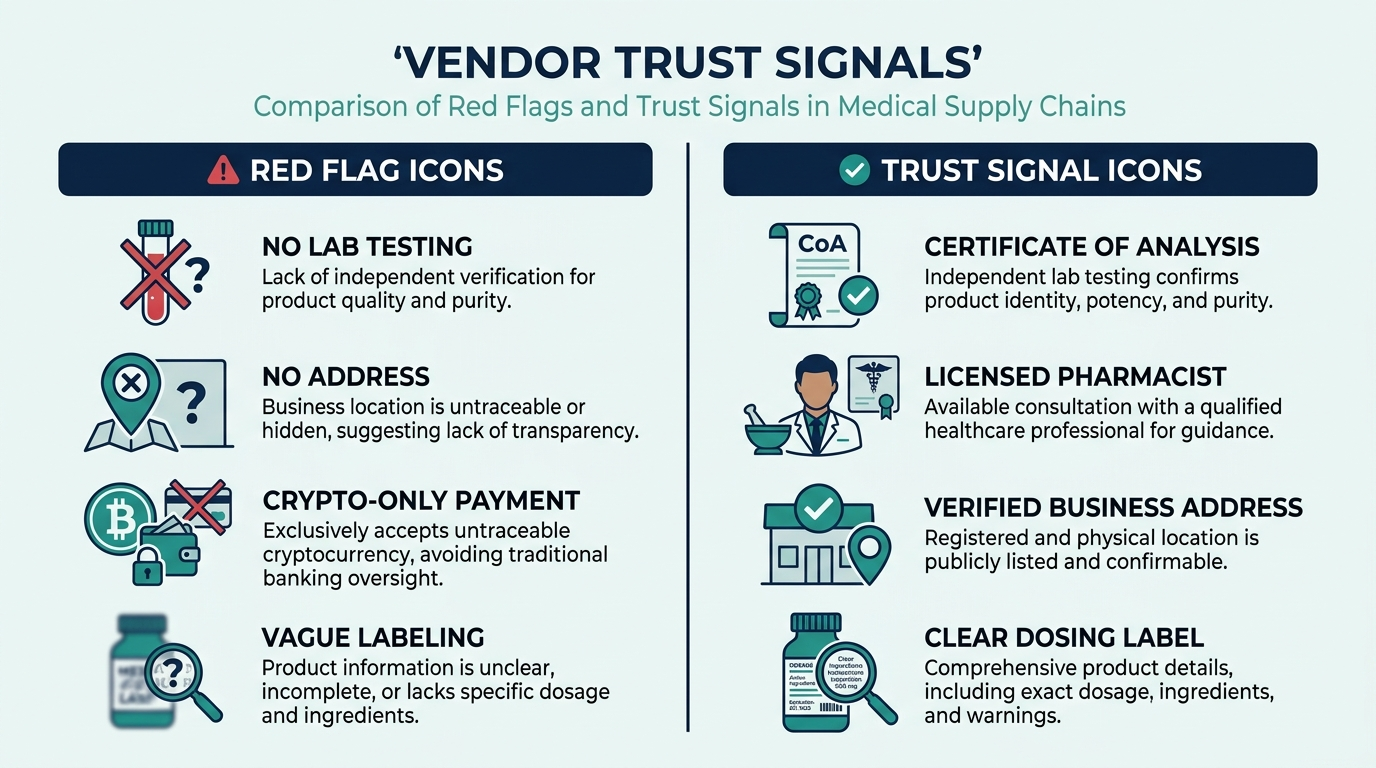
This is the lane I would steer most people toward, and it has matured a lot. Named platforms that operate with real clinicians include Defy Medical, Marek Health, and Hone Health, with newer entrants like OneTwenty launching in June 2026. Through these, sermorelin, NAD+, and glutathione are available now, and the FDA-approved peptides (semaglutide, tirzepatide, sermorelin, tesamorelin) remain fully accessible with a prescription.
A legitimate provider has five non-negotiables:
– A licensed physician, NP, or PA actually prescribing, not a checkbox.
– Medication from a named, verifiable 503A or 503B compounding pharmacy.
– Baseline lab work required before your first dose, not “optional.”
– Structured follow-up with protocol adjustments triggered by labs.
– Pricing that makes sense for what is included.
And here is the insider tell worth the whole section: if a telehealth platform is openly advertising injectable BPC-157 or TB-500 in 2026, treat it as a red flag, not a green light. Given where the regulations sit this year, a compliant pharmacy is not freely dispensing those yet, so a site offering them casually is either using a non-compliant pharmacy or quietly sourcing from research-chem vendors and dressing it up in a clinical UI. The same goes for any “patient” materials that still carry “research use only” language, same-day prescriptions with no clinical review, and prices dramatically below market with no explanation.
Full-body lab membership: 100+ biomarkers, doctor-reviewed, tracked over time.
What does buying a research peptide actually involve? (the part the price hides)
People compare a $60 vial to a $250 monthly program and call the program a ripoff. They are not comparing the same thing, and the gap is mostly in everything the vial does not include. A research peptide does not arrive ready to use. It arrives as a lyophilized (freeze-dried) powder you have to reconstitute yourself, and that process is where a lot of first-time buyers quietly mess up.
In plain terms, here is what handling it actually requires (educational, not a protocol, and a clinician should set any real dose):
- You buy bacteriostatic water separately. It contains 0.9% benzyl alcohol, which lets you draw from the same vial for weeks without bacterial growth.
- You swab both stoppers, draw the water into a U-100 insulin syringe, and inject it slowly down the glass wall of the peptide vial, not directly onto the powder, then let it dissolve without shaking.
- You do the concentration math. Add 1 mL (100 units on a U-100 syringe) of water to a 5 mg vial and you get 5 mg/mL, which is 5,000 mcg/mL. On that syringe, 10 units = 0.1 mL, 25 units = 0.25 mL, 50 units = 0.5 mL. Your dose volume is your target dose divided by that concentration.
- You discard the vial 30 days after reconstitution.
Get a decimal wrong in that math, and you are not “slightly off,” you are out by a factor of ten. This is the unglamorous reality the discount hides: with the grey-market vial, you are the pharmacist, the QC lab, and the nurse, and the only one accountable if any of the three goes wrong. With the clinic, all three are someone else’s licensed problem. That is most of what the price difference buys.
How much do peptides actually cost?
Pricing splits cleanly along the lanes, and the cheap number is almost always cheap for a reason.
- Collagen and topical peptides: $20 to $60. Genuinely low risk; buy on reviews and formulation.
- Grey-market research vials: roughly $40 to $120 a vial (PeakedLabs), plus bacteriostatic water, syringes, and the cost of not actually knowing what you injected.
- Telehealth sermorelin: $175 to $225 a month, versus $600 to $1,200+ for old-school synthetic HGH (IvyRx).
- Telehealth BPC-157 / general peptide therapy: $199 to $399 a month, monitoring included (sermorelin.com).
One line the clinics will tell you and the vendors will not: none of this is covered by insurance. Compounded peptides for longevity or optimization are classified as elective or experimental, so you pay out of pocket regardless of the clinical rationale. Budget for it before you start, not after the first invoice.
Can you buy peptides over the counter?
Only the cosmetic and supplement ones. Collagen peptides and topical copper-peptide (GHK-Cu) serums are sold openly because they are food supplements and cosmetics, not drugs. Therapeutic and research peptides are not legitimate over-the-counter products, and any site selling injectable peptides “OTC, no prescription, for human use” is telling you, in writing, that it does not follow the rules. That is not convenience. That is the tell.
What I would actually do
Personally? I would not start with a vendor at all. I would start with a blood panel and a clinician, in that order, and I say that as someone who finds the grey-market price genuinely tempting on a spreadsheet.
The reasoning is about more than safety; it is about timing. The 2025 to 2026 crackdown did not just remove bad actors, it removed predictability. The vendor with a clean Janoshik key today can lose its payment processor, swap its supplier, or post a goodbye note next month, exactly like Peptide Sciences and Science.bio did. Meanwhile the regulatory door is swinging back toward licensed compounding pharmacies for the major therapy peptides, with a decision due in July 2026. The safe lane and the cheap lane are converging, and the safe one is pulling ahead on everything except sticker price.
If you take one line from this page: buy the lane, not the discount. The molecule is the cheap part. Everything that makes it safe, the identity test, the dose, the pharmacy, the clinician, the accountability, is what you are actually paying for. In 2026, that bundle finally costs about what a year of 3 a.m. “is this vendor legit” anxiety was already costing you.
Curious what your own levels look like?
Baseline 100+ biomarkers today and retest as life changes, all in one membership with physician review.
Frequently asked questions
Why did Peptide Sciences shut down?
Peptide Sciences voluntarily closed all operations on 6 March 2026 with no advance notice, after a 15-month FDA enforcement campaign (warning letters from December 2024, the June 2025 Amino Asylum raid, 50+ letters in September 2025, and DOJ criminal pleas). Independent testing by Finnrick had also failed its retatrutide across 37 batches, with purity reported as low as 75%. The closure shows why an unaccountable vendor is risky for anything you intend to use.
Where can I buy peptides safely online?
For prescription peptides, use a licensed telehealth clinic or compounding pharmacy ($199 to $399 a month with monitoring) such as Defy Medical, Marek Health, or Hone Health. For collagen and skincare peptides, buy from the brand or a major retailer. For research peptides, only consider vendors with a recent, batch-matched, independently verifiable third-party COA, and check them on Finnrick’s vendor ratings first.
Is BPC-157 legal in 2026?
It is in a thawing grey zone. The FDA removed BPC-157 from its 503A Category 2 list on 22 April 2026, and HHS signaled in February 2026 that it and about 13 other peptides may return to Category 1 (permitted for compounding), pending a Pharmacy Compounding Advisory Committee meeting on 23 to 24 July 2026. It is still not FDA-approved as a finished drug.
How much do peptides cost?
Collagen and topical peptides run $20 to $60. Grey-market research vials run $40 to $120 but include no oversight or supplies. Telehealth sermorelin is $175 to $225 a month and broader peptide therapy is $199 to $399 a month, none of it covered by insurance.
How do I know if a peptide vendor is legit?
Demand a recent, batch-specific Certificate of Analysis with both HPLC purity (96% minimum, 99% excellent) and a Mass Spec identity match, from an independent lab like Janoshik, MZ Biolabs, or Colmaric, with a verification key you can confirm on the lab’s own site. Cross-check the vendor on Finnrick. No verifiable third-party COA, crypto-only checkout, and fire-sale prices are the three biggest red flags.
Can you buy peptides over the counter?
Only cosmetic and supplement peptides like collagen and topical copper-peptide serums. Injectable therapy and research peptides are not legitimate OTC products, and any site offering them “no prescription needed” is operating outside the rules.
Why is a research vial so much cheaper than a clinic?
Because the vial is only the molecule. The clinic price bundles a clinician’s prescription, a named compounding pharmacy, baseline and follow-up labs, correct dosing, and accountability if something goes wrong. With a research vial you perform all of those roles yourself, including reconstituting a freeze-dried powder and calculating the dose, where a single decimal error changes the dose tenfold.
Author: Vital Signs Today Editorial Team, [credential]”]. Educational content, not medical advice. Sources linked inline.
Primary sources (verify live before publish): FDA bulk drug substances under 503A; FDA GLP-1 compounding policy statement; Finnrick independent testing database and vendor ratings; Janoshik report verification; SURMOUNT-1 tirzepatide trial; telehealth and research pricing guides (IvyRx, PeakedLabs, sermorelin.com).
Related reading
Vital Signs Today may earn a commission if you buy through links on this page. It does not affect our editorial assessments.