
Last updated 18 June 2026. Educational content, not medical advice. Tesamorelin is FDA-approved only for HIV-associated lipodystrophy; any other use is off-label. Consult a licensed clinician before starting any peptide protocol.
Short answer: Compounded tesamorelin through a telehealth clinic runs $150 to $500 per month depending on dose and provider; brand-name Egrifta WR (the FDA-approved version) costs $2,400 to $2,800 per month at specialty pharmacies before any insurance offset; research-chemical vendors sell lyophilized tesamorelin starting around $5 to $15 per mg, but with no prescription, no cold-chain guarantee, and no liability if the vial contains something else entirely.
Before spending hundreds a month on tesamorelin, see what your hormone and metabolic numbers look like right now. One at-home Superpower draw checks 100+ biomarkers, physician-reviewed.
Why does tesamorelin cost so much in one aisle and so little in another?
Three completely different markets sell what is labeled “tesamorelin,” and each operates under different rules, different quality controls, and different accountability frameworks. The $40 vial and the $2,600 monthly prescription are not competing on price for the same product. They are different products that share an amino acid sequence.
Understanding the price is really understanding which lane you are in, because the lane determines what you actually receive when the package arrives.
Full-body lab membership: 100+ biomarkers, doctor-reviewed, tracked over time.
What exactly is tesamorelin, and why does it command this price at all?
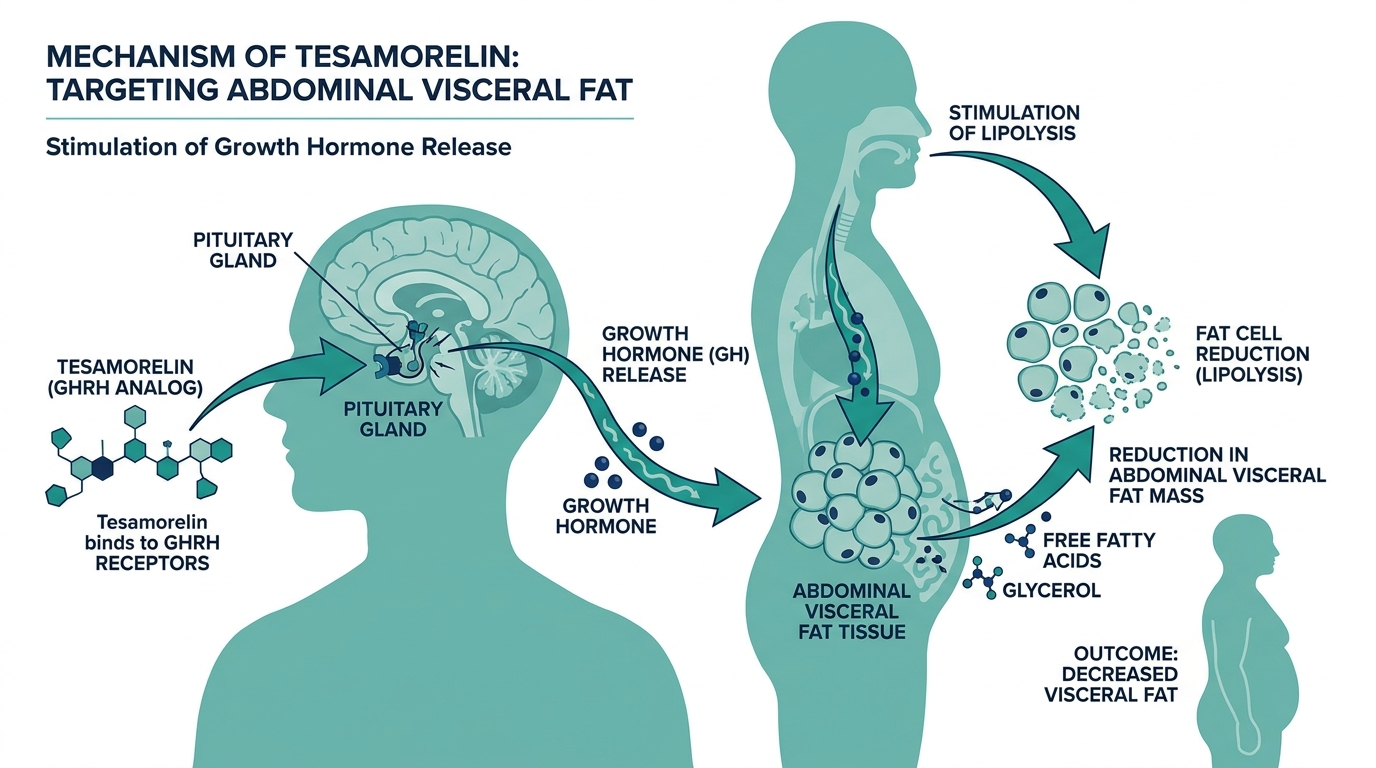
Tesamorelin is a synthetic 44-amino-acid analogue of human growth hormone-releasing hormone (GHRH), with a trans-3-hexenoic acid group added at the amino terminus to prevent rapid degradation by dipeptidyl peptidase 4 (DPP-4). That chemical modification is not cosmetic. It is what makes tesamorelin work where natural GHRH falls apart within minutes of injection.
Unlike injecting growth hormone directly, tesamorelin works upstream. It stimulates the pituitary gland to produce and pulse its own GH in a more physiologic pattern, which preserves the hypothalamic-pituitary negative feedback loop. That distinction matters clinically: direct GH creates sustained, supraphysiologic elevations that disrupt regulatory signaling; tesamorelin keeps the body’s own thermostat in the circuit.
The FDA approved tesamorelin in November 2010 as Egrifta, making it the only approved GHRH analogue on the US market. The indication was narrow: reduction of excess visceral abdominal fat in HIV-infected adults with lipodystrophy. That specific approval is why it exists in the licensed pharmacy lane at all, and it is also why compounding pharmacies can legally dispense it with a prescription for off-label use.
Theratechnologies, the manufacturer, received FDA approval in March 2025 for a new formulation called Egrifta WR (the “WR” stands for weekly reconstitution). The F8 formulation is 8 times more concentrated than the original and requires reconstitution only once per week instead of daily, with less than half the injection volume. Specialty pharmacies began stocking it in September 2025. This is not a minor convenience upgrade; for patients who previously had to reconstitute a daily vial, the compliance difference is significant.
What do the Phase III trials actually show?
Clinicians and patients price-compare tesamorelin against sermorelin and CJC-1295 all the time, usually on the basis of cost. The more honest comparison is on evidence. Tesamorelin has Phase III data. Most other GHRH secretagogues used off-label do not.
The pivotal trials enrolled HIV-positive adults and randomized them to tesamorelin 2 mg per day or placebo for 26 weeks. Across those trials and a subsequent meta-analysis published in 2026, tesamorelin produced a mean reduction in visceral adipose tissue (VAT) of 27.71 cm2 (95% CI [-38.37, -17.06]; P<0.001) and a reduction in trunk fat of approximately 1.18 kg. Liver fat decreased. Triglycerides improved. Importantly, overall glucose tolerance did not worsen significantly in the major trials, even though GH is known to have insulin-antagonist effects.
The liver fat reduction is the detail that surprises most people when they read the actual papers. A 2015 randomized trial in JAMA demonstrated that tesamorelin reduced liver fat content and fibrosis markers in HIV patients, a finding that has since drawn interest in non-HIV metabolic liver disease research.
For non-HIV patients, the trials are smaller and less controlled, but the mechanism is the same GHRH stimulation pathway. Clinicians prescribing off-label typically cite the visceral fat and metabolic data from the HIV trials plus the preserved feedback loop argument. That is the clinical rationale your telehealth provider will use when they write the prescription.
How much does compounded tesamorelin cost through a telehealth clinic?
This is where most buyers spend the most time, and the honest answer is that the number depends on three variables: dose, the specific pharmacy your provider uses, and whether the platform charges an all-in monthly fee or unbundles the pieces.
At the common off-label dose of 1 mg per day:
- 503A compounding pharmacy, standard supply: $150 to $300 per month. A 503A pharmacy compounds for individual patients on a prescription-by-prescription basis.
- 503B outsourcing facility (FDA-registered, batch-manufactured): $300 to $500 per month. The higher cost reflects stricter manufacturing standards, larger batches with documented sterility and potency testing, and typically better cold-chain logistics.
At the full 2 mg per day dose (matching the approved HIV protocol):
- 503A: $250 to $500 per month
- 503B: $500 to $900 per month
Telehealth clinics that include tesamorelin in a broader hormone-optimization package typically charge $199 to $600 per month bundling the medication, clinician oversight, lab draws, and shipping. Named platforms operating in this space in 2026 include Defy Medical, Marek Health, Hone Health, and TeleWellnessMD, each with slightly different bundling models.
One thing the platform pricing pages rarely disclose upfront: cold-chain shipping adds $30 to $60 per shipment. Tesamorelin must be stored at 2 to 8 degrees Celsius before reconstitution, and the lyophilized powder is sensitive to heat exposure during transit. A provider that does not mention cold-chain logistics has either folded it into the fee or is not sending it cold, and the second option matters more than most buyers realize.
Telehealth GLP-1 program with provider visits and pharmacy coordination.
How does that compare to the brand-name Egrifta WR?
Brand-name Egrifta WR through a specialty pharmacy runs approximately $2,400 to $2,800 per month at retail before insurance, based on the standard 2 mg per day dosing that mirrors the pivotal trial protocol.
That number is not misprint. It is how specialty biologics are priced in the US reimbursement system. Commercial insurers and Medicare classify tesamorelin at Tier 4 or Tier 5 (specialty tier), requiring prior authorization and documented HIV-associated lipodystrophy diagnosis confirmed by CT or MRI imaging. For the approved indication with insurance coverage and manufacturer assistance, out-of-pocket costs can come down substantially. Without that, it is a cash-pay figure most patients cannot sustain.
This is precisely why compounded tesamorelin exists as a market. A physician can write a legal prescription for compounded tesamorelin off-label for a patient with no HIV diagnosis, the compounding pharmacy makes it from the same API at 503A or 503B quality standards, and the patient pays $200 to $500 per month instead of $2,600. Do not believe anyone who tells you this is a regulatory loophole; off-label prescribing of FDA-approved compounds has been a cornerstone of US clinical practice for decades.
The practical difference between compounded and brand in 2026 is convenience: Egrifta WR’s weekly reconstitution schedule is genuinely easier than reconstituting a new vial daily, and the auto-injector system is more user-friendly. For patients whose insurance covers it, that matters. For cash-pay patients, the price difference removes the choice entirely.
What about research-vendor pricing?
Research-chemical vendors list lyophilized tesamorelin starting around $5.13 per mg, which works out to roughly $50 to $150 for a 10 mg vial. At 1 mg per day that is 10 days of supply per vial, so monthly cost lands at approximately $150 to $450, overlapping with the low end of the telehealth-compounded range.
The per-milligram number is not the meaningful comparison.
Tesamorelin is the single most counterfeited GHRH analog on the research-chemical market, according to independent testing platforms. Cheaper peptides like sermorelin (15-28 amino acids) and CJC-1295 can be synthesized for far less and are difficult to distinguish from tesamorelin without mass spectrometry. A vendor selling you “tesamorelin” at a steep discount may be selling you a cheaper peptide with a relabeled vial, and you would need LC-MS equipment to know the difference. HPLC purity alone does not confirm identity.
The cold-chain issue is also more serious with tesamorelin than with most peptides because of its molecular size. At 44 amino acids and 5,135 daltons, tesamorelin is a large, fragile peptide more susceptible to degradation from heat, improper pH, or mechanical agitation during shipping than the shorter GH-secretagogues. The research-vendor model does not guarantee temperature-controlled shipping as standard practice.
Personally, I would not buy research tesamorelin at any price, and not primarily for legal reasons. The impersonation risk is too high given how easily cheaper peptides can be substituted, and the cold-chain question is unresolved with every vendor I have seen. The cost saving versus a real telehealth prescription narrows when you account for the supplies you buy separately, and it disappears entirely if you are injecting the wrong compound.
What does the full cost of a telehealth tesamorelin protocol actually look like?
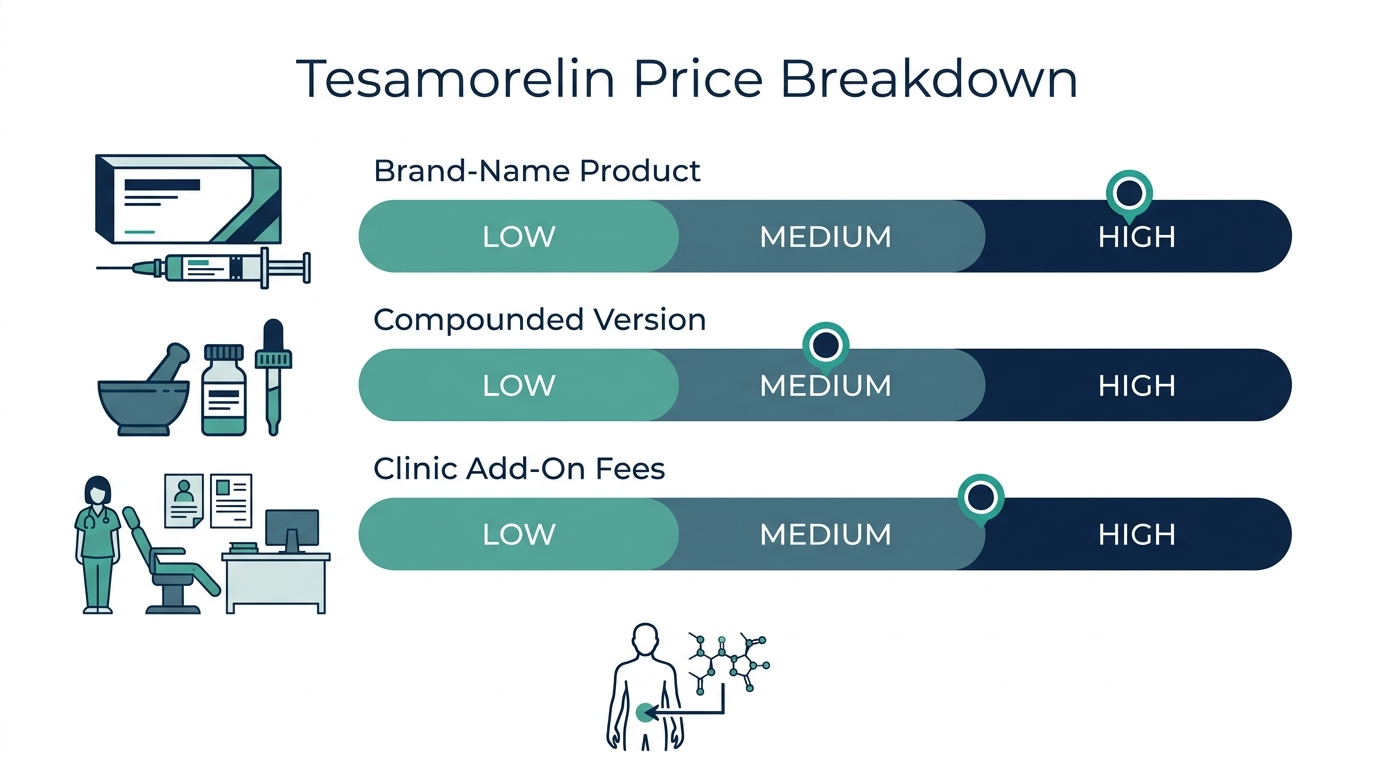
Line-itemizing this helps, because the monthly medication fee is not the whole number.
| Cost component | Typical range | Notes |
|---|---|---|
| Telehealth intake consultation | $75 to $200, usually one-time | Some clinics waive this if you sign up for a program |
| Baseline lab panel (IGF-1, glucose, HbA1c, lipids, CBC) | $100 to $250 | Required by responsible providers; may be ordered at Quest/LabCorp |
| Compounded tesamorelin (1 mg/day, 503A) | $150 to $300 per month | 30-day supply |
| Compounded tesamorelin (2 mg/day, 503A) | $250 to $500 per month | Matching trial dose |
| Bacteriostatic water (if not included) | $10 to $20 per supply | Needed for reconstitution |
| Insulin syringes (U-100, 29-31 gauge) | $15 to $30 per month | Not always shipped with medication |
| Cold-chain shipping | $30 to $60 per shipment | Ask explicitly if it is included |
| Follow-up labs (IGF-1 at 4-8 weeks) | $60 to $150 | Critical safety check, not optional |
A realistic all-in first-month budget for a 1 mg per day protocol through a telehealth clinic: $600 to $900, with ongoing months running $250 to $450 depending on the provider’s follow-up model.
Why does follow-up lab monitoring matter enough to line-item it? Because tesamorelin raises IGF-1 levels, and the FDA prescribing information explicitly recommends monitoring for persistent elevations above 3 standard deviations. Sustained high IGF-1 is the primary safety concern, not just an academic one. A provider who does not mention IGF-1 monitoring in the first intake call is not running a protocol you should accept.
Who is actually a good candidate for tesamorelin?
Clinicians prescribing off-label typically focus on patients who have measurable visceral adiposity that has not responded to lifestyle changes, often combined with elevated triglycerides, fatty liver findings, or metabolic syndrome markers. The FDA’s on-label population had HIV-associated lipodystrophy, but the underlying biology is not HIV-specific: the visceral fat depot is sensitive to GH pulsatility regardless of the underlying cause of accumulation.
Tesamorelin is explicitly contraindicated in anyone with an active malignancy, pituitary gland tumor, or known hypersensitivity to GHRH. It is not appropriate for pregnant or nursing patients. Patients with pre-existing diabetes require careful glucose monitoring, because the GH-mediated insulin-antagonist effect can worsen glycemic control even when the drug does not significantly raise fasting glucose at the population level.
People who are already lean, have normal visceral fat by imaging, and are primarily looking for a “growth hormone boost” are not the population the trials studied. The mechanism targets fat-depot reduction more than pure performance enhancement. A physician who orders baseline imaging before prescribing is doing this correctly.
What is the realistic timeline and results?
Based on the Phase III trial data:
- Weeks 4 to 8: Most patients report early changes in bloating and abdominal firmness, often before any measurable waist reduction.
- Week 12: Clinically meaningful reductions in visceral fat on imaging (the trials documented over 15% VAT reduction in six months in the HIV population).
- Week 26: The primary trial endpoints were met at 26 weeks; this is the minimum reasonable commitment.
- Beyond 26 weeks: Discontinuation leads to visceral fat returning toward baseline in most patients. This is not a finite course; it is an ongoing protocol that requires active management.
The return-to-baseline finding is the most important thing to understand before pricing a protocol. You are not buying a course of treatment with a defined endpoint. You are buying a monthly maintenance expense, indefinitely, if you want sustained results. A 1 mg per day protocol at $200 per month adds up to $2,400 per year. A 2 mg per day protocol at $400 per month is $4,800 per year. Neither number includes labs or clinician fees.
Most people who price-shop tesamorelin against a research vial are not doing that math yet.
How does tesamorelin stack up against similar options on cost?
| Peptide | Typical monthly cost (telehealth/compounded) | FDA approval | Evidence quality |
|---|---|---|---|
| Tesamorelin | $150 to $500 | Yes (HIV lipodystrophy) | Phase III RCT |
| Sermorelin | $175 to $225 | Approved (discontinued as brand, compounded available) | Older RCTs, smaller |
| CJC-1295 + Ipamorelin (stack) | $200 to $350 | No (research use only) | Limited human data |
| Semaglutide (compounded) | $299 to $499 | Yes (T2D, weight loss) | Multiple large Phase III trials |
| Tirzepatide (compounded) | $349 to $599 | Yes (T2D, weight loss) | SURMOUNT-1: 22.5% body weight loss |
Tesamorelin is the most expensive pure-GHRH option on that list, and also the one with the deepest human clinical evidence for visceral fat specifically. Sermorelin is cheaper but has older, smaller trial data and a different molecular profile. The GLP-1 drugs target total body weight loss more broadly; tesamorelin targets visceral adiposity more selectively. These are not interchangeable choices.
Don’t just read about your health, track it.
A single result is a snapshot. Superpower re-tests 100+ markers over time so you can watch them move as you change sleep, food, and training.
Frequently asked questions
How much does tesamorelin cost per month through a telehealth clinic?
Compounded tesamorelin through a licensed telehealth clinic runs $150 to $300 per month at a 1 mg per day dose via a 503A pharmacy, or $300 to $500 per month through a 503B outsourcing facility. At the full 2 mg per day dose those ranges shift to $250 to $500 and $500 to $900 respectively. Bundled programs from clinics like Defy Medical or Marek Health typically fall between $199 and $600 per month including clinical oversight.
How much does brand-name Egrifta WR cost?
Egrifta WR (approved March 2025) retails at $2,400 to $2,800 per month at specialty pharmacies before insurance. Coverage through commercial insurers and Medicare requires prior authorization with documentation of HIV-associated lipodystrophy. Cash-pay patients are the ones compounded tesamorelin was designed to serve.
Is compounded tesamorelin as good as brand-name Egrifta?
Both use the same 44-amino-acid tesamorelin API synthesized to USP standards. Third-party assays of compounded tesamorelin from reputable 503B facilities show 98 to 99.5% purity, in line with Egrifta’s own COA specifications. The clinical difference is reconstitution convenience (Egrifta WR needs reconstitution weekly; compounded typically daily) and the level of regulatory oversight over the manufacturing process.
What does tesamorelin cost from research-chemical vendors?
Research vendors list lyophilized tesamorelin starting at approximately $5 to $15 per mg, or $50 to $150 for a 10 mg vial. At 1 mg per day that covers 10 days of supply. However, tesamorelin is one of the most counterfeited GHRH analogs on the research market because cheaper shorter peptides are nearly impossible to distinguish without mass spectrometry. No prescription and no cold-chain guarantee are also standard with this route.
Does insurance cover tesamorelin?
Brand-name Egrifta WR is covered by commercial insurers and Medicare Part D at Tier 4 or Tier 5 for HIV patients with documented lipodystrophy confirmed by imaging. Compounded tesamorelin for off-label use is cash-pay only in virtually all cases.
How long do you need to take tesamorelin to see results?
Phase III trial endpoints were measured at 26 weeks (six months). Most patients see the first changes in abdominal firmness at four to eight weeks. Visceral fat reduction greater than 15% on imaging occurs by six months in the trial populations. Discontinuation causes visceral fat to return toward baseline, making this an ongoing protocol rather than a finite course.
What monitoring is required during a tesamorelin protocol?
The FDA prescribing information recommends monitoring IGF-1 levels, with consideration to discontinue if IGF-1 remains persistently above 3 standard deviations. Baseline fasting glucose and HbA1c are essential before starting; repeat glucose monitoring every 4 to 8 weeks is standard at responsible clinics. Any provider who does not mention IGF-1 monitoring before prescribing is not running a complete protocol.
Author: Vital Signs Today Editorial Team, [credential]”]. Educational content, not medical advice. Sources linked inline.
Primary sources (verify live before publish):
– Theratechnologies Egrifta WR FDA approval announcement
– Tesamorelin meta-analysis, visceral fat outcomes, 2026 (PubMed 41545261)
– LiverTox: Tesamorelin monograph, NIH/NCBI
– Tesamorelin liver fat RCT, PMC4363137
– Safety in type 2 diabetes, PLOS ONE
– Egrifta SV full prescribing information, FDA
– Tesamorelin cost 2026, realpeptides.co
– Tesamorelin cost, perfectb.com
– Tesamorelin peptide deck, where to buy
Related reading
Vital Signs Today may earn a commission if you buy through links on this page. It does not affect our editorial assessments.