A low result on a lactate dehydrogenase (LDH) blood test is one of the few abnormal lab findings that is usually good news, or simply unimportant. LDH is an enzyme your cells release when they are damaged, so doctors watch for high levels far more often than low ones. If your number came back under the reference range, here is what that actually means and the rare situations where it is worth a second look.
- A low LDH blood test result is uncommon and, in most adults, is not considered a health problem; normal LDH in adults runs roughly 135 to 225 U/L per Cleveland Clinic.
- The most frequent reason for a falsely low LDH is taking large doses of vitamin C or vitamin E, which interfere with the test rather than your health (MedlinePlus).
- A genuinely and persistently low LDH is rare and points mainly to inherited lactate dehydrogenase deficiency, a condition that affects muscle energy during hard exercise (MedlinePlus Genetics).
What does a low LDH result mean and what is the cutoff
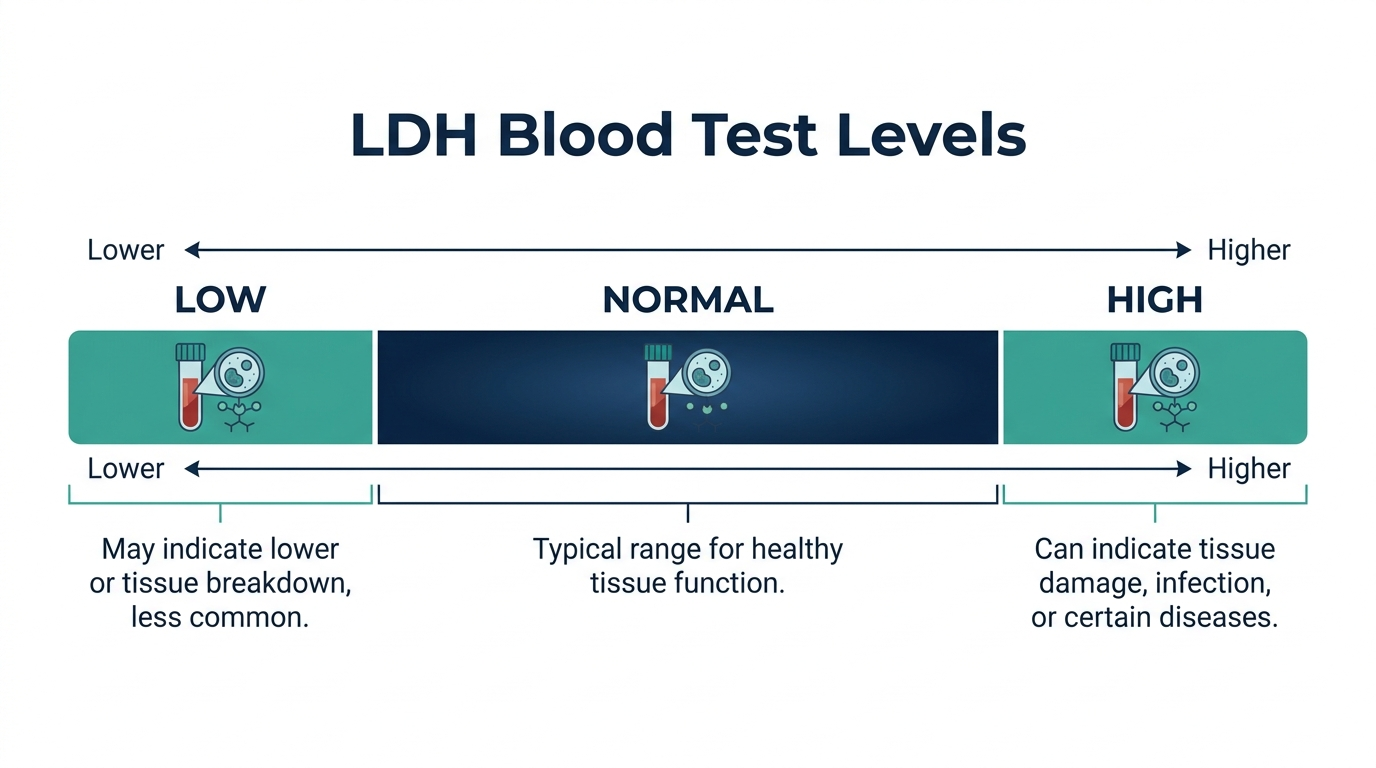
A low LDH result means your blood holds less of this enzyme than the lab expects, and in adults that is rarely a sign of disease. According to Cleveland Clinic, the typical adult reference range is 135 to 225 U/L for males and 135 to 214 U/L for females, so “low” generally means a value below about 135 U/L. MedlinePlus states plainly that “lower than normal LDH levels aren’t common and usually aren’t considered to be a health problem.”
A low LDH result is usually good news, but see the fuller panel to know what’s normal for you. One at-home Superpower draw checks 100+ biomarkers, physician-reviewed.
Reference ranges differ between laboratories because they use different equipment and methods, so always read your result against the range printed on your own report. Children and infants naturally run higher than adults, which means a “normal” childhood number can look high by adult standards. The single most useful step is to compare your number to the lab’s stated low end, not to a figure you found online.

What causes a low LDH blood test
The leading cause of a low LDH is not a disease at all but vitamin interference: large amounts of vitamin C (ascorbic acid) or vitamin E can artificially lower the measured value, per MedlinePlus and Cleveland Clinic. This is a lab artifact, meaning the enzyme in your body may be normal while the test reads low.
Beyond supplements, the recognized causes are limited:
- High-dose vitamin C or vitamin E: the most common reason, and fully reversible once you pause the supplement before testing (MedlinePlus).
- Inherited lactate dehydrogenase deficiency: a rare autosomal recessive disorder, including LDH-A deficiency, also called glycogen storage disease XI (MedlinePlus Genetics).
- Lab and sample factors: reference ranges and methods vary by lab, so a borderline-low reading can simply reflect the assay used (Cleveland Clinic).
Older references sometimes mention chronic malnutrition or heavy alcohol use, but these are not consistently confirmed and a low LDH alone is not used to diagnose them.
Symptoms of low LDH, or whether it is silent
A low LDH usually causes no symptoms at all, because in most people it reflects vitamin interference rather than any organ problem (MedlinePlus). You would not feel a low enzyme level the way you might feel anemia or thyroid trouble, so a quietly low result on routine bloodwork typically needs no action.
The exception is inherited lactate dehydrogenase deficiency, which can produce symptoms during physical effort. According to MedlinePlus Genetics, people with this condition experience exercise intolerance: fatigue, muscle pain, and cramps that appear during exertion. In some cases intense exercise triggers rhabdomyolysis, a breakdown of muscle tissue that releases myoglobin into the blood. That myoglobin can turn urine red or brown and, in severe episodes, strain the kidneys. If your low LDH comes with these exertion-linked symptoms, it deserves genetic and metabolic evaluation rather than reassurance.
When a low LDH is dangerous
A low LDH by itself is almost never dangerous, and MedlinePlus notes it usually is not considered a health problem. The risk lives not in the low number but in the rare metabolic disorder that can underlie it. Inherited lactate dehydrogenase deficiency becomes a concern only during heavy exertion, when it can provoke rhabdomyolysis and, in serious cases, life-threatening kidney injury from myoglobin overload (MedlinePlus Genetics).
Red and brown urine after intense exercise, severe muscle pain, or marked weakness are the warning signs that an exertion-triggered muscle problem may be present. For the average person whose routine panel simply shows a slightly low LDH and no symptoms, there is no emergency and often no follow-up test needed. Context decides everything: the same low value is trivial in a healthy adult and meaningful in someone with repeated exercise-induced muscle breakdown.

What to do next and when to see a doctor
For most people, the next step is reassurance and a quick review of supplements, since high-dose vitamin C or E is the usual culprit behind a low LDH (MedlinePlus). Cleveland Clinic stresses that any unusual result should be interpreted alongside your full medical history rather than in isolation.
Practical steps:
- List your supplements: tell your clinician about vitamin C, vitamin E, and any megadose products, as these can lower the reading.
- Check the whole panel: a lone low LDH with everything else normal rarely matters; patterns across tests matter more.
- Note exercise symptoms: report any muscle cramps, severe fatigue, or dark urine after hard activity.
See a doctor promptly if you have exertion-related muscle pain, weakness, or red-brown urine, which can signal muscle breakdown that needs evaluation. Otherwise, discuss the result at your next routine visit.
Insider nuance: why doctors rarely chase a low LDH
Here is the part most lab websites underplay: LDH is ordered to detect tissue damage, so it is built to flag highs, and a low value carries almost no diagnostic weight in everyday practice. Because LDH sits inside nearly every cell in the body, from heart to liver to red blood cells, the test is sensitive but not specific. That design means clinicians treat a low result as background noise unless it travels with a clinical story, such as exercise intolerance.
There is also a hidden quirk in the opposite direction. Rough handling of the blood sample can break open red blood cells (hemolysis) and spill LDH, which pushes a result up, not down (MedlinePlus). So the practical takeaway is counterintuitive: spurious LDH errors usually inflate the number, while a true low almost always traces back to vitamins or a rare inherited enzyme problem. That is why an isolated low LDH rarely earns a repeat draw on its own.
What LDH actually is, and its five isoenzymes
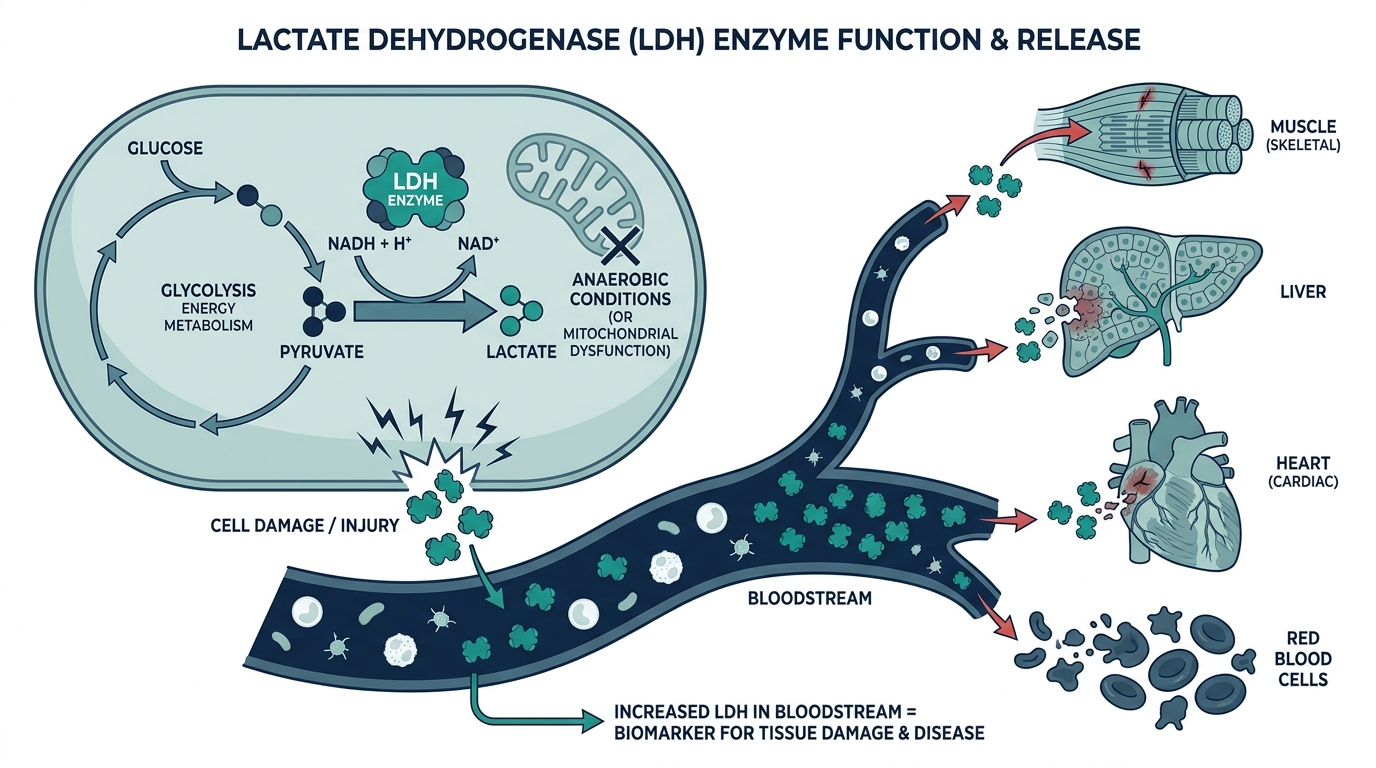
Understanding what LDH does explains why a low value means so little on its own. Lactate dehydrogenase is an enzyme that lives inside almost every cell in your body. Its job is to convert lactate to pyruvate and back, a step in how cells produce energy, especially when oxygen is limited. Because it is packed inside cells, LDH escapes into the blood when cells are injured, which is why a high LDH is a general flag for tissue damage somewhere.
LDH is not a single molecule but a family of five forms, called isoenzymes, each concentrated in different tissues:
- LDH-1: heart and red blood cells.
- LDH-2: the reticuloendothelial system, including white blood cells.
- LDH-3: the lungs and other tissues.
- LDH-4: the kidneys, placenta, and pancreas.
- LDH-5: the liver and skeletal muscle.
A standard LDH test reports the total of all five. In special situations, a lab can break the result into its isoenzyme fractions to help localize where a high value is coming from, for example distinguishing a heart source from a liver or muscle source. For a low total LDH, this fractionation is rarely useful, because the clinically meaningful low states involve a deficiency in the enzyme itself rather than a shift between tissues.

Why doctors order LDH in the first place
Knowing why the test exists makes a low result far easier to put in perspective. LDH is ordered to detect and monitor cell damage and turnover, not to look for deficiency, so it is essentially built to catch high values.
Common reasons a clinician orders LDH include monitoring certain cancers such as lymphoma, where LDH can track disease activity; assessing hemolysis, where red blood cells break down and release their LDH; evaluating tissue injury in the liver, heart, or muscle; and helping characterize fluid collections around the lungs or abdomen. In every one of these settings, the finding that matters is an elevation. This is the core reason a low LDH gets so little attention: the test was never designed to answer a question that a low value would address. When a low total LDH does turn up, experienced clinicians first think of the two explanations that genuinely fit, high-dose vitamin C or E interfering with the assay, or, rarely, an inherited enzyme deficiency, rather than searching for a disease that lowers LDH, because very few do.
Inherited LDH deficiency: the one low result that matters
The single situation where a persistently low LDH is genuinely important is an inherited deficiency of the enzyme, and it is worth understanding because its consequences show up in a specific, recognizable way.
LDH is built from two types of subunit, an M (muscle) subunit encoded by the LDHA gene and an H (heart) subunit encoded by the LDHB gene. The two best-described conditions reflect which subunit is missing:
- LDH-A (M-subunit) deficiency: also called glycogen storage disease type XI. Because the M subunit dominates in skeletal muscle, this form impairs how muscle generates energy during intense, anaerobic effort. It is inherited in an autosomal recessive pattern, meaning two altered gene copies are needed.
- LDH-B (H-subunit) deficiency: generally milder and often symptom-free, since the affected isoenzymes are less critical for everyday function.
The hallmark of the M-subunit form is exertional trouble. During ordinary daily activity people usually feel fine, but heavy or sustained exercise can bring on muscle pain, cramps, and fatigue, and in more severe episodes rhabdomyolysis, a breakdown of muscle that releases myoglobin and can turn urine red or brown. Management centers on recognizing personal exercise limits, avoiding the extreme exertion that triggers episodes, staying well hydrated, and seeking prompt care for dark urine or severe muscle pain after activity. Diagnosis is confirmed with metabolic and genetic testing rather than the routine LDH panel alone. For anyone whose low LDH pairs with these exertion-linked symptoms, this is the thread worth pulling.
How LDH is read alongside other markers
Because total LDH is nonspecific, it earns most of its meaning from the tests around it. When a low or unexpected LDH appears, these companions help sort artifact from significance.
| Marker | What it adds |
|---|---|
| Creatine kinase (CK) | A muscle-specific enzyme. If exertional muscle symptoms are present, a high CK points to muscle breakdown, complementing the LDH picture. |
| Haptoglobin and reticulocytes | Used to assess red blood cell breakdown; they help separate a hemolysis-driven high LDH from other causes. |
| Complete blood count (CBC) | Anemia or abnormal cell counts can accompany conditions that alter LDH, giving context to the value. |
| Liver enzymes (AST, ALT) | Because LDH-5 comes from the liver, liver tests help judge whether the liver is contributing. |
| Urinalysis | Detecting myoglobin or blood in the urine supports a muscle-breakdown episode in someone with exertional symptoms. |
The pattern-first approach is the whole point. A lone low LDH with a normal CBC, normal liver enzymes, and no symptoms is background noise. The same low value in someone with dark urine and high CK after a workout tells a very different story and warrants a metabolic workup.

Avoiding artifacts and preparing for the test
Since the most common reason for a low LDH is interference rather than illness, a little preparation makes the result far more trustworthy. Two practical themes matter.
- Supplements: high-dose vitamin C (ascorbic acid) and vitamin E can artificially lower the measured LDH. If you take megadose supplements, tell your clinician, who may ask you to pause them before testing so the value reflects your true state.
- Sample handling, in the opposite direction: rough drawing or delayed processing can rupture red blood cells (hemolysis), spilling their LDH and pushing the result up, not down. This is why spurious LDH errors usually inflate the number, and a surprisingly high LDH is sometimes rechecked with a cleaner draw.
Put together, these two facts explain the counterintuitive reality of LDH testing: artifacts tend to raise it, so a genuine low value almost always traces back to vitamins or the rare inherited deficiency. That is exactly why an isolated low LDH so rarely earns a repeat draw on its own, while an unexpectedly high one sometimes does.
When a low LDH actually deserves follow-up
Because the default response to a low LDH is reassurance, it helps to know the specific circumstances that flip it into something worth pursuing. Follow-up is reasonable when the low value keeps company with a clinical story rather than standing alone.
Consider a closer look if any of the following apply. You have exercise intolerance, meaning muscle pain, cramps, or unusual fatigue that reliably appears with hard or sustained exertion, since this is the pattern of inherited LDH deficiency. You have experienced red or brown urine after intense activity, which can signal muscle breakdown and warrants prompt evaluation. There is a family history of a muscle energy disorder or unexplained exercise-induced muscle problems, which raises the chance of an inherited cause. Or the low LDH persists across multiple draws after you have stopped high-dose vitamin C and E, removing the most common artifact and leaving a genuinely low value to explain. In these situations, the right path is metabolic and, where indicated, genetic testing guided by a clinician, not simply repeating the same total LDH. For everyone else, a solitary low LDH on an otherwise normal panel is one of the least concerning findings a lab report can hold, and it usually calls for nothing more than a conversation at your next routine visit.
Common misconceptions about a low LDH
A low LDH generates more worry than it deserves, largely because of a few misunderstandings.
- “A low LDH means my organs are failing.” The opposite framing is closer to the truth. LDH rises with tissue damage, so a low value is generally reassuring, not a sign of organ failure.
- “Every abnormal lab needs treatment.” A lone low LDH with a normal panel and no symptoms usually needs nothing beyond a look at your supplements.
- “My supplements make me healthier, so they cannot skew a test.” High-dose vitamin C and E can genuinely distort the LDH assay regardless of their other effects; this is about chemistry, not health.
- “A low LDH rules out any muscle problem.” In the rare inherited deficiency, a low LDH is precisely the clue to a muscle energy problem that shows up during hard exercise.
- “I should retest a low LDH to be safe.” Because artifacts usually raise LDH rather than lower it, an isolated symptom-free low value rarely benefits from repeat testing.
What a high LDH means, and why low is the quiet direction
Most people who look up a low LDH end up asking the natural next question: what would a high result have meant instead? The contrast is worth understanding, because it explains why the low side of this test is so rarely chased. LDH is an enzyme that lives inside cells, so when cells are damaged or turning over quickly, they spill it into the blood and the level rises. That makes a high LDH a broad, nonspecific flag for tissue injury or rapid cell turnover, and it is the direction doctors actually watch.
The causes of a high LDH span the mundane to the serious. A hemolyzed blood sample, where red cells break during collection, can lift the number artificially, so a repeat draw is often the first move. Real elevations show up with hemolytic anemia, muscle or heart injury, liver disease, infection, and inflammation. At the far end, markedly high levels can accompany certain cancers, and specialists use LDH as one input when staging and following lymphomas and some solid tumors, since it tends to track disease burden (StatPearls, Biochemistry of LDH).
Set that against the low side and the asymmetry is clear. A high LDH says cells somewhere are breaking down faster than usual and invites a search for where and why. A low LDH says the opposite is not really a problem: there is no such thing as too little cellular housekeeping enzyme circulating. That is exactly why a low or low-normal result is usually filed as reassuring background rather than a lead to run down, unless it appears with the specific patterns covered earlier in this guide.
Turn what you just learned into action.
Superpower lets you test 100+ biomarkers from home, then re-check them over time so you can actually see progress, physician-reviewed at every step.
Frequently asked questions
Is a low LDH level bad?
Usually not. MedlinePlus states that lower than normal LDH levels are uncommon and generally not considered a health problem. In most adults a low result reflects vitamin supplements interfering with the test rather than any disease, so it rarely requires treatment.
What is the normal range for LDH?
Cleveland Clinic lists roughly 135 to 225 U/L for adult males and 135 to 214 U/L for adult females. Ranges vary by laboratory and children run higher, so compare your value to the range printed on your own report.
Can vitamins cause a low LDH result?
Yes. Large amounts of vitamin C (ascorbic acid) or vitamin E can artificially lower an LDH reading, according to MedlinePlus and Cleveland Clinic. This is a lab artifact, so tell your clinician about any high-dose supplements before testing.
What is lactate dehydrogenase deficiency?
It is a rare inherited disorder, including LDH-A deficiency or glycogen storage disease XI, that impairs how muscle cells make energy. MedlinePlus Genetics reports it causes exercise intolerance with muscle pain and cramps, and intense exertion can trigger muscle breakdown.
Do I need to retest a low LDH?
Often no. An isolated low LDH with no symptoms and a normal rest of the panel rarely needs repeating. Discuss it at a routine visit, but seek care sooner if you have exercise-related muscle pain or red-brown urine.
Sources
- Cleveland Clinic, Lactate Dehydrogenase (LDH) Test
- MedlinePlus, Lactate Dehydrogenase (LDH) Test
- MedlinePlus Genetics, Lactate dehydrogenase deficiency
- NCBI PMC, Novel Mutations in the LDHA Gene (GSD XI)
This article is for general educational purposes and is not medical advice. It cannot diagnose or treat you and does not replace your clinician. Always discuss your lab results and any health decisions with a qualified healthcare professional.
Related: compare the best at-home biomarker and blood tests.
Vital Signs Today may earn a commission if you buy through links on this page. It does not affect our editorial assessments.