Never had your vitamin D checked outside a yearly physical? Test it plus 100+ other biomarkers from home. One at-home Superpower draw checks 100+ biomarkers, physician-reviewed.
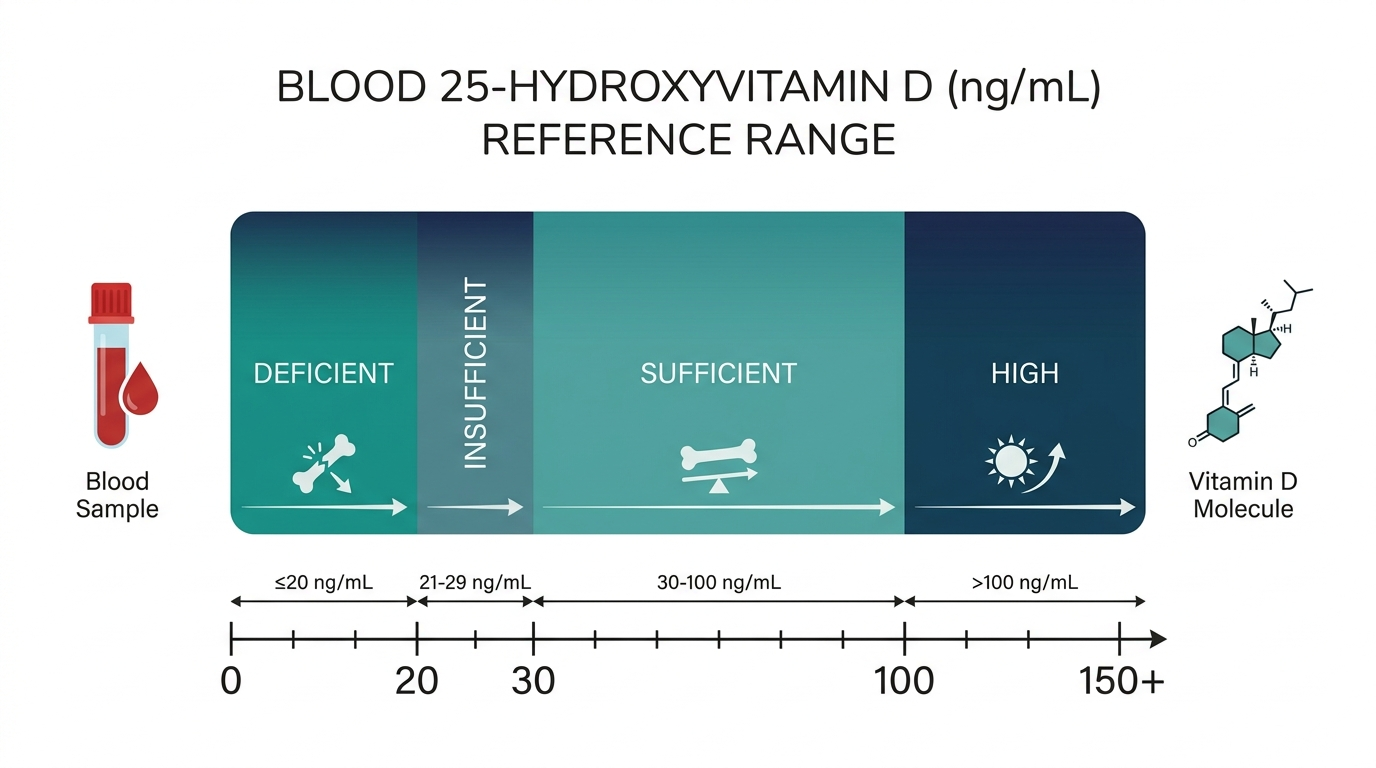
- A vitamin D blood test measures 25-hydroxyvitamin D (25-OH-D) in your blood, and the National Institutes of Health considers a level of 50 nmol/L (20 ng/mL) or above adequate for bone and overall health.
- A 25-hydroxyvitamin D result below 30 nmol/L (12 ng/mL) signals deficiency that can weaken bones, while a level above 125 nmol/L (50 ng/mL) is too high and may cause harm, according to the NIH Office of Dietary Supplements.
- The test is a simple blood draw, usually ordered when you have bone pain, muscle weakness, low calcium, malabsorption, or risk factors such as limited sun exposure.
What is vitamin D in a blood test?
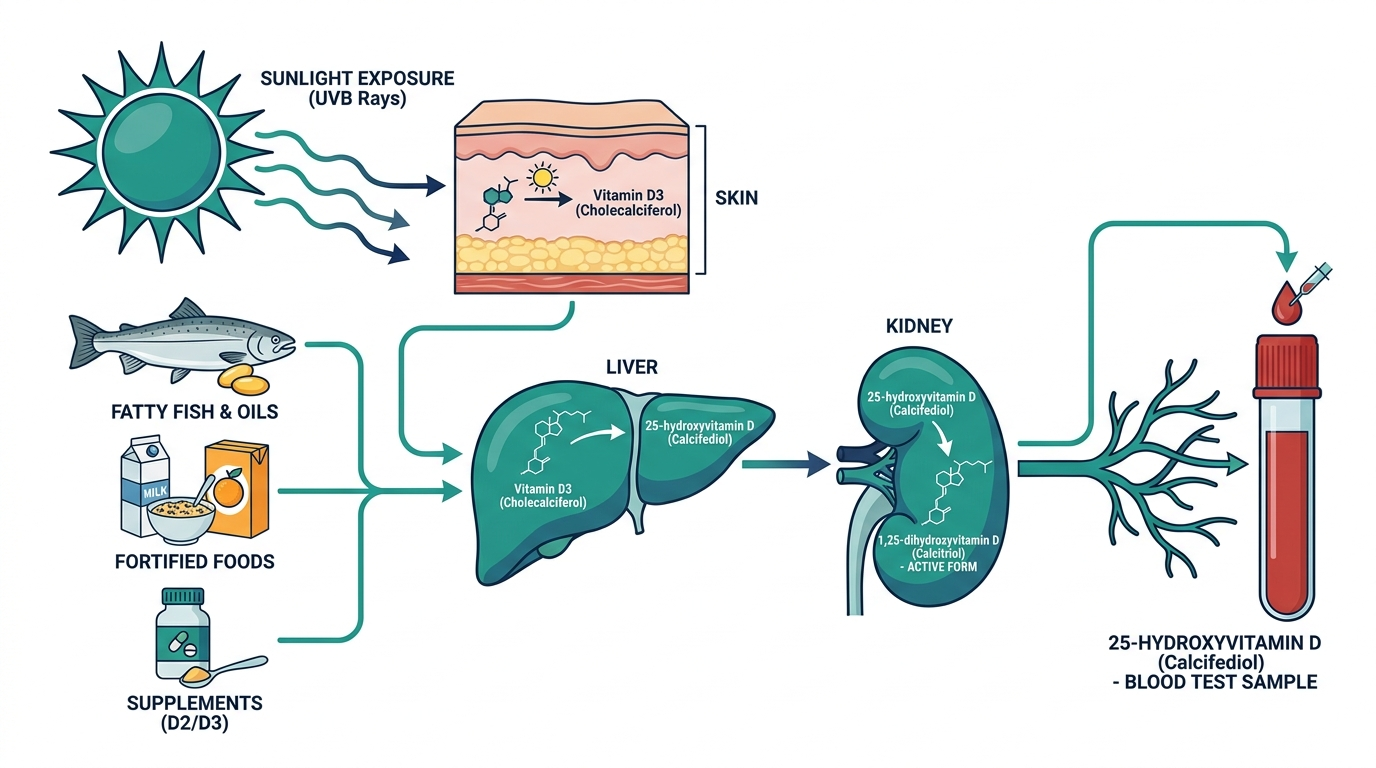
In a blood test, “vitamin D” almost always means 25-hydroxyvitamin D (25-OH-D), the storage form your liver makes after your skin and diet supply vitamin D. The National Institutes of Health Office of Dietary Supplements considers a level of 50 nmol/L (20 ng/mL) or above adequate for most people. Results are reported in two units, nanomoles per liter (nmol/L) or nanograms per milliliter (ng/mL), and one ng/mL equals 2.5 nmol/L.
This is the marker labs use because 25-OH-D reflects your true vitamin D status over the past few weeks. The active hormone form, called 1,25-dihydroxyvitamin D, changes too quickly and is only ordered for specific kidney or calcium problems. Reference ranges differ slightly between laboratories, so always read your result against the range printed on your own report.

Why is vitamin D measured?
Vitamin D is measured because it controls how your body absorbs calcium and phosphorus, the minerals that keep bones and teeth strong. The NIH notes that levels at or above 50 nmol/L (20 ng/mL) support bone and overall health, while a shortfall can lead to soft or brittle bones over time.
Clinicians typically order the test when there is a clear reason rather than as routine screening. Common triggers include:
- Bone or muscle symptoms: aching bones, muscle weakness, or unexplained fractures.
- Abnormal blood chemistry: low or high calcium, low phosphorus, or a high parathyroid hormone reading.
- Malabsorption conditions: celiac disease, Crohn disease, or past weight-loss surgery that reduces nutrient uptake.
- Higher-risk profiles: older adults, people with limited sun exposure, darker skin, or obesity.
The test itself is a standard venous blood draw from the arm and needs no special fasting in most cases.
What does a high vitamin D mean?
A high vitamin D result means your 25-hydroxyvitamin D is above the level your body needs, and the NIH flags readings above 125 nmol/L (50 ng/mL) as too high and potentially harmful. The main danger is not vitamin D itself but the calcium it pulls into your blood. Excess calcium, called hypercalcemia, can cause nausea, frequent urination, kidney stones, and in severe cases kidney damage.
Almost all high results trace back to taking too much supplemental vitamin D, not to sun or food. Cleveland Clinic notes that the skin limits how much vitamin D it makes, so sunlight does not push levels into the toxic range. Megadose supplements bought without testing are the usual culprit. If your result is high, your clinician will usually review your supplement dose, recheck your blood calcium, and adjust or stop the supplement rather than treat the number in isolation.

What does a low vitamin D mean?
A low vitamin D result points to deficiency or inadequacy, and the NIH defines a 25-hydroxyvitamin D level below 30 nmol/L (12 ng/mL) as too low to protect your bones and health. Levels between 30 and 50 nmol/L (12 to 20 ng/mL) are generally considered inadequate, sitting in a gray zone below the adequate cutoff.
Low readings are common and have many causes:
- Too little sunlight: indoor lifestyles, high latitudes, winter months, or heavy sunscreen use.
- Diet gaps: few vitamin D rich foods such as fatty fish, fortified milk, or egg yolks.
- Absorption problems: celiac, Crohn, or other gut conditions that block fat-soluble vitamin uptake.
- Other factors: obesity, darker skin, older age, and certain liver or kidney diseases.
Severe, long-standing deficiency can cause rickets in children and osteomalacia, or soft bones, in adults. Treatment is usually corrected vitamin D supplementation, then a follow-up test to confirm the level has risen.
How is vitamin D interpreted with other markers?
Vitamin D is rarely read alone, because its job is to manage calcium. Clinicians interpret your 25-hydroxyvitamin D alongside calcium, phosphorus, and parathyroid hormone (PTH) to see the whole mineral picture. The NIH adequacy benchmark of 50 nmol/L (20 ng/mL) is the anchor, but the surrounding markers tell the story.
A classic pattern of true deficiency is low vitamin D plus low or low-normal calcium plus high PTH. Here the parathyroid glands work overtime to defend blood calcium, which is a warning sign even before bones visibly suffer. By contrast, a high vitamin D with high calcium points toward supplement excess. Your clinician may also check kidney function, since the kidneys activate vitamin D, and magnesium, which the body needs to use vitamin D properly. Reading these together prevents both missed deficiency and unnecessary alarm over a single borderline number.

The insider nuance: one number does not equal one diagnosis
Here is what experienced clinicians watch for that patients often miss: the “normal range” on a vitamin D report is not settled science. The NIH and the Institute of Medicine set the bone-health adequacy line at 20 ng/mL (50 nmol/L), but some specialty groups have historically aimed for 30 ng/mL or higher. That is why two labs can flag the same result differently.
The practical takeaway is to treat the result as a trend, not a verdict. A single 25-OH-D value taken after a sunny vacation or a recent high-dose supplement can mislead. What matters more is your level over time, your symptoms, and your other mineral markers. Chasing a very high number with aggressive dosing has no proven extra benefit and raises the risk of hitting the harmful zone above 125 nmol/L (50 ng/mL). More is not better once you are in the adequate range.
How to prepare for a vitamin D test and what can skew the result
A vitamin D test is one of the more forgiving blood draws because it does not require fasting in most cases. The marker being measured, 25-hydroxyvitamin D, is not affected by a recent meal the way glucose or triglycerides are. That said, several practical factors do change the number you get back, and knowing them helps you read your report correctly.
- Recent supplement dose: A large vitamin D supplement taken in the days before the draw can transiently lift your reading. If you want a picture of your true baseline, do not change your supplement routine right before testing.
- Season and sun exposure: Levels naturally rise in late summer and fall after months of sun, then drift down through winter. A test in September and a test in March can differ meaningfully in the same person without anything being wrong.
- Which vitamin D form you take: Supplements come as D2 (ergocalciferol) or D3 (cholecalciferol). Some older automated immunoassays detect D2 less reliably than D3, so if you take high-dose prescription D2, mention it to your lab.
- The assay method itself: Two labs can report slightly different numbers for the same sample. Liquid chromatography with tandem mass spectrometry, often written as LC-MS/MS, is treated as the reference method because it cleanly separates D2 and D3 and resists interference. Automated immunoassays are faster and more common but can show bias at very low or very high levels (Enzyme-linked immunoassay vs LC-MS/MS comparison, PMC).
The takeaway is to keep conditions consistent when you re-test. Same lab, same rough time of year, same supplement habits. That way a change in your number reflects a real change in your body rather than a change in method or season.

Who is most at risk of low vitamin D
Deficiency is not evenly distributed. Certain groups run low far more often, and if you belong to one of them, a normal-looking lifestyle may still leave you short. Knowing your risk category helps you decide whether testing is worth doing and how to interpret a borderline result.
- People with darker skin: Higher melanin reduces the skin’s vitamin D production from a given amount of sunlight, so more sun time is needed to make the same amount.
- Older adults: Aging skin makes less vitamin D, and older people often spend less time outdoors, which compounds the shortfall.
- People with obesity: Vitamin D is fat-soluble and gets sequestered in body fat, lowering the amount circulating in blood even when intake is adequate.
- People with malabsorption: Celiac disease, Crohn disease, and past bariatric surgery reduce absorption of fat-soluble vitamins, vitamin D included.
- People with limited sun exposure: Indoor workers, those who cover their skin for cultural or medical reasons, residents of high latitudes, and anyone using heavy sunscreen year-round.
- Breastfed infants: Breast milk alone often does not supply enough vitamin D, which is why supplementation is commonly recommended.
The Cleveland Clinic notes that vitamin D deficiency is one of the most common nutrient deficiencies worldwide (Cleveland Clinic). If two or more of these risk factors apply to you, a low result is unsurprising and usually straightforward to correct.
Symptoms of vitamin D deficiency and the red flags
One reason vitamin D deficiency is so common is that early shortage is often silent. You can be well below the adequate line and feel nothing, which is exactly why testing exists. When symptoms do appear, they tend to be nonspecific and easy to blame on other things.
- Fatigue and low mood: Vague tiredness is a frequent complaint, though many things cause it, so it is not proof of deficiency on its own.
- Bone pain and muscle weakness: Aching in the lower back, hips, or legs, and difficulty rising from a chair or climbing stairs, can reflect the muscle and bone effects of long-standing shortage.
- Frequent illness: Some people report more respiratory infections, although the evidence here is mixed.
- Slow-healing or repeated fractures: In prolonged, severe deficiency, bones soften, a condition called osteomalacia in adults and rickets in children.
When to treat symptoms as a red flag: unexplained fractures, marked muscle weakness that affects walking, or bone pain paired with abnormal calcium or a high parathyroid hormone reading all warrant prompt medical review. These point to deficiency severe enough to be affecting your skeleton and mineral balance, not just a number slightly under the line.
What happens after an abnormal result: treatment and follow-up
Getting a number is only step one. What you do next depends on how far off you are and why.
If your level is low
Treatment is usually vitamin D supplementation, with the dose and duration tailored to how deep the deficiency is. A mild shortfall may need only a modest daily maintenance dose, while a severe deficiency may prompt a higher loading course followed by maintenance. Because the body stores vitamin D and 25-hydroxyvitamin D has a half-life of roughly two to three weeks (half-life data, PMC), levels rise gradually rather than overnight. Clinicians typically recheck the blood level after about three months to confirm it has reached the adequate range before settling into a long-term maintenance dose.
If your level is high
Almost every high result traces back to supplements, so the first move is a review of everything you are taking, including combination products and cod liver oil. Your clinician will usually recheck blood calcium, since the real risk of toxicity is high calcium rather than high vitamin D itself, and adjust or pause the supplement. Sunlight alone does not cause toxicity because the skin self-limits its production.
The point of the follow-up test
Re-testing is not busywork. It confirms that treatment worked, prevents overshooting into the harmful zone above 125 nmol/L (50 ng/mL), and establishes your personal maintenance need, which varies a lot between people. A single result tells you where you are today. Two results months apart tell you whether your plan is working.
Common misconceptions about the vitamin D test
Vitamin D attracts more myths than almost any other routine marker. Clearing these up changes how you read your own report.
- “Higher is always better.” Not true. Once you reach the adequate range, pushing higher with aggressive dosing has no proven added benefit and raises the risk of toxicity. The goal is sufficiency, not a record-high number.
- “I get sun, so I cannot be low.” Sun exposure varies enormously by skin tone, latitude, season, clothing, and sunscreen. Plenty of people who feel they get sun still test low, especially in winter.
- “The active form is the one to measure.” The active hormone, 1,25-dihydroxyvitamin D, fluctuates too quickly to reflect your overall status and is only ordered for specific kidney or calcium problems. For everyday screening, 25-hydroxyvitamin D is the correct marker.
- “Any lab’s normal range is the truth.” The adequacy cutoff is a public-health benchmark set by bodies like the NIH, not an exact biological line. Ranges vary between labs and specialty groups, which is why the same value can be flagged differently in two reports.
- “One good result means I am set for life.” Vitamin D status drifts with season, weight, age, and habits. A good number this summer does not guarantee a good number next winter.
Reading vitamin D as a trend, not a single snapshot
The most useful shift in how you think about this test is to stop treating one value as a verdict. Because 25-hydroxyvitamin D reflects the past several weeks of input from sun, food, and supplements, any single draw is a snapshot of a moving picture. A result taken right after a sunny vacation or a recent high-dose supplement can read higher than your true baseline, and a mid-winter draw can read lower.
Here is a practical way to interpret your own numbers over time:
- Compare like with like. Line up results from the same season and the same lab before concluding your level has genuinely changed.
- Pair the number with your symptoms and other markers. A borderline value with normal calcium, normal parathyroid hormone, and no bone symptoms is very different from the same value alongside high parathyroid hormone and bone pain.
- Watch the direction, not just the position. A level that started at 18 ng/mL and climbed to 32 ng/mL after treatment is a success even though both are on the same chart. A level drifting down year over year is worth acting on before it hits the deficient zone.
- Do not chase a maximum. Once you are comfortably in the adequate range, the goal is to stay there, not to keep climbing. More is not better past sufficiency.
Treating vitamin D this way turns a confusing lab flag into a manageable signal you can actually steer, especially when you re-test on a consistent schedule and read it in context.
Turn what you just learned about vitamin D into action.
Superpower lets you test vitamin D and 100+ biomarkers from home, then re-check them over time so you can actually see progress, physician-reviewed at every step.
Frequently asked questions
What is a good vitamin D blood level?
The NIH considers a 25-hydroxyvitamin D level of 50 nmol/L (20 ng/mL) or above adequate for bone and overall health in most people. Levels below 30 nmol/L (12 ng/mL) are deficient, and levels above 125 nmol/L (50 ng/mL) may be harmful.
Do I need to fast for a vitamin D test?
No. In most cases a vitamin D blood test does not require fasting, since it measures 25-hydroxyvitamin D rather than blood sugar or fats. Follow any specific instructions your clinician or lab gives you, as some bundled panels may have other requirements.
Can too much vitamin D be dangerous?
Yes. Levels above 125 nmol/L (50 ng/mL) can be harmful, mainly by raising blood calcium and risking kidney problems. This almost always comes from excessive supplements, not sunlight, because the skin limits how much vitamin D it produces.
How long does it take to correct low vitamin D?
It varies by starting level and dose, but raising a low 25-hydroxyvitamin D often takes several weeks to a few months of consistent supplementation. Clinicians usually recheck the blood level after about three months to confirm it has reached the adequate range.
What units are vitamin D results reported in?
Results appear as nanomoles per liter (nmol/L) or nanograms per milliliter (ng/mL). One ng/mL equals 2.5 nmol/L, so 20 ng/mL is the same as 50 nmol/L. Check which unit your report uses before comparing it to any range.
Sources
- NIH Office of Dietary Supplements, Vitamin D (Consumer fact sheet)
- NIH Office of Dietary Supplements, Vitamin D (Health Professional fact sheet)
- MedlinePlus, 25-hydroxy vitamin D test
- StatPearls (NCBI Bookshelf), Vitamin D
- Cleveland Clinic, Vitamin D Deficiency
This article is for general educational purposes and is not medical advice. It cannot diagnose or treat you and does not replace your clinician. Always discuss your lab results and any health decisions with a qualified healthcare professional.
Related reading
Vital Signs Today may earn a commission if you buy through links on this page. It does not affect our editorial assessments.