You got your results back, scanned for anything in bold, and there it was: CRP, flagged high. Maybe your doctor ordered it because you felt rough. Maybe it showed up on a routine panel and now you are staring at a number you have never thought about before. Either way, the question is the same, and it is a fair one. What does a high CRP actually tell you about your body?
Here is the short version before we go deep. CRP is not a disease. It is a smoke alarm. A high reading means the alarm is going off somewhere, and the entire job from here is figuring out where the smoke is coming from.
A high CRP flags inflammation somewhere in your body. Ready to see what’s actually driving it? One at-home Superpower draw checks 100+ biomarkers, physician-reviewed.
Part of our Inflammation Blood Tests guide.
What does a high CRP blood test mean?
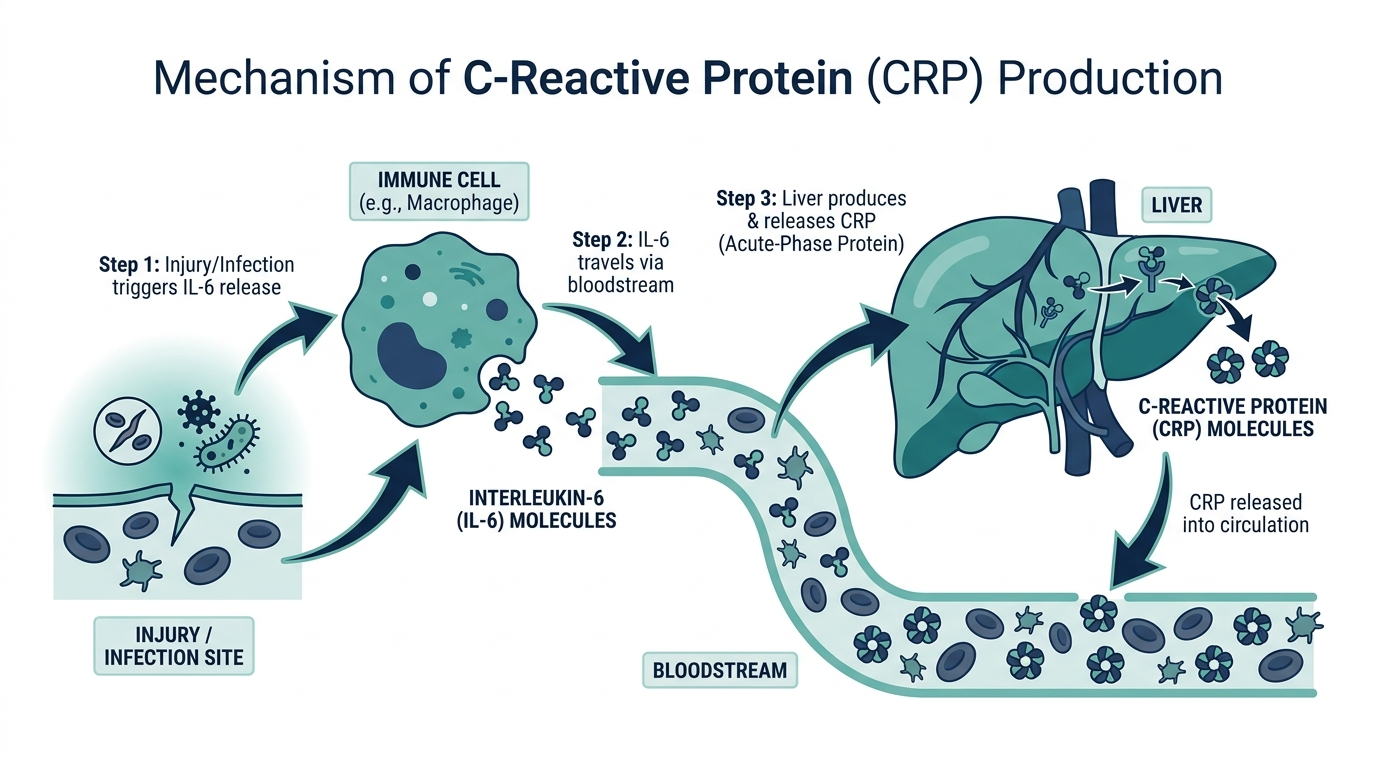
A high CRP blood test means your body is producing extra C-reactive protein, a substance your liver pumps out in response to inflammation (Cleveland Clinic). When tissue is injured, infected, or inflamed, your liver ramps up CRP within hours, so a raised level is one of the fastest, bluntest signals that something inflammatory is happening. What it cannot do is tell you what or where. CRP confirms there is a fire. It does not draw you a map.
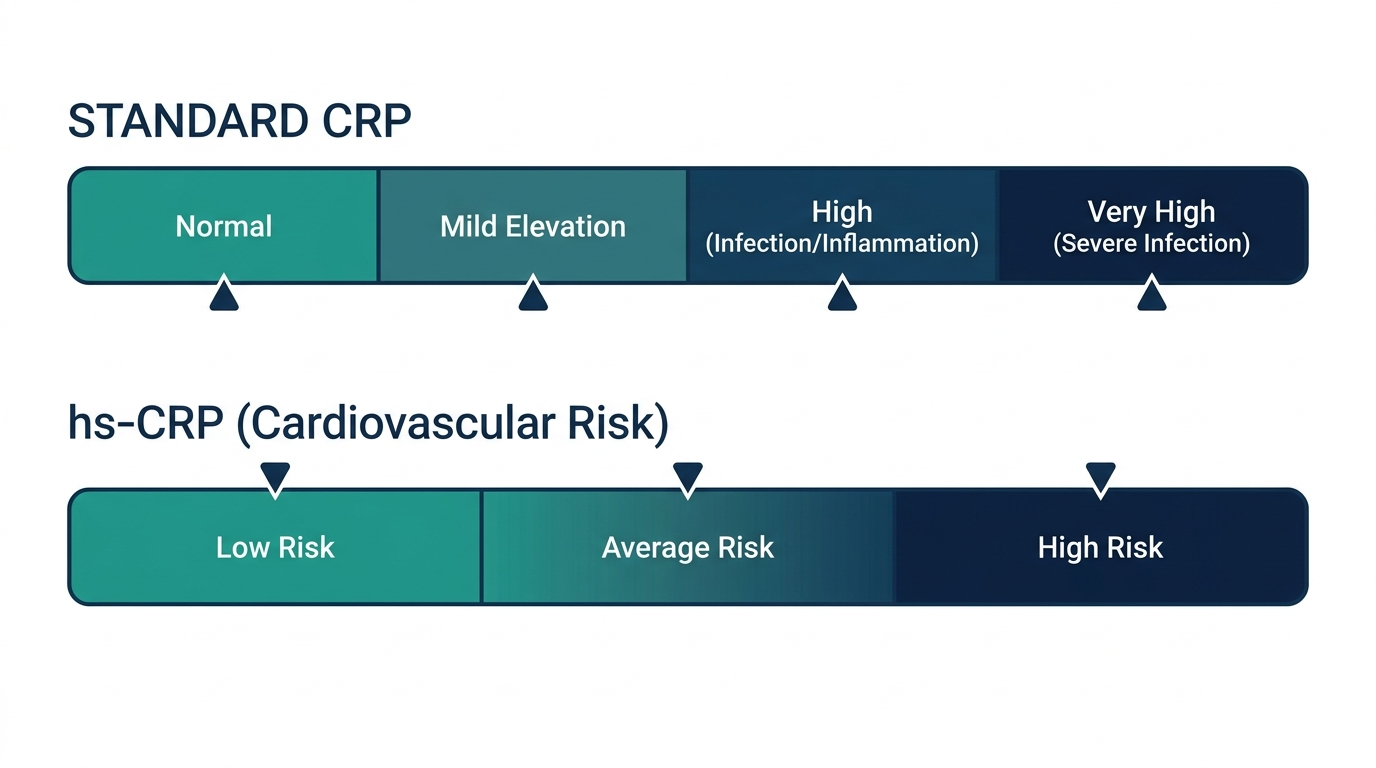
The numbers that matter, using the standard CRP test reported in milligrams per deciliter (mg/dL): a normal result is generally less than 0.9 mg/dL, a moderate elevation runs from about 1.0 to 10.0 mg/dL, and a marked elevation is anything above 10 mg/dL (Cleveland Clinic). When CRP climbs above 50 mg/dL, an acute bacterial infection is the cause roughly 90 percent of the time. One important caveat right away: labs report CRP in different units and against slightly different reference ranges, so the only number that truly matters for you is the one printed next to “reference range” on your own report.

What causes a high CRP?
The differential is long because almost anything inflammatory can lift CRP. The trick is knowing the usual suspects, roughly most common first.
- Infection. This is the heavyweight. Bacterial infections in particular can drive CRP very high, very fast, which is why a markedly elevated result so often traces back to an infection somewhere in the body (Cleveland Clinic). Viral infections raise it too, usually more modestly.
- Autoimmune and inflammatory disease. Rheumatoid arthritis, lupus, and vasculitis are classic causes, and CRP is often used to gauge how active these conditions are (MedlinePlus).
- Inflammatory bowel disease. Crohn’s disease and ulcerative colitis both stoke inflammation that shows up as a higher CRP (MedlinePlus).
- Tissue injury and trauma. Surgery, a recent heart attack, pancreatitis, major trauma, and burns all spike CRP as the body repairs damage (Cleveland Clinic).
- Chronic low-grade inflammation. This is the slow burn category, and it is the one people overlook. Obesity, smoking, diabetes, poor sleep, gum disease, and even depression are each linked to modestly raised CRP (MedlinePlus). None of these is dramatic on its own, but together they explain a lot of mildly elevated readings in otherwise healthy-feeling people.
And then there is the category nobody likes to hear about: nothing in particular. About 1 in 20 healthy people will land outside the normal range on any given lab test simply by chance (Cleveland Clinic). A single mildly high CRP, with no symptoms and nothing else amiss, is not proof of disease.
What are the symptoms of a high CRP?
Here is the part that surprises people. A high CRP itself has no symptoms. CRP is a downstream chemical signal, not a condition, so it does not cause fever, pain, or fatigue on its own. What you feel comes from whatever is driving the inflammation, not from the protein in your blood.
So if your CRP is up, the useful question is not “what does high CRP feel like” but “what else is going on right now.” A high reading alongside a fever, a productive cough, burning when you urinate, or a hot swollen joint points toward infection or active inflammation. A high reading with no symptoms at all is a different conversation, and usually a calmer one. This is exactly why doctors never read CRP in isolation. The number only means something next to your story.

When is a high CRP dangerous or a medical emergency?
The CRP value alone is not the emergency. How you feel is. A CRP of 80 mg/dL in someone who is alert and comfortable is handled very differently from a CRP of 80 mg/dL in someone with a high fever, a racing heart, and confusion, where it can be a marker of serious infection or sepsis.
That said, the level does carry weight. A markedly elevated CRP above 50 mg/dL is associated with acute bacterial infection roughly 90 percent of the time (Cleveland Clinic), so a very high number deserves prompt attention rather than a wait-and-see. Seek urgent care if a high CRP comes packaged with any of these red flags: a fever above 103 degrees Fahrenheit or one that will not break, shaking chills, a fast heartbeat with shortness of breath, severe abdominal pain, a stiff neck with a bad headache, confusion or trouble staying awake, or a spreading area of hot red skin. Those signs, not the lab value, are what turn a high CRP into something that cannot wait.
What should you do about a high CRP?
The most important thing to understand is that you do not treat CRP. You treat the cause, and CRP follows it down. There is no pill for a high number.
What actually happens next depends on the size of the elevation and how you feel:
- Find the source. A high CRP almost always triggers more specific tests, because the result confirms inflammation without naming it (MedlinePlus). Depending on the clinical picture that can mean a complete blood count, cultures, imaging, or markers for specific autoimmune conditions.
- Treat the driver. If it is an infection, the infection gets treated and CRP falls. If it is rheumatoid arthritis or inflammatory bowel disease, controlling the disease brings the number down, which is why CRP is also used to monitor whether treatment is working.
- Address the slow burn. For a mild, persistent elevation tied to lifestyle, the levers are the unglamorous ones that genuinely move inflammation: stopping smoking, losing excess weight, treating gum disease, improving sleep, and getting blood sugar under control (MedlinePlus).
- Recheck it. Because CRP responds quickly, a repeat test after the trigger has passed is often the cleanest way to tell a one-off blip from a real, persistent signal.

The insider read: why your high CRP might be misleading
This is the part that rarely makes it into the patient handout, and it changes how you should interpret your own result.
First, the high-sensitivity version of the test, hs-CRP, is a different animal from the standard CRP. It is calibrated to detect very small elevations and is used to estimate heart disease risk (MedlinePlus). The widely used cardiovascular categories, in milligrams per liter (mg/L), are: low risk below 1.0, average risk from 1.0 to 3.0, and higher risk above 3.0 (American Heart Association, Circulation). Here is the catch most people miss. An hs-CRP above 10 mg/L is generally too high to mean anything about chronic heart risk. At that point it is signaling acute inflammation, an infection or injury, and the honest move is to treat the result as invalid for cardiac scoring, wait until you are well, and repeat it. A high hs-CRP measured while you are fighting a cold is not a heart warning. It is a cold.
Second, hs-CRP for heart risk is genuinely confounded, and the confounders are common. CRP runs higher in people with a higher body mass index, in women, and in some racial groups, independent of actual cardiovascular disease. In one analysis, the great majority of people reclassified as higher risk by CRP alone were women, often with osteoarthritis driving a background hum of inflammation (PMC, CRP interpretation and confounders). The practical lesson: a single hs-CRP number, read without context, can push you into a scarier risk bucket than your heart actually deserves.
The thread running through both points is the same one clinicians live by. CRP is exquisitely sensitive and almost completely nonspecific. That combination makes it a brilliant tripwire and a terrible standalone verdict. Never let one elevated CRP, especially measured when you are unwell, become a diagnosis in your head before it has been one in your doctor’s office.
When should you see a doctor?
If a doctor ordered the CRP, the result goes back to them to interpret in context, so book the follow-up rather than guessing. If you found a high CRP on your own and feel fine, it is still worth a conversation, particularly if the number is well above the normal range or if it stays high on a repeat test. And if a high CRP arrives with any of the red flags above, high fever, severe pain, breathlessness, confusion, or spreading skin infection, do not wait for an appointment. Get seen urgently. The lab number is a clue. Your symptoms are the deciding vote.
CRP versus ESR, and the markers to read alongside it
CRP almost never travels alone in a workup. Because it confirms inflammation without naming it, clinicians pair it with a small set of other tests that add the missing context. Knowing what these are helps you understand why one high CRP triggers a cascade of further checks rather than a single answer.
- ESR, the erythrocyte sedimentation rate. This is the older inflammation marker, and it often gets ordered alongside CRP. The key difference is speed. CRP rises within hours of an inflammatory trigger and falls quickly once it resolves, while ESR climbs and settles far more slowly over days. A high CRP with a normal ESR can suggest very recent or acute inflammation, whereas a high ESR that lingers after CRP has normalized points to a more drawn-out process.
- White blood cell count. On a complete blood count, a high white cell count alongside a high CRP strengthens the case for infection. A normal white count with an isolated CRP elevation shifts attention toward chronic low-grade inflammation or a non-infectious cause.
- Ferritin. This iron-storage protein doubles as an inflammation marker, and a very high ferritin with a high CRP can flag a more intense inflammatory state.
- Autoimmune markers. When the picture suggests rheumatoid arthritis, lupus, or vasculitis, tests such as rheumatoid factor, anti-CCP antibodies, or ANA are added to name the specific driver behind the inflammation.
- Procalcitonin. In a hospital setting this marker is often used with CRP to help distinguish bacterial infection from other causes of inflammation, since it rises more selectively with bacterial illness.
The pattern that emerges from these markers together is what actually guides diagnosis. CRP opens the question, and the surrounding tests narrow it down.
What can skew your CRP result
CRP does not require fasting and has no special preparation, but several everyday factors can nudge it up or down and change how a borderline result should be read.
- A recent minor illness or injury. A cold, a dental cleaning, a strenuous workout, or a small wound in the days before the draw can lift CRP temporarily. This is a common reason a mildly high result turns out to mean nothing once you retest after recovery.
- Body weight. Fat tissue produces low-grade inflammatory signals, so a higher body mass index tends to raise baseline CRP independent of any acute problem. This matters most for the high-sensitivity version used in heart-risk scoring.
- Recent vigorous exercise. An intense endurance session causes transient muscle inflammation that can bump CRP for a day or two, which is why a marathon runner tested the morning after a race may see an inflated value.
- Hormonal factors. Estrogen-containing medications, including some forms of hormonal contraception and hormone therapy, can raise CRP. Pregnancy also elevates it.
- Anti-inflammatory medication. Steroids and NSAIDs can lower CRP, potentially masking inflammation that is actually present.
Because so many ordinary conditions move the number, the cleanest interpretation comes from a CRP drawn when you are otherwise well and free of recent injury or acute illness.
Reading your own CRP: worked scenarios
The same CRP value can mean opposite things depending on how you feel and what else is happening. These illustrative patterns show how a clinician turns a number into a next step. They are not a diagnosis, and your provider always reads your full picture.
- CRP mildly high, no symptoms, you had a cold last week. This is the classic transient elevation. The sensible move is usually to retest once you are fully recovered, since the number often returns to normal on its own.
- CRP markedly high above 50 mg/dL, fever, and a productive cough. A very high level paired with infection symptoms points strongly toward an acute bacterial infection and calls for prompt evaluation rather than waiting.
- CRP persistently mildly high, no acute illness, plus fatigue and joint stiffness. A chronic low-grade elevation that will not settle, alongside joint symptoms, is the pattern that prompts a look for autoimmune disease.
- hs-CRP of 2.5 mg/L in a healthy adult with normal other labs. Here the number is being read for long-term cardiovascular risk rather than acute inflammation, and it sits in the average-risk band that invites attention to lifestyle rather than alarm.
The recurring lesson is that CRP is a sensitive tripwire. The value tells you the alarm sounded, but your symptoms and history decide what it means.
Common misconceptions about a high CRP
A few myths make a high CRP more frightening or more meaningful than it should be. Clearing them up sharpens how you react to the result.
- “A high CRP is a diagnosis.” It is a signal, not a disease. CRP confirms that inflammation exists somewhere but names neither the cause nor the location, which is why it always needs a follow-up story.
- “I can lower my CRP with a supplement.” There is no supplement that meaningfully targets CRP directly. The number falls when the underlying inflammation is addressed, whether that is treating an infection, controlling an autoimmune condition, or reducing the lifestyle drivers of chronic inflammation.
- “A high hs-CRP means I have heart disease.” The heart-risk version is easily thrown off by any acute inflammation, and a value above 10 mg/L usually reflects an infection or injury rather than cardiovascular risk. It should be repeated once you are well before being read as a heart signal.
- “One elevated result is enough to act on.” Because CRP responds so fast to transient triggers, a single high reading taken while you are unwell is a weak data point. A repeat when you are healthy is what separates a blip from a true persistent elevation.
Held in the right frame, a high CRP is an invitation to look closer, not a verdict to fear. It is one of medicine’s most useful early warnings precisely because it is so quick to react, and that same sensitivity is why it should never be read alone.
Don’t just read about your health, track it.
A single result is a snapshot. Superpower re-tests 100+ markers over time so you can watch them move as you change sleep, food, and training.
Frequently asked questions
What level of CRP is considered high?
On a standard CRP test, a normal result is generally below 0.9 mg/dL, a moderate elevation runs about 1.0 to 10.0 mg/dL, and anything above 10 mg/dL is markedly high (Cleveland Clinic). Always compare your result to the reference range printed on your own report, because labs use different units and cutoffs.
Should I worry about a high CRP?
Not automatically. A high CRP confirms inflammation but does not name a cause, and about 1 in 20 healthy people fall outside the normal range by chance (Cleveland Clinic). It matters most when read alongside your symptoms and other tests. A very high number, or one paired with fever or severe symptoms, deserves prompt medical attention.
What is the most common cause of a high CRP?
Infection, especially bacterial infection, is the most common driver of a high CRP, and it can raise the level sharply and quickly (Cleveland Clinic). Other frequent causes include autoimmune disease, inflammatory bowel disease, tissue injury, and chronic low-grade inflammation from things like obesity and smoking (MedlinePlus).
Can a high CRP go back to normal?
Yes. CRP rises and falls quickly in response to inflammation, so once the underlying cause is treated or resolves, the level typically returns toward normal (MedlinePlus). That is why doctors often repeat the test and also use it to track whether treatment is working.
Does a high CRP mean I have heart disease?
Not by itself. The high-sensitivity hs-CRP test is used to estimate heart disease risk, with categories of low risk below 1.0 mg/L, average 1.0 to 3.0 mg/L, and higher above 3.0 mg/L (American Heart Association). A reading above 10 mg/L usually reflects acute infection or injury rather than heart risk and should be repeated once you are well (PMC).
This article is for general educational purposes and is not medical advice. It cannot diagnose or treat you and does not replace your clinician. Always discuss your lab results and any health decisions with a qualified healthcare professional.
Vital Signs Today may earn a commission if you buy through links on this page. It does not affect our editorial assessments.