A single vial of blood, drawn in about ten seconds from a vein in your arm, can carry a startling amount of news about you. It can flag a sugar problem years before symptoms, catch a quiet thyroid slowdown, hint at an infection you have not noticed, and even sketch your risk of a heart attack down the road. The catch is that almost nobody explains the menu. People walk out with a printout full of acronyms and no map of what those acronyms were actually looking for.
One vial can reveal a surprising amount. Curious exactly what your own blood would show across 100+ markers? One at-home Superpower draw checks 100+ biomarkers, physician-reviewed.
So here is the map. Not a list of every exotic test in existence, but a clear answer to the question you actually have when you stare at that page.
What can blood tests find?
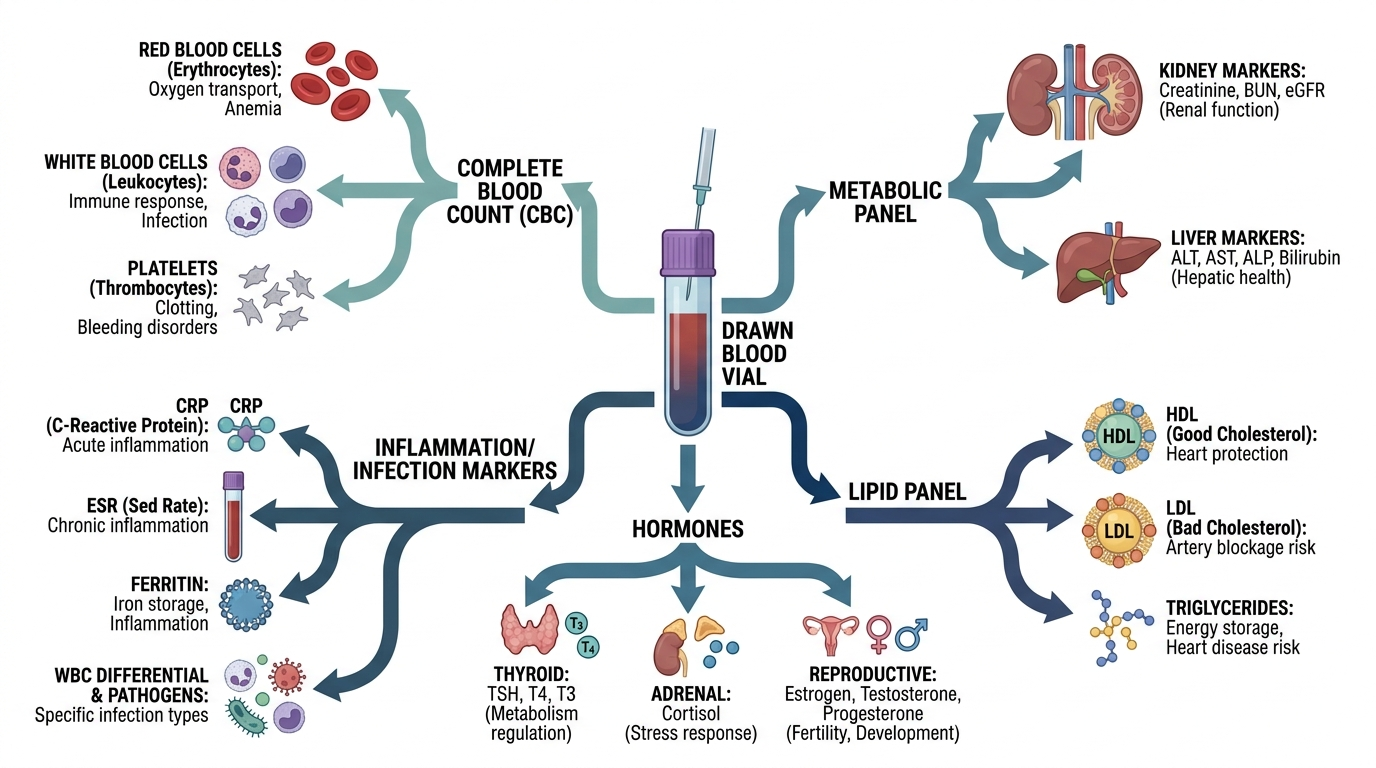
Blood tests can find anemia, infection, diabetes, kidney and liver problems, electrolyte imbalances, abnormal cholesterol, thyroid disorders, clotting issues, and clues that point toward certain cancers, often before you feel a single symptom. Blood reveals changes throughout the body because it touches every organ, so measuring its cells, chemicals, proteins, enzymes, and hormones gives a snapshot of how the whole system is running (Cleveland Clinic).
The honest version is this. A routine panel does not scan for one disease. It is a broad sweep of organ function and blood chemistry, and abnormal numbers act as tripwires that tell your clinician where to look next. That is the mental model to carry into the rest of this article: blood tests narrow the field, they rarely close the case on their own.

What can you find in a blood test, panel by panel?
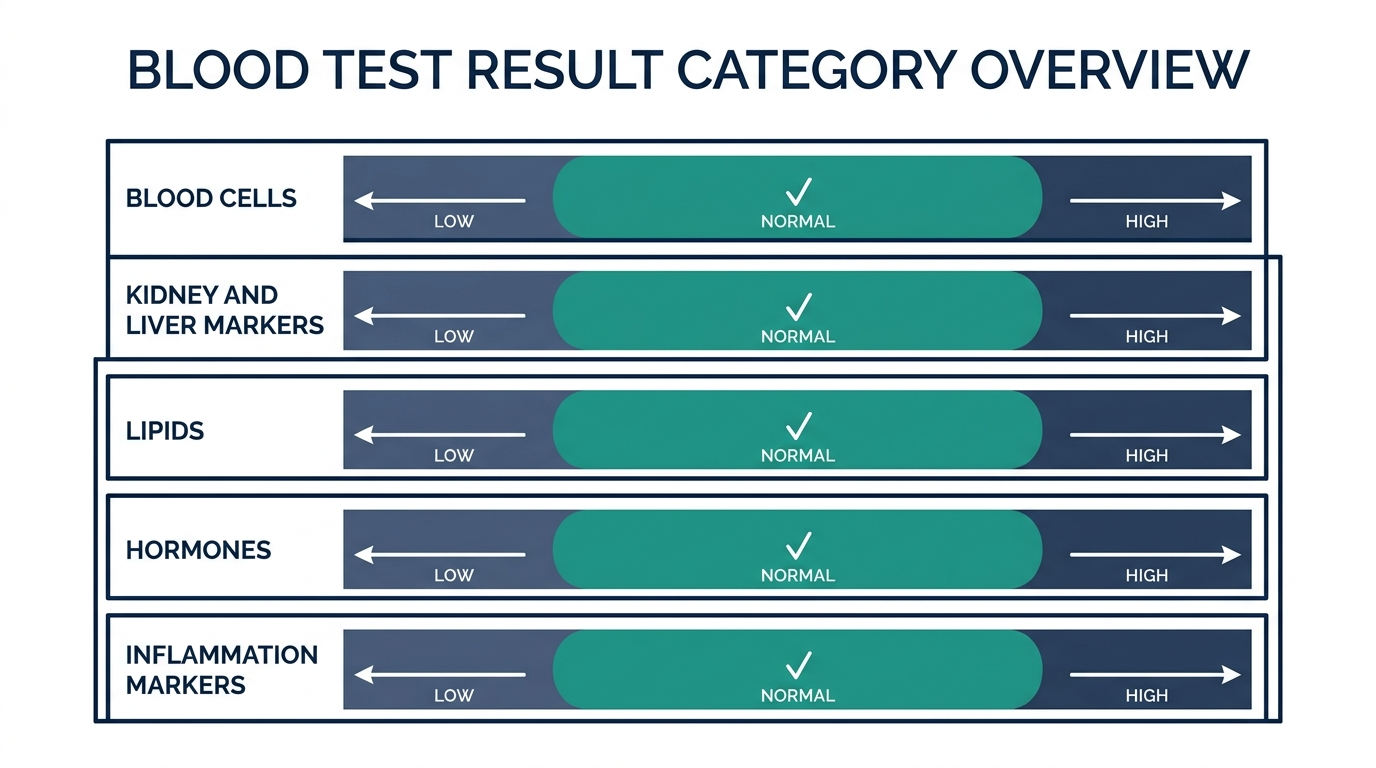
Most of what a standard checkup looks for comes from three workhorse panels: the complete blood count, a metabolic panel, and a lipid panel. Each one targets a different layer of your physiology.
Complete blood count (CBC). This is the most common blood test, and it counts and characterizes your red blood cells, white blood cells, and platelets (NHLBI). What it can find: anemia, signs of infection or inflammation, blood-clotting problems, immune-system disorders, and in some cases clues pointing to blood cancers such as leukemia. White cell counts that run too high or too low can signal infection or a marrow problem, and abnormal platelet counts can point to either a bleeding or a clotting tendency.
Metabolic panel (BMP or CMP). A basic metabolic panel measures eight substances, mostly glucose, calcium, and electrolytes, plus kidney markers. A comprehensive metabolic panel measures fourteen substances and adds liver enzymes and proteins (MedlinePlus). What it can find: diabetes or prediabetes (through glucose), kidney trouble (through BUN and creatinine), liver disease (through ALT, AST, ALP, and bilirubin), and dangerous shifts in sodium, potassium, or calcium that affect the heart, nerves, and muscles.
Lipid panel. This measures the fats in your blood: LDL cholesterol, HDL cholesterol, triglycerides, and total cholesterol. What it can find: an elevated risk of heart disease, heart attack, and stroke (Cleveland Clinic). LDL is the type that collects in vessel walls, HDL is the protective type, and high triglycerides add to cardiovascular risk. Cleveland Clinic lists healthy targets as total cholesterol below 200 mg/dL, LDL below 100 mg/dL, HDL above 60 mg/dL, and triglycerides below 150 mg/dL.
Beyond these three, common add-ons widen the net: a thyroid test (TSH) for an over or underactive thyroid, blood enzyme tests such as troponin to check for a heart attack, clotting tests for people on blood thinners, and tumor markers like PSA for the prostate or CA-125 for the ovaries (Cleveland Clinic).
What can blood tests find before you have symptoms?
This is the real reason routine blood work matters: several serious conditions are silent for years, and blood tests can catch them while you still feel fine. A comprehensive metabolic panel can flag liver, kidney, and metabolic problems before symptoms appear, which is exactly why it shows up in so many routine checkups (MedlinePlus).
Three of the most important silent finds:
- Diabetes and prediabetes. A rising fasting glucose, or an A1C if your clinician orders it, can appear long before thirst, fatigue, or other classic symptoms.
- Chronic kidney disease. Kidneys can lose a large share of function with no warning signs. A creeping creatinine and a falling estimated GFR are often the first hint.
- Liver disease. Many forms of liver injury, including fatty liver, are painless. Elevated ALT or AST can be the only early sign on an otherwise unremarkable day.
Here is the insider point most people never hear. A normal-looking result does not always mean nothing is happening. Reference ranges are built from large populations, and a value can drift across most of the normal band, a creatinine rising from the low end toward the high end, for instance, while staying technically in range the whole way. That is why clinicians who pay attention compare your numbers to your own past results, not just to the lab cutoff. A single in-range number is a snapshot. The trend across several years is the movie, and the movie is where early disease shows itself first. If you only ever look at the bold flags, you will miss the slow drift that often matters most.

What can blood tests NOT find?
Blood tests are powerful, but they have hard limits, and knowing them keeps you from both false alarms and false comfort. The single most important caveat from the lab world itself: a blood test result is not a diagnosis. An abnormal result does not mean you definitely have a serious condition, and a normal result does not guarantee you are disease-free (Cleveland Clinic).
What a standard blood panel generally cannot do:
- Confirm most cancers on its own. Tumor markers such as PSA or CA-125 can rise for benign reasons and can be normal even when cancer is present, so they support a workup rather than settle it.
- See structural problems. A blood test will not show a torn ligament, a tumor’s exact location, a blocked artery, or a fracture. That is the job of imaging.
- Screen for everything at once. A test only finds what it specifically measures. A routine panel does not check for HIV, hepatitis, vitamin D, or most hormones unless those tests are deliberately ordered.
Normal ranges also shift with age, sex, altitude, and other factors, which is part of why results need professional interpretation rather than a quick glance against a chart online (NHLBI). The takeaway is not that blood tests are unreliable. It is that they are one instrument in a larger toolkit, and they work best paired with your history, an exam, and sometimes imaging.
How to find your blood test results, and where to read them
The fastest way to find your blood test results is through your healthcare provider’s online patient portal, where labs are usually posted within a few days of the draw. If you used a hospital, clinic, or lab company, each typically has its own portal or app, and results often appear there before your clinician has even called.
A few practical pointers for reading them once you find them:
- Read each value against the reference range on your own report, not a number you found elsewhere. Ranges differ by lab and instrument.
- Look for your past results in the same portal so you can see the trend, which often matters more than a single point.
- Note the flags (H for high, L for low), but remember a flag is a prompt to ask a question, not a verdict.
If your results are not online, the lab or clinic that ran the test can release a copy to you on request. In the US you have a right to your own lab records. And if a number is flagged or you do not understand it, that is precisely the moment to message your clinician rather than to fall down a search-engine spiral at midnight.

Reference ranges for the tests that find the most
Numbers only mean something once you can place them against a range. Below are the adult reference ranges that show up on the majority of routine reports. Two cautions before you read them. First, your own lab prints its own range on your report, and those cutoffs vary by instrument and by population, so always read your value against the range on your own page. Second, a value sitting inside the range is not automatically ideal, and a value just outside it is not automatically a crisis. Ranges describe where most healthy people fall, not where the line between well and sick is drawn.
| Test | Typical adult reference range | What a result outside it can suggest |
|---|---|---|
| Fasting glucose | 70 to 99 mg/dL | 100 to 125 mg/dL suggests prediabetes, 126 mg/dL or higher on two occasions suggests diabetes |
| Hemoglobin A1C | Below 5.7% | 5.7% to 6.4% suggests prediabetes, 6.5% or higher suggests diabetes |
| Hemoglobin (men) | About 13 to 18 g/dL | Low points toward anemia, high can reflect dehydration or other causes |
| Hemoglobin (women) | About 12 to 16 g/dL | Same directions as above, with a lower baseline than men |
| White blood cell count | About 4,500 to 11,000 per microliter | High can signal infection or inflammation, low can point to a marrow or immune issue |
| Platelet count | About 150,000 to 450,000 per microliter | Low raises bleeding risk, high can raise clotting risk |
| Total cholesterol | Below 200 mg/dL | Higher adds to cardiovascular risk in the context of the full lipid panel |
| LDL cholesterol | Below 100 mg/dL | Higher is the fraction that collects in vessel walls |
| HDL cholesterol | Above 60 mg/dL is protective | Lower removes some of that protection |
| Triglycerides | Below 150 mg/dL | Higher adds independently to cardiovascular risk |
The glucose and A1C thresholds above follow the diagnostic bands used in US clinical practice, and the A1C reflects your average blood sugar over roughly the previous three months rather than a single morning (NIDDK). The lipid targets match the healthy figures published by Cleveland Clinic, and the CBC ranges reflect commonly used adult intervals, though your report always governs.
Notice how the CBC ranges split by sex. Women generally carry lower hemoglobin, hematocrit, and red cell counts than men, which is normal physiology, not a problem. This is a clean example of why a range that fits one person can mislead another, and why age and sex are printed on every lab report for a reason.
How to prepare so your results actually reflect you
Poor preparation is one of the most common reasons a result looks worse, or better, than the truth. A test measures the blood in your vein at the moment of the draw, and several everyday things move those numbers around temporarily. Getting the prep right is the cheapest way to make a panel trustworthy.
- Fasting when required. Glucose and the lipid panel are the two big ones. A recent meal spikes blood sugar and can raise triglycerides, so many clinicians ask for an 8 to 12 hour fast, water allowed, before those specific tests. A CBC and many other tests do not require fasting. If you are unsure, ask when you book, because arriving fed for a fasting test can force a repeat visit.
- Medications and supplements. Biotin, a common hair and nail supplement, can distort certain lab assays, including some thyroid and hormone tests, in ways that produce falsely high or low readings. Tell your clinician what you take, prescription and over the counter, and ask whether to pause anything. Do not stop a prescribed medication on your own.
- Recent hard exercise. A very strenuous workout in the day or two before a draw can transiently raise muscle and liver enzymes, which can make a liver panel look abnormal when the liver is fine.
- Hydration. Being well hydrated makes the draw easier and keeps concentration-sensitive values honest. Dehydration can nudge several numbers, including hemoglobin, upward simply by concentrating the blood.
- Timing and stress. Some values follow a daily rhythm, cortisol and iron among them, so the time of day can matter. Acute stress and even the anxiety of the needle can shift a few readings briefly.
The practical rule is simple. When you book, ask two questions: do I need to fast, and should I hold any medications or supplements. Those two answers prevent most preventable errors on a report.

How the panels read together, not in isolation
The real skill in interpreting blood work is not reading one number, it is reading the pattern across several. A single flagged value rarely tells the story. The way one result frames another is where a clinician earns their reputation. A few worked examples show the logic.
- Low hemoglobin with a low mean cell volume. Anemia plus small red cells points toward iron deficiency as a leading suspect, which then justifies iron studies rather than guessing. The MCV, a routine part of the CBC, changes the whole interpretation of the anemia.
- Elevated ALT and AST with a normal bilirubin. Mildly raised liver enzymes without jaundice often reflect something like fatty liver or a recent hard workout rather than acute liver failure, so the pattern guides how urgently to act.
- A rising creatinine with a falling estimated GFR. These two move together and describe kidney filtration from two angles. Read side by side, a small creatinine rise that drops the GFR meaningfully carries more weight than either number alone.
- High glucose with a normal A1C, or the reverse. A single high fasting glucose after a rough night can be a blip, but a high A1C confirms a longer three month pattern. When the two disagree, the A1C usually wins the argument about chronic control, while a one off glucose prompts a recheck.
This is why ordering a broad panel and then reading it as a whole beats chasing one number at a time. The context supplied by the neighboring results is often what turns a confusing flag into a clear next step.
Who should get blood tests, and how often
There is no single schedule that fits everyone, because the right frequency depends on your age, your risk factors, and what a previous result showed. Still, a few sensible patterns hold for most adults.
- Healthy adults with no risk factors. A basic panel at a routine physical, often yearly or every couple of years depending on your clinician, is a reasonable baseline. The value of these is partly the trend they build over time.
- Adults with risk factors. A family history of diabetes, heart disease, or kidney disease, along with higher blood pressure, excess weight, or smoking, usually justifies more frequent monitoring of the relevant markers, such as glucose, A1C, lipids, or kidney function.
- People managing a known condition. If you already have diabetes, high cholesterol, thyroid disease, or kidney disease, your clinician sets a testing rhythm tied to how stable you are and what treatments you take. An A1C every few months is common in diabetes, for example.
- People on medications that need monitoring. Blood thinners, some cholesterol drugs, and certain other prescriptions come with their own lab schedules to keep the dose safe.
After an abnormal result, the next step is rarely panic and rarely nothing. It is usually a recheck to confirm the finding, sometimes a more specific follow up test, and a conversation about whether a lifestyle change or treatment is warranted. One flagged number is the start of a question, not the end of one.
Common misunderstandings about what blood tests find
A handful of myths cause more confusion than any acronym on the page. Clearing them up changes how you read your own report.
- “A normal result means I am healthy.” A test only finds what it measures, and a value can drift across most of the normal band while a problem quietly develops. Normal is reassuring, not a guarantee.
- “An abnormal result means I have a disease.” Many flags have benign explanations, from a recent meal to a hard workout to a lab quirk, which is why a single abnormal value usually earns a recheck rather than a diagnosis.
- “One blood test screens for everything.” No single draw checks for every condition. A routine panel does not test for HIV, hepatitis, vitamin D, or most hormones unless those are specifically ordered. If you want a specific answer, someone has to order the specific test.
- “A blood test can confirm cancer.” Tumor markers can support a workup, but they rise for harmless reasons and can be normal even when cancer is present, so they rarely settle the question alone.
- “The internet range is the range that matters.” Ranges differ by lab and instrument. The only range that governs your result is the one printed next to it on your own report.
The thread running through all five is the same idea this article opened with. Blood tests narrow the field and flag where to look, and their power grows when you read them in context, against your own history, and with a clinician rather than a search bar.
Don’t just read about your health, track it.
A single result is a snapshot. Superpower re-tests 100+ markers over time so you can watch them move as you change sleep, food, and training.
Frequently asked questions
What can you find in a blood test?
A standard blood test can find anemia, infection, diabetes, kidney and liver problems, electrolyte imbalances, abnormal cholesterol, and clues pointing to certain cancers, often before symptoms appear, by measuring blood cells, chemicals, enzymes, and hormones (Cleveland Clinic).
Can a blood test detect cancer?
Sometimes it can raise suspicion, but it usually cannot confirm cancer on its own. Tumor markers like PSA or CA-125 can rise for harmless reasons and can be normal even when cancer is present, so they support a broader workup that often includes imaging or a biopsy (Cleveland Clinic).
How do I find my blood test results?
The quickest route is your provider’s online patient portal or the lab company’s app, where results usually post within a few days. If they are not online, the clinic or lab that ran the test can give you a copy on request.
What does a comprehensive metabolic panel check for?
A CMP measures fourteen substances, including glucose, calcium, electrolytes, kidney markers (BUN and creatinine), liver enzymes (ALT, AST, ALP), bilirubin, and proteins, and it can help find diabetes, kidney disease, and liver disease before symptoms appear (MedlinePlus).
Does a normal blood test mean I am healthy?
Not necessarily. A test only finds what it specifically measures, normal ranges vary by age and sex, and a value can drift within the normal band while a problem develops, so results are best read as one piece of a larger picture with your clinician (NHLBI).
This article is for general educational purposes and is not medical advice. It cannot diagnose or treat you and does not replace your clinician. Always discuss your lab results and any health decisions with a qualified healthcare professional.
Related reading
Vital Signs Today may earn a commission if you buy through links on this page. It does not affect our editorial assessments.