You got a blood test back and somewhere in the results, maybe ordered after a fever or a flare of joint pain, you spotted three letters: CRP. If the number was high, your stomach probably dropped a little. If it was normal, you scrolled on. Either way, almost nobody explains what this marker actually is or why a doctor reached for it in the first place.
Here is the short version. CRP is one of the fastest, bluntest alarm bells your body has, and learning to read it tells you more about what your doctor is thinking than almost any other line on the page.
CRP flags inflammation but not the cause. Ready to see what a full panel reveals about it? One at-home Superpower draw checks 100+ biomarkers, physician-reviewed.
Part of our Inflammation Blood Tests guide.
What is a CRP blood test?
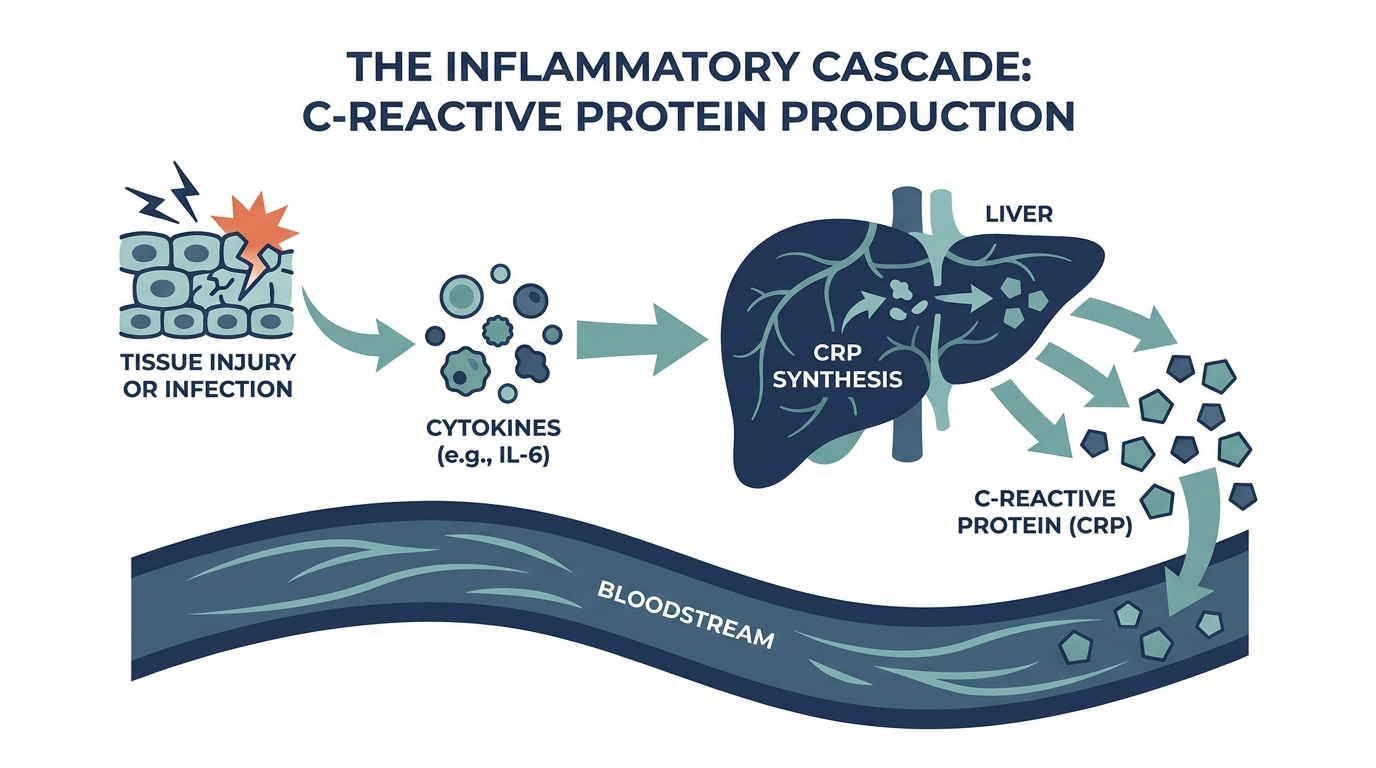
A CRP blood test measures the amount of C-reactive protein in your blood, a protein your liver makes and releases whenever there is inflammation somewhere in your body (Cleveland Clinic). When tissue gets injured, infected, or inflamed, your liver pumps CRP into the bloodstream within hours, and the level rises and falls with how much inflammation is present. In plain terms: CRP is a smoke detector. It tells you there is a fire, it just does not tell you which room.
That single idea, that CRP is a general inflammation signal and not a disease in itself, is the key to everything below. It is why one elevated CRP can mean a chest infection in one person and a rheumatoid arthritis flare in another.

What does CRP mean in a blood test?
When people ask what does CRP mean on a blood test, the honest answer is that CRP means inflammation, full stop. C-reactive protein is what is called an acute phase reactant, a substance the liver ramps up in response to the chemical signals released during an inflammatory response (MedlinePlus). The test does not identify the cause or the location of that inflammation. It simply puts a number on how much of it is happening.
This is why CRP is so useful and so easy to misread at the same time. A high value is real and meaningful, but on its own it is a question, not an answer. Your clinician reads it alongside your symptoms, your exam, and often other tests to figure out where the smoke is coming from.
What does a CRP blood test show?
A CRP blood test shows whether you have active inflammation in your body and roughly how intense it is. Doctors order it to help diagnose and monitor a long list of conditions (MedlinePlus):
- Infections, especially bacterial infections, which tend to push CRP up sharply.
- Autoimmune and inflammatory diseases, such as rheumatoid arthritis, lupus, and inflammatory bowel disease.
- Monitoring after surgery, where a rising CRP can be an early hint of a postoperative infection.
- Tracking treatment, because watching CRP fall is one way to confirm an inflammatory condition is responding to therapy.
So when someone asks what blood test is CRP, the simplest framing is this: it is the test a doctor uses to confirm and measure inflammation, then track whether it is getting better or worse over time.
What is a normal CRP level?
A normal CRP level is generally less than 0.9 milligrams per deciliter (mg/dL), though laboratories use slightly different reference ranges, so the number printed on your own report is the one that matters (Cleveland Clinic). MedlinePlus describes a value around 0.8 to 1.0 mg/dL or lower as a healthy amount (MedlinePlus).
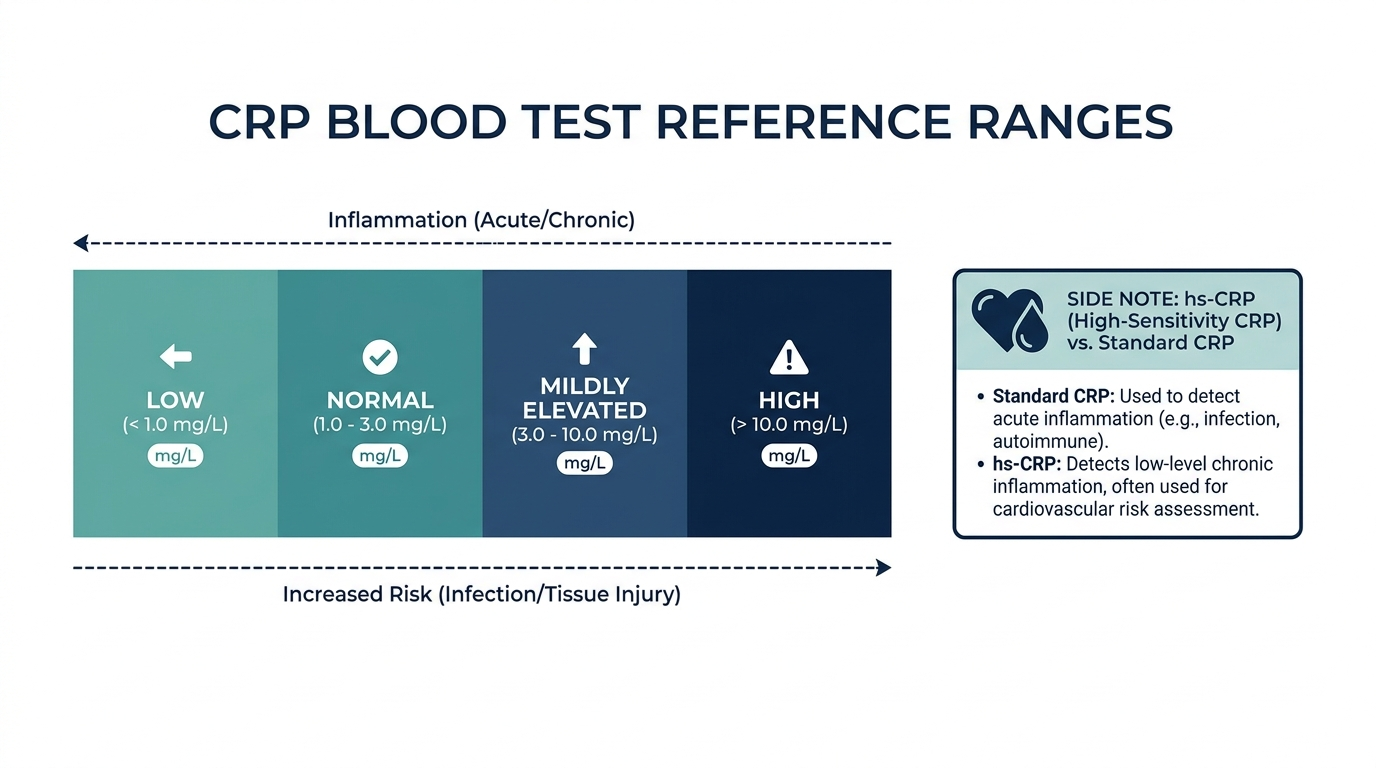
It helps to know that CRP is often reported in two different units, which trips people up constantly. Standard CRP is usually given in mg/dL, while the high sensitivity version is reported in milligrams per liter (mg/L). One mg/dL equals 10 mg/L, so a standard CRP of 0.9 mg/dL is the same as 9 mg/L. Always check which unit your lab used before you compare your number to anything online.

What does a high CRP mean?
A high CRP means there is significant inflammation somewhere in your body, and the size of the number gives a rough sense of how intense it is. Cleveland Clinic groups elevated standard CRP results into broad tiers (Cleveland Clinic):
- Moderate elevation (about 1.0 to 10.0 mg/dL): common with autoimmune conditions like rheumatoid arthritis and lupus, heart attack, pancreatitis, or bronchitis.
- Marked elevation (over 10 mg/dL): often points to acute bacterial or viral infections, vasculitis, or major trauma.
- Severe elevation: a result over 50 mg/L is associated with serious acute bacterial infection roughly 90 percent of the time.
It is worth knowing that plenty of everyday things nudge CRP up too, including smoking, obesity, recent injury, pregnancy, poor sleep, and even depression (Cleveland Clinic). That is exactly why a single high CRP is never read in isolation.
What is the difference between CRP and hs-CRP?
CRP and hs-CRP measure the exact same protein, but they answer completely different questions, and confusing them is one of the most common mistakes patients make. A standard CRP test is built to detect the large spikes that come with infection and active inflammatory disease. A high sensitivity CRP test, or hs-CRP, is calibrated to pick up the very small increases that sit within the so called normal range, and it is used to help estimate long term cardiovascular risk (MedlinePlus).
For cardiovascular risk, the U.S. Centers for Disease Control and the American Heart Association use these widely cited hs-CRP cutoffs (PMC, hs-CRP in clinical practice):
- Lower risk: less than 1 mg/L.
- Average risk: 1 to 3 mg/L.
- Higher risk: greater than 3 mg/L.
So a CRP that would look perfectly normal on an infection workup, say 2 mg/L, can still flag average to elevated cardiovascular risk on an hs-CRP scale. Same protein, different lens.
The insider point: why one CRP number can fool you
Here is the detail that separates how a seasoned clinician reads CRP from how a worried patient reads it. Because CRP responds to any inflammation, a single elevated value taken during a cold, a flare, or the week after a fall is close to meaningless for judging your baseline. The accepted clinical move is to not trust a high hs-CRP on the first draw. Guidelines recommend repeating any hs-CRP value above 5 mg/L at least a month later, and if the repeat is lower, using that lower number for risk assessment instead (PMC, hs-CRP in clinical practice). A transient acute phase response can quietly double your reading and then vanish.
The flip side is just as important, and it is where CRP gets genuinely interesting. A CRP that stays elevated across two separate draws is far more telling than a single spike. In a large cohort study, people whose hs-CRP was sustained at or above 3 mg/L across two visits had roughly a 50 percent higher risk of coronary heart disease and all-cause death, and a higher risk of new diabetes, heart failure, and stroke, even after accounting for other factors (PMC, six-year change in hs-CRP and risk). The researchers put it plainly: two measurements are better than one. A persistent low grade fire, not a one off flare, is the signal that matters.

What does a low CRP mean?
A low CRP is good news. It means your body is not showing measurable signs of active inflammation, which is exactly what you want to see. There is no recognized condition defined by an abnormally low CRP, so on the standard test a low or undetectable result is simply normal and nothing to chase. On the hs-CRP scale, a level under 1 mg/L places you in the lower cardiovascular risk band (PMC, hs-CRP in clinical practice).
Keep one caveat in mind. A normal CRP does not rule out every disease. Some chronic conditions can be active without driving CRP up, so this marker is a strong clue, not a clean bill of health.
How fast CRP rises and falls, and why the timing matters
One reason CRP is such a favorite of clinicians is its speed. Understanding its kinetics explains why the test is drawn when it is and how to interpret a number in the context of when your symptoms started.
After an inflammatory trigger, CRP begins climbing within about 6 to 8 hours, and it peaks roughly 48 hours, or two to three days, later (C-reactive protein overview). Just as importantly, it has a short half-life of about 19 hours, so once the underlying inflammation resolves, the level falls quickly, often heading back toward normal within a few days. This fast up-and-down behavior has practical consequences:
- A test drawn too early can look reassuring. If you are tested in the first few hours of a new infection, CRP may not have risen yet, so a normal value does not fully exclude early inflammation.
- CRP is excellent for tracking. Because it responds quickly in both directions, a falling CRP over days is a reliable sign that an infection or flare is improving, which is why it is repeated to monitor treatment (MedlinePlus).
- Recent events still count. Surgery, an injury, or an illness in the past week can keep CRP elevated even after you feel better, so timing relative to those events matters when reading a result.
CRP versus ESR: two inflammation tests, two speeds
CRP is often ordered alongside an older inflammation test, the erythrocyte sedimentation rate (ESR), and patients frequently wonder why both are done. They measure inflammation through different mechanisms and on different timelines, so they complement each other.
| Feature | CRP | ESR |
|---|---|---|
| What it measures | A liver protein made in response to inflammation | How fast red cells settle, driven largely by fibrinogen |
| How fast it rises | Within 6 to 8 hours | Over 24 to 48 hours |
| How fast it falls | Within days as inflammation resolves | Can stay elevated for weeks |
| Best for | Acute changes and quick tracking | Slower or chronic inflammatory processes |
Because CRP reacts faster in both directions, it tends to reflect what is happening right now, while ESR lags and can stay high after the problem has started to settle. When the two disagree, that mismatch itself can be informative. A clinician who orders both is usually trying to capture both the fast and the slow picture of inflammation.
What CRP does not tell you
Respecting the limits of the test is what keeps a high number from turning into needless fear. CRP is powerful precisely because it is broad, but that breadth is also its main weakness.
- It does not name the cause. CRP confirms inflammation exists and estimates its intensity, but it cannot tell an infection from an autoimmune flare from a recent injury (MedlinePlus).
- It does not locate the problem. The smoke detector analogy holds. A high CRP says there is a fire, not which room it is in.
- A normal CRP does not clear you. Some active conditions do not raise CRP much, so a normal result is a strong clue but not proof of health.
- Everyday factors nudge it. Smoking, excess weight, poor sleep, and even pregnancy can raise baseline CRP, which is one more reason a single value is read in context rather than acted on alone (Cleveland Clinic).
None of this makes CRP less useful. It just means the number is a starting point for a conversation, not a verdict delivered on its own.
Can you lower a high CRP?
Because a persistently elevated hs-CRP is linked to higher cardiovascular risk, a natural question is whether you can bring it down. You often can, but the right approach depends entirely on why it is high, and the goal is to reduce the underlying inflammation rather than to chase the number for its own sake.
- Treat the cause. If CRP is up because of an infection or an autoimmune flare, it falls as that condition is treated. This is the single most important lever.
- Lifestyle changes that reduce chronic inflammation. Not smoking, reaching a healthy weight, regular physical activity, and better sleep are all associated with lower baseline CRP (Cleveland Clinic).
- Statins, in the right patients. Beyond lowering cholesterol, statins reduce CRP. In the JUPITER trial, rosuvastatin lowered hs-CRP by roughly 37 percent, and people with normal LDL but elevated hs-CRP still benefited, which reshaped how clinicians think about inflammation and heart risk (PMC, JUPITER perspective).
The key mindset is that a lower CRP is a byproduct of less inflammation, not a target to game. Whether medication is appropriate is a decision for your clinician based on your full cardiovascular risk, not on the CRP number alone.
How CRP is used across different conditions
The same blood test plays noticeably different roles depending on what a clinician is investigating, which is why the identical number can carry different weight from one appointment to the next.
- Suspected infection. A sharply elevated CRP supports a bacterial infection and helps gauge severity, and a falling CRP over the following days signals the infection is responding (Cleveland Clinic).
- Autoimmune and inflammatory disease. In conditions like rheumatoid arthritis or inflammatory bowel disease, CRP is used to track how active the disease is and whether treatment is controlling it (MedlinePlus).
- After surgery. CRP normally rises after an operation and then falls. A CRP that climbs again instead of settling can be an early warning of a postoperative infection.
- Cardiovascular risk. Here the hs-CRP version is used to refine long-term risk in people who are otherwise well, not to diagnose anything acute (PMC, hs-CRP in clinical practice).
Recognizing which of these jobs your CRP was ordered for is the fastest way to understand what your result actually means for you.
How the test is done and what can throw it off
The CRP test itself is simple, but a few practical points help you get a result that reflects your true baseline rather than a passing blip.
- Preparation. A standard CRP usually needs no special preparation, and it can be drawn at any time of day as part of a routine blood draw (MedlinePlus).
- Recent inflammation is the biggest confounder. A cold, a recent injury, a dental infection, or intense exercise in the days before can all transiently raise CRP, so mention anything like that to your clinician.
- For cardiovascular risk, timing matters most. hs-CRP should be measured when you are well, not during or right after an illness, and an elevated value above 5 mg/L is repeated about a month later before it is used for risk assessment (PMC, hs-CRP in clinical practice).
- Check the units. As noted earlier, mg/dL and mg/L differ by a factor of ten, and mixing them up is the most common self-interpretation error.
Put simply, the test is easy, but a thoughtful result comes from drawing it at the right moment and reading it against the rest of your clinical picture.
What nudges your baseline CRP even when you are not sick
Not every elevated CRP comes from an infection or a flare. A number of ongoing factors gently raise the resting level, which is why two healthy people can sit at different baselines and why lifestyle shows up in this marker over time.
- Excess body fat. Fat tissue, especially around the abdomen, is metabolically active and releases low grade inflammatory signals, so a higher body mass tends to track with a higher baseline CRP. This is one reason weight change can move the number across months rather than days.
- Smoking. Tobacco use is associated with higher resting inflammation, and CRP tends to drift down after quitting, which makes it a marker people can watch improve.
- Age and sex. Baseline CRP tends to be a little higher in older adults, and hormonal differences and estrogen-containing medications can shift it as well, so what counts as typical is not identical for everyone.
- Chronic conditions and daily habits. Poorly controlled blood sugar, ongoing psychological stress, disrupted sleep, and a sedentary routine can each keep low grade inflammation simmering, while regular physical activity is generally linked with lower CRP.
The practical lesson is that a modestly raised CRP is not always a hidden acute illness. Sometimes it reflects the slow-burn factors above, and those are exactly the ones you can influence. That is why clinicians reading an hs-CRP for heart risk consider weight, smoking, activity, and metabolic health alongside the number, and why re-testing after real lifestyle changes, not just once, is the honest way to see whether your baseline is actually moving in the right direction.
Turn what you just learned about CRP into action.
Superpower lets you test CRP and 100+ biomarkers from home, then re-check them over time so you can actually see progress, physician-reviewed at every step.
Frequently asked questions
What does CRP mean in a blood test?
CRP stands for C-reactive protein, a protein your liver releases in response to inflammation. A CRP result means your body has some level of active inflammation, but the test does not reveal the cause or location on its own (MedlinePlus). Your clinician interprets it alongside your symptoms and other tests.
What is a normal CRP level?
A normal CRP is generally less than 0.9 mg/dL, with healthy values often around 0.8 to 1.0 mg/dL or lower, though ranges vary by lab (Cleveland Clinic). Always compare your result to the reference range printed on your own report and check whether it is reported in mg/dL or mg/L.
What does a high CRP blood test show?
A high CRP shows significant inflammation, and the higher the number the more intense it tends to be. Marked elevations above 10 mg/dL often point to acute infection, while moderate elevations can reflect autoimmune disease, injury, or other causes (Cleveland Clinic).
What is the difference between CRP and hs-CRP?
Both measure the same protein, but standard CRP detects the large spikes of infection and active disease, while hs-CRP detects tiny increases used to estimate cardiovascular risk, with cutoffs of under 1, 1 to 3, and over 3 mg/L for lower, average, and higher risk (PMC, hs-CRP in clinical practice).
Should I worry about one high CRP result?
Not necessarily. A single high CRP can be caused by a passing infection or injury, which is why guidelines recommend repeating an elevated hs-CRP above 5 mg/L about a month later before drawing conclusions (PMC, hs-CRP in clinical practice). A level that stays high across two draws is far more meaningful.
This article is for general educational purposes and is not medical advice. It cannot diagnose or treat you and does not replace your clinician. Always discuss your lab results and any health decisions with a qualified healthcare professional.
Vital Signs Today may earn a commission if you buy through links on this page. It does not affect our editorial assessments.