
Last updated June 2026. Educational content, not medical advice. Talk to a licensed clinician before starting any peptide or GLP-1 therapy.
Short answer: GLP-1 drugs like semaglutide (Ozempic, Wegovy) and tirzepatide (Mounjaro, Zepbound) are technically peptides, short chains of amino acids. The confusion comes from how the term “peptide therapy” gets used in wellness clinics, which usually means growth hormone secretagogues or repair peptides like BPC-157. These two categories share a molecular family but work through completely different mechanisms, carry very different evidence bases, and sit in entirely different regulatory lanes.
GLP-1 drugs are technically peptides, but the real question is what your own metabolic markers say about using them. One at-home Superpower draw checks 100+ biomarkers, physician-reviewed.
Why does everyone mix these two things up?
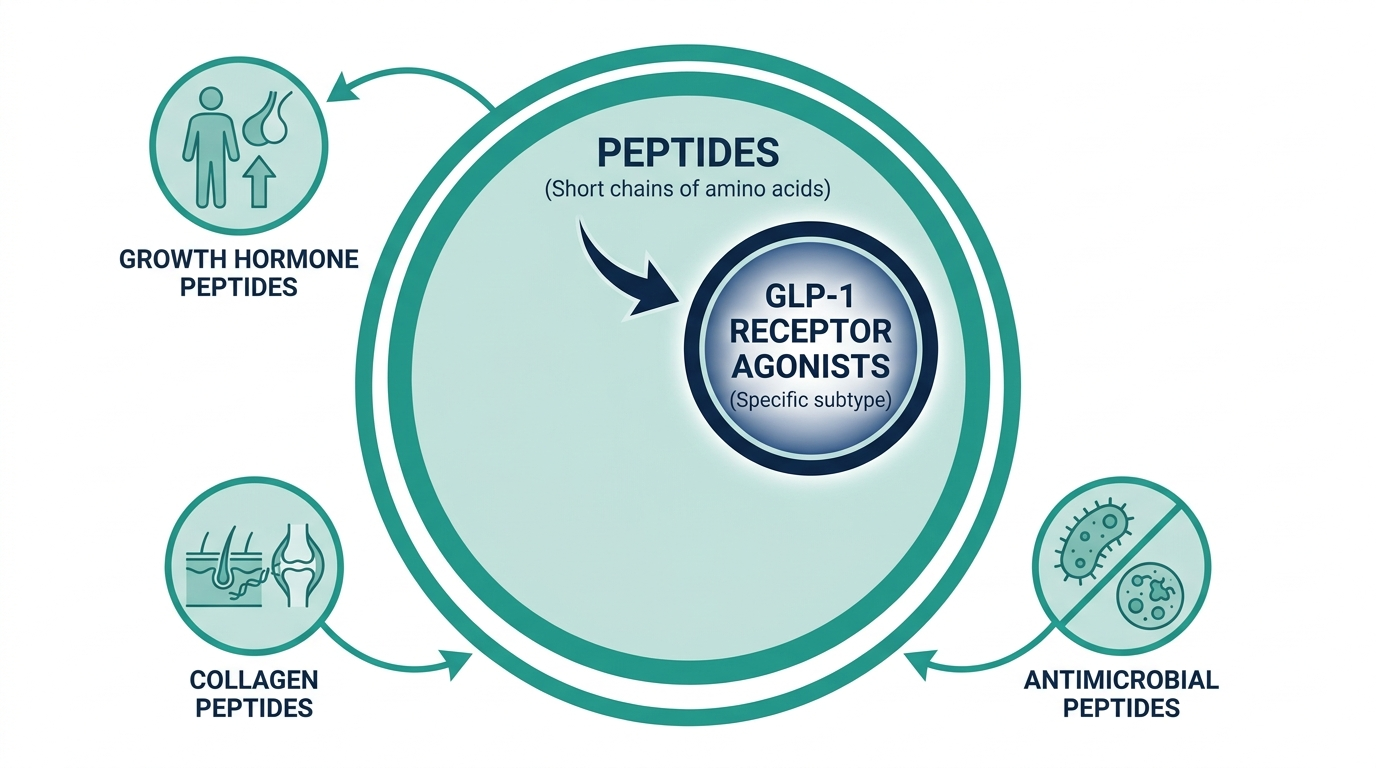
The confusion is understandable, because both camps use the same word. Biochemically, a peptide is any chain of 2 to 50 amino acids. GLP-1 (glucagon-like peptide-1) is a 30 to 31 amino acid chain your intestinal L-cells release after you eat, and every GLP-1 drug is a chemically engineered version of that molecule. So yes, Ozempic is a peptide.
“Peptide therapy,” as clinics and forums use the term, means something narrower: synthetic peptides like CJC-1295, ipamorelin, BPC-157, TB-500, or AOD-9604 that are not designed to mimic GLP-1 at all. They target completely different receptors, different tissues, and different outcomes. Calling both of them “peptides” without qualification is like calling both ibuprofen and amoxicillin “pills.” Technically true, practically misleading.
This distinction matters more in 2026 than it did even two years ago, because GLP-1 drugs have become mainstream enough that patients walk into wellness clinics asking for “peptides” and leave with something that may have almost nothing in common with the drug they actually want.
How do GLP-1 receptor agonists actually work?
The simplest way to actually get this done
Superpower is a full-body lab membership that runs 100+ biomarkers, has each result reviewed by a doctor, and tracks your numbers year over year (about $199/year). It is what we point readers to when they would rather get one clean, complete draw than chase single tests one at a time. Here is superpower reviewed in full.
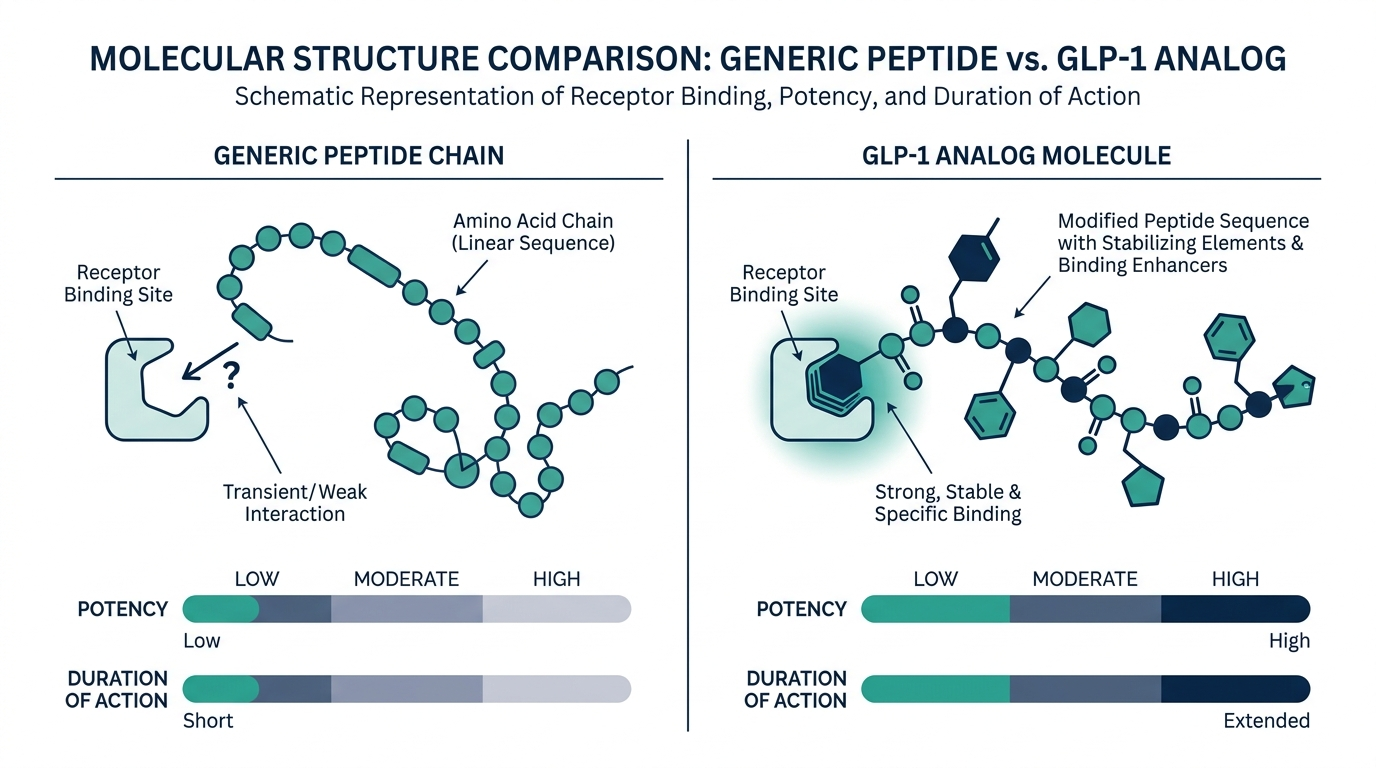
GLP-1 receptor agonists (GLP-1 RAs) mimic a gut hormone that your body secretes in response to food. They latch onto GLP-1 receptors in the pancreas, brain, gut, and heart. The result is a coordinated set of effects: delayed gastric emptying, reduced appetite signals to the hypothalamus, and glucose-dependent insulin secretion. In plain terms, food stays in your stomach longer, you feel full faster, and you eat less. The result is not subtle. The STEP 1 trial showed semaglutide 2.4 mg produced a mean 14.9% body weight reduction over 68 weeks. The SURMOUNT-5 trial, the first head-to-head comparison between semaglutide and tirzepatide, found tirzepatide produced 21.6% weight reduction versus 15.4% for semaglutide over 72 weeks, which settles the “which one is stronger” debate with a Phase 3b answer.
There is now an oral option, too. The FDA approved oral semaglutide 25 mg (Wegovy pill) on December 22, 2025, making it the first oral GLP-1 approved specifically for weight management. In the OASIS 4 trial, fully adherent participants lost a mean 16.6% body weight at 64 weeks, and one-third achieved at least 20% weight loss.
Full-body lab membership: 100+ biomarkers, doctor-reviewed, tracked over time.
How does “peptide therapy” work? (The non-GLP-1 kind)
Peptide therapy, in the wellness-clinic sense, typically falls into three buckets:
Growth hormone secretagogues (GHS): Peptides like ipamorelin and CJC-1295 signal the pituitary gland to release more of your own growth hormone (GH). They are not GH itself, and they do not suppress your pituitary the way synthetic HGH can. Ipamorelin is the most selective ghrelin mimetic available, stimulating GH release without raising cortisol, prolactin, or aldosterone. CJC-1295 acts as a GHRH (growth hormone releasing hormone) analog, providing sustained GH release lasting roughly six days post-injection. Together, they produce a synergistic GH pulse stronger than either alone. The goal is not dramatic weight loss on the scale of GLP-1 trials, but improved body composition: visceral fat reduction and lean mass preservation over months.
Repair and recovery peptides: BPC-157 (Body Protection Compound-157) is a 15-amino-acid synthetic peptide studied primarily in animals for gut repair, tendon healing, and inflammation modulation. TB-500 (a synthetic version of thymosin beta-4) is often stacked with BPC-157 for soft-tissue recovery protocols. Neither has completed large-scale human trials for metabolic outcomes. Personally, I think the lack of Phase 3 data on BPC-157 is one of the most honestly under-discussed realities in the peptide space. The mechanism is interesting. The human evidence is thin.
Fat-metabolism peptides: AOD-9604 is a 16-amino-acid fragment derived from human growth hormone that was originally developed as an anti-obesity drug in the 1990s. It stimulates lipolysis and inhibits lipogenesis through beta-3 adrenergic receptor modulation, with no meaningful effect on blood sugar. However, it failed to achieve statistical significance in its largest Phase IIb trial and development was terminated in 2007. Clinics still offer it. The trial record does not support the enthusiasm.

The one comparison that surprises most people
Personally, the muscle-loss data on GLP-1 drugs is the most underreported story in the weight-loss conversation right now. Research consistently puts the lean body mass fraction of GLP-1-driven weight loss at 25 to 40%, with a 2025 Endocrine Society presentation placing it near 40% for semaglutide. That means for someone losing 40 pounds on Ozempic, 10 to 16 of those pounds could be muscle, not fat. A June 2026 analysis in Cell Reports Medicine offered some reassurance, showing that lean mass loss is not disproportionate relative to total weight loss, but the issue remains clinically real for older adults and anyone already at risk for sarcopenia.
Growth hormone secretagogues are designed to do the opposite: preserve or build lean mass while targeting fat. This is why some clinicians now stack them together, using a GLP-1 drug for overall weight reduction while using CJC-1295/ipamorelin to counteract the lean mass loss. A 2026 combination trial combining semaglutide with bimagrumab (a myostatin inhibitor) reduced the lean mass fraction of weight loss from roughly 21% to just 7%, pointing to where clinical protocols are headed. GLP-1 drugs and peptide therapy are not necessarily rivals. For some patients, they are a planned pairing.
Side-by-side comparison
| Category | GLP-1 Receptor Agonists | Peptide Therapy (non-GLP-1) |
|---|---|---|
| Examples | Semaglutide (Ozempic/Wegovy), Tirzepatide (Mounjaro/Zepbound) | CJC-1295/Ipamorelin, BPC-157, TB-500, AOD-9604 |
| Mechanism | Mimics gut hormone; slows gastric emptying, suppresses appetite, stimulates insulin | Signals pituitary (GHS), promotes tissue repair, modulates fat metabolism |
| Weight loss data | Strong: 15-22% body weight in Phase 3 RCTs | Weak to moderate; no Phase 3 obesity trials |
| Lean mass effect | 25-40% of weight lost is lean mass | GH secretagogues designed to preserve lean mass |
| FDA approval status | Approved (semaglutide, tirzepatide, liraglutide) | None approved for obesity; some prescription via compounding |
| Route | Subcutaneous injection or oral pill (Wegovy 25 mg) | Subcutaneous injection (most); some topical |
| Who prescribes | Any licensed MD/NP/PA; major telehealth platforms | Specialized telehealth / longevity clinics; compounding pharmacies |
| Typical monthly cost | $179 to $550/mo (brand or compounded telehealth) | $175 to $399/mo (telehealth with monitoring) |
| Regain on discontinuation | ~Two-thirds of lost weight within one year of stopping | Returns to baseline GH pattern after stopping |
Do not believe any clinic that tells you peptide therapy produces GLP-1-equivalent weight loss numbers. The trial evidence does not exist. The only head-to-head weight-loss data with those kinds of results is behind semaglutide and tirzepatide, full stop.
What the regulatory picture looks like in 2026
GLP-1 drugs are straightforward: FDA-approved, covered by select insurance plans and Medicare, available through any licensed prescriber. The telehealth route has expanded access substantially, with compounded semaglutide programs starting around $169 to $199 per month and all-inclusive platforms like MEDVi at $179 for the first month. Brand-name Wegovy runs $550/month without coverage but eligible Medicare members can access select GLP-1s for $50/month through the Medicare GLP-1 Bridge Program.
Peptide therapy sits in a more complicated place. Most GH secretagogues and repair peptides are not FDA-approved as finished drugs. The regulatory landscape thawed meaningfully in early 2026 when HHS signaled that roughly 14 peptides, including BPC-157, TB-500, CJC-1295, ipamorelin, and sermorelin, are expected to return to Category 1 status (permitted for compounding) under 503A, pending a Pharmacy Compounding Advisory Committee meeting in July 2026. That is a genuine opening for the licensed compounding route. It is not a greenlight for the research-chemical grey market.
For practical purposes: if a telehealth clinic is offering CJC-1295/ipamorelin or sermorelin with a real prescription and a named compounding pharmacy, that is a legitimate option. If a site is selling injectable peptides with no prescription and a disclaimer that says “for research use only,” that label transfers all regulatory risk to the buyer and tells you nothing about what is in the vial.
Telehealth GLP-1 program with provider visits and pharmacy coordination.
Which one is actually right for you?
This is where the honest answer diverges from the marketing. Most people searching “peptides vs GLP-1” are either trying to lose significant weight quickly or trying to optimize body composition without the dramatic caloric restriction GLP-1 drugs impose.
For significant weight loss (think 15% or more of body weight), the clinical evidence overwhelmingly favors GLP-1 drugs. No peptide therapy protocol comes close on the numbers. The tradeoff is the commitment to ongoing use: the STEP 1 trial extension showed that patients who stopped semaglutide regained roughly two-thirds of their lost weight within one year. GLP-1 drugs are currently closer to management than cure.
For body composition, lean mass preservation, and slower optimization, GH secretagogues like CJC-1295/ipamorelin are a more targeted tool. They work over months, not weeks, and the effects on fat mass are modest compared to GLP-1s. The realistic expectation is improved body composition with better sleep and recovery, not the 20% body weight drop you see in semaglutide trials.
For some patients, particularly those already on a GLP-1 drug who are concerned about muscle loss, combining a GH secretagogue protocol is what 2026 clinical practice is increasingly moving toward. Your metabolic baseline, age, lean mass index, and underlying drivers of weight gain all matter here. This is exactly the kind of decision that benefits from labs first, prescriber second.
One insider truth worth knowing: the clinics that offer both categories often diagnose patients into whatever they happen to sell. A longevity clinic heavy on peptide therapy will find a reason to prescribe peptides. A GLP-1-focused platform will push GLP-1s. The honest ones do labs first and match the protocol to what the labs show.
Side effect profiles: why these two categories feel so different in the body
People assume that because both are peptides, they carry similar risks. They do not. The side effects trace directly back to the mechanism, and knowing the pattern helps you recognize what is normal versus what is a red flag.
GLP-1 receptor agonists act on the gut and brain, so their side effects are overwhelmingly gastrointestinal. The most common are nausea, vomiting, constipation, diarrhea, and early satiety, driven by the delayed gastric emptying that also produces the appetite suppression. These effects are usually strongest in the first weeks and after each dose increase, which is why titration schedules exist. Less common but more serious concerns include gallstones (rapid weight loss increases gallbladder risk generally), pancreatitis, and a boxed warning for a theoretical thyroid C-cell tumor risk seen in rodents, which is why these drugs are contraindicated in people with a personal or family history of medullary thyroid carcinoma or MEN2. Dehydration from vomiting or diarrhea can stress the kidneys, so hydration matters.
Growth hormone secretagogues act on the pituitary, so their side effects cluster around fluid balance and glucose. Water retention, joint aches, tingling in the hands (a carpal-tunnel-like sensation), and transient increases in blood sugar are the classic ones, mirroring the known effects of raising growth hormone. Because GH opposes insulin, someone with borderline glucose control should be monitored. Ipamorelin is favored partly because it raises GH with little effect on cortisol or prolactin, unlike older secretagogues.
Repair peptides like BPC-157 and TB-500 have thin human safety data precisely because they lack large trials. The honest position is that the absence of documented side effects at scale reflects the absence of studies, not proof of safety. That uncertainty is itself the main caution.
What to monitor with labs before and during therapy
Both categories reward a labs-first approach, and the specific markers you track differ by mechanism. This is the practical answer to the recurring theme that you should run labs before choosing a protocol, then keep monitoring while on it.
- Before a GLP-1: a baseline metabolic picture. HbA1c and fasting glucose to gauge dysglycemia, fasting insulin and a HOMA-IR calculation for insulin resistance, a full lipid panel, and liver and kidney function (ALT, AST, creatinine, eGFR). A baseline of lean mass, even a simple body composition scan, is smart given the muscle-loss concern.
- While on a GLP-1: recheck HbA1c and metabolic markers to confirm improvement, watch kidney function if GI side effects cause dehydration, and track body composition so you can catch excessive lean mass loss early and respond with protein intake and resistance training.
- Before a GH secretagogue: IGF-1 as the practical readout of growth hormone activity, fasting glucose and HbA1c because GH can nudge glucose upward, and a lipid panel. IGF-1 gives you a target to monitor, since the goal is to raise it into a healthy range without overshooting.
- While on a secretagogue: recheck IGF-1 to confirm the protocol is working and not pushing levels too high, and monitor fasting glucose given GH’s counter-regulatory effect on insulin.
The point is not to self-interpret these numbers. It is to walk into the prescriber conversation with data so the choice of protocol, and the dose, is anchored to your actual physiology rather than a clinic’s product menu.
Common misconceptions worth clearing up
- “Peptides are natural, so they are safer than drugs.” A synthetic peptide made in a lab is a drug. Being a chain of amino acids does not make something gentle or risk-free. GLP-1 drugs are peptides and carry a boxed warning; the natural-versus-drug framing is marketing, not pharmacology.
- “Research use only means it is a legal supplement.” That label is the opposite of reassuring. It signals the product was never approved for human use and shifts all regulatory and safety risk to the buyer. It tells you nothing about purity, dose accuracy, or sterility of what is in the vial.
- “GLP-1 weight loss is all fat.” A meaningful fraction of the weight lost on a GLP-1, commonly cited in the 25 to 40 percent range, is lean mass. That is why resistance training and adequate protein are not optional add-ons but core parts of doing it well.
- “You can stop once you hit your goal.” The trial data show most people regain a large share of lost weight within a year of stopping a GLP-1. These drugs currently manage a condition rather than cure it, which reframes them as a long-term commitment, not a quick course.
- “Compounded and grey-market are the same thing.” A prescription from a licensed prescriber filled by a named 503A compounding pharmacy is a regulated path. An anonymous website selling vials with a research disclaimer is not. The molecule name being identical does not make the sources equivalent.
Turn what you just learned into action.
Superpower lets you test 100+ biomarkers from home, then re-check them over time so you can actually see progress, physician-reviewed at every step.
Frequently asked questions
Are GLP-1 drugs technically peptides?
Yes. Semaglutide is a 31-amino-acid peptide analog of the naturally occurring GLP-1 hormone. Tirzepatide is a 39-amino-acid dual GIP/GLP-1 receptor agonist. Both are synthetic peptides. When clinics use “peptide therapy,” they typically mean a different class of peptides entirely, specifically growth hormone secretagogues and repair peptides, not GLP-1 receptor agonists.
Which produces more weight loss, GLP-1 or peptide therapy?
GLP-1 drugs produce dramatically more weight loss. Semaglutide 2.4 mg produced 14.9% body weight reduction over 68 weeks in the STEP 1 trial; tirzepatide produced up to 21.6% in SURMOUNT-5. No peptide therapy protocol, including CJC-1295/ipamorelin or AOD-9604, has Phase 3 trial data approaching those numbers.
Do peptides help you lose weight without the side effects of GLP-1 drugs?
Some do target fat metabolism, but the evidence is weaker. AOD-9604 failed its Phase IIb obesity trial. CJC-1295/ipamorelin improve body composition over months, not body weight dramatically. Common GLP-1 side effects like nausea, constipation, and gastroparesis do not apply to GH secretagogues, so the side effect profile is genuinely different, but so are the results.
Can you take both GLP-1 drugs and peptide therapy at the same time?
Some clinicians prescribe them together, specifically GLP-1 for total weight reduction and a GH secretagogue to counteract lean mass loss. The bimagrumab plus semaglutide trial showed this kind of combination can reduce the lean mass fraction of weight loss from roughly 21% to 7%. This should only be done under clinical supervision with baseline and follow-up labs.
Is peptide therapy FDA-approved?
For GH secretagogues and repair peptides, no. Semaglutide and tirzepatide (the GLP-1 drugs) are FDA-approved. Many non-GLP-1 peptides are available through licensed compounding pharmacies under 503A rules, which changed meaningfully in 2026 as the FDA moved to restore several peptides to permitted compounding status.
How much does each cost?
Telehealth GLP-1 programs run approximately $169 to $550 per month depending on the drug, dose, and platform. Peptide therapy through a telehealth or longevity clinic typically runs $175 to $399 per month. None of it is covered by standard insurance for weight optimization. Some Medicare plans now offer GLP-1 access at $50/month for eligible members.
What should I do first before choosing between them?
Get a baseline lab panel. A comprehensive metabolic panel with HbA1c, fasting insulin, HOMA-IR, IGF-1, and a full lipid profile tells you whether your primary issue is insulin resistance (where GLP-1 drugs have the strongest evidence), GH insufficiency (where secretagogues are more targeted), or something else entirely. Choosing a drug before running labs is guessing. Your clinician should be explaining why your lab results point to one protocol over the other.
Author: Vital Signs Today Editorial Team, [credential]”]. Educational content, not medical advice. Sources linked inline.
Telehealth GLP-1 program with provider visits and pharmacy coordination.
Primary sources:
– SURMOUNT-5 trial summary, American College of Cardiology
– STEP 1 trial, NEJM
– Tirzepatide vs Semaglutide for Obesity, NEJM SURMOUNT-5
– FDA approval Wegovy pill, Novo Nordisk press release
– GLP-1 lean mass loss, Cell Reports Medicine 2026
– Pharmacologic lean mass preservation during weight loss, PMC 2026
– FDA bulk drug substances under 503A
– AOD-9604 research, ResearchGate
– GLP-1 telehealth cost comparison, Walgreens Weight Management
– GLP-1 activity reduction on Ozempic, ScienceDaily June 2026
Want a real clinician to run the numbers, not a guess?
Joi + Blokes is a telehealth clinic that prescribes GLP-1 medication (Zepbound, compounded semaglutide and tirzepatide), hormone therapy (TRT, HRT), thyroid care, and peptides after a real lab panel and clinician review, with no membership or consult fee (prescriptions from about $59/month, lab panels from $149). If the scale will not budge, this is where you find out whether insulin, thyroid, or hormones are the real reason. Here is Joi + Blokes reviewed in full.
Related reading
Vital Signs Today may earn a commission if you buy through links on this page. It does not affect our editorial assessments.