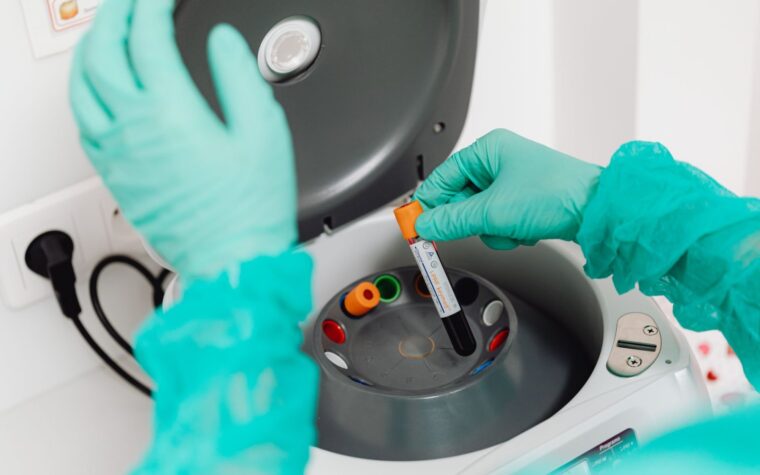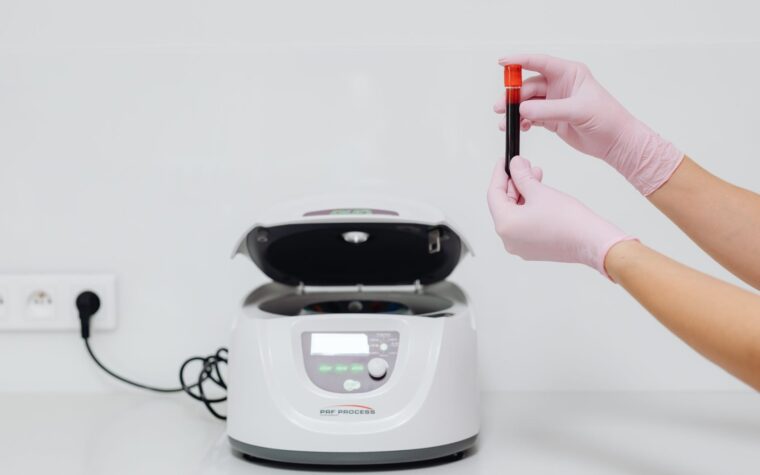
- A calcium blood test measures the amount of calcium in your blood, and a normal total calcium level for adults is about 8.6 to 10.2 mg/dL (Cleveland Clinic).
- High blood calcium (hypercalcemia) is most often caused by overactive parathyroid glands or cancer, while low calcium (hypocalcemia) is most often caused by vitamin D deficiency or underactive parathyroid glands (MedlinePlus).
- Total calcium results should be interpreted alongside your albumin level, because roughly 40 percent of blood calcium is bound to albumin and low albumin can falsely lower the reading (StatPearls).
Part of our Comprehensive Metabolic Panel guide.
What is calcium in a blood test?
A calcium blood test measures the total amount of calcium in your blood, and a normal result for most adults is about 8.6 to 10.2 mg/dL (Cleveland Clinic). MedlinePlus lists a closely overlapping range of 8.5 to 10.2 mg/dL, or 2.15 to 2.55 mmol/L. Calcium is the most abundant mineral in your body, and more than 99 percent of it is stored in your bones and teeth (NIH Office of Dietary Supplements). The small fraction circulating in your blood does heavy work: it helps your heart beat, your muscles contract, your nerves fire, and your blood clot.
Calcium looks simple on paper but the full picture takes more than one number. See yours alongside 100+ other biomarkers. One at-home Superpower draw checks 100+ biomarkers, physician-reviewed.
There are two common versions of this test. Total calcium: measures all calcium in the blood, both the free form and the part bound to proteins, and it is the version included in a standard metabolic panel. Ionized (free) calcium: measures only the active, unbound calcium, with a normal range near 4.6 to 5.3 mg/dL (Cleveland Clinic). Reference ranges vary slightly between labs, so always read the range printed next to your own result.

Why is calcium measured?
Calcium is measured to check your general health and to screen for problems with your bones, kidneys, parathyroid glands, and metabolism, which is why it appears on the basic and comprehensive metabolic panels ordered at most routine checkups (MedlinePlus). It is one of the most frequently run blood chemistries in the United States precisely because abnormal calcium can flag conditions long before symptoms appear.
Your doctor may order or repeat a calcium test for specific reasons:
- Symptoms of high calcium: excessive thirst, frequent urination, constipation, nausea, fatigue, or confusion.
- Symptoms of low calcium: muscle cramps, numbness or tingling around the mouth and fingers, and twitching.
- Monitoring: tracking kidney disease, parathyroid disorders, certain cancers, or the effect of medicines such as diuretics, lithium, or calcium and vitamin D supplements (Cleveland Clinic).
Because calcium in the blood is kept in a tight range by the parathyroid glands, vitamin D, and the kidneys, a value outside that range is a useful clue that one of those systems is off balance.
What does a high calcium mean?
A high calcium result, called hypercalcemia, means your blood calcium is above the normal range, and Cleveland Clinic grades it as mild at 10.5 to 11.9 mg/dL, moderate at 12.0 to 13.9 mg/dL, and severe at 14.0 mg/dL or higher. Severe hypercalcemia can be a medical emergency.
Two causes account for the large majority of cases. Primary hyperparathyroidism: one or more parathyroid glands make too much parathyroid hormone, pulling calcium out of bone, and this is the leading cause in people who feel well. Cancer: some tumors, including breast, lung, and blood cancers such as multiple myeloma, raise calcium, and this is the leading cause in people who are hospitalized (MedlinePlus). Together these explain about 90 percent of hypercalcemia. Other causes include too much vitamin D, sarcoidosis, hyperthyroidism, prolonged immobilization, and some medications. Symptoms often follow the old teaching phrase “stones, bones, groans, and psychiatric overtones,” meaning kidney stones, bone pain, abdominal upset, and mood or memory changes.
What does a low calcium mean?
A low calcium result, called hypocalcemia, means your blood calcium is below the normal range, generally under about 8.6 mg/dL on a total calcium test (Cleveland Clinic). Before treating it, clinicians first confirm the low value is real and not just a side effect of low blood protein.
Common causes include:
- Vitamin D deficiency: without enough vitamin D, your gut cannot absorb calcium well, one of the most common reasons for a low reading (MedlinePlus).
- Hypoparathyroidism: the parathyroid glands make too little hormone, sometimes after thyroid or neck surgery.
- Kidney disease, low magnesium, pancreatitis, and malabsorption conditions such as celiac disease.
Mild hypocalcemia may cause no symptoms. As it drops further, people can notice tingling around the mouth and fingertips, muscle cramps, and in severe cases spasms or seizures (StatPearls). Truly low ionized calcium is what drives these symptoms.

How is calcium interpreted with other markers?
Calcium is rarely interpreted alone, and the single most important partner marker is albumin, because about 40 percent of blood calcium is bound to this protein, so low albumin can make total calcium look falsely low (StatPearls). To adjust, clinicians use the corrected calcium formula: corrected calcium = measured calcium + 0.8 x (4.0 minus albumin in g/dL). In practice this adds roughly 0.8 mg/dL of calcium for every 1 g/dL that albumin sits below 4.0.
Other markers sharpen the picture:
- Parathyroid hormone (PTH): high calcium with high PTH points to hyperparathyroidism, while high calcium with low PTH points toward cancer.
- Vitamin D: a low level helps explain low calcium.
- Phosphorus, magnesium, and kidney function (creatinine): these round out the metabolic story and help locate the source.
This is why a single odd calcium value usually leads to a repeat test plus albumin and PTH rather than an immediate diagnosis.
The insider nuance: a “borderline” calcium can still be a real problem
A calcium value that lands just inside the normal range can still be abnormal once you account for PTH, which is the nuance clinicians watch for and patients often miss. In early primary hyperparathyroidism, calcium may read a perfectly normal 10.0 to 10.4 mg/dL, yet if PTH is also elevated instead of suppressed, the body is working too hard to hold that “normal” number, and the diagnosis can still be hyperparathyroidism (Cleveland Clinic).
The practical lesson: do not over-read one value in isolation, but do not dismiss a high-normal calcium either, especially with a personal history of kidney stones, osteoporosis, or fatigue. The trend across several tests, paired with PTH and albumin, tells a far more reliable story than a single snapshot. If your calcium sits at the top of the range repeatedly, it is reasonable to ask your clinician whether a PTH level is worth checking.
Calcium reference ranges at a glance
Calcium is reported in a few different ways, and knowing which number you are looking at prevents confusion. The table below summarizes the common measures and their typical adult ranges. Always compare your result to the range printed on your own report, since labs validate their own instruments.
| Measure | Typical adult range | What it tells you |
|---|---|---|
| Total calcium | About 8.6 to 10.2 mg/dL (Cleveland Clinic) | All calcium, bound and free; the standard panel value. |
| Total calcium (SI units) | About 2.15 to 2.55 mmol/L (MedlinePlus) | The same measure in international units. |
| Ionized (free) calcium | About 4.6 to 5.3 mg/dL (Cleveland Clinic) | The active, unbound calcium that drives function. |
| Hypercalcemia (high) | Above about 10.5 mg/dL | Mild, moderate, or severe by degree. |
| Hypocalcemia (low) | Under about 8.6 mg/dL total | Confirmed against albumin first. |
Ranges shift modestly with age and between laboratories, and total calcium in particular must be read alongside albumin, since a low protein level can make the number look falsely low. This is why clinicians often reach for the corrected calcium calculation or an ionized calcium measurement when the total looks off.

The biology: how your body keeps calcium in a tight range
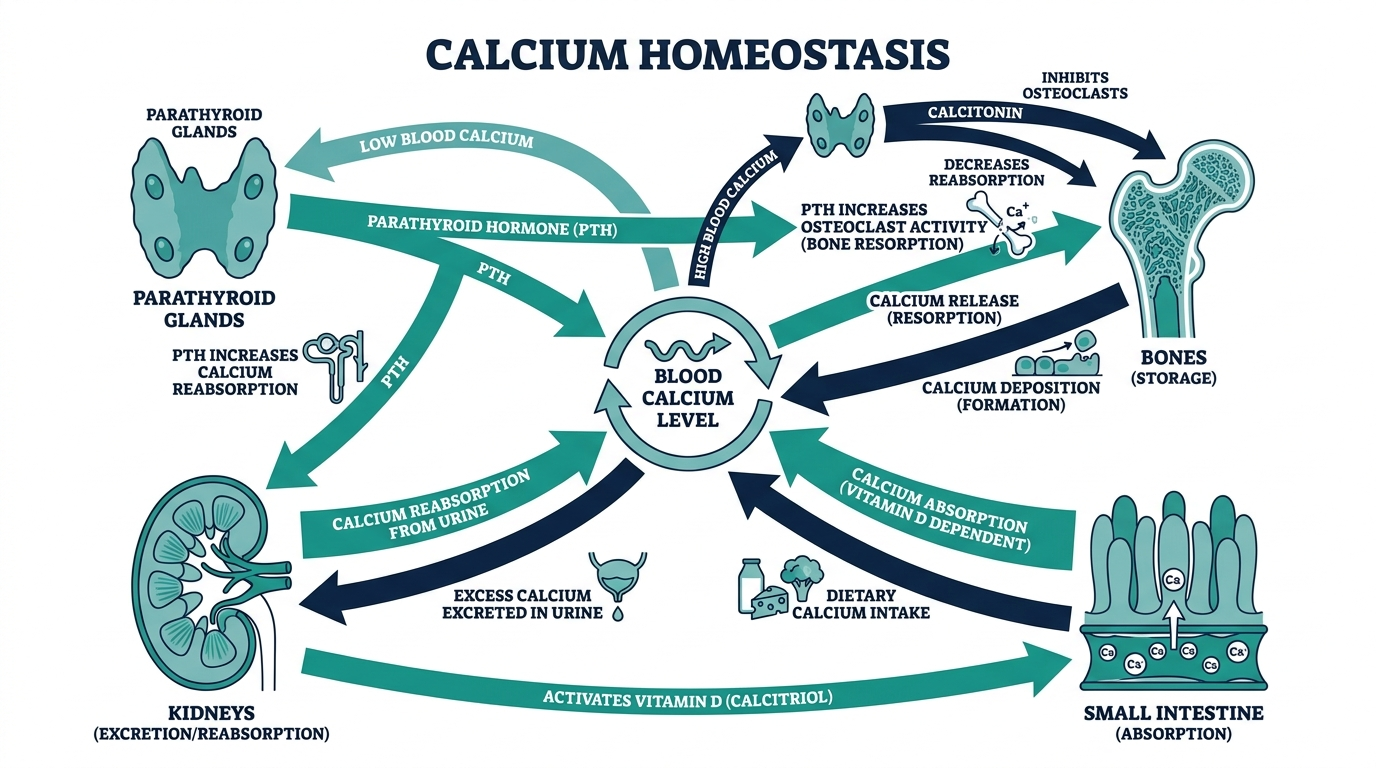
Blood calcium is one of the most tightly regulated values in the body, held within a narrow band because both too much and too little disrupt how nerves and muscles work. Three players run this control system, and understanding them explains almost every abnormal result.
- Parathyroid hormone (PTH): released by four tiny glands in the neck when calcium drops. PTH raises calcium by pulling it from bone, telling the kidneys to keep more, and activating vitamin D.
- Vitamin D: in its active form, it helps the intestine absorb calcium from food. Without enough vitamin D, calcium absorption falls.
- The kidneys: fine-tune how much calcium is kept or excreted, and they also help convert vitamin D to its active form.
Bone acts as the body’s calcium bank, holding more than 99 percent of total calcium and releasing or storing it as the blood level demands (NIH Office of Dietary Supplements). Because this system is a feedback loop, an abnormal calcium value usually points to a problem in one of its parts. High calcium with high PTH suggests the parathyroid glands are overactive, while low calcium with low vitamin D suggests an absorption problem. Reading calcium as the output of this loop, rather than a standalone number, is exactly how clinicians locate the cause.
Symptoms and red flags by direction
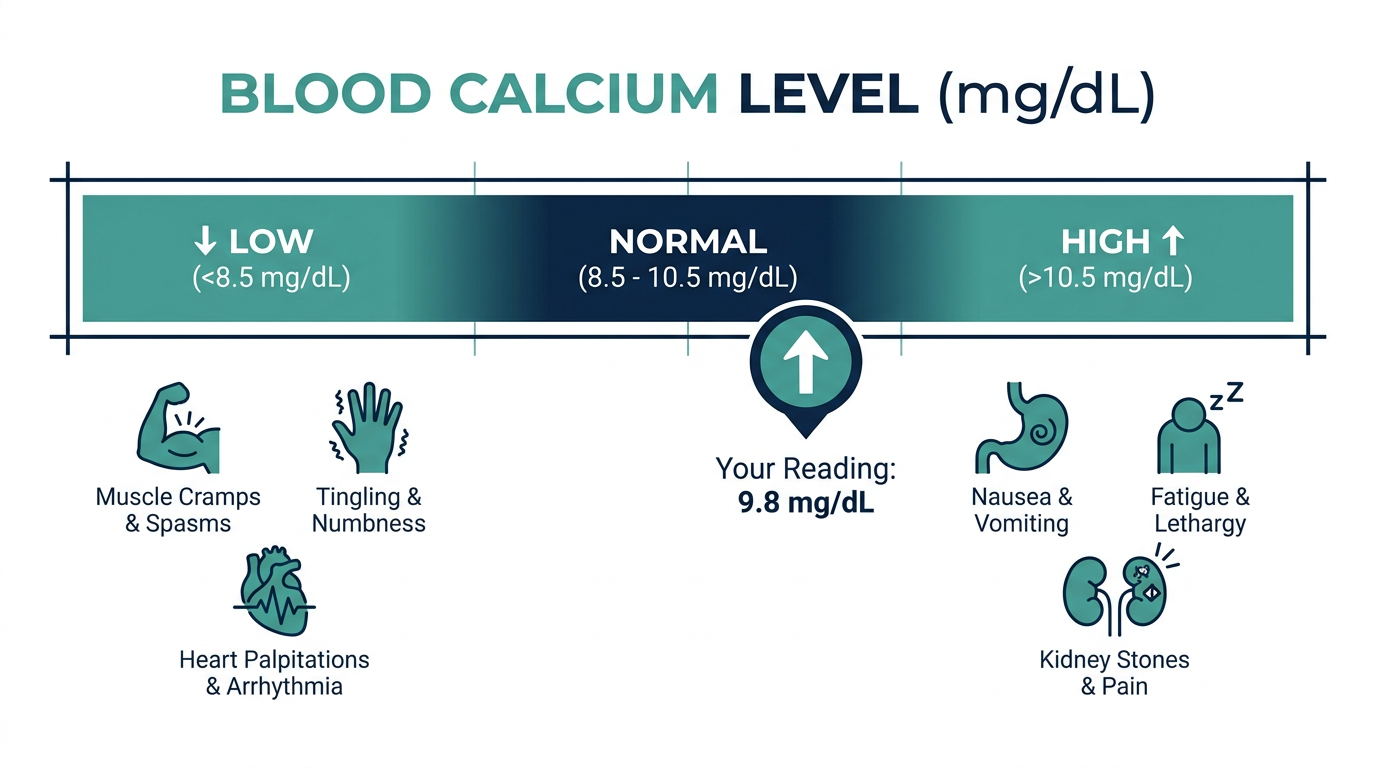
Because calcium powers nerves, muscles, and the heart, both extremes produce recognizable patterns. The symptoms often guide which direction a clinician investigates.
Signs that may accompany high calcium
- Excessive thirst and frequent urination as the kidneys work to clear the excess.
- Constipation, nausea, and loss of appetite.
- Bone pain and, over time, kidney stones.
- Fatigue, difficulty concentrating, and mood changes, sometimes summarized as “stones, bones, groans, and psychiatric overtones.”
Signs that may accompany low calcium
- Tingling or numbness around the mouth, fingers, and toes.
- Muscle cramps and twitching.
- In severe cases, muscle spasms, an irregular heartbeat, or seizures.
Certain features are red flags that call for prompt care rather than a routine appointment. Severe hypercalcemia at 14 mg/dL or higher can cause confusion, extreme weakness, and abnormal heart rhythms and is treated as an emergency (Cleveland Clinic). Likewise, severe hypocalcemia causing spasms, seizures, or a fast or irregular heartbeat needs urgent attention. Milder abnormalities are usually worked up in an outpatient setting.
Understanding corrected calcium with examples
The most important adjustment in calcium interpretation is correcting for albumin, and a couple of worked examples make it concrete. Because roughly 40 percent of total calcium is bound to albumin, a low albumin makes total calcium read falsely low even when the active, ionized calcium is fine (StatPearls). Clinicians use this formula: corrected calcium equals measured calcium plus 0.8 times (4.0 minus albumin in g/dL).
- Example one: a measured calcium of 8.0 mg/dL looks low, but the albumin is only 3.0 g/dL. Corrected calcium equals 8.0 plus 0.8 times (4.0 minus 3.0), which is 8.0 plus 0.8, or 8.8 mg/dL. That is actually within range, so the low reading was an artifact of low protein.
- Example two: a measured calcium of 8.4 mg/dL with an albumin of 2.0 g/dL corrects to 8.4 plus 0.8 times 2.0, which is 8.4 plus 1.6, or 10.0 mg/dL, comfortably normal.
The lesson is that a total calcium can never be read without its albumin. When albumin is abnormal or the picture is unclear, an ionized calcium measurement sidesteps the issue by measuring the free, active fraction directly.

Companion markers read alongside calcium
Calcium gains meaning from the values around it. A handful of companion markers turn a bare number into a diagnosis.
- Albumin: essential for interpreting total calcium and calculating corrected calcium.
- Parathyroid hormone (PTH): the key that distinguishes hyperparathyroidism from cancer in high calcium, and pinpoints hypoparathyroidism in low calcium.
- Vitamin D: a low level commonly explains low calcium.
- Phosphorus: often moves opposite to calcium and helps localize the problem.
- Magnesium: low magnesium can cause stubborn low calcium that will not correct until magnesium is replaced.
- Creatinine (kidney function): the kidneys are central to calcium balance, so their status matters.
The single most informative pairing is calcium with PTH. High calcium with an inappropriately high or normal PTH points to the parathyroid glands, while high calcium with a suppressed PTH shifts suspicion toward a cancer-related cause. This is why an abnormal calcium rarely stands alone and usually triggers a small follow-up panel.
Sample interpretation scenarios
Concrete examples show how the same calcium value can mean different things. These illustrate clinical reasoning and are not personalized advice.
- Calcium 8.2 mg/dL with albumin 2.8 g/dL: looks low, but corrects to about 9.2 mg/dL, so it is likely a protein artifact rather than true hypocalcemia.
- Calcium 10.6 mg/dL with high PTH: mild hypercalcemia with an inappropriate PTH points toward primary hyperparathyroidism.
- Calcium 10.1 mg/dL, high-normal, in someone with recurrent kidney stones: even a normal-looking value warrants a PTH check, since early hyperparathyroidism can hide here.
- Calcium 7.8 mg/dL with low vitamin D: true low calcium likely driven by poor absorption, often improving when vitamin D is corrected.
In every case, the surrounding values and the trend over time matter more than a single reading.
Common misconceptions about calcium testing
Calcium is widely misunderstood, partly because people conflate blood calcium with bone health. A few clarifications help.
- “A normal blood calcium means my bones are fine.” Blood calcium is tightly regulated and can stay normal even when bones are losing density, so it is not a bone-strength test. A DEXA scan assesses bone density.
- “Taking calcium supplements will raise my blood level a lot.” The body regulates blood calcium tightly, so supplements mainly support bone stores rather than pushing the blood number up, though very high intake can occasionally cause problems.
- “A single high calcium means cancer.” Most outpatient hypercalcemia in people who feel well is hyperparathyroidism, not cancer, and confirmation testing sorts the two.
- “A low total calcium always needs treatment.” Often it is a low-albumin artifact that corrects on paper, so albumin must be checked first.
The practical habit is to read calcium alongside albumin and, when needed, PTH and vitamin D, and to watch the trend rather than reacting to one value.
Calcium and vitamin D from food, and why the blood number stays steady
Because low calcium so often traces back to poor absorption, it helps to understand where dietary calcium and vitamin D come from, and why eating more rarely swings the blood number much. The body holds blood calcium in a tight band by drawing on bone, so diet mostly protects your bone bank rather than moving the lab value.
- Calcium-rich foods: dairy such as milk, yogurt, and cheese are the classic sources, alongside fortified plant milks, canned fish with soft bones, tofu set with calcium, and leafy greens.
- Vitamin D, the absorption partner: without enough vitamin D, the gut cannot absorb calcium well, which is why a deficiency is a common driver of a low reading. Sunlight, fatty fish, and fortified foods contribute, and supplements are often used when levels are low.
- Magnesium in the background: low magnesium can keep calcium stubbornly low until it is replaced, so a varied diet supports the whole system.
The practical point is that diet is about long-term bone health and preventing deficiency, not about nudging a single blood value up or down. When a low calcium is truly driven by poor vitamin D, correcting the vitamin D is usually what brings calcium back toward normal.
Following calcium over time rather than reacting to one value
A single calcium result is a snapshot, and its meaning sharpens across several readings. Because the number is tightly regulated, a slow drift matters more than one value sitting near the edge of the range.
- Compare to your own history: a calcium that has crept from mid-range up to the high-normal zone over successive tests can be more telling than one isolated reading.
- Always pair it with albumin: tracking the corrected calcium, not just the raw total, keeps a low-protein artifact from masquerading as a real change.
- Add PTH when the trend is high-normal: a repeatedly top-of-range calcium, especially with kidney stones or thinning bones, is a reasonable prompt to check parathyroid hormone.
- Look for direction, not a perfect number: a stable value inside the range is reassuring, while a steady climb or fall is what earns a closer look.
This is why clinicians rarely act on one calcium reading in isolation. The trend, read alongside albumin and, when needed, PTH and vitamin D, turns a confusing one-off flag into a pattern you can actually interpret.
Turn what you just learned about calcium into action.
Superpower lets you test calcium and 100+ biomarkers from home, then re-check them over time so you can actually see progress, physician-reviewed at every step.
Frequently asked questions
What is a normal calcium level in a blood test?
For most adults, a normal total calcium level is about 8.6 to 10.2 mg/dL (Cleveland Clinic). MedlinePlus cites a similar 8.5 to 10.2 mg/dL. Ionized (free) calcium runs about 4.6 to 5.3 mg/dL. Lab ranges vary slightly, so check the range listed on your own report.
Should I worry if my calcium is slightly high?
One mildly high calcium reading is common and often not serious, since diet, dehydration, and supplements can raise it. Your doctor will usually repeat the test and add albumin and parathyroid hormone. Persistently high calcium deserves a workup, because hyperparathyroidism and cancer are the main causes.
What is the difference between total and ionized calcium?
Total calcium measures all calcium in your blood, including the part bound to proteins, and it is the standard panel test. Ionized calcium measures only the free, active calcium not attached to proteins. Ionized calcium is often ordered when total calcium is abnormal or albumin is off.
Do I need to fast before a calcium blood test?
A calcium test alone usually does not require fasting. However, it is often drawn as part of a metabolic panel that may include glucose, so your clinic may ask you to fast for several hours. Follow the specific instructions your provider or lab gives you.
Can low vitamin D cause low calcium?
Yes. Vitamin D helps your intestines absorb calcium, so a deficiency is a common cause of low blood calcium (MedlinePlus). This is why doctors often check vitamin D alongside calcium when a result comes back low, and correcting the vitamin D frequently restores calcium toward normal.
Sources
- Cleveland Clinic, Calcium Blood Test
- Cleveland Clinic, Hypercalcemia
- Cleveland Clinic, Ionized Calcium
- MedlinePlus, Calcium Blood Test
- MedlinePlus Medical Encyclopedia, Calcium blood test
- StatPearls (NCBI Bookshelf), Hypocalcemia
- NIH Office of Dietary Supplements, Calcium
This article is for general educational purposes and is not medical advice. It cannot diagnose or treat you and does not replace your clinician. Always discuss your lab results and any health decisions with a qualified healthcare professional.
Vital Signs Today may earn a commission if you buy through links on this page. It does not affect our editorial assessments.