Educational content, not medical advice. Consult a licensed clinician before making any health decisions based on the information here.
Short answer: A peptide bond is a covalent chemical link formed when the carboxyl group of one amino acid reacts with the amino group of another, releasing a water molecule in the process. It is the backbone bond of every protein in nature, from the collagen holding your skin together to the semaglutide molecule in Ozempic.
The peptide bond builds every protein in your body, from collagen to insulin, so what do your own protein markers show? One at-home Superpower draw checks 100+ biomarkers, physician-reviewed.
The peptide bond is, by the numbers, the most consequential chemical bond in human biology. Your body holds roughly 19,000 to 20,000 distinct protein types according to the Human Proteome Project’s 2025 reference proteome, and every one of them is a chain of amino acids locked together by this single type of linkage. Understanding what a peptide bond actually is, how it forms, why it is both durable and breakable, and what that means for the collagen supplement in your cabinet or the GLP-1 prescription on your nightstand: that is the thread this article pulls.
Full-body lab membership: 100+ biomarkers, doctor-reviewed, tracked over time.
What exactly is a peptide bond?
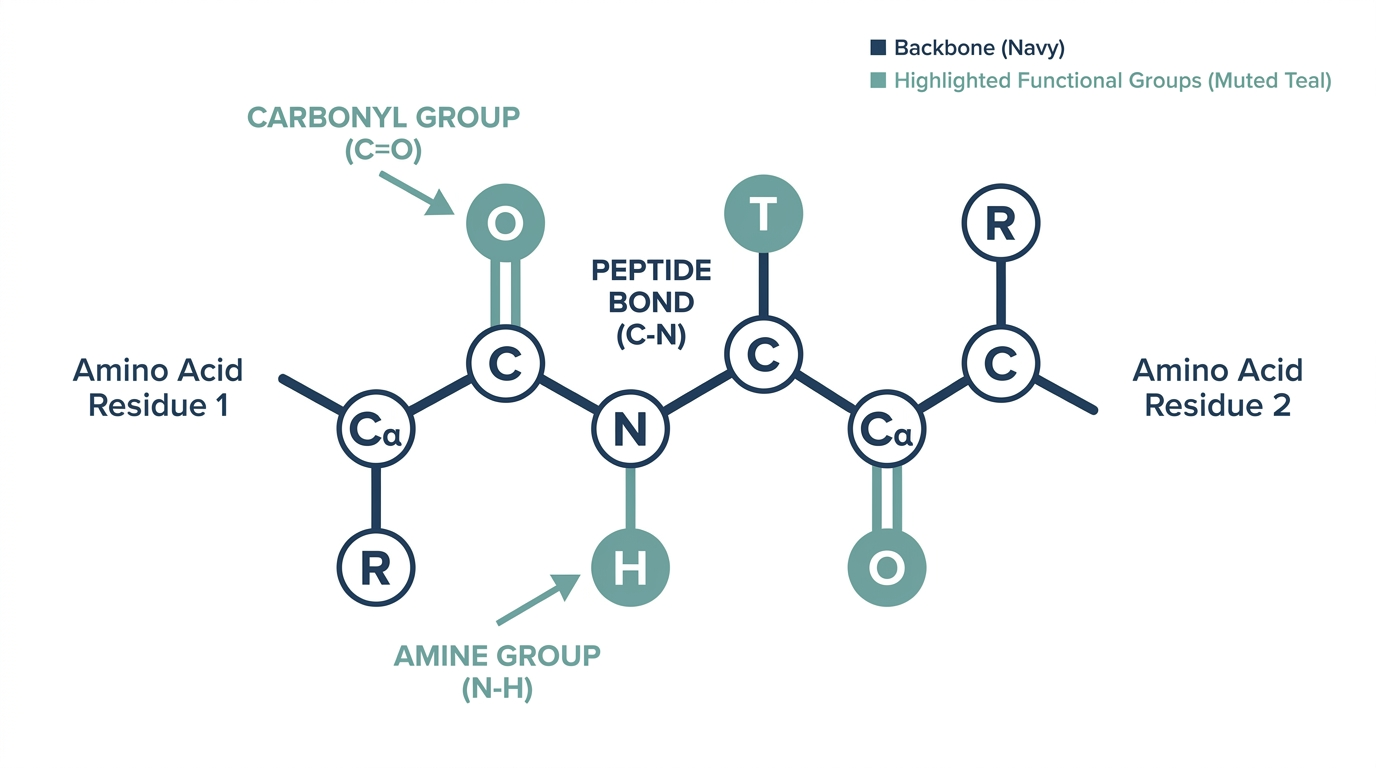
A peptide bond is a type of amide bond formed between two amino acids through a condensation reaction. The carboxyl group (–COOH) at the end of one amino acid loses an –OH, the amino group (–NH2) at the start of the next loses an –H, and together those fragments leave as a single water molecule (H2O). What remains connecting the two amino acids is a –CO–NH– linkage: the peptide bond.
The resulting group is also called an amide bond in organic chemistry, which is why you will see peptide bonds labeled “–CO–NH–” in diagrams. The carbon and nitrogen are directly bonded, the oxygen is double-bonded to the carbon, and that arrangement turns out to have profound structural consequences for how proteins fold.
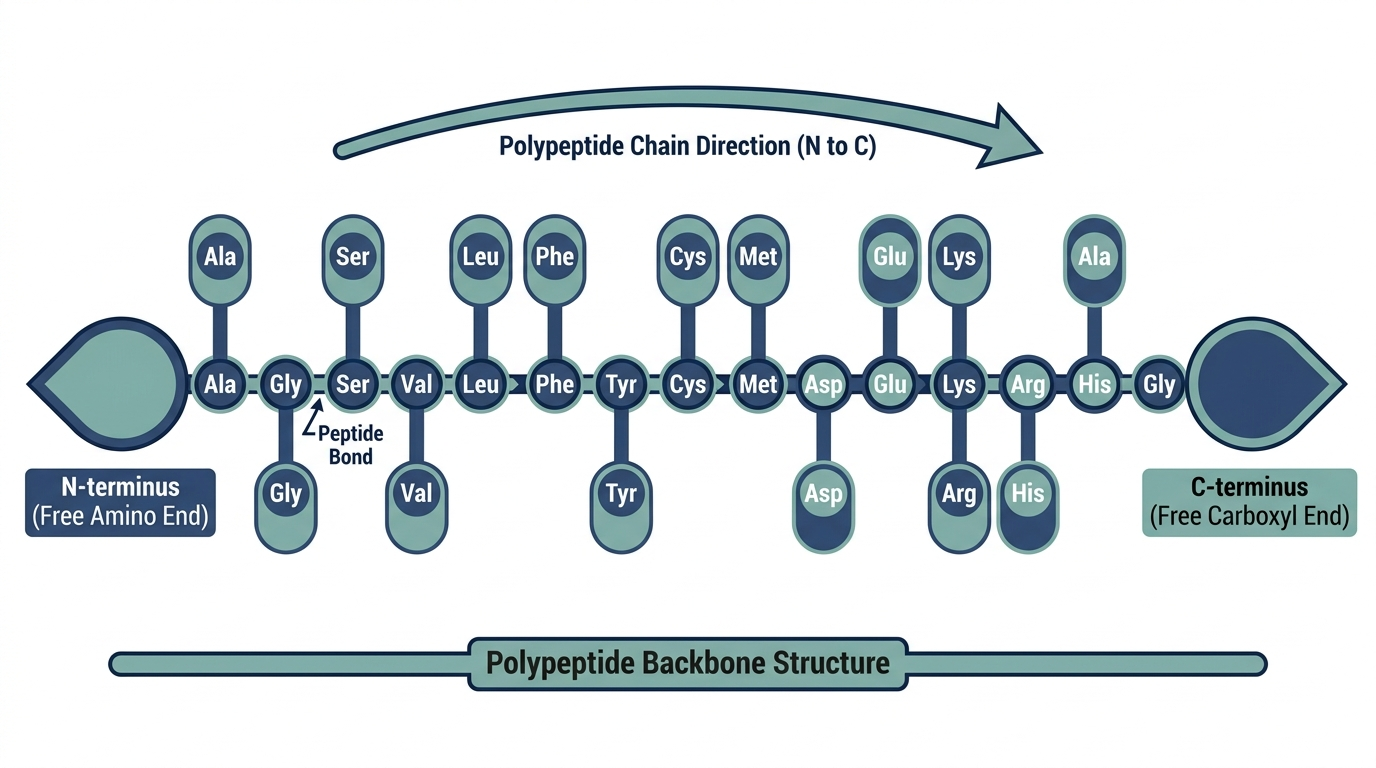
One amino acid joined to another by a peptide bond is a dipeptide. Three amino acids make a tripeptide. Chains of 2 to 50 residues are typically called peptides; longer chains become polypeptides and, once folded into a functional three-dimensional structure, proteins. The boundary is fuzzy in practice, but the chemistry is identical across all of them.
Why does the peptide bond behave like a partial double bond?
This is the part most explanations gloss over, but it is the reason proteins fold into the shapes they do.
After the peptide bond forms, the lone pair of electrons on the nitrogen atom overlaps with the pi electron system of the adjacent carbonyl (C=O). The result is resonance: the bond oscillates between two structures, one with a single C–N bond and a separate C=O double bond, and one where both the C–N and C–O carry partial double-bond character. The actual bond sits somewhere in between.
That partial double-bond character locks the six atoms directly around the bond, the nitrogen, its hydrogen, the carbonyl carbon, the carbonyl oxygen, and the two flanking alpha carbons, into a flat, rigid plane. Rotation around the C–N axis of the peptide bond is restricted to about 180 degrees. The bond cannot freely spin. This planarity is not incidental. It is the structural constraint that forces protein chains to fold along predictable paths, generating the alpha helices and beta sheets that give proteins their function.
Think of it this way: a peptide bond that rotated freely would be like a spine made of loose ball joints. Planarity is what gives the backbone its architecture.
Research published in PNAS in 2011 showed that nonplanar peptide bonds do occur in proteins, and they are not random: they are conserved across species and concentrated in functionally important regions. The geometry of the peptide bond is itself information, not just scaffolding.
How is a peptide bond formed in the body?
In chemistry textbooks the reaction is called dehydration synthesis or a condensation reaction. In a living cell the process is far more structured and far faster.
Proteins are built in ribosomes, the molecular machines that translate genetic code into amino acid sequences. The ribosome holds two adjacent amino acids in position and its catalytic core, called the peptidyl transferase center (PTC), catalyzes the formation of a new peptide bond between them. The PTC is made almost entirely of RNA, not protein, making it a rare example of a biological catalyst composed of nucleic acid. The rate is approximately 15 to 20 peptide bonds per second under physiological conditions, as reported across multiple kinetic studies including work cited in the Journal of Biological Chemistry in 2025.
Compare that to the uncatalyzed rate: a peptide bond forms spontaneously in water with a half-life measured in centuries, not seconds. The ribosome accelerates the reaction by over a million-fold. Without it, protein synthesis as we know it would take geological time.
The energy to drive this process comes from ATP. Each amino acid is first “activated” by being attached to its corresponding transfer RNA (tRNA) by an enzyme called aminoacyl-tRNA synthetase, a reaction that costs two ATP equivalents per amino acid. The peptide bond itself forms at no additional direct energy cost at the ribosome, but the activation step upstream is what makes the whole system thermodynamically possible.
What makes the peptide bond so stable, and yet breakable on demand?
Here is the counterintuitive part that catches people off guard.
Hydrolysis of a peptide bond, meaning its breakdown by water, is thermodynamically favorable. The reaction releases roughly 8 to 16 kJ/mol of Gibbs free energy (PMC: Peptide bond hydrolysis thermodynamics). In thermodynamic terms, proteins “want” to fall apart. Yet they do not, at least not quickly.
The reason is kinetics. Breaking a peptide bond requires overcoming an activation energy barrier of approximately 42 kcal/mol, a very high wall. In neutral water at 25 degrees Celsius, individual peptide bonds have half-lives between 350 and 600 years (JACS: Rates of uncatalyzed peptide bond hydrolysis). The bond is thermodynamically unstable but kinetically locked.
Enzymes called proteases unlock that barrier on demand. Proteases are highly specific: some cut only at certain amino acid sequences, others require a particular pH environment, others are activated only when a cell signals that a protein needs to be degraded. Your digestive system uses a suite of proteases, including pepsin in the stomach and trypsin and chymotrypsin from the pancreas, to break the peptide bonds in dietary protein, freeing the amino acids for absorption.
Do not believe claims that peptide bonds in supplements are inherently indigestible or that “intact peptides always survive digestion.” The answer is nuanced. Most peptide bonds are efficiently cleaved in the gut, which is actually the point for collagen supplements. A minority of short di- and tripeptides do cross the intestinal wall intact via the specialized PepT1 transporter: research shows that more than 70% of protein digestion products in the gastrointestinal tract are actually absorbed as di- or tripeptide fragments rather than free amino acids, as reviewed in studies examining intestinal di/tripeptide transport via PepT1.
Cis vs. trans: the configuration that determines whether a bond folds or freezes
Every peptide bond can exist in one of two spatial configurations: trans or cis. In the trans form the two flanking alpha carbons sit on opposite sides of the bond. In cis they sit on the same side.
Approximately 99.9% of peptide bonds in folded proteins are trans. The trans form positions the bulky side chains of adjacent amino acids as far apart as possible, minimizing steric clash. The energy difference between trans and cis is large enough that cis bonds are essentially excluded for most amino acid pairs.
The exception is proline. Because proline’s side chain loops back to bond its own nitrogen, the energy penalty for a cis conformation drops significantly. Roughly 5 to 10% of peptide bonds immediately preceding proline residues are cis, compared to only about 0.03% for all other amino acid pairs, according to structural analyses in the PMC study on cis-proline occurrence. Interconversion between cis and trans at proline is often the rate-limiting step in protein folding, and an entire class of enzymes, prolyl isomerases (like FKBP12), exists solely to catalyze this slow rotation.
Collagen is almost entirely proline and glycine, and its triple-helix structure demands that all peptide bonds be trans. Any cis slip collapses the helix.
What does this mean for real-world peptide products?
Collagen supplements
Collagen is the most abundant protein in the human body, constituting roughly 30% of total protein mass. Its triple helix is built from Gly-X-Pro and Gly-X-Hyp repeats (where X is any amino acid, Hyp is hydroxyproline), and those repeating tripeptides are held together by the same peptide bonds covered above, along with weaker interchain hydrogen bonds.
When you take a “hydrolyzed collagen” supplement, manufacturers have used enzymes to cut those peptide bonds into short fragments, mostly dipeptides and tripeptides averaging 2,000 to 5,000 daltons. This pre-digestion is intentional. A 12-week randomized, double-blind, placebo-controlled trial published in Dermatology Research and Practice in 2024 found that 10 g per day of hydrolyzed collagen improved skin elasticity by 22.7% versus placebo, with visible increases in upper dermal collagen. The theory is that specific tripeptide fragments, particularly those containing hydroxyproline, reach the bloodstream intact via PepT1 and signal fibroblasts to produce new collagen.
The dosing data from multiple trials converges on 2.5 g per day as the studied minimum for measurable skin outcomes and 10 g per day for more robust results. Below 2.5 g there is no convincing clinical evidence.
GLP-1 drugs (semaglutide, tirzepatide)
Semaglutide (Ozempic, Wegovy) is a 31-amino-acid peptide that is 94% homologous to native GLP-1. Its peptide bonds are the same chemistry described in this article, but its half-life has been engineered from roughly 2 minutes (native GLP-1) to about 7 days by two modifications: replacing the alanine at position 8 with alpha-aminoisobutyric acid (Aib), which blocks cleavage by the enzyme DPP-4, and attaching a fatty acid chain at position 26 that binds albumin in the bloodstream, slowing renal clearance.
Both of those modifications operate directly on peptide bond vulnerability. Position 8 is where DPP-4 cuts; swapping one amino acid blocks that specific protease recognition site. The albumin binding prolongs circulation by physically shielding adjacent peptide bonds from proteolytic attack. Understanding the chemistry is not academic: every engineering breakthrough in modern peptide drugs is an exercise in controlling where and when peptide bonds break.
Full-body lab membership: 100+ biomarkers, doctor-reviewed, tracked over time.
How does the peptide bond compare to other bonds in protein structure?
Proteins rely on several types of chemical interactions to achieve their final folded shape. Understanding where the peptide bond fits among them clarifies its unique role.
| Bond / Interaction | Type | Strength | Location in protein | Breakable by? |
|---|---|---|---|---|
| Peptide bond | Covalent amide | Strong (~40 kcal/mol to break) | Primary structure (backbone) | Proteases, strong acid/base |
| Disulfide bond | Covalent S-S | Moderate (~50 kcal/mol) | Tertiary structure (side chains) | Reducing agents, heat |
| Hydrogen bond | Electrostatic | Weak (1-5 kcal/mol each) | Secondary structure (helices, sheets) | Heat, denaturants |
| Hydrophobic interaction | Entropy-driven | Weak individually | Tertiary structure (core packing) | Detergents, heat |
| Salt bridge (ionic) | Electrostatic | Moderate | Tertiary / surface | pH shift |
| Van der Waals | Dispersion | Very weak | Throughout | Heat |
Peptide bonds are the only interactions that define the protein’s primary sequence and that cannot be reversed without an enzyme or harsh chemistry. Hydrogen bonds, salt bridges, and hydrophobic interactions are dynamic, they form and break as proteins breathe, flex, and interact with partners. The peptide bond backbone is the permanent chain; everything else is the adjustable folding on top of it.
Personally, I find the disulfide bond comparison most instructive for non-chemists. Insulin, for example, depends on three disulfide bonds to hold its two peptide chains (A and B) together once the connecting C-peptide is removed. Remove those disulfide bonds and insulin unfolds and aggregates into amyloid fibers. But those disulfides are secondary structure; the peptide bonds in the A and B chains remain intact throughout. The peptide bond is the sentence; everything else is punctuation.
How does the body break peptide bonds during digestion?
The sequence from food to free amino acids involves at least six major proteases working in a coordinated relay.
Pepsin activates in stomach acid (pH 1.5 to 2) and makes the first cuts, cleaving preferentially next to large hydrophobic or aromatic amino acids. The partially digested polypeptides then pass to the small intestine where pancreatic proteases take over: trypsin cuts after lysine and arginine, chymotrypsin cuts after phenylalanine, tryptophan, and tyrosine, elastase cuts after small neutral amino acids. Carboxypeptidases trim from the free end of the chain. Brush-border peptidases on intestinal cells handle the final di- and tripeptides.
The result is that most dietary proteins are converted to free amino acids and di/tripeptides within 1 to 2 hours. The efficiency is remarkable, exceeding 90% for most dietary proteins. It also explains why a meaningful fraction of intact bioactive peptides, sequences like the opioid-like fragments in casein (beta-casomorphins) or the ACE-inhibitory dipeptides in fermented dairy, survive long enough to exert physiological effects: they are produced by the very process of digestion and absorbed as intact di/tripeptides before the brush-border enzymes can finish them off.
What happens when peptide bonds break in the wrong place?
This question matters more than most nutrition articles acknowledge.
Misfolded proteins, those in which peptide bonds are correctly formed but folding has gone wrong, are the molecular basis of several neurodegenerative diseases. Alzheimer’s disease involves aggregates of amyloid-beta, a 40 to 42 amino acid peptide cleaved (at two peptide bonds) from the amyloid precursor protein by enzymes called beta- and gamma-secretase. Prion diseases arise when a normal cellular protein, PrPC, refolds into a misfolded form, PrPSc, that is remarkably resistant to the proteases that would normally clear it. The peptide bonds are intact; it is the folding that kills.
At the other end of the spectrum, cancer cells frequently upregulate specific proteases (matrix metalloproteinases, cathepsins) to cut the peptide bonds in extracellular matrix proteins like collagen, opening tunnels for invasion. Some of the most promising cancer drug strategies involve protease-cleavable linkers: pro-drugs that release their payload only when a specific protease, present only in the tumor microenvironment, cuts a specific peptide bond in the linker.
Curious what your own levels look like?
Baseline 100+ biomarkers today and retest as life changes, all in one membership with physician review.
Frequently asked questions
What is a peptide bond in simple terms?
A peptide bond is the chemical link that joins two amino acids together. When the carboxyl end of one amino acid connects to the amino end of the next, a water molecule is lost and a –CO–NH– bond forms. String enough of these bonds together and you have a protein.
Is a peptide bond the same as an amide bond?
Yes. A peptide bond is a specific type of amide bond: the amide formed between the alpha-amino group and the alpha-carboxyl group of consecutive amino acids in a protein or peptide chain. Not all amide bonds are peptide bonds, but all peptide bonds are amide bonds.
Why is the peptide bond planar?
Because the nitrogen’s lone-pair electrons overlap with the carbonyl pi system, creating resonance that gives the C–N bond partial double-bond character. That partial double bond restricts rotation and locks the bond and its six immediate atoms into a flat plane, which is the structural constraint behind alpha-helices and beta-sheets.
Can peptide bonds be broken by stomach acid alone?
Slowly, yes, but in practice the proteases (pepsin, trypsin, etc.) do most of the work. Pure acid hydrolysis at stomach pH is too slow to account for normal protein digestion. Industrial or laboratory hydrolysis of proteins uses concentrated HCl at high temperature (6N HCl, 110 degrees Celsius, 24 hours) to break all peptide bonds chemically.
What does “hydrolyzed” mean on a collagen supplement label?
It means the collagen’s peptide bonds have been pre-cut using proteases or acid into shorter fragments (typically 2,000 to 5,000 daltons). This improves absorption of the resulting tripeptides via the PepT1 transporter. A 2024 randomized trial found that 10 g per day of hydrolyzed collagen improved skin elasticity by 22.7% over 12 weeks compared to placebo.
Why can’t you take GLP-1 drugs like semaglutide in a normal capsule?
The peptide bonds in semaglutide would be cleaved by stomach proteases before the drug reached the bloodstream. Oral Rybelsus works because it is co-formulated with SNAC, a permeation enhancer that promotes absorption through the stomach wall at elevated local pH rather than through the intestine.
How many peptide bonds are in a typical protein?
One fewer than the number of amino acids. A typical protein of 300 amino acid residues contains 299 peptide bonds. The human proteome spans proteins from small peptide hormones like oxytocin (9 residues, 8 peptide bonds) to titin, the largest known human protein at roughly 34,350 amino acid residues and approximately 34,349 peptide bonds in a single chain.
Full-body lab membership: 100+ biomarkers, doctor-reviewed, tracked over time.
Author: Vital Signs Today Editorial Team, [credential]”]. Educational content, not medical advice. Sources linked inline.
Primary sources:
– Human Proteome Project 2025 reference proteome (HUPO)
– JACS: Rates of uncatalyzed peptide bond hydrolysis (Radzicka & Wolfenden, 1996)
– PMC: Formation vs. Hydrolysis of peptide bonds on mineral surfaces (thermodynamics)
– JBC: Fast peptide bond formation and release by the ribosomal large subunit (2025)
– PNAS: Nonplanar peptide bonds in proteins are common and conserved (2011)
– PMC: Cis-trans peptide variations in structurally similar proteins
– ScienceDirect: Intestinal epithelial transport of bioactive di/tripeptides through PepT1 (2025)
– PMC: 12-week hydrolyzed collagen RCT, skin elasticity +22.7% (Reilly, 2024)
– ResearchGate: Structure of semaglutide, 31 amino acids, modifications at positions 8, 26, 34
– Peptide bond – Wikipedia (for structural overview cross-reference)
Related reading
Vital Signs Today may earn a commission if you buy through links on this page. It does not affect our editorial assessments.